
Revision Notes
IB DP Psychology: Approaches to researching behaviour – Revision Notes
Revision notes on IB DP Psychology research methodology (first assessment 2027): experiments, correlations, qualitative methods, sampling, ethics, bias and credibility.
- Subject
- Psychology
- Level
- IB
- Topic
- Content – Research methodology
- Author
- Marlbridge Academic Team
- Updated
- Reviewed by
- Kanwal Aslam (what this means)
Aligned to International Baccalaureate IB Diploma Programme Psychology (DP Psychology (2027), DP Psychology (2019) / DP Psychology (2027)), First assessment 2027. Official specification .
Syllabus page (what it covers and how it is assessed): IB Diploma Programme Psychology.
Syllabus topics and points this page is mapped to
DP Psychology (2027)
- 5 Content: Research methodology (topic-level mapping)
"Topic-level mapping" means this page belongs to that topic; it does not claim to cover every point in it.
Research methodology is one of the four content areas of IB DP Psychology (first assessment 2027): research methods, sampling techniques, procedures, data collection and analysis. It runs through every approach and context, it is the focus of the class practicals (an interview, an observation, a survey/questionnaire and an experiment), and you use it to evaluate studies on Paper 2. At HL, Paper 3 assesses data analysis and interpretation of research data from several sources.
Related: Approaches to researching behaviour study guide.
Syllabus coverage (first assessment 2027)
| Area | What to know |
|---|---|
| Research methods | Experiments (true or quasi-); observations (naturalistic or controlled, overt or covert, participant or non-participant); surveys/questionnaires; interviews (structured, semi-structured or focus group); correlational studies; case studies |
| Sampling techniques | Self-selected, opportunity, stratified, random, snowball (and the advantages and disadvantages of each); purposive sampling is not named in the guide but is common in qualitative work |
| Ethics and responsibility | Informed consent, deception, debriefing, right to withdraw, protection from harm, anonymity, cost-benefit analysis; use of animals and child participants |
| Research considerations | Reliability; validity (internal, external, content, face, construct); generalizability; researcher and participant biases; reflexivity; transferability; credibility |
| Data analysis and interpretation | Bar graph, box and whisker plot, distributions, frequency table, histogram, line graph, outliers, scatterplot; descriptive and inferential statistics; correlation coefficient; thematic analysis. Studied at SL and HL, assessed at HL only |
| HL Paper 3 | Four source-based questions (30 marks) with quantitative and qualitative findings, focused on one HL extension: interpretation of graphs (3), data analysis (6), a research consideration of credibility, bias or transferability (6) and synthesis (15) |
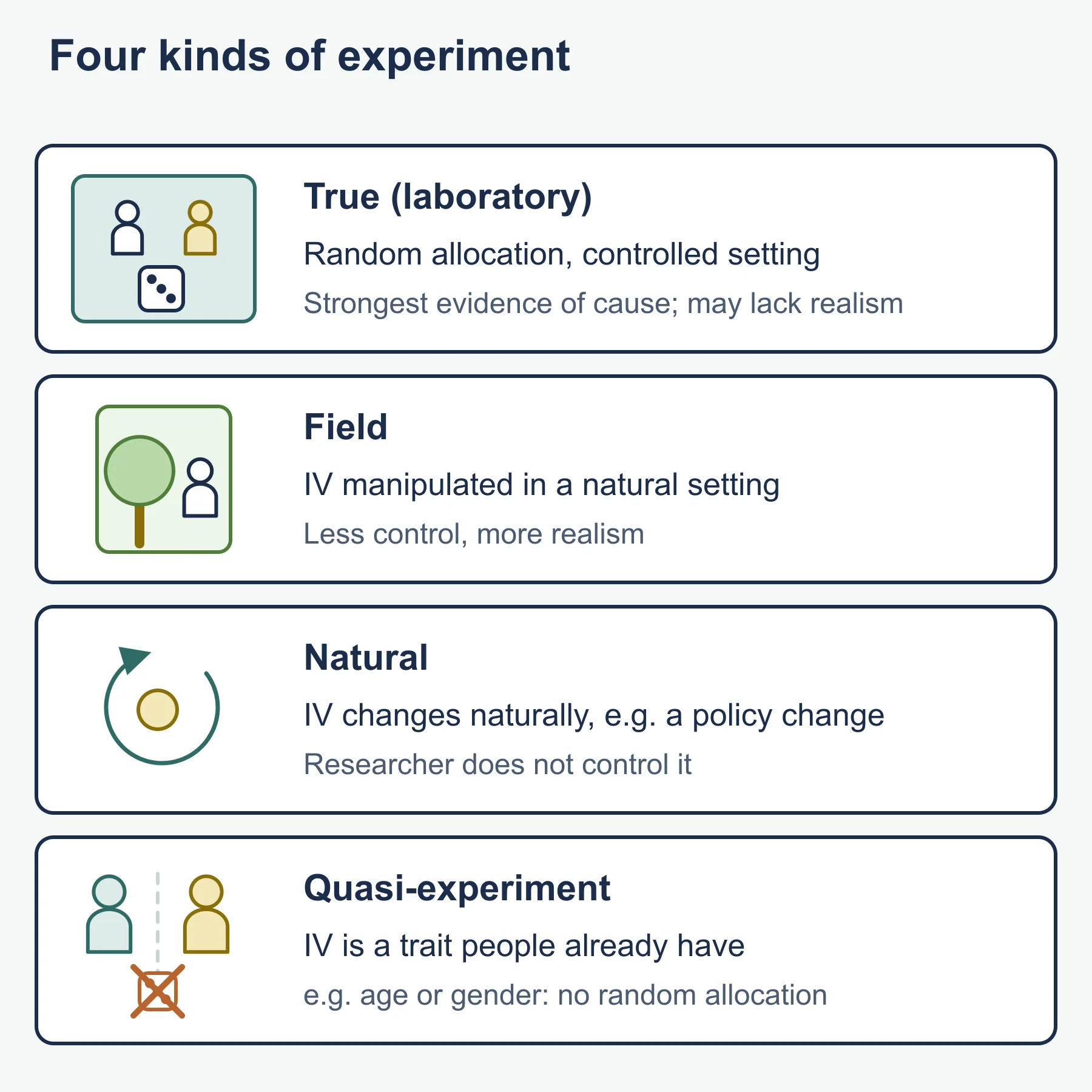
Experiments compared
| Type | IV manipulated? | Random allocation? | Setting | Main strength | Main limitation |
|---|---|---|---|---|---|
| True (lab) experiment | Yes | Yes | Controlled | Cause and effect; replicable | Low ecological validity; demand characteristics |
| Field experiment | Yes | Usually | Natural | Higher ecological validity | Less control over extraneous variables |
| Natural experiment | No – occurs naturally | No | Natural | Studies variables that cannot be manipulated ethically | No causal conclusions with confidence |
| Quasi-experiment | No – pre-existing groups (e.g. gender) | No | Either | Compares groups that could not be assigned | Confounding participant variables |
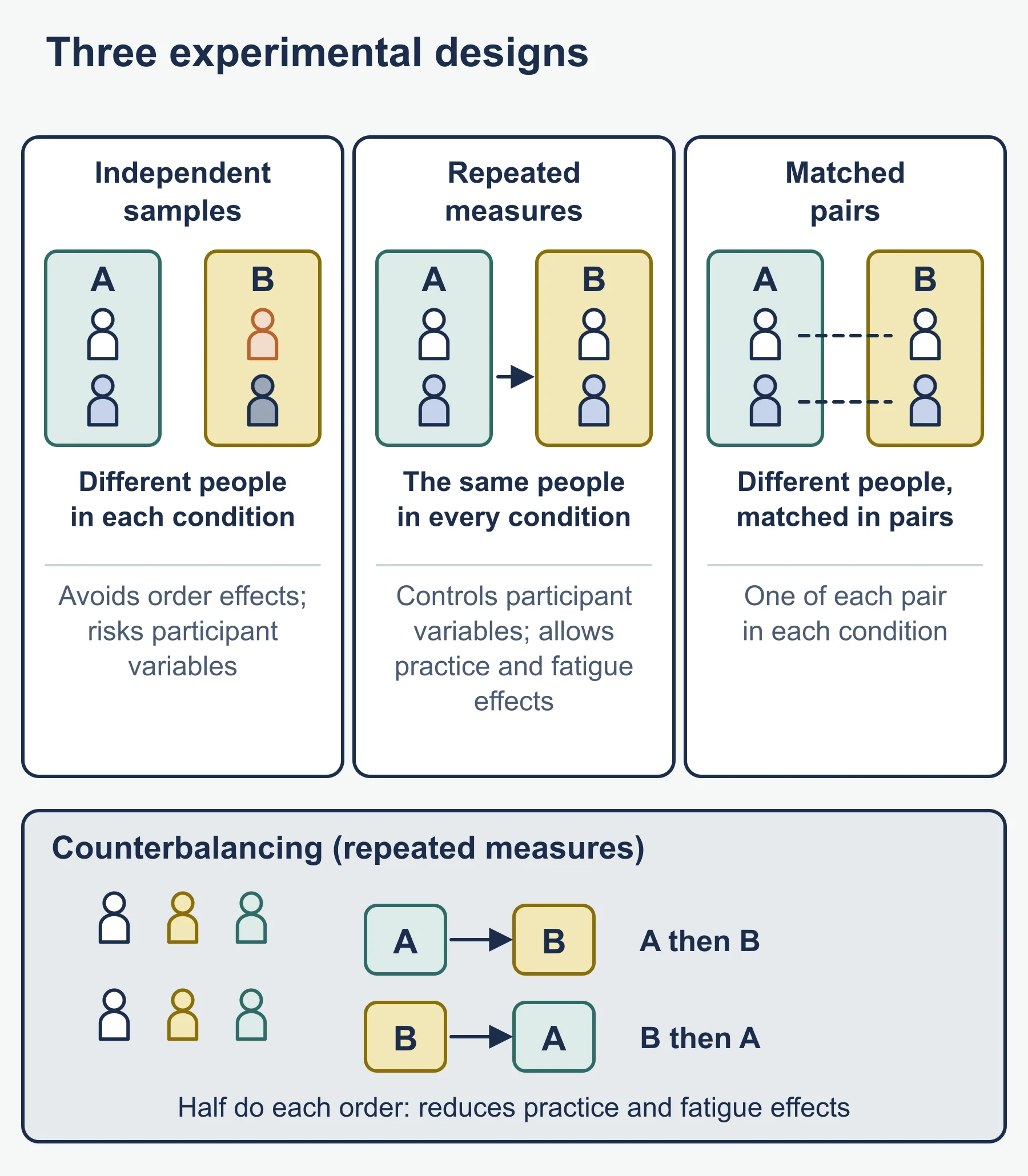
Designs: independent samples (different participants per condition; risk of participant variables), repeated measures (same participants; risk of order effects, controlled by counterbalancing), matched pairs (participants matched on key variables).
Correlational studies and hypotheses
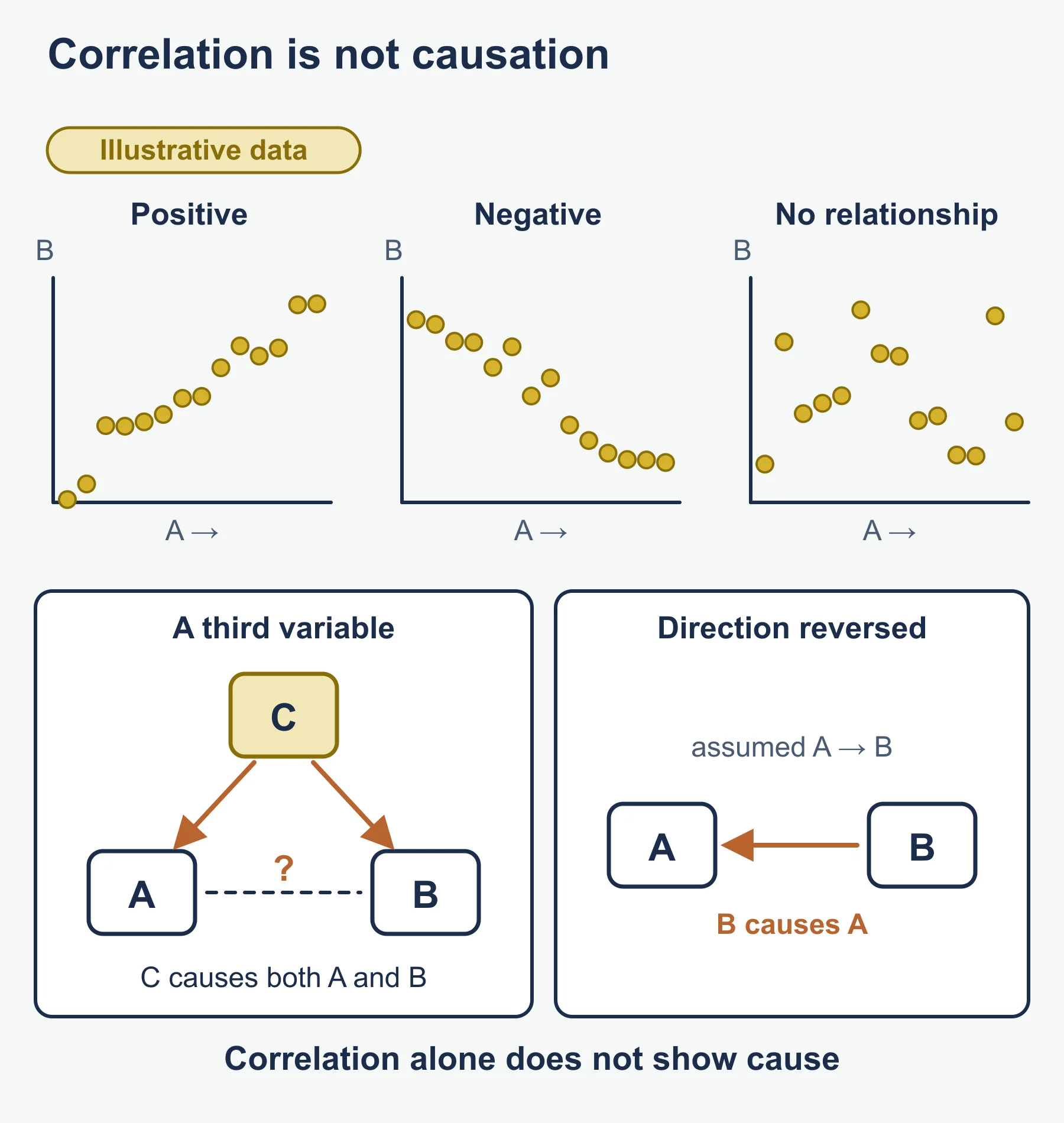
- A correlational study measures two co-variables without manipulating either. A positive correlation means both rise together; a negative correlation means one falls as the other rises.
- Correlation is not causation: a third variable may cause both, or the direction may be the reverse of what is assumed (bidirectional ambiguity).
- An alternative hypothesis predicts a difference or relationship; the null hypothesis predicts none. Both must name operationalised variables, e.g. “hours of sleep” rather than “tiredness”.
- A confounding variable varies with the IV and offers another explanation of the result.
Qualitative research quality
| Concept | Meaning | How it is improved |
|---|---|---|
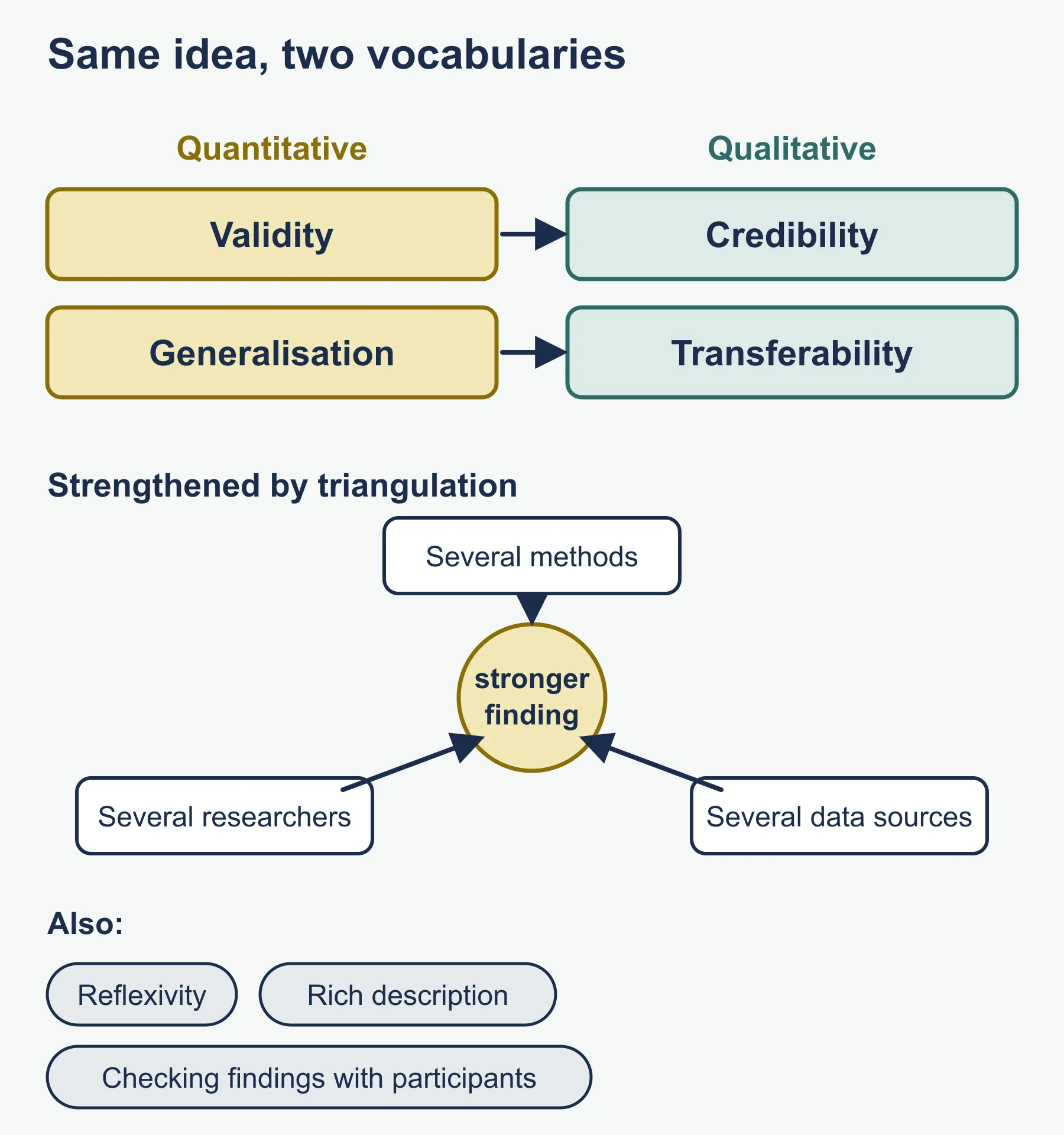
| Credibility | Findings reflect participants’ realities (qualitative equivalent of internal validity) | Triangulation, member checking, rapport, reflexivity |
| Researcher bias | The researcher’s beliefs affect data collection or interpretation (e.g. confirmation bias) | Reflexivity, researcher triangulation |
| Participant bias | Acquiescence, social desirability, dominant respondent in focus groups, sensitivity | Rapport, neutral questions, anonymity |
| Triangulation | Using several methods, data sources, researchers or theories | Method, data, researcher and theory triangulation |
| Transferability | How far findings apply to other settings | Rich, thick description of the context and sample |
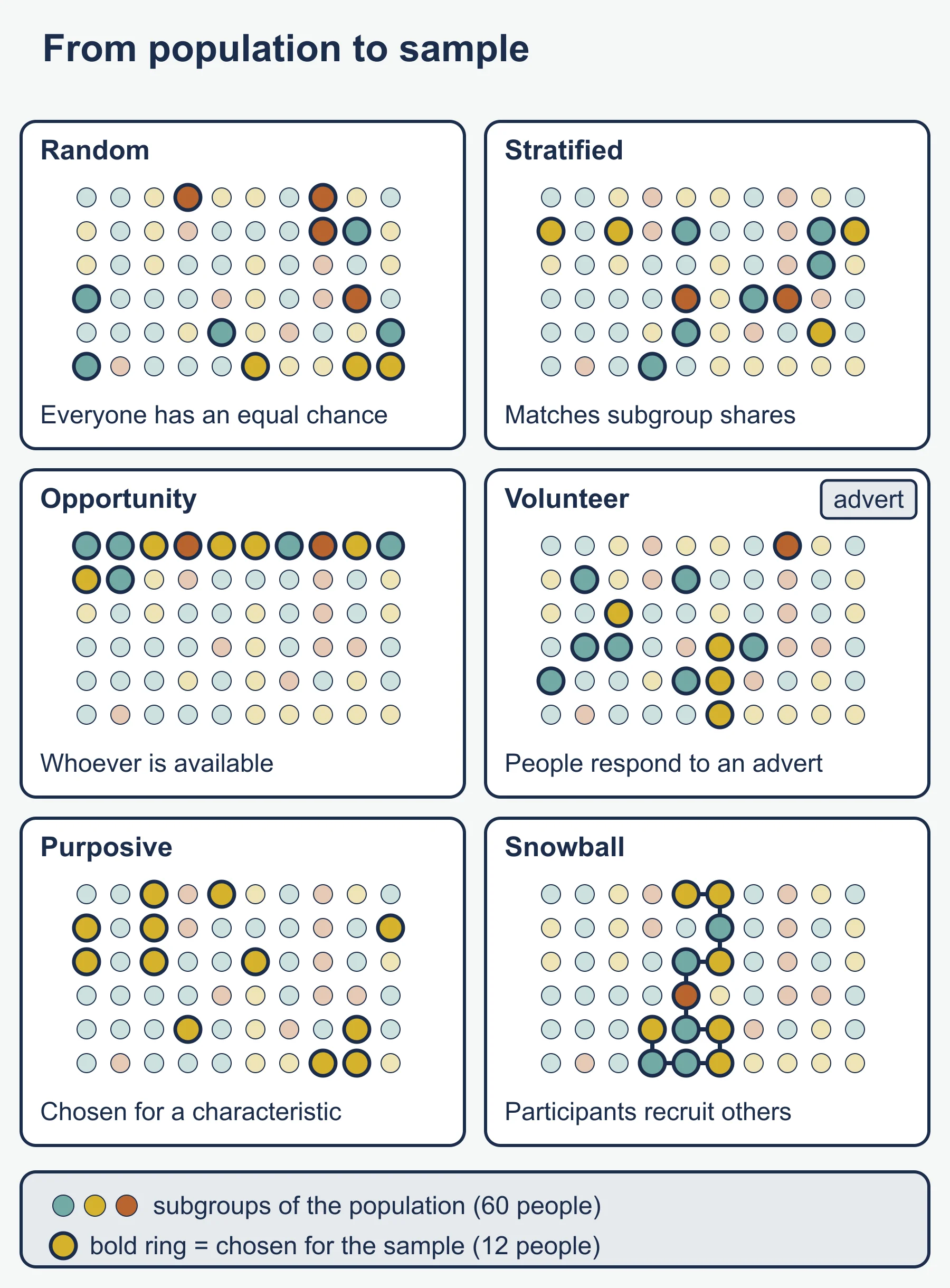
Sampling quick table
| Method | How | Generalisation |
|---|---|---|
| Random | Every member of the target population has an equal chance | Best for sample-to-population generalisation |
| Stratified | Sample mirrors subgroups’ proportions | Representative on chosen variables |
| Opportunity | Whoever is available | Weak; often students |
| Self-selected | Volunteers respond to an advert | Volunteer bias |
| Purposive | Chosen because they have a characteristic of interest | Qualitative; theoretical generalisation |
| Snowball | Participants recruit others | Hard-to-reach populations; not representative |
Worked example: identifying a method
Summary: researchers interviewed 12 nurses about burnout, using open questions, then coded the transcripts into themes.
- Method: semi-structured interview (qualitative). Characteristics: flexible, open-ended questions; data are words analysed by thematic coding.
- Sampling: likely purposive – participants had to be nurses with relevant experience.
- Ethics: informed consent, confidentiality of identifiable workplace details, right to withdraw, debriefing; protection from distress when recalling stressful events.
- Generalisation: not sample-to-population; possible transferability to similar health-care settings if the context is richly described; theoretical generalisation to models of burnout.
Common mistakes / exam traps
- Calling every study an experiment. No manipulated IV means no true experiment.
- Quantitative language for qualitative studies. Use credibility, transferability and reflexivity, not “statistical significance”.
- Listing ethics without application. Say how each consideration was, or should have been, applied in the study described.
- “Small sample, so not generalisable” as the whole answer. Distinguish the three types of generalisation.
- Forgetting the context. Answers on Paper 2 section B and Paper 3 must refer to the specific study or sources given.
- Causal claims from correlations. Say “is associated with”, not “causes”, unless an IV was manipulated.
Frequently asked questions
Is research methodology examined at SL? Yes. SL students study research methodology and use it on Paper 2 (section A on the class practicals and section B on an unseen study) and in the internal assessment. Data analysis and interpretation is studied at SL but is assessed at HL only, on Paper 3.
What is Paper 3? A 1 hour 45 minute HL paper worth 30 marks and 30% of the HL grade. It gives four source-based questions with quantitative and qualitative findings, focused on one of the HL extensions (culture, motivation or technology). Question 1 (3 marks) asks about one issue that limits interpretation of a source, question 2 (6 marks) asks you to analyse one source and state a conclusion, question 3 (6 marks) asks about credibility, bias or transferability, and question 4 (15 marks) asks you to synthesise at least three sources to discuss the validity of a claim.
Do I need inferential statistics? The 2027 guide lists descriptive and inferential statistics, the correlation coefficient and thematic analysis under data analysis and interpretation, which HL students are assessed on in Paper 3.
Self-test
- What distinguishes a quasi-experiment from a true experiment? Participants are in pre-existing groups, not randomly allocated.
- Define reflexivity. The researcher’s reflection on how their own beliefs and role may have affected the research.
- Which sampling method best supports sample-to-population generalisation? Random (or stratified random) sampling.
- Name two types of triangulation. Method and researcher triangulation.
- What is counterbalancing? Varying the order of conditions to control order effects in repeated measures designs.
Related resources
-
Study guides
IB DP Psychology: Approaches to researching behaviour – Study Guide
Qualitative and quantitative research methods, sampling, ethics, bias and credibility, and descriptive statistics for IB DP Psychology.
Psychology · International Baccalaureate · IB
Read guide -
Study guides
IB DP Psychology: Bias in Research and How to Avoid It
Participant and researcher bias for IB DP Psychology research methods: the main types, how to reduce each, and a worked HL Paper 3 answer on avoiding bias (first assessment 2027).
Psychology · International Baccalaureate · IB
Read guide -
Practice questions
IB DP Psychology: Bias in Research and How to Avoid It – Practice Questions
Original IB DP Psychology practice on research bias: identifying bias types, matching strategies, two invented study summaries and a 6-mark Paper 3 discussion.
Psychology · International Baccalaureate · IB
Try questions
Studying Psychology?
This page is free and stays free. Marlbridge is not offering Psychology classes at the moment, so there is no tuition to book for it. The free study resources stay open to everyone.
Get free revision emails (optional)
Occasional emails with practice questions, worked explanations and links to free resources for the qualification and subjects you choose. No spam, and you can unsubscribe from any email. The free tools on this site never need an email.