
Study Guides
IB DP Psychology: Health and well-being – Study Guide
Study guide to health and well-being in IB DP Psychology: determinants of health, stress, addiction and obesity, health belief models and prevention.
- Subject
- Psychology
- Level
- IB
- Topic
- Context: Health and well-being
- Author
- Marlbridge Academic Team
- Updated
- Reviewed by
- Kanwal Aslam (what this means)
Aligned to International Baccalaureate IB Diploma Programme Psychology (DP Psychology (2027), DP Psychology (2019) / DP Psychology (2027)), First assessment 2027. Official specification .
Syllabus page (what it covers and how it is assessed): IB Diploma Programme Psychology.
Syllabus topics and points this page is mapped to
DP Psychology (2027)
- 6 Context: Health and well-being (topic-level mapping)
"Topic-level mapping" means this page belongs to that topic; it does not claim to cover every point in it.
Health psychology asks why some people stay healthy and others do not, and what psychology can do about it. It treats health as the product of biology, thinking and social context together, rather than as the absence of disease. In the IB Diploma Programme (first assessment 2027) it appears in the context Health and well-being, which all SL and HL students study alongside the biological, cognitive and sociocultural approaches and research methodology, and it is a good place to practise building an argument from theory, research and evaluation.
Where this fits in the course
The 2027 course has no options. Health and well-being is one of four contexts (with human development, human relationships, and learning and cognition), and the contexts are studied through the six concepts and the content areas. For this context the guide lists three areas of study. Mental health disorders: one or more of major depressive disorder, eating disorders, post-traumatic stress disorder, obsessive-compulsive disorders or anxiety disorders. Health problems: one or more of obesity, drug misuse or abuse, or social media addiction, including the role of stress and social learning. Prevention and treatment. The class practical for this context is an interview.
This guide covers the second and third areas: stress and health, addiction and obesity, and prevention strategies. It does not cover the mental health disorders area. Determinants of health are not a listed area of study in the 2027 guide, so the next section is background that links the three approaches to health.
In assessment, Paper 1 Section B sets two compulsory questions that apply content to an unseen situation, each from one of four contexts, and Section C offers a choice of two concept-based extended-response questions (15 marks), each from a different context. Paper 1 does not assess the details of research studies, so the studies below are evidence for an argument, not a list to memorise.
The context follows a pattern that runs through IB Psychology: factors that influence health, specific health problems, and then how behaviour change and promotion work in practice.
Determinants of health
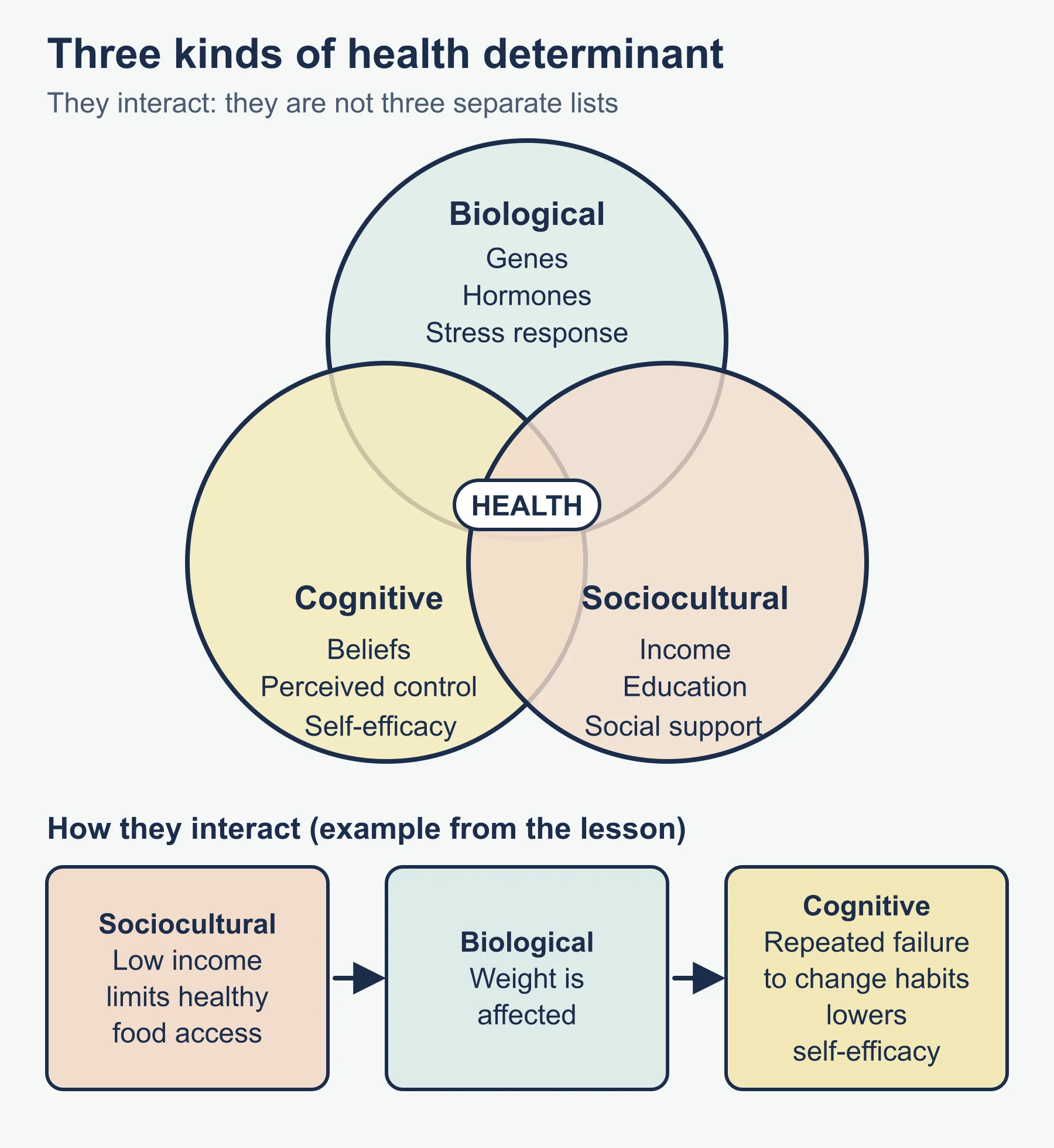
A determinant is a factor that raises or lowers the likelihood of good or poor health. Examiners expect you to separate them clearly and then show how they interact.
- Biological determinants include genetic predisposition, hormonal and neurological differences, and the physiological stress response. Twin and adoption studies are used to estimate how far a condition runs in families, although they cannot remove shared environment completely.
- Cognitive determinants include beliefs about illness, perceived control, optimism and self-efficacy (a person’s belief in their ability to carry out a behaviour). A person who believes that outcomes are under their own control is more likely to attempt change.
- Sociocultural determinants include income, education, social support, culture and the environment in which a person lives. The Whitehall studies of British civil servants are the best-known example of a social gradient in health: death and illness rates were higher in lower employment grades even though all participants had stable jobs.
A strong answer does not list these in isolation. For example, low income (sociocultural) may limit access to healthy food, which affects weight (biological), while repeated failure to change habits can reduce self-efficacy (cognitive).
Stress
Stress is a response to a perceived demand that exceeds a person’s perceived ability to cope.
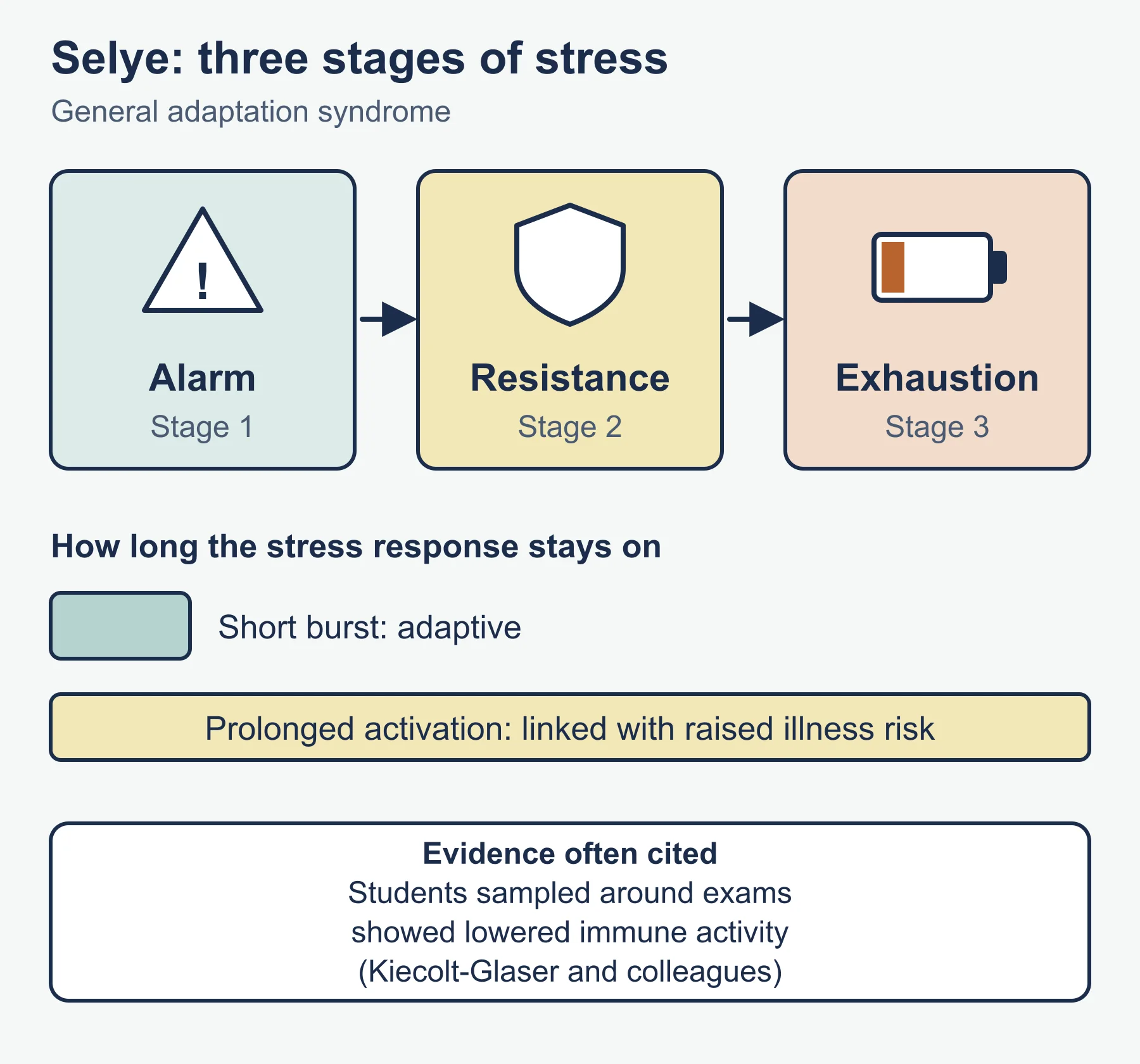
Biological explanations. Selye’s general adaptation syndrome describes three stages: alarm, resistance and exhaustion. Short bursts of the stress response are adaptive, but prolonged activation of the body’s stress systems is linked with raised illness risk. Kiecolt-Glaser and colleagues’ work on students sampled around examination time reported lowered immune activity under stress, which is often cited as evidence for a link between stress and immune function.
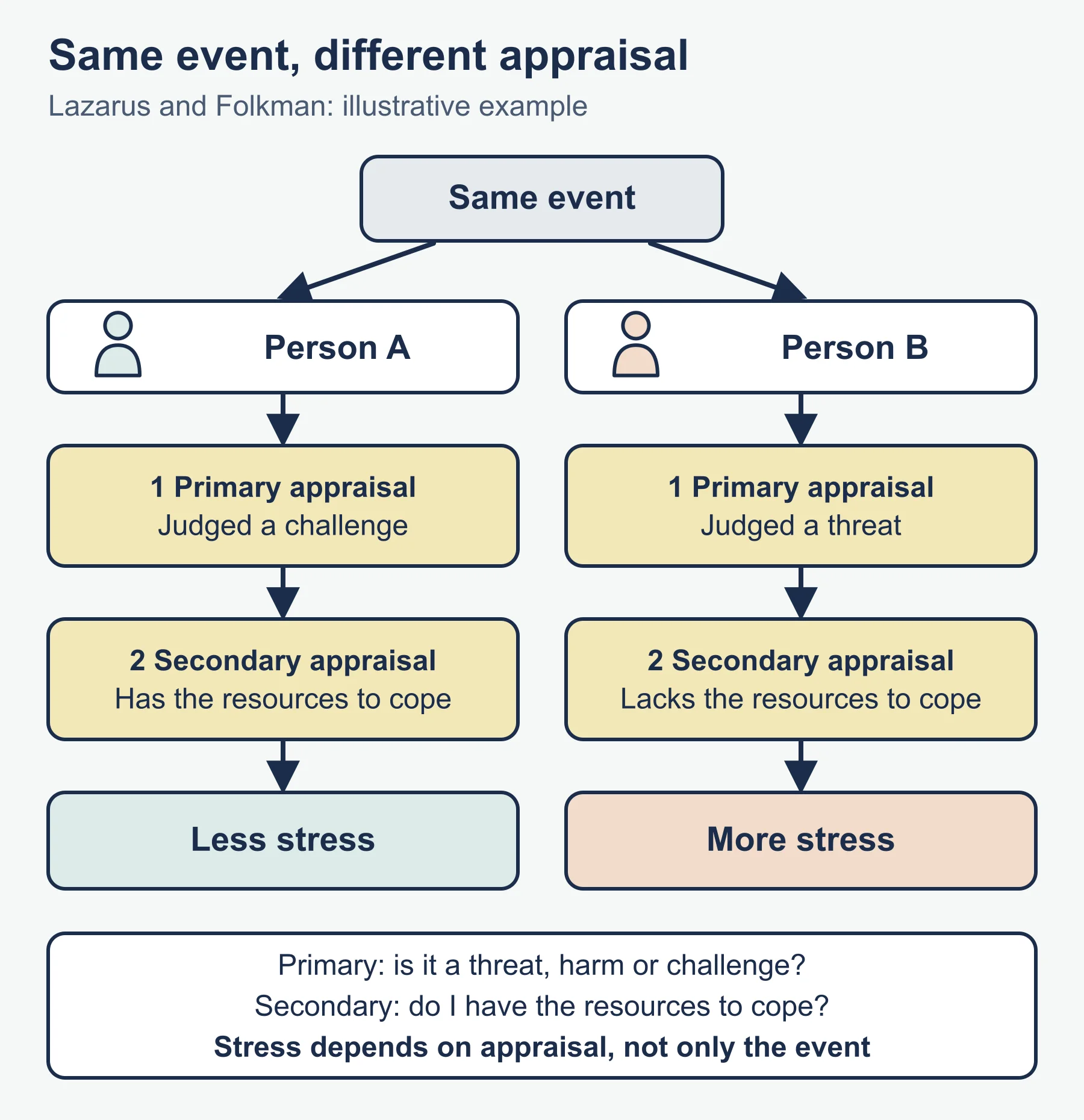
Cognitive explanations. Lazarus and Folkman’s transactional model says that stress depends on appraisal. In primary appraisal you judge whether an event is a threat, a harm or a challenge; in secondary appraisal you judge whether you have the resources to cope. Two people can therefore react very differently to the same event.
Measuring stress. Holmes and Rahe developed a life-events scale that gave each event a weighting. It is simple to use, but critics point out that it treats all people alike, ignores appraisal and assumes that change itself, rather than the meaning of change, is stressful.
Coping. Problem-focused coping tackles the source of stress; emotion-focused coping manages the feelings it produces. Neither is always better. Which works best depends on whether the situation can actually be changed.
Addiction, obesity and other health problems
The context asks you to study one or more health problems in depth, chosen from obesity, drug misuse or abuse, and social media addiction. Whichever you cover, build your understanding in the same three layers.
- What explains it biologically? For addiction, the role of dopamine pathways and genetic vulnerability; for obesity, genetic influences on appetite and metabolism.
- What explains it cognitively? For addiction, expectations and beliefs about a substance; for obesity, beliefs about food and self-control.
- What explains it socioculturally? For addiction, peer influence and availability; for obesity, food environment, advertising and cultural attitudes to body size.
Be ready to explain why a single-factor explanation is incomplete. For instance, a purely biological account of obesity cannot explain why average weights have risen across populations within a few decades, which points towards environmental change.
Health beliefs and promoting health
Health promotion tries to change behaviour at the level of the individual, the community or the whole population.
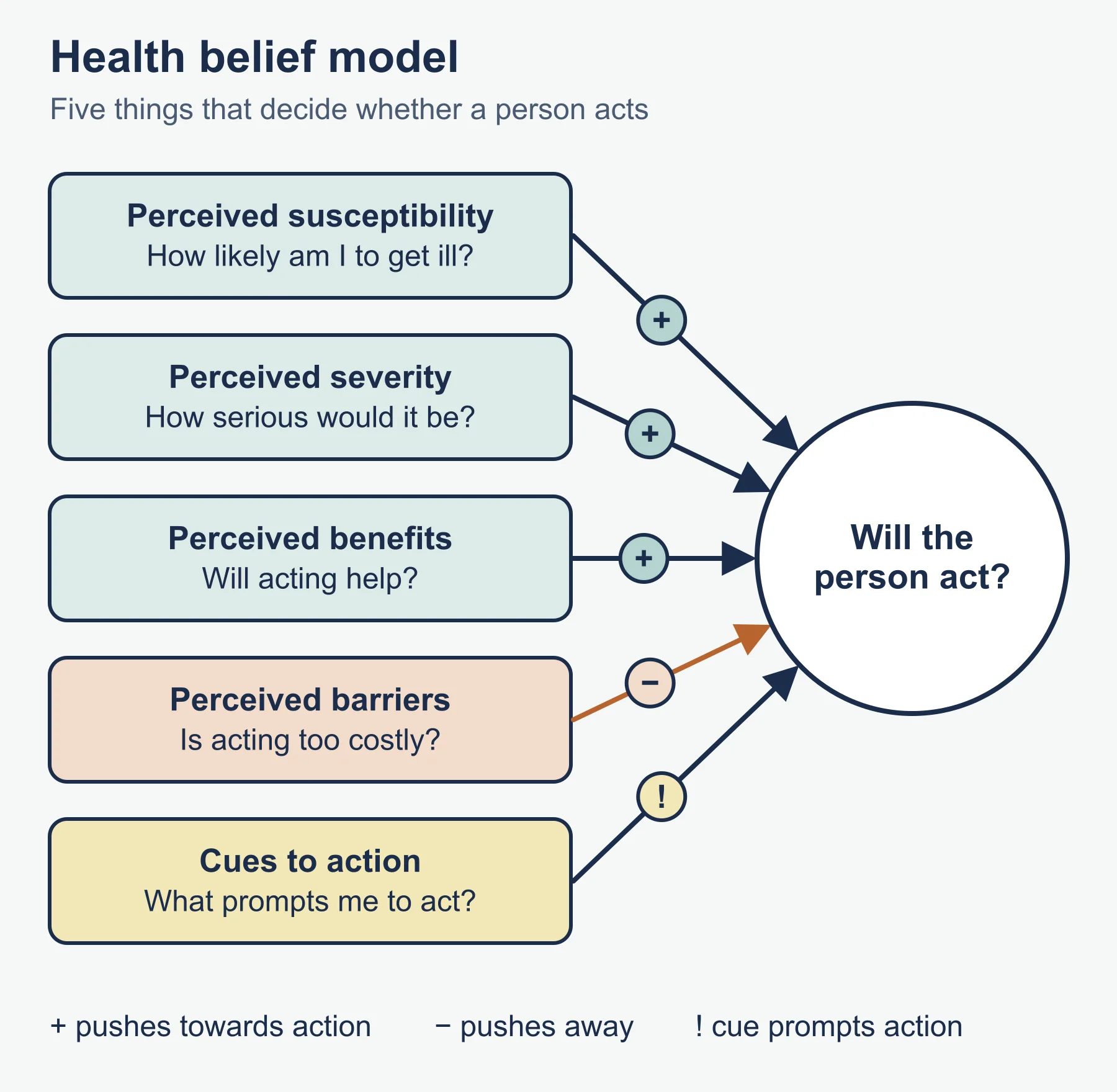
- Health belief model. Whether a person acts depends on perceived susceptibility, perceived severity, perceived benefits, perceived barriers and cues to action. A person who thinks they are unlikely to get ill, or that taking action is too costly, is less likely to change.
- Theory of planned behaviour. Intention is shaped by attitude towards the behaviour, subjective norms (what important others think) and perceived behavioural control. Intention predicts behaviour, but the gap between intending and doing is a well-known weakness.
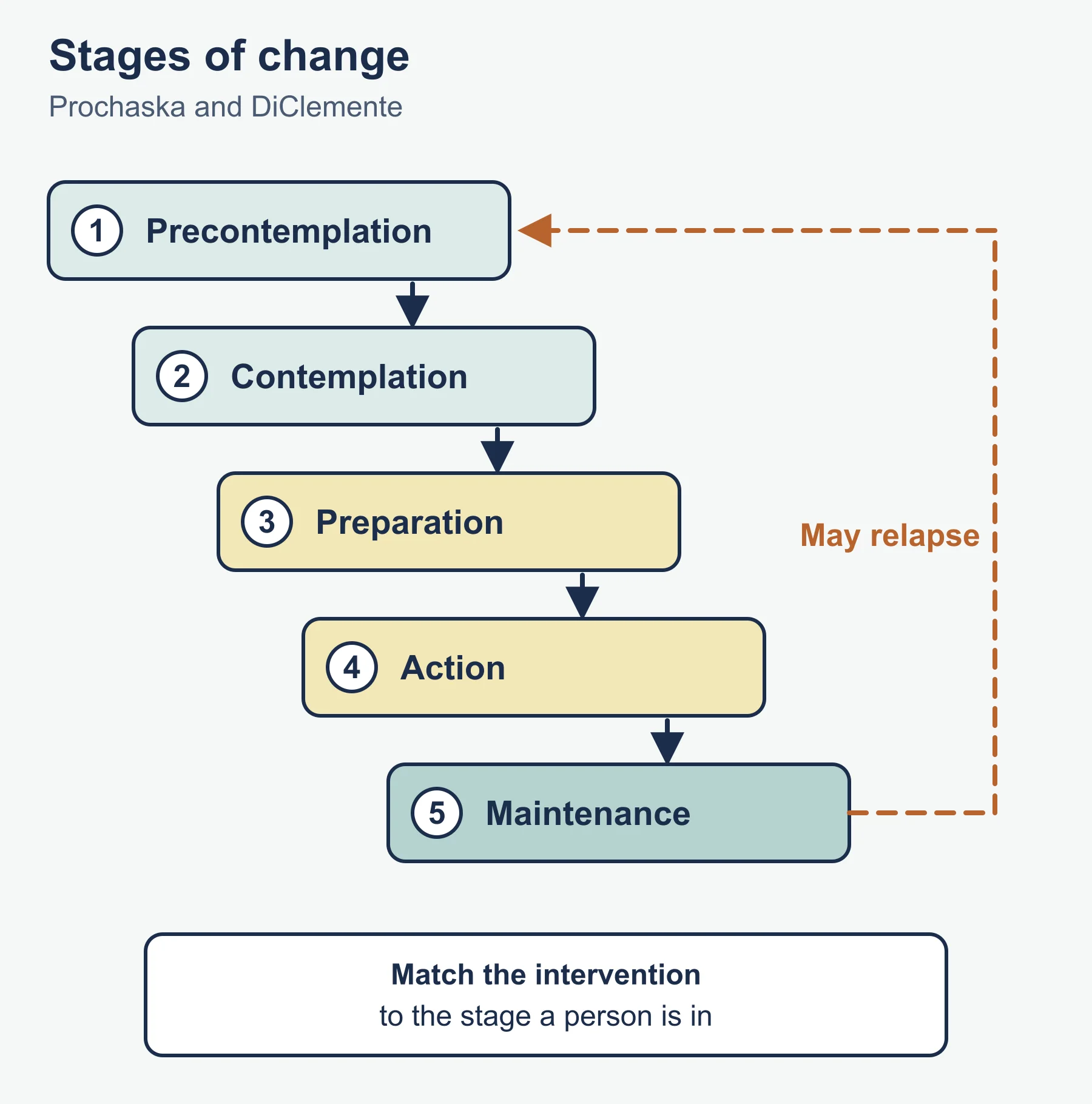
- Stages of change. Prochaska and DiClemente suggest that people move through precontemplation, contemplation, preparation, action and maintenance, and may relapse. Interventions should match the stage a person is in.
- Fear appeals. Messages that frighten people can work if they are paired with a clear, achievable action, but high fear without an effective response can lead to avoidance.
When evaluating promotion, ask who the target is, what was measured (intention or actual behaviour), how long the follow-up lasted and whether the sample resembles the people you want to generalise to.
Worked example: evaluating an intervention
The data below are fictional and for practice only.
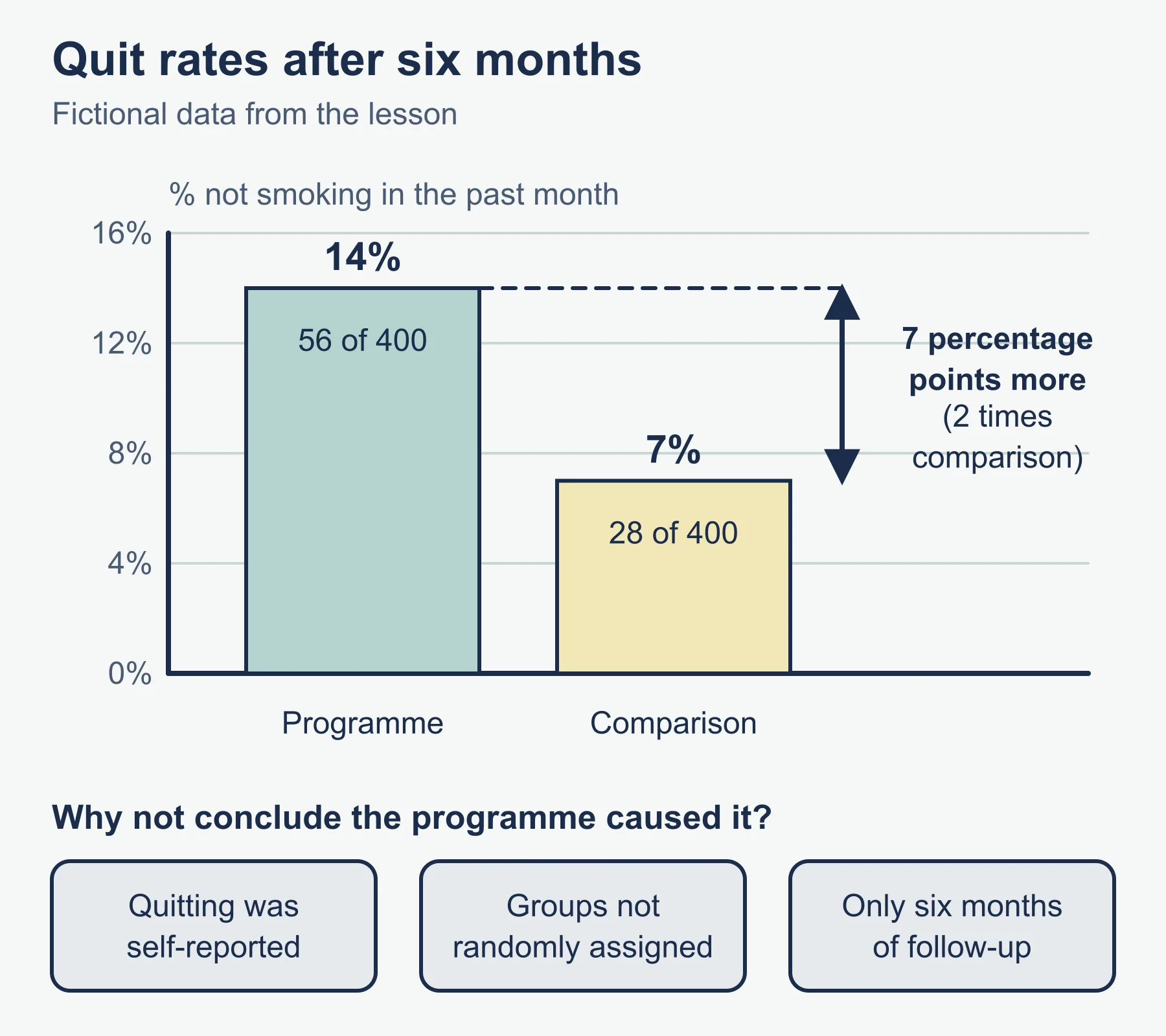
A community clinic runs a six-month programme to help smokers quit. It recruits 400 smokers for the programme and 400 comparable smokers as a comparison group. At six months, 56 programme participants and 28 comparison participants report not having smoked in the past month.
Step 1: calculate the quit rates. Programme group: 56 / 400 = 0.14, so 14%. Comparison group: 28 / 400 = 0.07, so 7%.
Step 2: compare them. The difference is 14% - 7% = 7 percentage points. The programme group’s quit rate is 14 / 7 = 2 times the comparison group’s.
Step 3: evaluate. The result suggests the programme is associated with a higher quit rate, but quote the limits. Quitting was self-reported, so participants may have exaggerated; the groups were not described as randomly assigned, so motivated smokers may have chosen the programme; and six months says nothing about long-term maintenance. A strong paragraph would link this back to a model, for example saying that the programme’s gains fit the idea that raising perceived benefits and self-efficacy increases action.
Notice that the answer separates calculation, interpretation and evaluation. Examiners reward that structure.
Common mistakes
- Describing a study in detail but never saying what it shows about the question asked.
- Treating the biopsychosocial factors as three separate lists instead of showing interaction.
- Assuming correlation means cause, for example claiming that stress causes illness from correlational evidence alone.
- Using unsupported figures. If you cannot recall a statistic exactly, describe the finding in words rather than guess a number.
- Writing about one health problem only through the biological lens and calling it a full evaluation.
- Ignoring ethics: using stress, deception or withholding treatment in research raises real concerns.
Exam technique
Pay close attention to the command term. Describe needs a clear account without judgement. Explain needs reasons and a causal link. Discuss needs a balanced consideration of several views, with support. Evaluate needs a judgement about strengths and limitations of theories or research. To what extent needs a reasoned conclusion.
For longer responses, plan before you write: a short introduction that defines the key term, two or three developed arguments each supported by named research, and a conclusion that answers the question set. Use research selectively; one well-explained study with a stated limitation is better than five mentioned in a sentence each. Comment on methodology, sampling, generalisability, validity and cultural bias where they are relevant.
Check your understanding
- Name the three stages of Selye’s general adaptation syndrome in order. Alarm, resistance and exhaustion.
- What is the difference between primary and secondary appraisal? Primary appraisal judges whether an event is a threat, harm or challenge; secondary appraisal judges whether you have the resources to cope.
- Give one criticism of measuring stress with a life-events scale. It ignores individual appraisal and treats everyone’s response to an event as the same.
- Which five ideas make up the health belief model? Perceived susceptibility, severity, benefits, barriers and cues to action.
- In the worked example, why is the 7 percentage point difference not enough to conclude the programme caused the extra quitting? The groups were not randomly assigned, quitting was self-reported and follow-up was short.
- Why is a single-factor explanation of obesity weak? It cannot account for population-wide weight changes over short periods, which implicate environment as well as biology.
- What does the theory of planned behaviour add to the idea of attitudes? Subjective norms and perceived behavioural control, with intention as the link to behaviour.
- Why should a health intervention take account of the stage of change? Different messages suit people who are not yet considering change than those already acting or trying to maintain change.
Frequently asked questions
What are the determinants of health in psychology? Biological determinants include genetics and the stress response, cognitive determinants include beliefs, perceived control and self-efficacy, and sociocultural determinants include income, education, social support and culture.
What is Lazarus and Folkman’s transactional model of stress? It says stress depends on appraisal. In primary appraisal you judge whether an event is a threat, harm or challenge, and in secondary appraisal you judge whether you have the resources to cope.
What is the health belief model? The health belief model says whether a person acts depends on perceived susceptibility, perceived severity, perceived benefits, perceived barriers and cues to action.
What is the difference between problem-focused and emotion-focused coping? Problem-focused coping tackles the source of stress, while emotion-focused coping manages the feelings it produces. Which works best depends on whether the situation can be changed.
Related resources
-
Study guides
IB DP Psychology: Risk and Protective Factors in Health
Risk and protective factors for IB DP Psychology health and well-being: childhood adversity, stress and infection, social ties and the buffering hypothesis.
Psychology · International Baccalaureate · IB
Read guide -
Practice questions
IB DP Psychology: Risk and Protective Factors in Health – Practice Questions
Original IB DP health and well-being practice on risk and protective factors: definitions, pathways, an invented survey to analyse and a 15-mark essay plan.
Psychology · International Baccalaureate · IB
Try questions -
Revision notes
IB DP Psychology: Risk and Protective Factors in Health – Revision Notes
Condensed IB DP Psychology notes on risk and protective factors in health: pathways, the ACE study, stress and colds, social ties, buffering and a self-test.
Psychology · International Baccalaureate · IB
Revise topic
Studying Psychology?
This page is free and stays free. Marlbridge is not offering Psychology classes at the moment, so there is no tuition to book for it. The free study resources stay open to everyone.
Get free revision emails (optional)
Occasional emails with practice questions, worked explanations and links to free resources for the qualification and subjects you choose. No spam, and you can unsubscribe from any email. The free tools on this site never need an email.