
Revision Notes
IB DP Psychology: Option: Psychology of human relationships – Revision Notes
Revision notes for the IB DP Psychology human relationships option: attraction, communication, relationship change, group conflict, prejudice and bystanderism.
- Subject
- Psychology
- Level
- IB
- Topic
- Topic 8: Option: Psychology of human relationships
- Author
- Marlbridge Academic Team
- Updated
Aligned to International Baccalaureate IB Diploma Programme Psychology (DP Psychology (2019) / DP Psychology (2027)), First assessment 2019. Official specification .
Syllabus page (what it covers and how it is assessed): IB Diploma Programme Psychology.
Syllabus topics and points this page is mapped to
DP Psychology (2019) / DP Psychology (2027)
- 8 Option: Psychology of human relationships (topic-level mapping)
"Topic-level mapping" means this page belongs to that topic; it does not claim to cover every point in it.
Course note: these notes follow IB DP Psychology for first assessment 2019, whose last examination session is November 2026. The replacement course is first assessed in May 2027.
The psychology of human relationships is one of the four IB DP Psychology options, examined on Paper 2 through 22-mark essays. It covers personal relationships (how they form, how communication shapes them and why they change or end), group dynamics (co-operation, competition, prejudice and conflict) and social responsibility (bystanderism and prosocial behaviour), using research from all three approaches.
Related: Human relationships study guide and practice questions.
Syllabus coverage (first assessment 2019)
| Topic | Content |
|---|---|
| Personal relationships | Formation of personal relationships; role of communication; explanations for why relationships change or end |
| Group dynamics | Cooperation and competition; prejudice and discrimination; origins of conflict and conflict resolution |
| Social responsibility | Bystanderism; prosocial behaviour; promoting prosocial behaviour |
Personal relationships
| Content | Explanation | Research |
|---|---|---|
| Formation | Proximity, similarity, physical attractiveness, evolutionary preferences, neurochemistry of attraction | Festinger, Schachter and Back (1950): friendships in a student housing complex formed most often between neighbours; Buss (1989): across 37 cultures men valued youth and attractiveness more, women financial prospects; Fisher et al. (2005): fMRI showed dopamine-rich reward areas activated by photos of a loved partner |
| Communication | Patterns of interaction and attributions affect satisfaction | Gottman’s “four horsemen” (criticism, contempt, defensiveness, stonewalling); Buehlman, Gottman and Katz (1992): oral-history interviews predicted later divorce with high accuracy; Bradbury and Fincham (1990) on relationship-enhancing and distress-maintaining attributions |
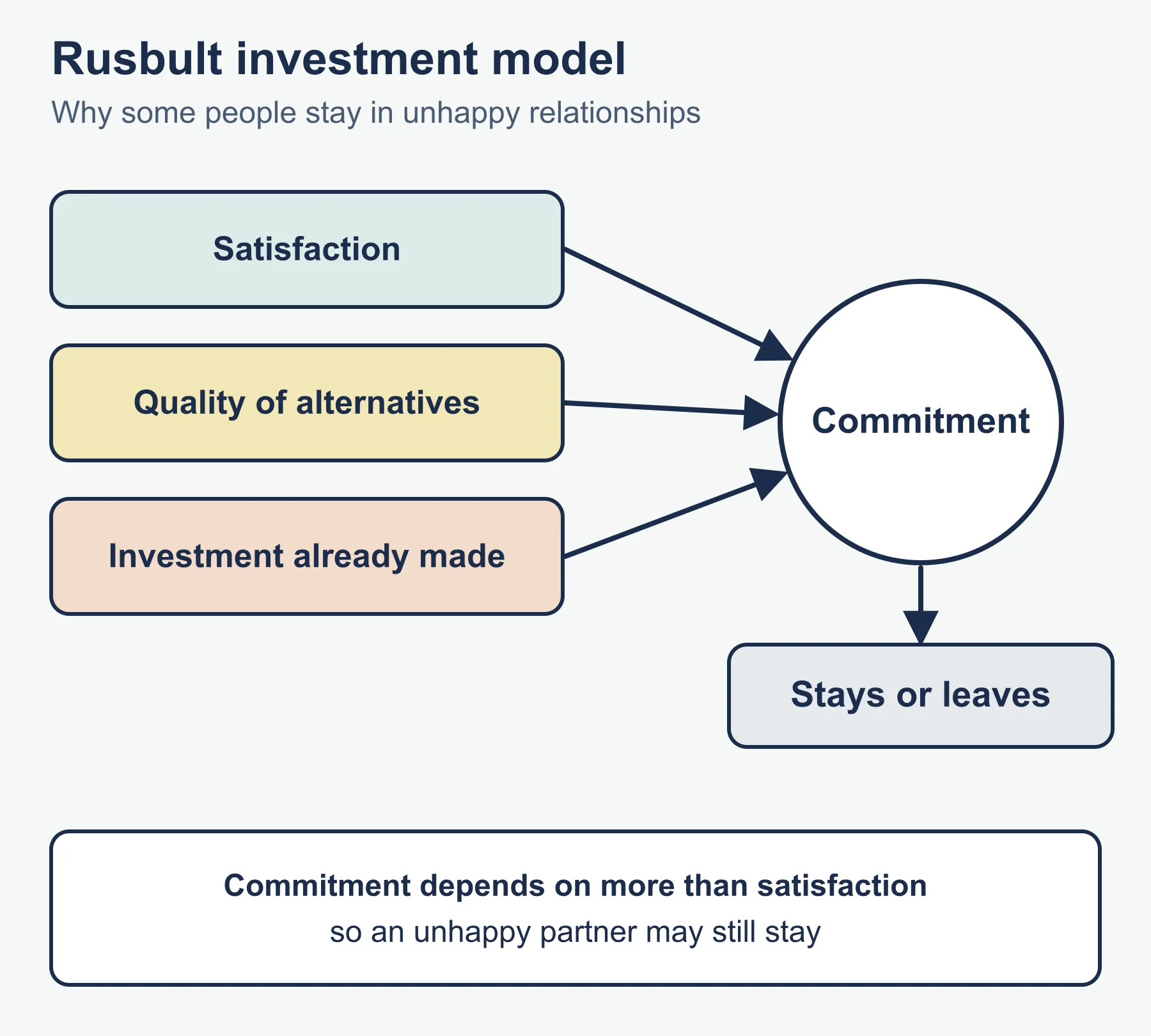
| Change or end | Costs and rewards, investment, comparison with alternatives | Rusbult’s investment model: commitment depends on satisfaction, quality of alternatives and investment size |
Group dynamics
| Content | Explanation | Research |
|---|---|---|
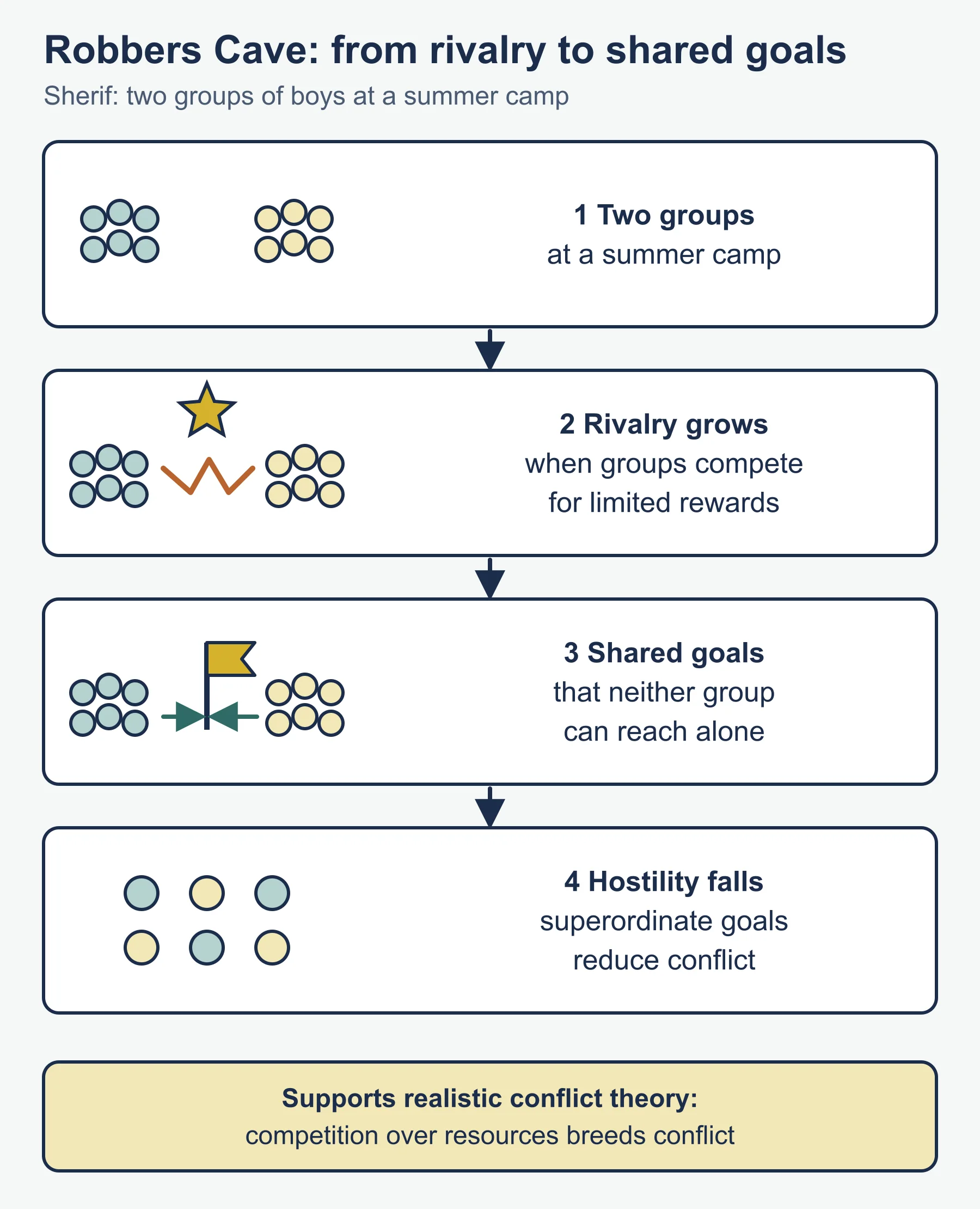
| Cooperation and competition | Realistic conflict theory: competition for scarce resources creates hostility; superordinate goals create cooperation | Sherif et al. (Robbers Cave, 1954): boys at a summer camp formed hostile groups during competition; shared goals reduced conflict |
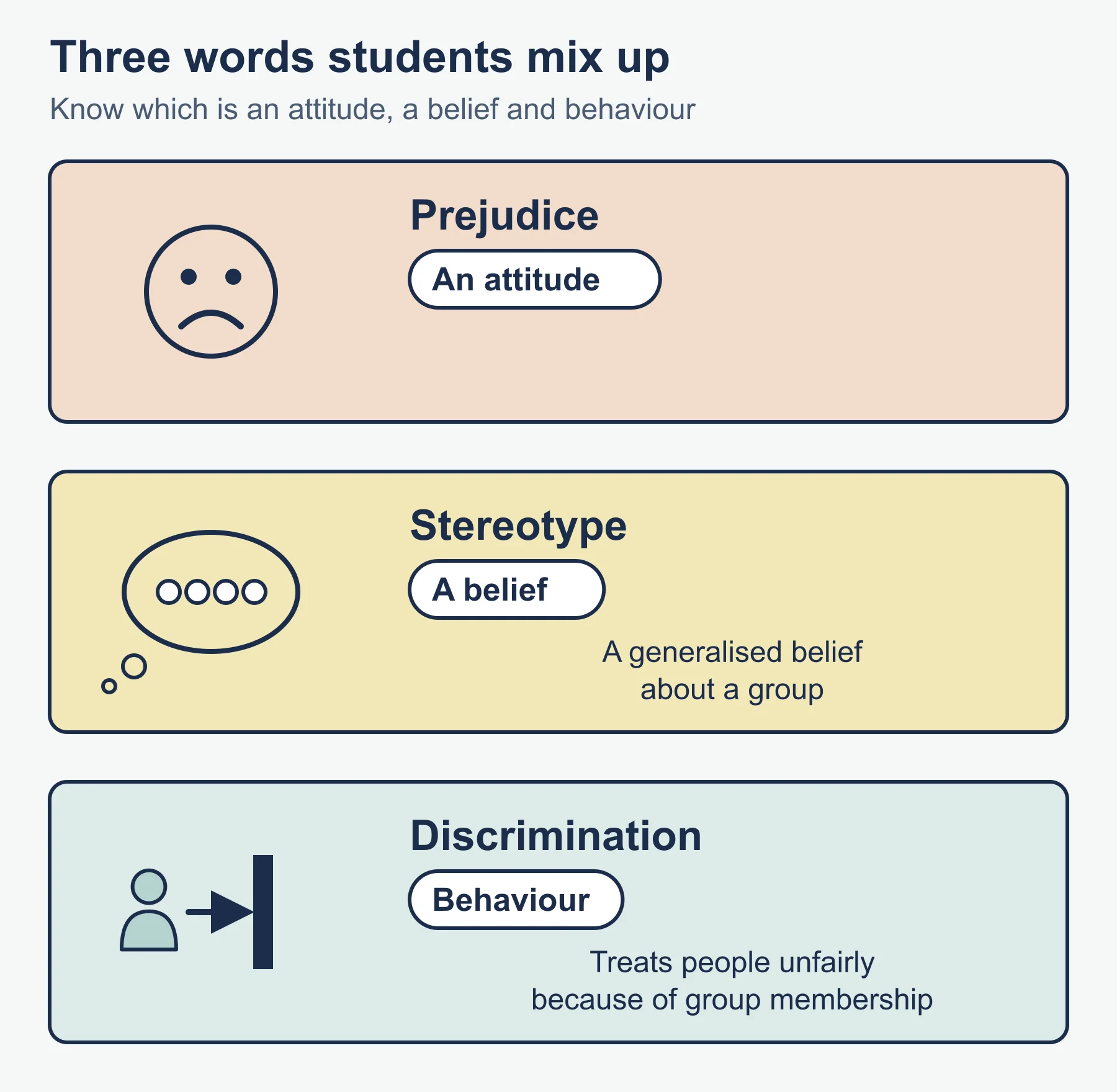
| Prejudice and discrimination | Social identity theory; stereotypes | Tajfel et al. (1971) minimal groups; Bertrand and Mullainathan (2004): CVs with White-sounding names received more interview callbacks than identical CVs with Black-sounding names |
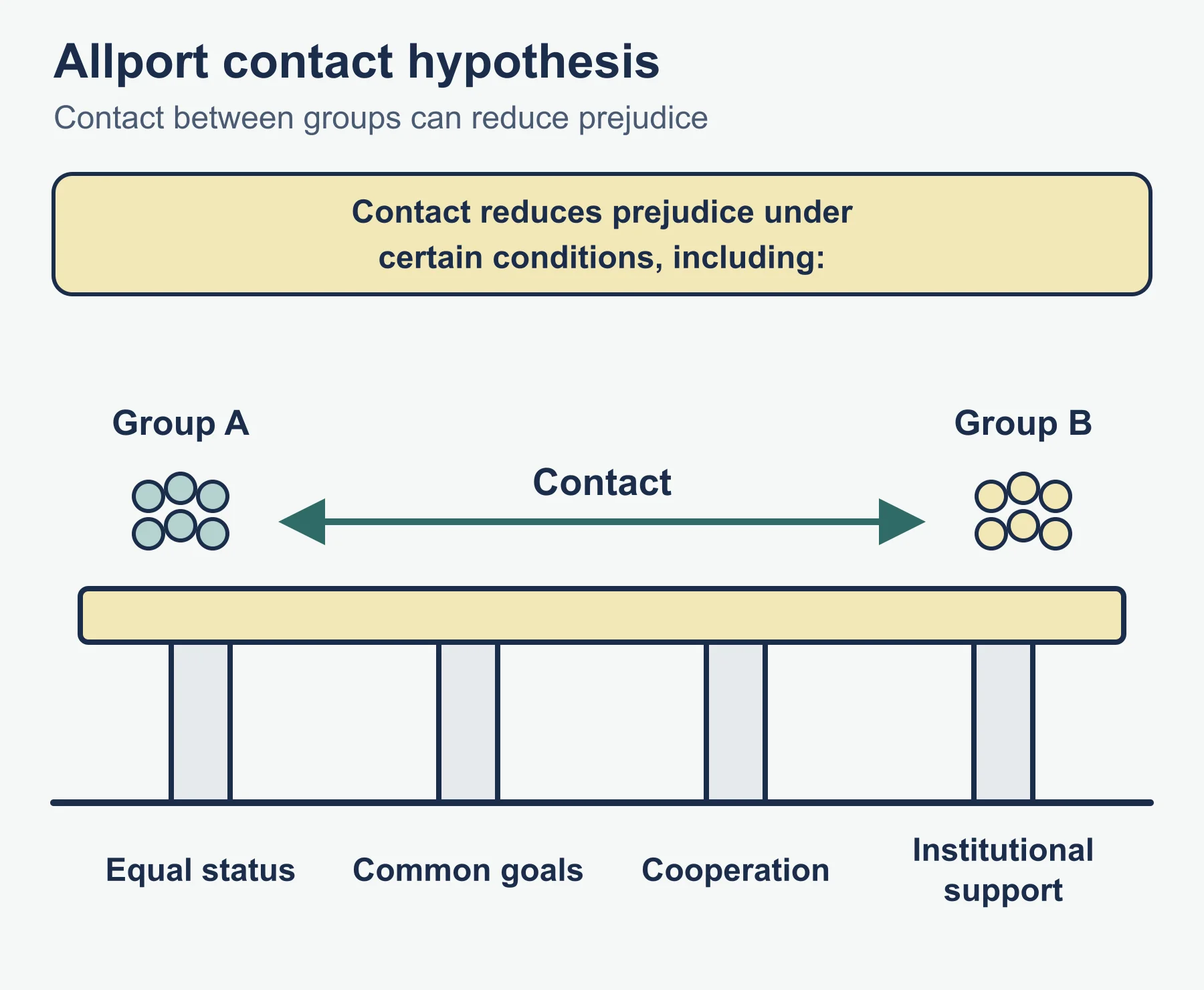
| Origins of conflict and resolution | Competition, identity threat; contact and cooperation | Allport’s contact hypothesis (1954): equal status, common goals, institutional support; Aronson’s jigsaw classroom: interdependent learning reduced prejudice |
Social responsibility
| Content | Explanation | Research |
|---|---|---|
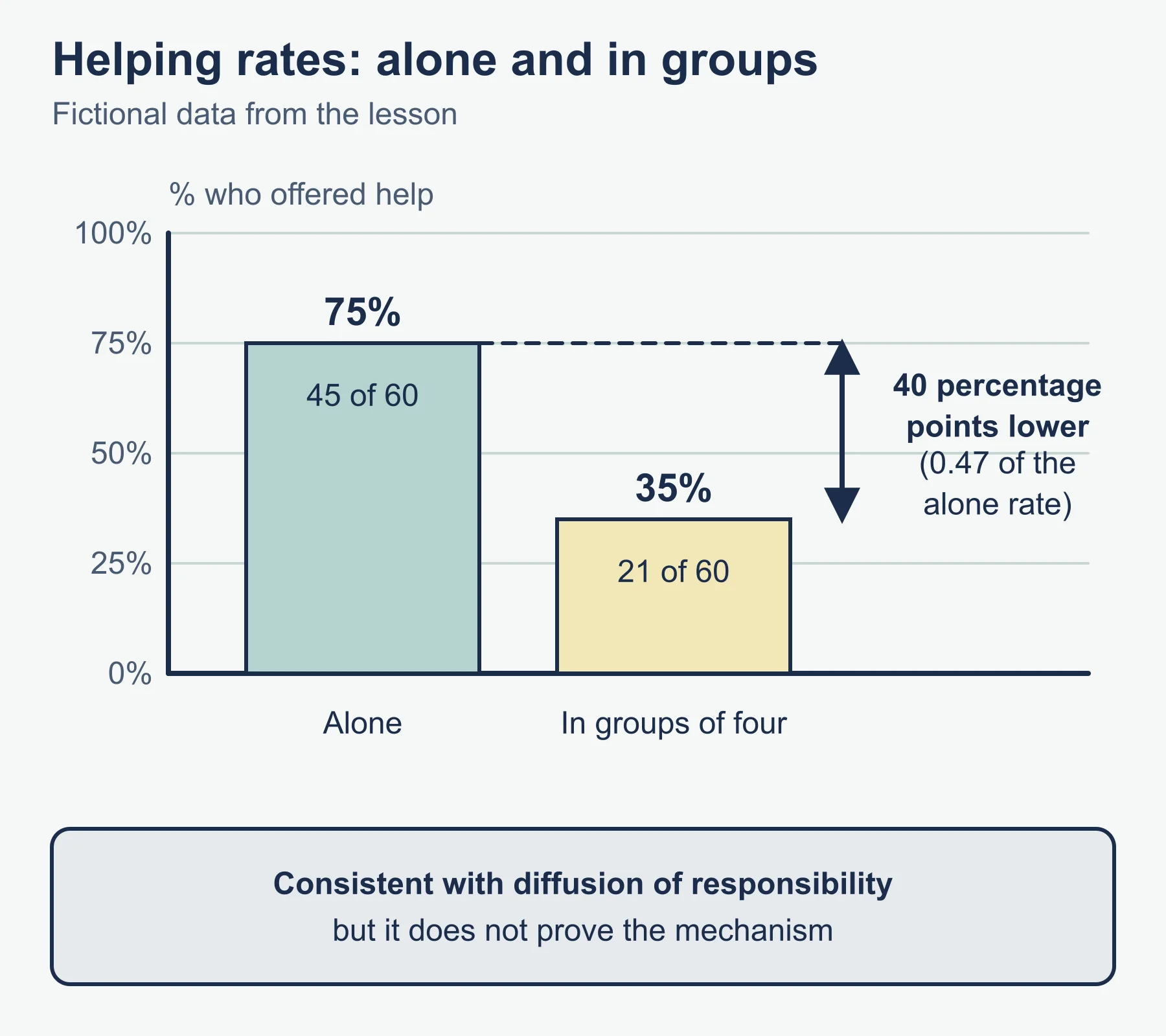
| Bystanderism | Diffusion of responsibility; Latané and Darley’s decision model (notice, interpret, take responsibility, decide how, act); arousal: cost-reward model | Darley and Latané (1968): participants who believed they alone heard a seizure helped far more often and faster than those who believed others heard it; Piliavin et al. (1969): a victim with a cane was helped more often than one who appeared drunk |
| Prosocial behaviour | Empathy-altruism hypothesis versus egoistic explanations; kin selection | Batson et al. (1981): high-empathy participants helped even when escape was easy |
| Promoting prosocial behaviour | Modelling, media, education, reducing anonymity | Research on prosocial television content, such as meta-analysis of children’s programming effects |
Methods and ethics across the option
| Method | Example | Evaluation |
|---|---|---|
| Field experiment | Robbers Cave; Piliavin’s subway study; the CV study | High ecological validity; consent and debriefing often impossible |
| Laboratory experiment | Darley and Latané; Batson et al.; Tajfel’s minimal groups | Control and replicability; deception and artificial tasks |
| Survey and interview | Buss’s cross-cultural survey; Gottman’s oral-history interview | Large or rich data; self-report bias |
| Brain imaging | Fisher et al. (2005) | Biological correlates; small samples and correlation only |
Worked example: applying the decision model
A student passes a classmate crying in an empty corridor, and later a stranger lying on a busy street.
- Notice: both noticed; on the busy street, distractions reduce noticing.
- Interpret: crowd inaction suggests “not an emergency” (pluralistic ignorance).
- Responsibility: alone in the corridor, responsibility is clear; on the street it is diffused.
- Decide and act: cost-reward judgement – knowing the classmate lowers costs.
The model predicts help is more likely in the corridor, as Darley and Latané’s findings suggest.
Common mistakes / exam traps
- Formation essays on one factor only. Show a range of factors and evaluate their relative importance.
- Treating Robbers Cave as a lab experiment. It was a field experiment with a small, homogeneous sample of boys.
- Using evolutionary findings without cultural evaluation. Buss’s data are self-report preferences, and gender equality varies across cultures.
- Bystander essays that only describe studies. Explain the mechanism: diffusion of responsibility, pluralistic ignorance, cost-reward.
- Ignoring the question’s focus on “promoting”. Promotion questions need interventions, not just explanations.
Frequently asked questions
How is this option examined? On Paper 2: three 22-mark ERQs are set on each option; you answer one (SL) or one from each of two options (HL).
Is prejudice here the same as in the sociocultural approach? The concepts overlap, but this option asks about prejudice and discrimination within group dynamics and conflict resolution; link research to conflict and its reduction.
Which ethical issues come up? Deception and harm in bystander studies (Darley and Latané; Piliavin), and in field experiments without consent, such as the Robbers Cave camp.
Self-test
- What is diffusion of responsibility? The reduced sense of personal responsibility to help when others are present.
- Name Gottman’s four horsemen. Criticism, contempt, defensiveness, stonewalling.
- What are superordinate goals? Goals that require groups to cooperate.
- What does Rusbult’s investment model predict? Commitment rises with satisfaction and investment and falls with attractive alternatives.
- What did Batson et al. (1981) test? Whether empathy produces altruistic helping even when escape is easy.
Related resources
-
Study guides
IB DP Psychology: Option: Psychology of human relationships – Study Guide
Personal relationships, group dynamics and social responsibility in IB Diploma Psychology: key theories, studies, evaluation points and a worked data example.
Psychology · International Baccalaureate · IB
Read guide -
Study guides
IB DP Psychology (2019): Bystanderism
Bystanderism for the IB DP human relationships option: the decision model, pluralistic ignorance, social identity, dangerous emergencies and real CCTV evidence.
Psychology · International Baccalaureate · IB
Read guide -
Practice questions
IB DP Psychology (2019): Bystanderism – Practice Questions
Original IB DP practice on bystanderism: the decision model, inhibiting processes, an invented field study to analyse, social identity and a 22-mark essay plan.
Psychology · International Baccalaureate · IB
Try questions
Studying Psychology?
This page is free and stays free. Marlbridge is not offering Psychology classes at the moment, so there is no tuition to book for it. The free study resources stay open to everyone.
Get free revision emails (optional)
Occasional emails with practice questions, worked explanations and links to free resources for the qualification and subjects you choose. No spam, and you can unsubscribe from any email. The free tools on this site never need an email.