
Revision Notes
AQA A-Level Biology: Organisms Exchange Substances With Their Environment (7402) – Revision Notes
Condensed recall notes on surface area to volume ratio, gas exchange, digestion, haemoglobin, the heart and plant transport for AQA A-level Biology 7402.
- Subject
- Biology
- Level
- AS LEVEL
- Topic
- Organisms exchange substances with their environment
- Author
- Marlbridge Academic Team
- Updated
- Reviewed by
- Hina Mogul (what this means)
Aligned to AQA A Level Biology (7402), For first teaching 2015. Official specification .
Syllabus page (what it covers and how it is assessed): AQA A Level Biology.
Syllabus points this page covers
7402 (AS Level)
- 3 Organisms exchange substances with their environment (whole topic)
- 3.3.1 Surface area to volume ratio
- 3.3.2 Gas exchange
- 3.3.3 Digestion and absorption
- 3.3.4 Mass transport
Found an error? Report a correction.
Need help with this topic? Request a free trial class for A Level Biology (7402).
These notes condense section 3.3.1 to 3.3.4 (Organisms exchange substances with their environment) of the AQA AS and A-level Biology specification, version 1.5, for the A-level Biology (7402) course. The content is part of topics 1 to 4, which the specification lists as assessable on Paper 1 and Paper 3 at A-level. For the fuller explanation, use the study guide, then test yourself with the practice questions. Course hub: AQA A-level Biology. Printable list: checklist. Unsure where to start? Try the free diagnostics.
Background for this topic is in biological molecules and lipids and protein structure.
3.3.1 Surface area to volume ratio
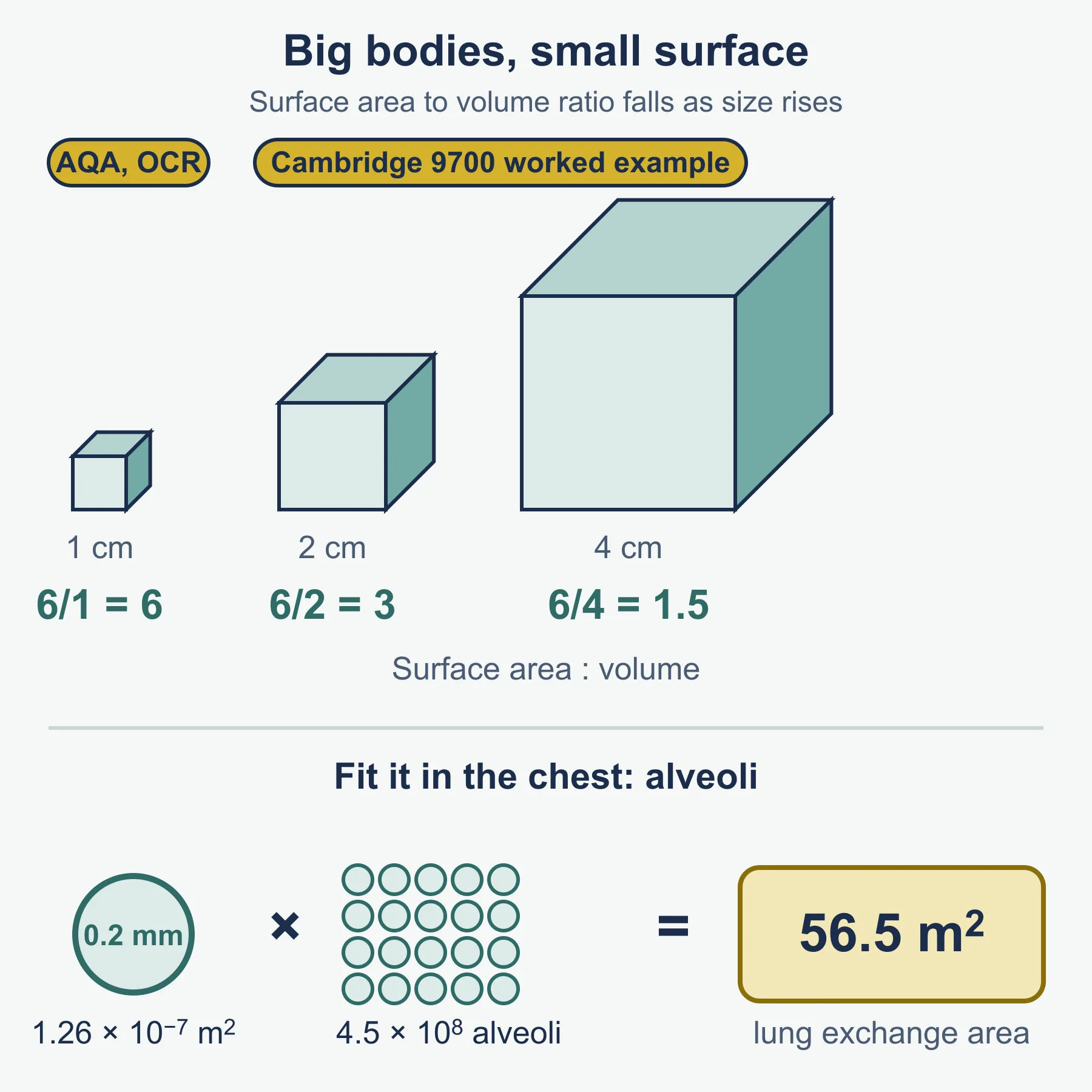
- Surface area to volume ratio (SA:V) falls as an object gets bigger, because volume grows faster than surface area.
- Small organisms: large SA:V, so diffusion across the body surface can meet demand. Large organisms: small SA:V, so they need exchange surfaces plus a mass transport system.
| Cube side | Surface area | Volume | SA:V |
|---|---|---|---|
| 1 cm | 6 cm² | 1 cm³ | 6 : 1 |
| 2 cm | 24 cm² | 8 cm³ | 3 : 1 |
| 4 cm | 96 cm² | 64 cm³ | 1.5 : 1 |
Doubling the side halves the ratio. A sphere of radius r has SA:V = 3/r.
Adaptations as the ratio falls: flattened bodies (more surface per unit volume), folded or branched exchange surfaces (gills, alveoli), and transport systems such as a circulatory system.
Metabolic rate link: a small animal loses heat quickly through its large relative surface, so it needs a high metabolic rate per gram to stay warm. It therefore takes up oxygen and food faster per gram than a large animal. A large animal has a lower rate per gram.
3.3.2 Gas exchange
Four exchange surfaces
| Organism | Route and key structures | Why it works |
|---|---|---|
| Single-celled | Diffusion straight across the cell surface | High SA:V, short distance |
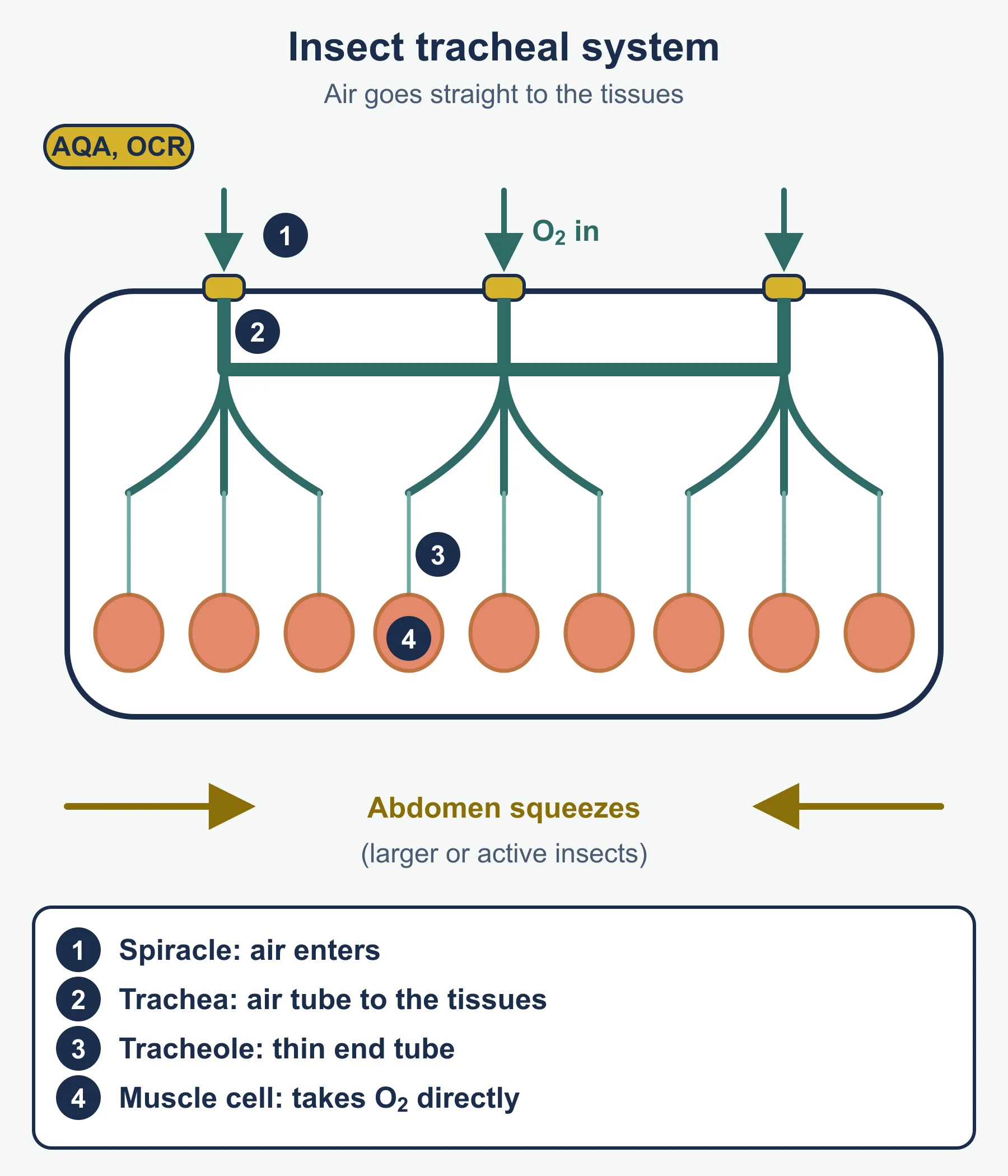
| Insect | Spiracles, tracheae, tracheoles; tracheole ends hold fluid and reach the muscle cells | Air-filled tubes carry gases close to cells; diffusion in air is fast |
| Fish | Water over gill filaments; each has many lamellae | Thin, richly supplied lamellae; counter-current flow |
| Dicot leaf | Stomata, air spaces, mesophyll | Air reaches the wet surfaces of mesophyll cells; guard cells control the pore |
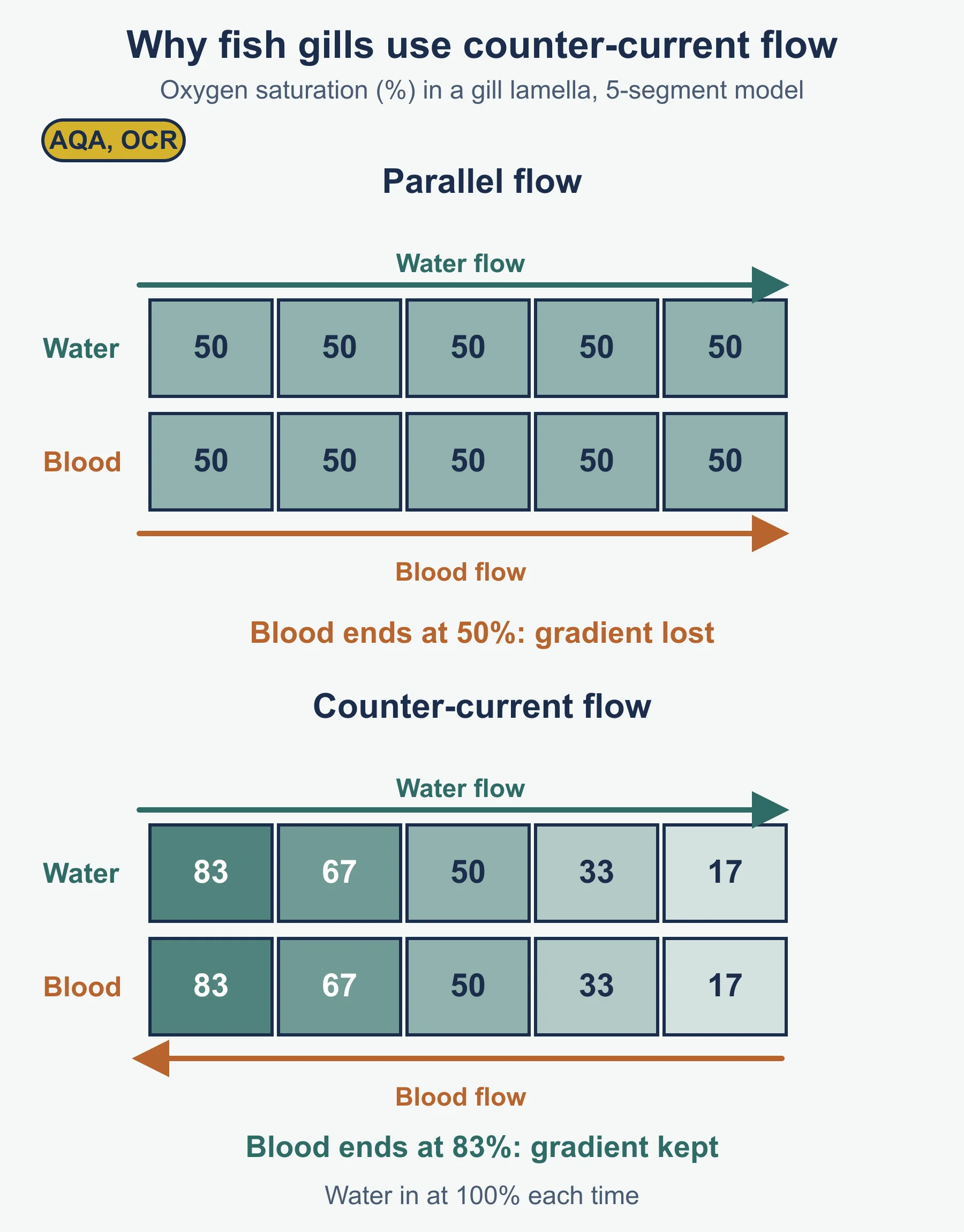
Counter-current principle: blood in the lamellae runs opposite to the water. The water always meets blood with a lower oxygen content, so a diffusion gradient exists along the full length of the lamella and a large share of the oxygen is taken up. Parallel flow would let the two streams reach equilibrium part-way along.
Water loss against gas exchange
- Insects: spiracles can close, which limits water loss, and a waterproof cuticle covers the body. The cost is less gas entry while closed.
- Xerophytes: thick cuticle, sunken stomata, rolled leaves and hairs trap humid air next to the stomata and cut the gradient for water vapour. The cost is a longer, more restricted diffusion path for CO2 and O2.
Human gas exchange system
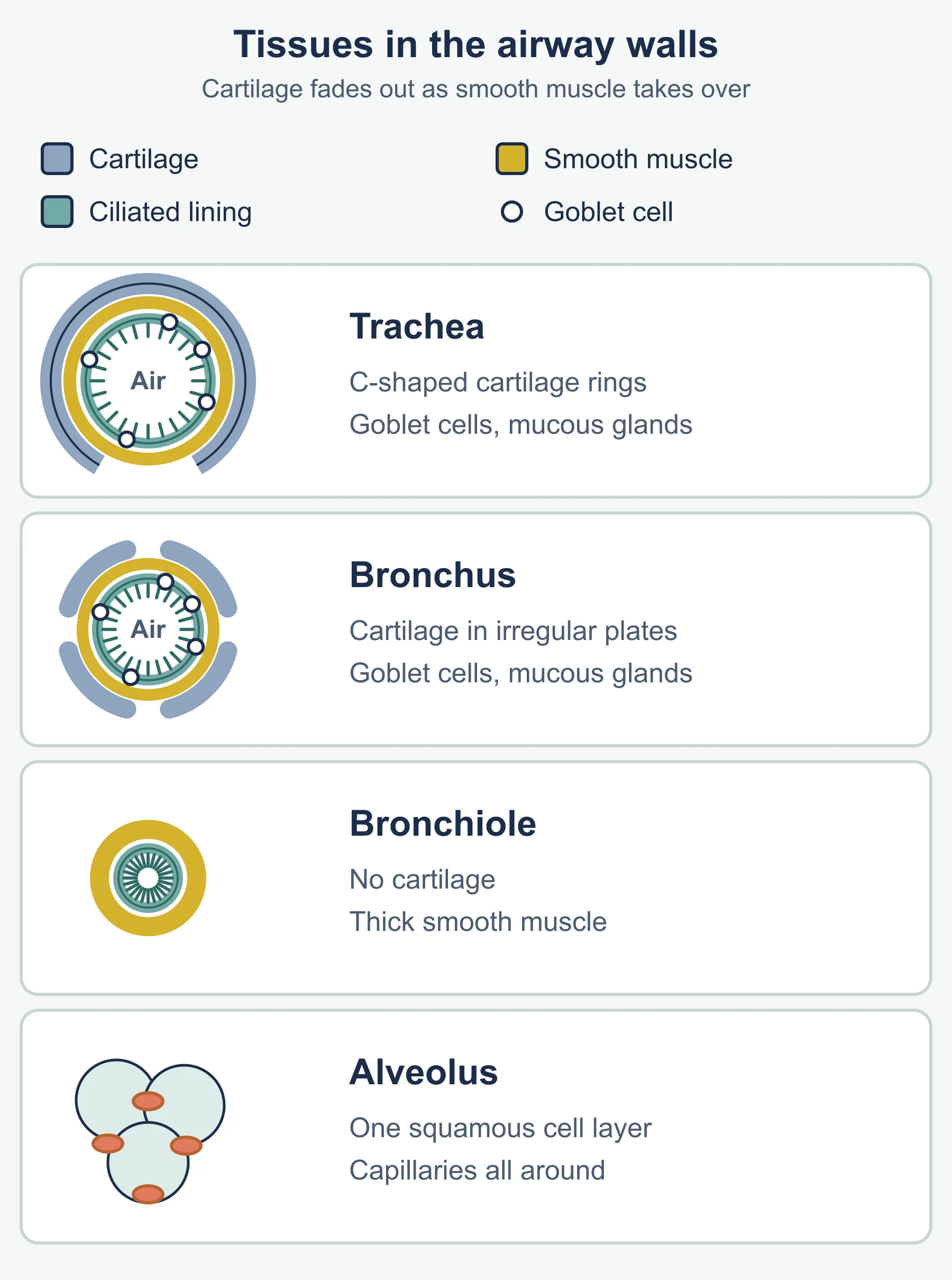
Order of air flow: trachea, bronchi, bronchioles, alveoli, all inside the lungs.
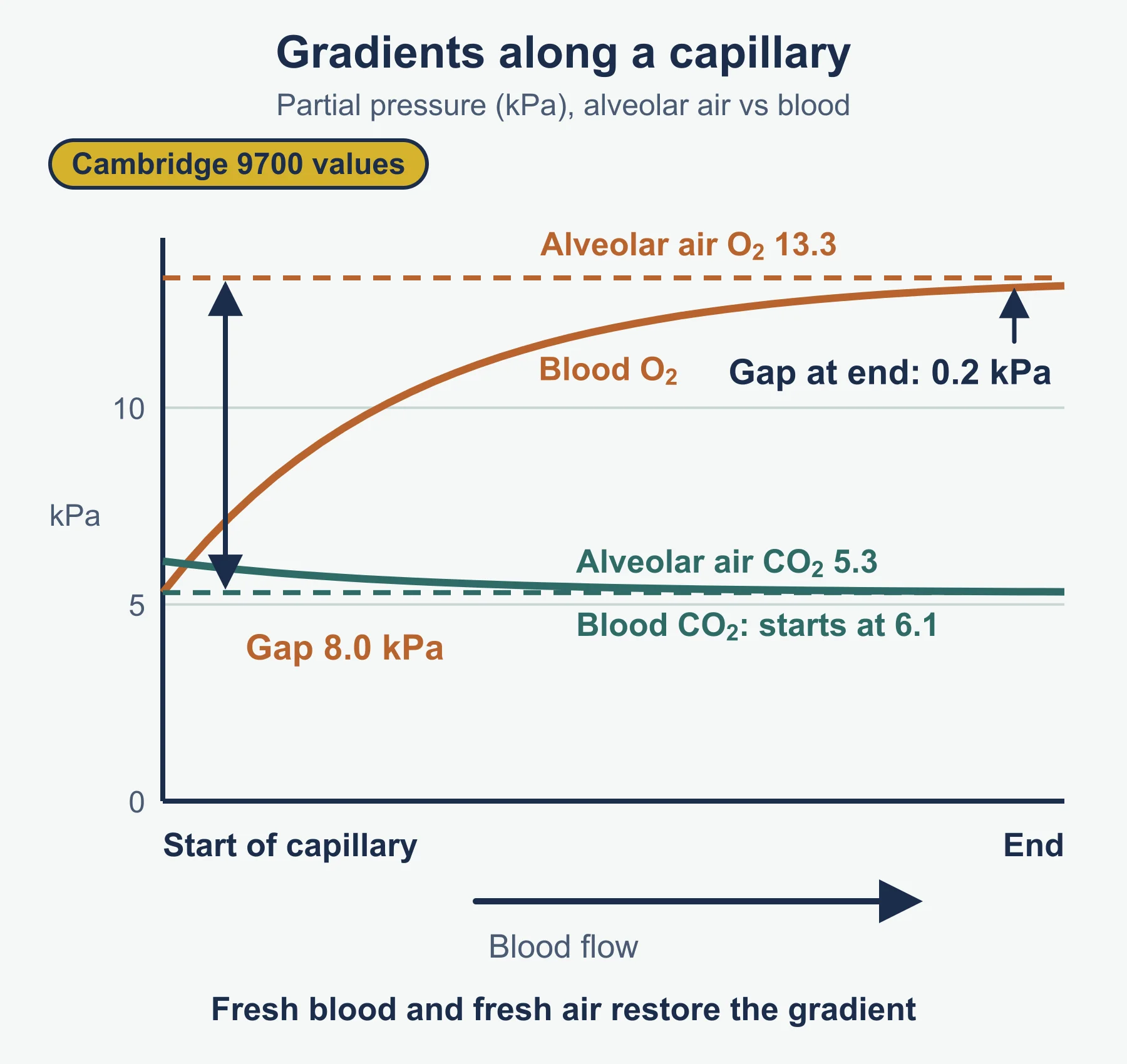
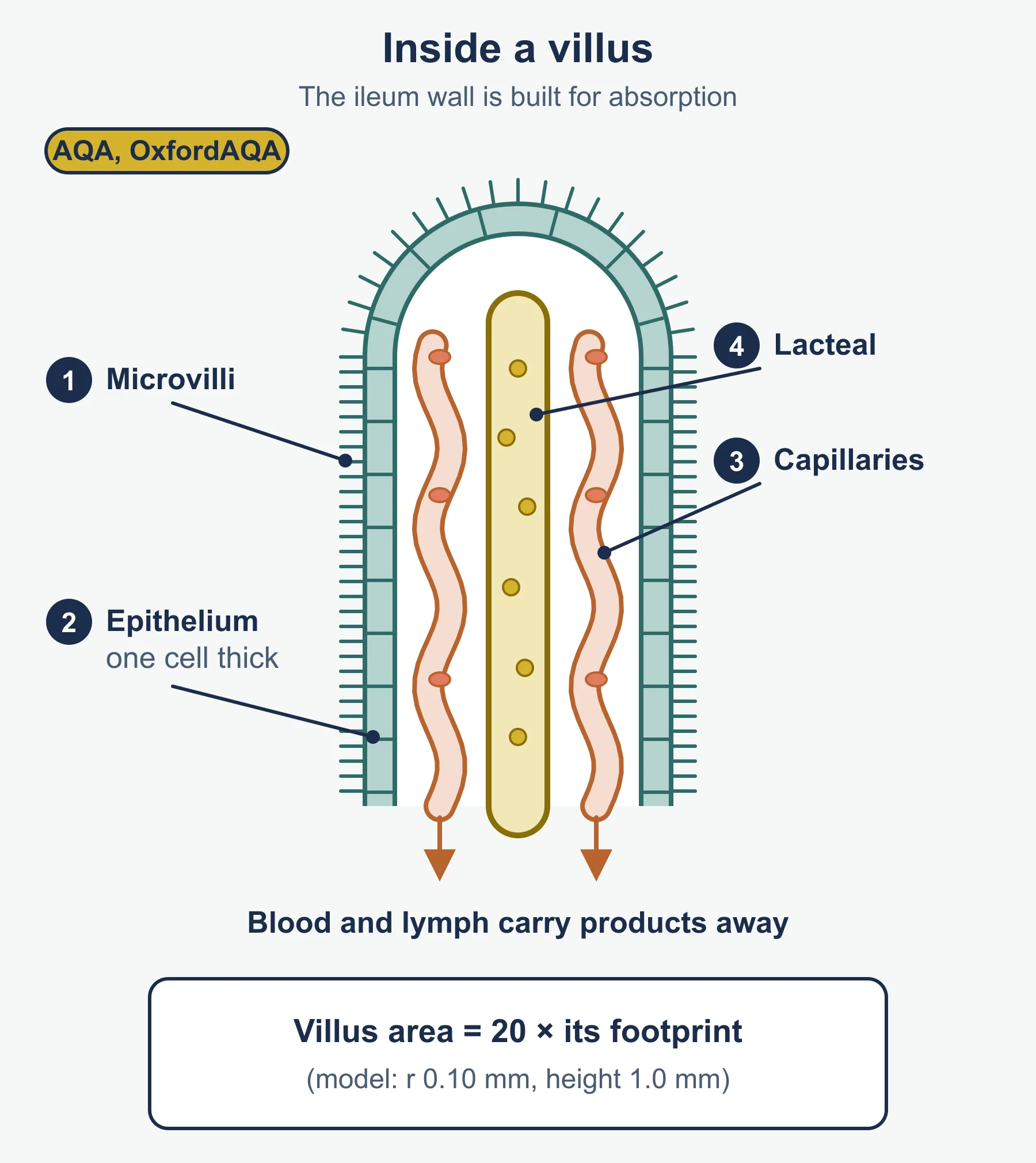
Alveolar epithelium: one cell thick and flat, which gives a short diffusion distance. It sits against a dense capillary network, which keeps blood flowing and removes oxygen to maintain the gradient. There are very many alveoli, giving a large surface. Moist lining lets gases dissolve.
Breathing
| Inspiration | Expiration (at rest) | |
|---|---|---|
| Diaphragm | Contracts, flattens | Relaxes, domes upward |
| External intercostals | Contract, ribs up and out | Relax |
| Internal intercostals | Relax | Contract during forced expiration only |
| Thoracic volume / pressure | Volume up, pressure below atmospheric | Volume down, pressure above atmospheric |
The two sets of intercostals are antagonistic: one raises the ribs, the other lowers them.
Pulmonary ventilation rate (PVR) = tidal volume × breathing rate. Rearrange for either factor.
Lung disease and risk factors: be ready to read tables and graphs on lung disease (for example reduced lung elasticity, thickened or scarred tissue, fewer alveoli) and its effect on gas exchange or ventilation. A correlation between smoking or pollution and disease does not alone prove cause. Stronger evidence combines a dose-response trend, controlled comparison groups and an explained mechanism. Be able to evaluate how such data led to laws restricting a risk factor.
3.3.3 Digestion and absorption
Digestion is hydrolysis: large molecules are split by water into units small enough to cross membranes.
| Food group | Enzymes | Product |
|---|---|---|
| Carbohydrate | Amylase (salivary, pancreatic); membrane-bound disaccharidases (maltase, sucrase, lactase) | Starch to maltose; then monosaccharides |
| Lipid | Lipase; bile salts emulsify | Monoglycerides and fatty acids |
| Protein | Endopeptidases cut inside the chain; exopeptidases remove terminal amino acids; membrane-bound dipeptidases | Amino acids |
Absorption in the ileum
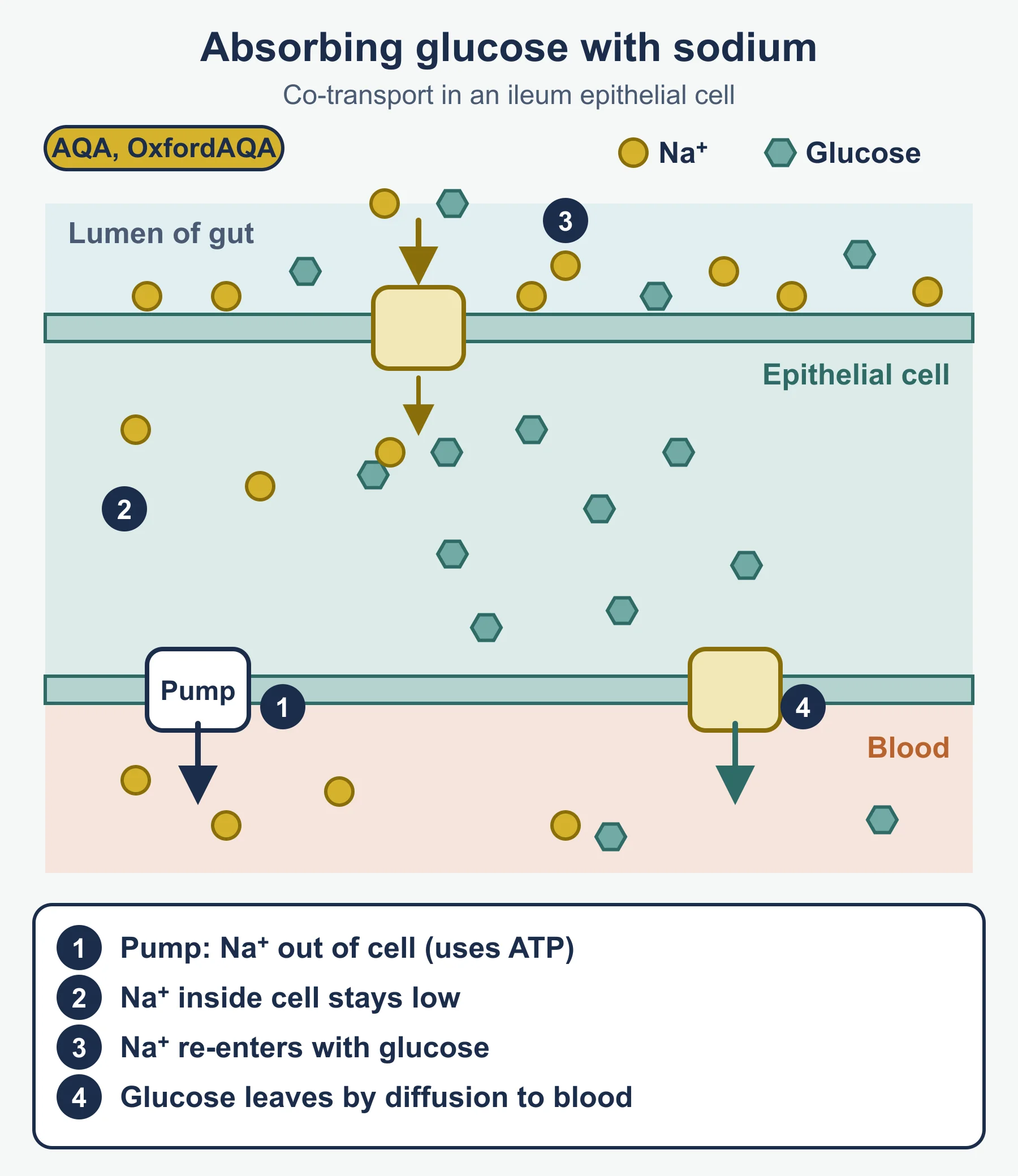
- Monosaccharides and amino acids: sodium ions are pumped out of the epithelial cell by active transport, which lowers the internal sodium concentration. Sodium then enters down its gradient through a carrier protein that carries glucose or an amino acid with it (co-transport). The solute builds up in the cell, then leaves by facilitated diffusion into blood.
- Lipids: bile salts help form tiny micelles holding monoglycerides and fatty acids. Micelles bring these to the cell surface, so they keep a high local concentration there. The lipids are lipid-soluble and diffuse across the membrane.
3.3.4.1 Mass transport in animals
Haemoglobin and oxygen
- Red blood cells carry haemoglobin, a protein with quaternary structure: four polypeptide chains, each with a haem group. Different organisms carry chemically similar but not identical haemoglobins with different oxygen properties.
- Loading happens in the lungs (high partial pressure of oxygen); unloading in respiring tissue (low).
- The S-shaped dissociation curve shows cooperative binding: the first oxygen alters the shape and makes the next ones bind more easily.
- Bohr effect: more CO2 shifts the curve right, so haemoglobin releases oxygen at a given partial pressure more readily.
- A curve to the left means higher affinity: useful at low oxygen availability (for example a high-altitude animal or a fetus). A curve to the right suits an active animal.
Circulation, heart and vessels
- Mammalian circulation is double: heart to lungs and back, then heart to body and back. Know the names of the coronary arteries and of the vessels entering and leaving the heart, lungs and kidneys (aorta, vena cava, pulmonary artery and vein, renal artery and vein).
- Heart: left and right atria and ventricles, atrioventricular valves, semilunar valves. The left ventricle wall is thicker.
- Cardiac cycle: atrial systole pushes blood into ventricles; ventricular systole raises pressure, shutting the atrioventricular valves and opening semilunar valves; diastole lets pressure fall, semilunar valves close and the atria refill. Valves open only when pressure behind exceeds pressure in front, so flow is one way.
- Cardiac output = stroke volume × heart rate.
| Vessel | Structure | Function link |
|---|---|---|
| Artery | Thick muscle and elastic wall | Withstands and smooths pulses |
| Arteriole | Muscle in wall | Constricts or dilates to adjust flow |
| Vein | Thin wall, wide lumen, valves | Low pressure return; valves stop backflow |
| Capillary | One cell thick | Short path; beds are exchange surfaces |
Tissue fluid: at the arteriole end, hydrostatic pressure forces fluid out through the capillary wall. Plasma proteins stay behind, so blood water potential falls. Toward the venule end, hydrostatic pressure has dropped and water re-enters by osmosis. Some fluid drains into the lymph system and returns to the blood.
Data skills: interpret pressure and volume curves of the cardiac cycle. For cardiovascular disease risk factors, analyse the incidence data, then weigh conflicting evidence by comparing sample size, control of other variables and whether a mechanism is known; remember that a correlation does not prove cause.
Required practical 5: dissection of a gas exchange or mass transport system, or an organ within one.
3.3.4.2 Mass transport in plants
- Xylem carries water up stems and leaves. Cohesion-tension: transpiration lowers pressure at the leaf; hydrogen bonds make water molecules cohere, so the column is pulled up under tension and adheres to the walls.
- Phloem carries organic substances. Mass flow: sucrose is loaded into the phloem at the source, water follows by osmosis, hydrostatic pressure rises, and sap flows toward the sink where sucrose is removed or used.
- Tracers: radioactive carbon in supplied CO2 is later detected in phloem sugars, showing direction and speed.
- Ringing: removing a ring of bark and phloem causes sugars to collect above the cut, supporting phloem transport of sugars; the xylem stays intact. Evaluate for and against mass flow: sap does flow under pressure, but sieve plates would be expected to slow bulk flow, and translocation stops when respiration is inhibited, which suggests energy is needed beyond simple pressure flow.
Quick self-test
- A cube has sides of 5 cm. State its SA:V.
- Why is a large animal’s metabolic rate per gram lower than a mouse’s?
- Name the structures that carry air into an insect’s tissues, in order from outside.
- What does counter-current flow maintain?
- Tidal volume is 0.35 dm³ and breathing rate 16 per minute. Find PVR.
- Name the enzyme type that completes protein digestion at the ileum surface.
- Which ion gradient drives glucose co-transport?
- A rightward shift of the dissociation curve means what?
- Cardiac output is 5.4 dm³ per minute at 72 beats per minute. Find stroke volume in cm³.
- In a ringing experiment, where do sugars collect?
Answers
- 150 cm² divided by 125 cm³ = 1.2 : 1.
- Smaller SA:V means less heat lost per gram, so less metabolic activity is needed.
- Spiracles, tracheae, tracheoles.
- A diffusion gradient along the whole lamella.
- 0.35 × 16 = 5.6 dm³ per minute.
- Membrane-bound dipeptidases.
- The sodium ion gradient into the cell.
- Oxygen is released more readily at a given partial pressure.
- 5400 / 72 = 75 cm³.
- Just above the ring.
Where marks are usually lost
- Writing “bigger surface” without saying that SA:V falls with size and why that matters.
- Describing counter-current flow without saying the water and blood move in opposite directions.
- Saying the insect “breathes through its skin” rather than naming spiracles, tracheae and tracheoles.
- Mixing up which intercostals contract during inspiration, or forgetting that pressure change drives air movement.
- Calling co-transport “passive” or leaving out sodium ions.
- Saying haemoglobin “has a high affinity for oxygen” without linking it to partial pressure.
- Stating a correlation proves cause in a risk-factor question.
- Confusing xylem (water, tension, no living cells) with phloem (sugars, pressure, energy).
Frequently asked questions
Why does surface area to volume ratio fall as an organism gets bigger? Volume increases faster than surface area as size increases, so SA:V falls. Doubling the side length of a cube halves the ratio.
What is the counter-current principle in fish gills? Blood in the gill lamellae flows in the opposite direction to the water passing over them, so a diffusion gradient is maintained along the whole length of the lamellae.
How do you calculate pulmonary ventilation rate? Pulmonary ventilation rate = tidal volume × breathing rate.
What does the Bohr effect do? More carbon dioxide shifts the oxyhaemoglobin dissociation curve to the right, so haemoglobin releases oxygen more readily in respiring tissues.
How do you calculate cardiac output? Cardiac output = stroke volume × heart rate.
Official syllabus
AQA AS and A-level Biology specification (7401 and 7402), version 1.5, published 26 November 2021 by AQA. This page covers section 3.3.
Get free revision emails (optional)
Occasional emails with practice questions, worked explanations and links to free resources for the qualification and subjects you choose. No spam, and you can unsubscribe from any email. The free tools on this site never need an email.
Related resources
-
Exam preparation
AQA A-Level Biology: Paper-by-Paper Exam Preparation
How AQA A-Level Biology 7402 Papers 1, 2 and 3 work, with strategy for the Paper 2 comprehension, the Paper 3 essay and practical skills, plus a checklist.
Biology · AQA · A Level
Read guide -
Study guides
AQA A-Level Biology: Organisms Exchange Substances With Their Environment (7402)
Surface area to volume ratio, gas exchange, digestion and absorption, and mass transport in animals and plants: section 3.3 of AQA A-level Biology (7402).
Biology · AQA · AS Level
Read guide -
Practice questions
AQA A-Level Biology: Organisms Exchange Substances With Their Environment (7402) – Practice Questions
Twelve original questions with worked answers on exchange surfaces, digestion, haemoglobin, the heart and plant transport for AQA A-level Biology 7402.
Biology · AQA · AS Level
Try questions
Related articles
-
study skills
How to revise for a science examination
Most science revision fails because it rereads notes instead of retrieving them. A practical method for revising physics, chemistry and biology in the weeks before a paper.
14 July 2026
-
teaching
A Level tuition in Dubai: Cambridge or Pearson Edexcel International A Level?
Schools in Dubai and Abu Dhabi teach either Cambridge International AS & A Level or Pearson Edexcel International A Level. How the two are structured, why it matters for tuition, and how online classes from Lahore work.
9 October 2026
Studying this with a teacher
Working through Biology AS LEVEL?
This page is free and stays free. If you would rather be taught it, Marlbridge runs Biology classes one-to-one and in small groups of up to 15, online in your own time zone. The first trial class is free. WhatsApp replies within an hour (8am–11pm Pakistan time, every day); email the same day.
AQA Biology teachers at Marlbridge


