
Revision Notes
AQA A-Level Physics: SI Units and Estimation (7408) – Revision Notes
Condensed AQA A-Level Physics 7408 notes on SI base and derived units, prefixes, J/eV and J/kW h conversions, orders of magnitude and estimation.
- Subject
- Physics
- Level
- A LEVELS
- Topic
- Measurements and their errors
- Author
- Marlbridge Academic Team
- Updated
- Reviewed by
- Hassan (what this means)
Aligned to AQA A Level Physics (7408), For first teaching 2015. Official specification .
Syllabus page (what it covers and how it is assessed): AQA A Level Physics.
Syllabus points this page covers
7408
- 3.1.1 Use of SI units and their prefixes
- 3.1.3 Estimation of physical quantities
Found an error? Report a correction.
Need help with this topic? Request a free trial class for A Level Physics (7408).
These are condensed revision notes for the AQA A-level Physics (7408) specification, first teaching 2015. They cover section 3.1.1 (Use of SI units and their prefixes) and section 3.1.3 (Estimation of physical quantities) of Measurements and their errors. For full explanations, start with the study guides: Use of SI Units and Their Prefixes and Estimation of Physical Quantities. Section 3.1.2 (limitations of measurement) has its own page: Limitation of Physical Measurements.
See also the AQA A-level Physics hub, the printable checklist and the free 10-minute diagnostics.
What the specification asks for
| Section | You must be able to |
|---|---|
| 3.1.1 | Use mass, length, time, amount of substance, temperature and electric current with their SI units |
| 3.1.1 | Know that other SI units are derived from these |
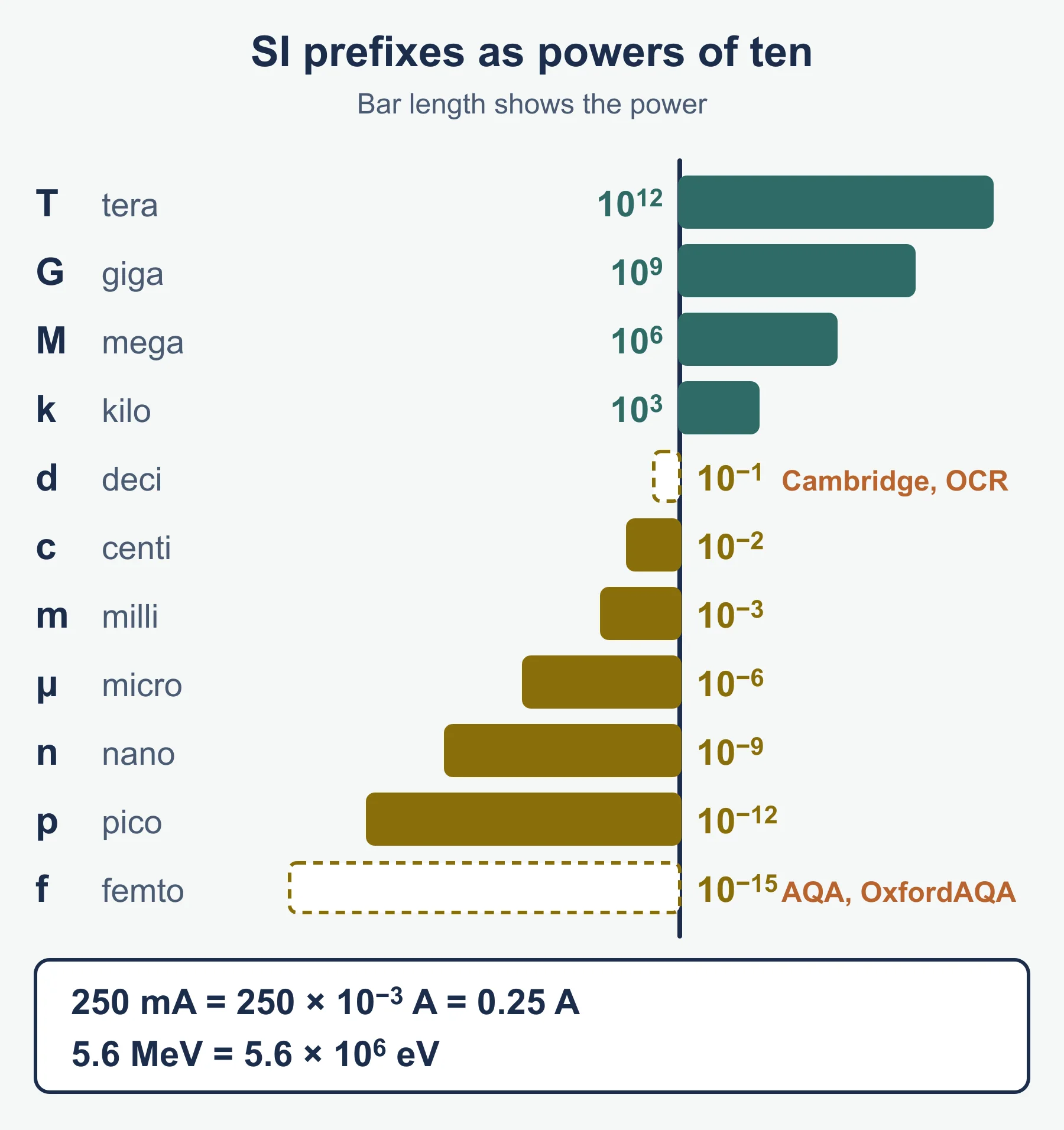
| 3.1.1 | Know the ten listed prefixes (T, G, M, k, c, m, μ, n, p, f), their values, and standard form |
| 3.1.1 | Convert between units of the same quantity, for example J and eV, J and kW h |
| 3.1.3 | Use orders of magnitude and estimate approximate values of physical quantities |
| 3.1.3 | Combine estimates with physics knowledge to produce further derived estimates, to the nearest order of magnitude |
Three limits are stated in the specification. The candela (the unit of light intensity) is excluded. Formal definitions of the fundamental quantities are not needed, and dimensional analysis is not part of the requirement.
Base units
| Base quantity | Unit name | Symbol |
|---|---|---|
| mass | kilogram | kg |
| length | metre | m |
| time | second | s |
| amount of substance | mole | mol |
| temperature | kelvin | K |
| electric current | ampere | A |
Points to hold on to:
- The kilogram is the base unit, not the gram. Any mass in grams must be divided by 1000 before it goes into an equation that expects SI units.
- A temperature written in °C is not in the base unit, which is the kelvin.
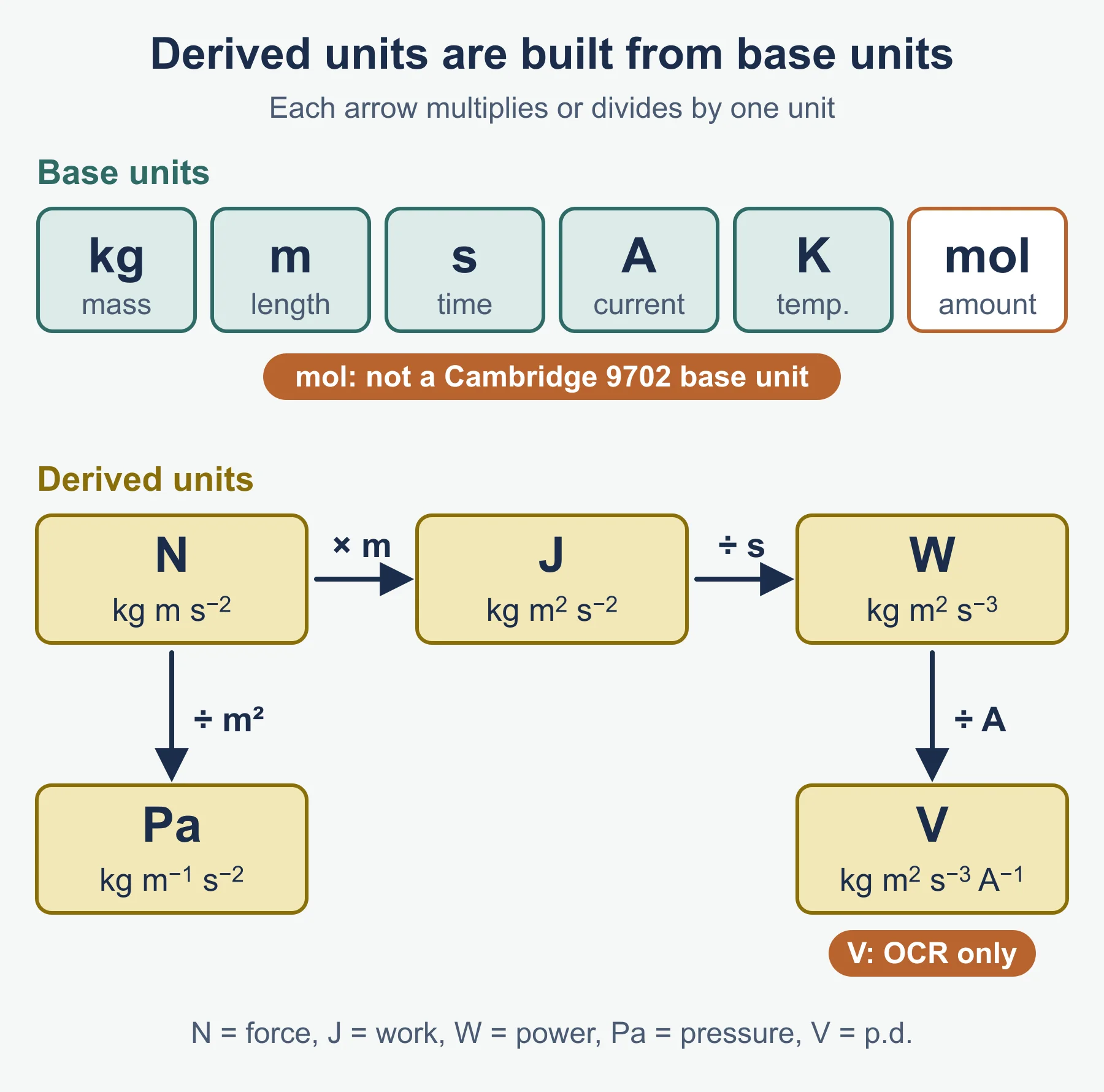
- The newton, joule, watt, coulomb and volt are all derived units. None of them is a base unit.
Derived units
A derived unit is a combination of base units, usually given its own name. The name is shorthand for the base-unit combination.
| Quantity | Named unit | In base units |
|---|---|---|
| force | newton, N | kg m s⁻² |
| energy | joule, J | kg m² s⁻² |
| power | watt, W | kg m² s⁻³ |
| pressure | pascal, Pa | kg m⁻¹ s⁻² |
| charge | coulomb, C | A s |
| frequency | hertz, Hz | s⁻¹ |
Method to get a derived unit in steps:
- Write the defining equation, for example pressure = force ÷ area.
- Substitute the unit of each quantity on the right.
- Combine the powers: N ÷ m² = kg m s⁻² ÷ m² = kg m⁻¹ s⁻².
You do not need to do dimensional analysis, which means testing an equation by comparing the units on both sides. You do need to know that every derived unit can be traced back to base units, and to write a unit with negative indices when asked, for example m s⁻¹ rather than m/s.
Prefixes and standard form
| Prefix | Symbol | Factor | Standard form |
|---|---|---|---|
| tera | T | 1 000 000 000 000 | 10¹² |
| giga | G | 1 000 000 000 | 10⁹ |
| mega | M | 1 000 000 | 10⁶ |
| kilo | k | 1000 | 10³ |
| centi | c | 0.01 | 10⁻² |
| milli | m | 0.001 | 10⁻³ |
| micro | μ | 0.000 001 | 10⁻⁶ |
| nano | n | 0.000 000 001 | 10⁻⁹ |
| pico | p | 10⁻¹² | 10⁻¹² |
| femto | f | 10⁻¹⁵ | 10⁻¹⁵ |
Standard form is a multiplier at least 1 and below 10, times a power of ten. The power is the number of places the decimal point has moved.
Reminders that keep marks
- Moving from a prefixed value to the base unit: multiply by the factor. 420 nm = 420 × 10⁻⁹ m = 4.2 × 10⁻⁷ m. A frequency of 2.4 GHz is 2.4 × 10⁹ Hz.
- Moving the other way: divide by the factor. 18 × 10⁻¹² m is 18 pm, which is 1.8 × 10⁻¹¹ m in standard form.
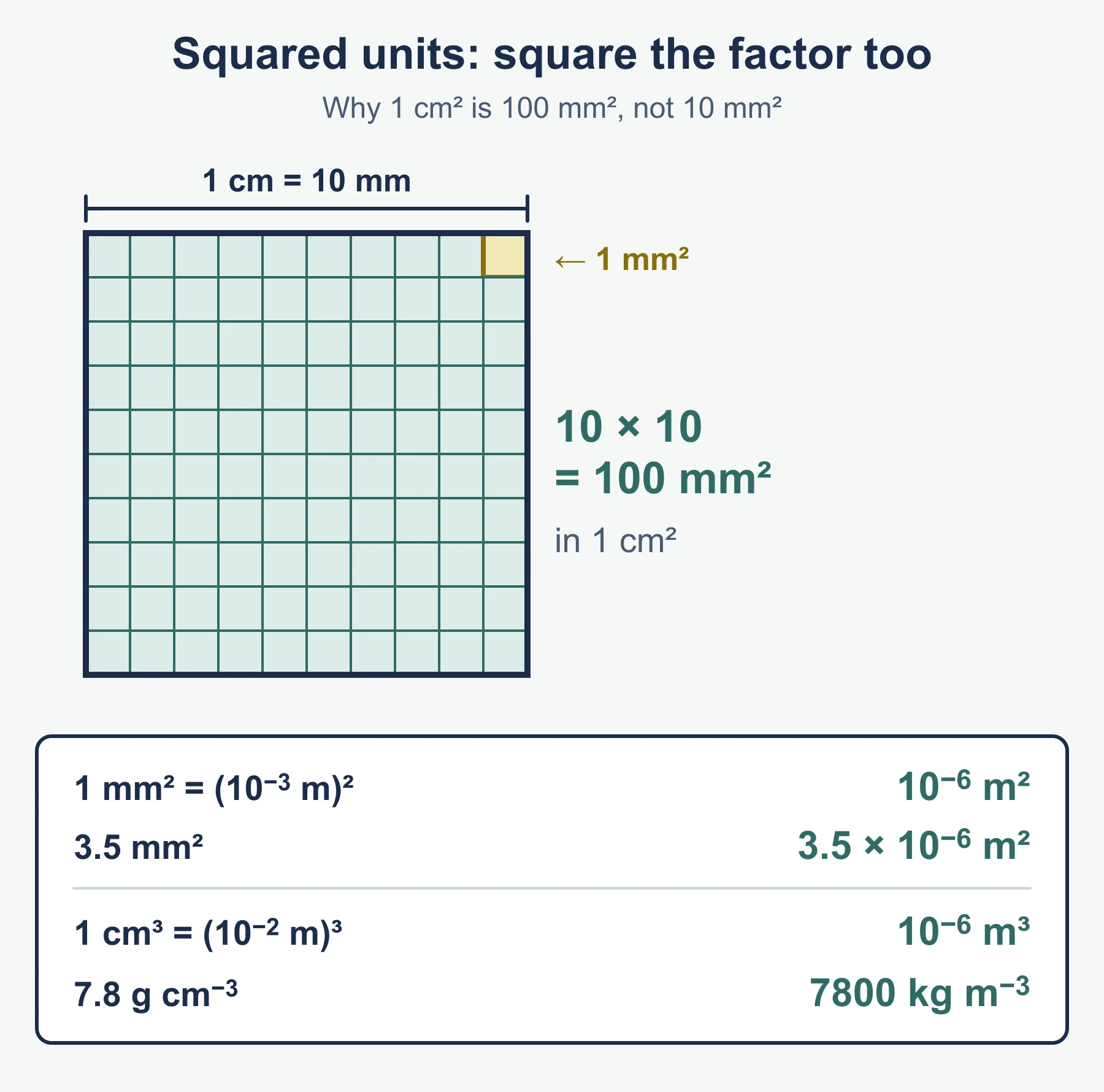
- The prefix applies to the whole unit, including any power. 1 cm² is (10⁻² m)² = 10⁻⁴ m², not 10⁻² m². So 8.5 cm² = 8.5 × 10⁻⁴ m².
- Volumes follow the same rule: 1 cm³ = 10⁻⁶ m³.
- Capital and lower-case letters matter. M is mega (10⁶) and m is milli (10⁻³). A mistake here is a factor of 10⁹.
Converting between units of the same quantity
Both conversions named in the specification are energy conversions. Each one needs one conversion factor.
| Conversion | Factor | Where it comes from |
|---|---|---|
| eV to J | multiply by 1.6 × 10⁻¹⁹ | the energy gained by one electron through 1 V |
| J to eV | divide by 1.6 × 10⁻¹⁹ | the same factor, used in reverse |
| kW h to J | multiply by 3.6 × 10⁶ | 1000 W × 3600 s |
| J to kW h | divide by 3.6 × 10⁶ | the same factor, used in reverse |
Sense check: the joule is much larger than the electronvolt, so converting J to eV gives a much larger number. The kilowatt-hour is much larger than the joule, so converting kW h to J also gives a much larger number.
Worked reminder 1 (eV with a prefix):
particle energy = 2.5 MeV = 2.5 × 10⁶ eV
in J = 2.5 × 10⁶ × 1.6 × 10⁻¹⁹ = 4.0 × 10⁻¹³ J
Worked reminder 2 (J to eV):
energy = 1.28 × 10⁻¹⁷ J
in eV = 1.28 × 10⁻¹⁷ ÷ 1.6 × 10⁻¹⁹ = 80 eV
Worked reminder 3 (J to kW h):
energy = 9.0 × 10⁶ J
in kW h = 9.0 × 10⁶ ÷ 3.6 × 10⁶ = 2.5 kW h
Worked reminder 4 (power × time to J):
2.0 kW heater, 45 minutes = 0.75 h
energy = 2.0 × 0.75 = 1.5 kW h
in J = 1.5 × 3.6 × 10⁶ = 5.4 × 10⁶ J
If a question supplies a conversion factor, use the value it gives.
Orders of magnitude
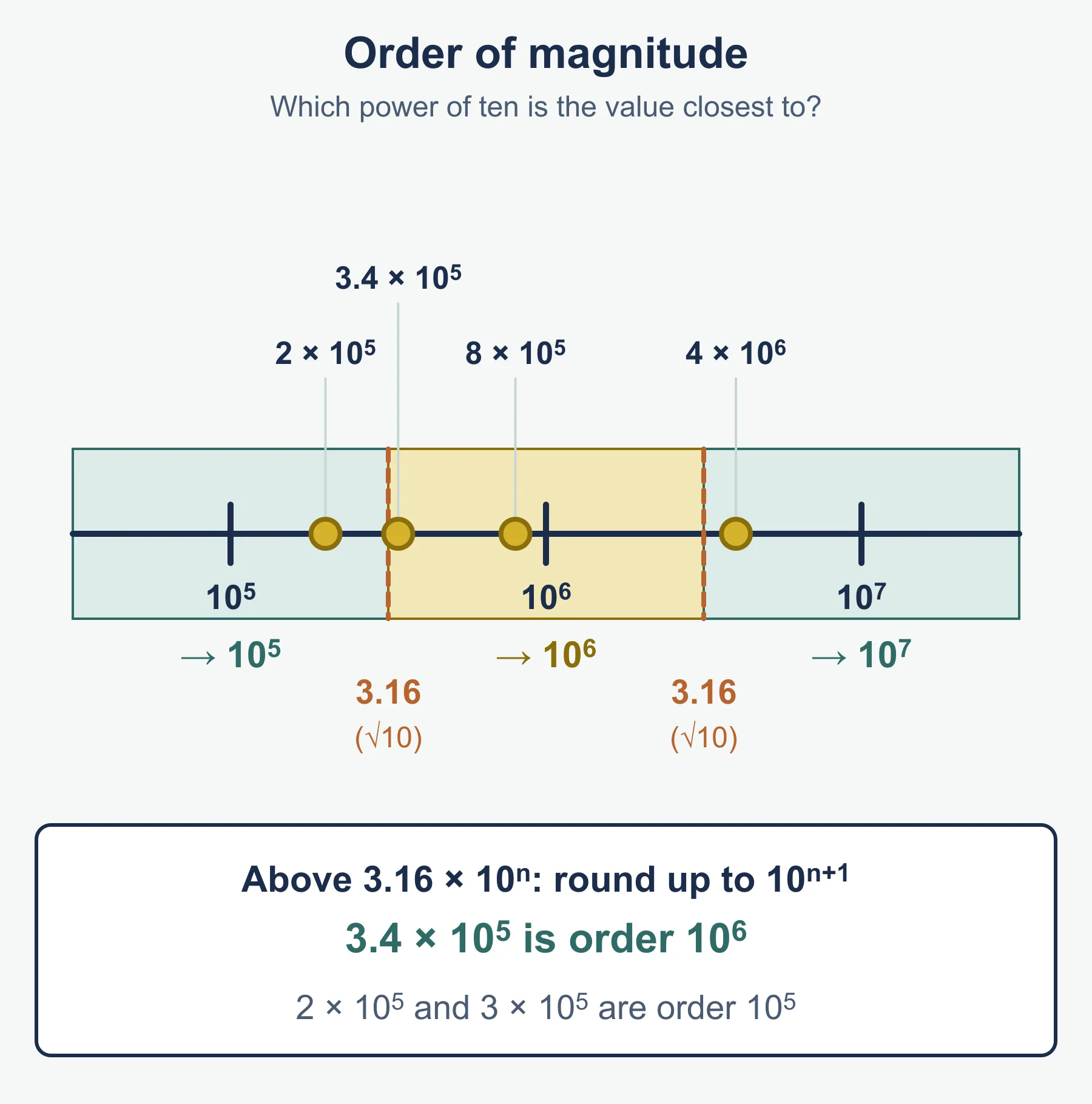
The order of magnitude of a quantity is the power of ten nearest to it, judged by ratio. A value written as a × 10ⁿ with 1 ≤ a < 10 has order of magnitude 10ⁿ if a is below about 3.16 (the square root of 10) and 10ⁿ⁺¹ if a is above it. This is a common rounding convention, not a rule printed in the specification.
| Value | Order of magnitude |
|---|---|
| 2.9 × 10⁴ | 10⁴ |
| 3.3 × 10⁴ | 10⁵ |
| 6.4 × 10⁶ | 10⁷ |
| 4 × 10⁻³ | 10⁻² |
Two numbers can share an order of magnitude even if they differ by a factor of three, and two close numbers can lie either side of the boundary.
Reference values to the nearest order of magnitude
These are rounded anchors for estimates, not measured results.
| Quantity | Approximate value | Order of magnitude |
|---|---|---|
| mass of an adult | 70 kg | 10² kg |
| walking speed | 1.4 m s⁻¹ | 10⁰ m s⁻¹ |
| speed of sound in air | 340 m s⁻¹ | 10³ m s⁻¹ |
| speed of light in a vacuum | 3 × 10⁸ m s⁻¹ | 10⁸ m s⁻¹ |
| wavelength of visible light | 5 × 10⁻⁷ m | 10⁻⁶ m |
| diameter of an atom | 10⁻¹⁰ m | 10⁻¹⁰ m |
| mass of an electron | 9.1 × 10⁻³¹ kg | 10⁻³⁰ kg |
| radius of the Earth | 6.4 × 10⁶ m | 10⁷ m |
| density of water | 10³ kg m⁻³ | 10³ kg m⁻³ |
| seconds in a year | 3.15 × 10⁷ s | 10⁷ s |
Method for a derived estimate
- Split the quantity into parts you can estimate: sizes, rates, masses, times.
- Write each estimate in standard form and say what you assumed.
- Convert every part to consistent SI units before combining.
- Combine using the physics: multiply for a total, divide for a count that fits into a space.
- Round the result to the nearest order of magnitude using the 3.16 boundary.
- Check that the answer is sensible.
Worked reminder 5 (kinetic energy):
sprinter: m ≈ 80 kg, v ≈ 10 m s⁻¹
Ek = ½mv² = 0.5 × 80 × 10² = 4000 J = 4 × 10³ J
4 is above 3.16, so order of magnitude = 10⁴ J
Worked reminder 6 (a count by division):
hair width ≈ 7 × 10⁻⁵ m, atom diameter ≈ 1 × 10⁻¹⁰ m
atoms across = 7 × 10⁻⁵ ÷ 1 × 10⁻¹⁰ = 7 × 10⁵  → 10⁶
Worked reminder 7 (a rate multiplied by time):
15 breaths per minute × 60 min × 24 h = 21 600 breaths per day
21 600 = 2.16 × 10⁴, which is below 3.16, so order of magnitude = 10⁴
volume per breath ≈ 5 × 10⁻⁴ m³ → 21 600 × 5 × 10⁻⁴ = 10.8 m³ → 10¹ m³
The result depends on your assumptions. If the atom diameter in reminder 6 were 3 × 10⁻¹⁰ m, the count would be 2.3 × 10⁵ and the order of magnitude would drop to 10⁵. State your assumptions.
Worked reminder 8 (using an estimate as a check):
A student finds the energy a 2 kW kettle uses in 3 minutes as 3.6 × 10⁸ J.
estimate: 2000 W × 180 s = 3.6 × 10⁵ J
The student's value is 10³ times too large; a prefix or a time conversion has slipped.
Must-know distinctions
- Base unit and derived unit: kg, m, s, mol, K, A are base units. N, J, W, Pa, C, Hz, V are derived.
- Prefix on a squared or cubed unit: the power applies to the prefix as well as the unit.
- Order of magnitude and one significant figure: 8 × 10⁵ has one significant figure but its order of magnitude is 10⁶, not 10⁵.
Quick self-test
- State the SI base unit, with its symbol, for amount of substance.
- Which base quantity is excluded from the specification?
- Write 0.000 000 033 m using a prefix.
- Write 4.7 pF in farads, in standard form.
- Write 1.8 GHz in hertz, in standard form.
- Write 560 μs in seconds, in standard form.
- A particle has energy 3.0 MeV. Give this in joules.
- Convert 7.2 × 10⁶ J into kW h.
- State the order of magnitude of 2.9 × 10⁴ and of 3.3 × 10⁴.
- A walk of 5000 m uses a stride of 0.7 m. Estimate the number of strides to the nearest order of magnitude.
- A sample has volume 25 cm³. Give this in m³.
Answers
- The mole, mol.
- Luminous intensity, whose unit is the candela.
- 33 nm.
- 4.7 × 10⁻¹² F.
- 1.8 × 10⁹ Hz.
- 5.6 × 10⁻⁴ s.
- 3.0 × 10⁶ × 1.6 × 10⁻¹⁹ = 4.8 × 10⁻¹³ J.
- 7.2 × 10⁶ ÷ 3.6 × 10⁶ = 2.0 kW h.
- 2.9 × 10⁴ is order 10⁴, and 3.3 × 10⁴ is order 10⁵, because 3.3 is above 3.16.
- 5000 ÷ 0.7 ≈ 7100, which is 7.1 × 10³, so the order of magnitude is 10⁴ strides.
- 25 × 10⁻⁶ = 2.5 × 10⁻⁵ m³.
Where marks are usually lost
- Putting a value in grams, millimetres or milliamperes into an equation without converting first.
- Confusing M (mega) with m (milli), or μ with m, which gives errors of 10⁹ or 10³.
- Applying a prefix factor once to a squared or cubed unit, such as converting cm² by 10⁻² instead of 10⁻⁴.
- Multiplying when the conversion needs division, for example turning J into eV by multiplying.
- Rounding an order of magnitude by looking at the digit only, so that 3.4 × 10⁵ is given as 10⁵.
- Giving an estimate to several significant figures where the question asks for the nearest order of magnitude.
- Leaving out the assumptions behind an estimate, so a wrong power of ten shows no method.
Next step: try the practice sets for SI units and estimation.
Frequently asked questions
What are the SI base units in AQA A-level Physics? The six base units are the kilogram (mass), metre (length), second (time), mole (amount of substance), kelvin (temperature) and ampere (electric current). The candela is excluded from the AQA 7408 specification.
How do you convert electronvolts to joules? Multiply by 1.6 × 10⁻¹⁹ to convert eV to J, and divide by the same factor to convert J to eV. Because the joule is much larger, converting J to eV gives a much larger number.
How do you convert kilowatt-hours to joules? Multiply by 3.6 × 10⁶, since 1 kW h is 1000 W for 3600 s. Divide by 3.6 × 10⁶ to convert joules back to kilowatt-hours.
How do you convert cm² to m²? The prefix applies to the whole unit, including its power, so 1 cm² = (10⁻² m)² = 10⁻⁴ m². Similarly 1 cm³ = 10⁻⁶ m³.
Official syllabus
AQA, AS and A-level Physics (7407 and 7408), specification for first teaching in 2015: sections 3.1.1 Use of SI units and their prefixes and 3.1.3 Estimation of physical quantities.
Get free revision emails (optional)
Occasional emails with practice questions, worked explanations and links to free resources for the qualification and subjects you choose. No spam, and you can unsubscribe from any email. The free tools on this site never need an email.
Related resources
-
Study guides
Limitation of Physical Measurements
Random and systematic errors, precision and accuracy, and the treatment of uncertainty, for sub-topic 3.1.2 of AQA A-level Physics (7408).
Physics · AQA · A Level
Read guide -
Study guides
Use of SI Units and Their Prefixes
Fundamental (base) SI units, derived units, and standard-form prefixes, for sub-topic 3.1.1 of AQA A-level Physics (7408).
Physics · AQA · A Level
Read guide -
Practice questions
AQA A-Level Physics: Use of SI Units and Their Prefixes — Practice Questions
Original practice questions with worked answers on SI base and derived units, prefixes, standard form and unit conversions for sub-topic 3.1.1 of AQA 7408.
Physics · AQA · A Level
Try questions
Related articles
-
study skills
How to revise for a science examination
Most science revision fails because it rereads notes instead of retrieving them. A practical method for revising physics, chemistry and biology in the weeks before a paper.
14 July 2026
-
teaching
A Level tuition in Dubai: Cambridge or Pearson Edexcel International A Level?
Schools in Dubai and Abu Dhabi teach either Cambridge International AS & A Level or Pearson Edexcel International A Level. How the two are structured, why it matters for tuition, and how online classes from Lahore work.
9 October 2026
Studying this with a teacher
Working through Physics A LEVELS?
This page is free and stays free. If you would rather be taught it, Marlbridge runs Physics classes one-to-one and in small groups of up to 15, online in your own time zone. The first trial class is free. WhatsApp replies within an hour (8am–11pm Pakistan time, every day); email the same day.
AQA Physics teachers at Marlbridge

