
Study Guides
AQA GCSE Business: The purpose and nature of businesses and Business ownership (8132)
Study guide to why businesses exist, enterprise, entrepreneurs and the five forms of ownership, with worked examples, for AQA GCSE Business 8132.
- Subject
- Business
- Level
- GCSE
- Topic
- Business in the real world
- Author
- Marlbridge Academic Team
- Updated
- Reviewed by
- Salman Ahmad (what this means)
Aligned to AQA GCSE Business (8132), For first teaching from September 2017. Official specification .
Syllabus page (what it covers and how it is assessed): AQA GCSE Business.
Syllabus points this page covers
8132
- 3.1.1 The purpose and nature of businesses
- 3.1.2 Business ownership
Found an error? Report a correction.
Need help with this topic? Request a free trial class for GCSE Business (8132).
This guide is aligned to the AQA GCSE Business (8132) specification, for first teaching from September 2017. It covers sections 3.1.1 (The purpose and nature of businesses) and 3.1.2 (Business ownership) of Business in the real world. The specification lists Business in the real world as assessed on both Paper 1 and Paper 2, so this material can be used in either. For a short overview of the whole topic, see the Business in the real world study guide. This guide goes deeper on the two sections above and adds worked examples.
Quick links: AQA GCSE Business hub, printable checklist, revision notes for this unit, practice questions for this unit, earlier topic revision notes, earlier topic practice and the free diagnostics.
What this unit covers
| Spec section | What you must be able to do |
|---|---|
| 3.1.1 | Explain what a business is and why people start one |
| 3.1.1 | Distinguish goods from services, and needs from wants |
| 3.1.1 | Explain the factors of production (land, labour, capital, enterprise) |
| 3.1.1 | Define opportunity cost |
| 3.1.1 | Define the primary, secondary and tertiary sectors, with examples |
| 3.1.1 | Explain enterprise and entrepreneur; outline characteristics and objectives of an entrepreneur |
| 3.1.1 | Explain why the business environment keeps changing |
| 3.1.2 | Explain sole traders, partnerships, private limited companies (ltd), public limited companies (plc) and not-for-profit organisations |
| 3.1.2 | Analyse benefits and drawbacks of each, and understand limited liability |
| 3.1.2 | Evaluate which structure suits a given business |
The specification also asks you to be aware of how business in the real world affects the four functional areas: business operations, human resources, marketing and finance. A choice about ownership, for example, changes the finance available, and a change in technology affects operations.
3.1.1 The purpose and nature of businesses
What a business is and why people start one
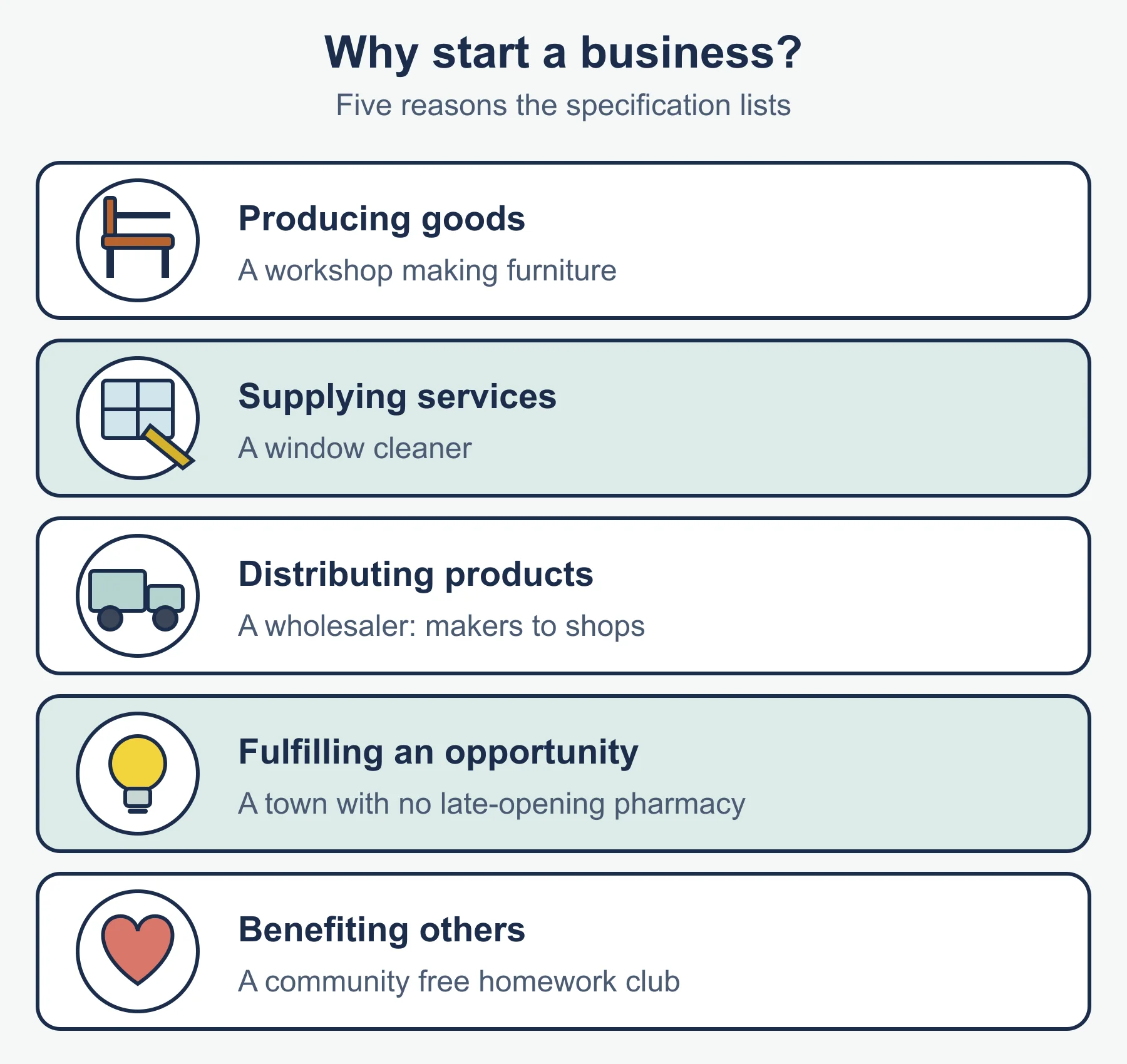
A business is an organisation that uses resources to produce goods or services that customers want. The specification lists these reasons for starting one:
- producing goods, such as a workshop that makes furniture
- supplying services, such as a window cleaner
- distributing products, such as a wholesaler that moves goods from makers to shops
- fulfilling a business opportunity, such as spotting a town with no late-opening pharmacy
- providing a good or service to benefit others, such as a community project that offers free homework clubs
Match the reason to the evidence in the case study. “She noticed nobody sold gluten-free pastries nearby” points to a business opportunity, not simply to making goods.
Goods, services, needs and wants
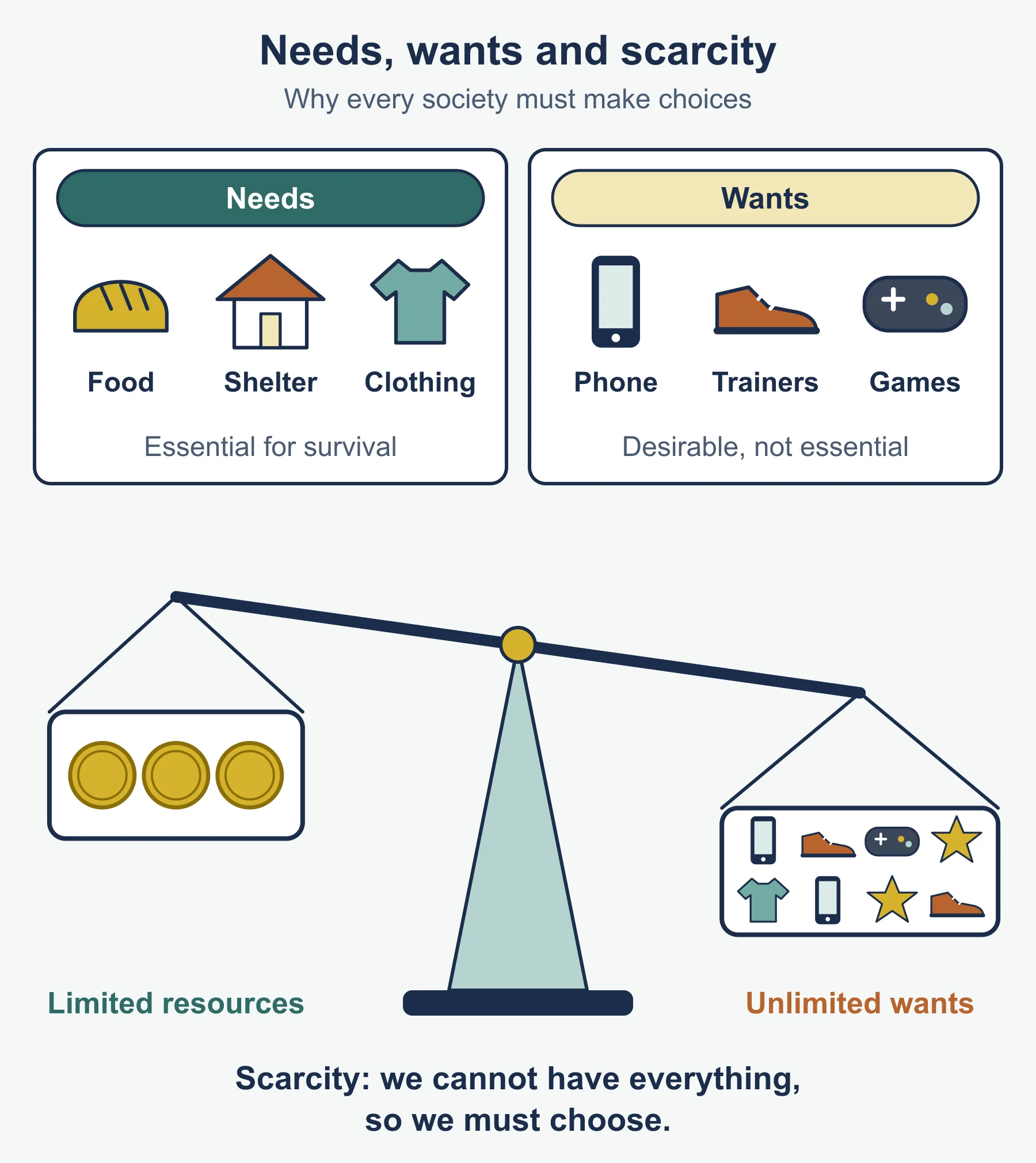
Goods are physical items you can touch, such as bicycles. Services are activities done for you, such as repairs. Many businesses sell both: a cycle shop sells bikes (goods) and fits them (service).
Needs are things people must have to live, such as food, water, shelter and clothing. Wants are things people would like but could live without, such as a new phone. The same item can sit on either side: a first winter coat is a need, a fifth designer coat is a want.
Factors of production
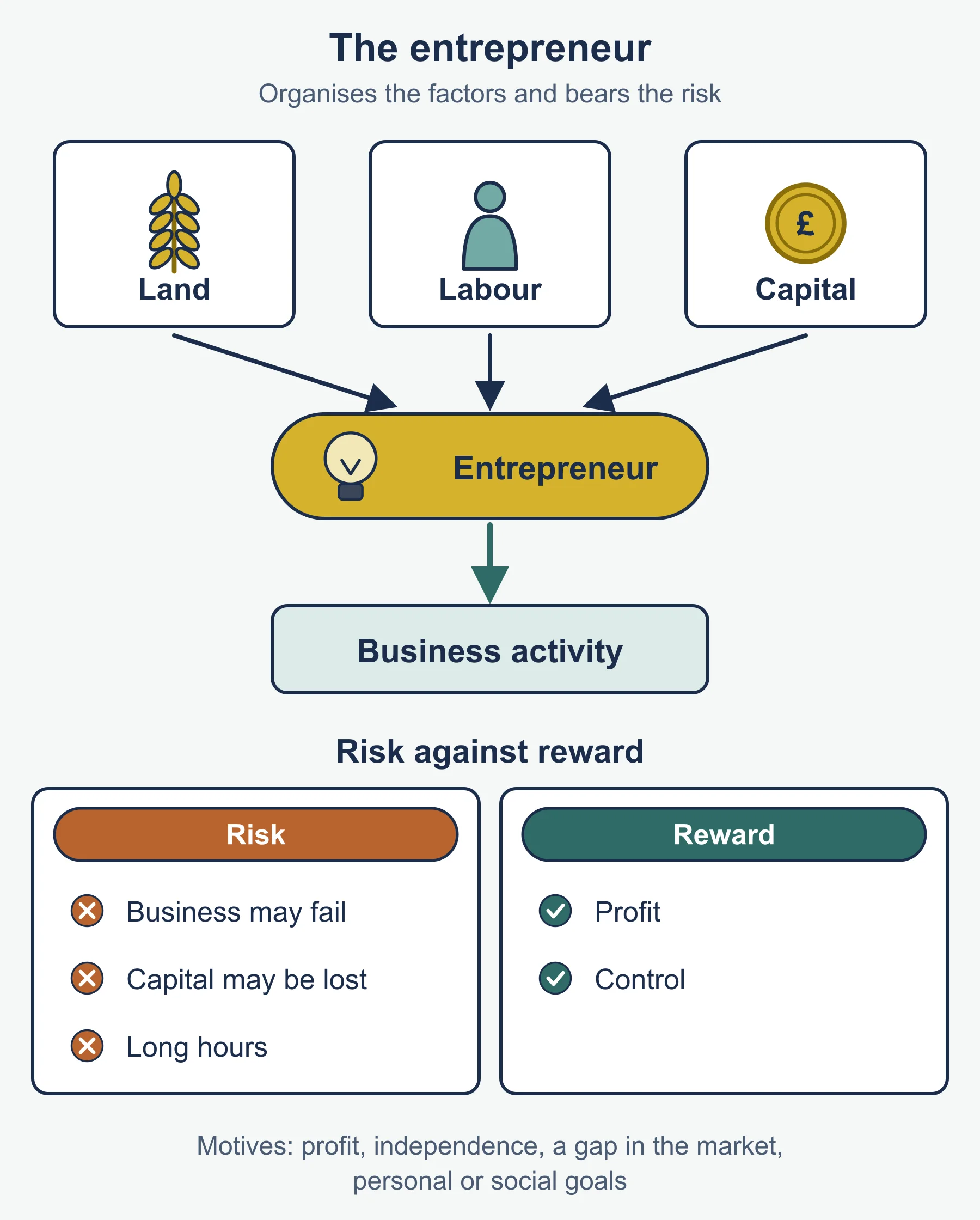
Businesses combine four resources to make products.
| Factor | Meaning | Example for a bakery |
|---|---|---|
| Land | Natural resources and the site used | The plot the shop stands on, flour grown by farmers |
| Labour | The people who work | Bakers, shop assistants |
| Capital | Man-made resources used to produce | Ovens, mixers, delivery van |
| Enterprise | Organising the other factors and taking the risk | The owner who sets it up |
Capital here means machinery and vehicles, not start-up money.
Opportunity cost
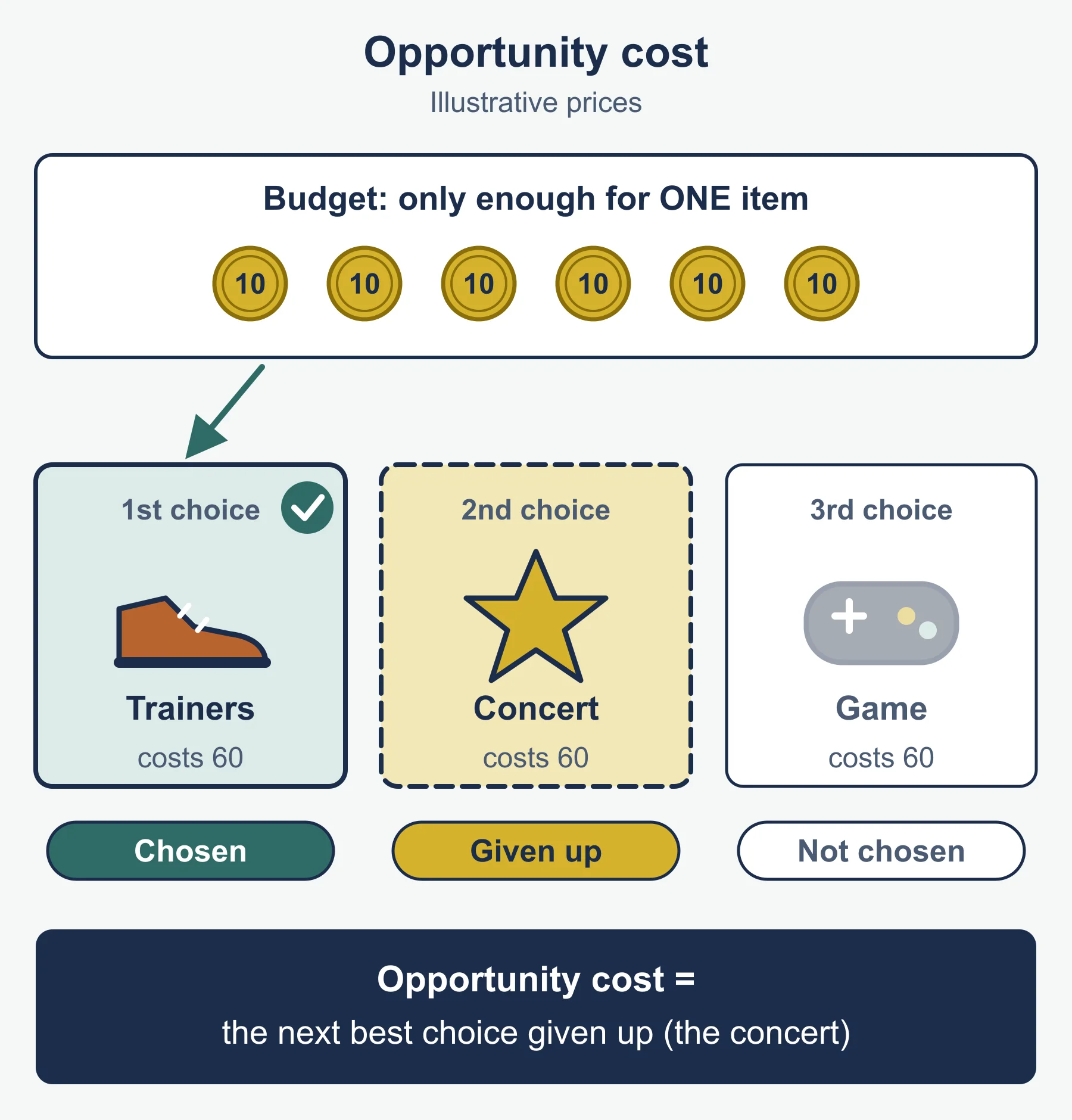
Opportunity cost is the next best alternative given up when you make a choice. Resources are limited, so using them one way means not using them another way.
Worked example. Wrenna runs Harbrook Pottery and has one kiln session on Saturday. She can fire 40 mugs, each making £6 profit, or 12 planters, each making £25 profit. Or she could work a café shift for £90.
- Profit from mugs: 40 × £6 = £240.
- Profit from planters: 12 × £25 = £300.
- Wage from the café: £90.
- She chooses planters because £300 is the highest.
- The next best alternative is mugs at £240, so the opportunity cost of choosing planters is £240, not £90 and not £300.
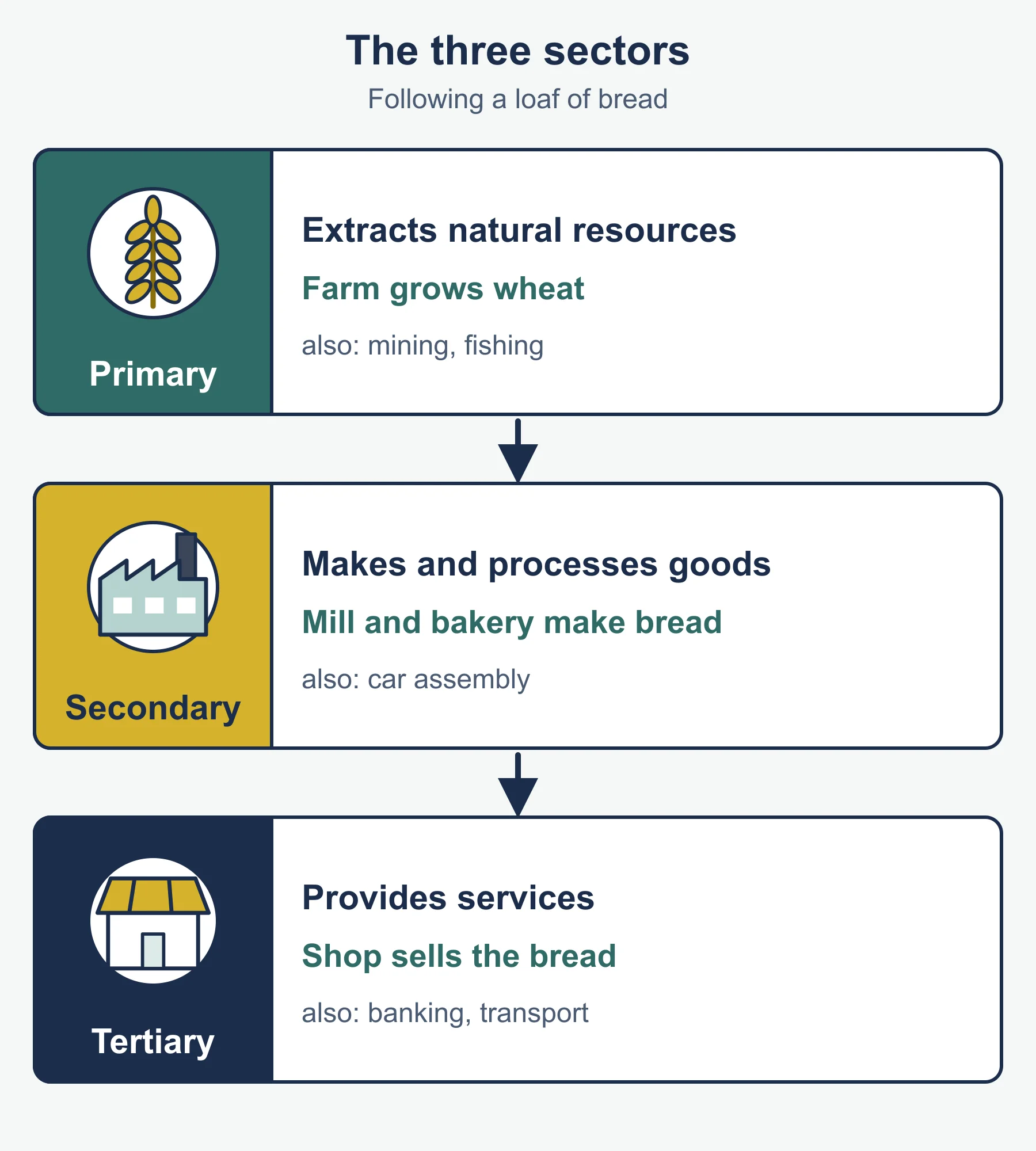
The three sectors
| Sector | What happens | Examples |
|---|---|---|
| Primary | Extracting or growing natural resources | Farming, fishing, mining, forestry |
| Secondary | Making or building products from raw materials | Car manufacturing, construction, food processing |
| Tertiary | Providing services | Retail, banking, teaching, hairdressing |
Classify by what the activity is. A farm shop that grows and sells vegetables does primary work (growing) and tertiary work (selling).
Enterprise and entrepreneurs
Enterprise is the process of spotting a business opportunity, taking a risk and organising resources to exploit it. An entrepreneur is the person who does this.
The specification outlines these characteristics: hard working, innovative, organised and willing to take a risk. Develop each one in an answer. For instance, “willing to take a risk” matters because the entrepreneur may lose savings if sales are poor.
It also outlines the objectives that drive entrepreneurs:
- to be their own boss
- to have flexible working hours
- to pursue an interest
- to earn more money
- to identify a gap in the market
- dissatisfaction with a current job
Link the objective to the person described. A parent working around school hours wants flexible hours; someone who left after being passed over for promotion shows dissatisfaction with a current job.
A dynamic environment
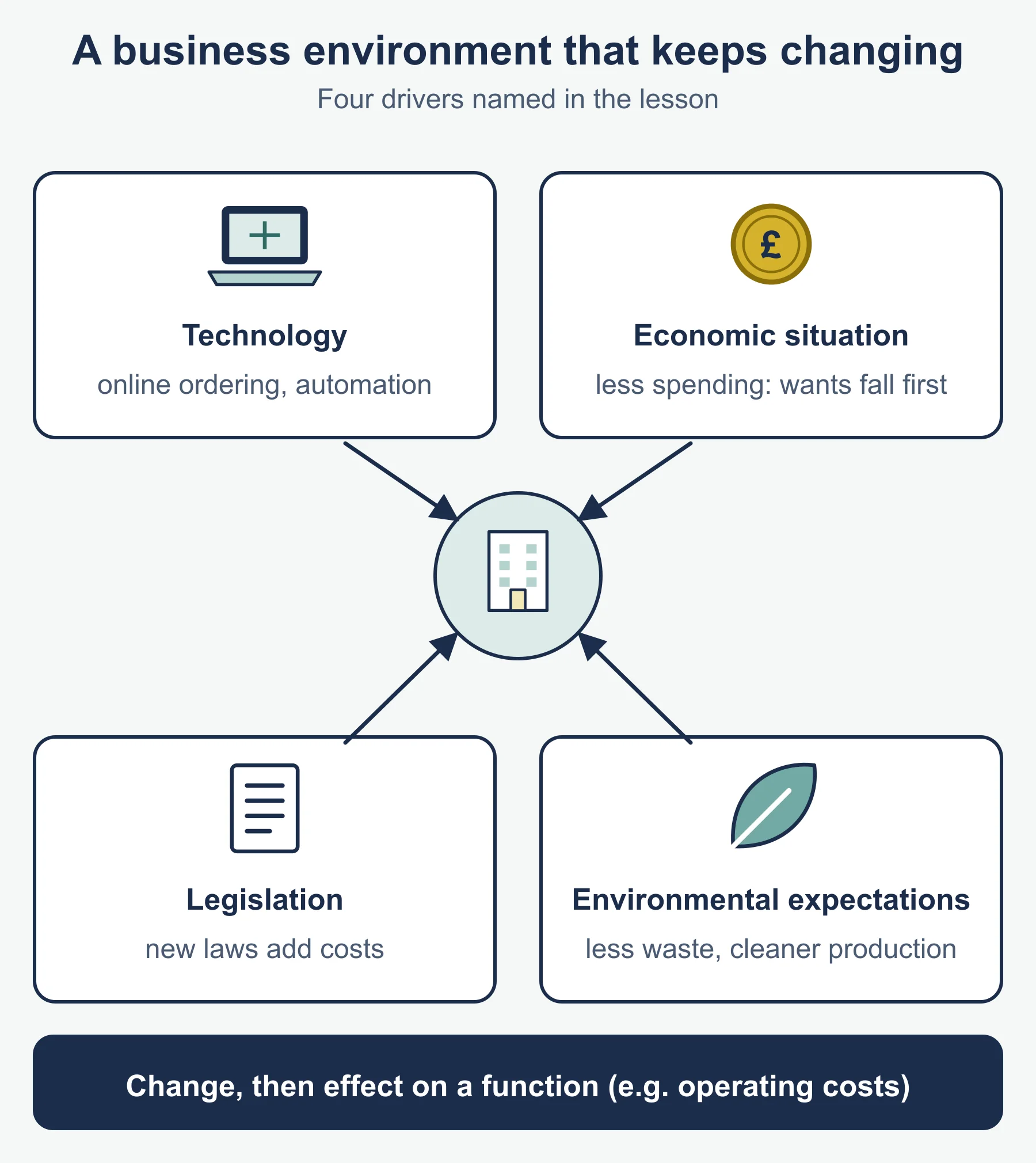
Businesses face a constantly changing environment. The specification names four drivers.
- Technology: online ordering and automation change how firms sell and produce.
- Economic situation: when households have less to spend, demand for wants falls first.
- Legislation: new laws can add costs or force changes to how a firm trades.
- Environmental expectations: customers and communities expect lower waste and cleaner production.
A good answer states the change, then its effect on a function, such as packaging expectations raising a bakery’s operating costs.
3.1.2 Business ownership
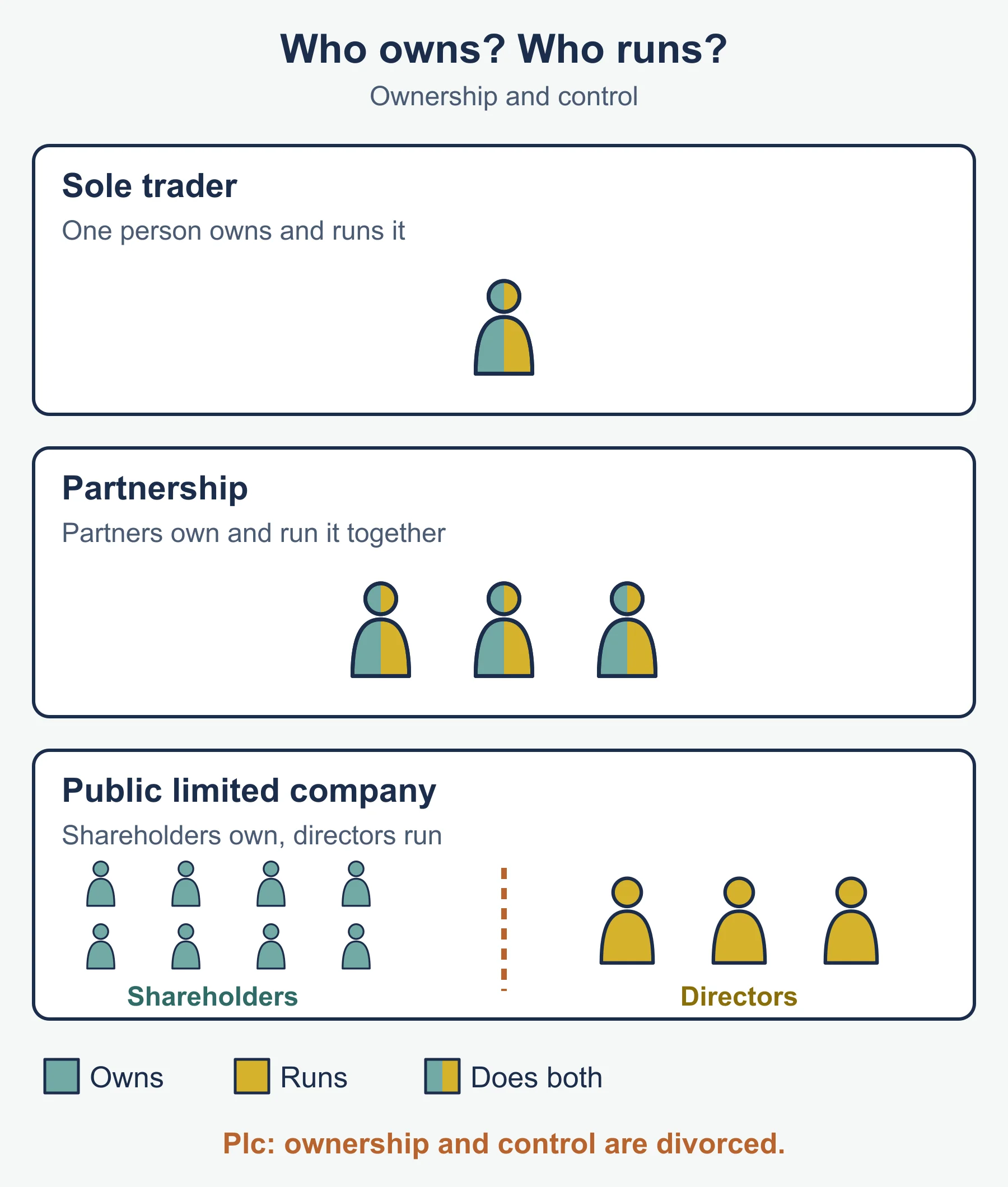
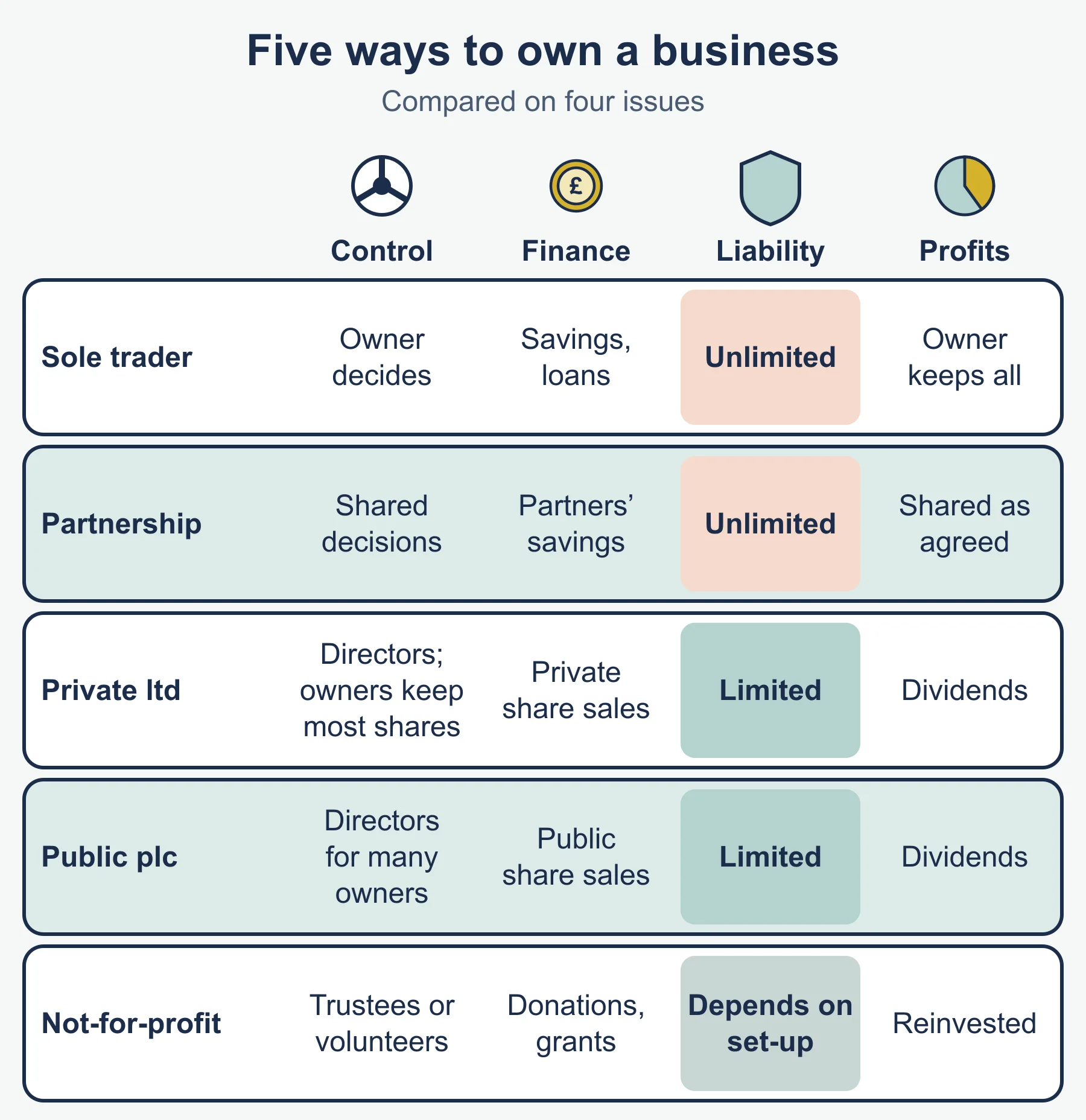
Ownership means the legal structure a business adopts. The specification expects you to understand the structures and compare them on four issues: management and control, sources of finance, liability and distribution of profits. You are not expected to know the legal process of incorporation.
Limited and unlimited liability
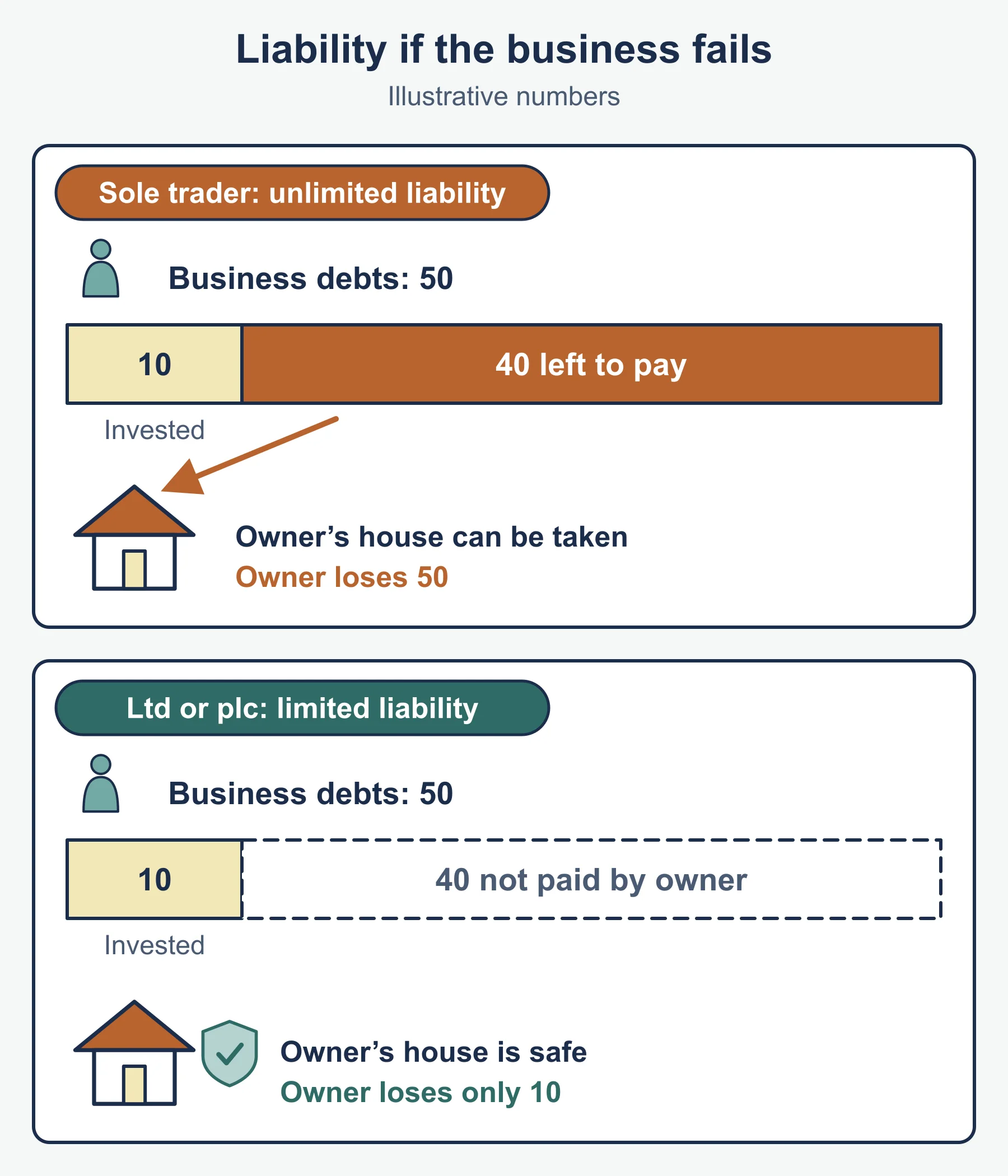
Liability is responsibility for a business’s debts. With unlimited liability the owner is personally responsible, so creditors can claim from personal assets such as savings or a house. With limited liability an owner can lose only the money they put in. Sole traders and partnerships have unlimited liability. Private limited companies and public limited companies have limited liability, because the company is treated as separate from its owners.
Worked example. Northcrake Bikes fails owing suppliers and the bank £64,000. Selling its stock and equipment raises £25,000.
- Shortfall: £64,000 − £25,000 = £39,000.
- If Northcrake were a sole trader, the owner is personally liable for the £39,000, so personal assets could be used.
- If it were a private limited company and a shareholder had invested £15,000, that shareholder loses the £15,000 invested but is not asked to pay the £39,000 from personal savings.
Sole traders
One person owns the business, although they can employ staff.
- Management and control: the owner decides everything and can act quickly.
- Finance: mainly the owner’s savings, profit kept back and bank loans, so capital is limited.
- Liability: unlimited.
- Profits: the owner keeps all of them.
- Drawbacks: all the risk, and no one to share skills or cover absence.
Partnerships
Two or more people own the business together.
- Management and control: decisions are shared, so more skills, but disagreements are possible.
- Finance: more owners means more capital than one person could raise.
- Liability: unlimited for the partners.
- Profits: shared in the way the partners agree, so each gets less than a sole trader would.
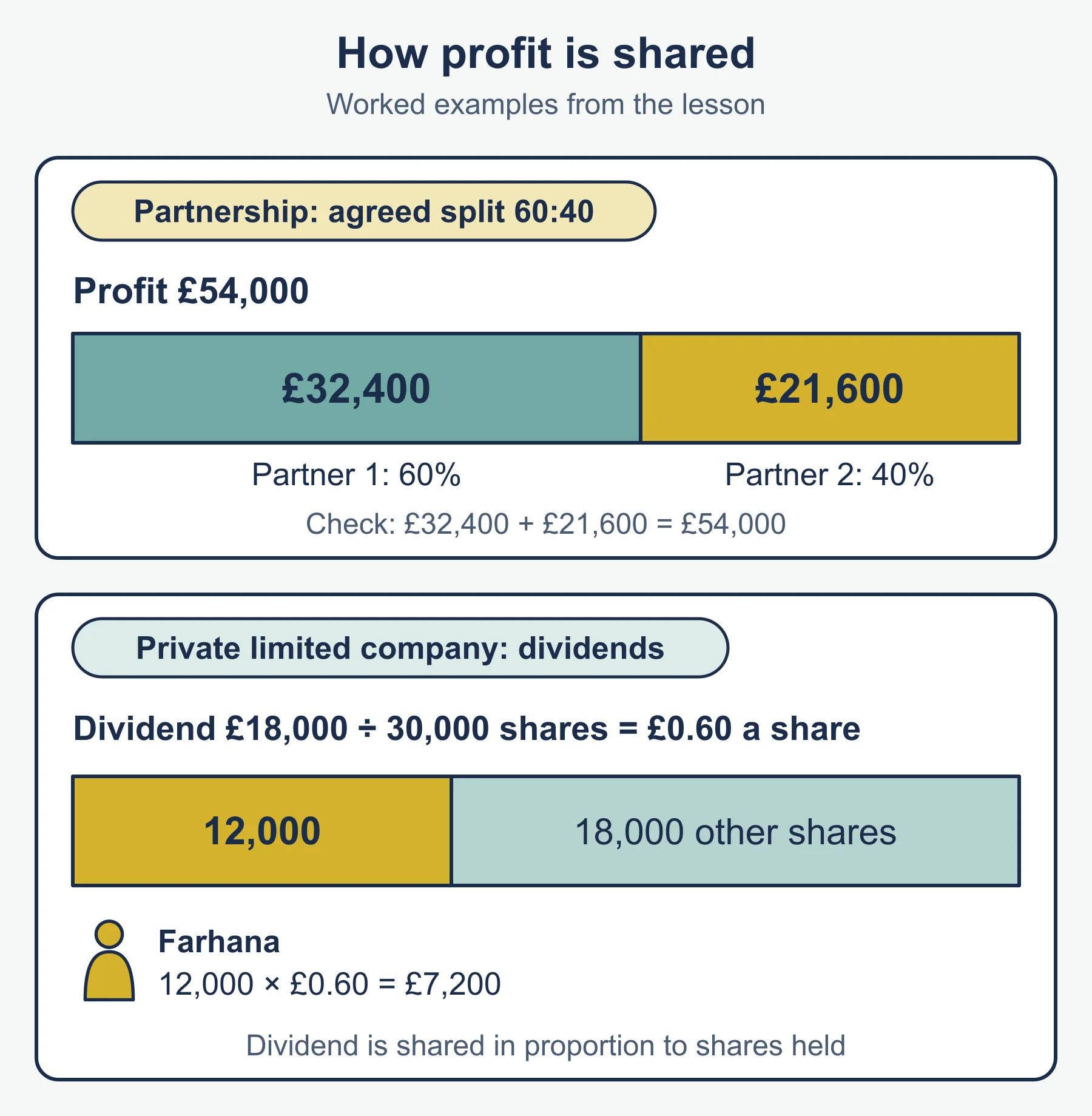
Worked example. Marwen Bakery has two partners who agree to share profit 60:40. Profit is £54,000.
- First partner: 0.6 × £54,000 = £32,400.
- Second partner: 0.4 × £54,000 = £21,600.
- Check: £32,400 + £21,600 = £54,000.
Private limited companies (ltd)
A private limited company is owned by shareholders. Shares cannot be offered to the public on the stock market; they are sold privately, often to family, friends or investors the owners choose.
- Management and control: shareholders elect directors, but the original owners can keep control by keeping most of the shares.
- Finance: shares raise more capital than a sole trader or small partnership, and banks may lend more readily.
- Liability: limited.
- Profits: shared out as dividends in proportion to shares held, with some kept back for growth.
- Drawbacks: more paperwork, and the firm’s financial information is more open to view than a sole trader’s.
Worked example. Braidwood Print Ltd decides to pay £18,000 in dividends. It has 30,000 shares.
- Dividend per share: £18,000 ÷ 30,000 = £0.60.
- Farhana owns 12,000 shares: 12,000 × £0.60 = £7,200.
Public limited companies (plc)
A plc can sell shares to the public, usually through a stock market. The word public here means anyone may buy the shares. It does not mean the state owns it: a plc is in the private sector.
- Management and control: directors run the business for many shareholders, so ownership is separated from day-to-day control. Owners can lose control if enough shares are bought by others.
- Finance: the largest amounts of capital, since many investors can buy shares; banks also see large firms as lower risk.
- Liability: limited.
- Profits: dividends paid to a very large number of shareholders, and shareholders expect returns.
- Drawbacks: costly to run, more public scrutiny, and the business can be taken over.
Not-for-profit organisations
These exist mainly to benefit a cause or community rather than to pay profit to owners. Charities and many community groups are examples. Any surplus (income left after costs) is normally put back into the work, not shared out among owners.
- Management and control: often volunteers or trustees, with decisions guided by the cause.
- Finance: donations, grants, and income from trading.
- Liability: depends on how the organisation is set up, so do not assume it; say so in an exam if the question is unclear.
- Profits: reinvested rather than distributed.
- Drawbacks: income can be uncertain, and the cause limits what the organisation may do.
Choosing a structure: an evaluation approach
The specification asks you to evaluate which structure is most appropriate for examples that include new start-ups and large established firms. Use this method.
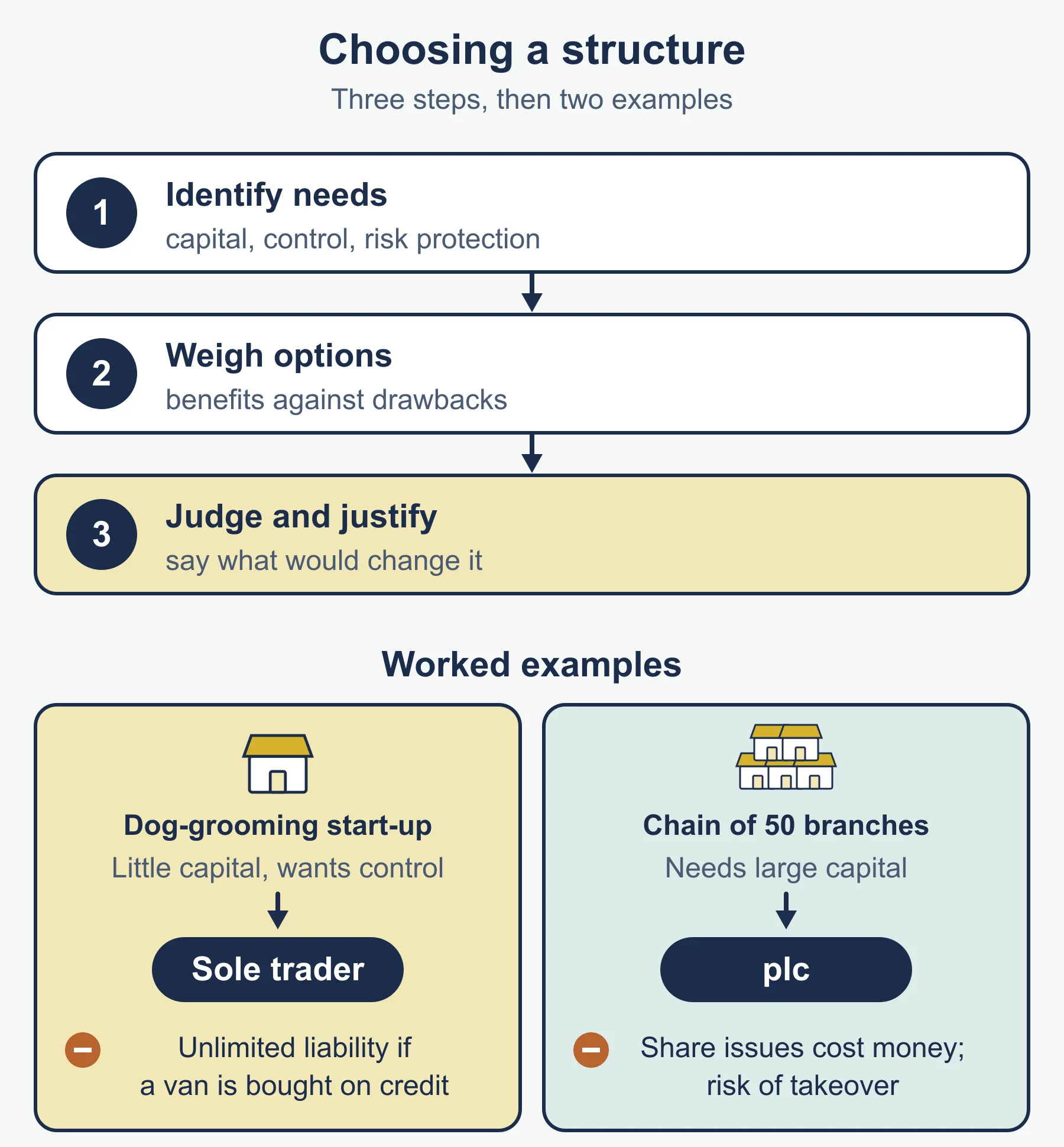
- Identify what the business needs: capital, control, protection from risk.
- Weigh each option’s benefits and drawbacks against those needs.
- Make a judgement and justify it. Say what would change your answer.
Example. A new mobile dog-grooming start-up needs little capital and its founder wants control. A sole trader may be suitable, but unlimited liability matters if she buys a costly van on credit. A large established chain that wants to open fifty branches needs large amounts of capital, which points to a plc. If the owners also want to keep control, the cost of share issues and the risk of takeover count against it.
Common errors
- Writing that limited liability means “limited debts”. The debts are the company’s; the owners’ loss is limited.
- Calling a plc a government business.
- Describing the opportunity cost as all options given up, instead of the single next best.
- Giving benefits of an ownership form with no link to the business in the scenario.
- Treating a farm or factory as tertiary because it sells things.
- Listing characteristics of an entrepreneur without saying why each helps in running a business.
Go on to the revision notes and then test yourself with the practice questions.
Frequently asked questions
What is the difference between a need and a want? A need is something people must have to live, such as food, water, shelter and clothing. A want is something people would like but could live without.
What are the characteristics of an entrepreneur in AQA GCSE Business (8132)? The specification outlines being hard working, innovative, organised and willing to take a risk. In an exam, link each characteristic to how it helps the person in the case run the business.
What causes the business environment to change? The specification names technology, the economic situation, legislation and environmental expectations. A good answer states the change and then its effect on a functional area of the business.
What happens to the profit of a not-for-profit organisation? Any surplus is reinvested in the organisation’s purpose rather than shared out among owners.
Official syllabus
AQA GCSE Business (8132) specification, for first teaching from September 2017, published by AQA. Sections 3.1.1 and 3.1.2.
Get free revision emails (optional)
Occasional emails with practice questions, worked explanations and links to free resources for the qualification and subjects you choose. No spam, and you can unsubscribe from any email. The free tools on this site never need an email.
Related resources
-
Practice questions
AQA GCSE Business: The purpose and nature of businesses and Business ownership (8132) – Practice Questions
Eleven original questions with worked answers on business purpose, enterprise and ownership structures for AQA GCSE Business (8132) 3.1.1 and 3.1.2.
Business · AQA · GCSE
Try questions -
Revision notes
AQA GCSE Business: The purpose and nature of businesses and Business ownership (8132) – Revision Notes
Condensed recall notes with tables and a self-test on business purpose, enterprise and legal structures for AQA GCSE Business (8132) 3.1.1 and 3.1.2.
Business · AQA · GCSE
Revise topic -
Practice questions
GCSE Business: Business in the Real World — Practice Questions
Original exam-style practice questions with full worked answers on business ownership, aims, stakeholders, location and growth.
Business · AQA · GCSE
Try questions
Related articles
-
teaching
A Level tuition in Dubai: Cambridge or Pearson Edexcel International A Level?
Schools in Dubai and Abu Dhabi teach either Cambridge International AS & A Level or Pearson Edexcel International A Level. How the two are structured, why it matters for tuition, and how online classes from Lahore work.
9 October 2026
-
curriculum guides
Choosing subjects at IGCSE and A Level
How subject choices at 14 and 16 affect university options later, and how to keep pathways open without overloading a timetable.
28 July 2026
Studying this with a teacher
Working through Business GCSE?
This page is free and stays free. If you would rather be taught it, Marlbridge runs Business classes one-to-one and in small groups of up to 15, online in your own time zone. The first trial class is free. WhatsApp replies within an hour (8am–11pm Pakistan time, every day); email the same day.
AQA Business teachers at Marlbridge
