
Revision Notes
Cambridge International AS & A Level Psychology (9990): Research methods – Revision Notes
Revision notes for the six 9990 AS research methods: features, evaluation, core-study examples, planning checklists, key terms, traps and a self-test.
- Subject
- Psychology
- Level
- AS LEVEL
- Topic
- Paper 2 – Research Methods
- Author
- Marlbridge Academic Team
- Updated
- Reviewed by
- Kanwal Aslam (what this means)
Aligned to Cambridge A Level Psychology (9990), 2024-2026. Official specification .
Syllabus page (what it covers and how it is assessed): Cambridge A Level Psychology.
Syllabus points this page covers
9990 (AS Level)
- Research methods
These notes condense the research methods named in section 3.1.2 of Cambridge International AS & A Level Psychology (9990), syllabus for 2024 to 2026. For each method you need features (describe), strengths and weaknesses (evaluate), and the ability to use it in a new scenario (apply). The research methods study guide explains each in full, and the research methods practice questions let you test yourself.
The six methods at a glance
| Method | Defining feature | Core-study example | Key strength | Key weakness |
|---|---|---|---|---|
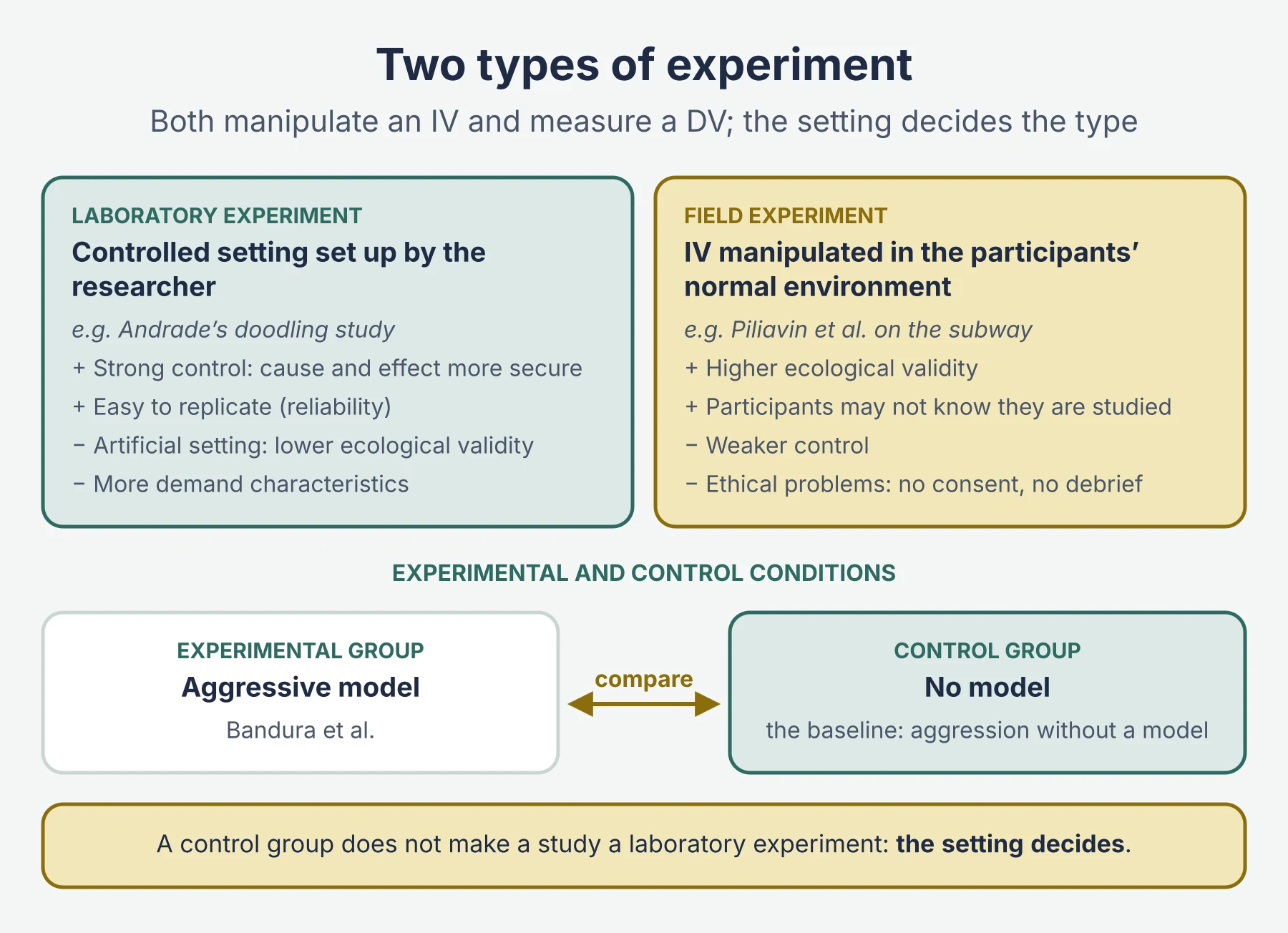
| Laboratory experiment | IV manipulated in a controlled setting | Andrade | High control, so cause and effect | Low ecological validity; demand characteristics |
| Field experiment | IV manipulated in a natural setting | Piliavin et al. | High ecological validity | Less control; consent problems |
| Self-report | Participants report on themselves | AQ questionnaire in Baron-Cohen et al. | Access to thoughts and feelings | Social desirability bias |
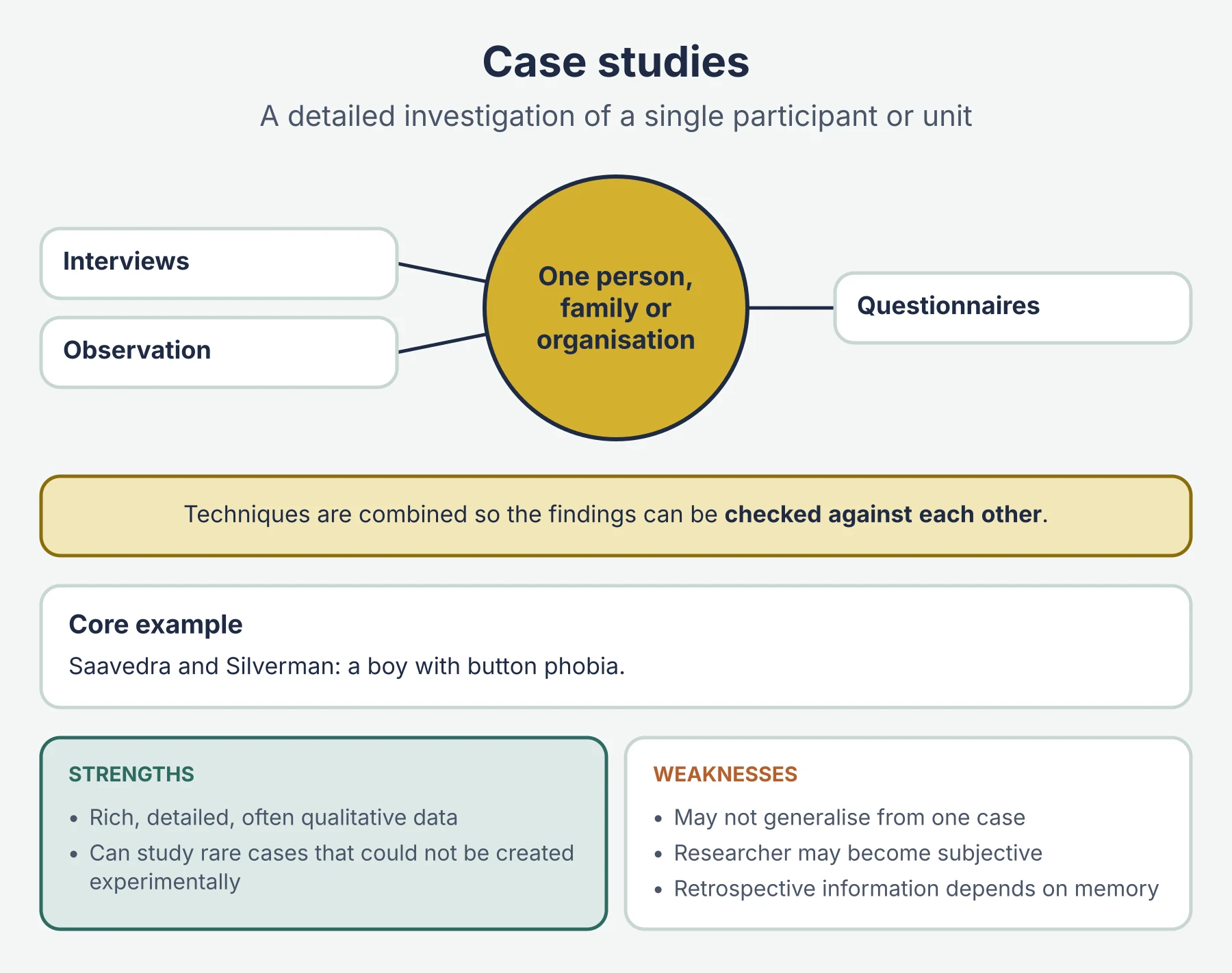
| Case study | Single participant or unit in detail | Saavedra and Silverman | Rich, detailed data | Hard to generalise |
| Observation | Behaviour watched and recorded | Fagen et al. | Records actual behaviour | Observer bias; consent if covert |
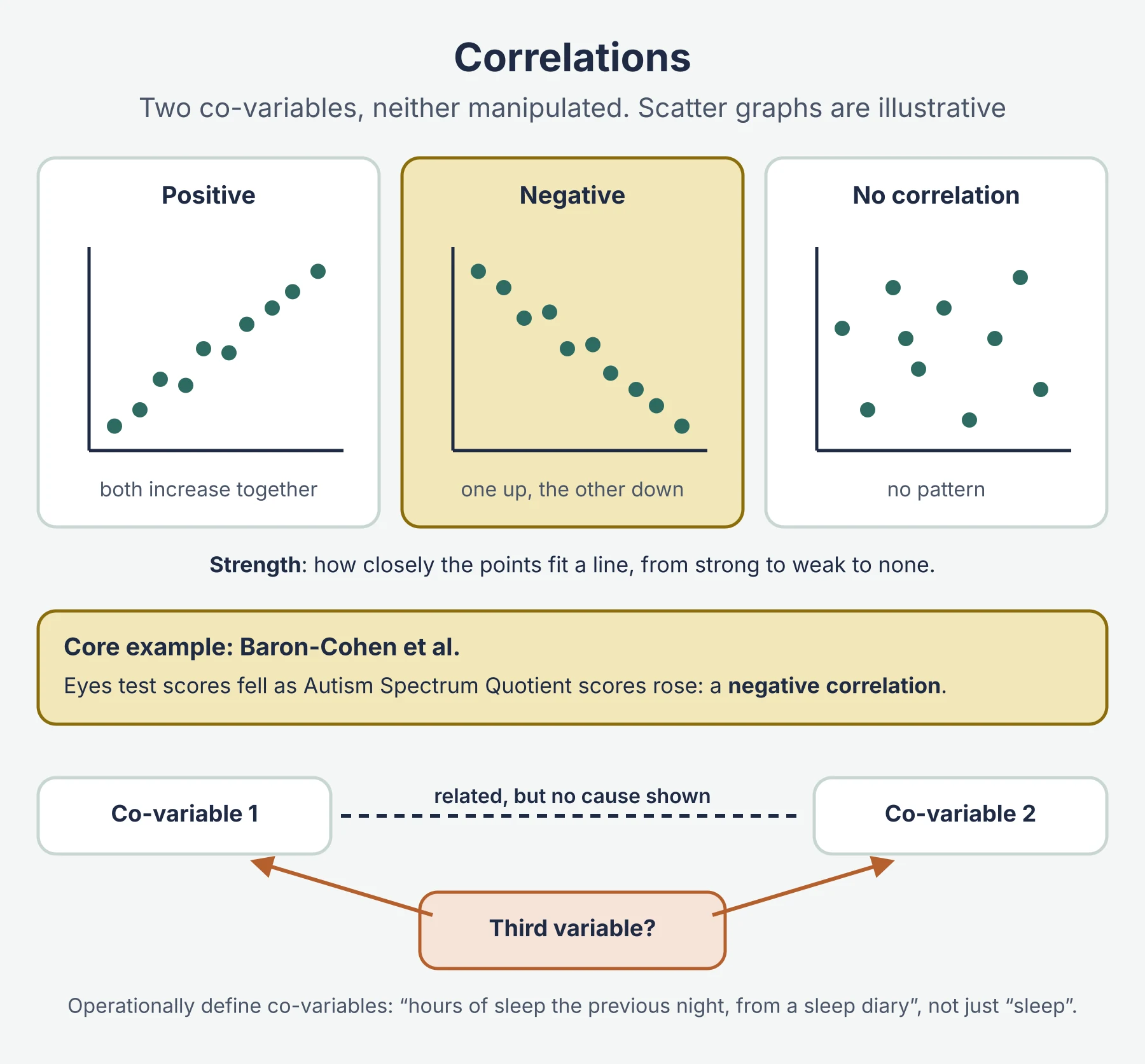
| Correlation | Relationship between two measured co-variables | Eyes test and AQ in Baron-Cohen et al. | Studies variables that cannot be manipulated | No causality |
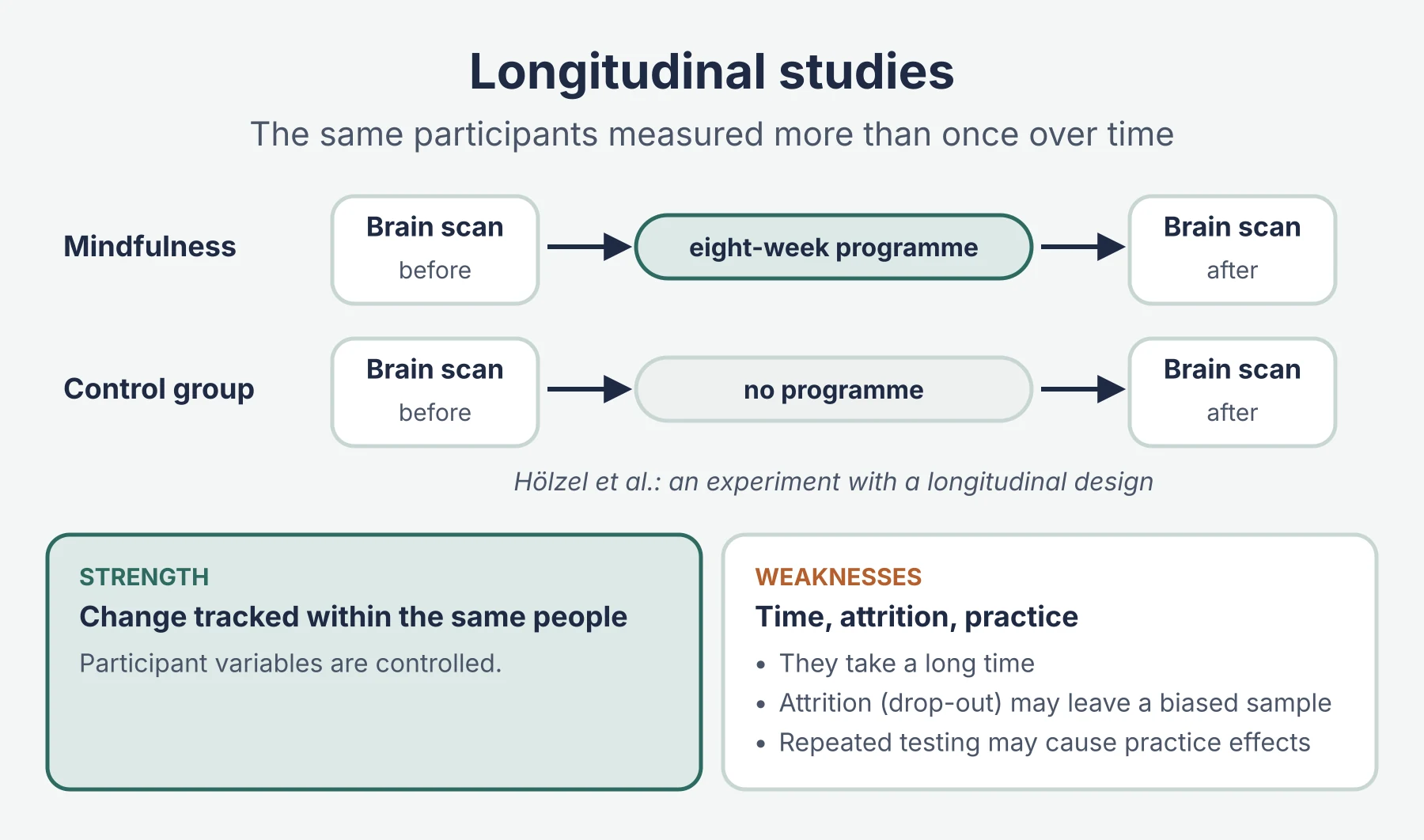
| Longitudinal study | Same participants measured over time | Hölzel et al. | Tracks change within people | Attrition; time-consuming |
Experimental designs
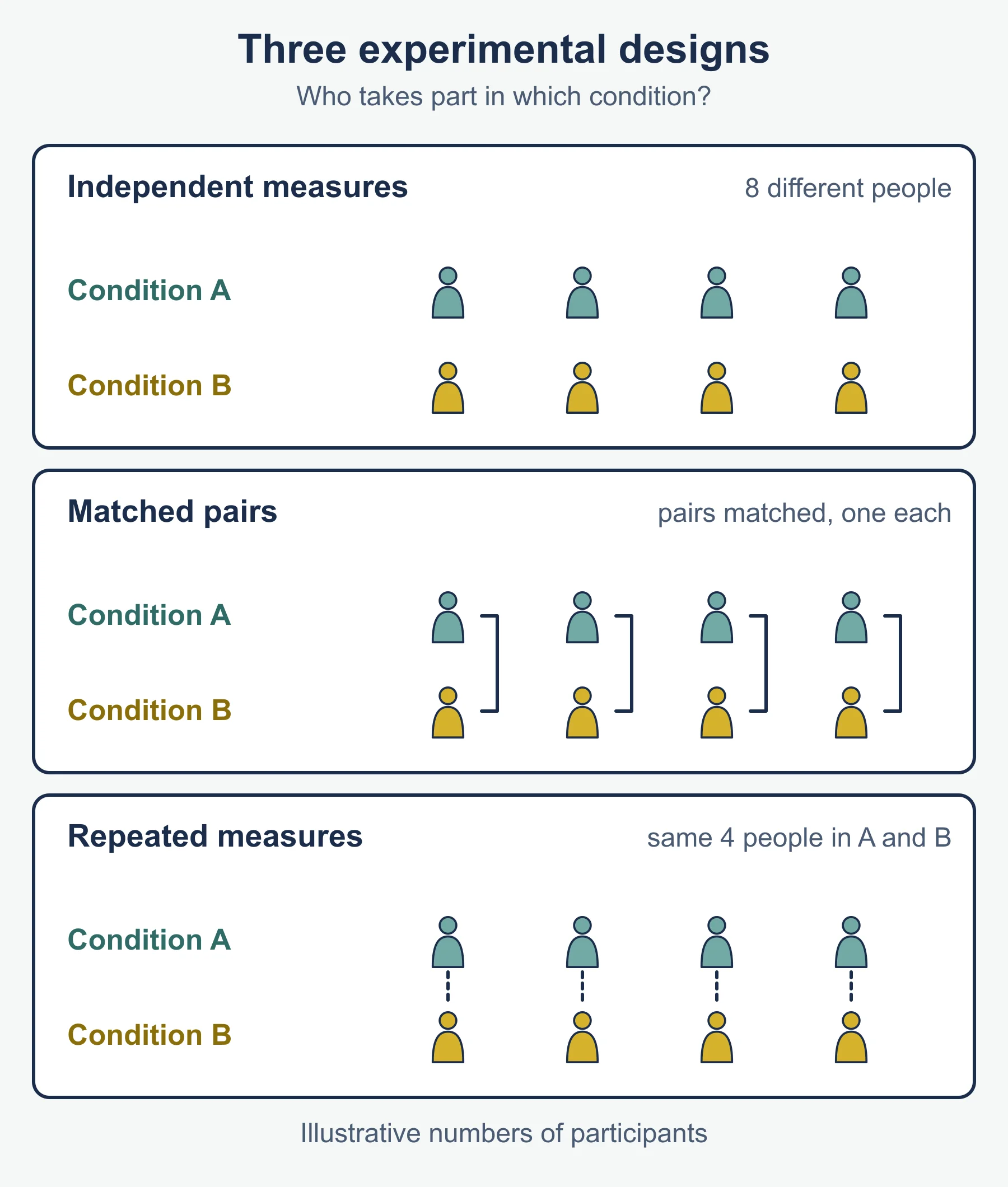
| Design | Problem it avoids | Problem it has | Fix |
|---|---|---|---|
| Independent measures | Order effects | Participant variables | Random allocation |
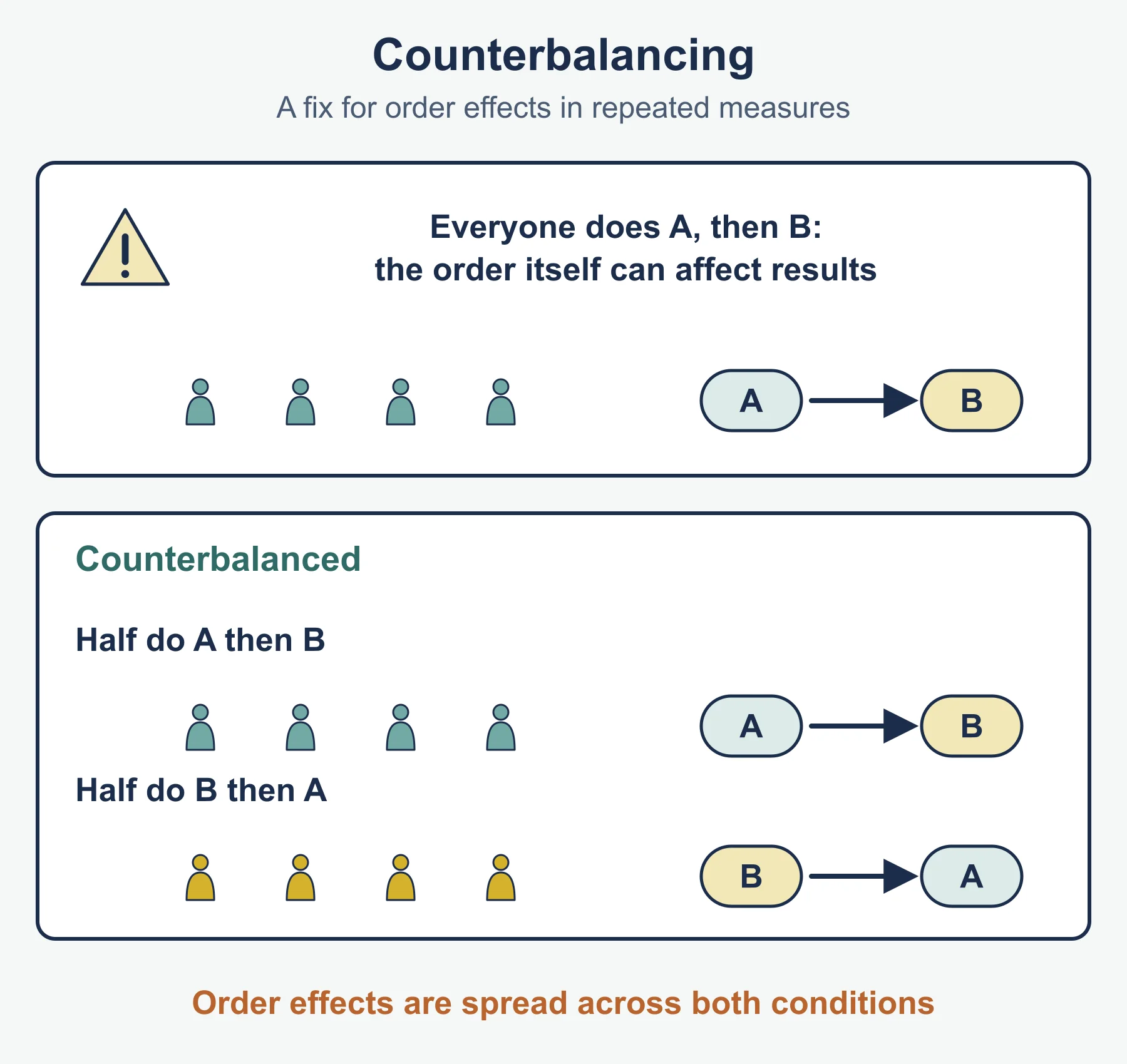
| Repeated measures | Participant variables | Order effects | Counterbalancing |
| Matched pairs | Both, mostly | Imperfect, time-consuming matching | Match on the most relevant variable |
Self-report checklist
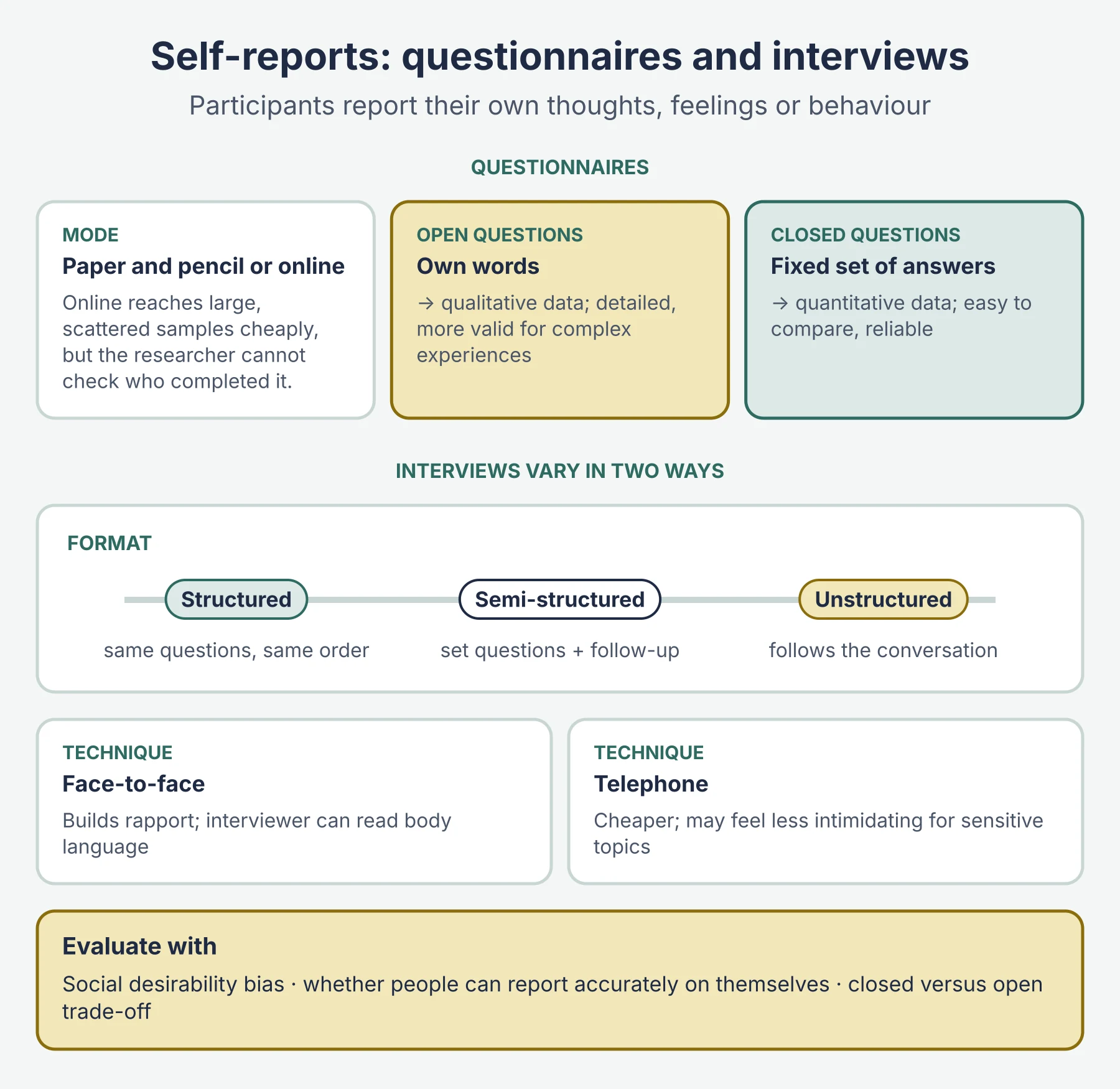
- Questionnaire: technique (paper and pencil, online); question format (open, closed).
- Interview: format (structured, unstructured, semi-structured); technique (face-to-face, telephone); question format (open, closed).
Observation checklist
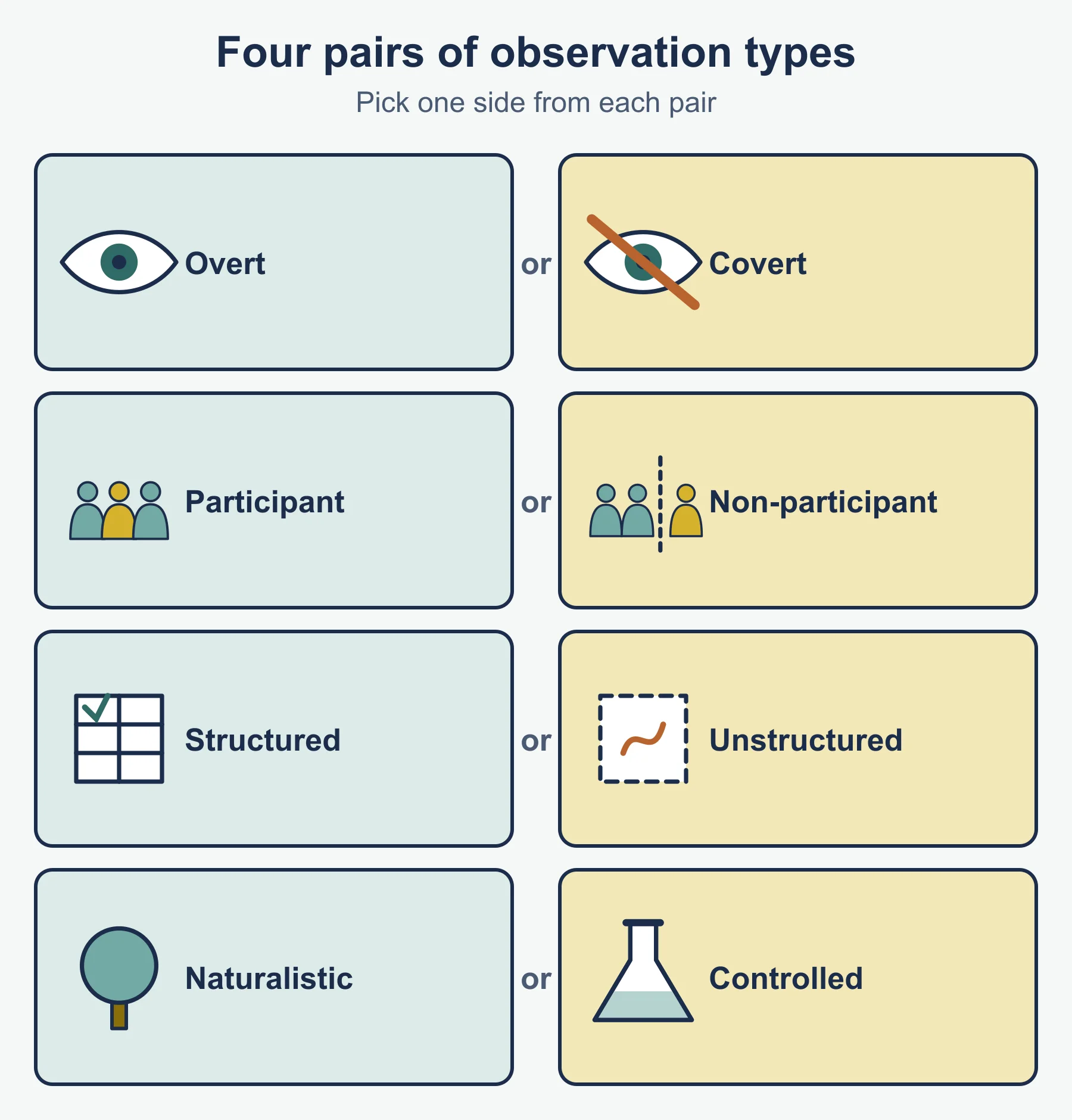
Overt or covert; participant or non-participant; structured (behavioural categories) or unstructured; naturalistic or controlled.
Paper 2 planning features by method
| Method | Required features |
|---|---|
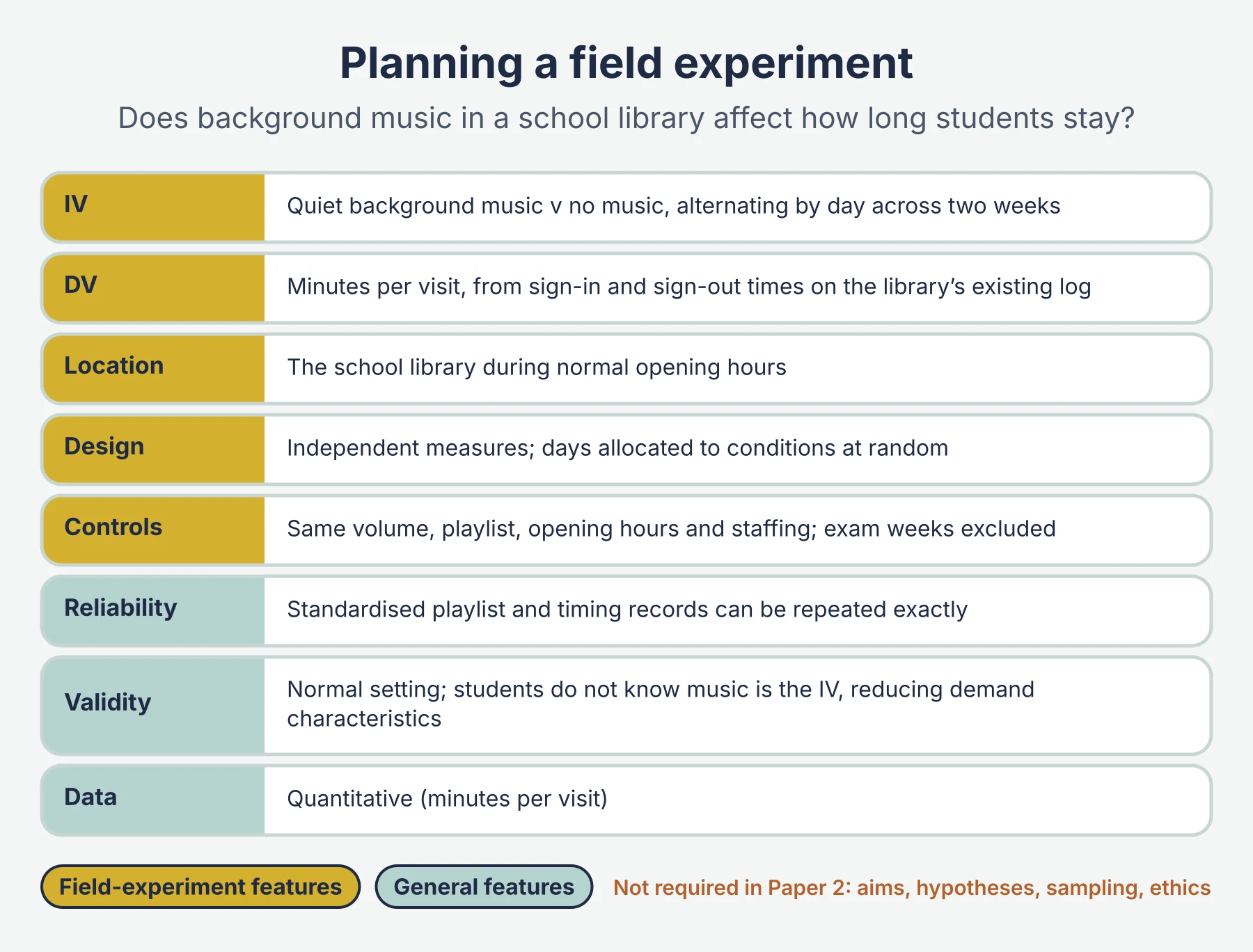
| Experiment | IV; DV; controls or standardisation; experimental design; plus location for a field experiment |
| Self-report | Question format; example questions; scoring or interpretation; plus technique (questionnaire) or format and technique (interview) |
| Case study | Details of the participant or unit; content of information collected; two or more techniques; analysis, interpretation or triangulation |
| Observation | Overt or covert; participant or non-participant; naturalistic or controlled; structured (behavioural categories) or unstructured |
| Correlation | Two co-variables; measure of each; nature of the relationship or scatter graph |
| Longitudinal | Tests or tasks; scoring; frequency or interval; re-contacting participants; controls |
All plans also need procedure, validity, reliability and types of data. Aims, hypotheses, sampling and ethics are not required in a Paper 2 plan.
Key terms
| Term | Meaning |
|---|---|
| Control condition | A condition without the IV, used as a baseline |
| Order effects | Changes in performance due to doing conditions in sequence |
| Practice effect | Improvement from having done a task before |
| Fatigue effect | Worse performance from tiredness or boredom |
| Counterbalancing | Half do A then B, half B then A |
| Random allocation | Each participant has an equal chance of each condition |
| Open question | Answered in the participant’s own words |
| Closed question | Answer chosen from fixed options |
| Semi-structured interview | Set questions plus freedom to follow up |
| Triangulation | Checking a finding using more than one technique |
| Co-variable | A measured variable in a correlation |
| Attrition | Participants dropping out of a longitudinal study |
Exam traps
- A field experiment still has a manipulated IV; a natural setting alone does not make it a field experiment.
- “Counterbalancing stops order effects”: it balances them.
- Writing “random sampling” when you mean random allocation.
- Correlations need two measured co-variables, not an IV and a DV.
- “Semi-structured” is a format; telephone is a technique.
- Applying generic strengths (“it is reliable”) without saying why, for this scenario.
Self-test
- Distinguish a laboratory experiment from a field experiment.
- Which design suffers from order effects, and how are they dealt with?
- Give one strength of matched pairs over independent measures.
- What is the purpose of a control group?
- Give one strength of telephone interviews.
- What type of data do closed questions produce?
- Define a case study as the syllabus does.
- What is a covert observation?
- What is a negative correlation?
- Why can a correlation not show cause and effect?
- What makes an experiment “longitudinal”?
- Name two features required in a Paper 2 plan for a correlational study.
Answers: (1) both manipulate an IV; a laboratory experiment is in a controlled setting arranged by the researcher, a field experiment in the participants’ normal environment. (2) repeated measures; counterbalancing. (3) participant variables are reduced because similar people are compared across conditions. (4) to give a baseline against which the effect of the IV can be judged. (5) cheaper and quicker than face-to-face, and may feel less intimidating for sensitive topics. (6) quantitative data. (7) a detailed study of a single participant or unit. (8) participants do not know they are being observed. (9) as one co-variable increases, the other decreases. (10) neither variable is manipulated, so a third variable could cause both. (11) the same participants are measured before and after the IV over a period of time. (12) any two of: two co-variables; a measure of each; the nature of the relationship or a scatter graph.
Official syllabus
Cambridge International AS & A Level Psychology 9990 syllabus for 2024, 2025 and 2026, section 3.1.2, Research methods, and section 4, Planning studies for Paper 2 — cambridgeinternational.org.
More resources on this topic
Related resources
-
Study guides
Cambridge A-Level Psychology: Research Methods (9990)
Guide to Paper 2 Research Methods in Cambridge AS & A Level Psychology (9990): the six methods, sampling, validity, reliability and the planning question.
Psychology · Cambridge · AS Level
Read guide -
Practice questions
Cambridge A-Level Psychology: Research Methods — Practice Questions
Practice questions and answers on research methods, validity, reliability, ethics and the Paper 2 planning question for Cambridge AS & A Level Psychology 9990.
Psychology · Cambridge · AS Level
Try questions -
Revision notes
Cambridge A-Level Psychology: Research Methods — Revision Notes (9990)
Condensed revision notes on the six research methods, methodological concepts, and the Paper 2 planning question for Cambridge AS & A Level Psychology (9990).
Psychology · Cambridge · AS Level
Revise topic
Studying Psychology?
This page is free and stays free. Marlbridge is not offering Psychology classes at the moment, so there is no tuition to book for it. The free study resources stay open to everyone.
Get free revision emails (optional)
Occasional emails with practice questions, worked explanations and links to free resources for the qualification and subjects you choose. No spam, and you can unsubscribe from any email. The free tools on this site never need an email.