
Study Guides
Cambridge International AS & A Level Psychology (9990): Research methods
The six AS research methods in Cambridge 9990 Psychology explained in depth: experiments and designs, self-reports, case studies, observations and more.
- Subject
- Psychology
- Level
- AS LEVEL
- Topic
- Paper 2 – Research Methods
- Author
- Marlbridge Academic Team
- Updated
- Reviewed by
- Kanwal Aslam (what this means)
Aligned to Cambridge A Level Psychology (9990), 2024-2026. Official specification .
Syllabus page (what it covers and how it is assessed): Cambridge A Level Psychology.
Syllabus points this page covers
9990 (AS Level)
- Research methods
This guide covers the “Research methods” heading of section 3.1.2 of the Cambridge International AS & A Level Psychology (9990) syllabus. Six methods are named: experiments, self-reports, case studies, observations, correlations and longitudinal studies. For each, you must describe it, evaluate it and apply it to a new scenario. The Paper 2 Research Methods overview summarises the whole paper; this page goes method by method, with examples from the core studies and a worked planning answer. The methodological concepts (variables, sampling, validity and so on) have their own methodological concepts guide.
Revise with the research methods revision notes and practise with the research methods practice questions.
Experiments
An experiment manipulates an independent variable (IV) and measures its effect on a dependent variable (DV), while controlling other variables. The syllabus names two types.
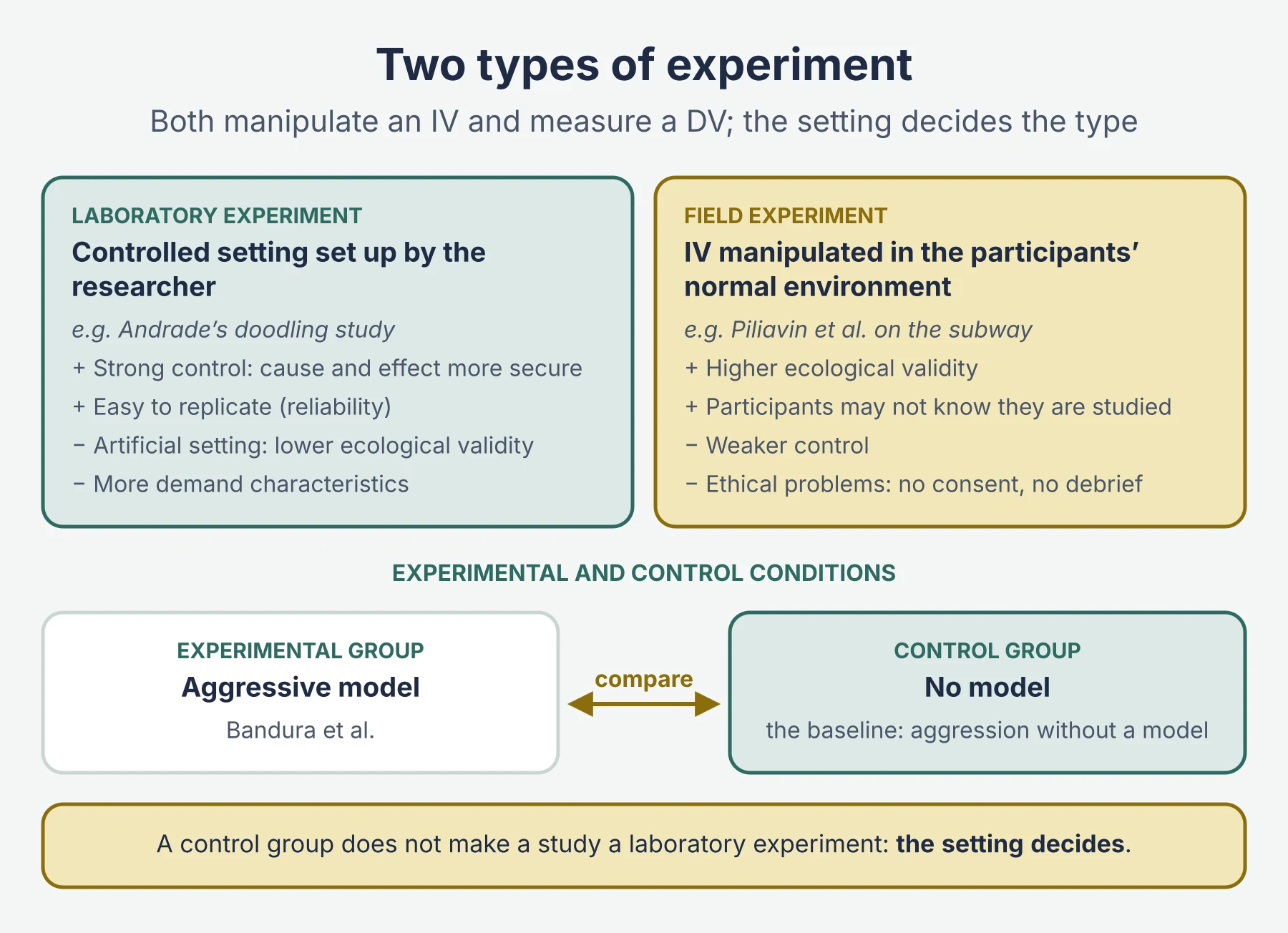
- Laboratory experiment: carried out in a controlled environment set up by the researcher. Andrade’s doodling study is an example. Strong control makes cause-and-effect conclusions more secure and the procedure easy to replicate (reliability), but the artificial setting can lower ecological validity and raise demand characteristics.
- Field experiment: the IV is manipulated in the participants’ normal environment. Piliavin et al. on the subway is the core-study example. Ecological validity is higher and participants may not know they are being studied, but control is weaker and ethical problems (no consent, no debrief) are more likely.
You must also evaluate the use of experimental and control groups or conditions. A control condition gives a baseline: in Bandura et al., the no-model group showed what aggression would look like without a model, so the effect of the aggressive model could be judged.
Experimental designs
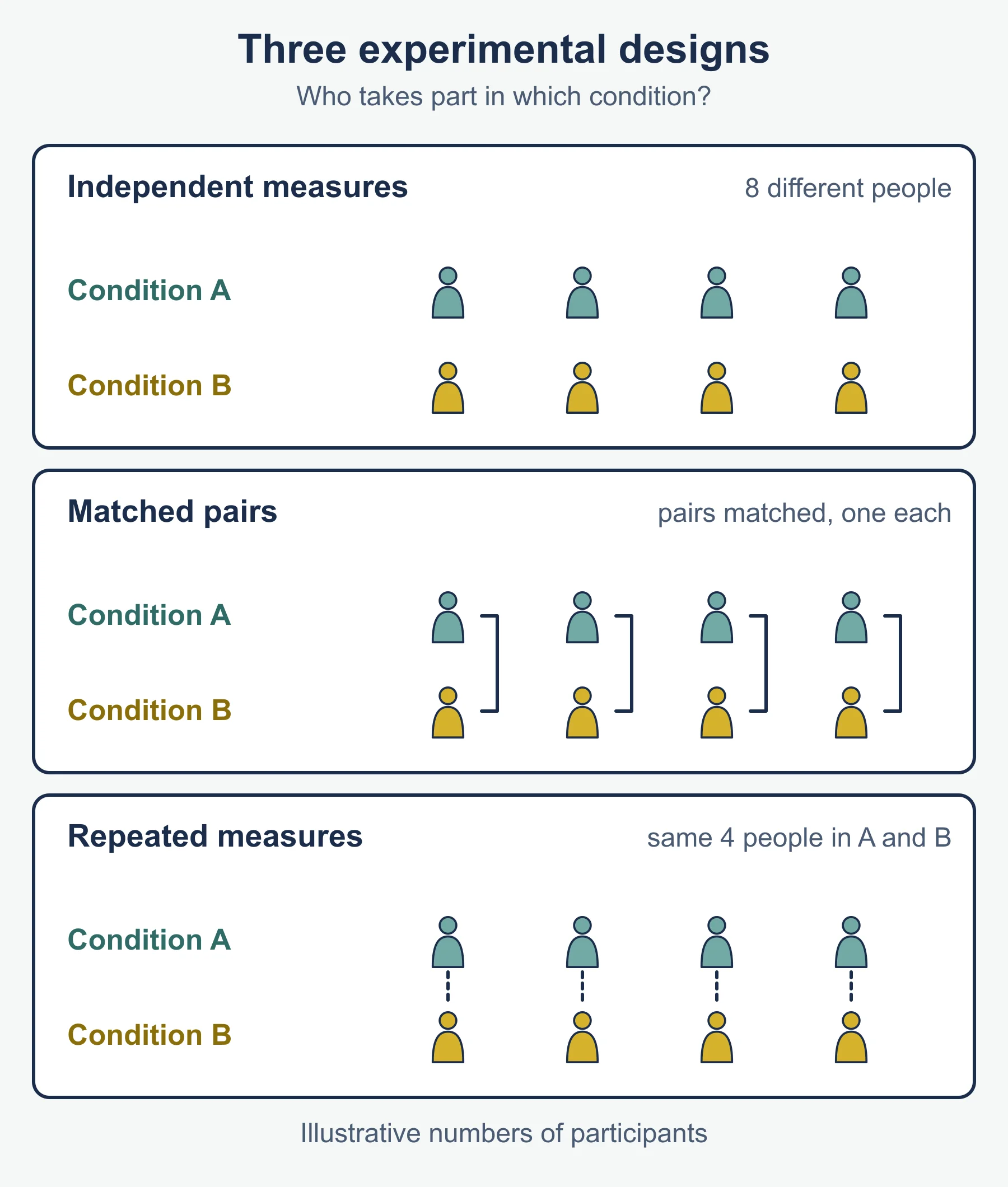
| Design | What it is | Main strength | Main weakness | How to reduce the weakness |
|---|---|---|---|---|
| Independent measures | Different participants in each condition | No order effects | Participant variables differ between groups | Random allocation |
| Repeated measures | The same participants do every condition | Participant variables are the same in each condition | Order effects (practice and fatigue) | Counterbalancing |
| Matched pairs | Pairs matched on a relevant variable; one of each pair in each condition | Reduces participant variables without order effects | Matching is time-consuming and never perfect | Match on the variable most likely to affect the DV |
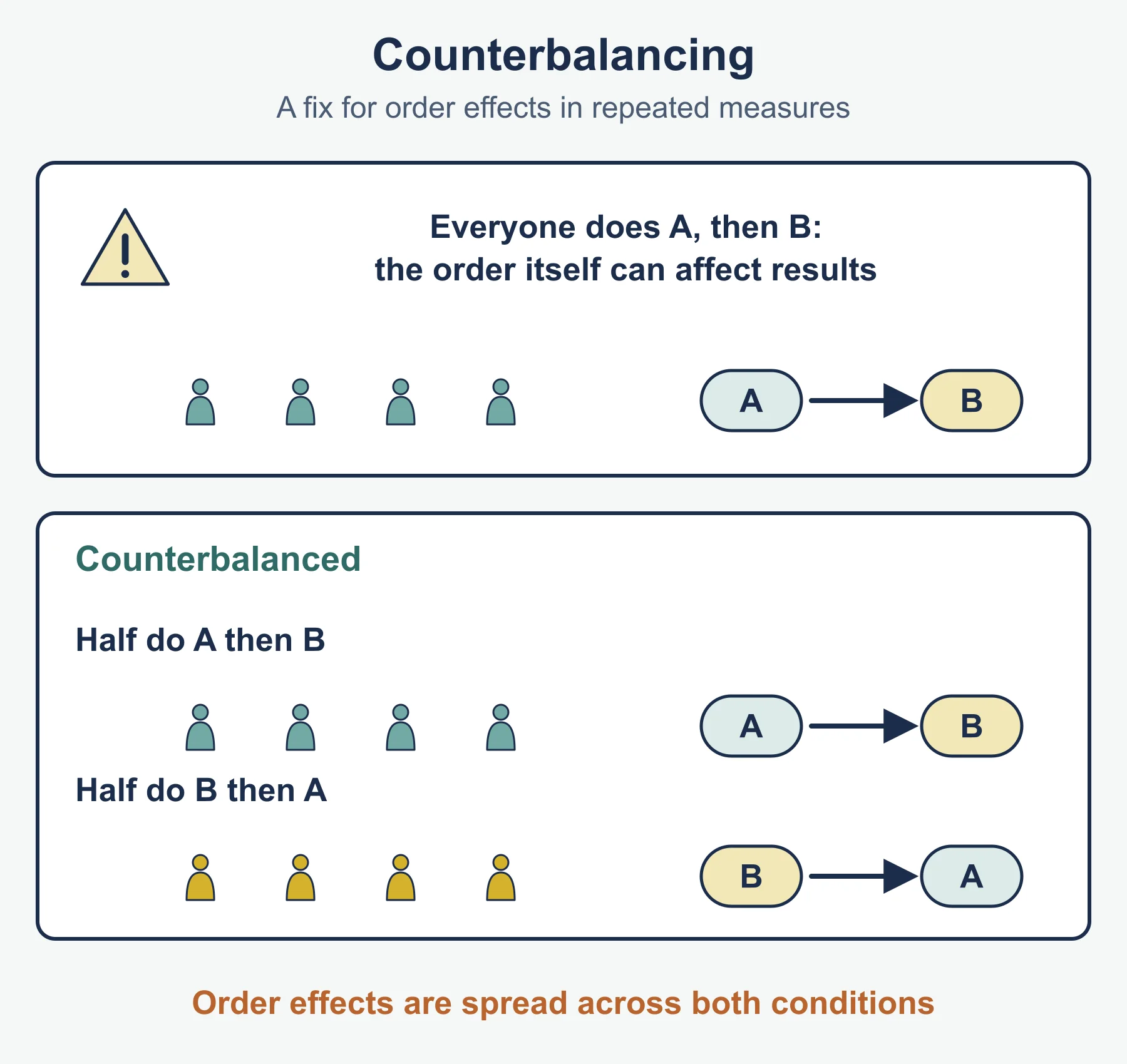
Order effects are changes in performance caused by doing conditions in sequence. Practice effects improve performance in later conditions; fatigue effects worsen it. Counterbalancing gives half the participants condition A then B, and half B then A, so order effects are spread equally. Random allocation gives each participant an equal chance of being in each condition, so participant variables are likely to be spread evenly.
Self-reports
Self-reports ask participants to report their own thoughts, feelings or behaviour.
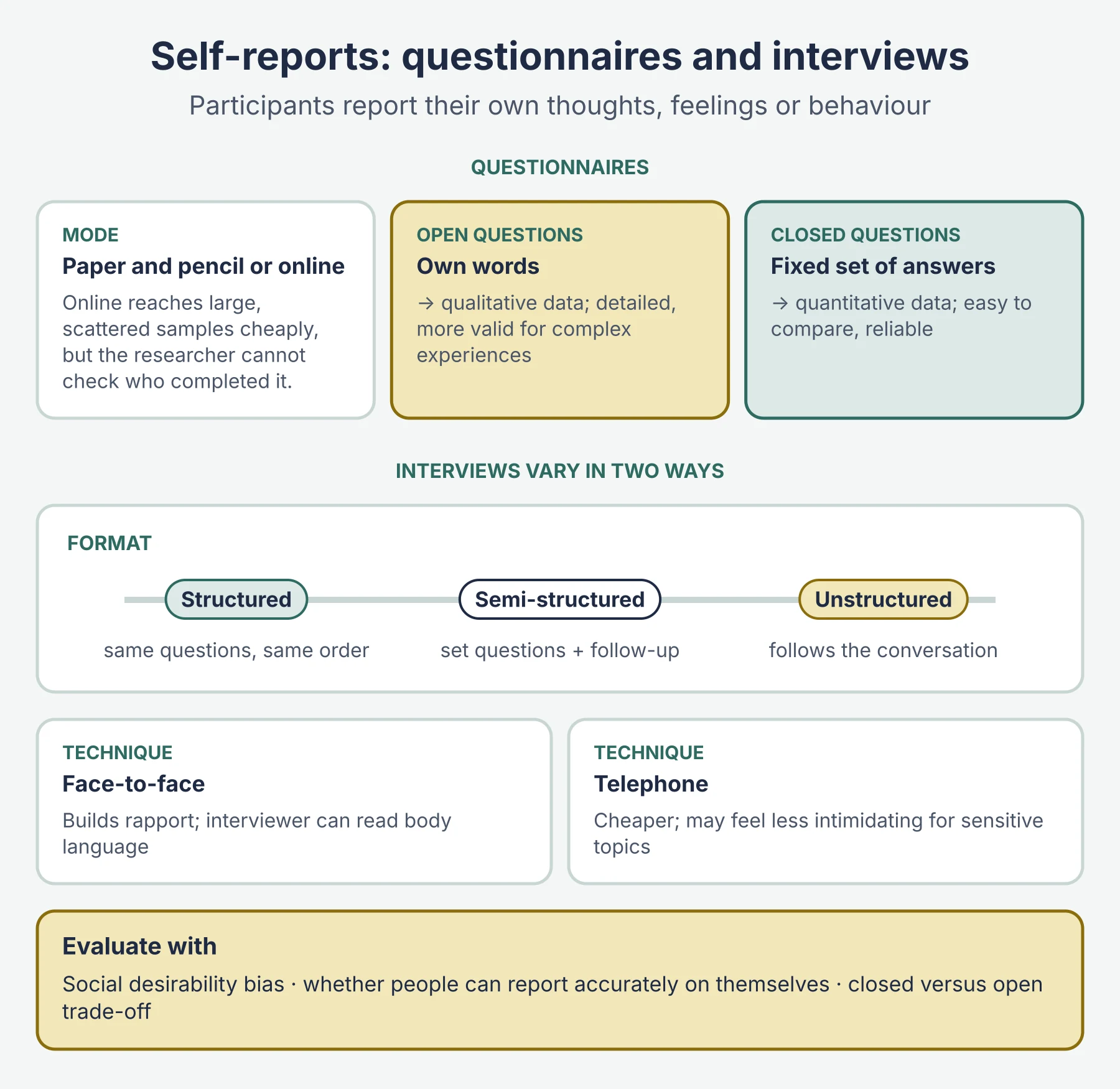
Questionnaires can be paper and pencil or online, and use open questions (participants answer in their own words, giving qualitative data) or closed questions (a fixed set of answers, giving quantitative data). Online questionnaires reach large, scattered samples cheaply, but the researcher cannot check who completed them.
Interviews vary in format: a structured interview uses the same questions in the same order for everyone; an unstructured interview follows the conversation; a semi-structured interview has set questions with freedom to follow up. They also vary in technique: face-to-face builds rapport and lets the interviewer read body language, while telephone is cheaper and may feel less intimidating for sensitive topics.
Evaluate self-reports in terms of social desirability bias (giving answers that make you look good), whether people can accurately report on themselves, and the trade-off between closed questions (easy to compare, reliable) and open questions (detailed, more valid for complex experiences).
Case studies
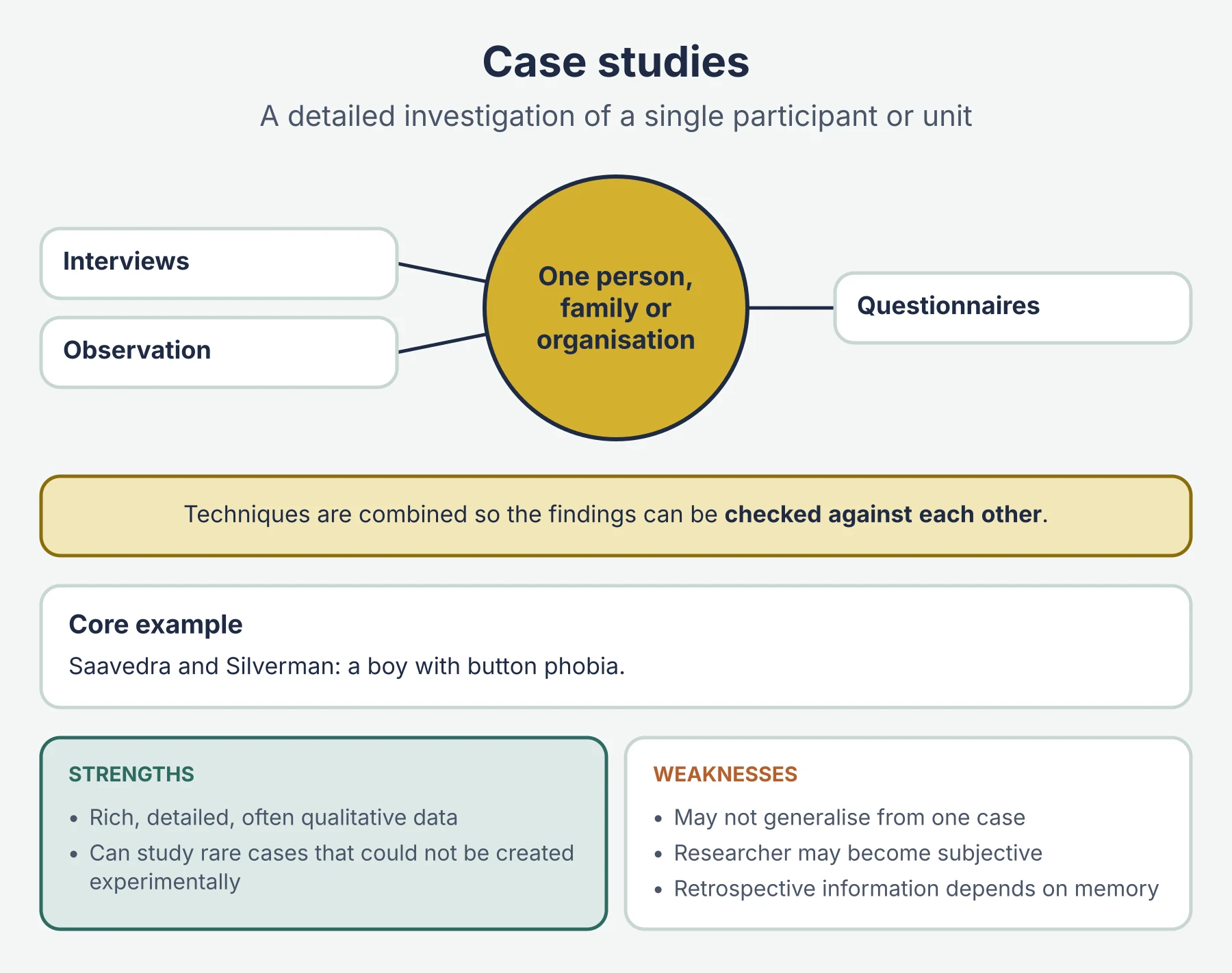
A case study is a detailed investigation of a single participant or unit, such as one person, one family or one organisation. Saavedra and Silverman’s study of a boy with button phobia is the core example. Case studies usually combine techniques, such as interviews, observation and questionnaires, so the findings can be checked against each other.
Strengths: rich, detailed, often qualitative data; they can study rare cases that could not be created experimentally. Weaknesses: findings may not generalise from one case, the researcher may become subjective, and retrospective information depends on memory.
Observations
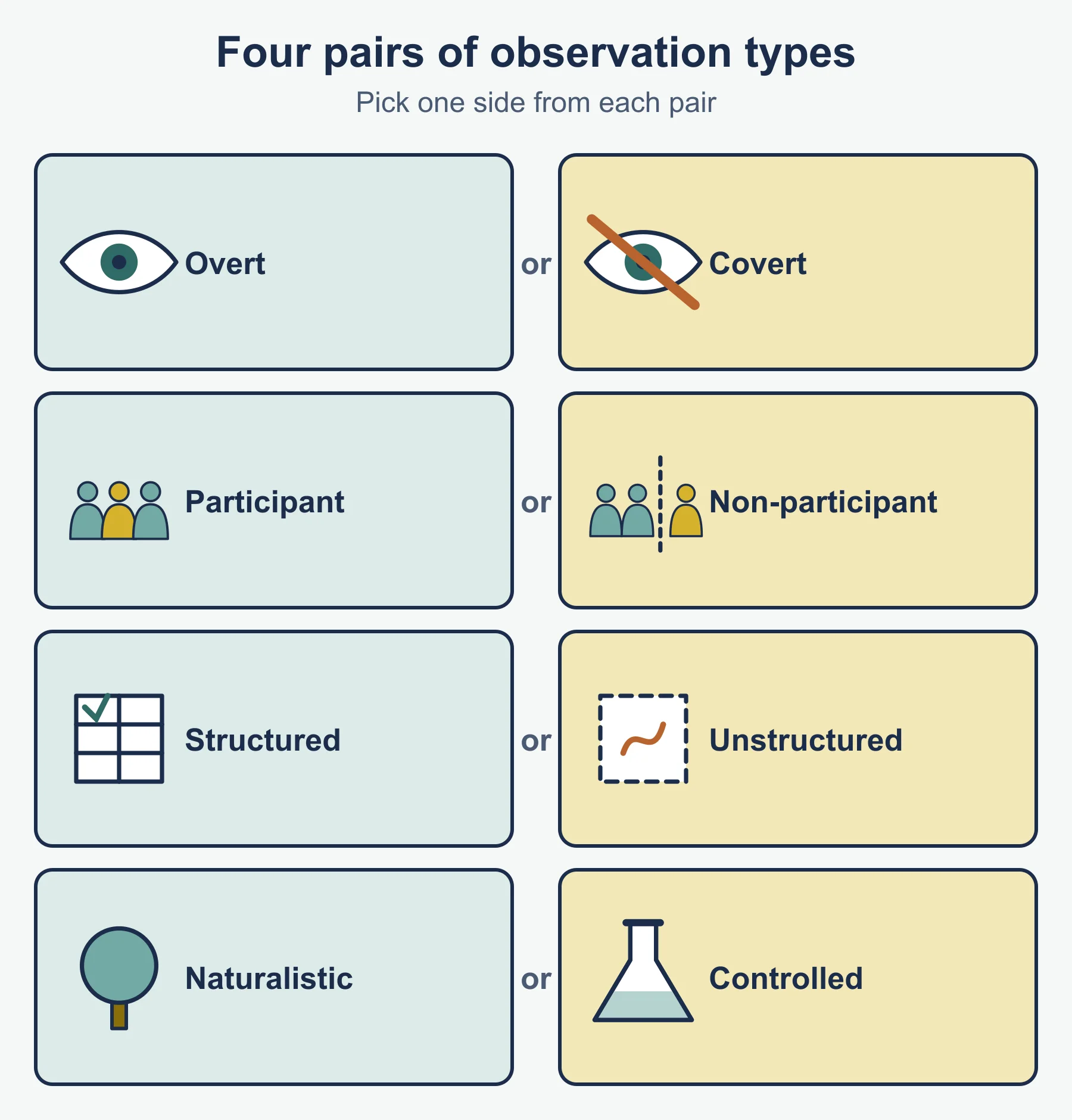
The syllabus names four pairs of features:
- Overt / covert: participants know or do not know they are being watched.
- Participant / non-participant: the observer joins in the activity or stays apart.
- Structured / unstructured: behaviour is recorded in pre-set behavioural categories, or everything relevant is noted freely.
- Naturalistic / controlled: behaviour in its normal setting, or in a situation arranged by the researcher.
Fagen et al.’s elephant study is a structured observation using a behavioural checklist. Observations record what people actually do rather than what they say, but covert observation raises consent and privacy issues, and overt observation risks participants changing their behaviour. With more than one observer, inter-observer reliability can be checked.
Correlations
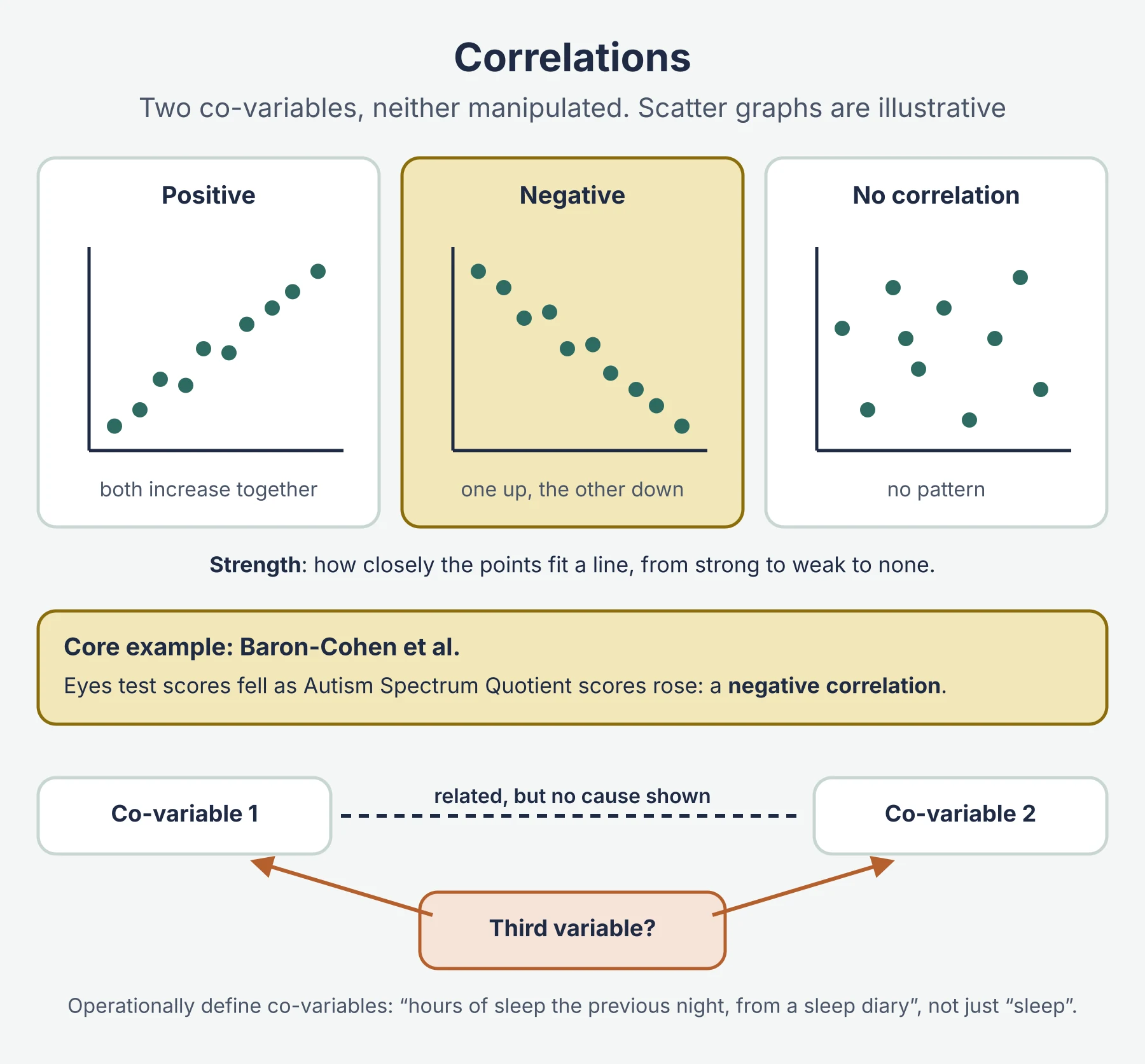
A correlation measures the relationship between two co-variables, neither of which is manipulated. In a positive correlation both increase together; in a negative correlation one increases as the other decreases. Strength describes how closely the points on a scatter graph fit a line, from strong to weak to no correlation. Baron-Cohen et al.’s finding that Eyes test scores fell as Autism Spectrum Quotient scores rose is a negative correlation.
The key weakness is lack of causality: a correlation does not show that one variable causes the other, as a third variable may affect both. Co-variables must be operationally defined, for example “hours of sleep the previous night, from a sleep diary” rather than just “sleep”.
Longitudinal studies
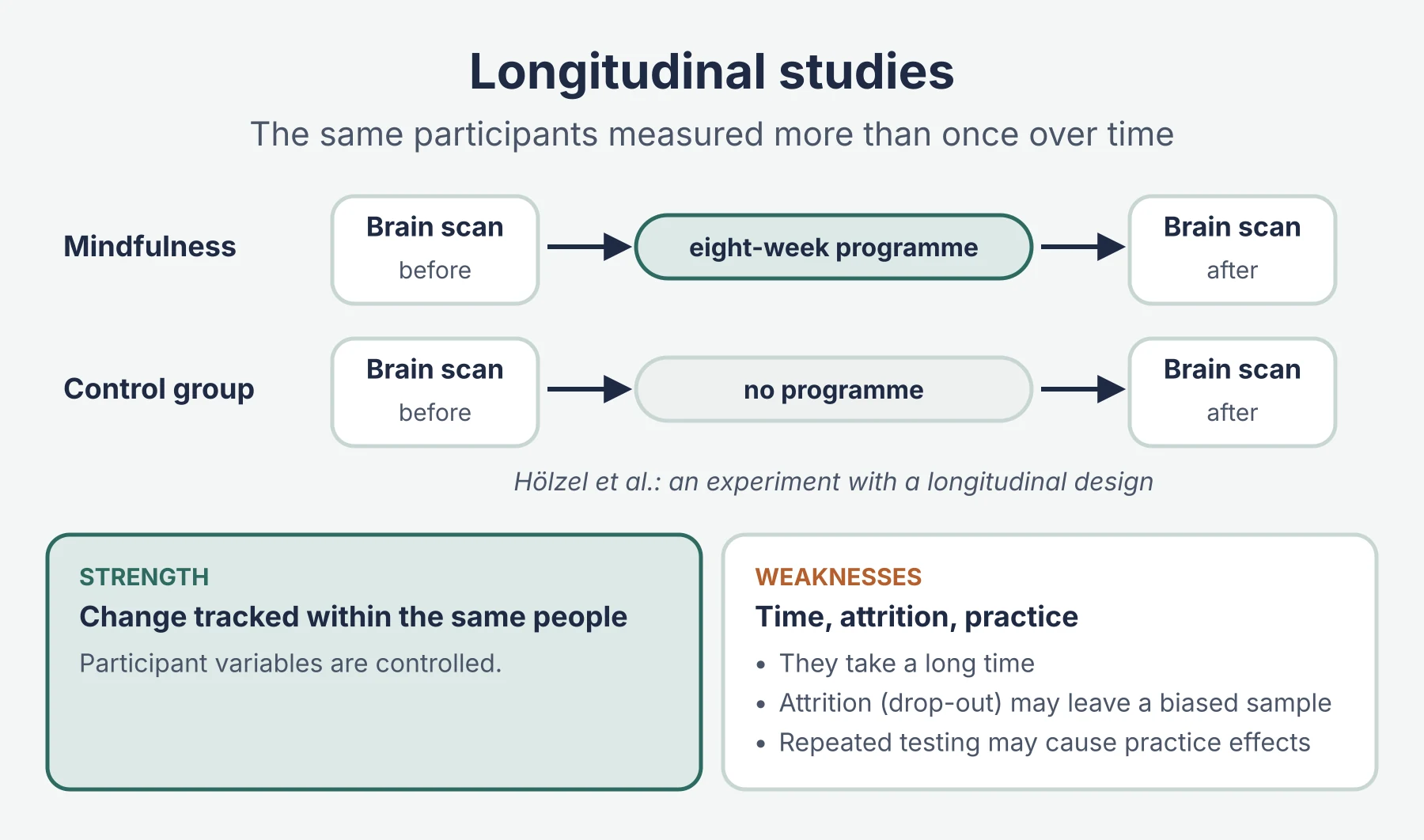
A longitudinal study follows the same participants over time, measuring them more than once. An experiment with a longitudinal design combines this with a manipulated IV, as in Hölzel et al., where brain scans were taken before and after an eight-week mindfulness programme and compared with a control group. Strengths: development and change can be tracked within the same people, so participant variables are controlled. Weaknesses: they take a long time, and attrition (participants dropping out) may leave a biased sample; repeated testing may also cause practice effects.
Worked planning example
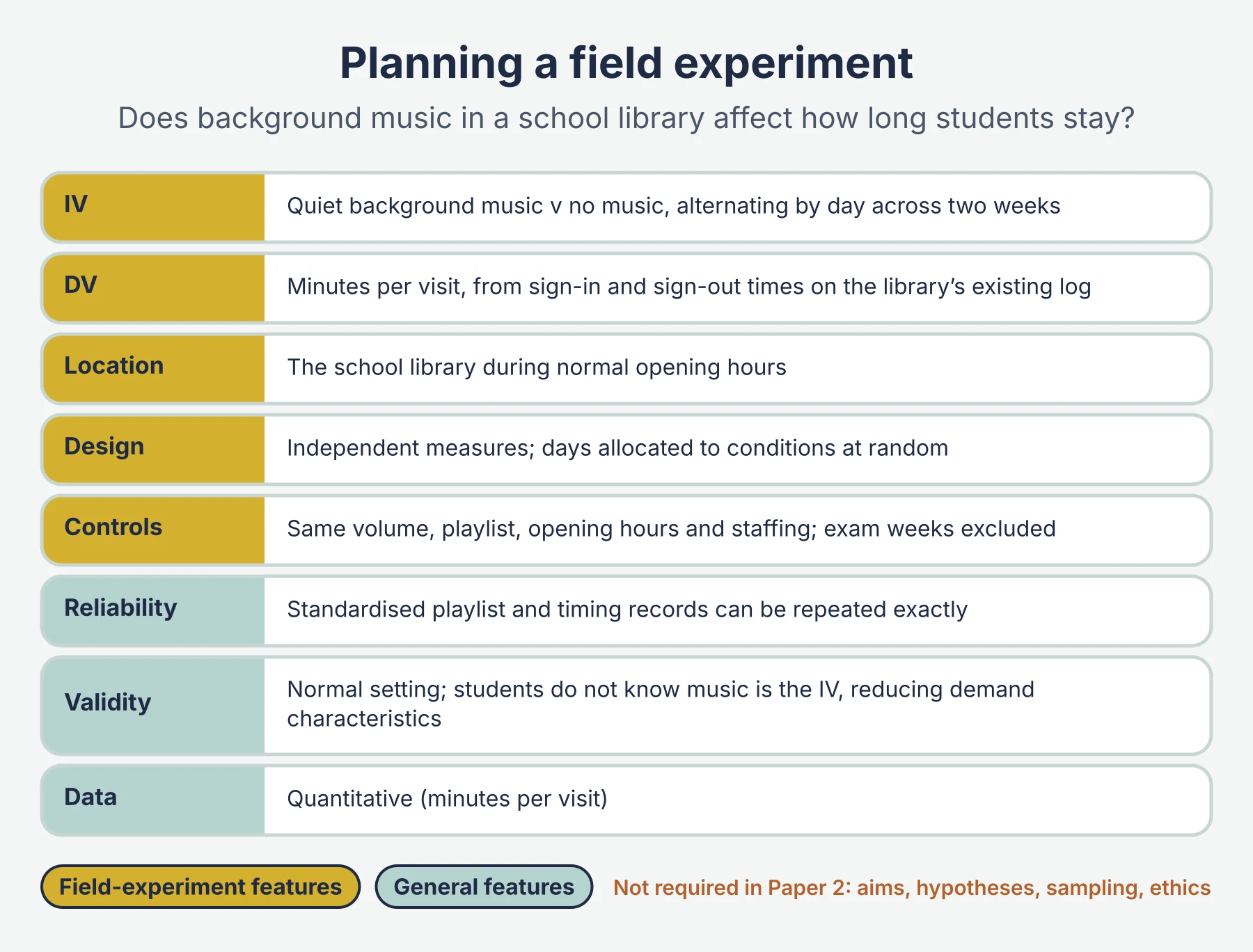
Plan a field experiment to investigate whether background music in a school library affects how long students stay. [Paper 2 style]
IV: background music playing quietly versus no music, alternating by day across two weeks. DV: time spent in the library per visit, from the sign-in and sign-out times on the library’s existing log. Location: the school library during normal opening hours. Design: independent measures, because students visit on different days; days are allocated to conditions at random. Controls: same volume, same playlist, same opening hours and staffing in both conditions; exam weeks excluded. Reliability: the standardised playlist and timing records can be repeated exactly. Validity: students are in a normal setting and do not know the music is the IV, which reduces demand characteristics. Data: quantitative (minutes per visit).
This covers the general features (procedure, validity, reliability, types of data) and the features required for a field experiment (IV, DV, controls, design, location). The syllabus does not require aims, hypotheses, sampling or ethics in a Paper 2 plan.
Common mistakes
- Calling any study with a control group a laboratory experiment; the setting decides the type.
- Saying counterbalancing removes order effects: it balances them across conditions.
- Describing a correlation as showing that one variable “causes” another.
- Writing “semi-structured” as a technique: it is a format; telephone and face-to-face are techniques.
- Calling a case study “one person only”: the syllabus says a single participant or unit.
Exam technique
Describe questions on a method need its features, not its evaluation. Evaluate questions need a strength or weakness applied to the scenario. Suggest questions, common in the scenario section, reward any sensible proposal that is justified for that scenario. When a question names a core study, use that study’s details.
Official syllabus
Cambridge International AS & A Level Psychology 9990 syllabus for 2024, 2025 and 2026, section 3.1.2 Research methodology, Research methods, and section 4, Planning studies for Paper 2 — cambridgeinternational.org.
More resources on this topic
Related resources
-
Practice questions
Cambridge International AS & A Level Psychology (9990): Research methods – Practice Questions
Original Paper 2 style questions with answers on the six 9990 AS research methods, including core-study links, scenarios and a full planning question.
Psychology · Cambridge · AS Level
Try questions -
Revision notes
Cambridge International AS & A Level Psychology (9990): Research methods – Revision Notes
Revision notes for the six 9990 AS research methods: features, evaluation, core-study examples, planning checklists, key terms, traps and a self-test.
Psychology · Cambridge · AS Level
Revise topic -
Study guides
Cambridge A-Level Psychology: Research Methods (9990)
Guide to Paper 2 Research Methods in Cambridge AS & A Level Psychology (9990): the six methods, sampling, validity, reliability and the planning question.
Psychology · Cambridge · AS Level
Read guide
Studying Psychology?
This page is free and stays free. Marlbridge is not offering Psychology classes at the moment, so there is no tuition to book for it. The free study resources stay open to everyone.
Get free revision emails (optional)
Occasional emails with practice questions, worked explanations and links to free resources for the qualification and subjects you choose. No spam, and you can unsubscribe from any email. The free tools on this site never need an email.