
Revision Notes
Cambridge A Level Psychology (9990): Satisfaction at work – Revision Notes
Revision notes for Cambridge 9990 topic 4.5: Herzberg, job characteristics, JDI, QWL, sabotage and Blau and Boal, with a self-test.
- Subject
- Psychology
- Level
- A LEVEL
- Topic
- Specialist Option 4: Organisational Psychology
- Author
- Marlbridge Academic Team
- Updated
- Reviewed by
- Kanwal Aslam (what this means)
Aligned to Cambridge A Level Psychology (9990), 2024-2026. Official specification .
Syllabus page (what it covers and how it is assessed): Cambridge A Level Psychology.
Syllabus points this page covers
9990 (A Level)
- 4.5 Satisfaction at work
These notes condense topic 4.5, Satisfaction at work, from Specialist Option 4 of Cambridge International A Level Psychology 9990 (syllabus for 2024 to 2026). Learn it as theories (why people are satisfied), measures (how we find out) and attitudes (what dissatisfied people do: sabotage and absence).
The satisfaction at work study guide explains everything fully. Practise with the satisfaction at work practice questions.
Topic map
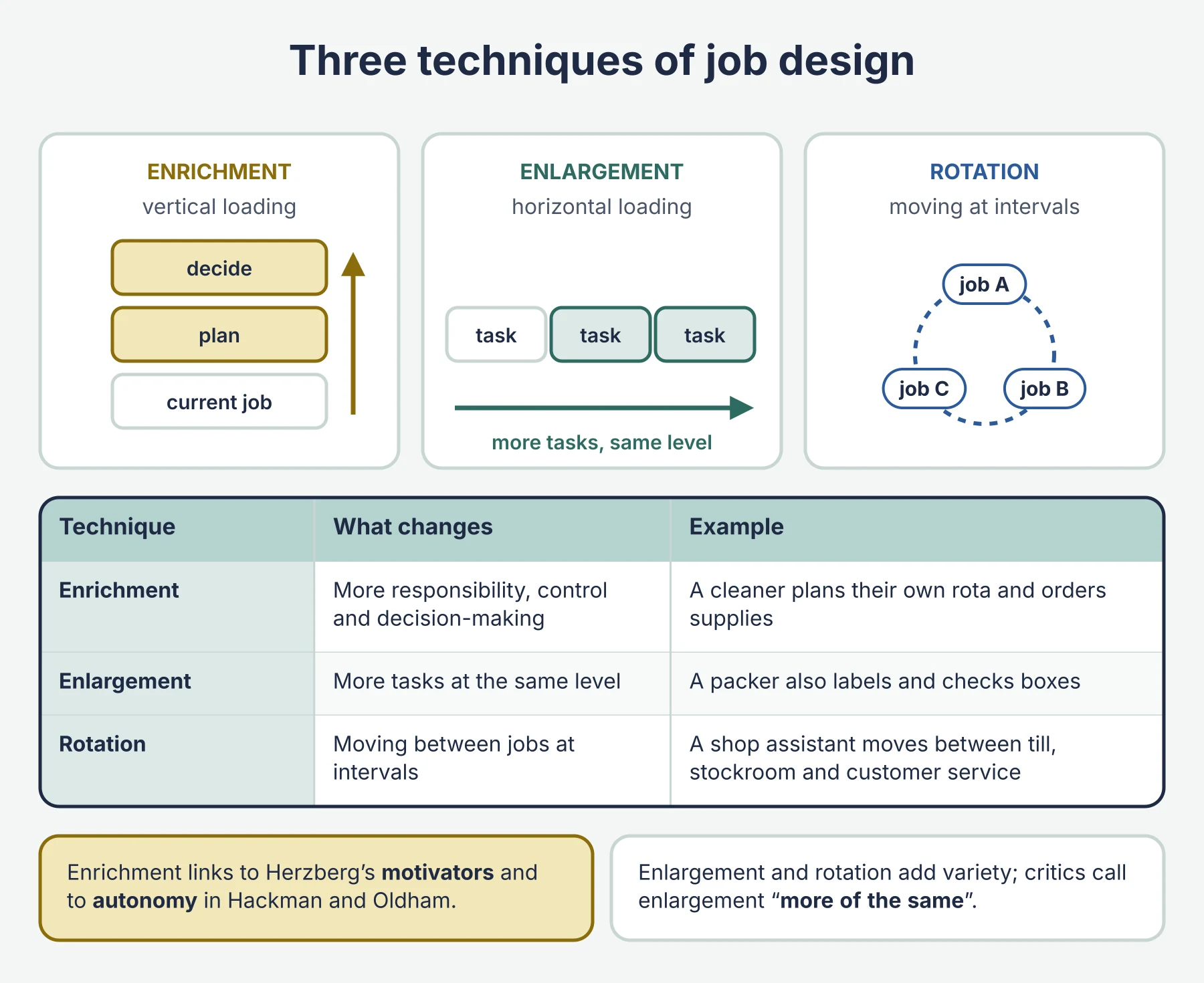
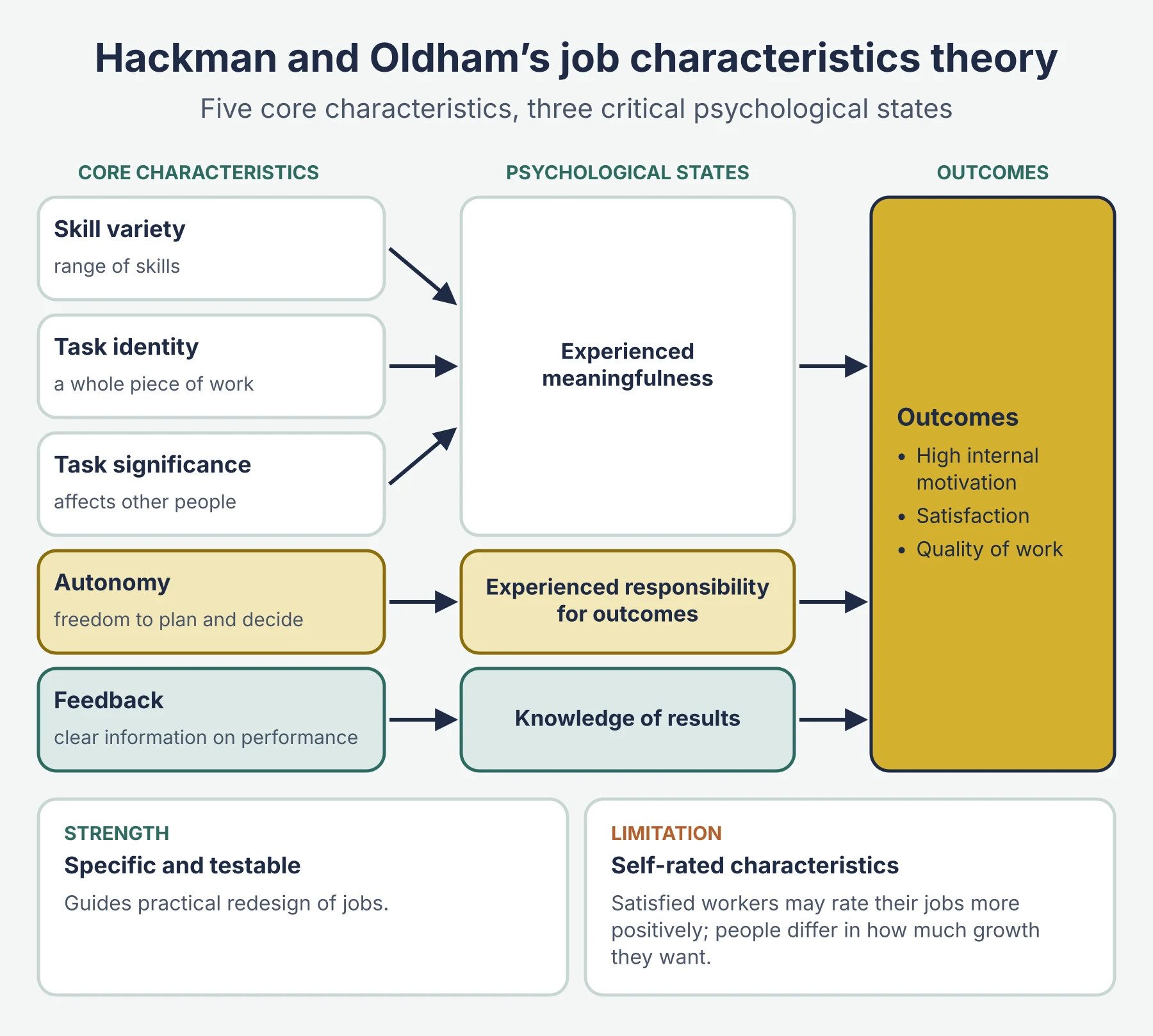
- 4.5.1: Herzberg’s hygiene factors and motivators; Hackman and Oldham’s five characteristics and three states; enrichment, rotation and enlargement (e.g. Belias and Sklikas, 2013).
- 4.5.2: the Job Descriptive Index; Walton’s eight QWL conditions and the QWL evaluation scale.
- 4.5.3: sabotage methods and reasons, key study Giacalone and Rosenfeld (1987); Blau and Boal’s absenteeism and commitment model.
Key terms
| Term | Definition |
|---|---|
| Hygiene factors | Context factors (pay, conditions, supervision) that prevent dissatisfaction |
| Motivators | Content factors (achievement, recognition, responsibility) that create satisfaction |
| Critical incident technique | Asking people to describe specific memorable events |
| Skill variety | Range of skills a job uses |
| Task identity | Completing a whole piece of work |
| Task significance | Impact of the job on others |
| Autonomy | Freedom to decide how to work |
| Experienced meaningfulness | Feeling the work is worthwhile |
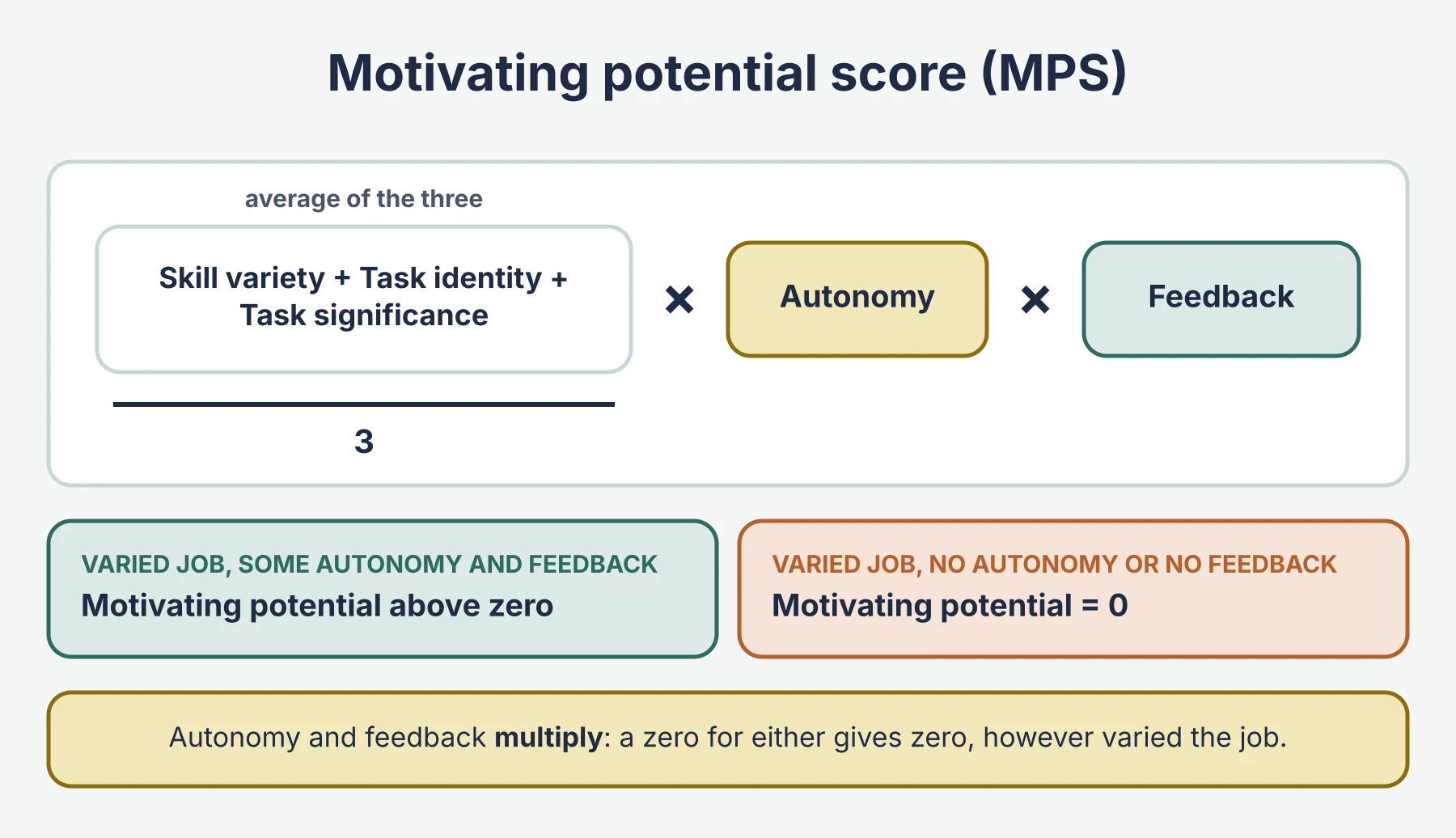
| Motivating potential score | (Variety + identity + significance) ÷ 3 × autonomy × feedback |
| Job enrichment | Adding responsibility and control |
| Job enlargement | Adding tasks at the same level |
| Job rotation | Moving between jobs |
| JDI | Yes / no / ? responses to descriptions of five job facets |
| Constitutionalism | Workers’ rights such as privacy and fair treatment (QWL) |
| Sabotage | Deliberate damage to an organisation’s property, production or reputation |
| Job involvement | Identification with one’s job |
| Organisational commitment | Identification with the organisation |
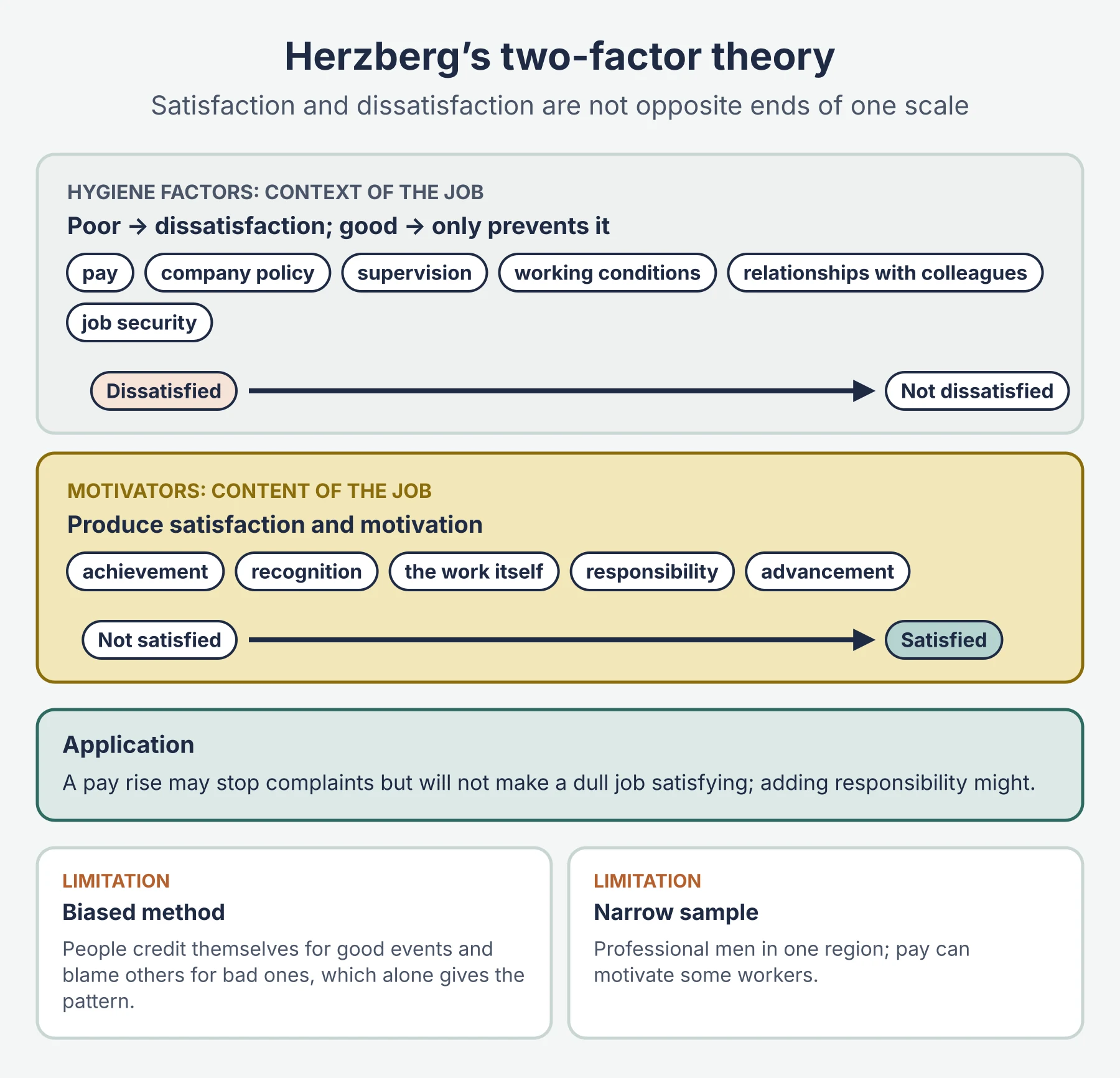
Herzberg in one table
| Hygiene factors (context) | Motivators (content) |
|---|---|
| Pay | Achievement |
| Company policy | Recognition |
| Supervision | The work itself |
| Working conditions | Responsibility |
| Relationships with colleagues | Advancement |
| Job security |
Herzberg and Hackman and Oldham compared
| Herzberg | Hackman and Oldham | |
|---|---|---|
| Key idea | Two separate sets of factors | Five characteristics lead to three states |
| Method behind it | Critical incidents from interviews | Ratings of job characteristics |
| Practical advice | Enrich jobs with motivators; fix hygiene to stop complaints | Raise autonomy and feedback first, as they multiply the MPS |
| Main criticism | Self-serving bias in recalled incidents | Self-rated characteristics may reflect existing satisfaction |
JDI facets and QWL conditions
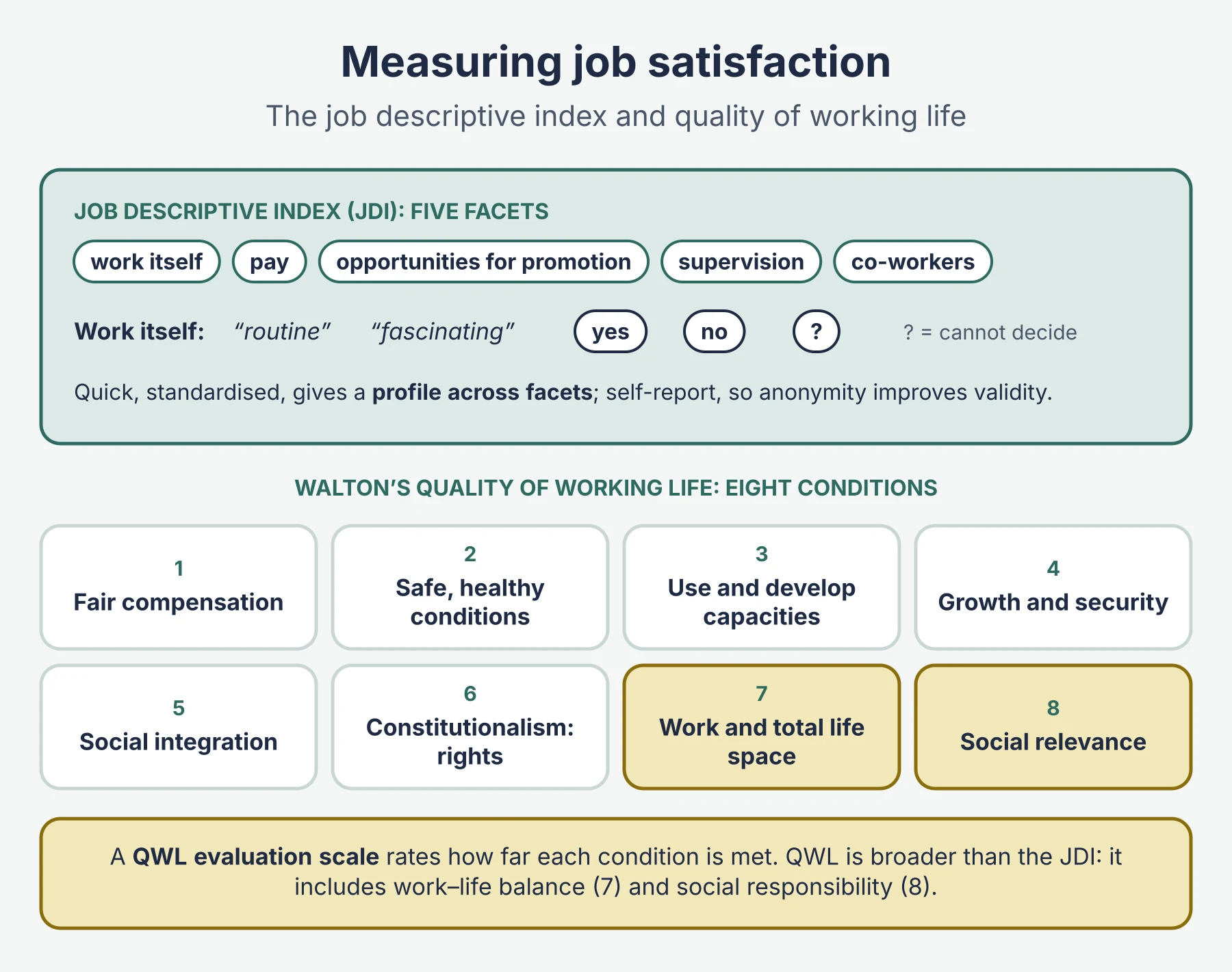
- JDI five facets: work itself, pay, promotion opportunities, supervision, co-workers.
- QWL eight conditions: fair compensation; safe and healthy conditions; use and development of capacities; growth and security; social integration; constitutionalism; work and total life space; social relevance.
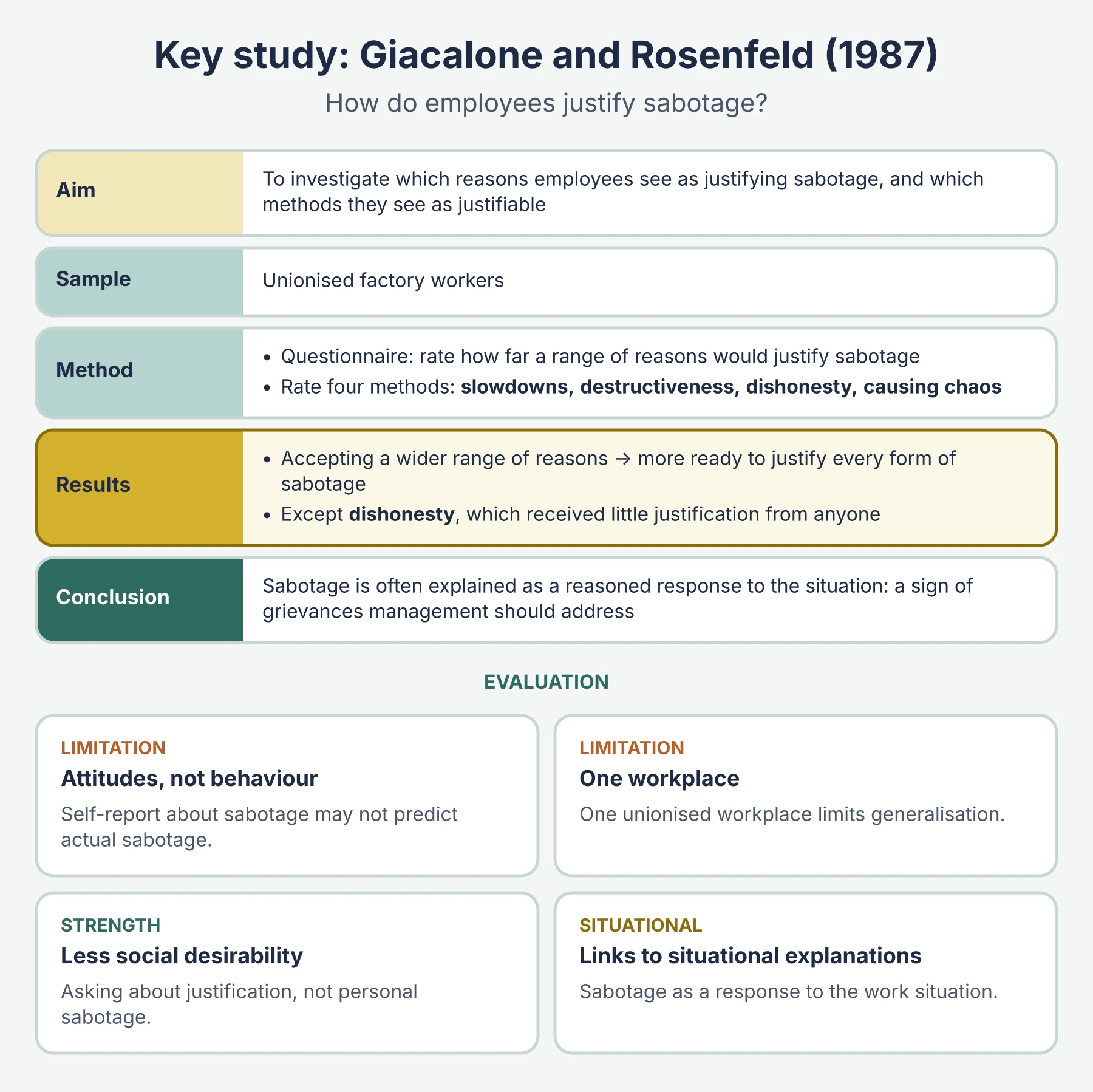
Key study grid: Giacalone and Rosenfeld (1987)
| Feature | Detail |
|---|---|
| Aim | How do employees justify sabotage? |
| Sample | Unionised factory workers |
| Method | Questionnaire rating reasons that would justify sabotage, and the justifiability of four methods |
| Four methods | Slowdowns, destructiveness, dishonesty, causing chaos |
| Results | Accepting more reasons meant justifying every method except dishonesty, which few justified |
| Conclusion | Sabotage is often presented as a reasoned response to the work situation |
| Weaknesses | Attitudes not behaviour; self-report; one workplace |
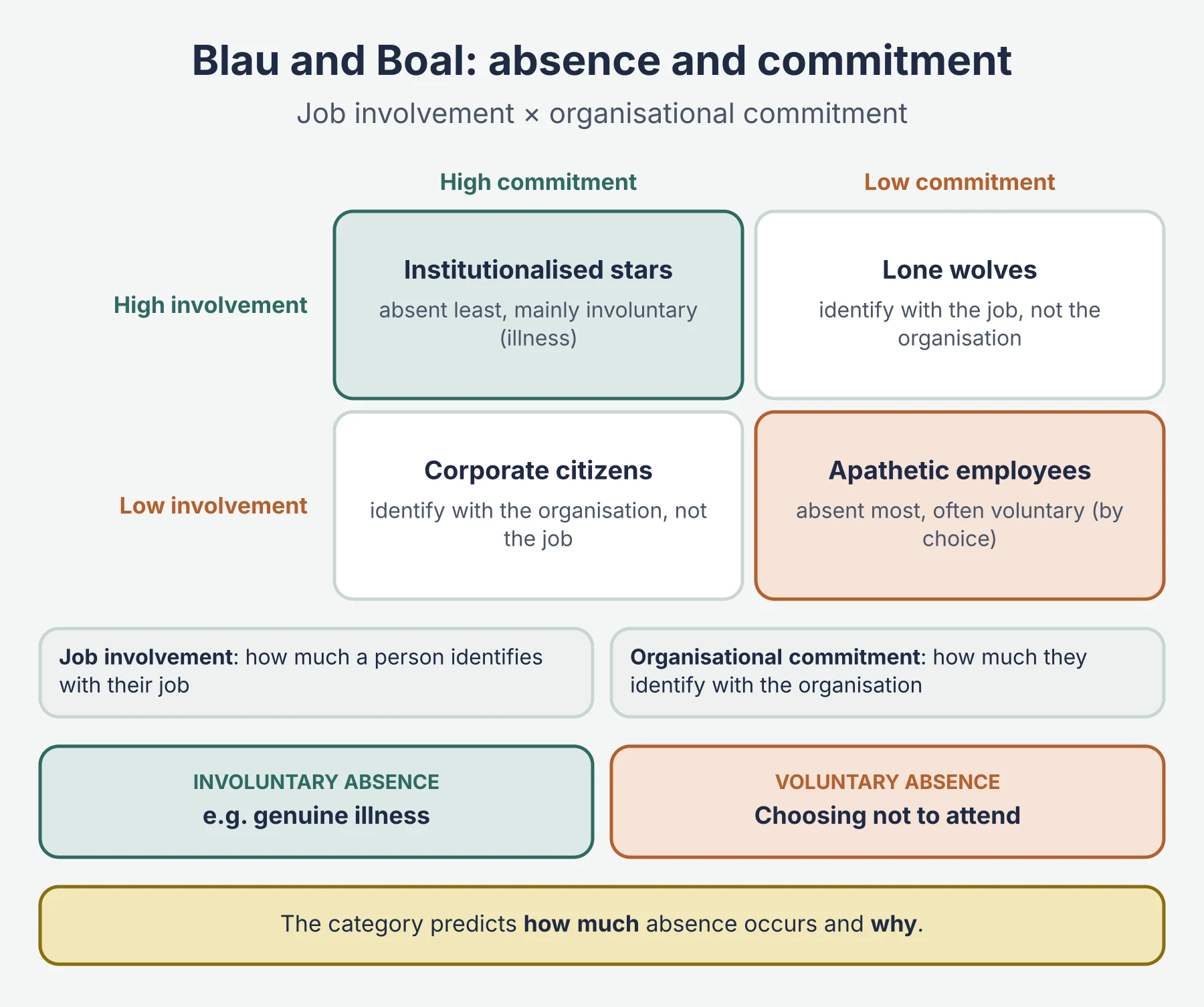
Blau and Boal’s four categories
| High organisational commitment | Low organisational commitment | |
|---|---|---|
| High job involvement | Institutionalised stars | Lone wolves |
| Low job involvement | Corporate citizens | Apathetic employees |
Apathetic employees are predicted to be absent most; institutionalised stars least.
Linking to issues and debates
- Cultural differences (4.5.1): Herzberg’s sample was American professionals; motivators may differ elsewhere.
- Reductionism versus holism (4.5.1): the MPS reduces a job to five numbers.
- Psychometrics, validity and reliability (4.5.2): JDI and QWL scales must be consistent and measure what they claim.
- Individual and situational explanations (4.5.3): sabotage reasons are situational; commitment categories are individual attitudes.
- Application to everyday life (4.5.1, 4.5.3): job redesign and attendance policies.
Exam traps
- Hygiene factors never create satisfaction in Herzberg’s theory.
- Autonomy and feedback multiply in the MPS; a zero on either gives zero.
- The JDI has three response options: yes, no and “?”.
- QWL has eight conditions; constitutionalism and social relevance are often forgotten.
- Giacalone and Rosenfeld measured justification, not acts of sabotage.
- Lone wolves are involved in the job but not committed to the organisation, not the reverse.
Quick self-test
- What research technique did Herzberg use?
- Give three hygiene factors and three motivators.
- Which three job characteristics produce experienced meaningfulness?
- Which characteristic produces knowledge of results?
- Distinguish job enrichment from job enlargement.
- Name the five JDI facets.
- What responses can a worker give on the JDI?
- Name four of Walton’s QWL conditions.
- What were the four methods of sabotage in Giacalone and Rosenfeld?
- Which method received little justification?
- Name Blau and Boal’s four categories.
- Which category is predicted to be absent most?
Answers
- The critical incident technique.
- Hygiene: any three of pay, policy, supervision, conditions, relationships, security. Motivators: any three of achievement, recognition, the work itself, responsibility, advancement.
- Skill variety, task identity, task significance.
- Feedback.
- Enrichment adds responsibility and control; enlargement adds more tasks at the same level.
- Work itself, pay, promotion opportunities, supervision, co-workers.
- Yes, no or “?” (cannot decide).
- Any four: fair compensation; safe and healthy conditions; use and development of capacities; growth and security; social integration; constitutionalism; work and total life space; social relevance.
- Slowdowns, destructiveness, dishonesty, causing chaos.
- Dishonesty.
- Institutionalised stars, lone wolves, corporate citizens, apathetic employees.
- Apathetic employees.
More resources on this topic
Related resources
-
Study guides
Cambridge A Level Psychology 9990: Organisational Psychology (Specialist Option 4)
Study guide to Cambridge A Level Psychology 9990 Organisational Psychology: motivation, leadership, groups, work conditions and job satisfaction, 4.1 to 4.5.
Psychology · Cambridge · A Level
Read guide -
Practice questions
Cambridge A Level Psychology 9990: Organisational Psychology — Practice Questions
Original Paper 3 and Paper 4 style questions with mark-scheme answers for Cambridge 9990 Organisational Psychology: motivation, leaders, groups, satisfaction.
Psychology · Cambridge · A Level
Try questions -
Revision notes
Cambridge A Level Psychology 9990: Organisational Psychology — Revision Notes
Condensed revision notes for Cambridge 9990 Organisational Psychology: theory lists, key terms, key studies, comparisons and a self-test for topics 4.1 to 4.5.
Psychology · Cambridge · A Level
Revise topic
Studying Psychology?
This page is free and stays free. Marlbridge is not offering Psychology classes at the moment, so there is no tuition to book for it. The free study resources stay open to everyone.
Get free revision emails (optional)
Occasional emails with practice questions, worked explanations and links to free resources for the qualification and subjects you choose. No spam, and you can unsubscribe from any email. The free tools on this site never need an email.