
Study Guides
Cambridge A Level Psychology (9990): Satisfaction at work
Cambridge 9990 topic 4.5 in depth: Herzberg, job characteristics, job design, the JDI and QWL, Giacalone and Rosenfeld (1987), Blau and Boal.
- Subject
- Psychology
- Level
- A LEVEL
- Topic
- Specialist Option 4: Organisational Psychology
- Author
- Marlbridge Academic Team
- Updated
- Reviewed by
- Kanwal Aslam (what this means)
Aligned to Cambridge A Level Psychology (9990), 2024-2026. Official specification .
Syllabus page (what it covers and how it is assessed): Cambridge A Level Psychology.
Syllabus points this page covers
9990 (A Level)
- 4.5 Satisfaction at work
Topic 4.5, Satisfaction at work, completes Specialist Option 4 (Organisational Psychology) in Cambridge International A Level Psychology 9990, syllabus for 2024 to 2026. It covers theories of job satisfaction and techniques of job design (4.5.1), ways of measuring satisfaction (4.5.2), and attitudes to work shown through sabotage and absence (4.5.3). The key study is Giacalone and Rosenfeld (1987) on reasons for employee sabotage.
The Organisational Psychology study guide summarises the topic. This guide explains each theory, measure and model more fully, shows how they connect and gives an annotated answer. Use it with the satisfaction at work revision notes and the satisfaction at work practice questions.
Syllabus content for 4.5
| Sub-topic | Content | Named study |
|---|---|---|
| 4.5.1 Theories of job satisfaction | Herzberg’s two-factor theory (hygiene and motivational factors); Hackman and Oldham’s job characteristics theory (job characteristics and psychological states); job design: enrichment, rotation, enlargement | e.g. Belias and Sklikas (2013) |
| 4.5.2 Measuring job satisfaction | Rating scales and questionnaires, focusing on the job descriptive index (JDI); Walton’s quality of working life (QWL), eight conditions and QWL evaluation scale | none named |
| 4.5.3 Attitudes to work | Workplace sabotage: methods and reasons; Blau and Boal’s absenteeism and organisational commitment model: types of absence, categories of commitment | Key study Giacalone and Rosenfeld (1987) |
4.5.1 Herzberg’s two-factor theory
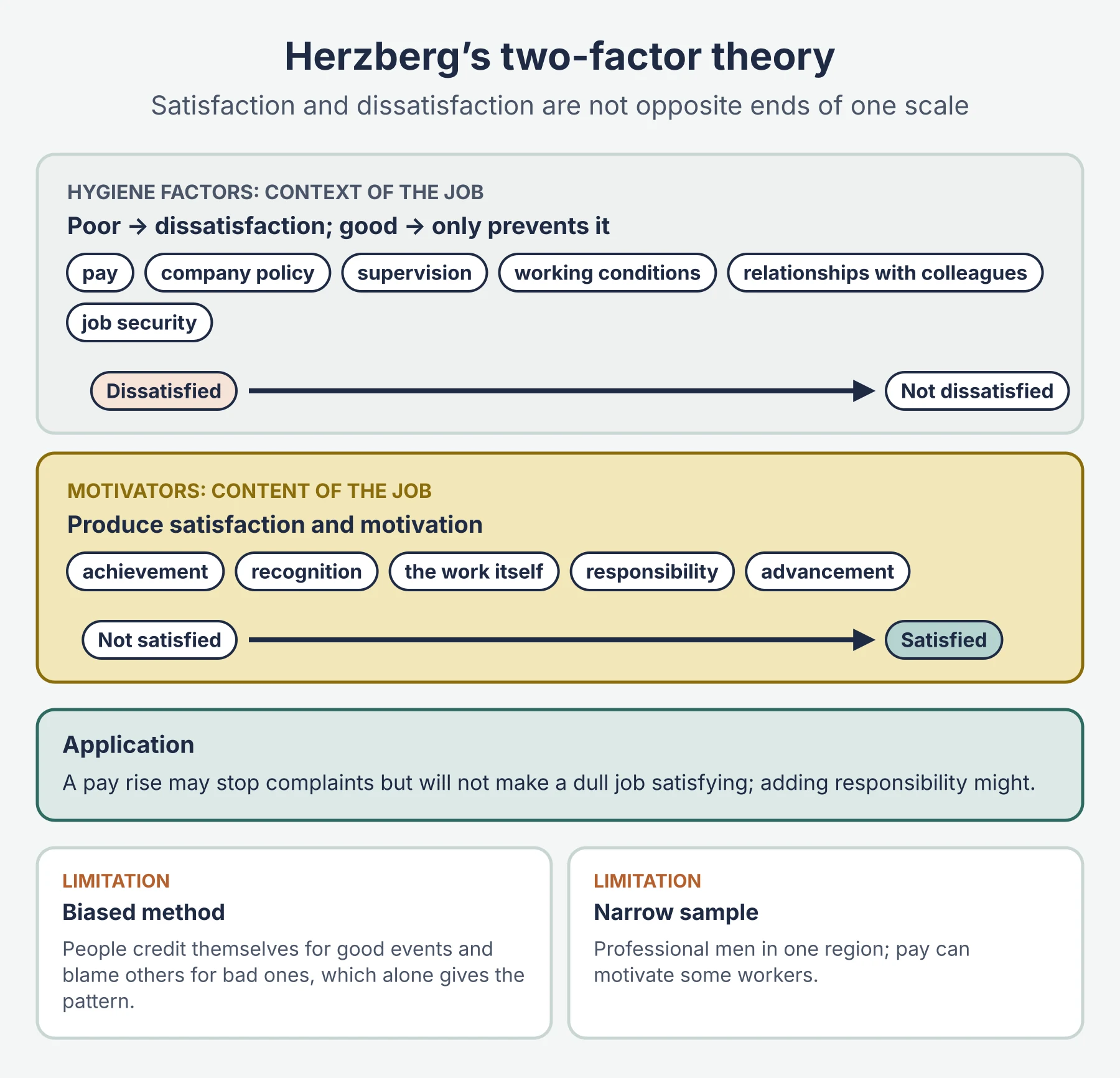
Herzberg asked engineers and accountants to describe times when they had felt exceptionally good or exceptionally bad about their jobs (the critical incident technique). The events behind good feelings were different from those behind bad feelings, so he proposed that satisfaction and dissatisfaction are not opposite ends of one scale.
- Hygiene factors relate to the context of the job: pay, company policy, supervision, working conditions, relationships with colleagues and job security. If poor, they cause dissatisfaction; if good, they prevent dissatisfaction but do not create satisfaction.
- Motivators relate to the content of the job: achievement, recognition, the work itself, responsibility and advancement. These produce satisfaction and motivation.
Application: a pay rise may stop complaints but will not make a dull job satisfying; adding responsibility might.
Evaluation: the method may be biased, because people tend to credit themselves for good events (achievement) and blame others for bad ones (supervision, policy), which would produce the two-factor pattern by itself. The original sample was narrow: professional men in one region. Pay can motivate some workers, which the theory underplays.
4.5.1 Hackman and Oldham’s job characteristics theory
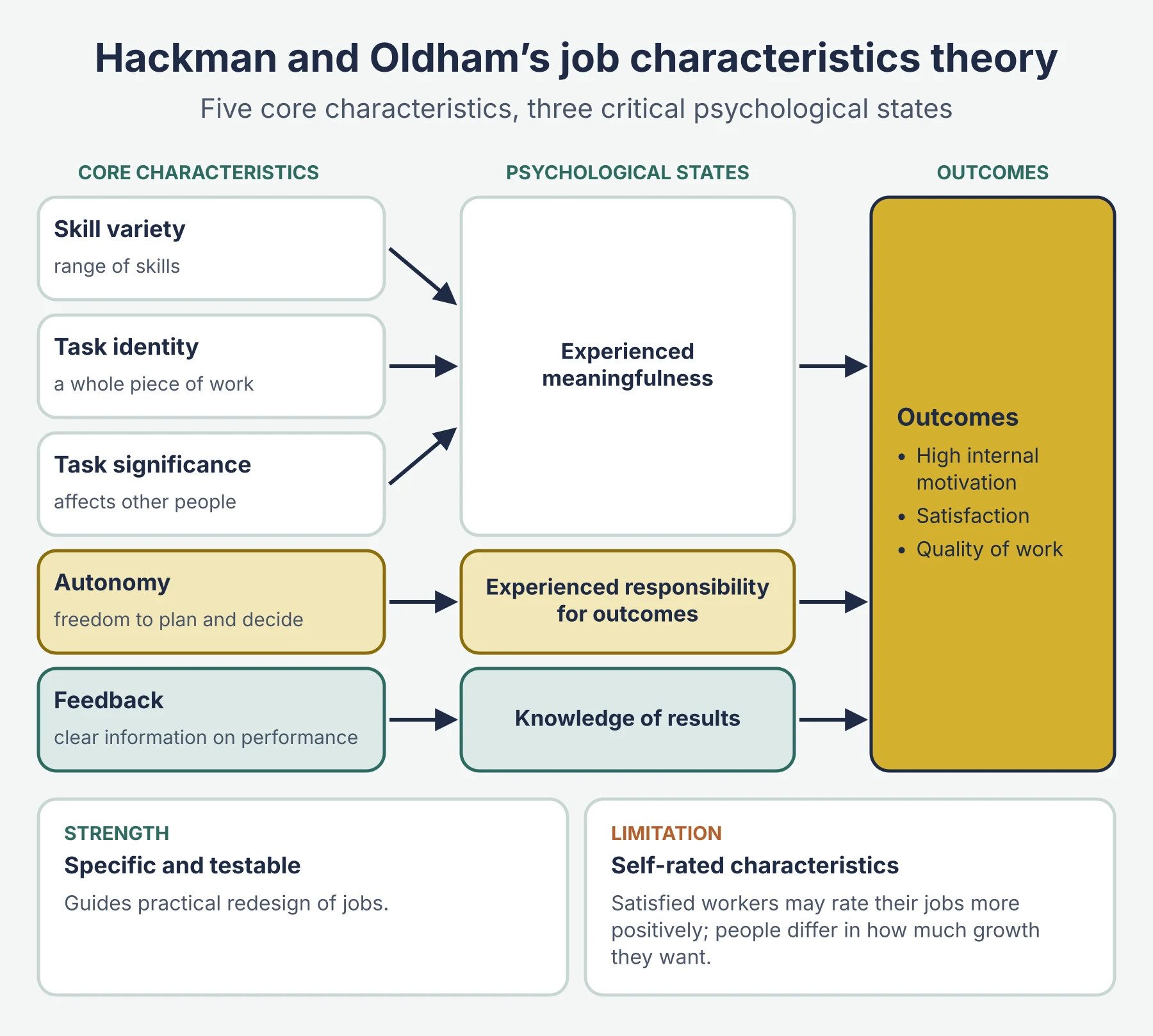
Hackman and Oldham proposed that five core job characteristics produce three critical psychological states, which lead to outcomes such as high internal motivation, satisfaction and quality of work.
| Core characteristic | Meaning | Psychological state |
|---|---|---|
| Skill variety | The job uses a range of skills | Experienced meaningfulness |
| Task identity | Completing a whole, identifiable piece of work | Experienced meaningfulness |
| Task significance | The job affects other people | Experienced meaningfulness |
| Autonomy | Freedom to plan and decide how to do the work | Experienced responsibility for outcomes |
| Feedback | Clear information about performance | Knowledge of results |
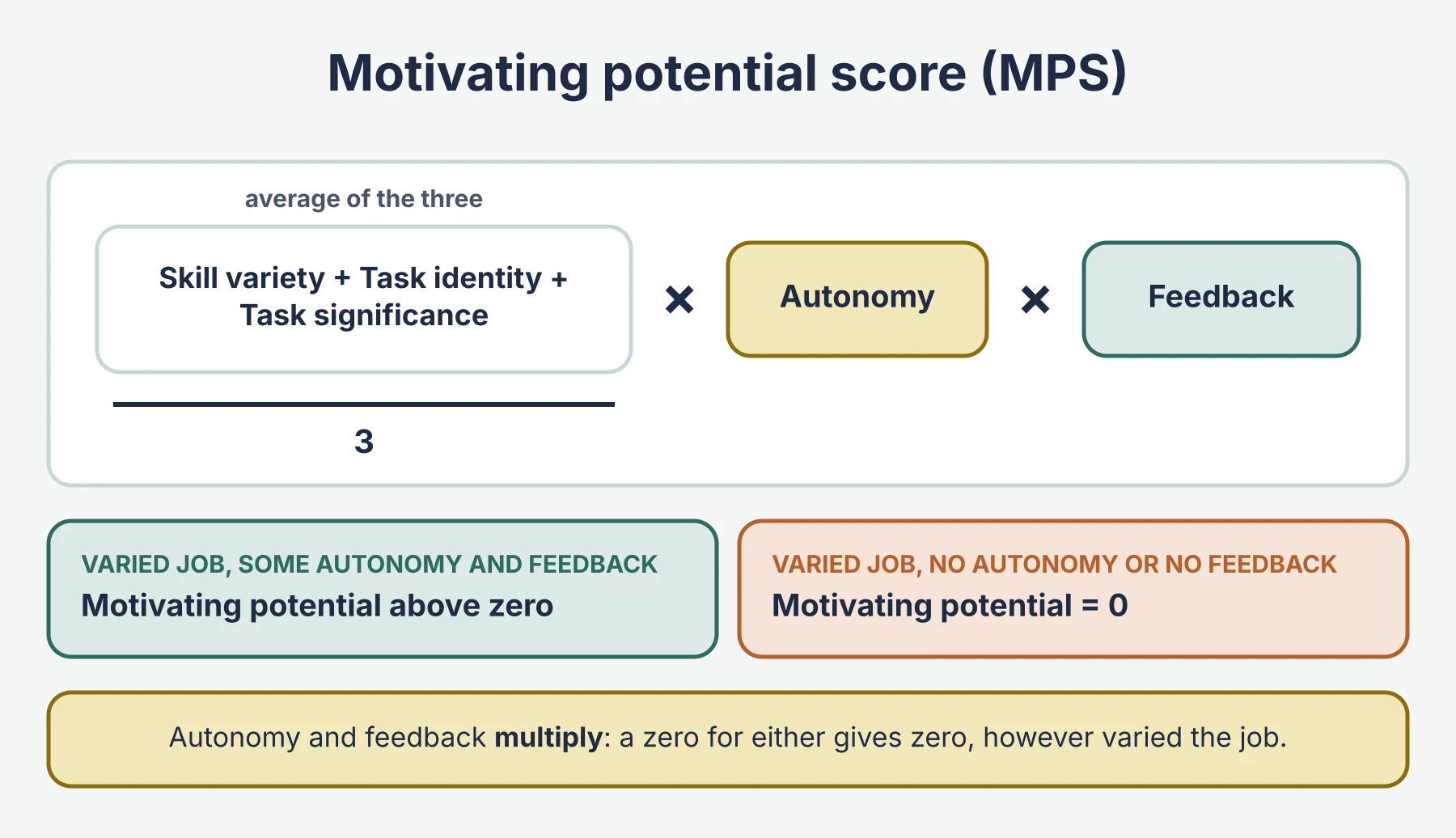
The theory also proposes a motivating potential score (MPS): the average of skill variety, task identity and task significance, multiplied by autonomy and by feedback. Because autonomy and feedback multiply, a job with none of either has a motivating potential of zero, however varied it is.
Evaluation: the model is specific and testable, and it guides practical redesign; but characteristics are usually rated by job holders themselves, so satisfied workers may simply rate their jobs more positively. Individuals differ in how much they want growth from their work.
4.5.1 Techniques of job design
| Technique | What changes | Example |
|---|---|---|
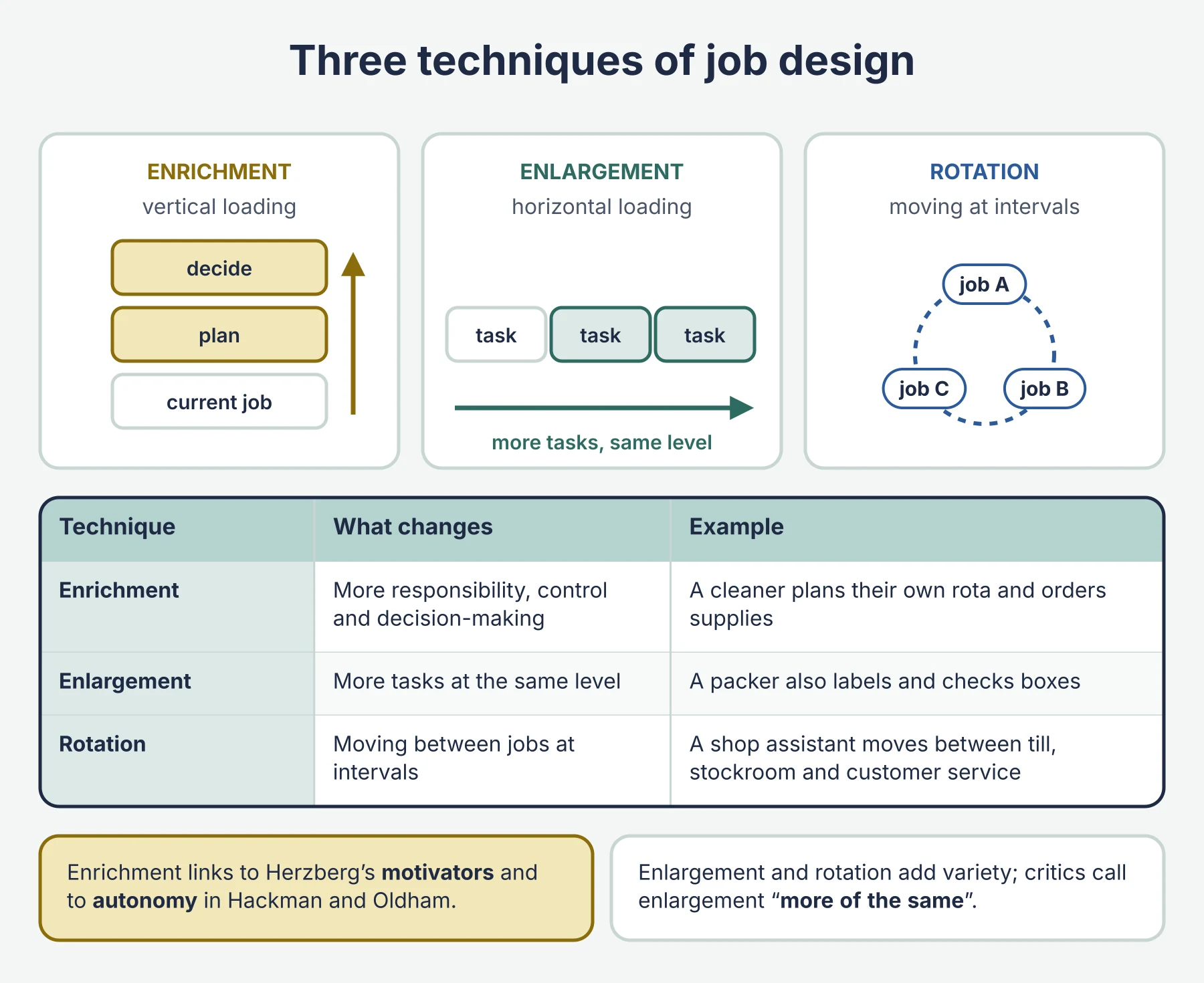
| Job enrichment (vertical loading) | More responsibility, control and decision-making | A cleaner plans their own rota and orders supplies |
| Job enlargement (horizontal loading) | More tasks at the same level | A packer also labels and checks boxes |
| Job rotation | Moving between jobs at intervals | A shop assistant moves between till, stockroom and customer service |
Enrichment links to Herzberg’s motivators and to autonomy in Hackman and Oldham. Enlargement and rotation add variety but critics describe enlargement as “more of the same”. Belias and Sklikas (2013) is the syllabus example discussing these techniques.
4.5.2 Measuring job satisfaction
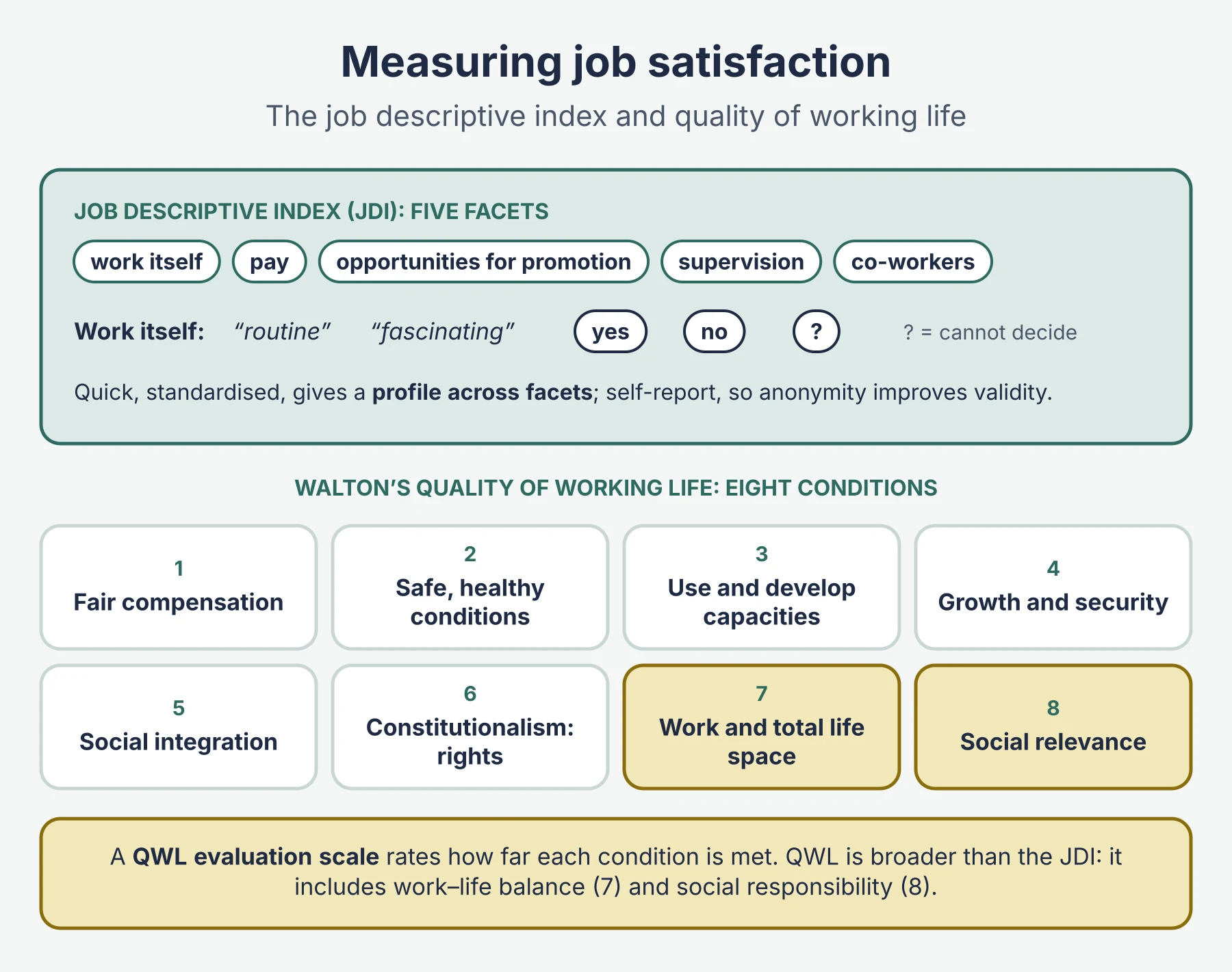
The Job Descriptive Index (JDI) measures satisfaction with five facets of the job: the work itself, pay, opportunities for promotion, supervision and co-workers. For each facet, the worker reads a list of adjectives or short phrases (such as “routine” or “fascinating”) and answers “yes”, “no” or “?” (cannot decide). It is quick, standardised and gives a profile across facets rather than one overall number, which helps an organisation see what to fix. Because it is self-report, answers may be affected by social desirability or by fear that managers will see them, so anonymity improves validity.
Walton’s quality of working life (QWL) identifies eight conditions:
- Adequate and fair compensation.
- Safe and healthy working conditions.
- Opportunity to use and develop human capacities.
- Opportunity for continued growth and security.
- Social integration in the work organisation.
- Constitutionalism: rights such as privacy, free speech and fair treatment.
- Work and the total life space: balance between work and the rest of life.
- Social relevance of work life: the organisation behaves responsibly in society.
A QWL evaluation scale asks employees to rate how far each condition is met. Compared with the JDI, QWL takes a broader view, including work–life balance and the organisation’s social responsibility.
4.5.3 Workplace sabotage
Sabotage is deliberate behaviour intended to damage an organisation’s property, products, production or reputation. Methods range from slowing work down to destroying equipment.
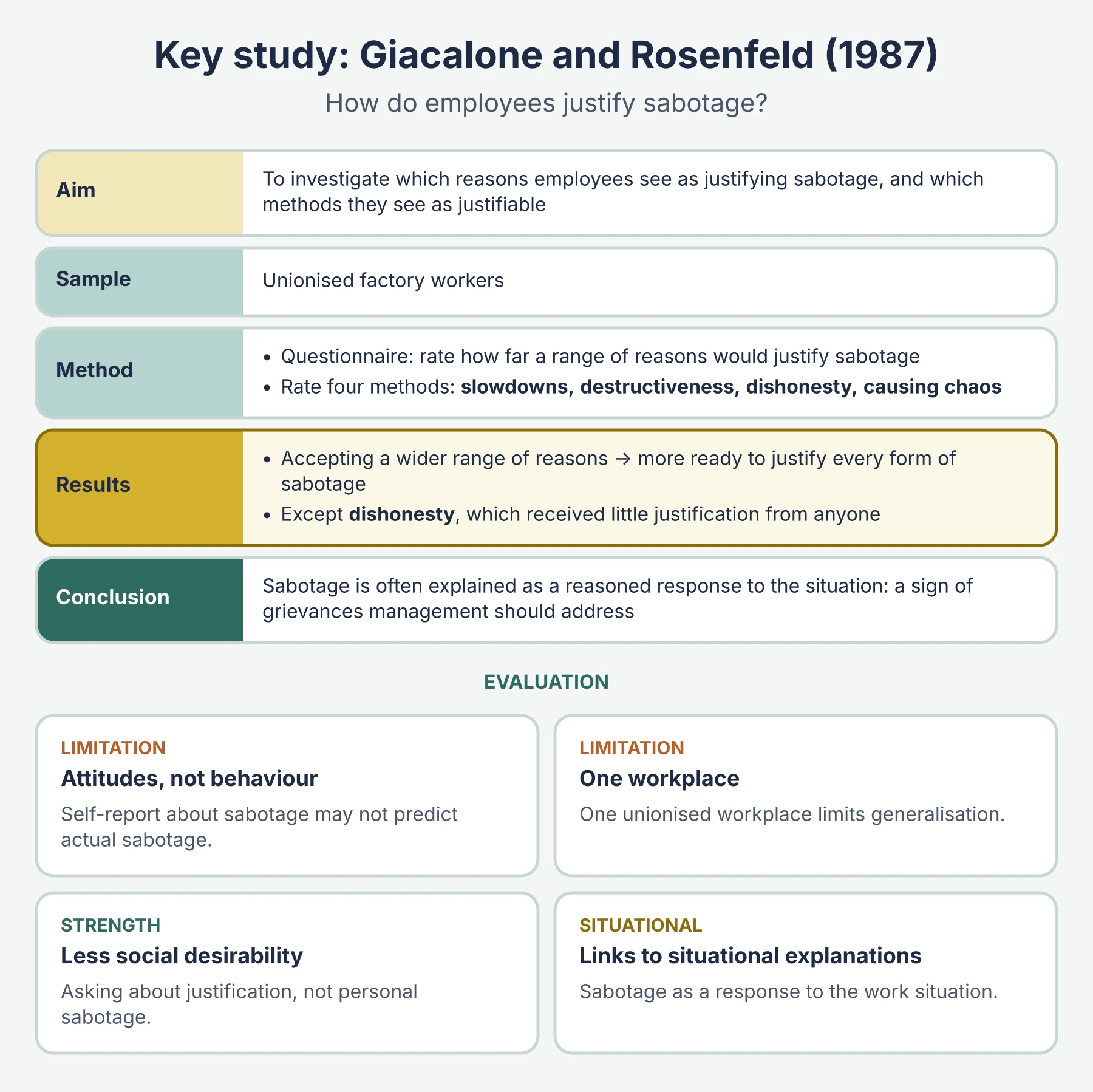
Key study: Giacalone and Rosenfeld (1987).
- Aim: to investigate how employees justify sabotage, by examining which reasons they see as justifying it and which methods they see as justifiable.
- Sample: unionised factory workers.
- Method: a questionnaire in which workers rated how far a range of reasons would justify sabotage, and how justifiable four general methods were: slowdowns, destructiveness, dishonesty and causing chaos.
- Results: workers who accepted a wider range of reasons were more ready to justify every form of sabotage except dishonesty, which received little justification from anyone.
- Conclusion: employees often explain sabotage as a reasoned response to their situation, so it can be seen as a sign of grievances that management should address.
Evaluation. The study links to the situational explanation of behaviour. It measures attitudes about sabotage through self-report, not actual sabotage, so it may not predict behaviour. The sample came from one unionised workplace, limiting generalisation. Asking about justification rather than personal sabotage may reduce social desirability bias.
4.5.3 Blau and Boal’s model of absenteeism and commitment
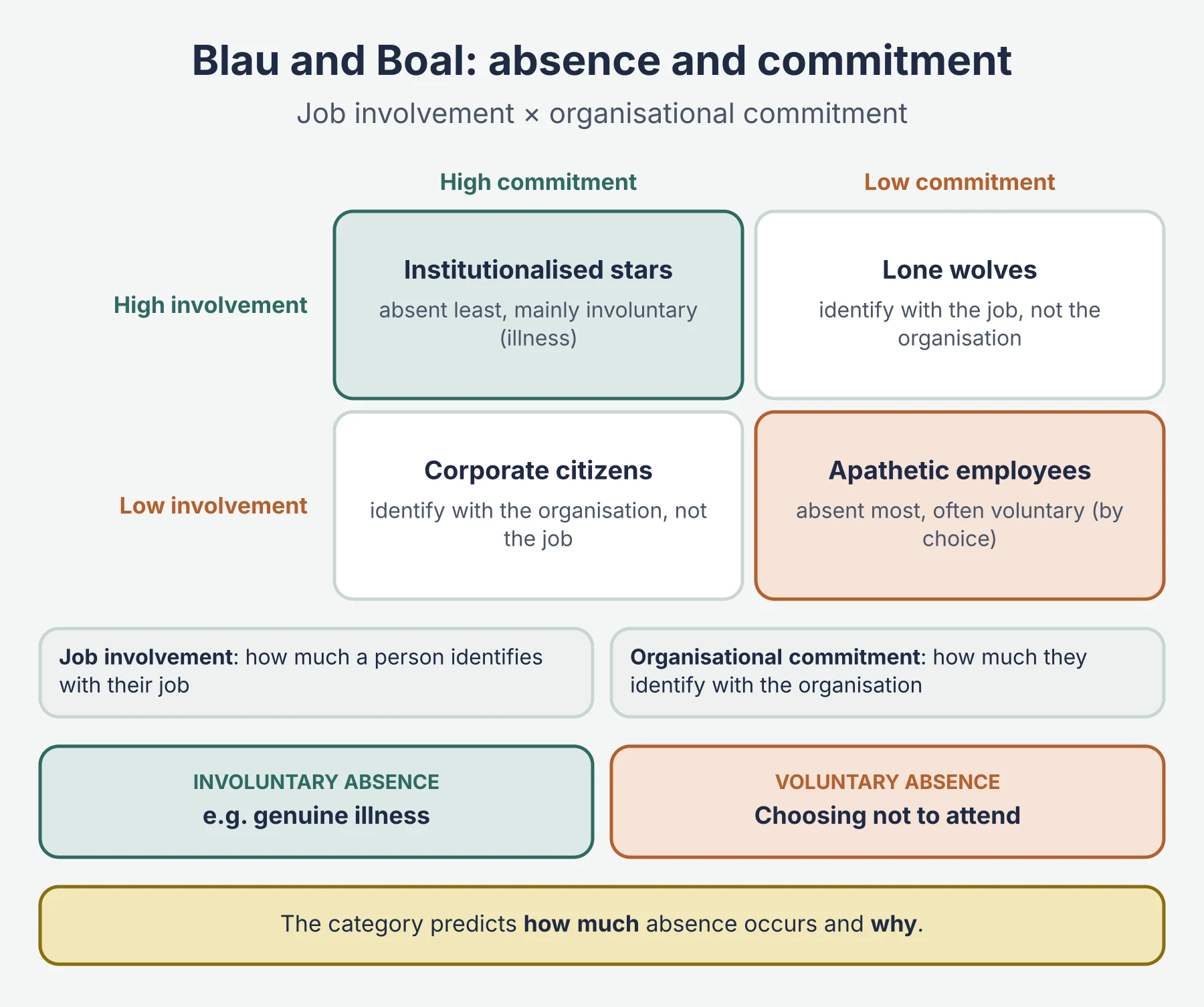
Blau and Boal combined two attitudes: job involvement (how much a person identifies with their job) and organisational commitment (how much they identify with the organisation). This gives four categories:
| Category | Job involvement | Organisational commitment |
|---|---|---|
| Institutionalised stars | High | High |
| Lone wolves | High | Low |
| Corporate citizens | Low | High |
| Apathetic employees | Low | Low |
The model predicts that the category affects how much absence occurs and why. Institutionalised stars are expected to be absent least, mainly for unavoidable reasons such as illness. Apathetic employees, with no attachment to the job or the organisation, are expected to be absent most, often by choice. Distinguishing involuntary absence (such as genuine illness) from voluntary absence (choosing not to attend) is central to applying the model.
Annotated answer: a 4-mark application
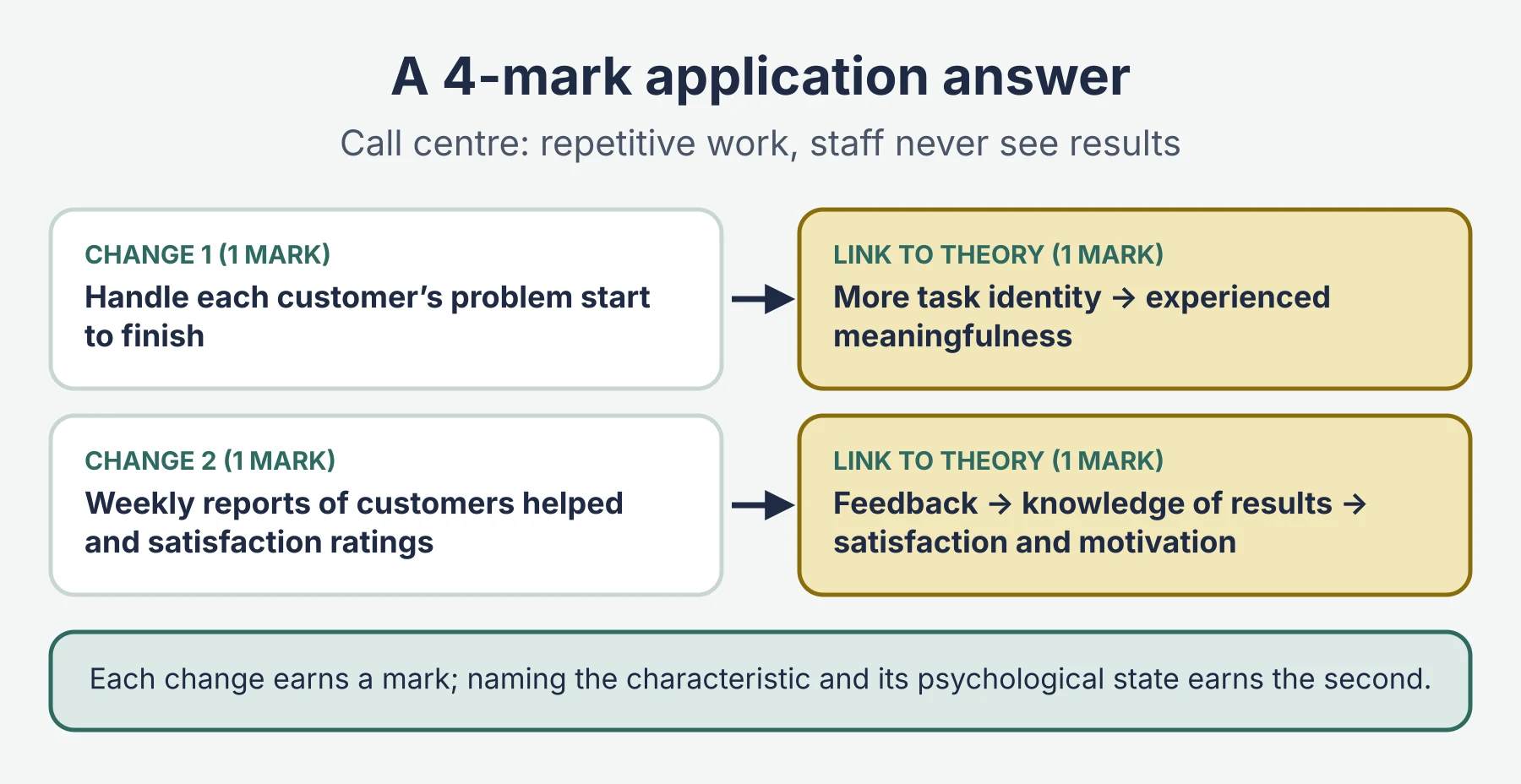
A bank’s call centre has high staff turnover. Staff say the work is repetitive and they never see the results of their efforts. Using Hackman and Oldham’s theory, suggest two changes. [4]
“Increase task identity by letting each employee handle a customer’s problem from start to finish rather than passing it on (1); this increases experienced meaningfulness (1). Give regular feedback, for example weekly reports of customers helped and satisfaction ratings (1); this gives knowledge of results, which the theory says increases satisfaction and motivation (1).”
Common mistakes
- Saying hygiene factors produce satisfaction. They only prevent dissatisfaction.
- Listing Hackman and Oldham’s characteristics without the psychological states.
- Confusing enrichment (more responsibility) with enlargement (more tasks).
- Writing that Giacalone and Rosenfeld measured actual sabotage. They measured how justifiable workers found it.
Exam technique
Describe questions on theories should include both parts (hygiene and motivators; characteristics and states). Evaluate using the syllabus issues: cultural differences and reductionism for 4.5.1; psychometrics, validity and reliability for 4.5.2; individual and situational explanations for 4.5.3. Suggest questions should name a technique and link it to the theory that predicts it will work.
More resources on this topic
- Satisfaction at work revision notes
- Satisfaction at work practice questions
- Organisational Psychology study guide
Official syllabus
Cambridge International AS & A Level Psychology 9990 syllabus for 2024, 2025 and 2026, Specialist Option 4: Organisational Psychology, topic 4.5 — cambridgeinternational.org.
Related resources
-
Practice questions
Cambridge A Level Psychology (9990): Satisfaction at work – Practice Questions
Original Paper 3 and Paper 4 style questions on Cambridge 9990 topic 4.5: satisfaction theories, measures, sabotage and absence, with answers.
Psychology · Cambridge · A Level
Try questions -
Revision notes
Cambridge A Level Psychology (9990): Satisfaction at work – Revision Notes
Revision notes for Cambridge 9990 topic 4.5: Herzberg, job characteristics, JDI, QWL, sabotage and Blau and Boal, with a self-test.
Psychology · Cambridge · A Level
Revise topic -
Study guides
Cambridge A Level Psychology 9990: Organisational Psychology (Specialist Option 4)
Study guide to Cambridge A Level Psychology 9990 Organisational Psychology: motivation, leadership, groups, work conditions and job satisfaction, 4.1 to 4.5.
Psychology · Cambridge · A Level
Read guide
Studying Psychology?
This page is free and stays free. Marlbridge is not offering Psychology classes at the moment, so there is no tuition to book for it. The free study resources stay open to everyone.
Get free revision emails (optional)
Occasional emails with practice questions, worked explanations and links to free resources for the qualification and subjects you choose. No spam, and you can unsubscribe from any email. The free tools on this site never need an email.