
Revision Notes
Cambridge A Level Psychology (9990): Organisational work conditions – Revision Notes
Revision notes for Cambridge 9990 topic 4.4: Hawthorne effect, open-plan offices, shifts, errors, token economy and Swat (1997), with a self-test.
- Subject
- Psychology
- Level
- A LEVEL
- Topic
- Specialist Option 4: Organisational Psychology
- Author
- Marlbridge Academic Team
- Updated
- Reviewed by
- Kanwal Aslam (what this means)
Aligned to Cambridge A Level Psychology (9990), 2024-2026. Official specification .
Syllabus page (what it covers and how it is assessed): Cambridge A Level Psychology.
Syllabus points this page covers
9990 (A Level)
- 4.4 Organisational work conditions
These notes condense topic 4.4, Organisational work conditions, from Specialist Option 4 of Cambridge International A Level Psychology 9990 (syllabus for 2024 to 2026). The topic has three parts: the physical environment, working time, and health and safety.
The work conditions study guide gives full explanations and an annotated answer. Practise with the work conditions practice questions.
Topic map
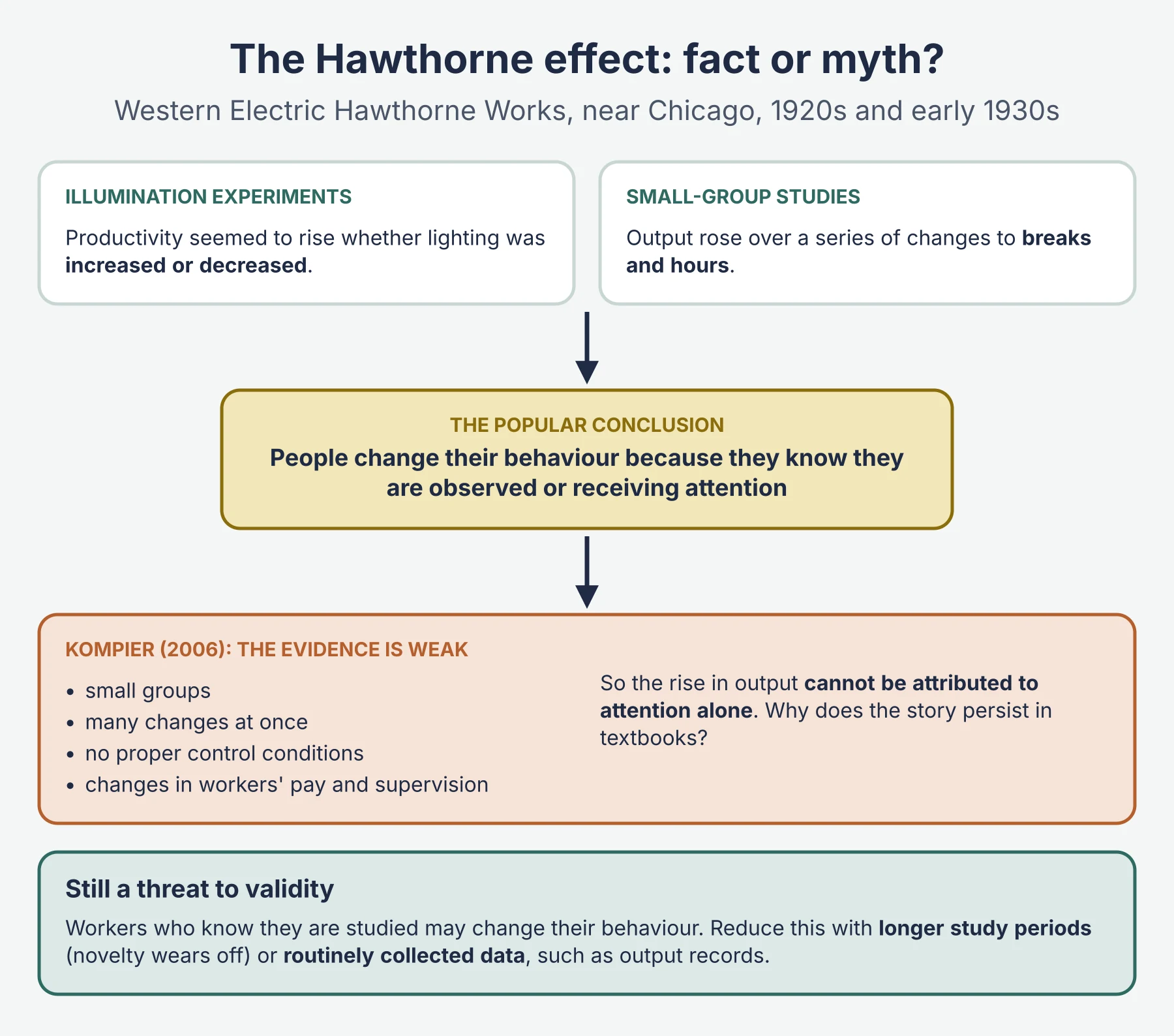
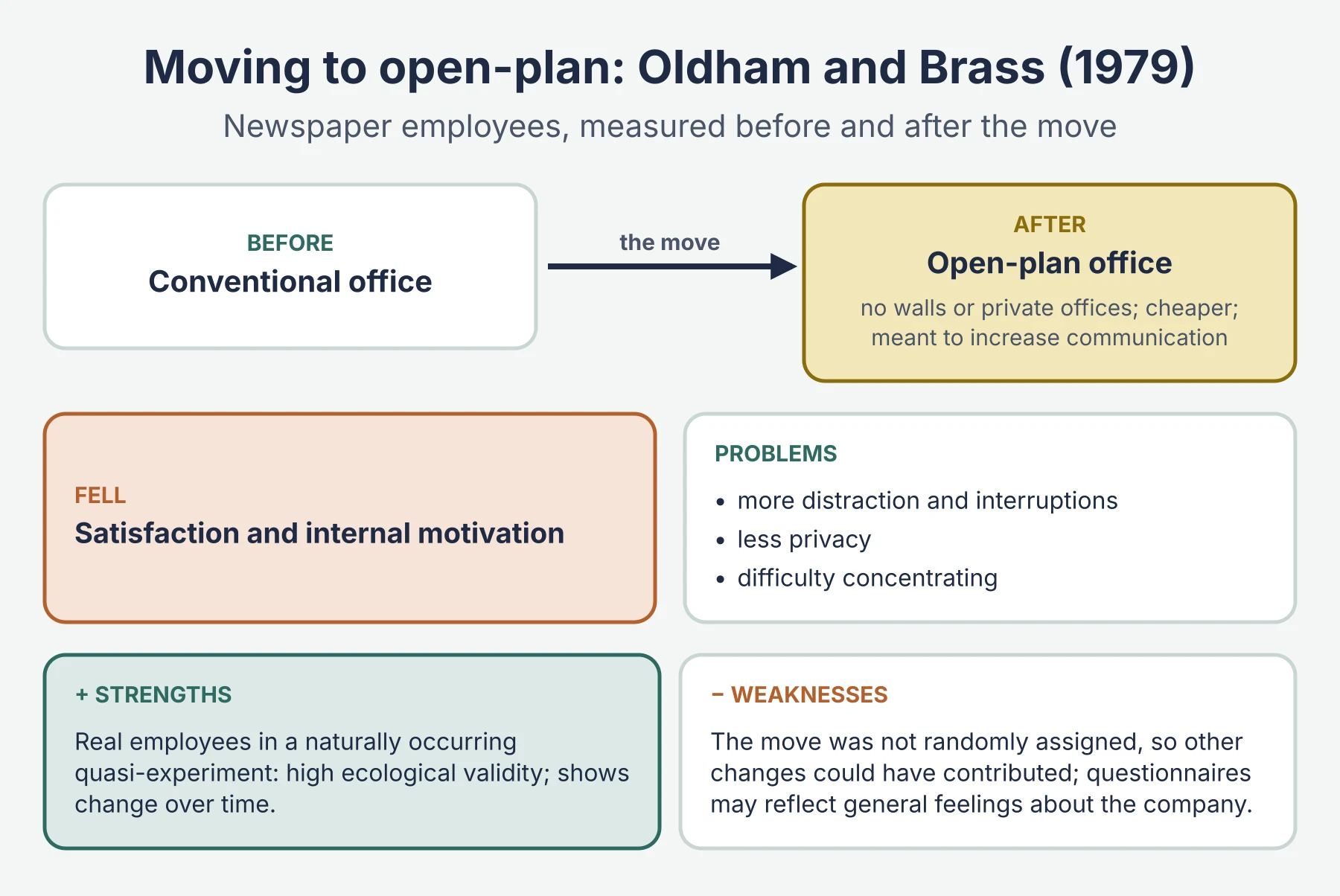
- 4.4.1 Physical: productivity and the Hawthorne effect (e.g. Kompier, 2006); open-plan offices (e.g. Oldham and Brass, 1979).
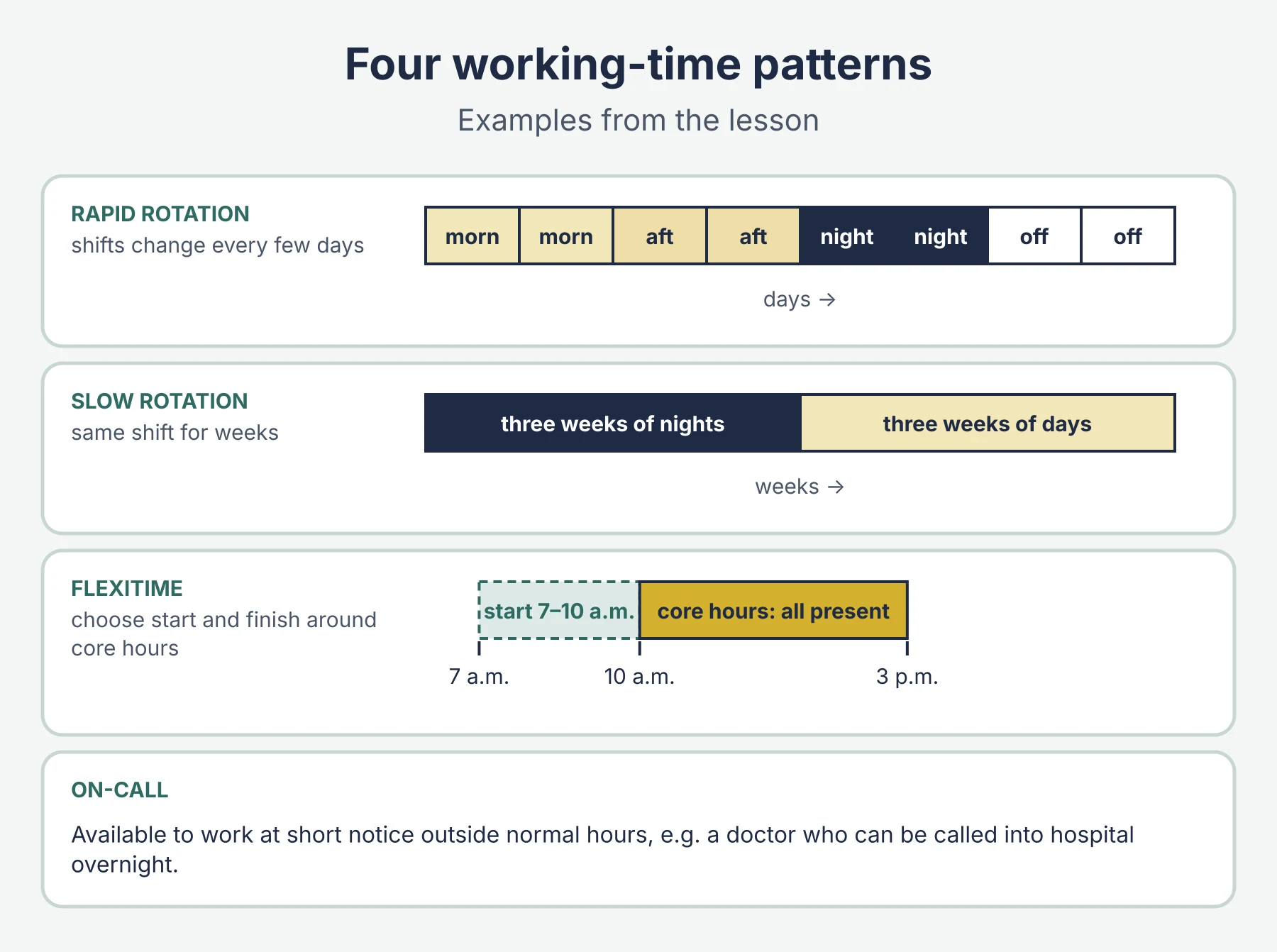
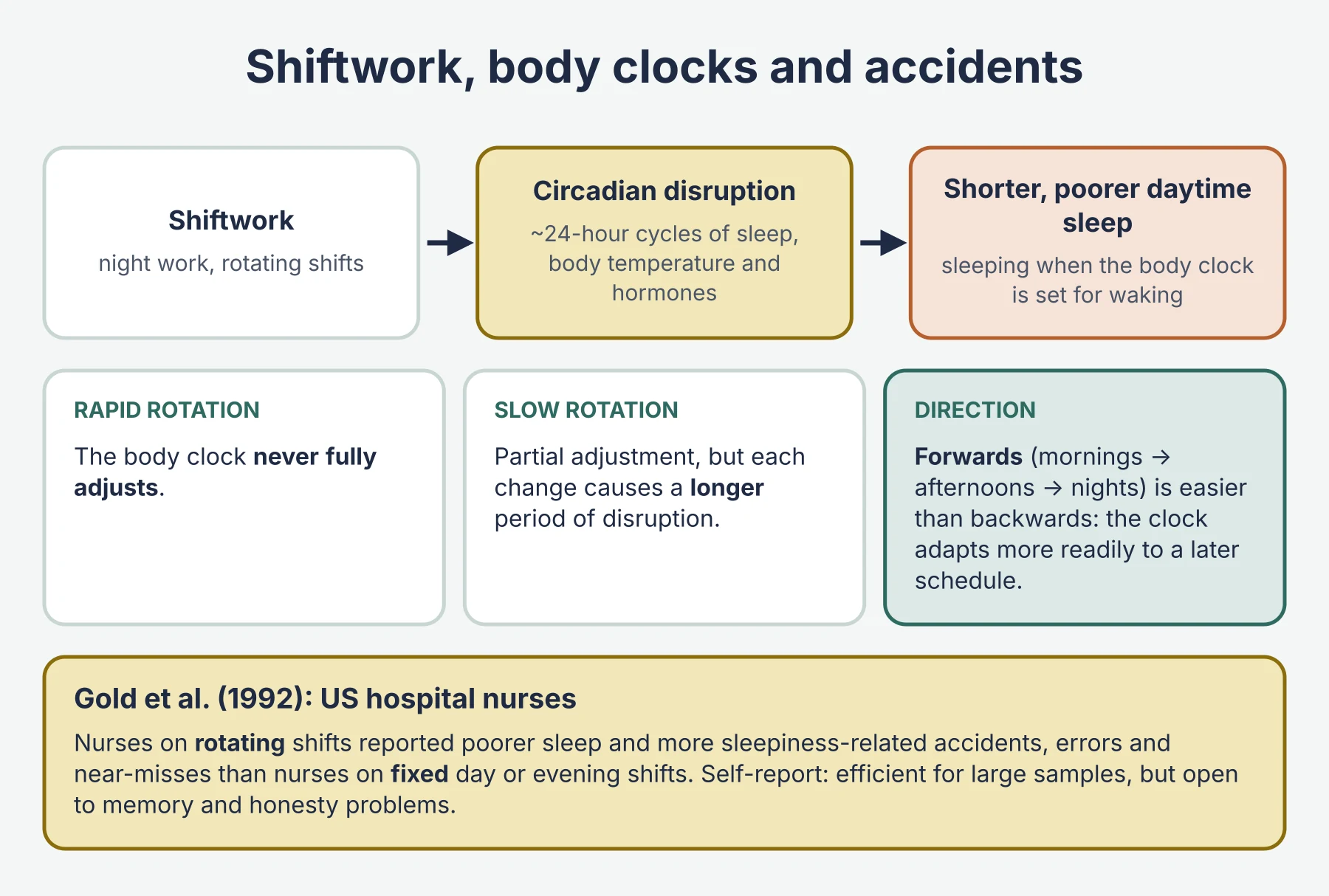
- 4.4.2 Temporal: rapid rotation, slow rotation, on-call, flexitime; effects of shiftwork on health and accidents (e.g. Gold et al., 1992).
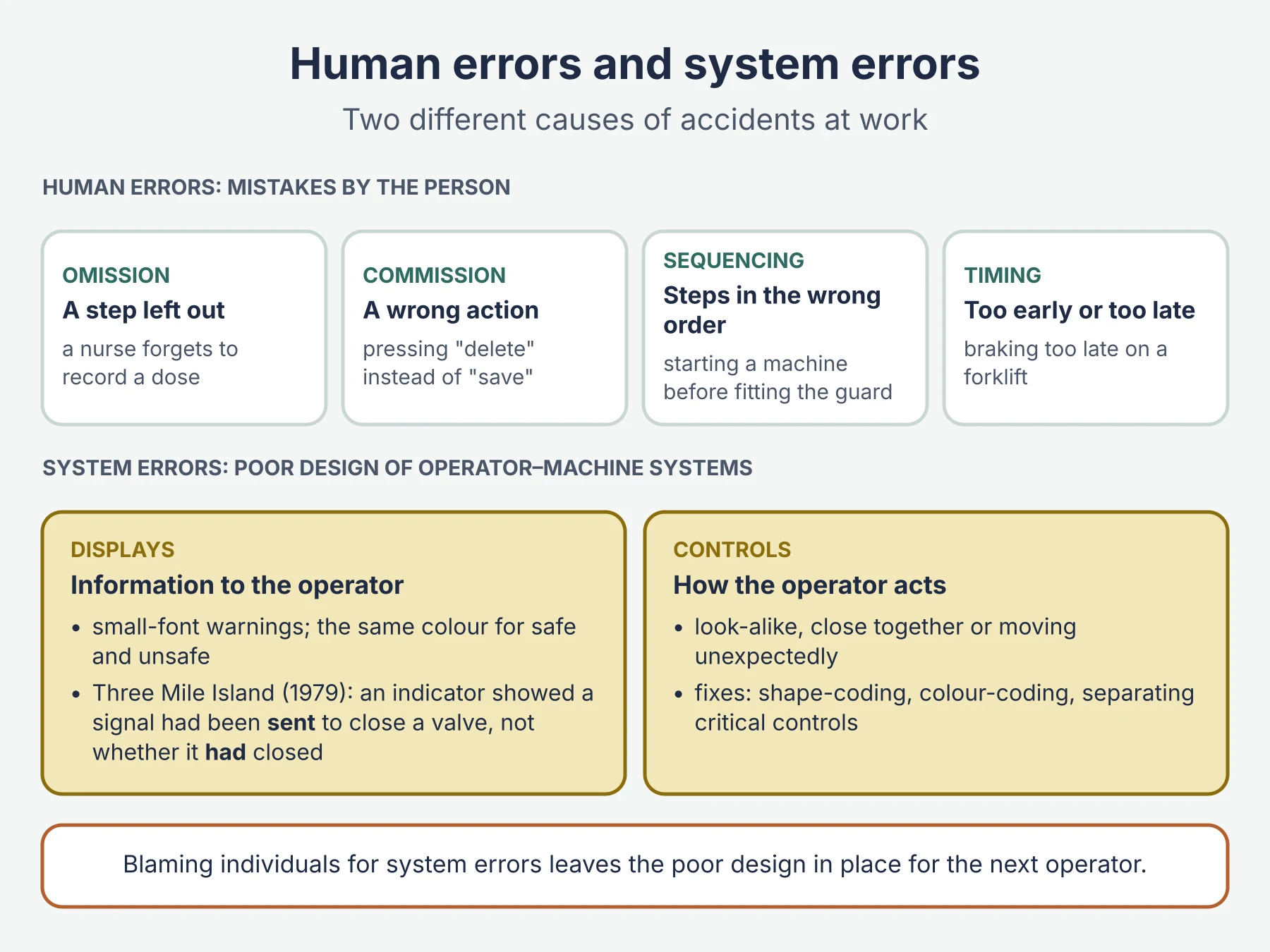
- 4.4.3 Health and safety: human errors (omission, commission, sequencing, timing); system errors (controls, displays); token economy (e.g. Fox et al., 1987); monitoring accidents, key study Swat (1997).
Key terms
| Term | Definition |
|---|---|
| Hawthorne effect | Behaviour changes because people know they are being studied |
| Open-plan office | Shared workspace without walls or private offices |
| Quasi-experiment | The independent variable occurs naturally rather than being assigned |
| Rapid rotation | Shift changes every few days |
| Slow rotation | Same shift for weeks before changing |
| On-call | Available to work at short notice |
| Flexitime | Choice of start and finish times around core hours |
| Circadian rhythm | A roughly 24-hour biological cycle, e.g. sleep–wake |
| Error of omission | Leaving out a required step |
| Error of commission | Performing a wrong action |
| Sequencing error | Steps in the wrong order |
| Timing error | Action too early or too late |
| Display | Part of a machine that gives information to the operator |
| Control | Part of a machine the operator uses to act |
| Token economy | Tokens for target behaviour, exchanged for rewards |
| Housekeeping | Keeping work areas tidy, clear and well maintained |
Studies to name
| Study | Sub-topic | Main point |
|---|---|---|
| Kompier (2006) | 4.4.1 | The Hawthorne effect as usually told is a myth based on flawed studies |
| Oldham and Brass (1979) | 4.4.1 | Move to open-plan reduced satisfaction and internal motivation |
| Gold et al. (1992) | 4.4.2 | Rotating-shift nurses reported poorer sleep and more sleepiness-related accidents and errors |
| Fox et al. (1987) | 4.4.3 | Token economy cut days lost to accidents in two mines |
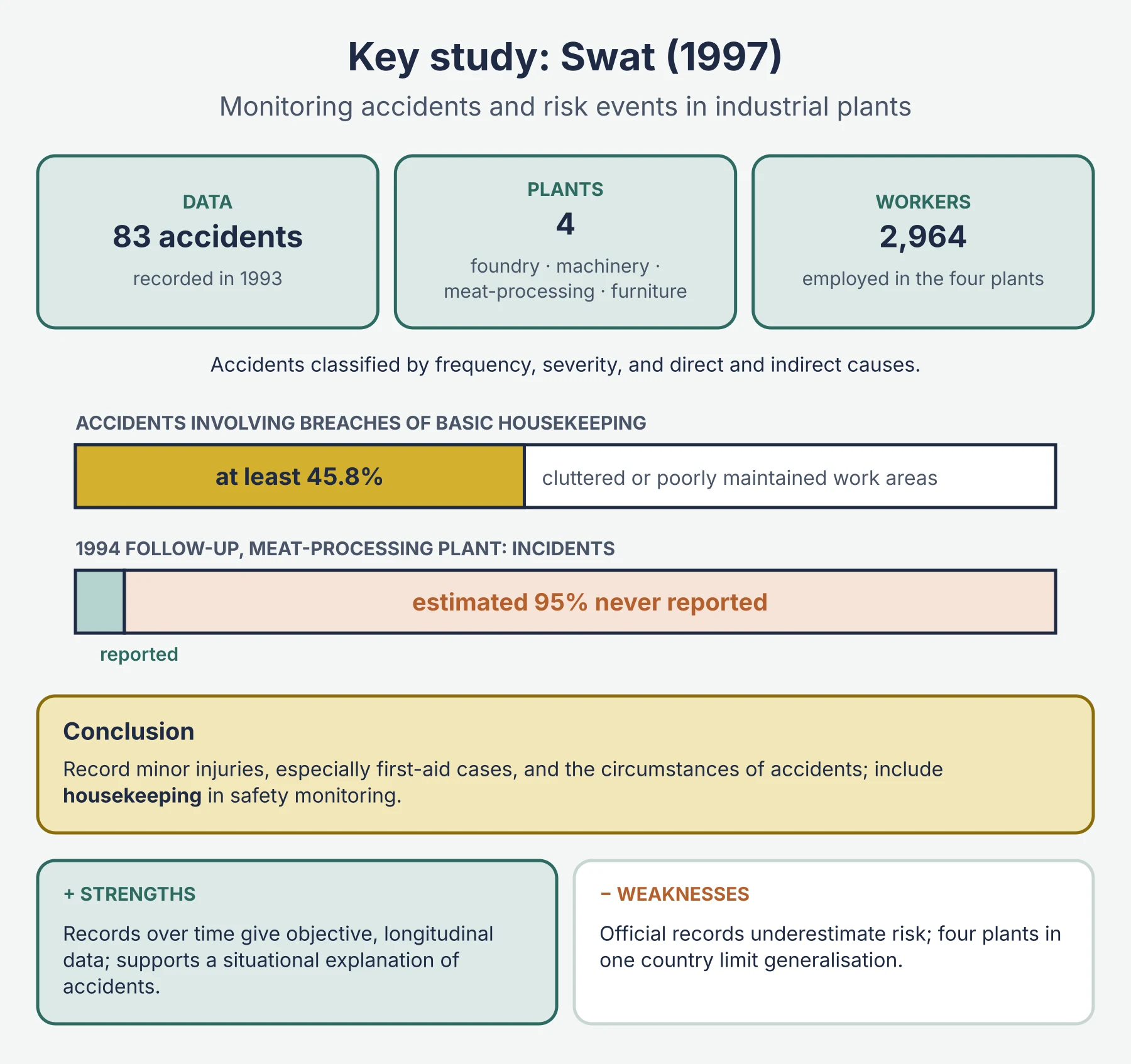
| Swat (1997) | 4.4.3 | Housekeeping breaches in at least 45.8% of accidents; 95% of incidents unreported at one plant |
Key study grid: Swat (1997)
| Feature | Detail |
|---|---|
| Context | Three-year project begun in 1994 on monitoring accidents and risk events |
| Data | 83 accidents recorded in 1993 |
| Plants | Foundry, machinery plant, meat-processing plant, furniture factory; 2,964 workers |
| Analysis | Frequency, severity, direct and indirect causes |
| Key results | At least 45.8% involved housekeeping breaches; 1994 follow-up estimated 95% of incidents unreported |
| Conclusion | Record minor injuries and accident circumstances; include housekeeping in monitoring |
| Methods | Objective records; longitudinal; limited by under-reporting |
Shift patterns compared
| Rapid rotation | Slow rotation | |
|---|---|---|
| Change frequency | Every few days | Every few weeks |
| Body clock | Never fully adjusts | Partly adjusts, then is disrupted again |
| Advantage | Fewer consecutive nights | Time to adapt to each shift |
| Disadvantage | Constant mild disruption | Larger disruption at each change |
Linking to issues and debates
- Determinism versus free will (4.4.1, 4.4.2): conditions and shifts shape behaviour, but workers can adapt.
- Longitudinal studies (4.4.1, 4.4.3): Oldham and Brass measured before and after; Swat followed records over years.
- Questionnaires and validity (4.4.1, 4.4.2): Gold et al. relied on self-reports of sleep and accidents.
- Individual and situational explanations (4.4.3): human errors are individual; system errors and housekeeping are situational.
- Objective and subjective data (4.4.3): accident records are objective but incomplete.
Exam traps
- Kompier challenges the Hawthorne effect; do not cite him as supporting it.
- Oldham and Brass found declines, not improvements, after the move to open-plan.
- Four human errors: omission, commission, sequencing, timing. Learn an example of each.
- System errors are about design of controls and displays, not careless workers.
- Swat’s figures: 83 accidents, four plants, 2,964 workers, at least 45.8% housekeeping, 95% unreported.
Quick self-test
- Define the Hawthorne effect.
- What did Kompier (2006) argue?
- What happened to satisfaction after the move in Oldham and Brass (1979)?
- Why is Oldham and Brass a quasi-experiment?
- Define slow rotation and give an example.
- What is flexitime?
- What did Gold et al. (1992) find?
- Give an example of an error of sequencing.
- Give one way to reduce system errors in controls.
- How does a token economy reduce accidents?
- How many accidents did Swat analyse, and in how many plants?
- What proportion of incidents were estimated to be unreported at the follow-up plant?
Answers
- A change in behaviour because people know they are being observed or studied.
- That the Hawthorne effect, as usually told, is a myth, because the original studies were poorly controlled.
- It fell, along with internal motivation.
- The move to open-plan happened naturally; the researchers did not assign employees to conditions.
- Working the same shift for weeks before changing, e.g. three weeks of nights then three weeks of days.
- Choosing start and finish times around fixed core hours.
- Nurses on rotating shifts reported poorer sleep and more sleepiness-related accidents and errors than nurses on fixed shifts.
- Starting a machine before fitting its safety guard.
- Shape-coding or colour-coding controls, or separating critical controls.
- Safe behaviour is positively reinforced with tokens exchanged for rewards, so it becomes more frequent.
- 83 accidents in four plants.
- 95%.
More resources on this topic
Related resources
-
Study guides
Cambridge A Level Psychology (9990): Satisfaction at work
Cambridge 9990 topic 4.5 in depth: Herzberg, job characteristics, job design, the JDI and QWL, Giacalone and Rosenfeld (1987), Blau and Boal.
Psychology · Cambridge · A Level
Read guide -
Practice questions
Cambridge A Level Psychology (9990): Satisfaction at work – Practice Questions
Original Paper 3 and Paper 4 style questions on Cambridge 9990 topic 4.5: satisfaction theories, measures, sabotage and absence, with answers.
Psychology · Cambridge · A Level
Try questions -
Revision notes
Cambridge A Level Psychology (9990): Satisfaction at work – Revision Notes
Revision notes for Cambridge 9990 topic 4.5: Herzberg, job characteristics, JDI, QWL, sabotage and Blau and Boal, with a self-test.
Psychology · Cambridge · A Level
Revise topic
Studying Psychology?
This page is free and stays free. Marlbridge is not offering Psychology classes at the moment, so there is no tuition to book for it. The free study resources stay open to everyone.
Get free revision emails (optional)
Occasional emails with practice questions, worked explanations and links to free resources for the qualification and subjects you choose. No spam, and you can unsubscribe from any email. The free tools on this site never need an email.