
Study Guides
Cambridge A Level Psychology (9990): Organisational work conditions
Cambridge 9990 topic 4.4 in depth: the Hawthorne effect, open-plan offices, shiftwork, human and system errors, token economies and Swat (1997) on accidents.
- Subject
- Psychology
- Level
- A LEVEL
- Topic
- Specialist Option 4: Organisational Psychology
- Author
- Marlbridge Academic Team
- Updated
- Reviewed by
- Kanwal Aslam (what this means)
Aligned to Cambridge A Level Psychology (9990), 2024-2026. Official specification .
Syllabus page (what it covers and how it is assessed): Cambridge A Level Psychology.
Syllabus points this page covers
9990 (A Level)
- 4.4 Organisational work conditions
Topic 4.4, Organisational work conditions, is part of Specialist Option 4 (Organisational Psychology) in Cambridge International A Level Psychology 9990, syllabus for 2024 to 2026. It covers how the physical environment affects productivity (4.4.1), how working hours and shift patterns affect health and safety (4.4.2), and why accidents happen and how they can be reduced and monitored (4.4.3). The key study is Swat (1997) on monitoring accidents and risk events in industrial plants.
The Organisational Psychology study guide outlines the topic. This page develops each part with examples, evaluation and an annotated answer. Pair it with the work conditions revision notes and the work conditions practice questions.
Syllabus content for 4.4
| Sub-topic | Content | Named study |
|---|---|---|
| 4.4.1 Physical work conditions | Impact of physical conditions on productivity and the Hawthorne effect; design of the work environment, focusing on open-plan offices | e.g. Kompier (2006); e.g. Oldham and Brass (1979) |
| 4.4.2 Temporal conditions | Shiftwork: rapid and slow rotation, on-call and flexitime, with definitions and examples; effects of shiftwork on health and accidents | e.g. Gold et al. (1992) |
| 4.4.3 Health and safety | Human errors (omission, commission, sequencing, timing) and system errors in operator–machine systems (controls and displays); token economy; monitoring accidents | e.g. Fox et al. (1987); key study Swat (1997) |
4.4.1 Physical conditions and the Hawthorne effect
Physical conditions include lighting, temperature, noise, space and layout. Poor conditions can reduce productivity directly (too dark to see detail) and indirectly (discomfort lowers motivation).
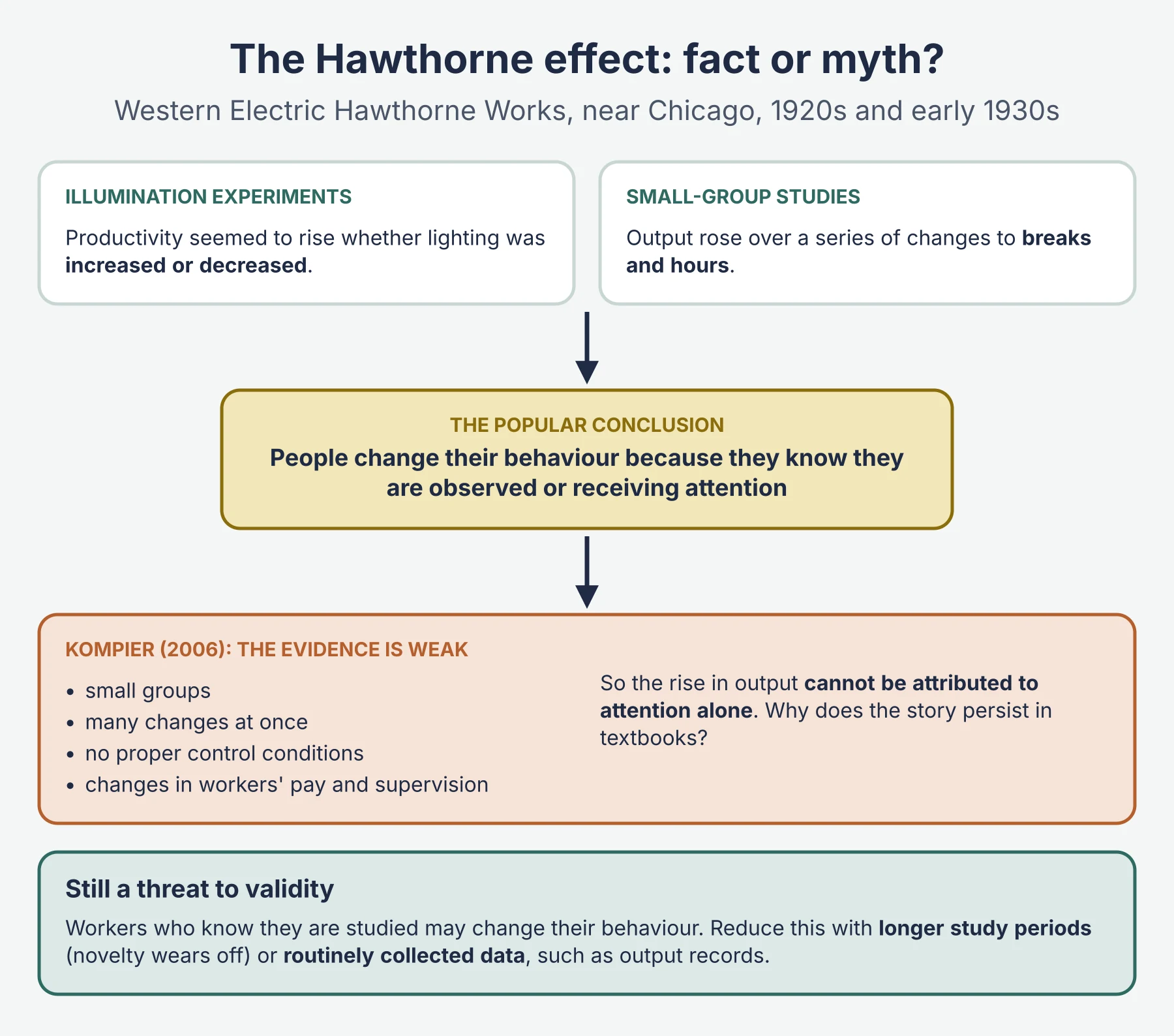
The Hawthorne studies were carried out at the Western Electric Hawthorne Works near Chicago in the 1920s and early 1930s. In the illumination experiments, productivity seemed to rise whether lighting was increased or decreased. In later studies of small groups of workers, output rose over a series of changes to breaks and hours. The popular conclusion was the Hawthorne effect: people change their behaviour because they know they are being observed or receiving attention.
Kompier (2006) argued that the Hawthorne effect, as usually told, is a myth: the original studies had small groups, many changes at once, no proper control conditions, and changes in workers’ pay and supervision, so the rise in output cannot be attributed to attention alone. He asked why the story persists in textbooks. This is a lesson in evaluating evidence: a famous finding may rest on weak methodology.
Why the Hawthorne effect still matters for research. When workers know they are part of a study, their behaviour may change, which is a threat to validity. Researchers reduce this by using longer study periods, so novelty wears off, or by using data collected routinely, such as output records.
4.4.1 Open-plan offices
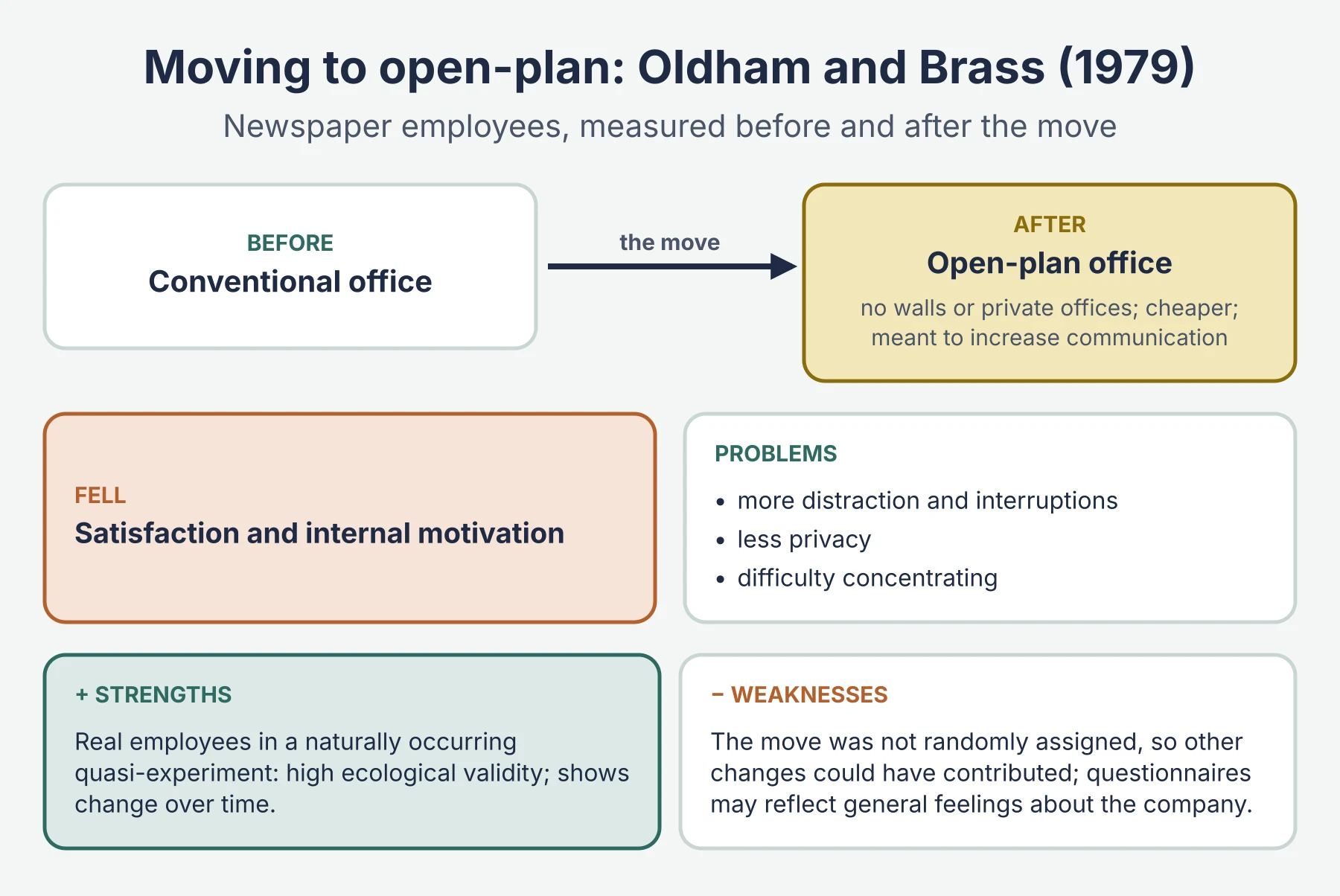
Open-plan offices remove walls and private offices so that many employees share one space. They are cheaper and intended to increase communication.
Oldham and Brass (1979) studied employees of a newspaper who moved from a conventional office to an open-plan office, a naturally occurring quasi-experiment, with measurements taken before and after the move. After the move, employees’ satisfaction and internal motivation fell. Problems included more distraction and interruptions, less privacy and difficulty concentrating.
Evaluation: the before-and-after design with real employees gives high ecological validity, and the longitudinal element shows change over time; but because the move was not randomly assigned, other changes at the same time could have contributed. Questionnaires give quantitative data but may be influenced by employees’ general feelings about the company.
4.4.2 Temporal conditions
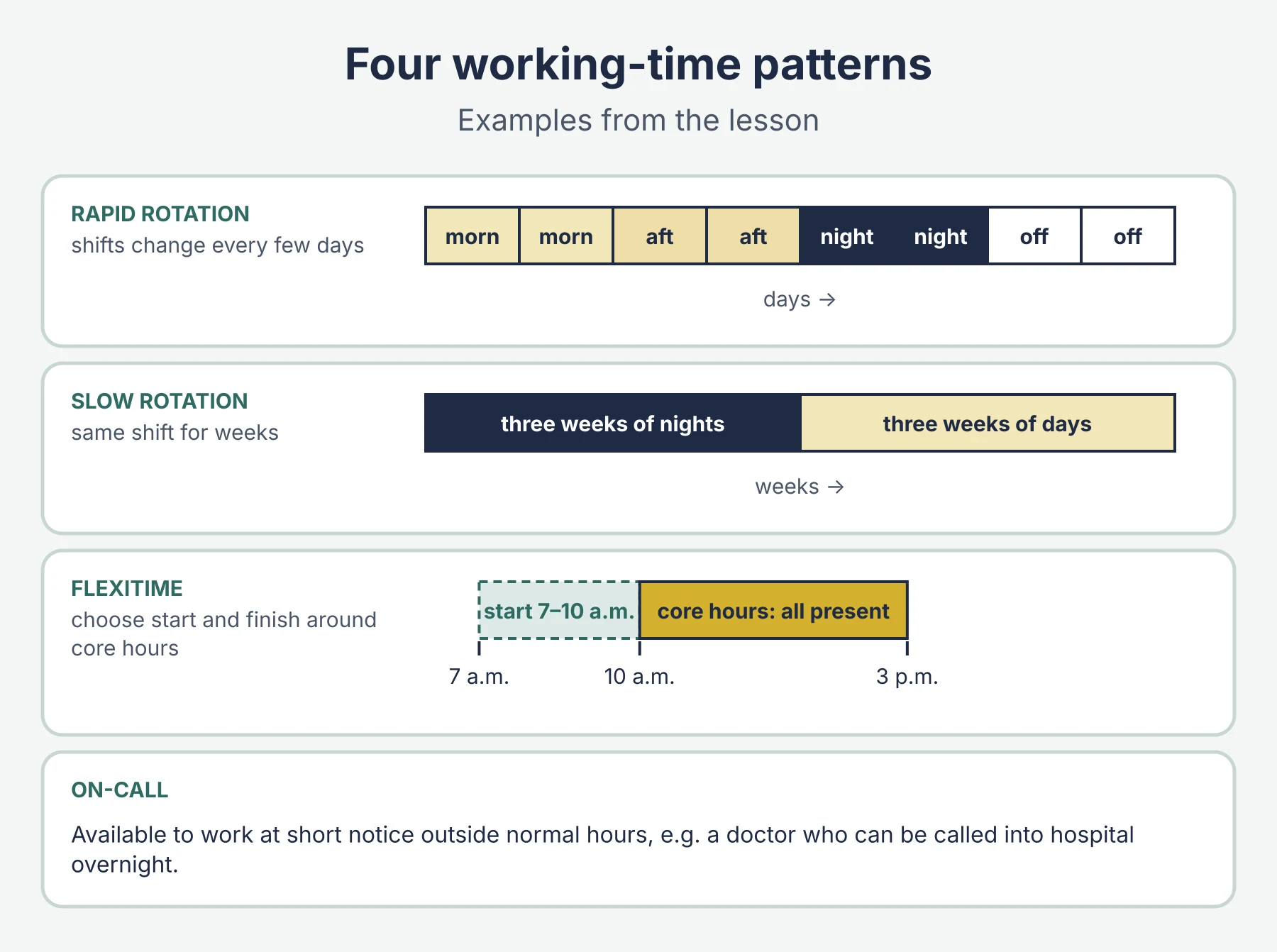
| Pattern | Definition | Example |
|---|---|---|
| Rapid rotation | Shifts change every few days | Two mornings, two afternoons, two nights, then days off |
| Slow rotation | The same shift is worked for weeks before changing | Three weeks of nights, then three weeks of days |
| On-call | Available to work at short notice outside normal hours | A doctor who can be called into hospital overnight |
| Flexitime | Employees choose start and finish times around core hours | Start between 7 and 10 a.m., all present 10 a.m. to 3 p.m. |
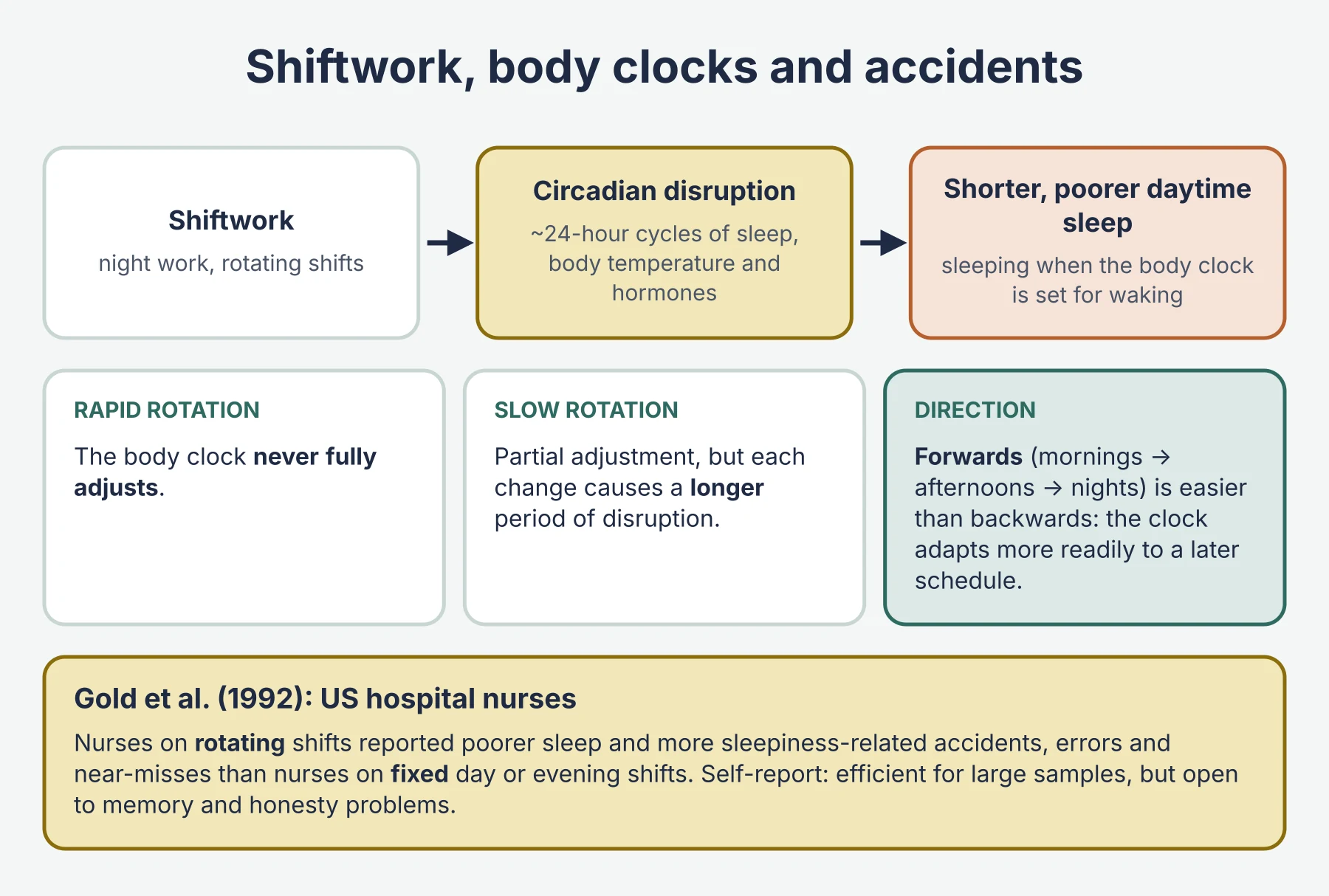
Effects on health. Shiftwork disrupts circadian rhythms, the roughly 24-hour cycles of sleep, body temperature and hormone release. Night workers try to sleep when their body clock is set for being awake, so daytime sleep is shorter and of poorer quality. Rapid rotation means the body clock never fully adjusts; slow rotation allows partial adjustment, but each change causes a longer period of disruption. Rotating forwards (mornings, then afternoons, then nights) is generally easier to adjust to than rotating backwards, because the body clock adapts more readily to a later schedule.
Gold et al. (1992) surveyed hospital nurses in the USA and found that nurses on rotating shifts reported poorer sleep and more accidents, errors and near-misses related to sleepiness than nurses on fixed day or evening shifts. The study used self-report questionnaires, which are efficient for large samples but may be affected by memory and honesty; however, the findings are consistent with what is known about circadian disruption.
4.4.3 Human and system errors
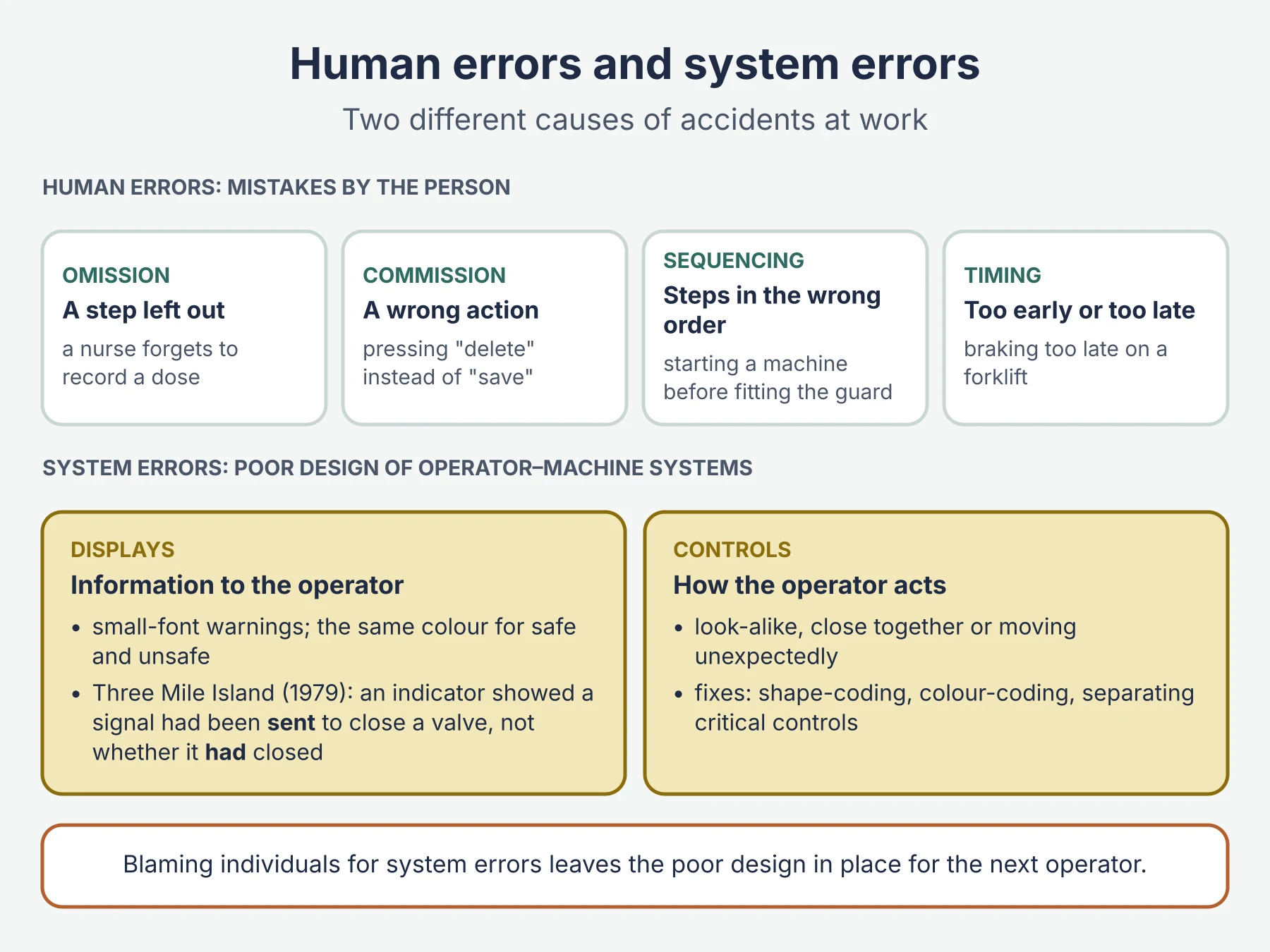
Human errors are mistakes by the person:
| Error | Meaning | Example |
|---|---|---|
| Omission | A required step is left out | A nurse forgets to record a dose |
| Commission | A wrong action is performed | Pressing “delete” instead of “save” |
| Sequencing | Steps are carried out in the wrong order | Starting a machine before fitting the guard |
| Timing | An action is too early or too late | Braking too late on a forklift |
System errors in operator–machine systems arise from poor design:
- Displays present information to the operator. A display that shows a warning in a small font, or uses the same colour for safe and unsafe states, invites misreading. A well-known example comes from the Three Mile Island nuclear accident in 1979, where a control-room indicator showed that a signal had been sent to close a valve rather than whether the valve had actually closed.
- Controls are the means by which the operator acts. Controls that look alike, sit close together or move in an unexpected direction lead to errors. Shape-coding, colour-coding and separating critical controls reduce this.
The distinction matters because blaming individuals for system errors leaves the poor design in place for the next operator.
Reducing and monitoring accidents
Token economy. Fox et al. (1987) introduced a token economy at two open-pit mines: workers earned trading stamps for periods without lost-time accidents, exchangeable for goods. Days lost through accidents fell and stayed lower over several years. It applies operant conditioning: safe behaviour is positively reinforced.
Key study: Swat (1997).
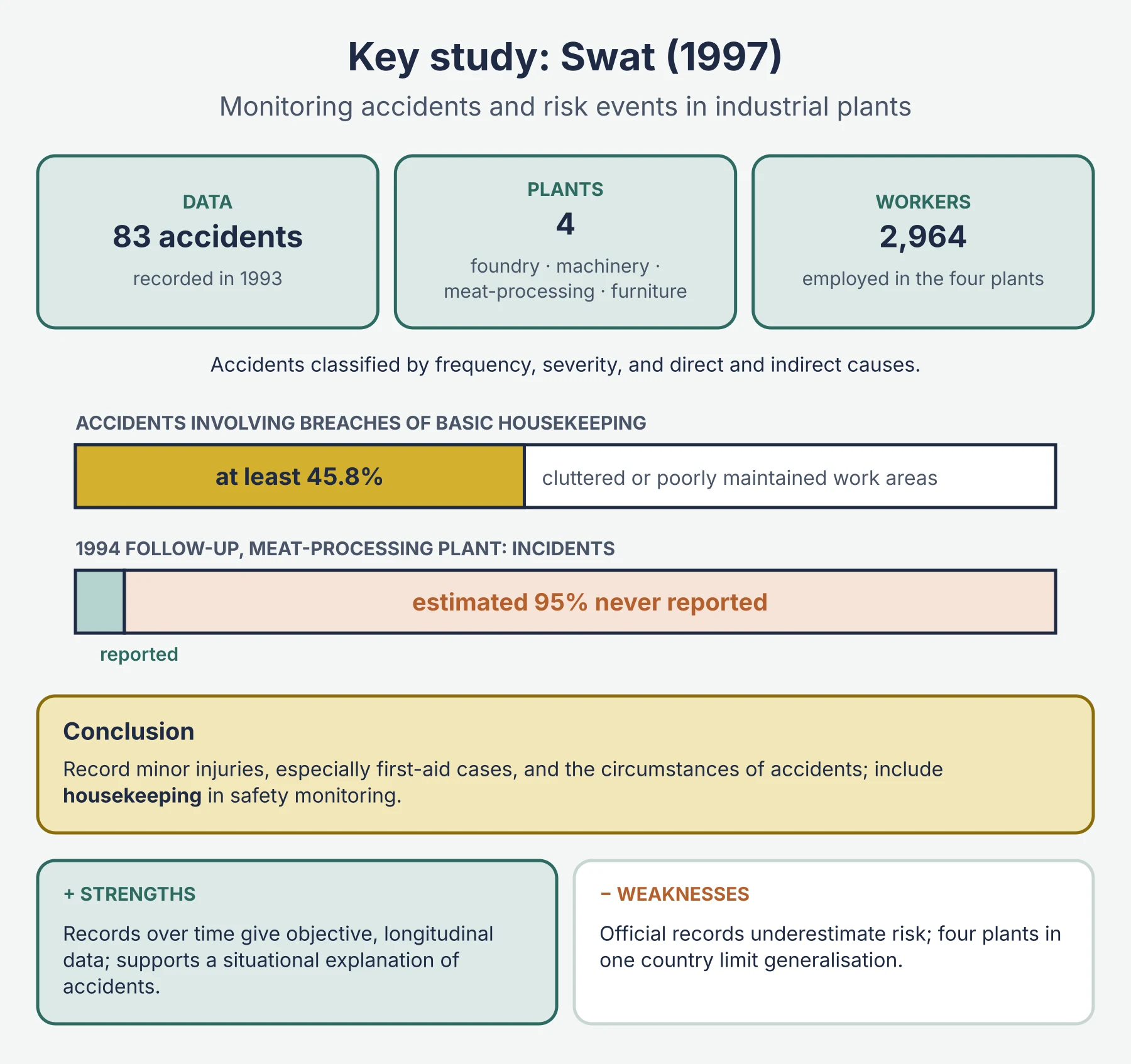
- Context: Swat studied the monitoring of accidents and risk events in industrial plants as part of a three-year project begun in 1994.
- Aim: to identify how accidents and risk events could be better monitored so that management problems become visible.
- Method: analysis of 83 accidents recorded in 1993 in four plants, a foundry, a machinery plant, a meat-processing plant and a furniture factory, employing 2,964 workers. Accidents were classified by frequency, severity and direct and indirect causes.
- Results: at least 45.8% of accidents involved breaches of basic housekeeping, such as cluttered or poorly maintained work areas. A 1994 follow-up at the meat-processing plant estimated that 95% of incidents were never reported.
- Conclusion: minor injuries, especially those needing first aid, and the circumstances of accidents should be recorded, and housekeeping should be included in safety monitoring.
Evaluation. Using records over time gives objective, longitudinal data, but the finding that most incidents go unreported shows that official records underestimate risk. The four plants were in one country, so generalisation to other industries and safety cultures needs care. The study supports a situational explanation of accidents (housekeeping and management) over a purely individual one (careless workers).
Annotated answer: a 6-mark describe question
Describe human errors and system errors as causes of accidents at work. [6]
“Human errors are mistakes made by the worker (1). Errors of omission are leaving out a step, such as forgetting to lock a machine before cleaning it (1). Errors of commission are doing the wrong thing, such as pressing the wrong button (1), while sequencing and timing errors are doing steps in the wrong order or at the wrong moment (1). System errors arise from the design of operator–machine systems (1): poorly designed displays may be misread, and controls that look similar may be confused (1).”
Common mistakes
- Presenting the Hawthorne effect as settled fact. Kompier (2006) argues the evidence is weak.
- Confusing rapid and slow rotation, or describing flexitime as shiftwork without core hours.
- Treating all accidents as human error. The syllabus also asks for system errors.
- Getting Swat’s findings wrong: housekeeping breaches in at least 45.8% of accidents; 95% of incidents unreported at the follow-up plant.
Exam technique
Define shift patterns precisely and give an example. Evaluate using the syllabus issues: longitudinal studies and questionnaires for 4.4.1; validity and questionnaires for 4.4.2; individual and situational explanations, longitudinal studies and objective and subjective data for 4.4.3. Suggest questions on safety should combine a human-error fix (training, checklists) with a system fix (redesigned display or control).
More resources on this topic
- Organisational work conditions revision notes
- Organisational work conditions practice questions
- Organisational Psychology study guide
Official syllabus
Cambridge International AS & A Level Psychology 9990 syllabus for 2024, 2025 and 2026, Specialist Option 4: Organisational Psychology, topic 4.4 — cambridgeinternational.org.
Related resources
-
Practice questions
Cambridge A Level Psychology (9990): Organisational work conditions – Practice Questions
Original Paper 3 and Paper 4 style questions on Cambridge 9990 topic 4.4: work conditions, errors and accident monitoring, with mark schemes.
Psychology · Cambridge · A Level
Try questions -
Revision notes
Cambridge A Level Psychology (9990): Organisational work conditions – Revision Notes
Revision notes for Cambridge 9990 topic 4.4: Hawthorne effect, open-plan offices, shifts, errors, token economy and Swat (1997), with a self-test.
Psychology · Cambridge · A Level
Revise topic -
Study guides
Cambridge A Level Psychology (9990): Satisfaction at work
Cambridge 9990 topic 4.5 in depth: Herzberg, job characteristics, job design, the JDI and QWL, Giacalone and Rosenfeld (1987), Blau and Boal.
Psychology · Cambridge · A Level
Read guide
Studying Psychology?
This page is free and stays free. Marlbridge is not offering Psychology classes at the moment, so there is no tuition to book for it. The free study resources stay open to everyone.
Get free revision emails (optional)
Occasional emails with practice questions, worked explanations and links to free resources for the qualification and subjects you choose. No spam, and you can unsubscribe from any email. The free tools on this site never need an email.