
Revision Notes
Cambridge A Level Psychology (9990): Group behaviour in organisations – Revision Notes
Revision notes for Cambridge 9990 topic 4.3: group stages, Belbin, groupthink, loafing, monitoring, conflict and bullying, with a self-test.
- Subject
- Psychology
- Level
- A LEVEL
- Topic
- Specialist Option 4: Organisational Psychology
- Author
- Marlbridge Academic Team
- Updated
- Reviewed by
- Kanwal Aslam (what this means)
Aligned to Cambridge A Level Psychology (9990), 2024-2026. Official specification .
Syllabus page (what it covers and how it is assessed): Cambridge A Level Psychology.
Syllabus points this page covers
9990 (A Level)
- 4.3 Group behaviour in organisations
These notes condense topic 4.3, Group behaviour in organisations, from Specialist Option 4 of Cambridge International A Level Psychology 9990 (syllabus for 2024 to 2026). The topic has three strands: how groups form and decide, how others affect performance, and how conflict happens.
The group behaviour study guide explains each theory with examples. Apply what you learn with the group behaviour practice questions.
Topic map
- 4.3.1: Tuckman’s stages (e.g. Tuckman and Jensen, 2010); Belbin’s nine roles; groupthink features and prevention; Forsyth’s errors of commission, omission and imprecision.
- 4.3.2: social facilitation and loafing; drive theory; evaluation apprehension; social impact theory; loafing across cultures (e.g. Earley, 1993); monitoring, key study Claypoole and Szalma (2019), experiment 1.
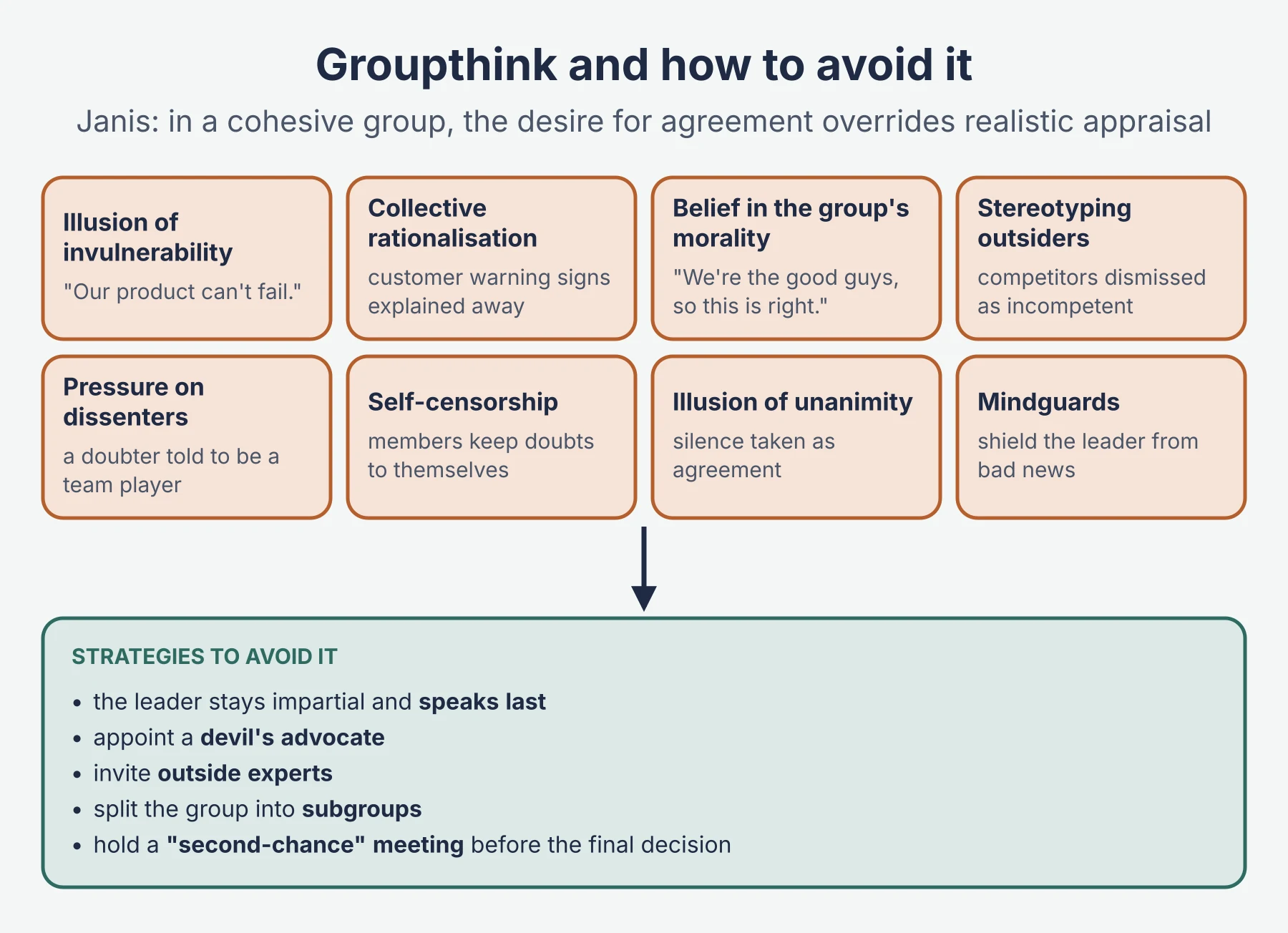
- 4.3.3: four levels of conflict and causes; Thomas–Kilmann’s five modes; bullying types, phases and causes (e.g. Einarsen, 1999).
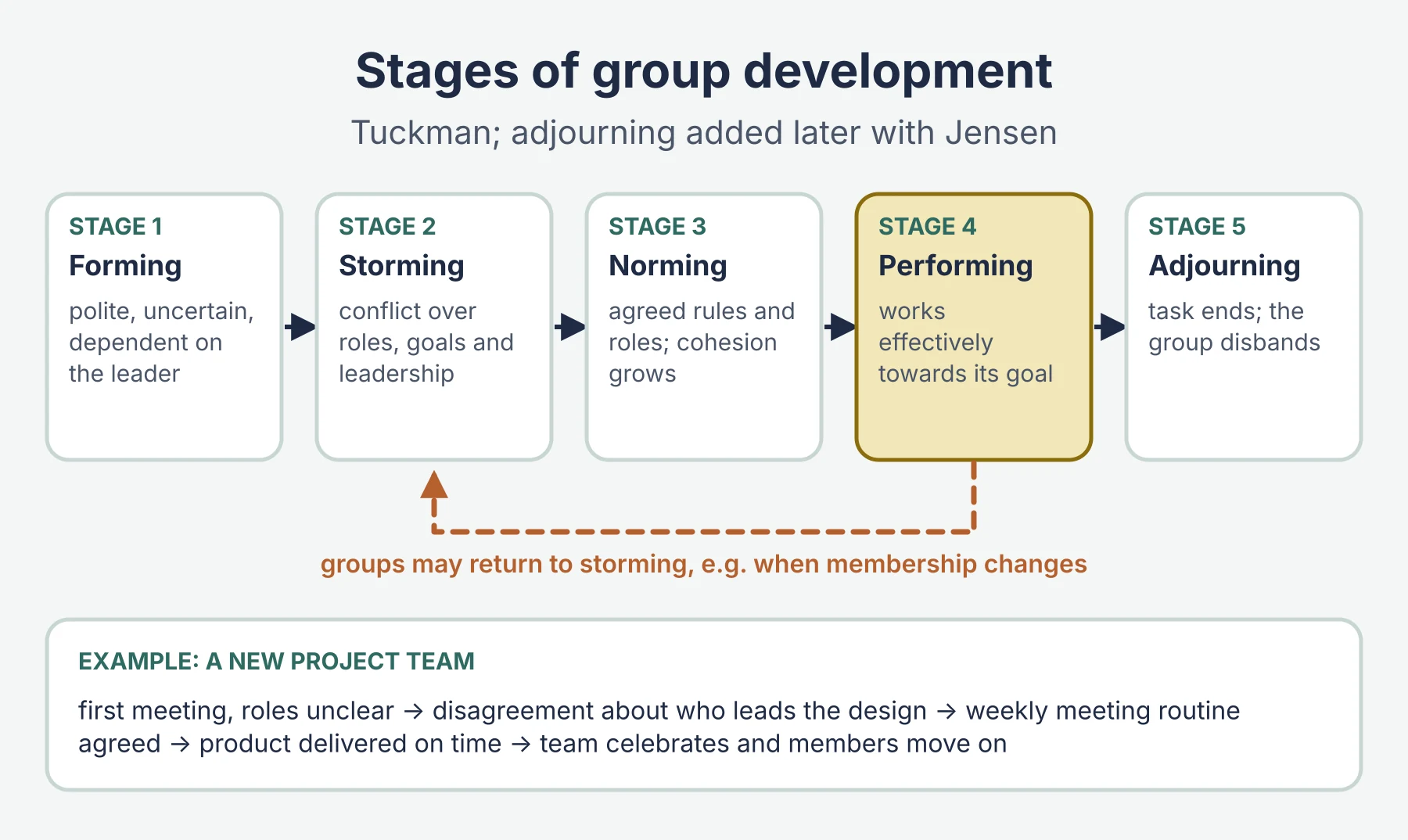
Key terms
| Term | Definition |
|---|---|
| Forming, storming, norming, performing, adjourning | Tuckman’s stages of group development |
| Team role | A pattern of behaviour a person contributes to a team (Belbin) |
| Groupthink | Desire for agreement in a cohesive group overrides realistic appraisal |
| Mindguard | A member who shields the group or leader from contrary information |
| Sunk cost bias | Continuing because of resources already invested |
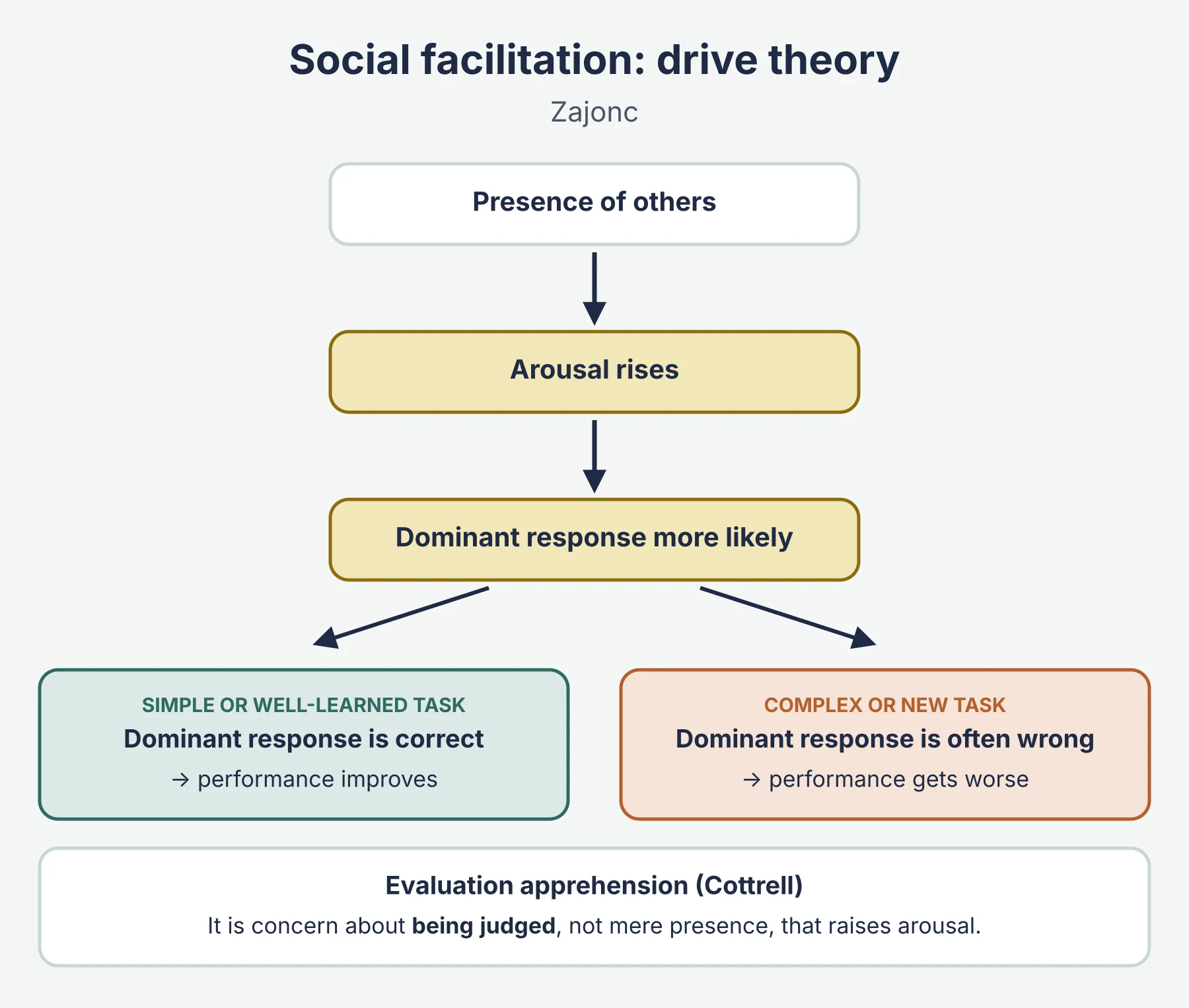
| Social facilitation | Better performance on easy tasks, worse on hard tasks, when others are present |
| Dominant response | The response most likely in a given situation |
| Evaluation apprehension | Concern about being judged by others |
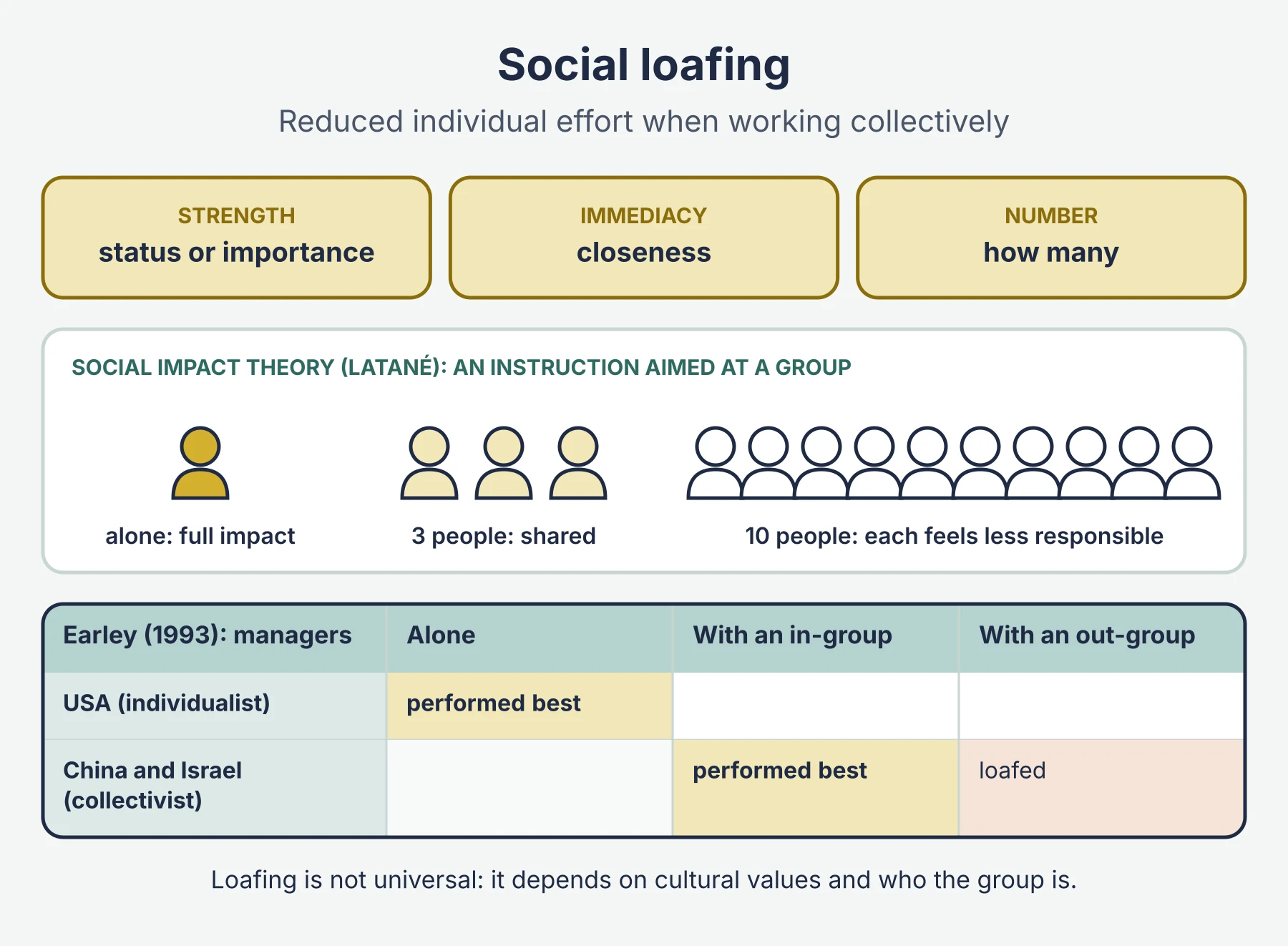
| Social loafing | Reduced individual effort in a group |
| Social impact theory | Impact depends on strength, immediacy and number of others |
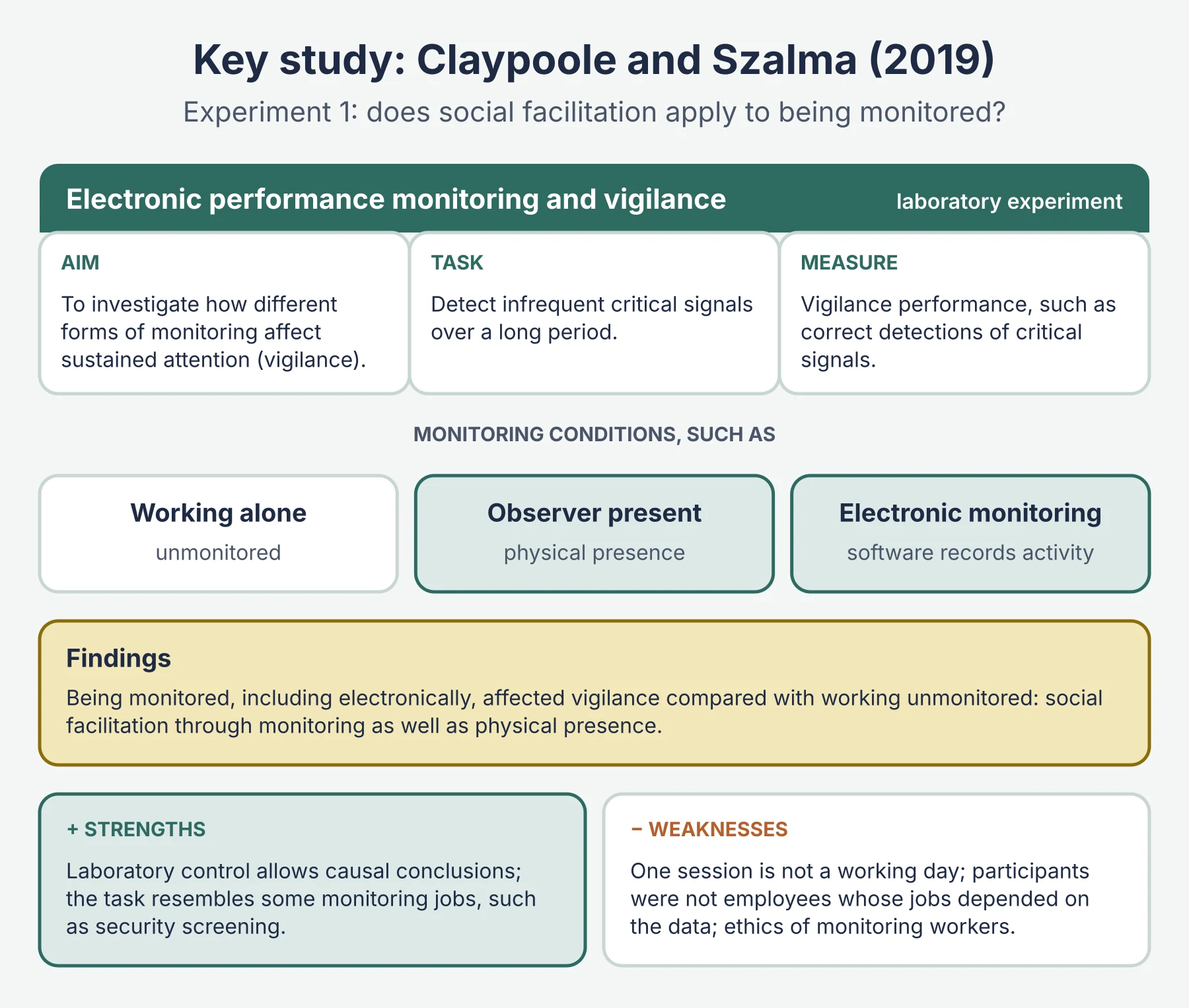
| Electronic performance monitoring | Using technology to record and assess workers’ performance |
| Vigilance | Sustained attention to detect rare signals |
| Intra-group conflict | Conflict within one team |
| Inter-group conflict | Conflict between teams or departments |
| Predatory bullying | Target singled out without provoking it |
| Dispute-related bullying | Bullying arising from an escalating conflict |
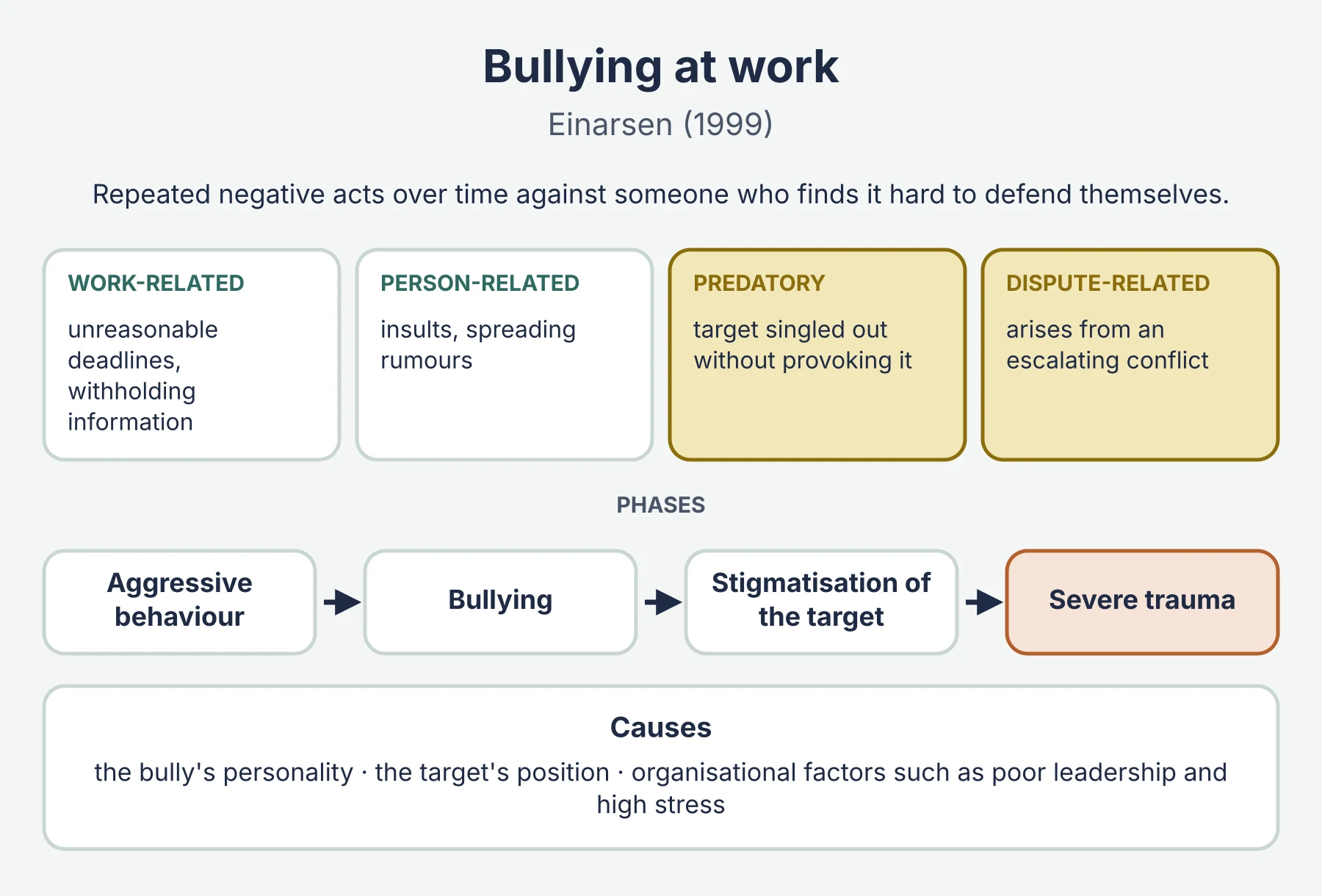
Belbin’s nine roles by group
- Thinking: plant, monitor evaluator, specialist.
- People: co-ordinator, teamworker, resource investigator.
- Action: shaper, implementer, completer finisher.
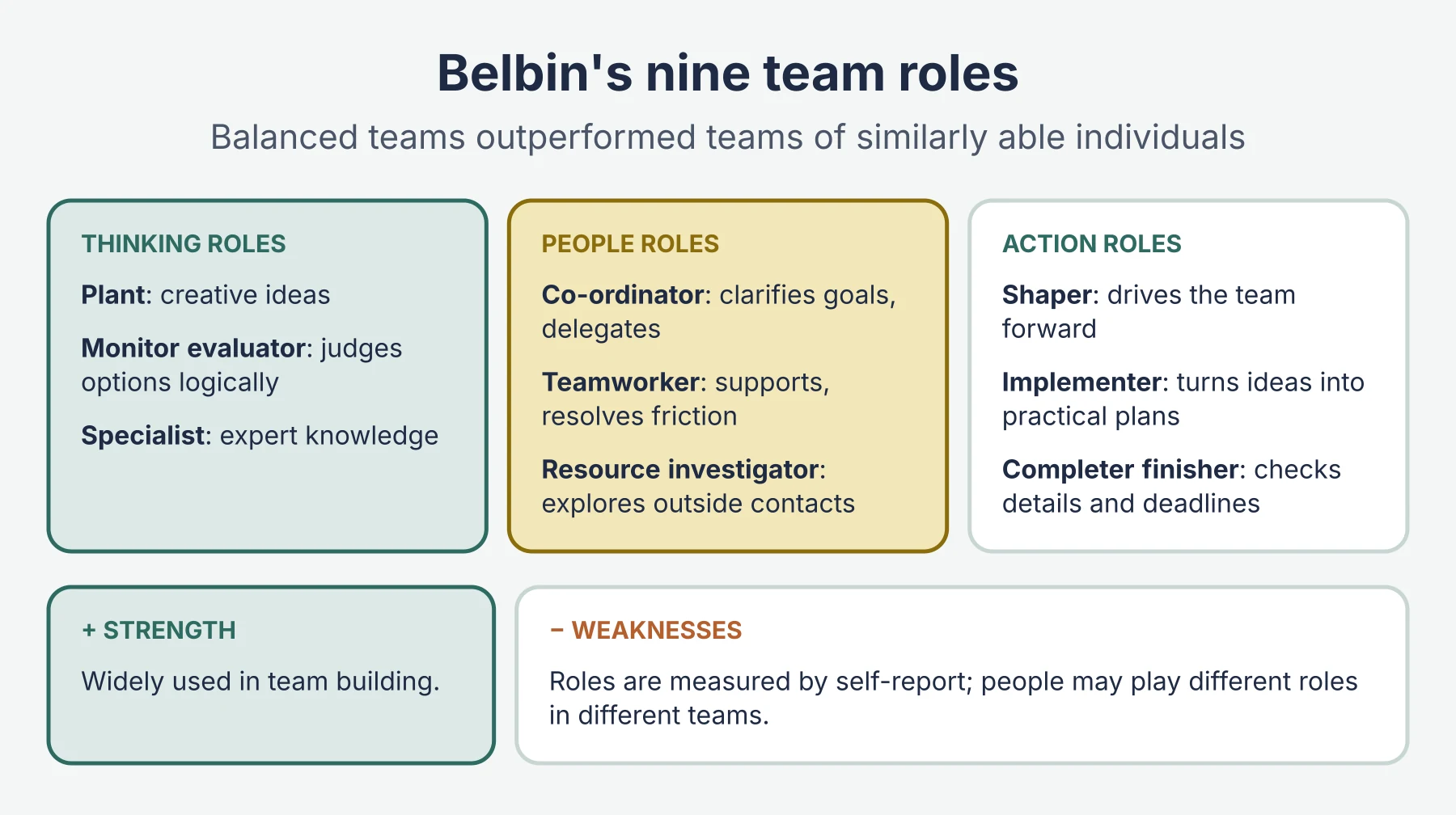
Groupthink: eight features and five remedies
- Features: illusion of invulnerability; collective rationalisation; belief in group morality; stereotyping outsiders; pressure on dissenters; self-censorship; illusion of unanimity; mindguards.
- Remedies: impartial leader who speaks last; devil’s advocate; outside experts; subgroups; second-chance meeting.
Facilitation and loafing compared
| Social facilitation | Social loafing | |
|---|---|---|
| Situation | Individual performance observed by others | Effort pooled in a group |
| Effect | Better on easy tasks, worse on hard | Less effort per person |
| Explanation | Drive theory; evaluation apprehension | Social impact theory; diffusion of responsibility |
| Reduced when | Task is well practised | Contributions are identifiable; group is valued |
Key study grid: Claypoole and Szalma (2019), experiment 1
| Feature | Detail |
|---|---|
| Context | Applying social facilitation to electronic performance monitoring |
| Method | Laboratory experiment with a vigilance (sustained-attention) task |
| IV | Monitoring condition, e.g. alone, observer present, electronic monitoring |
| DV | Performance on the vigilance task |
| Finding | Monitoring, including electronic, affected performance compared with working unmonitored |
| Interpretation | Social facilitation can occur through monitoring, not only physical presence |
| Evaluation | Good control; limited to one task and session; ethics of monitoring |
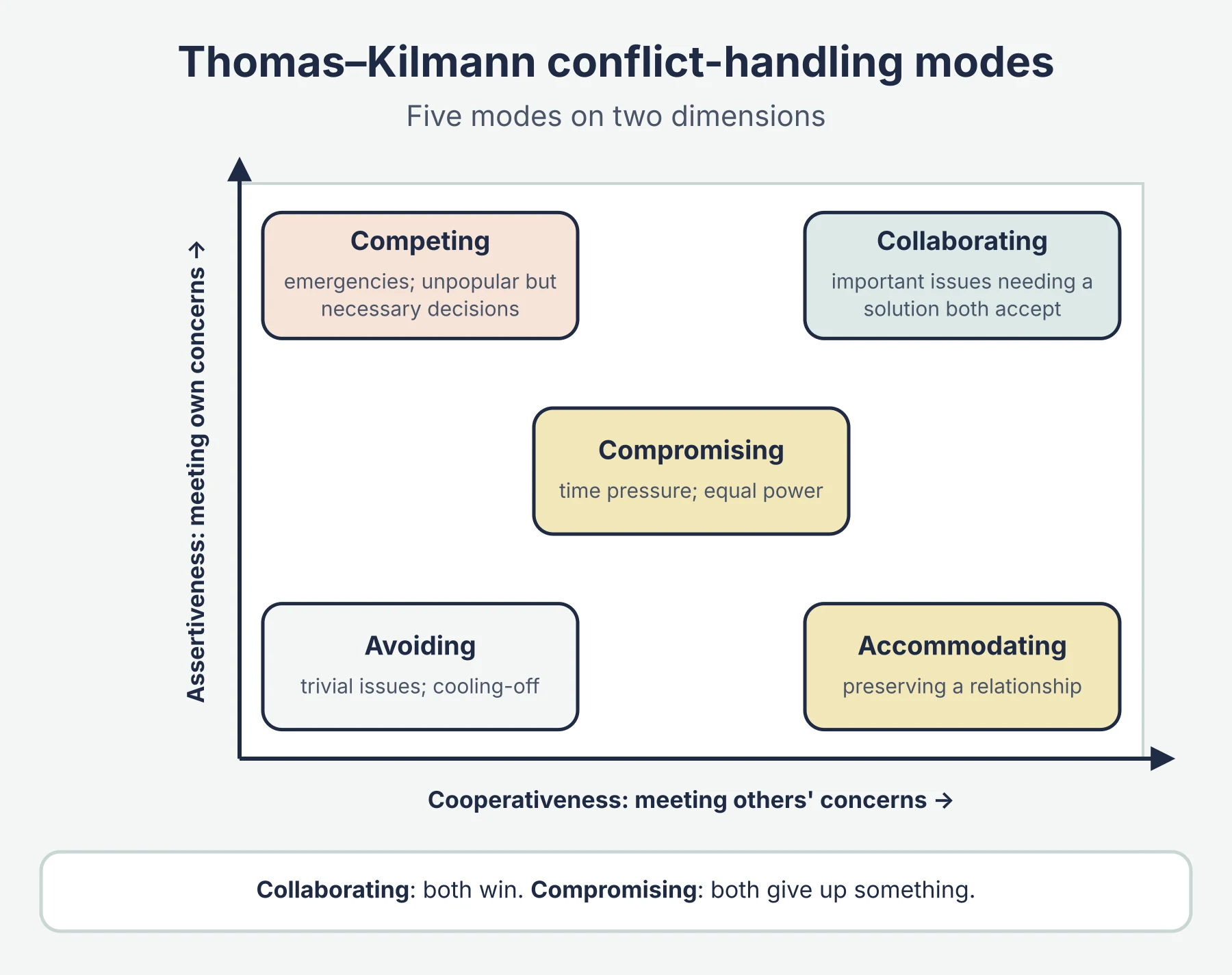
Thomas–Kilmann’s five modes
Competing (assertive, uncooperative); collaborating (assertive, cooperative); compromising (middle on both); avoiding (unassertive, uncooperative); accommodating (unassertive, cooperative).
Linking to issues and debates
- Cultural differences (4.3.2, 4.3.3): Earley shows loafing depends on individualism and collectivism.
- Individual and situational explanations (4.3.1, 4.3.3): Belbin roles are individual; groupthink arises from situational pressures.
- Determinism versus free will (4.3.2): monitoring implies behaviour is shaped by being watched.
- Reductionism versus holism (4.3.1): stage models simplify complex group processes.
- Application to everyday life: Belbin, groupthink remedies and conflict modes are used in training.
- Idiographic versus nomothetic (4.3.2, 4.3.3): Thomas–Kilmann gives general modes, but each person has a preferred mode, and bullying cases differ in detail.
- Quantitative and qualitative data (4.3.2): vigilance scores are quantitative; interviews with monitored staff would add their experience.
Exam traps
- Social facilitation depends on the task: easy improves, hard worsens.
- Collectivists still loafed in Earley (1993), with out-groups.
- Claypoole and Szalma: focus on experiment 1 only.
- Groupthink requires a cohesive group; it is not just any bad decision.
- Levels of conflict: intra means within, inter means between.
Quick self-test
- List Tuckman’s five stages in order.
- Which Belbin role checks details and meets deadlines?
- Give three features of groupthink.
- Give two ways to prevent groupthink.
- Name the three types of error in Forsyth’s classification.
- How does drive theory explain social facilitation?
- Who proposed evaluation apprehension, and what does it add?
- Name the three factors in social impact theory.
- What did Earley (1993) find about Chinese and Israeli managers?
- What type of task did Claypoole and Szalma use?
- Which Thomas–Kilmann mode is high on both assertiveness and cooperativeness?
- Distinguish predatory from dispute-related bullying.
Answers
- Forming, storming, norming, performing, adjourning.
- Completer finisher.
- Any three: illusion of invulnerability; collective rationalisation; belief in group morality; stereotyping outsiders; pressure on dissenters; self-censorship; illusion of unanimity; mindguards.
- Any two: devil’s advocate; impartial leader; outside experts; subgroups; second-chance meeting.
- Errors of commission, omission and imprecision.
- Others raise arousal, which increases the dominant response; this is correct on easy tasks and often wrong on hard ones.
- Cottrell; it is fear of being judged, not mere presence, that raises arousal.
- Strength, immediacy and number.
- They performed best with an in-group and loafed with an out-group.
- A vigilance (sustained-attention) task.
- Collaborating.
- Predatory: the target is singled out without having provoked it. Dispute-related: it grows out of an escalating conflict.
More resources on this topic
Related resources
-
Study guides
Cambridge A Level Psychology (9990): Leadership and management
Cambridge 9990 topic 4.2 in depth: universalist and behavioural theories, Heifetz, Muczyk and Reimann, Scouller, Cuadrado et al. (2008), the LPI and Kelley.
Psychology · Cambridge · A Level
Read guide -
Practice questions
Cambridge A Level Psychology (9990): Leadership and management – Practice Questions
Original Paper 3 and Paper 4 style questions on Cambridge 9990 topic 4.2: leadership theories, styles and followership, with mark schemes.
Psychology · Cambridge · A Level
Try questions -
Revision notes
Cambridge A Level Psychology (9990): Leadership and management – Revision Notes
Revision notes for Cambridge 9990 topic 4.2: theories, Heifetz, styles, Scouller, Cuadrado et al. (2008) and followership, with a self-test.
Psychology · Cambridge · A Level
Revise topic
Studying Psychology?
This page is free and stays free. Marlbridge is not offering Psychology classes at the moment, so there is no tuition to book for it. The free study resources stay open to everyone.
Get free revision emails (optional)
Occasional emails with practice questions, worked explanations and links to free resources for the qualification and subjects you choose. No spam, and you can unsubscribe from any email. The free tools on this site never need an email.