
Revision Notes
Cambridge A Level Psychology (9990): Leadership and management – Revision Notes
Revision notes for Cambridge 9990 topic 4.2: theories, Heifetz, styles, Scouller, Cuadrado et al. (2008) and followership, with a self-test.
- Subject
- Psychology
- Level
- A LEVEL
- Topic
- Specialist Option 4: Organisational Psychology
- Author
- Marlbridge Academic Team
- Updated
- Reviewed by
- Kanwal Aslam (what this means)
Aligned to Cambridge A Level Psychology (9990), 2024-2026. Official specification .
Syllabus page (what it covers and how it is assessed): Cambridge A Level Psychology.
Syllabus points this page covers
9990 (A Level)
- 4.2 Leadership and management
These notes condense topic 4.2, Leadership and management, from Specialist Option 4 of Cambridge International A Level Psychology 9990 (syllabus for 2024 to 2026). Remember the topic as three questions: who becomes a leader and why (theories), how they lead (style), and how leaders and followers relate.
For full explanations and an annotated answer, use the leadership and management study guide. Test yourself with the leadership and management practice questions.
Topic map
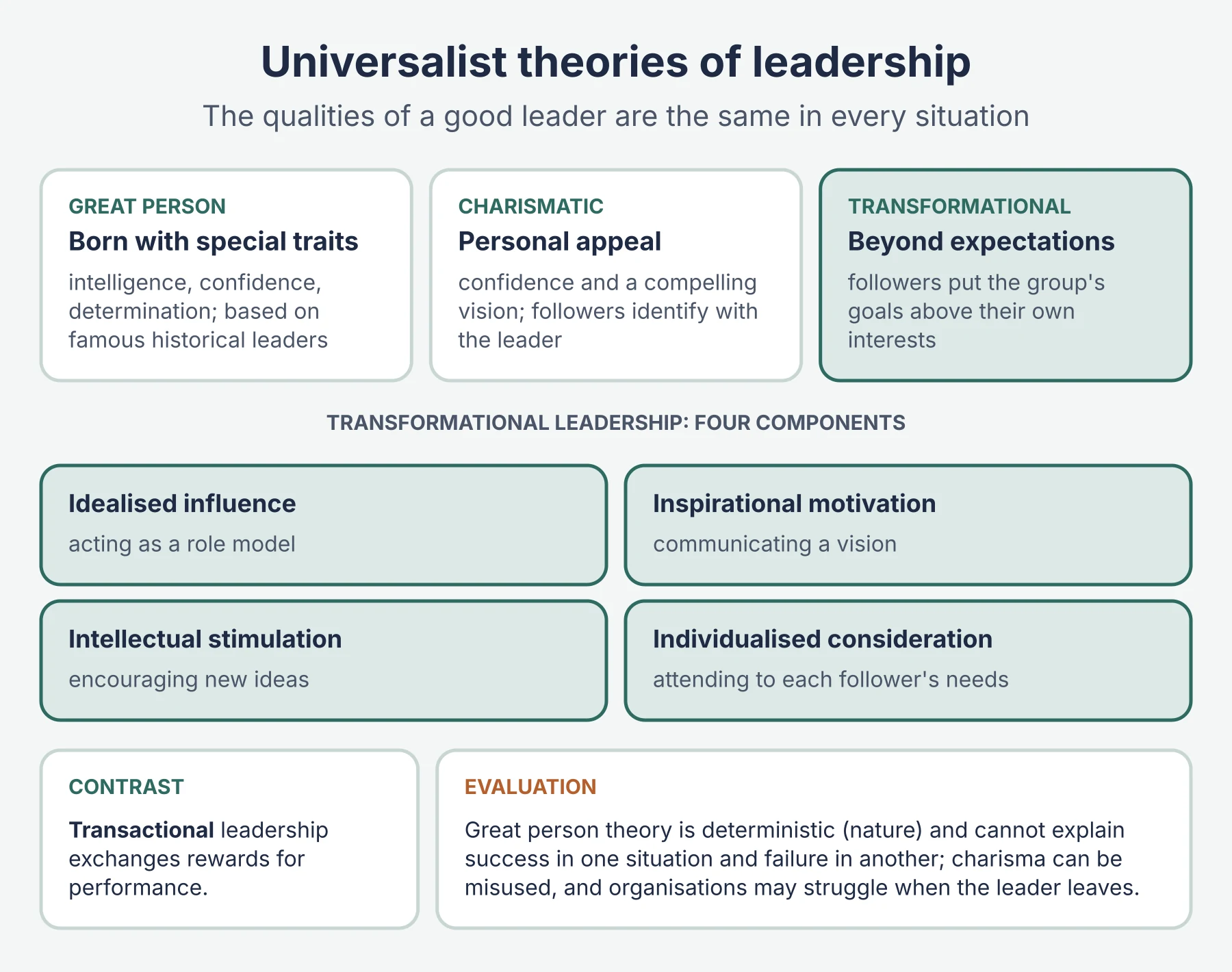
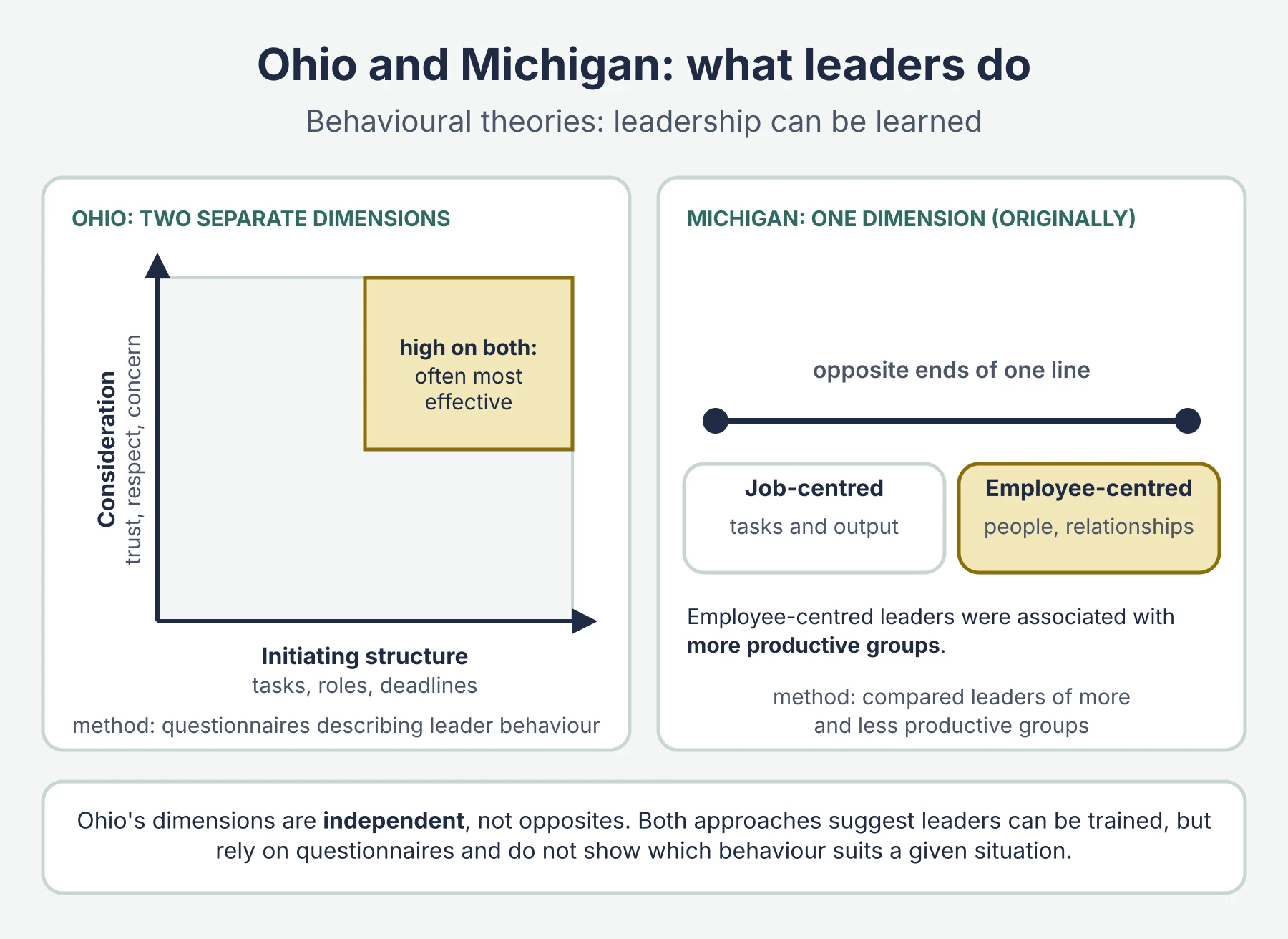
- 4.2.1: universalist (great person, charismatic, transformational); behavioural (Ohio, Michigan); Heifetz’s six principles for adaptive challenges.
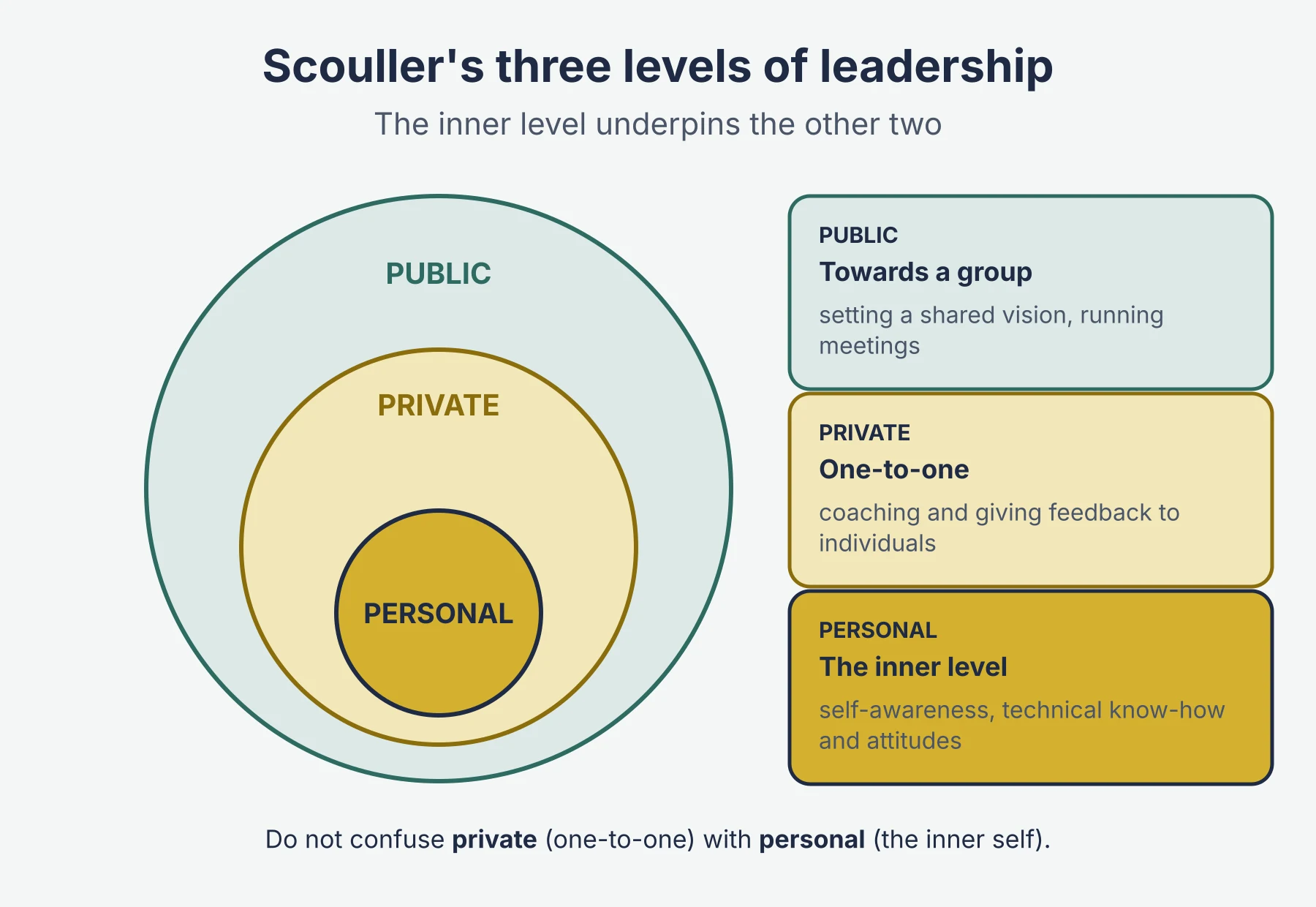
- 4.2.2: Muczyk and Reimann’s four styles; Scouller’s public, private and personal levels; gender and style, key study Cuadrado et al. (2008).
- 4.2.3: Kouzes and Posner’s LPI with five practices; Kelley’s (1988) followership, two dimensions and five styles.
Key terms
| Term | Definition |
|---|---|
| Universalist theory | The same leader qualities are effective in all situations |
| Great person theory | Leaders are born with special traits |
| Charismatic leader | Inspires through personal appeal and vision |
| Transformational leader | Motivates followers to put group goals above self-interest |
| Initiating structure | Ohio dimension: organising tasks and roles |
| Consideration | Ohio dimension: concern and respect for staff |
| Job-centred / employee-centred | Michigan contrast: focus on output versus focus on people |
| Adaptive challenge | A problem needing changes in values and behaviour, not a technical fix |
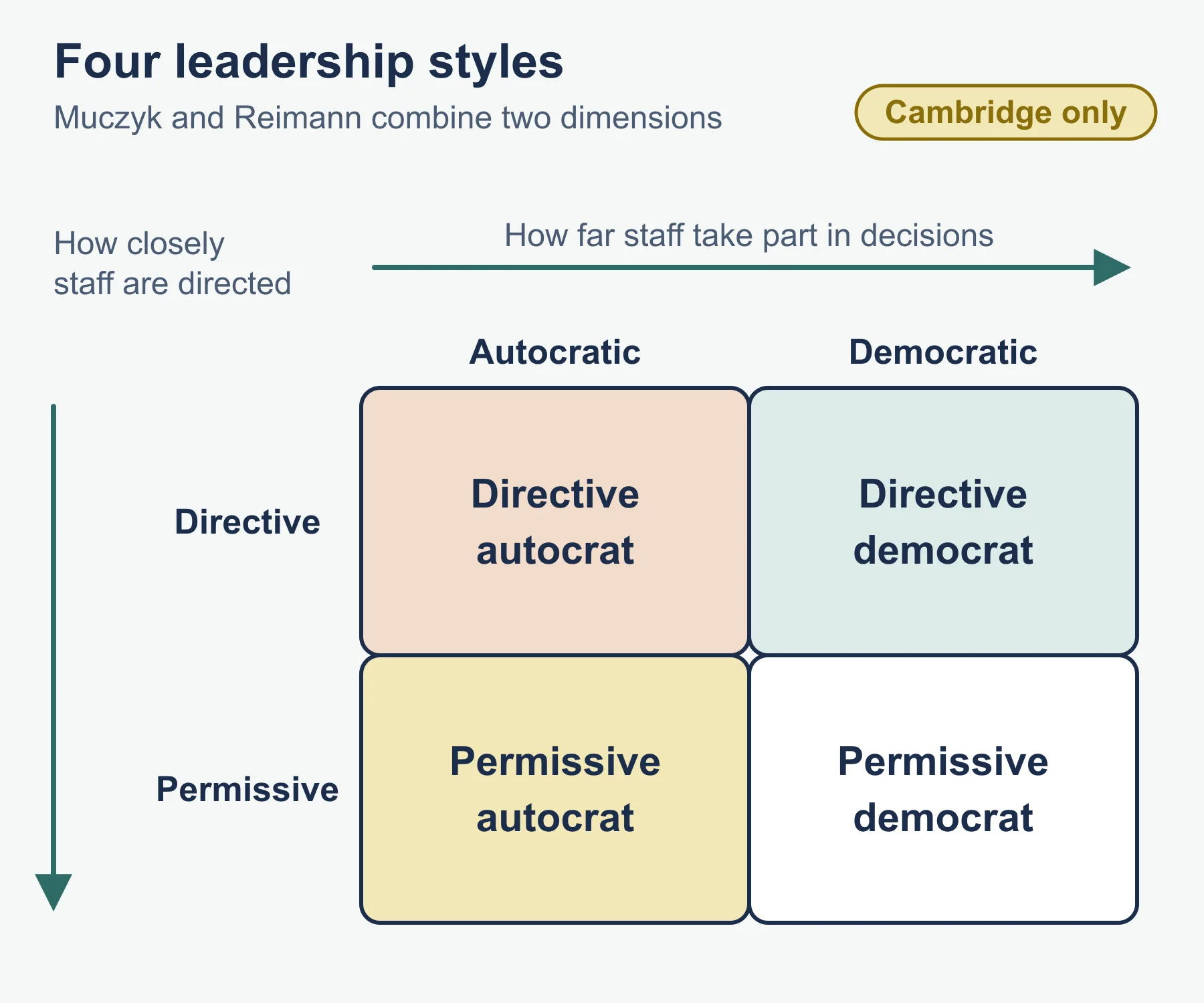
| Directive / permissive | How closely the leader supervises execution |
| Autocratic / democratic | Whether staff take part in decisions |
| Followership | The role of actively supporting a leader and the group’s goals |
| Role congruity theory | Leaders are judged against gender role expectations |
Muczyk and Reimann’s four styles
| Directive (close supervision) | Permissive (freedom in execution) | |
|---|---|---|
| Autocratic (leader decides) | Directive autocrat | Permissive autocrat |
| Democratic (staff share decisions) | Directive democrat | Permissive democrat |
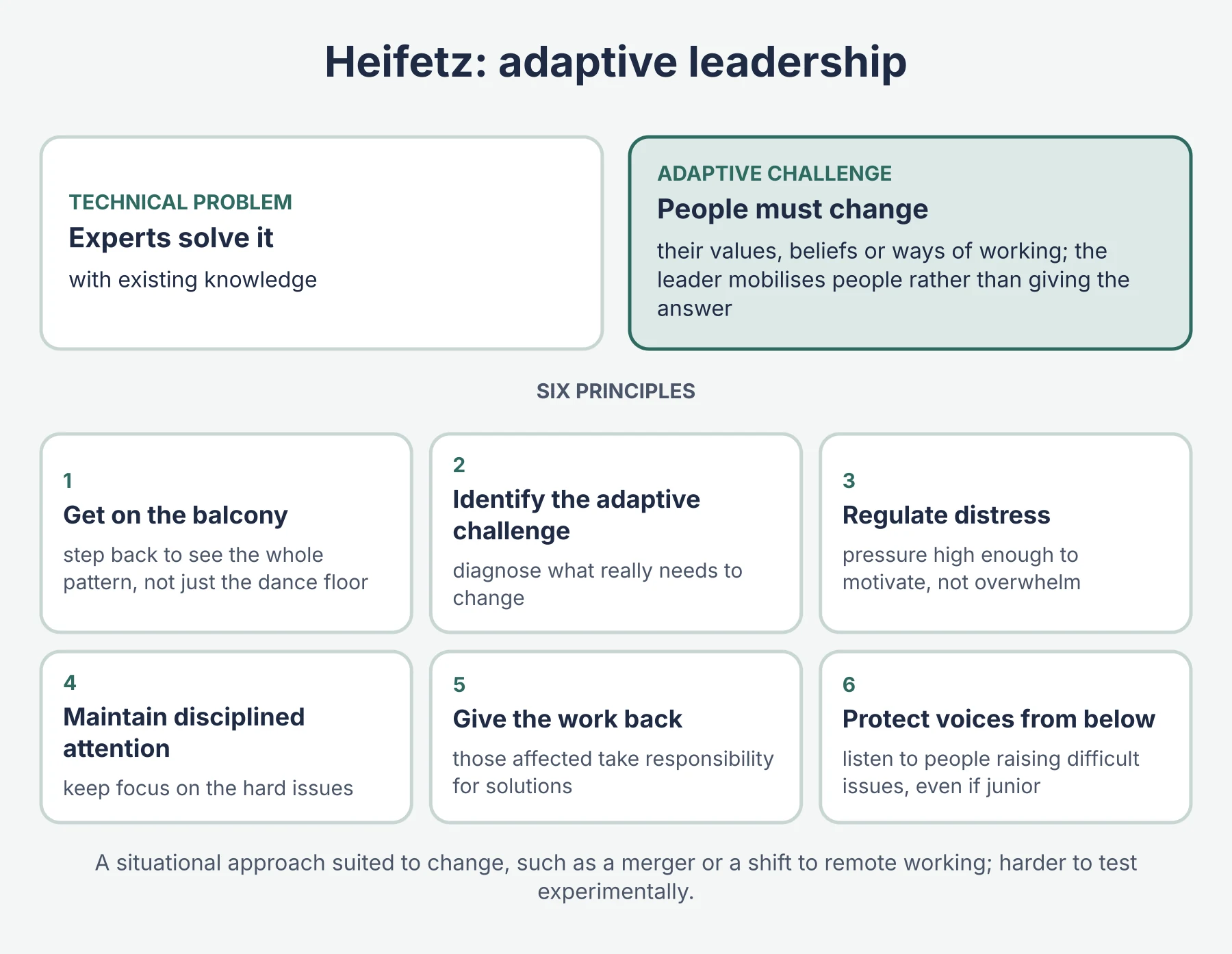
Heifetz’s six principles, applied to a school introducing a new timetable
| Principle | What the head teacher does |
|---|---|
| Get on the balcony | Steps back to see how the change affects every department |
| Identify the adaptive challenge | Recognises that staff habits, not the software, are the real issue |
| Regulate distress | Introduces the change in stages and keeps workloads manageable |
| Maintain disciplined attention | Keeps meetings focused on the difficult trade-offs |
| Give the work back to the people | Lets departments design their own solutions |
| Protect voices of leadership from below | Listens to junior teachers who raise problems |
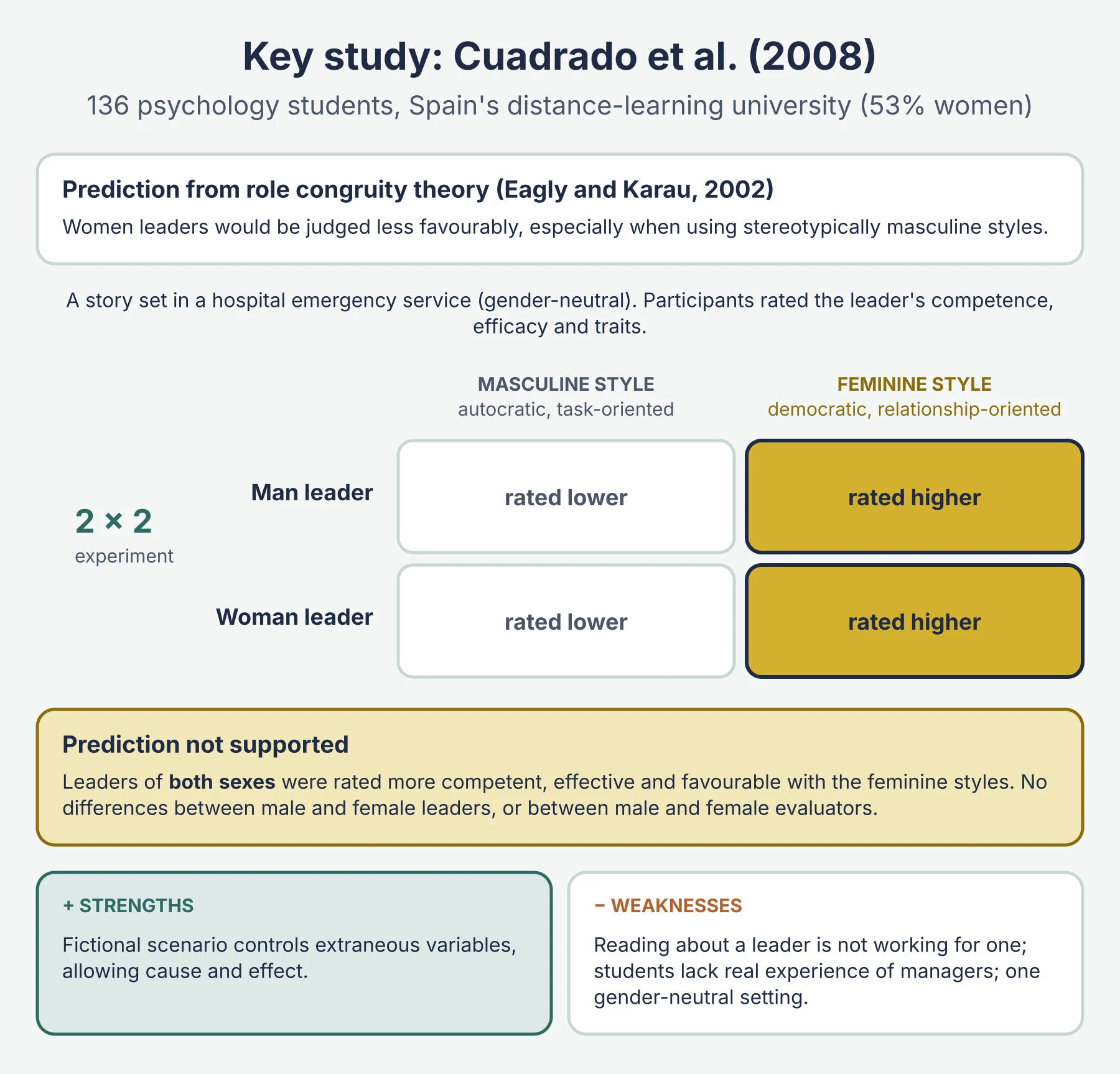
Key study grid: Cuadrado et al. (2008)
| Feature | Detail |
|---|---|
| Theory tested | Role congruity theory (Eagly and Karau, 2002) |
| Sample | 136 psychology students, Spanish national distance-learning university; 53% women |
| Design | 2 × 2 experiment: leader sex × leadership style |
| Materials | Story of a leader in a hospital emergency service (gender-neutral setting) |
| Styles | Masculine: autocratic, task-oriented. Feminine: democratic, relationship-oriented, individualised consideration |
| DVs | Ratings of competence, efficacy and traits |
| Results | Feminine styles rated more favourably for both sexes; no leader-sex or evaluator-sex differences |
| Conclusion | Prediction not supported in this setting |
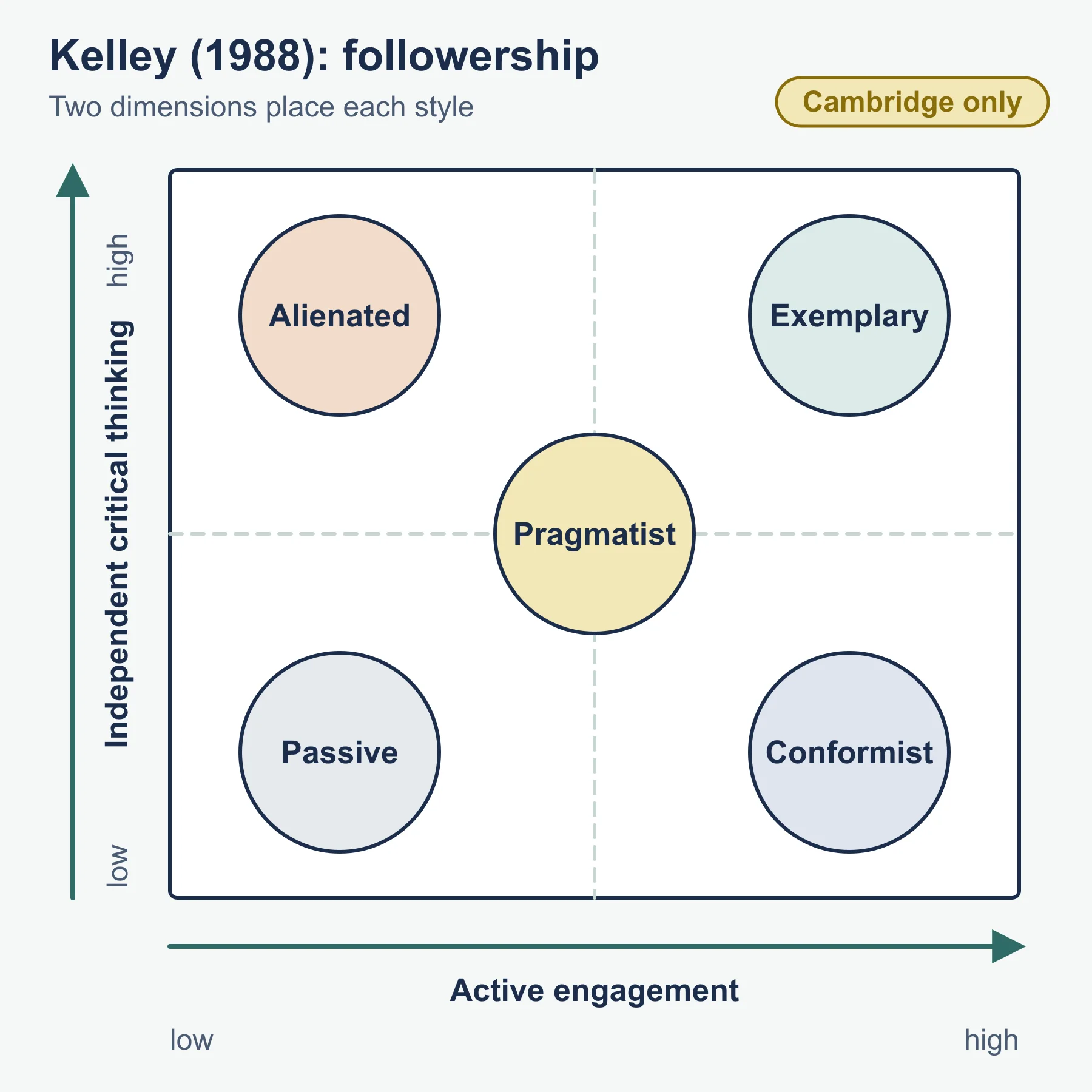
Kelley’s five followership styles
| Style | Critical thinking | Engagement |
|---|---|---|
| Exemplary | High | High |
| Alienated | High | Low |
| Conformist | Low | High |
| Passive | Low | Low |
| Pragmatist | Middle | Middle |
LPI: five practices
Model the way; inspire a shared vision; challenge the process; enable others to act; encourage the heart.
Linking to issues and debates
- Nature versus nurture (4.2.1): great person theory is nature; behavioural theories imply leadership can be learned.
- Individual and situational explanations (4.2.1, 4.2.2): traits are individual; Heifetz and Muczyk and Reimann stress the situation.
- Reductionism versus holism (4.2.1, 4.2.2): two-dimension models simplify leadership.
- Generalisations from findings (4.2.2): Cuadrado et al. used students and one setting.
- Self-reports and psychometrics (4.2.3): the LPI relies on ratings by leaders and observers.
- Cultural differences (4.2.3): followership expectations vary between cultures.
Exam traps
- Ohio dimensions are independent; a leader can be high on both.
- Heifetz’s leader does not give the answer; they give the work back to the people.
- Scouller’s personal level is the inner core, not one-to-one leadership (that is private).
- Cuadrado et al. did not find bias against women.
- Kelley’s two dimensions must be named to describe the styles properly.
Quick self-test
- What do universalist theories assume?
- Name the two Ohio dimensions.
- Name the two Michigan leader types.
- What is the difference between a technical problem and an adaptive challenge?
- Explain “get on the balcony”.
- Which Muczyk and Reimann style involves staff in decisions and lets them work independently?
- Name Scouller’s three levels.
- Which theory did Cuadrado et al. (2008) test?
- Why did Cuadrado et al. set the story in a hospital emergency service?
- What was the main finding of Cuadrado et al.?
- Name the five LPI practices.
- Which of Kelley’s styles is critical but passive?
Answers
- That the same qualities make a good leader in every situation.
- Initiating structure and consideration.
- Job-centred (production-centred) and employee-centred.
- A technical problem can be solved with existing expertise; an adaptive challenge requires people to change values, beliefs or behaviour.
- Stepping back from the action to see the whole pattern of what is happening.
- Permissive democrat.
- Public, private and personal.
- Role congruity theory.
- It was chosen as a gender-neutral context.
- Leaders of both sexes were rated more favourably with stereotypically feminine (democratic, relationship-oriented) styles; there were no sex differences.
- Model the way; inspire a shared vision; challenge the process; enable others to act; encourage the heart.
- Alienated.
More resources on this topic
Related resources
-
Study guides
Cambridge A Level Psychology (9990): Motivation to work
Cambridge 9990 topic 4.1 in depth: Maslow and McClelland, goal-setting and VIE theory, extrinsic and intrinsic rewards, and Landry et al. (2019) study 1.
Psychology · Cambridge · A Level
Read guide -
Practice questions
Cambridge A Level Psychology (9990): Motivation to work – Practice Questions
Original Paper 3 and Paper 4 style questions on Cambridge 9990 topic 4.1: need and cognitive theories, rewards and Landry et al. (2019), with full mark schemes.
Psychology · Cambridge · A Level
Try questions -
Revision notes
Cambridge A Level Psychology (9990): Motivation to work – Revision Notes
Revision notes for Cambridge 9990 topic 4.1: Maslow, McClelland, goal-setting, VIE, rewards and Landry et al. (2019), with a self-test.
Psychology · Cambridge · A Level
Revise topic
Studying Psychology?
This page is free and stays free. Marlbridge is not offering Psychology classes at the moment, so there is no tuition to book for it. The free study resources stay open to everyone.
Get free revision emails (optional)
Occasional emails with practice questions, worked explanations and links to free resources for the qualification and subjects you choose. No spam, and you can unsubscribe from any email. The free tools on this site never need an email.