
Study Guides
Cambridge A Level Psychology (9990): Motivation to work
Cambridge 9990 topic 4.1 in depth: Maslow and McClelland, goal-setting and VIE theory, extrinsic and intrinsic rewards, and Landry et al. (2019) study 1.
- Subject
- Psychology
- Level
- A LEVEL
- Topic
- Specialist Option 4: Organisational Psychology
- Author
- Marlbridge Academic Team
- Updated
- Reviewed by
- Kanwal Aslam (what this means)
Aligned to Cambridge A Level Psychology (9990), 2024-2026. Official specification .
Syllabus page (what it covers and how it is assessed): Cambridge A Level Psychology.
Syllabus points this page covers
9990 (A Level)
- 4.1 Motivation to work
Topic 4.1, Motivation to work, opens Specialist Option 4 (Organisational Psychology) in Cambridge International A Level Psychology 9990, syllabus for 2024 to 2026. It asks why people work hard. Need theories (4.1.1) say motivation comes from unmet needs; cognitive theories (4.1.2) say it comes from goals and beliefs; and 4.1.3 looks at the rewards organisations use and at self-determination theory. The key study is Landry et al. (2019), study 1, on how the meaning of a cash reward affects motivation.
The Organisational Psychology study guide summarises every topic. This page explains each theory more fully, shows how to apply and compare them, and gives a worked example. Use it with the motivation to work revision notes and the motivation to work practice questions.
Syllabus content for 4.1
| Sub-topic | Content | Named study |
|---|---|---|
| 4.1.1 Need theories | Maslow’s hierarchy of needs, including five needs; McClelland’s theory of achievement motivation (achievement, affiliation, power) | e.g. Saeednia (2011) |
| 4.1.2 Cognitive theories | Latham and Locke’s goal-setting theory, goal-setting principles and SMART goals; Vroom’s VIE (expectancy) theory | none named |
| 4.1.3 Motivators at work | Extrinsic: pay, bonuses, profit-sharing, performance-related pay; intrinsic: praise, respect, recognition, empowerment, sense of belonging; Deci and Ryan’s self-determination theory | Key study Landry et al. (2019), study 1 |
4.1.1 Need theories
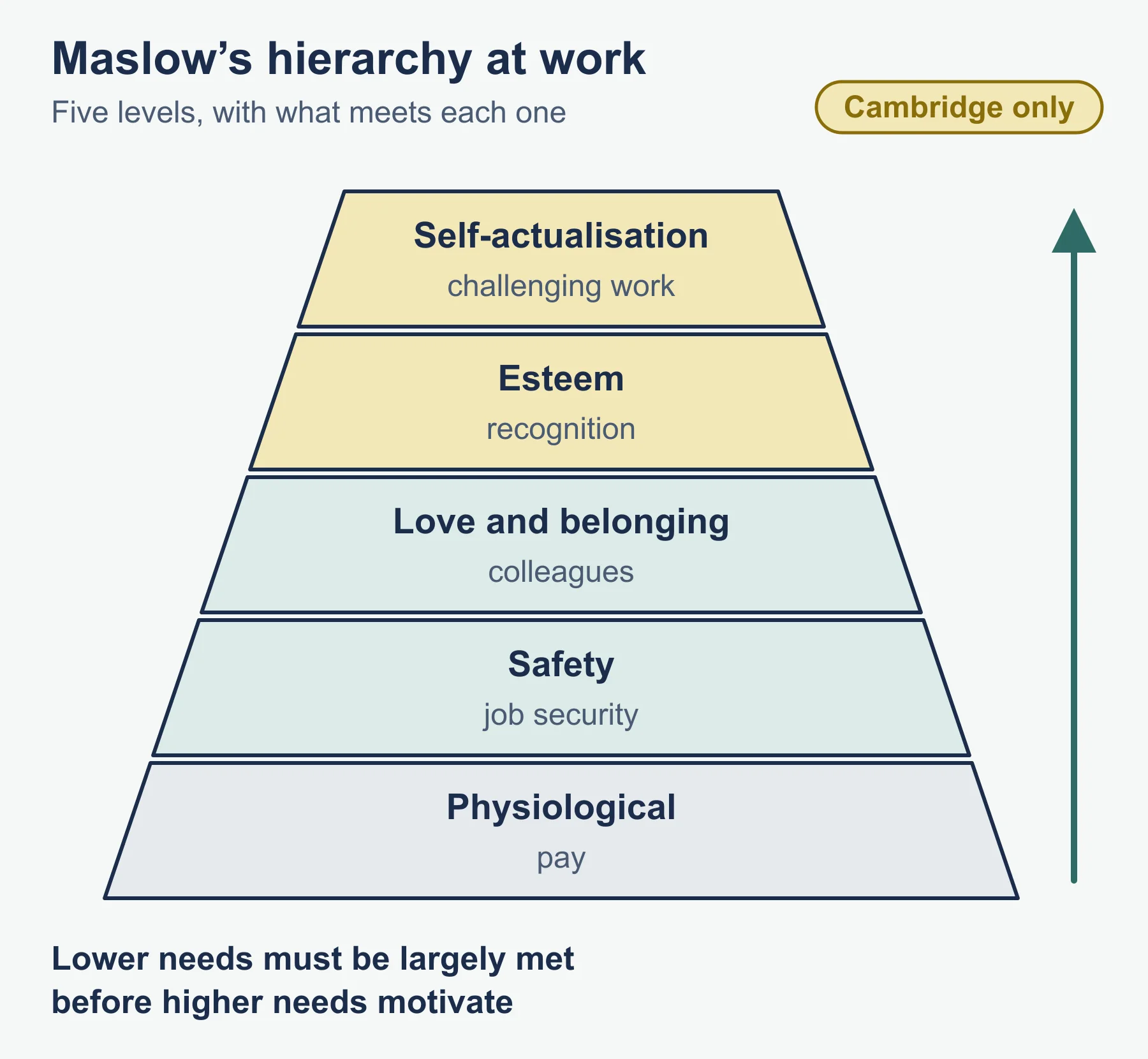
Maslow’s hierarchy of needs. Maslow proposed five levels of need, usually drawn as a pyramid:
| Level | Need | Workplace example |
|---|---|---|
| 5 | Self-actualisation | Creative, challenging projects; chances to grow |
| 4 | Esteem | Job title, recognition, promotion |
| 3 | Love and belonging | Friendly team, social events |
| 2 | Safety | Secure contract, safe conditions, pension |
| 1 | Physiological | Wage enough for food and housing; breaks |
The lower four are deficiency needs: lacking them creates tension. Self-actualisation is a growth need. A lower need must be largely satisfied before the next one becomes the main motivator. Saeednia (2011) is the syllabus example of research that developed a scale to measure satisfaction of these basic needs.
Evaluation: the theory is easy to apply to management, but the strict order is not well supported, since people may seek esteem before security. It reflects individualist values; in collectivist cultures belonging may be more important than self-actualisation.
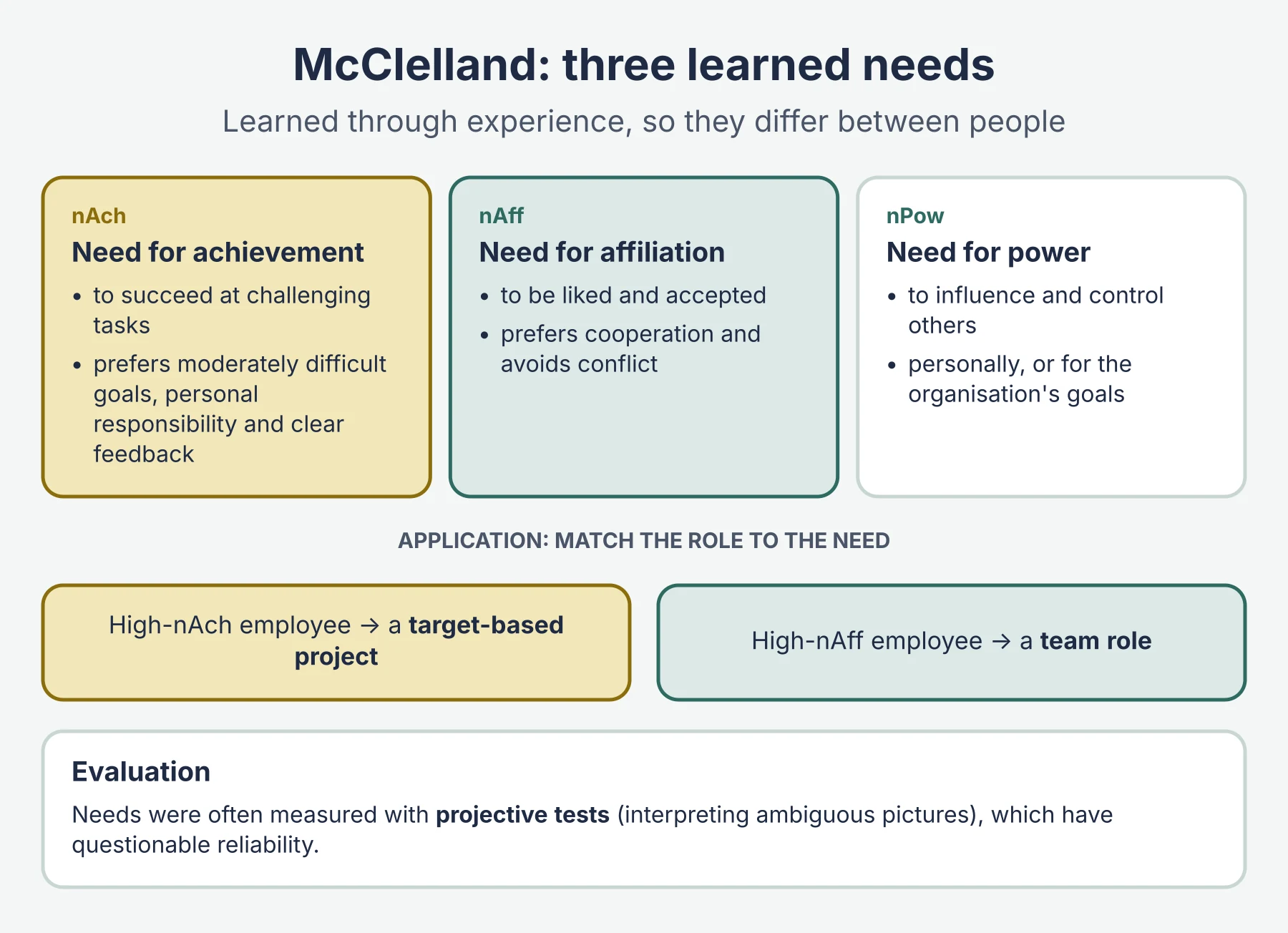
McClelland’s theory of achievement motivation proposes three needs that are learned through experience, so they differ between people:
- Need for achievement (nAch): to succeed at challenging tasks. High-nAch people prefer moderately difficult goals, personal responsibility and clear feedback.
- Need for affiliation (nAff): to be liked and accepted. High-nAff people prefer cooperation and avoid conflict.
- Need for power (nPow): to influence and control others, either personally or for the organisation’s goals.
Application: a manager can match roles to needs, giving a high-nAch employee a target-based project and a high-nAff employee a team role. Evaluation: needs were often measured with projective tests (interpreting ambiguous pictures), which have questionable reliability.
4.1.2 Cognitive theories
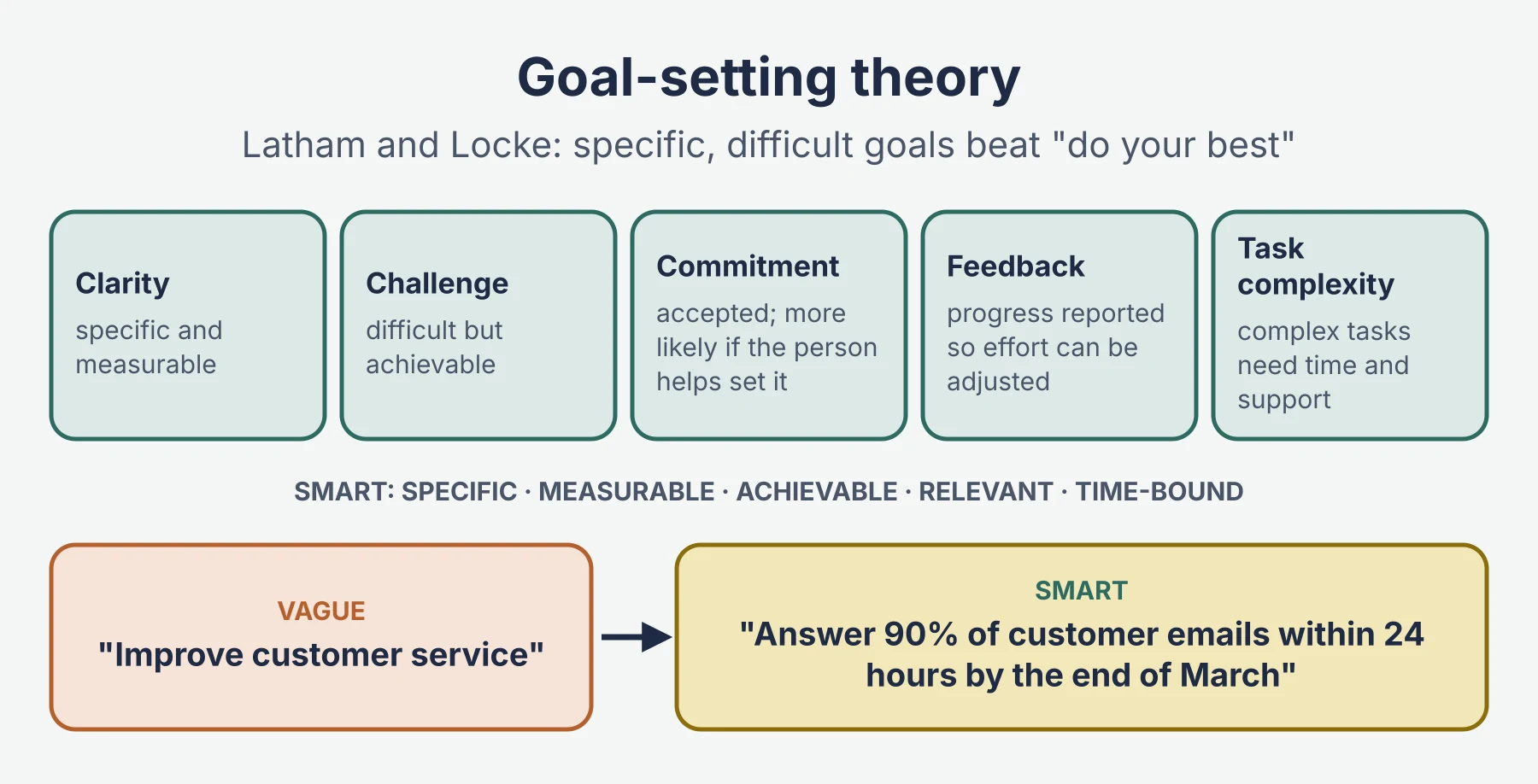
Goal-setting theory (Latham and Locke). Specific, difficult goals lead to higher performance than easy or vague “do your best” goals. Goal-setting principles include:
- Clarity: the goal is specific and measurable.
- Challenge: difficult but achievable.
- Commitment: the person accepts the goal, which is more likely if they help set it.
- Feedback: progress is reported so effort can be adjusted.
- Task complexity: complex tasks need time and support so the goal does not overwhelm.
SMART goals are specific, measurable, achievable, relevant and time-bound. Compare “Improve customer service” with “Answer 90% of customer emails within 24 hours by the end of March”.
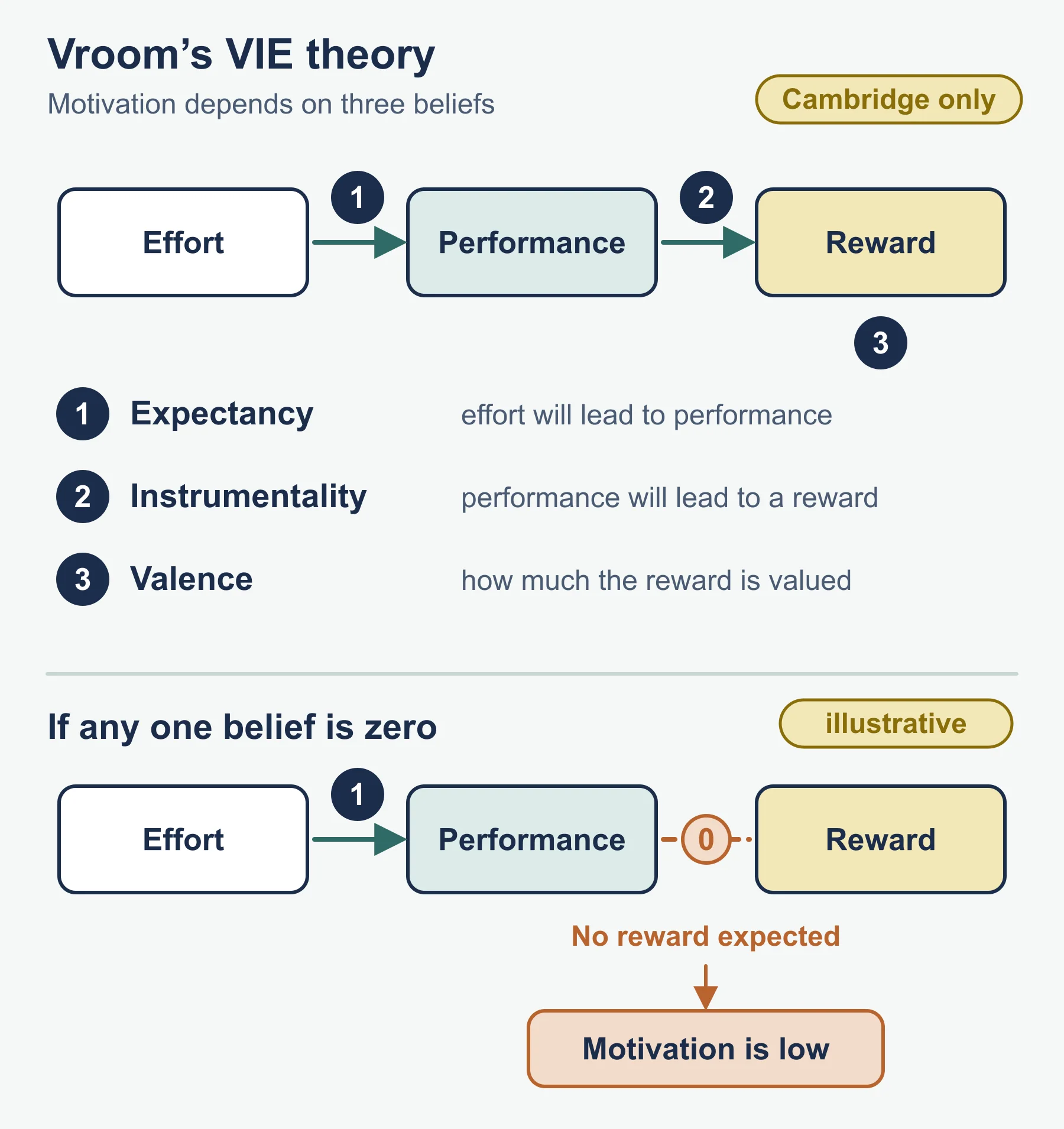
Vroom’s VIE (expectancy) theory. Motivation depends on three beliefs, often written as motivation = V × I × E:
- Expectancy: “If I try hard, will I perform well?”
- Instrumentality: “If I perform well, will I be rewarded?”
- Valence: “Do I value the reward?”
Because the beliefs multiply, if any one is zero, motivation is zero. A salesperson who believes extra effort will raise sales (high expectancy) and that sales bring a bonus (high instrumentality), but who does not care about money (zero valence), will not be motivated by the bonus.
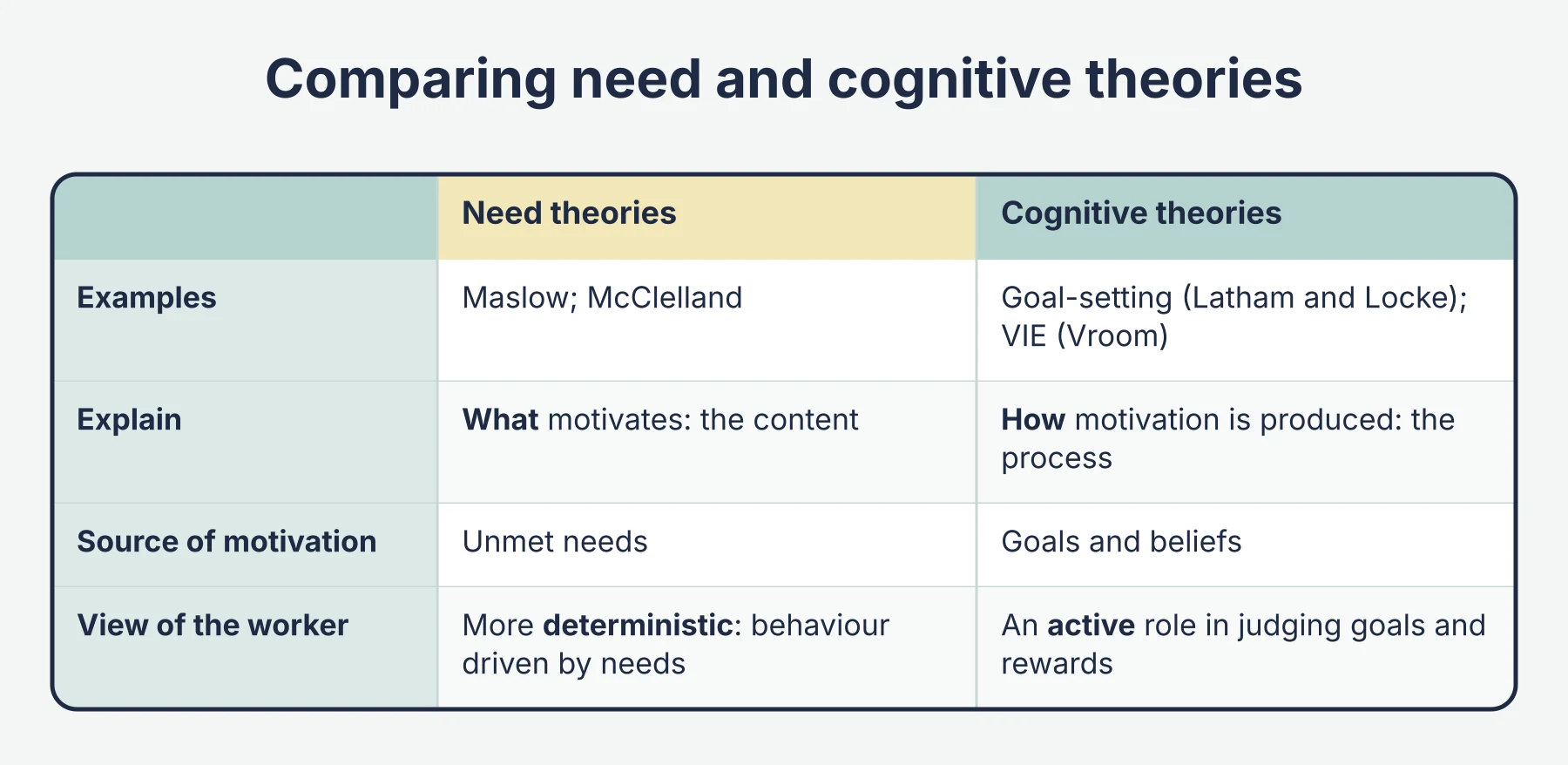
Comparing need and cognitive theories. Need theories explain what motivates (the content). Cognitive theories explain how motivation is produced (the process). Need theories are more deterministic, implying behaviour is driven by needs; cognitive theories give people an active role in judging goals and rewards.
4.1.3 Motivators at work
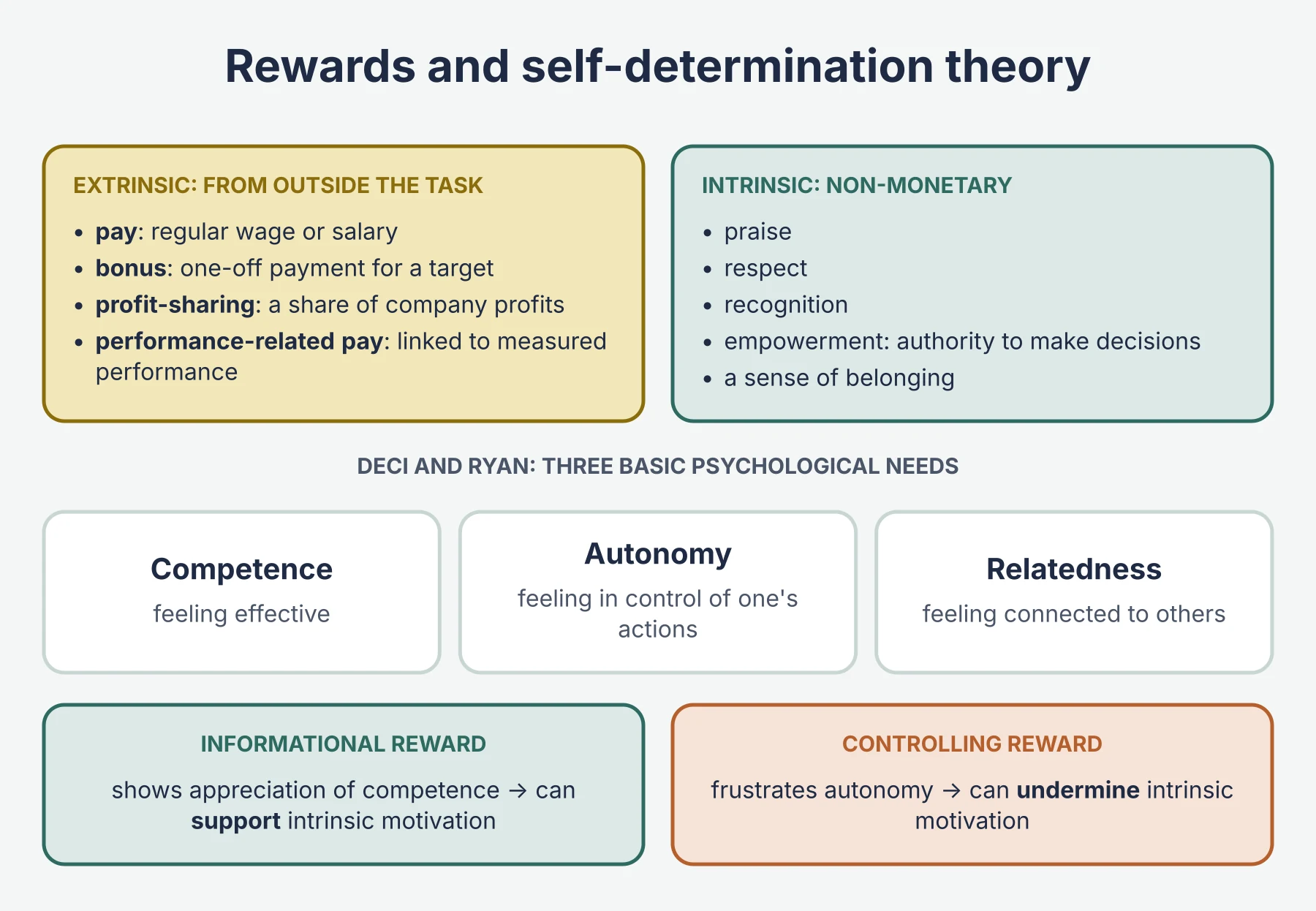
Extrinsic motivators come from outside the task:
| Reward | What it is |
|---|---|
| Pay | Regular wage or salary |
| Bonus | One-off payment for meeting a target |
| Profit-sharing | A share of company profits paid to employees |
| Performance-related pay | Pay linked to an individual’s measured performance |
Intrinsic motivators are non-monetary rewards: praise, respect, recognition, empowerment (being given authority to make decisions) and a sense of belonging.
Self-determination theory (Deci and Ryan) proposes three basic psychological needs: competence (feeling effective), autonomy (feeling in control of one’s actions) and relatedness (feeling connected to others). When these are satisfied, people show more autonomous (intrinsic) motivation. Rewards that feel controlling can frustrate autonomy and undermine intrinsic motivation; rewards that feel informational, showing appreciation of competence, can support it.
Key study: Landry et al. (2019), study 1
- Context: research on whether money undermines intrinsic motivation has given mixed results. Landry, Zhang, Papachristopoulos and Forest proposed that the functional meaning of a reward, not its size, is what matters.
- Aim: to test whether presenting the same cash-equivalent reward as autonomy-supportive or as controlling changes need satisfaction, motivation and performance.
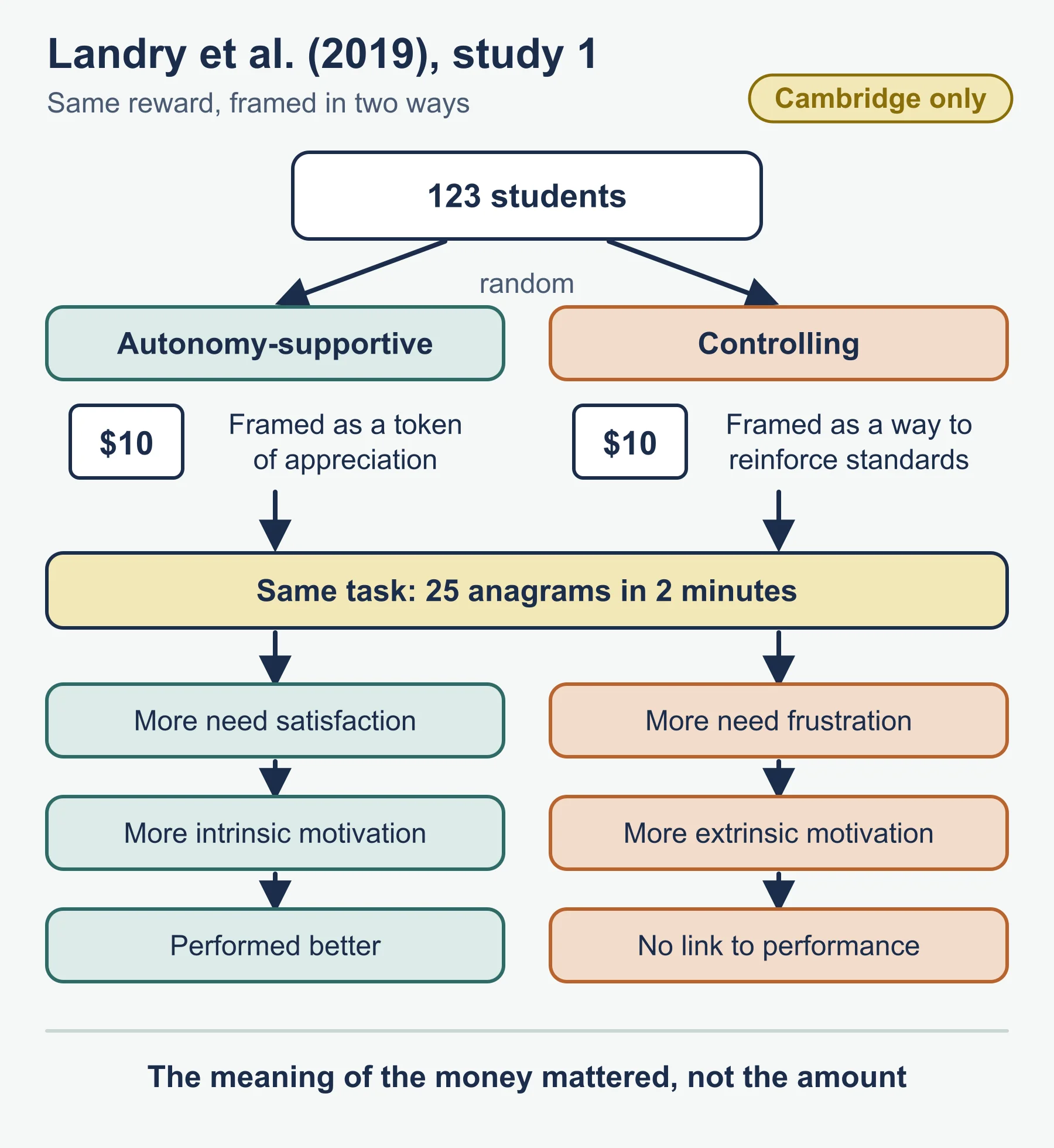
- Sample: 123 French-speaking students on an organisational behaviour course at a Canadian university (mean age 23, 60% women).
- Design: a laboratory experiment with random allocation to two conditions.
- Procedure: everyone was offered a $10 coffee-shop gift card. In the autonomy-supportive condition, it was presented as a token of appreciation for their contribution; in the controlling condition, as a means of reinforcing performance standards. Participants completed questionnaires on need satisfaction and frustration and on motivation, then had two minutes to solve as many as possible of 25 four-letter anagrams.
- Results: the autonomy-supportive group reported more satisfaction of competence, autonomy and relatedness, which predicted intrinsic motivation, and they performed better. The controlling group reported more need frustration, which predicted extrinsic motivation, and extrinsic motivation did not predict performance.
- Conclusion: how a reward is presented shapes its effect.
Evaluation.
- Control: random allocation and an identical reward isolate the effect of framing.
- Generalisation: student participants, a small reward and a two-minute task differ greatly from employees’ salaries and working lives.
- Self-report: need satisfaction and motivation were measured by questionnaire.
- Application: managers can describe bonuses as recognition rather than as pressure to meet standards.
- Reductionism versus holism: a single framing manipulation is a narrow slice of workplace motivation.
Worked example: applying VIE theory
Staff at a call centre are offered a bonus for handling 20% more calls, but few seem motivated. Using Vroom’s VIE theory, suggest why. [4]
“Expectancy may be low: staff may believe that however hard they try, they cannot handle 20% more calls because call length is outside their control (1). Instrumentality may be low if staff doubt managers will actually pay the bonus (1). Valence may be low if the bonus is too small to matter to them (1). Because motivation is the product of the three, a low value on any one reduces motivation overall (1).”
Common mistakes
- Listing Maslow’s needs in the wrong order or with four levels.
- Treating McClelland’s needs as inborn. They are learned.
- Writing that Landry et al. gave the two groups different amounts of money. The reward was identical; only its framing differed.
- Describing study 2 of Landry et al.; the syllabus says its methodological specifics are not needed.
Exam technique
Describe questions on theories reward named components plus a workplace example for each. Compare questions should contrast content and process theories, or deterministic and active views of the worker. Evaluate questions can use the syllabus issues for 4.1: application, individual and situational explanations, cultural differences, determinism versus free will, reductionism versus holism and generalisations from findings.
More resources on this topic
- Motivation to work revision notes
- Motivation to work practice questions
- Organisational Psychology study guide
Official syllabus
Cambridge International AS & A Level Psychology 9990 syllabus for 2024, 2025 and 2026, Specialist Option 4: Organisational Psychology, topic 4.1 — cambridgeinternational.org.
Related resources
-
Practice questions
Cambridge A Level Psychology (9990): Motivation to work – Practice Questions
Original Paper 3 and Paper 4 style questions on Cambridge 9990 topic 4.1: need and cognitive theories, rewards and Landry et al. (2019), with full mark schemes.
Psychology · Cambridge · A Level
Try questions -
Revision notes
Cambridge A Level Psychology (9990): Motivation to work – Revision Notes
Revision notes for Cambridge 9990 topic 4.1: Maslow, McClelland, goal-setting, VIE, rewards and Landry et al. (2019), with a self-test.
Psychology · Cambridge · A Level
Revise topic -
Study guides
Cambridge A Level Psychology (9990): Organisational work conditions
Cambridge 9990 topic 4.4 in depth: the Hawthorne effect, open-plan offices, shiftwork, human and system errors, token economies and Swat (1997) on accidents.
Psychology · Cambridge · A Level
Read guide
Studying Psychology?
This page is free and stays free. Marlbridge is not offering Psychology classes at the moment, so there is no tuition to book for it. The free study resources stay open to everyone.
Get free revision emails (optional)
Occasional emails with practice questions, worked explanations and links to free resources for the qualification and subjects you choose. No spam, and you can unsubscribe from any email. The free tools on this site never need an email.