
Revision Notes
Cambridge A Level Psychology (9990): Motivation to work – Revision Notes
Revision notes for Cambridge 9990 topic 4.1: Maslow, McClelland, goal-setting, VIE, rewards and Landry et al. (2019), with a self-test.
- Subject
- Psychology
- Level
- A LEVEL
- Topic
- Specialist Option 4: Organisational Psychology
- Author
- Marlbridge Academic Team
- Updated
- Reviewed by
- Kanwal Aslam (what this means)
Aligned to Cambridge A Level Psychology (9990), 2024-2026. Official specification .
Syllabus page (what it covers and how it is assessed): Cambridge A Level Psychology.
Syllabus points this page covers
9990 (A Level)
- 4.1 Motivation to work
These notes condense topic 4.1, Motivation to work, from Specialist Option 4 of Cambridge International A Level Psychology 9990 (syllabus for 2024 to 2026). Sort everything into three boxes: needs (what drives us), cognitions (how we judge goals and rewards), and rewards (what organisations offer).
The motivation to work study guide explains each theory with examples. Practise with the motivation to work practice questions.
Topic map
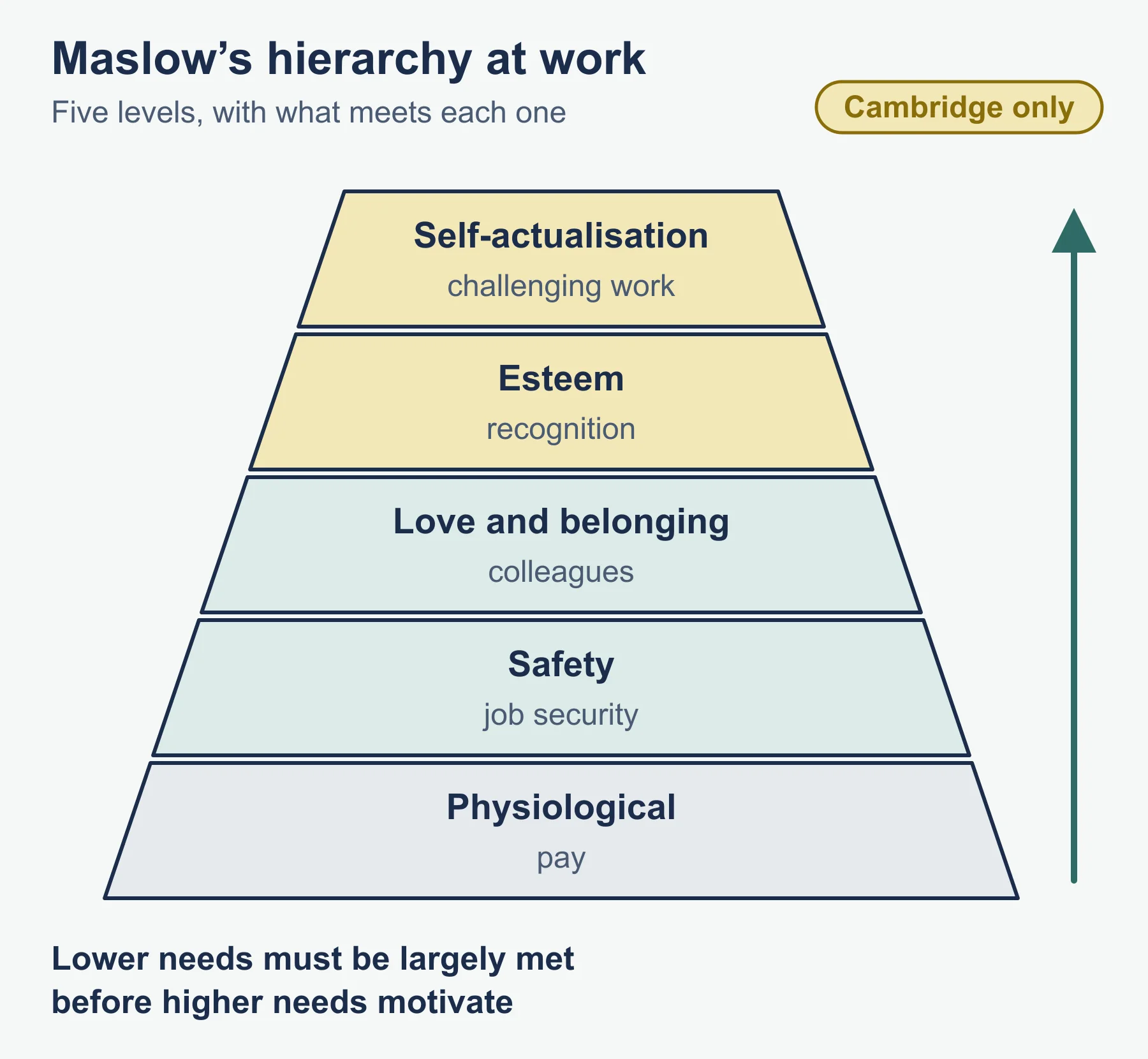
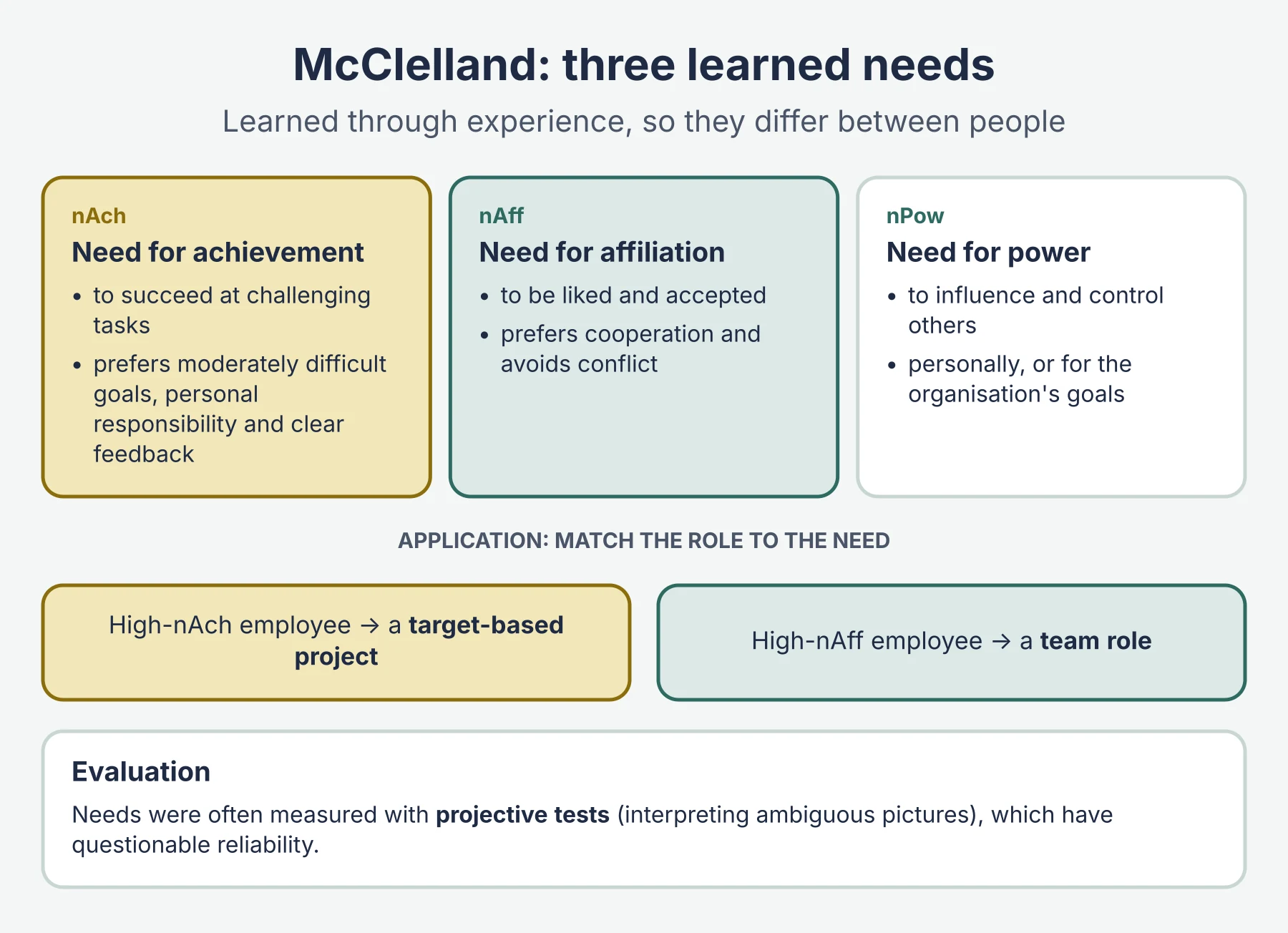
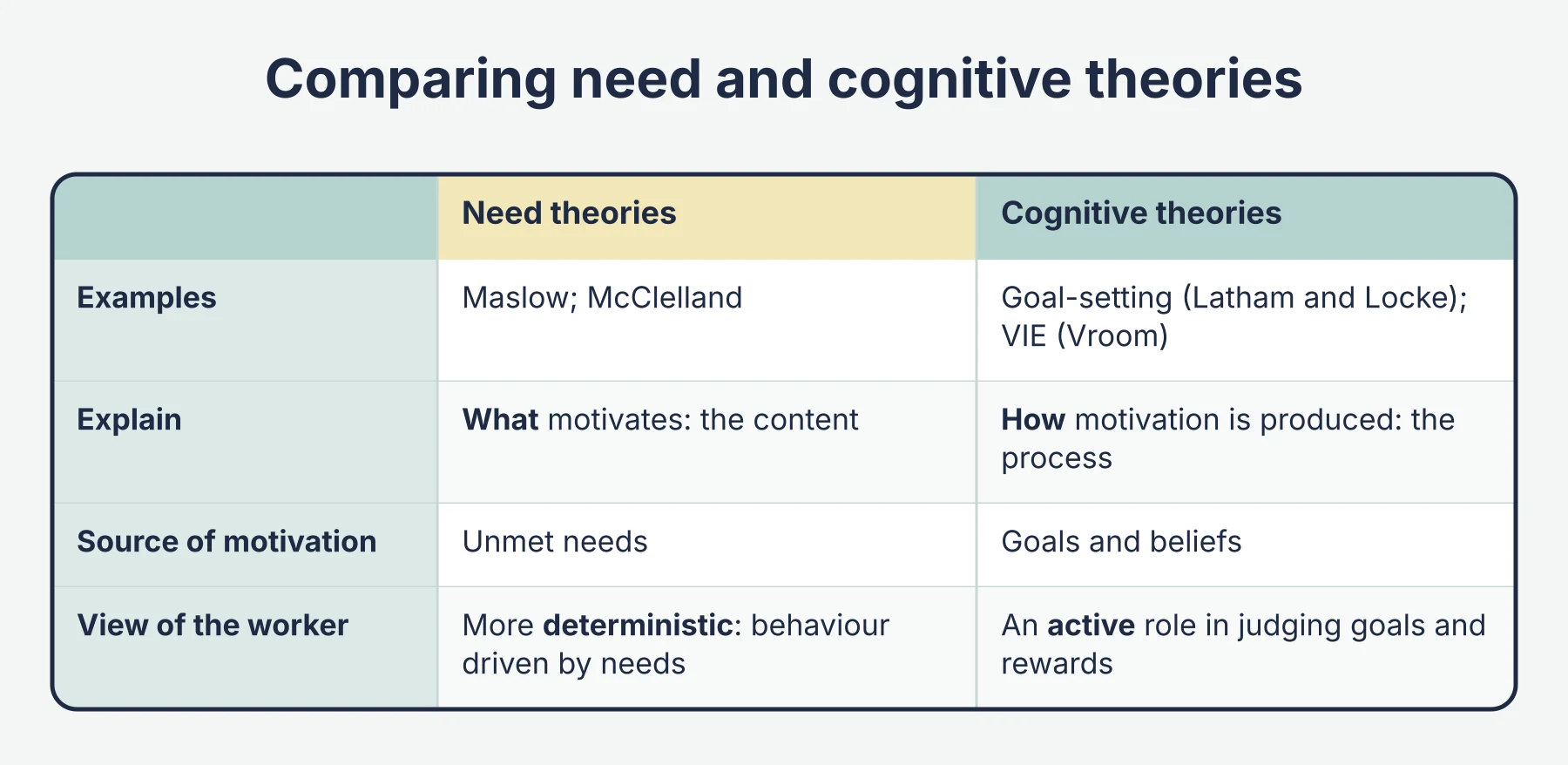
- 4.1.1 Need theories: Maslow’s five needs (e.g. Saeednia, 2011); McClelland’s achievement, affiliation and power.
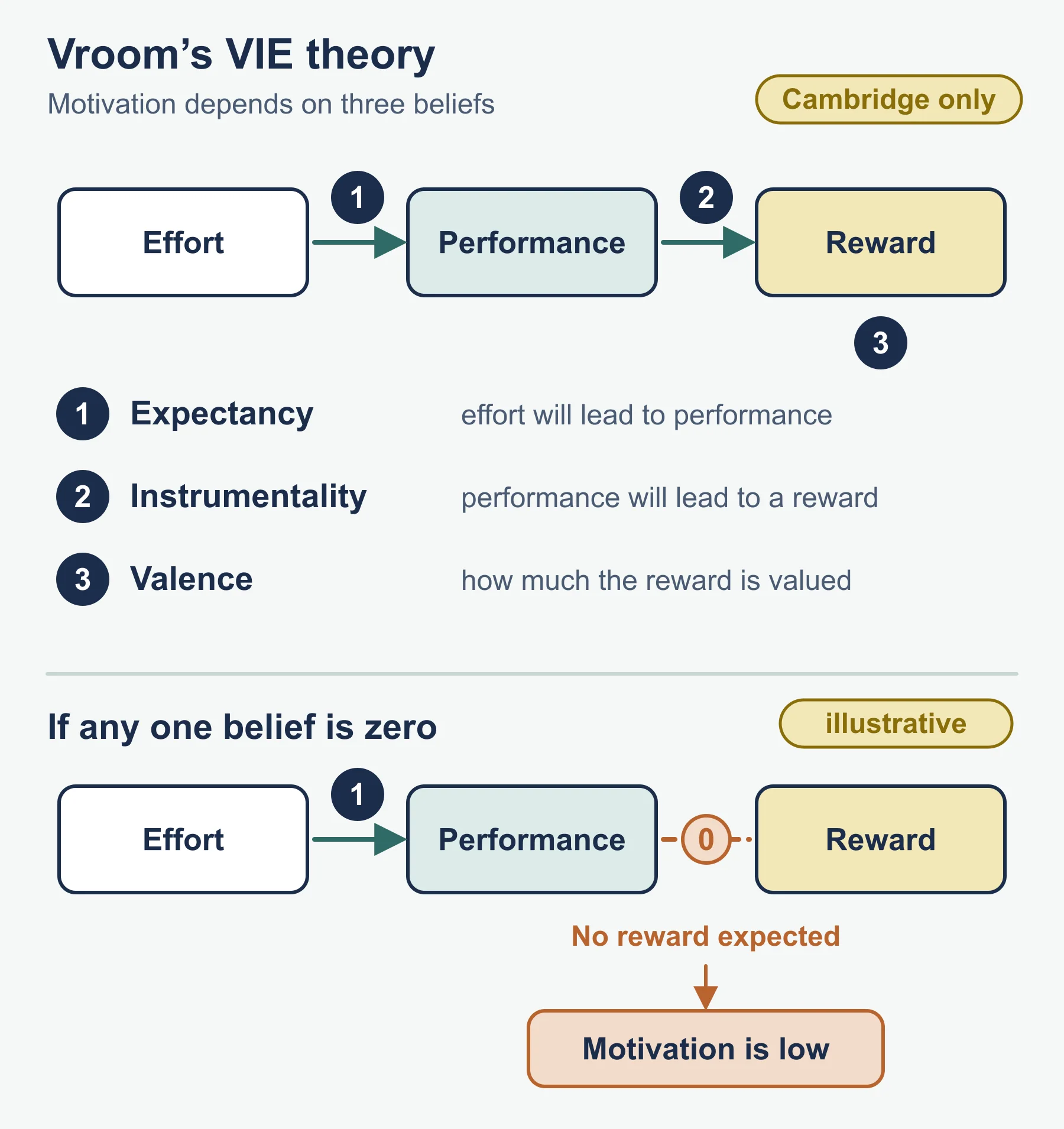
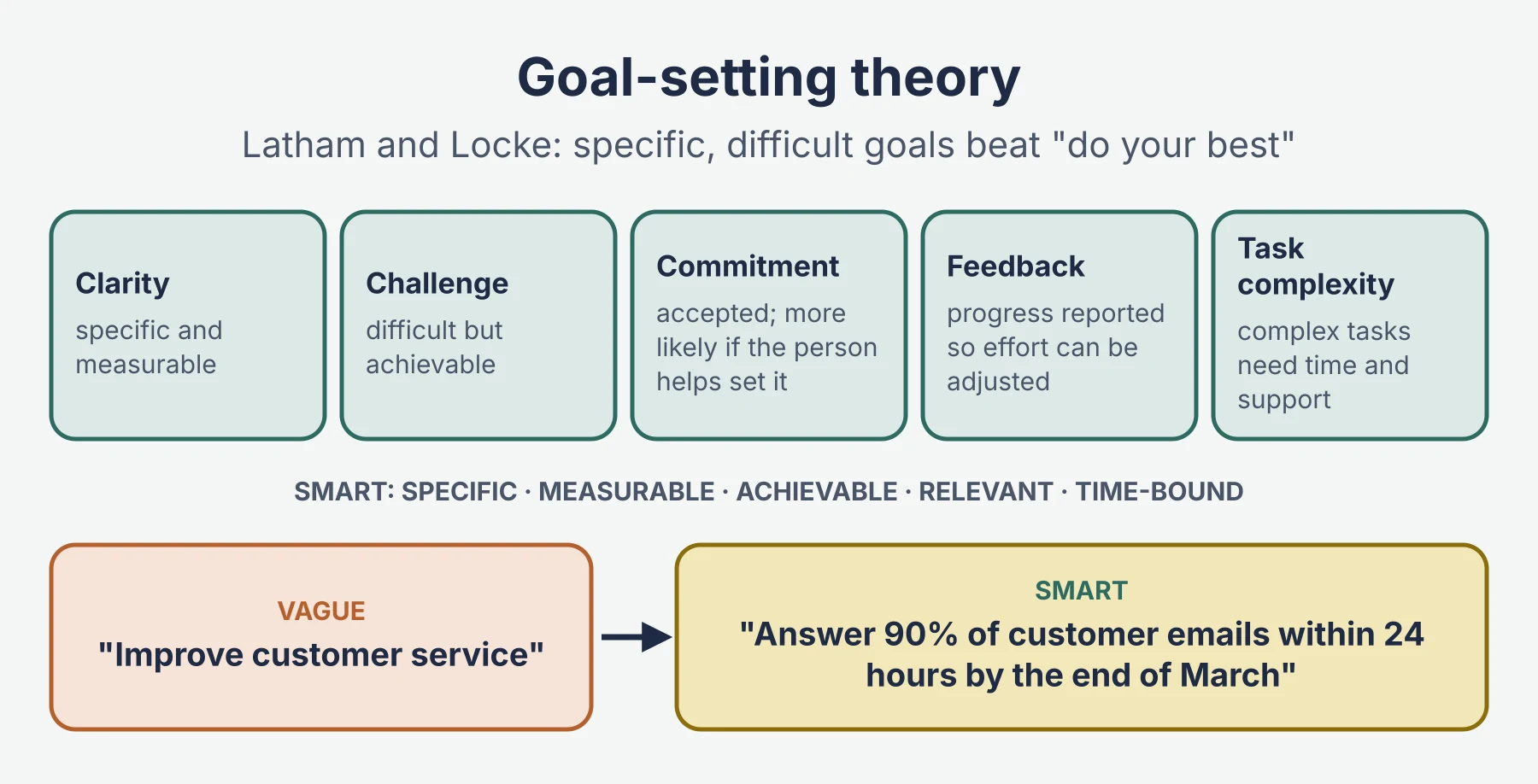
- 4.1.2 Cognitive theories: Latham and Locke’s goal-setting principles and SMART goals; Vroom’s VIE theory.
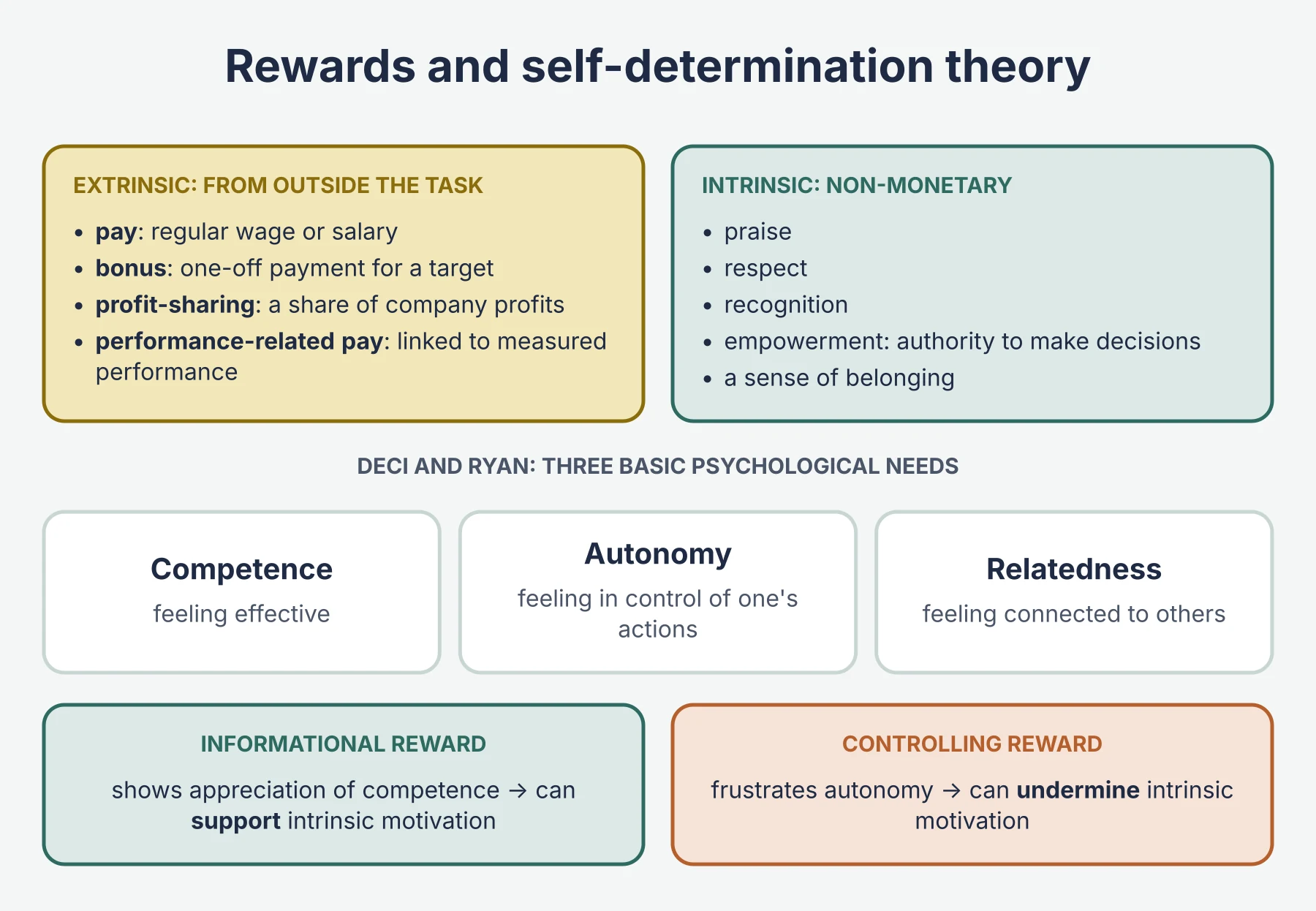
- 4.1.3 Motivators: extrinsic (pay, bonuses, profit-sharing, performance-related pay); intrinsic (praise, respect, recognition, empowerment, belonging); self-determination theory; key study Landry et al. (2019), study 1.
Key terms
| Term | Definition |
|---|---|
| Deficiency needs | Maslow’s lower four needs, which create tension when unmet |
| Self-actualisation | Fulfilling one’s potential; Maslow’s growth need |
| Need for achievement | Desire to succeed at challenging tasks with clear feedback |
| Need for affiliation | Desire to be liked and accepted |
| Need for power | Desire to influence and control others |
| SMART | Specific, measurable, achievable, relevant, time-bound |
| Expectancy | Belief that effort leads to performance |
| Instrumentality | Belief that performance leads to reward |
| Valence | The value placed on the reward |
| Profit-sharing | Employees receive a share of company profits |
| Performance-related pay | Pay linked to measured individual performance |
| Empowerment | Giving employees authority to make decisions |
| Competence, autonomy, relatedness | The three needs in self-determination theory |
| Functional meaning | What a reward signals to the person, e.g. appreciation or control |
Theories at a glance
| Theory | Type | Core claim | One evaluation point |
|---|---|---|---|
| Maslow | Need (content) | Five needs in a hierarchy | Strict order not well supported; individualist bias |
| McClelland | Need (content) | Three learned needs differ between people | Projective measures have low reliability |
| Goal-setting | Cognitive (process) | Specific, hard goals raise performance | Narrow goals can encourage ignoring other parts of a job |
| VIE | Cognitive (process) | Motivation = V × I × E | Assumes rational calculation; emotions ignored |
| Self-determination | Needs plus quality of motivation | Satisfying competence, autonomy and relatedness supports intrinsic motivation | Supported by Landry et al., but often with lab tasks |
Goal-setting principles
- Clarity: specific and measurable.
- Challenge: hard but achievable.
- Commitment: accepted, ideally set together.
- Feedback: progress reported.
- Task complexity: allow time and support for complex goals.
Key study grid: Landry et al. (2019), study 1
| Feature | Detail |
|---|---|
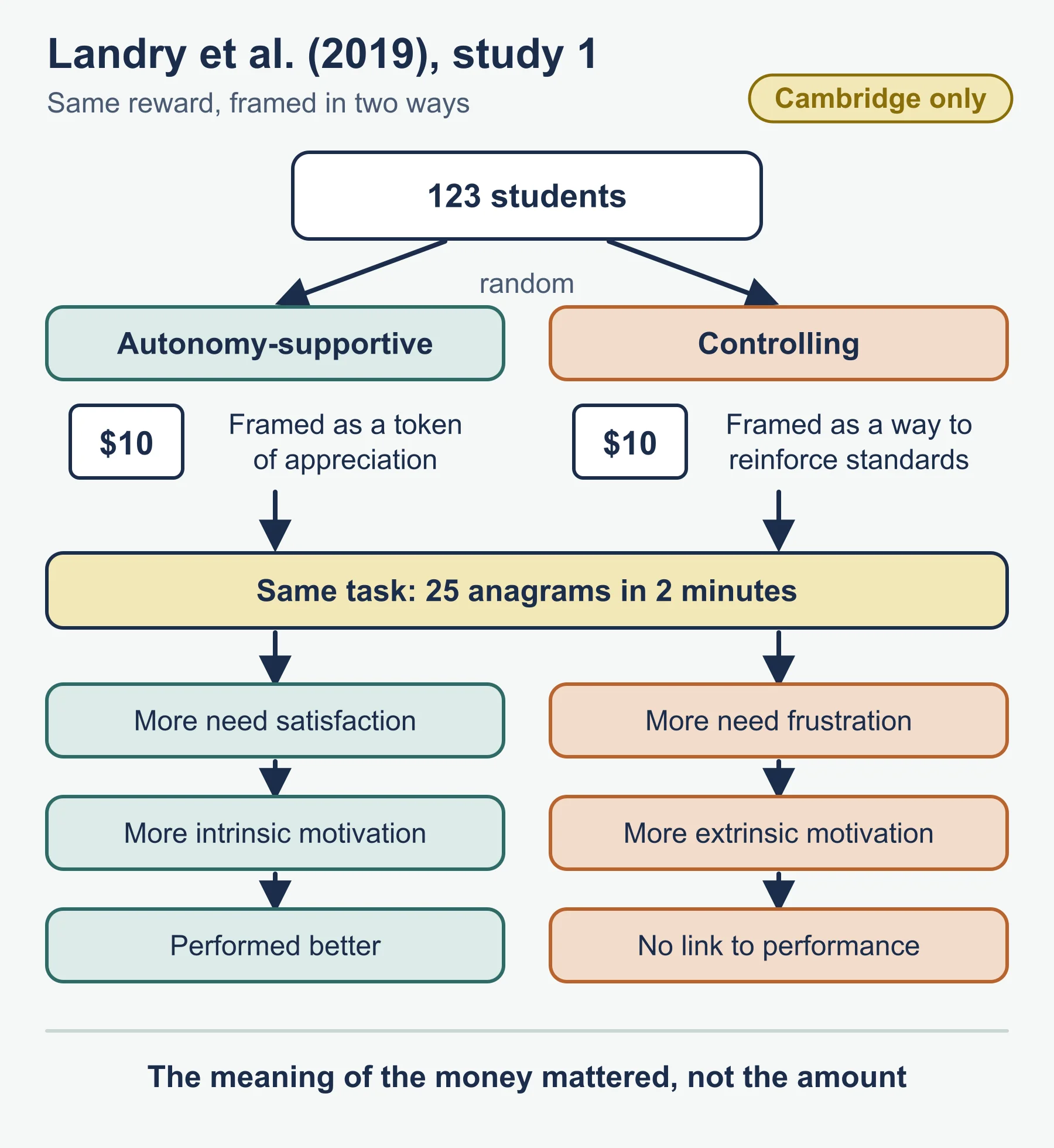
| Aim | Does the functional meaning of a cash reward change motivation and performance? |
| Sample | 123 French-speaking students, Canadian university; mean age 23; 60% women |
| Design | Lab experiment; random allocation to two conditions |
| Reward | $10 coffee-shop gift card in both conditions |
| Autonomy-supportive framing | A token of appreciation for their contribution |
| Controlling framing | A means of reinforcing performance standards |
| Task | Two minutes, 25 four-letter anagrams |
| Results | Autonomy-supportive: more need satisfaction, intrinsic motivation and better performance. Controlling: more need frustration and extrinsic motivation, which did not predict performance |
| Conclusion | Meaning, not amount, determines a reward’s effect |
One scenario, five theories
A bakery’s staff are leaving because they feel undervalued.
- Maslow: esteem needs are unmet; introduce recognition.
- McClelland: give high-achievement staff targets and feedback; give high-affiliation staff team roles.
- Goal-setting: set a SMART target, such as reducing waste by 5% by June, with weekly feedback.
- VIE: make sure staff believe good work will be rewarded (instrumentality) with something they value (valence).
- Self-determination theory: offer choice over tasks (autonomy) and present any bonus as appreciation.
Linking to issues and debates
- Individual and situational explanations: McClelland stresses individual needs; VIE depends on the situation (reward systems).
- Cultural differences: Maslow’s top level reflects individualist values.
- Determinism versus free will: need theories imply behaviour is driven by needs; cognitive theories give an active, choosing worker.
- Reductionism versus holism: VIE reduces motivation to three numbers.
- Generalisations from findings: Landry et al. used students and a short anagram task.
Exam traps
- Maslow has five levels, physiological at the bottom.
- McClelland’s needs are learned, not innate.
- In VIE, the terms multiply: one zero makes motivation zero.
- SMART must be applied to the scenario, not just expanded.
- In Landry et al., the reward was the same; only its framing changed.
- Do not describe study 2 of Landry et al.
Quick self-test
- List Maslow’s five needs from the bottom up.
- Which of Maslow’s needs is a growth need?
- What kind of goals do high-nAch people prefer?
- Give the five goal-setting principles.
- What does each letter of SMART stand for?
- Define instrumentality.
- A worker values a promotion and thinks good work leads to it, but believes she cannot do the work well. Which VIE component is low?
- Give two examples of extrinsic motivators and two of intrinsic motivators.
- Name the three needs in self-determination theory.
- What reward did Landry et al. (2019) give in study 1?
- How did the two conditions differ?
- What did extrinsic motivation predict in the controlling condition?
Answers
- Physiological, safety, love and belonging, esteem, self-actualisation.
- Self-actualisation.
- Moderately difficult goals with personal responsibility and clear feedback.
- Clarity, challenge, commitment, feedback, task complexity.
- Specific, measurable, achievable, relevant, time-bound.
- The belief that performing well will lead to a reward.
- Expectancy.
- Extrinsic: any two of pay, bonuses, profit-sharing, performance-related pay. Intrinsic: any two of praise, respect, recognition, empowerment, belonging.
- Competence, autonomy, relatedness.
- A $10 coffee-shop gift card.
- Only in how the reward was presented: as appreciation (autonomy-supportive) or as reinforcing performance standards (controlling).
- It did not predict performance.
More resources on this topic
Related resources
-
Study guides
Cambridge A Level Psychology (9990): Organisational work conditions
Cambridge 9990 topic 4.4 in depth: the Hawthorne effect, open-plan offices, shiftwork, human and system errors, token economies and Swat (1997) on accidents.
Psychology · Cambridge · A Level
Read guide -
Practice questions
Cambridge A Level Psychology (9990): Organisational work conditions – Practice Questions
Original Paper 3 and Paper 4 style questions on Cambridge 9990 topic 4.4: work conditions, errors and accident monitoring, with mark schemes.
Psychology · Cambridge · A Level
Try questions -
Revision notes
Cambridge A Level Psychology (9990): Organisational work conditions – Revision Notes
Revision notes for Cambridge 9990 topic 4.4: Hawthorne effect, open-plan offices, shifts, errors, token economy and Swat (1997), with a self-test.
Psychology · Cambridge · A Level
Revise topic
Studying Psychology?
This page is free and stays free. Marlbridge is not offering Psychology classes at the moment, so there is no tuition to book for it. The free study resources stay open to everyone.
Get free revision emails (optional)
Occasional emails with practice questions, worked explanations and links to free resources for the qualification and subjects you choose. No spam, and you can unsubscribe from any email. The free tools on this site never need an email.