
Study Guides
Cambridge A Level Psychology (9990): Leadership and management
Cambridge 9990 topic 4.2 in depth: universalist and behavioural theories, Heifetz, Muczyk and Reimann, Scouller, Cuadrado et al. (2008), the LPI and Kelley.
- Subject
- Psychology
- Level
- A LEVEL
- Topic
- Specialist Option 4: Organisational Psychology
- Author
- Marlbridge Academic Team
- Updated
- Reviewed by
- Kanwal Aslam (what this means)
Aligned to Cambridge A Level Psychology (9990), 2024-2026. Official specification .
Syllabus page (what it covers and how it is assessed): Cambridge A Level Psychology.
Syllabus points this page covers
9990 (A Level)
- 4.2 Leadership and management
Topic 4.2, Leadership and management, is part of Specialist Option 4 (Organisational Psychology) in Cambridge International A Level Psychology 9990, syllabus for 2024 to 2026. It covers traditional and modern theories of what makes a leader (4.2.1), styles of leadership, including how gender relates to style (4.2.2), and the relationship between leaders and followers (4.2.3). The key study is Cuadrado et al. (2008).
The Organisational Psychology study guide lists the content briefly. This page explains each theory in depth with workplace examples, sets out how to compare them and gives an annotated answer. Use it alongside the leadership and management revision notes and the leadership and management practice questions.
Syllabus content for 4.2
| Sub-topic | Content | Named study |
|---|---|---|
| 4.2.1 Traditional and modern theories | Universalist theories: great person, charismatic, transformational; behavioural theories: Ohio University and Michigan University; Heifetz’s six principles for adaptive challenges and responsibilities of an adaptive leader | none named |
| 4.2.2 Leadership style | Muczyk and Reimann’s four styles of leader behaviour; Scouller’s public, private and personal levels; leadership style and gender | Key study Cuadrado et al. (2008) |
| 4.2.3 Leaders and followers | Kouzes and Posner’s Leadership Practices Inventory (five practices); Kelley’s (1988) followership: definition, two dimensions, five styles | none named |
4.2.1 Universalist theories
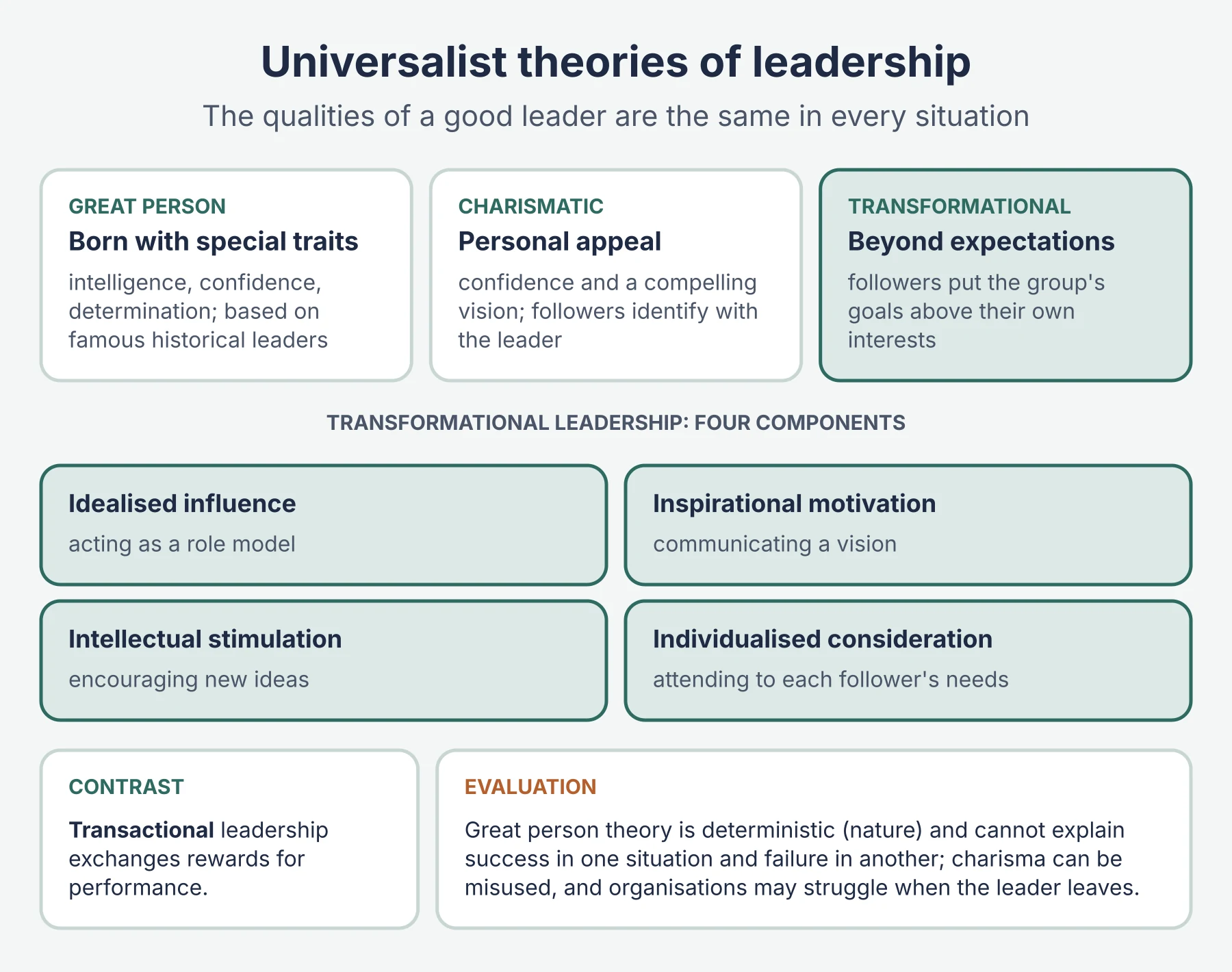
Universalist theories assume that the qualities of a good leader are the same in every situation.
Great person theory. Leaders are born with special traits, such as intelligence, confidence and determination, that set them apart. The theory is based on studying famous historical leaders. Evaluation: it is deterministic and leans towards the nature side of the nature–nurture debate; it cannot explain why a leader succeeds in one situation and fails in another; and early versions focused almost entirely on men.
Charismatic leadership. Charismatic leaders inspire followers through personal appeal, confidence and a compelling vision. Followers identify with the leader and are emotionally committed. Evaluation: charisma can produce strong commitment, but it can be misused, and an organisation may struggle when the charismatic leader leaves.
Transformational leadership. Transformational leaders motivate followers to put the group’s goals above their own interests and to perform beyond expectations. The approach is often described through four components: idealised influence (acting as a role model), inspirational motivation (communicating a vision), intellectual stimulation (encouraging new ideas) and individualised consideration (attending to each follower’s needs). It is often contrasted with transactional leadership, which exchanges rewards for performance.
4.2.1 Behavioural theories
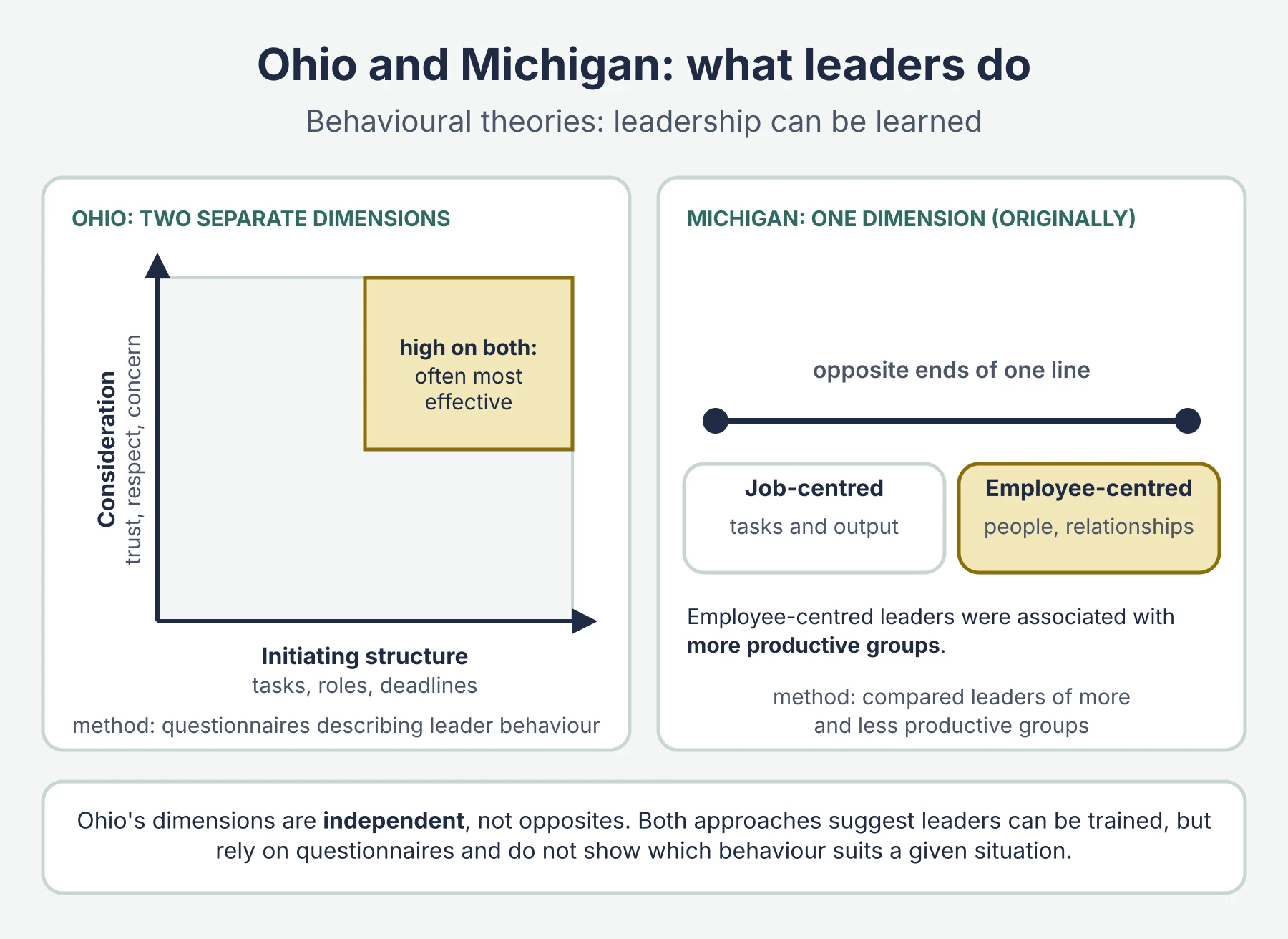
Behavioural theories focus on what leaders do, so leadership can be learned.
| Ohio University studies | Michigan University studies | |
|---|---|---|
| Method | Questionnaires describing leader behaviour | Comparing behaviour of leaders of more and less productive groups |
| Dimensions | Initiating structure: organising tasks, roles and deadlines. Consideration: trust, respect and concern for staff | Job-centred (production-centred): focus on tasks and output. Employee-centred: focus on people and relationships |
| Relationship between dimensions | Two separate dimensions; a leader can be high on both | Originally seen as opposite ends of one dimension |
| Key implication | Leaders high on both are often seen as most effective | Employee-centred leaders were associated with more productive groups |
Evaluation: both approaches suggest leaders can be trained, which is useful, but they rely on questionnaires and do not show which behaviour is best in a given situation.
Heifetz and adaptive leadership
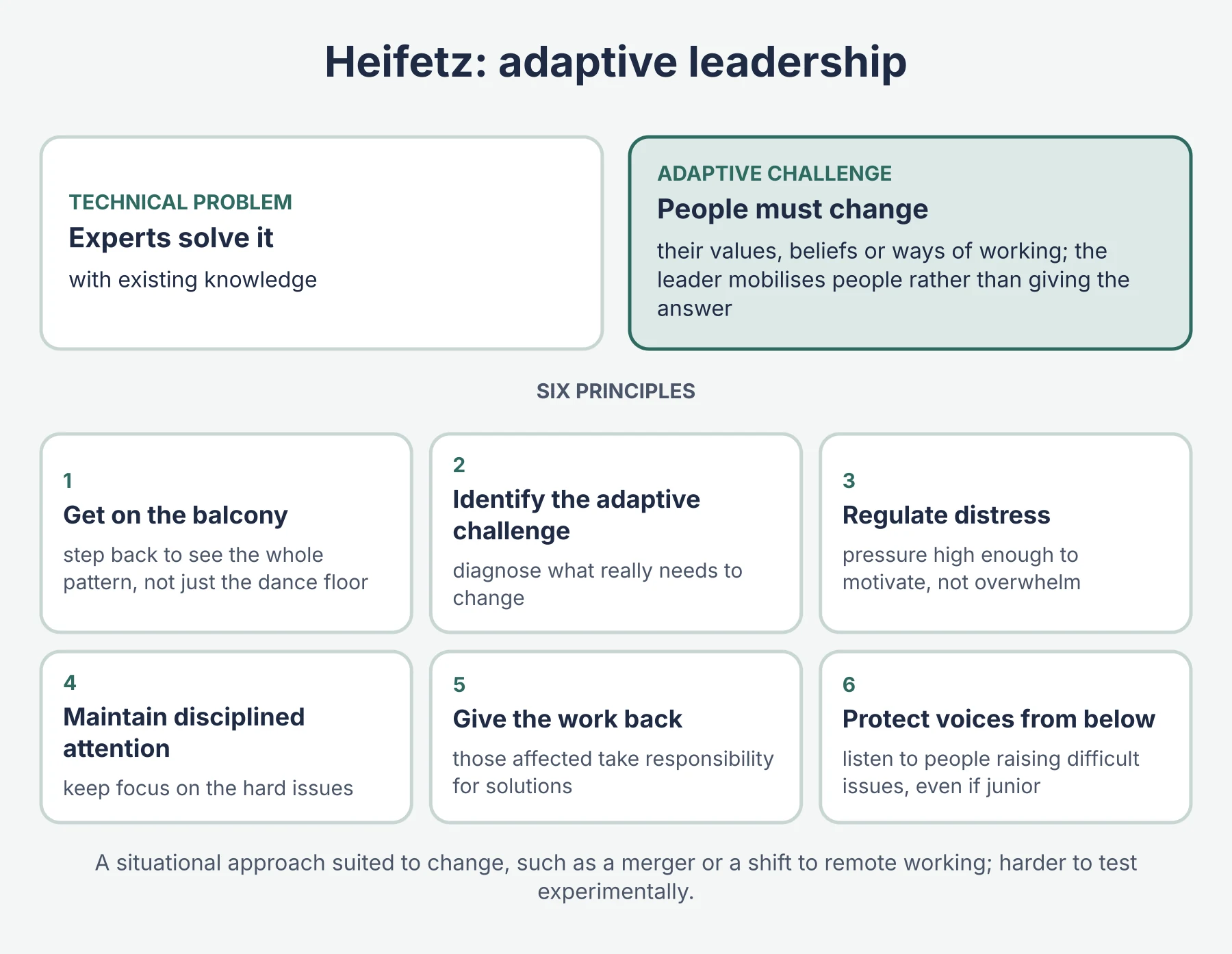
Heifetz distinguished technical problems, which experts can solve with existing knowledge, from adaptive challenges, which require people to change their values, beliefs or ways of working. An adaptive leader does not provide the answer but mobilises people to work on the problem. The six principles are:
- Get on the balcony: step back to see the whole pattern, not just the action on the “dance floor”.
- Identify the adaptive challenge: diagnose what really needs to change.
- Regulate distress: keep pressure high enough to motivate change but not so high that people are overwhelmed.
- Maintain disciplined attention: keep people focused on the hard issues rather than avoiding them.
- Give the work back to the people: let those affected take responsibility for solutions.
- Protect voices of leadership from below: listen to people who raise difficult issues, even if they are junior.
Evaluation: this is a situational approach suited to change, such as a merger or a shift to remote working; it is harder to test experimentally than behavioural theories.
4.2.2 Leadership style
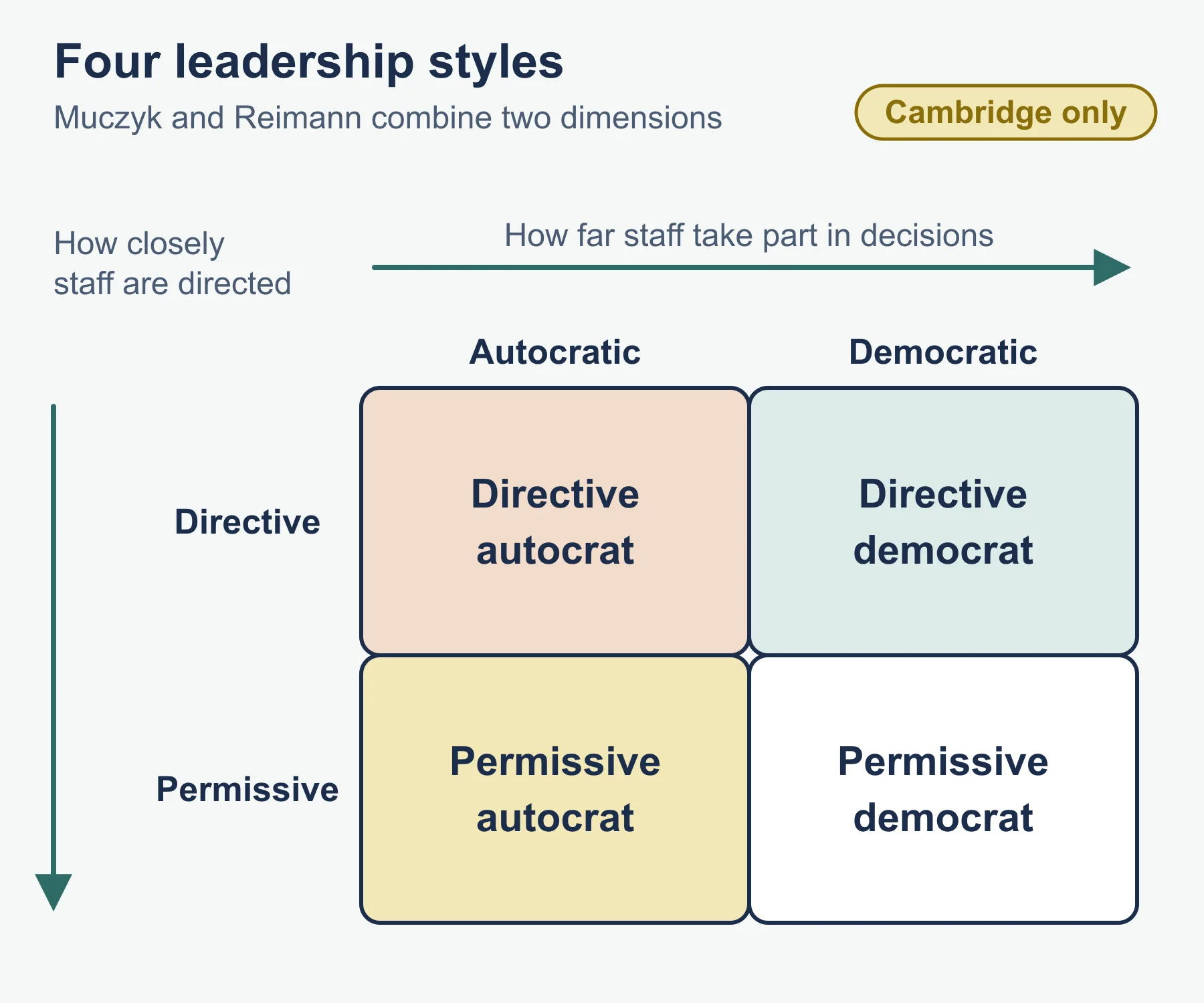
Muczyk and Reimann combined two dimensions: participation in decision-making (autocratic or democratic) and how closely the leader directs execution of the task (directive or permissive), giving four styles. A directive autocrat decides alone and supervises closely, which suits new or inexperienced staff and emergencies. A permissive autocrat decides alone but lets staff choose how to carry out the decision, suiting skilled staff when time is short. A directive democrat involves staff in decisions but supervises their execution closely. A permissive democrat involves staff in decisions and lets them work independently, suiting experienced, motivated teams.
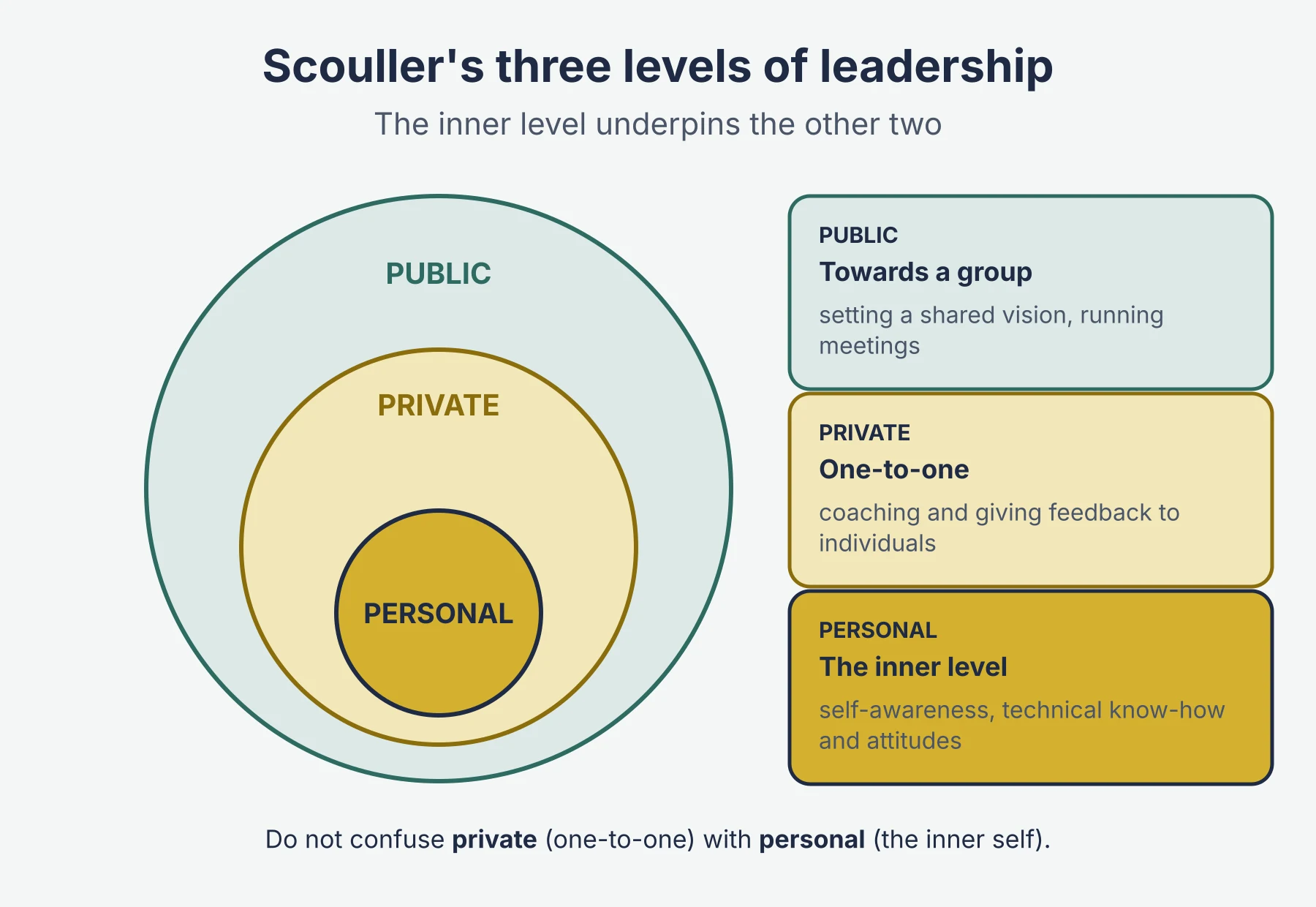
Scouller’s three levels of leadership.
- Public leadership: behaviour towards a group, such as setting a shared vision and running meetings.
- Private leadership: one-to-one behaviour, such as coaching and giving feedback to individuals.
- Personal leadership: the inner level, the leader’s self-awareness, technical know-how and attitudes, which underpins the other two.
Key study: Cuadrado et al. (2008)
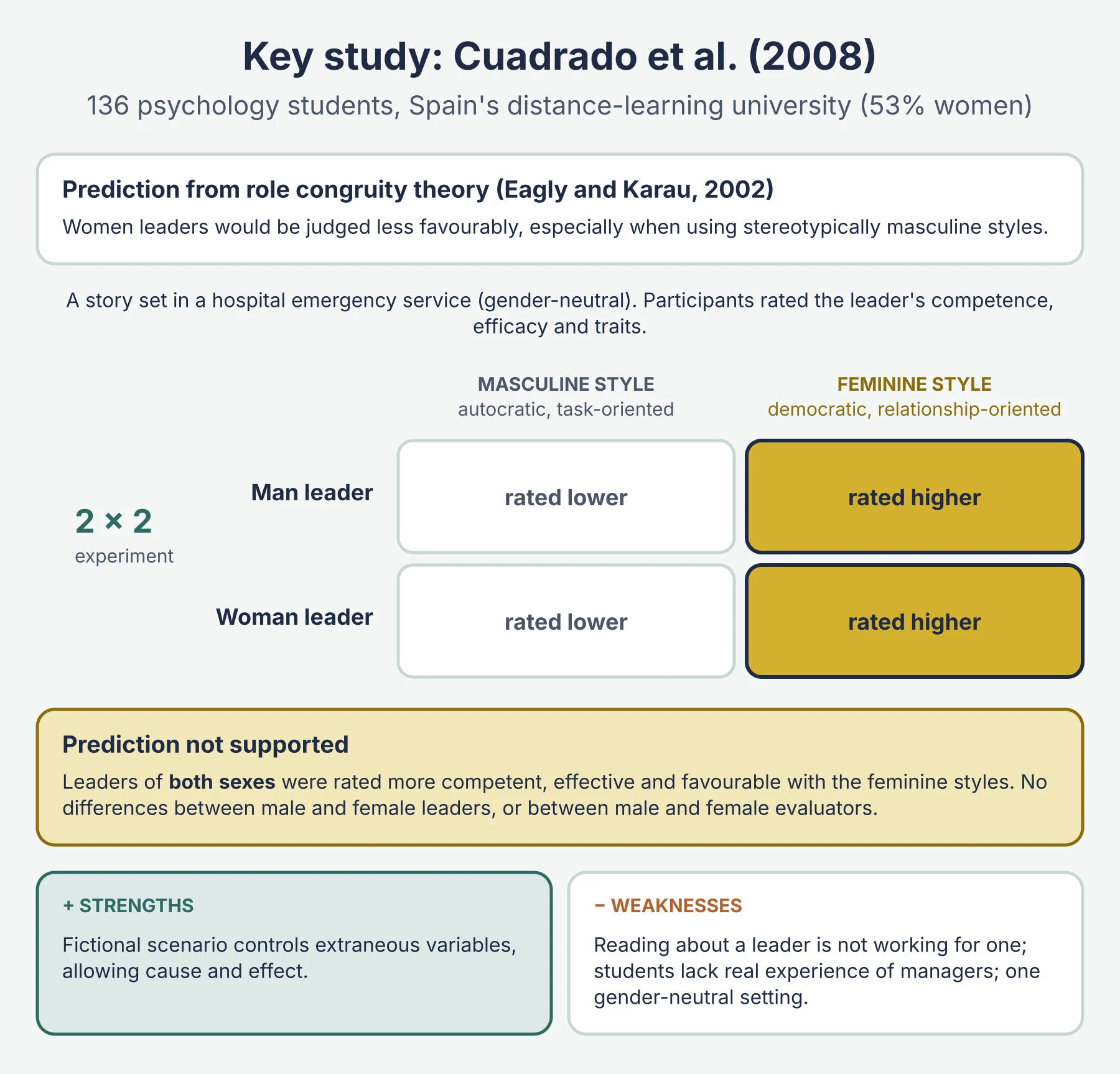
- Context: role congruity theory (Eagly and Karau, 2002) predicts that women leaders are judged less favourably, especially when they use stereotypically masculine styles, because these conflict with expectations of women.
- Aim: to test whether the leader’s sex and leadership style affect evaluations of the leader.
- Sample: 136 psychology students at Spain’s national distance-learning university, 53% women.
- Design: a 2 × 2 experiment, with leader sex (man or woman) and leadership style (stereotypically masculine or feminine) as independent variables.
- Procedure: participants read a story set in a hospital emergency service, chosen as a gender-neutral setting. The leader used either a masculine style (autocratic, task-oriented) or a feminine style (democratic, relationship-oriented, individualised consideration). Participants rated the leader’s competence, efficacy and traits.
- Results: the prediction was not supported. Leaders of both sexes were rated more competent, more effective and more favourably when they used the feminine styles. There were no differences between male and female leaders, or between male and female evaluators.
- Conclusion: in this setting, democratic and relationship-oriented styles were valued for any leader.
Evaluation. The fictional scenario controls extraneous variables, allowing cause and effect, but reading about a leader is not the same as working for one. Students are not employees with real experience of managers. One gender-neutral setting was used; results might differ in stereotypically male or female workplaces. The findings apply to everyday life by suggesting relationship-oriented styles are valued.
4.2.3 Leaders and followers
Kouzes and Posner’s Leadership Practices Inventory (LPI) measures five practices of exemplary leadership:
| Practice | Example behaviour |
|---|---|
| Model the way | Setting an example by following the standards one asks of others |
| Inspire a shared vision | Describing an exciting future the team can work towards |
| Challenge the process | Looking for new ways to improve and learning from mistakes |
| Enable others to act | Building trust and sharing power |
| Encourage the heart | Recognising contributions and celebrating success |
The LPI has a self-report version for the leader and an observer version for colleagues, so self-ratings can be compared with others’ views.
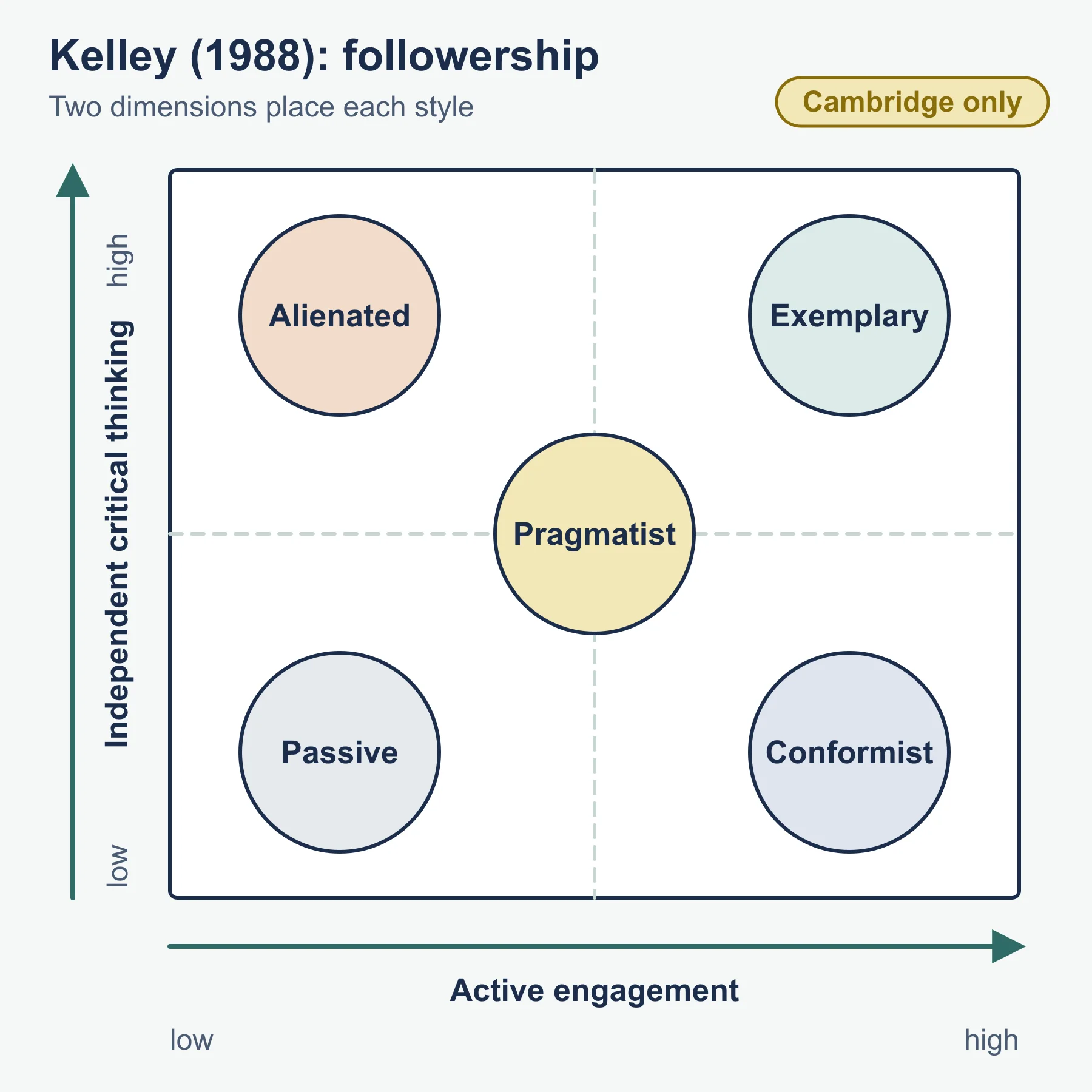
Kelley’s (1988) followership. Followership is the role of actively supporting a leader and the group’s goals. Kelley used two dimensions, independent critical thinking and active engagement, to define five styles: exemplary (high on both), alienated (critical but passive), conformist (active but uncritical), passive (low on both) and pragmatist (moderate on both, adapting to what is safe). Kelley argued organisations need exemplary followers as much as good leaders.
Annotated answer: a 4-mark application
A new head nurse leads a team of very experienced nurses. Using Muczyk and Reimann, suggest a suitable style and explain why. [4]
“A permissive democrat style would suit this team (1). The head nurse would involve the nurses in decisions, because their experience gives them valuable knowledge (1). She would also let them carry out tasks independently rather than supervising closely (1), because skilled, motivated staff may resent being directed and work best with autonomy (1).”
Common mistakes
- Treating the Ohio dimensions as opposites; they are independent.
- Mixing up Scouller’s private level (one-to-one) with the personal level (inner self).
- Saying Cuadrado et al. showed women were penalised for masculine styles. They were not.
- Listing Kelley’s styles without the two dimensions that define them.
Exam technique
Compare universalist and behavioural theories: both describe effective leaders, but one says leaders are born, the other that leadership is learned behaviour. Evaluate using the syllabus issues: nature versus nurture and individual and situational explanations for 4.2.1; generalisation and idiographic versus nomothetic for 4.2.2; self-reports, psychometrics and cultural differences for 4.2.3.
More resources on this topic
- Leadership and management revision notes
- Leadership and management practice questions
- Organisational Psychology study guide
Official syllabus
Cambridge International AS & A Level Psychology 9990 syllabus for 2024, 2025 and 2026, Specialist Option 4: Organisational Psychology, topic 4.2 — cambridgeinternational.org.
Related resources
-
Practice questions
Cambridge A Level Psychology (9990): Leadership and management – Practice Questions
Original Paper 3 and Paper 4 style questions on Cambridge 9990 topic 4.2: leadership theories, styles and followership, with mark schemes.
Psychology · Cambridge · A Level
Try questions -
Revision notes
Cambridge A Level Psychology (9990): Leadership and management – Revision Notes
Revision notes for Cambridge 9990 topic 4.2: theories, Heifetz, styles, Scouller, Cuadrado et al. (2008) and followership, with a self-test.
Psychology · Cambridge · A Level
Revise topic -
Study guides
Cambridge A Level Psychology (9990): Motivation to work
Cambridge 9990 topic 4.1 in depth: Maslow and McClelland, goal-setting and VIE theory, extrinsic and intrinsic rewards, and Landry et al. (2019) study 1.
Psychology · Cambridge · A Level
Read guide
Studying Psychology?
This page is free and stays free. Marlbridge is not offering Psychology classes at the moment, so there is no tuition to book for it. The free study resources stay open to everyone.
Get free revision emails (optional)
Occasional emails with practice questions, worked explanations and links to free resources for the qualification and subjects you choose. No spam, and you can unsubscribe from any email. The free tools on this site never need an email.