
Study Guides
Cambridge A Level Psychology (9990): Group behaviour in organisations
Cambridge 9990 topic 4.3 in depth: group development, Belbin, groupthink, Forsyth's errors, facilitation and loafing, Claypoole and Szalma (2019) and conflict.
- Subject
- Psychology
- Level
- A LEVEL
- Topic
- Specialist Option 4: Organisational Psychology
- Author
- Marlbridge Academic Team
- Updated
- Reviewed by
- Kanwal Aslam (what this means)
Aligned to Cambridge A Level Psychology (9990), 2024-2026. Official specification .
Syllabus page (what it covers and how it is assessed): Cambridge A Level Psychology.
Syllabus points this page covers
9990 (A Level)
- 4.3 Group behaviour in organisations
Topic 4.3, Group behaviour in organisations, is part of Specialist Option 4 (Organisational Psychology) in Cambridge International A Level Psychology 9990, syllabus for 2024 to 2026. It looks at how work groups form and make decisions (4.3.1), how the presence of others changes individual and group performance, including when workers are monitored (4.3.2), and how conflict arises and is handled (4.3.3). The key study is Claypoole and Szalma (2019), experiment 1.
The Organisational Psychology study guide covers the topic briefly. This guide explains each theory with workplace examples, shows how they connect, and gives an annotated answer. Pair it with the group behaviour revision notes and the group behaviour practice questions.
Syllabus content for 4.3
| Sub-topic | Content | Named study |
|---|---|---|
| 4.3.1 Group development and decision-making | Stages of group development; Belbin’s nine team roles; faulty decision-making: groupthink (features with examples) and Forsyth’s cognitive limitations and errors (types and subtypes), with strategies to avoid them | e.g. Tuckman and Jensen (2010) |
| 4.3.2 Individual and group performance | Social facilitation and social loafing, drive theory, evaluation apprehension, social impact theory; social loafing across cultures; performance monitoring | e.g. Earley (1993); key study Claypoole and Szalma (2019), experiment 1 |
| 4.3.3 Conflict at work | Levels of conflict; causes of organisational and interpersonal conflict; Thomas–Kilmann’s five conflict-handling modes; bullying: types, phases and causes | e.g. Einarsen (1999) |
4.3.1 Stages of group development
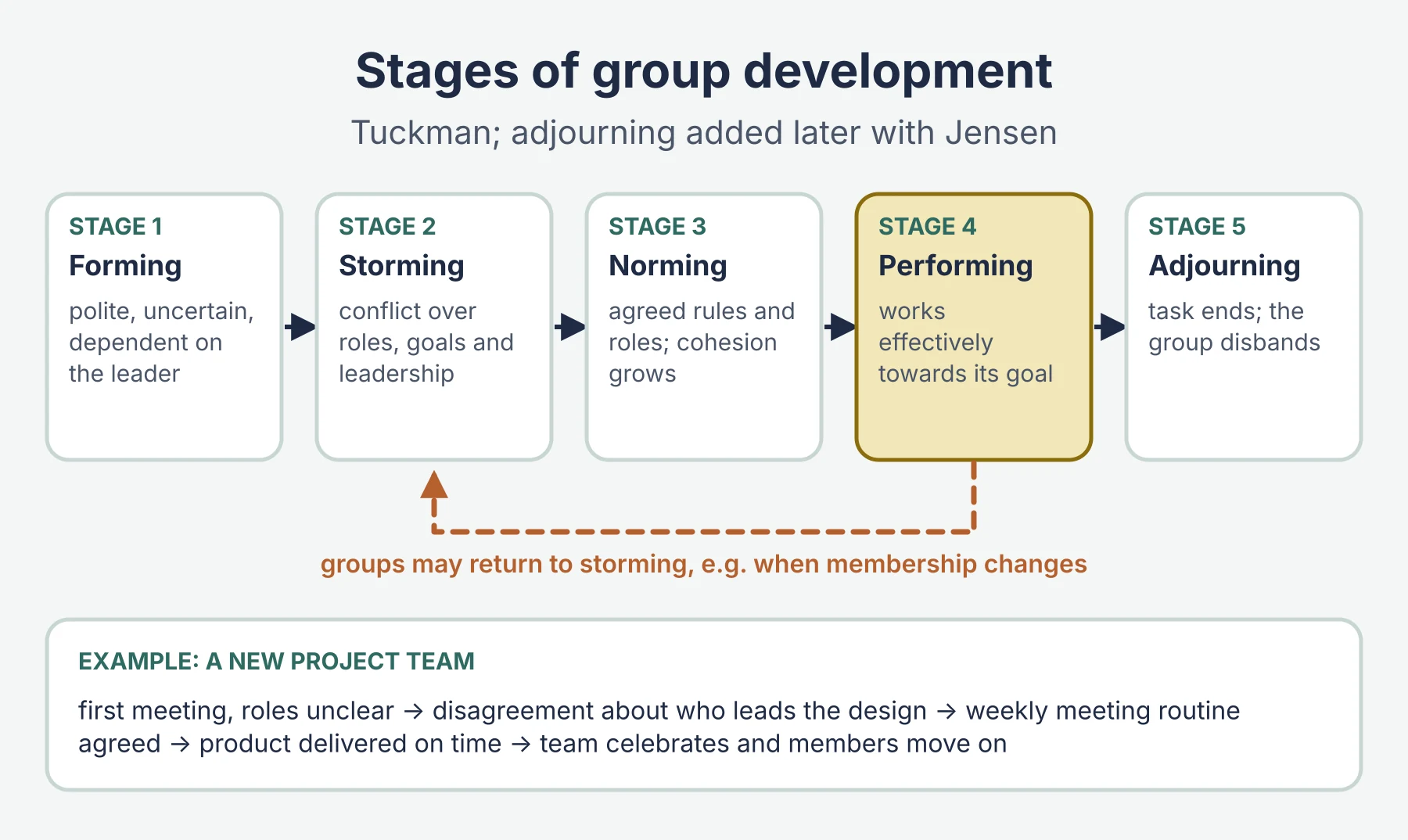
Tuckman proposed that groups pass through stages; adjourning was added later with Jensen.
| Stage | What happens | Example: a new project team |
|---|---|---|
| Forming | Members are polite, uncertain and dependent on the leader | First meeting; roles unclear |
| Storming | Conflict over roles, goals and leadership | Disagreement about who leads the design |
| Norming | Agreed rules and roles; cohesion grows | Weekly meeting routine agreed |
| Performing | The group works effectively towards its goal | Product delivered on time |
| Adjourning | The task ends and the group disbands | Team celebrates and members move on |
Evaluation: a useful description, but groups do not always pass through stages in order; some return to storming when membership changes.
Belbin’s nine team roles
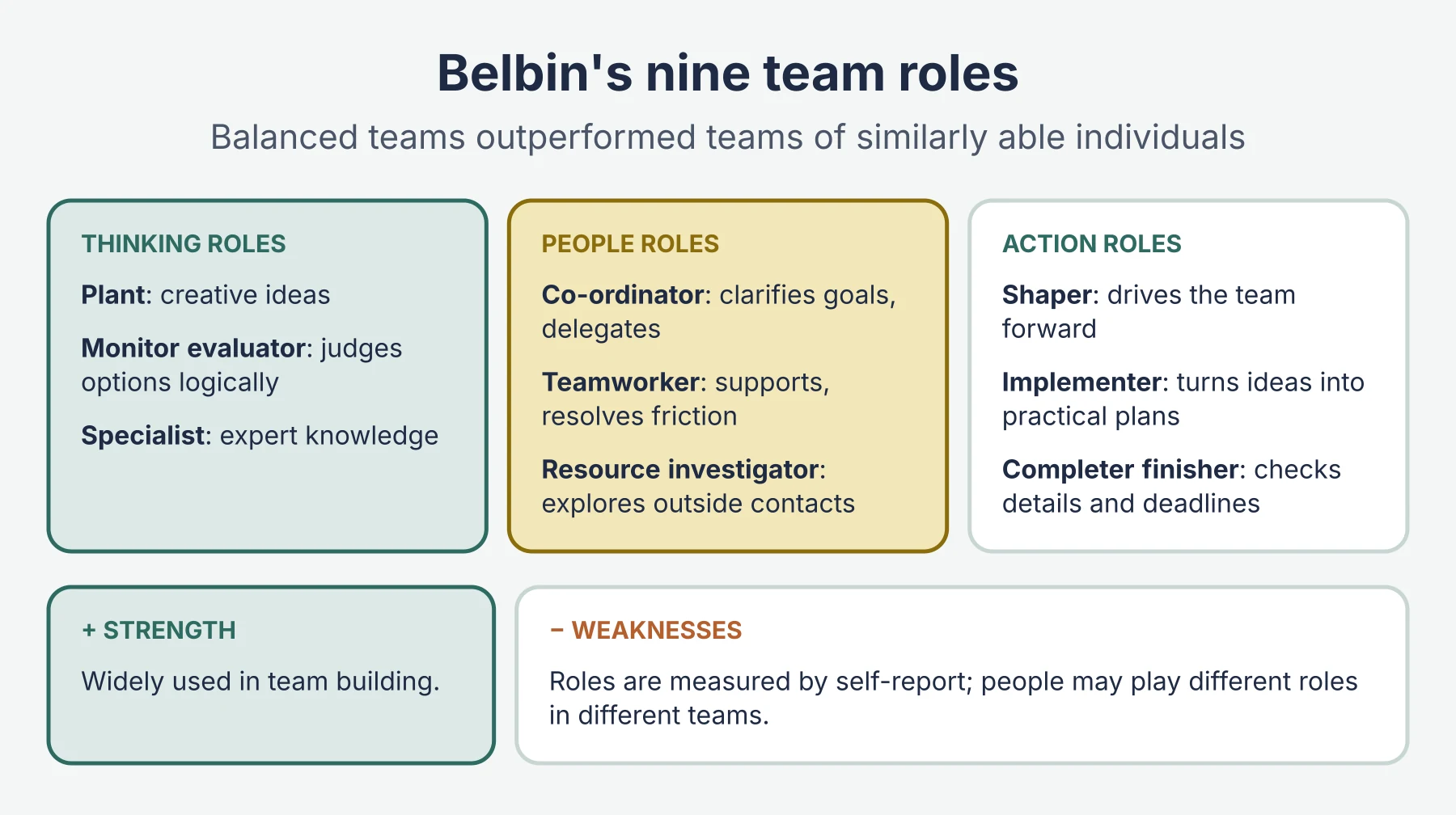
Belbin observed management teams and found that balanced teams, covering a range of roles, performed better than teams of similarly able individuals.
| Group | Role | Contribution |
|---|---|---|
| Thinking | Plant | Creative ideas |
| Thinking | Monitor evaluator | Judges options logically |
| Thinking | Specialist | Expert knowledge |
| People | Co-ordinator | Clarifies goals, delegates |
| People | Teamworker | Supports and resolves friction |
| People | Resource investigator | Explores outside contacts |
| Action | Shaper | Drives the team forward |
| Action | Implementer | Turns ideas into practical plans |
| Action | Completer finisher | Checks details and deadlines |
Evaluation: widely used in team building; roles are measured by self-report, and people may play different roles in different teams.
Faulty decision-making
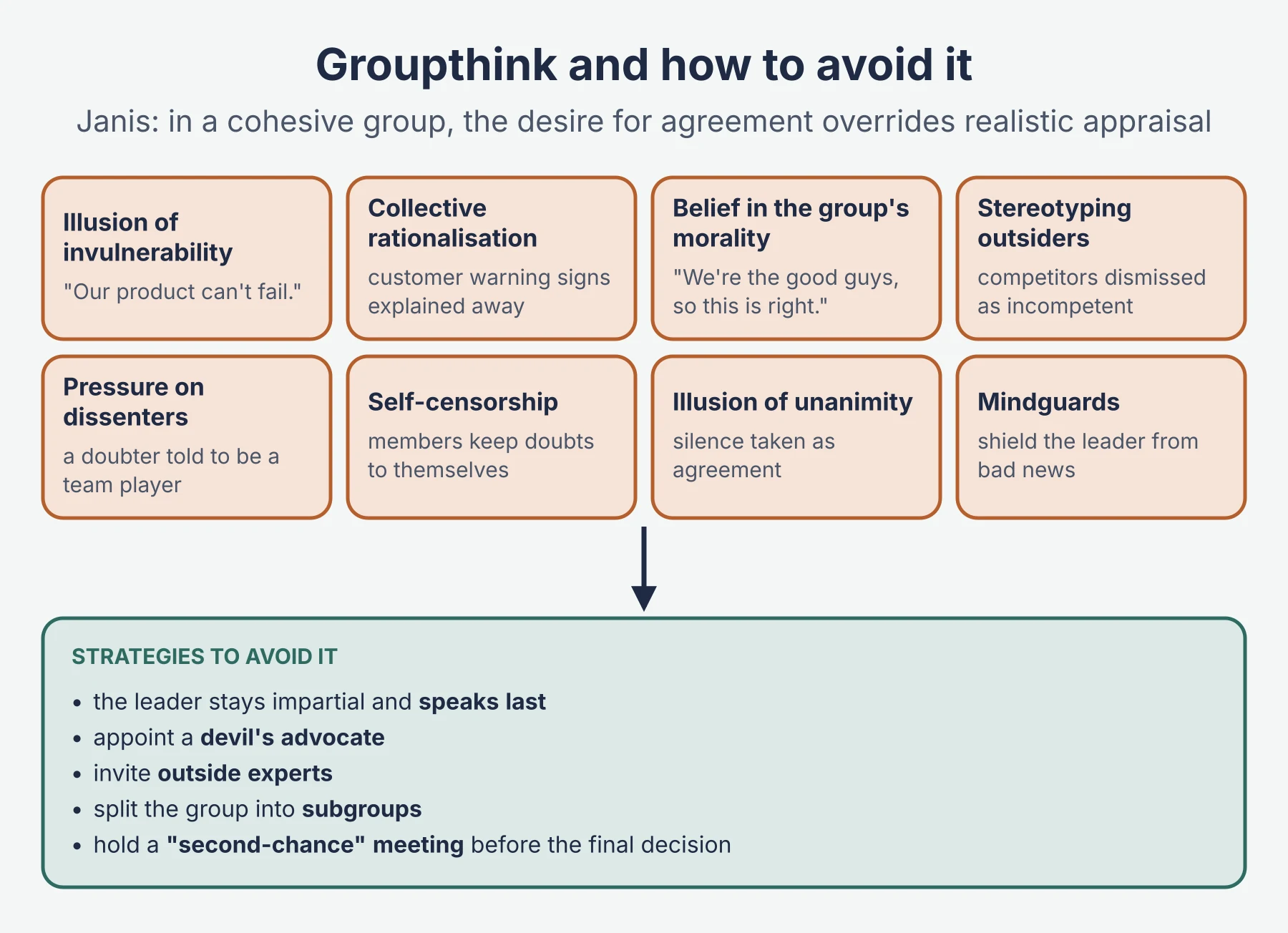
Groupthink (Janis) is a mode of thinking in a cohesive group where the desire for agreement overrides realistic appraisal of alternatives. Features, with workplace examples:
- Illusion of invulnerability: “Our product can’t fail.”
- Collective rationalisation: warning signs from customers are explained away.
- Belief in the group’s morality: “We’re the good guys, so this is right.”
- Stereotyping outsiders: competitors are dismissed as incompetent.
- Pressure on dissenters: a doubter is told to be a team player.
- Self-censorship: members keep doubts to themselves.
- Illusion of unanimity: silence is taken as agreement.
- Mindguards: members shield the leader from bad news.
Strategies to avoid it: the leader stays impartial and speaks last; a devil’s advocate is appointed; outside experts are invited; the group is split into subgroups; a “second-chance” meeting is held before a final decision.
Forsyth’s cognitive limitations and errors are grouped by type:
- Errors of commission (misusing information): for example sunk cost bias (continuing a failing project because of money already spent) and hindsight bias.
- Errors of omission (overlooking useful information): for example base-rate bias (ignoring how common something is in general).
- Errors of imprecision (relying on shortcuts): for example the availability heuristic (judging by what comes easily to mind).
Strategies include using structured decision procedures and checking that all relevant information has been shared.
4.3.2 Social facilitation and social loafing
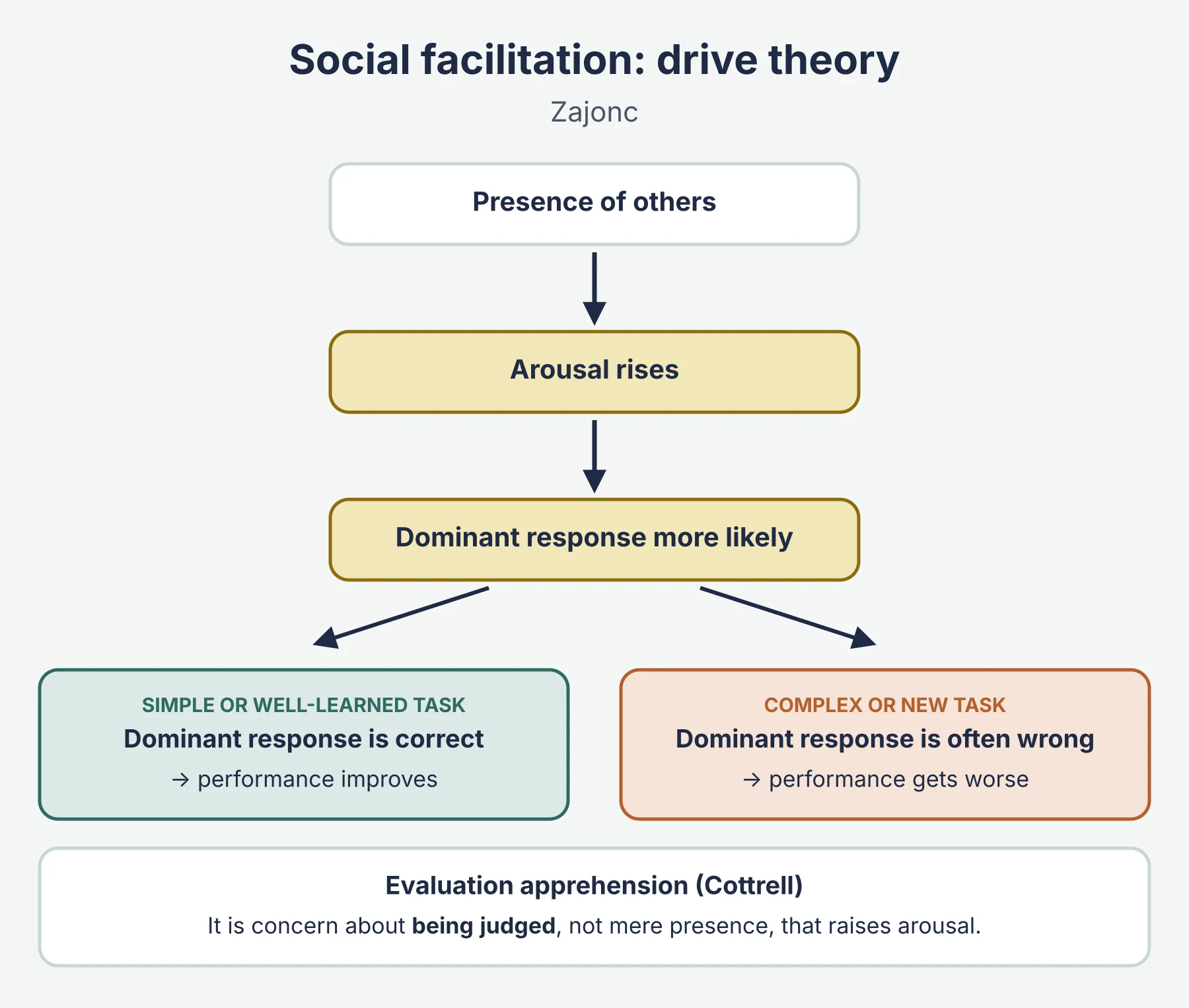
Social facilitation is improved performance on simple or well-learned tasks in the presence of others, with worse performance on complex or new tasks. Drive theory (Zajonc) explains this: others raise arousal, which increases the likelihood of the dominant response; on easy tasks this is correct, on hard tasks it is often wrong. Evaluation apprehension (Cottrell) argues it is concern about being judged, not mere presence, that raises arousal.
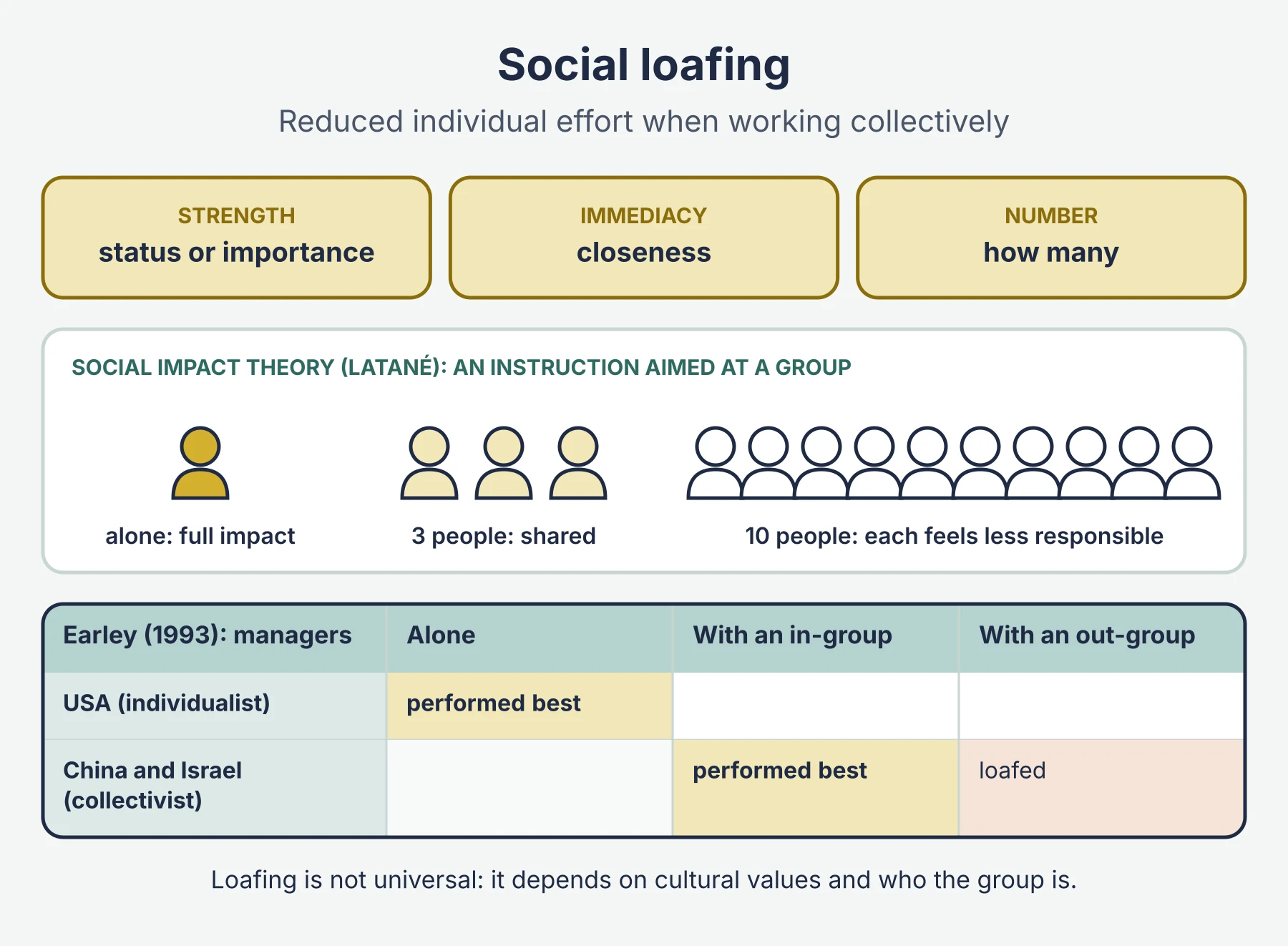
Social loafing is reduced individual effort when working collectively, especially when individual contributions cannot be identified. Social impact theory (Latané) proposes that the influence of others depends on their strength (status or importance), immediacy (closeness) and number. When an instruction is directed at a group, its impact is divided among members, so each feels less responsible.
Loafing across cultures. Earley (1993) compared managers from the USA (individualist) with managers from China and Israel (collectivist). American managers performed best working alone. Chinese and Israeli managers performed best when working with an in-group and loafed when working with an out-group. So loafing is not universal; it depends on cultural values and who the group is.
Key study: Claypoole and Szalma (2019), experiment 1
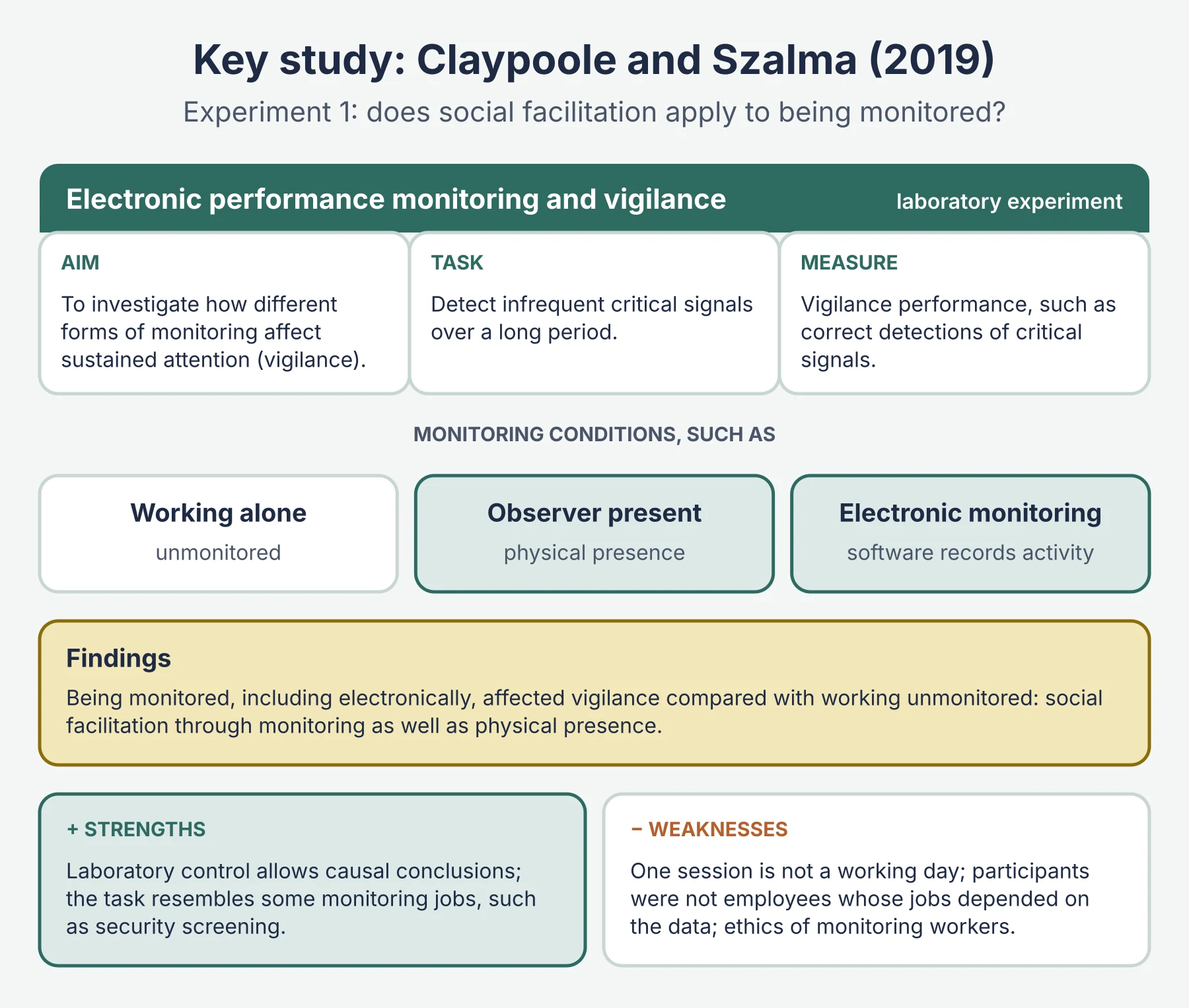
- Context: electronic performance monitoring (EPM), such as software that records activity, is increasingly common. Claypoole and Szalma asked whether social facilitation, originally about physical presence, also applies to being monitored.
- Aim: to investigate how different forms of monitoring affect sustained attention (vigilance).
- Design: a laboratory experiment in which participants carried out a vigilance task, detecting infrequent critical signals over a long period, under different monitoring conditions, such as working alone, in the presence of an observer, or under electronic monitoring.
- Measures: performance on the vigilance task, such as correct detections of critical signals.
- Findings: being monitored, including electronically, affected vigilance performance compared with working unmonitored, which the authors interpreted as social facilitation operating through monitoring as well as physical presence.
- Evaluation: laboratory control allows causal conclusions; a vigilance task resembles some monitoring jobs, such as security screening, but a single laboratory session is not a full working day, and participants were not employees whose jobs depended on the data. There are ethical questions about monitoring workers.
4.3.3 Conflict at work
Levels of conflict. Intra-individual (within one person, such as role conflict between work and family), inter-individual (between two people), intra-group (within a team) and inter-group (between teams or departments).
Causes. Organisational causes include competition for scarce resources, unclear responsibilities and incompatible goals between departments. Interpersonal causes include personality clashes, poor communication and differing values.
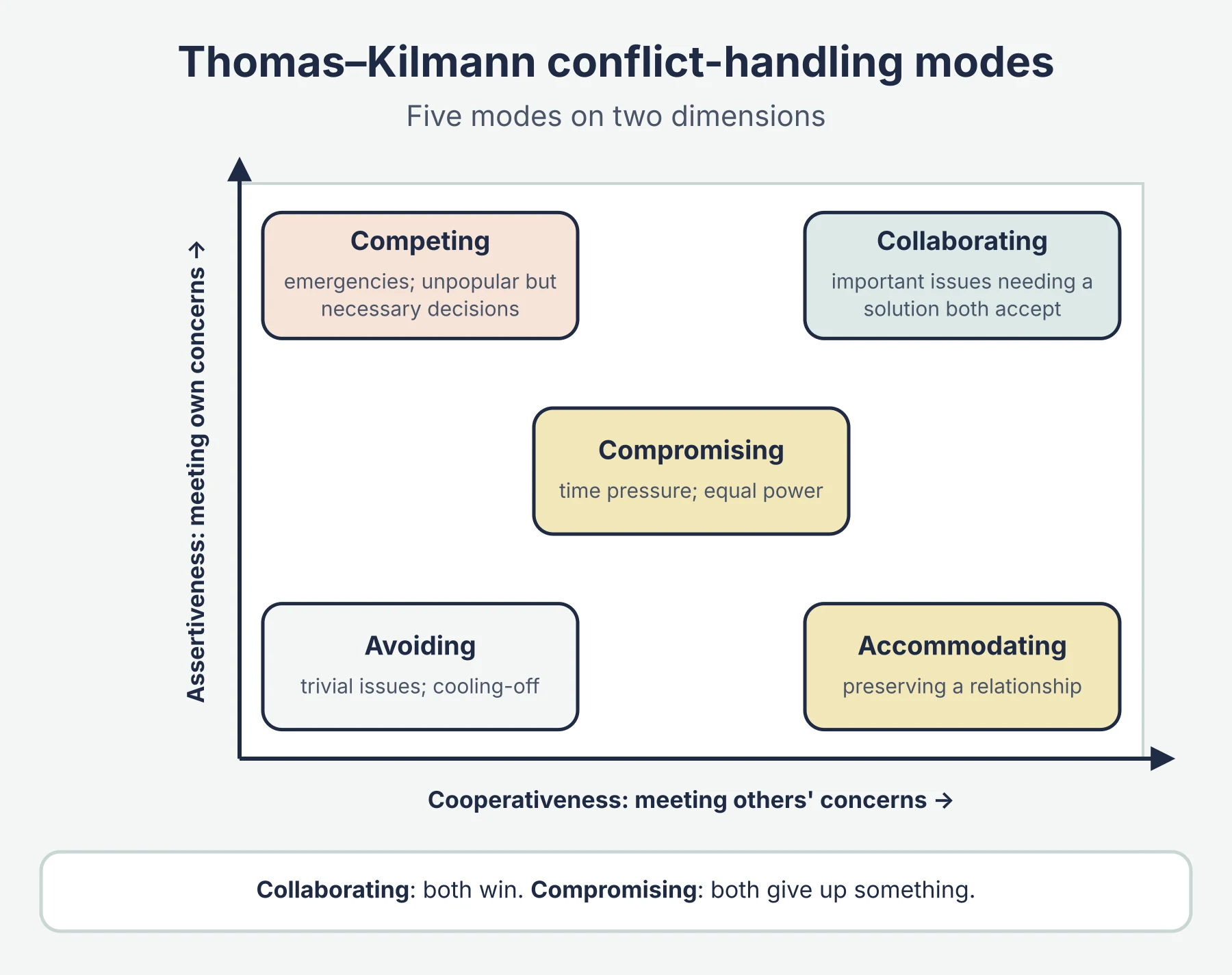
Thomas–Kilmann’s five conflict-handling modes, arranged on two dimensions, assertiveness (meeting one’s own concerns) and cooperativeness (meeting others’ concerns):
| Mode | Assertive | Cooperative | When useful |
|---|---|---|---|
| Competing | High | Low | Emergencies; unpopular but necessary decisions |
| Collaborating | High | High | Important issues needing a solution both accept |
| Compromising | Medium | Medium | Time pressure; equal power |
| Avoiding | Low | Low | Trivial issues; cooling-off |
| Accommodating | Low | High | Preserving a relationship |
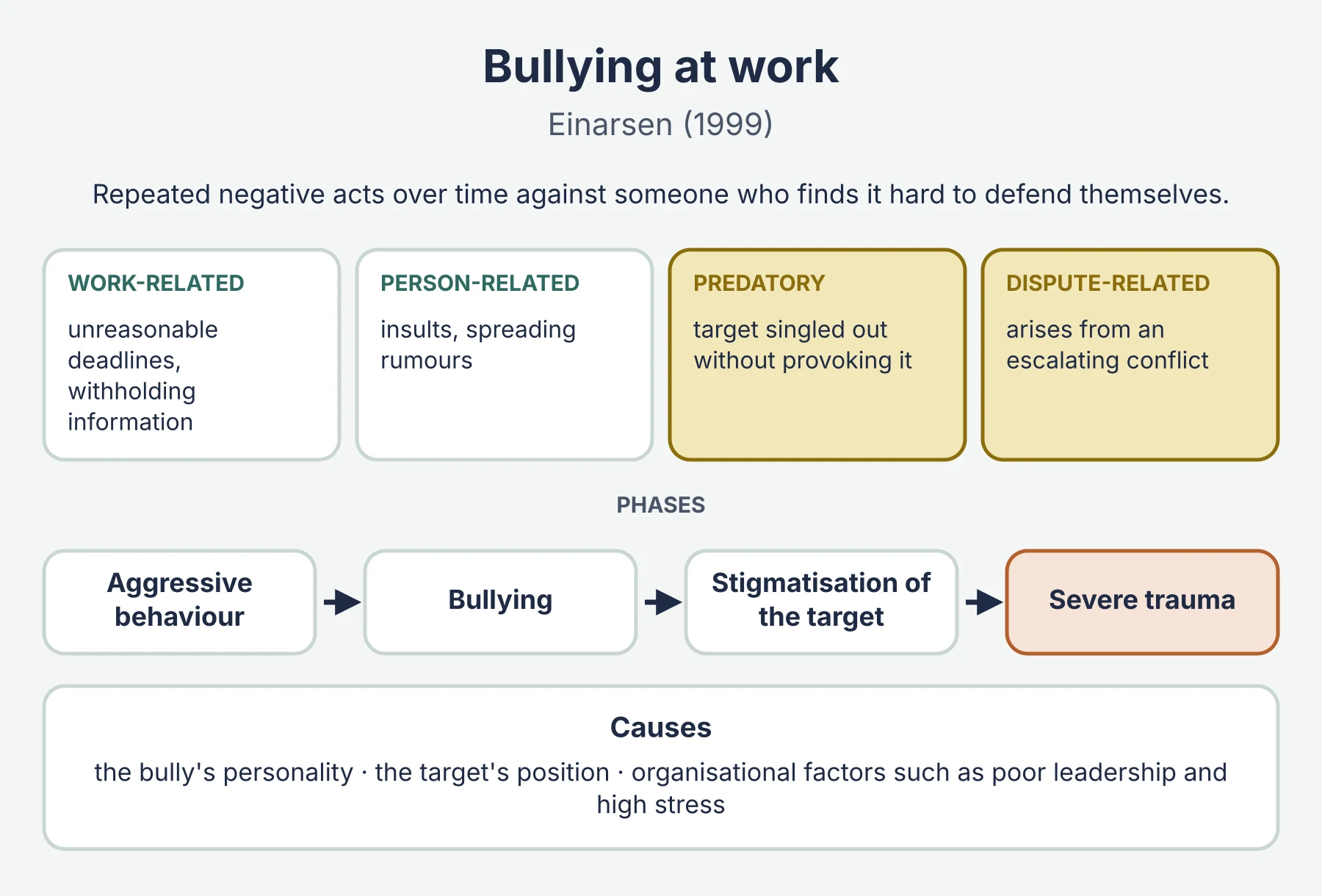
Bullying at work. Einarsen (1999) described bullying as repeated negative acts over time against someone who finds it hard to defend themselves. He distinguished work-related bullying (such as unreasonable deadlines or withholding information) from person-related bullying (such as insults or spreading rumours), and predatory bullying (the target is singled out without having done anything to provoke it) from dispute-related bullying (arising from an escalating conflict). He described bullying as developing through phases, from aggressive behaviour, to bullying, to stigmatisation of the target, to severe trauma. Causes include the bully’s personality, the target’s position and organisational factors such as poor leadership and high stress.
Annotated answer: a 4-mark application
Explain why a team of ten might produce less effort per person on a shared report than three people would. [4]
“This is social loafing (1). Social impact theory says the pressure to work hard is divided among group members, so with ten people each feels less responsible than with three (1). In a large group individual contributions are harder to identify (1), so people expect less evaluation of their own effort and reduce it (1).”
Common mistakes
- Defining social facilitation as “working harder when others watch” without the task-difficulty point.
- Listing groupthink features without examples when the syllabus says “features with examples”.
- Saying Earley found collectivists always loaf less; they loafed with out-groups.
- Confusing Thomas–Kilmann’s collaborating (both win) with compromising (both give up something).
Exam technique
Describe questions want named stages, roles or modes with an example each. Evaluate questions can use cultural differences (Earley), determinism versus free will (monitoring), idiographic versus nomothetic and quantitative and qualitative data, which the syllabus lists for 4.3.2. Suggest questions should name a strategy, such as a devil’s advocate, and apply it to the team in the scenario.
More resources on this topic
- Group behaviour in organisations revision notes
- Group behaviour in organisations practice questions
- Organisational Psychology study guide
Official syllabus
Cambridge International AS & A Level Psychology 9990 syllabus for 2024, 2025 and 2026, Specialist Option 4: Organisational Psychology, topic 4.3 — cambridgeinternational.org.
Related resources
-
Practice questions
Cambridge A Level Psychology (9990): Group behaviour in organisations – Practice Questions
Original Paper 3 and Paper 4 style questions on Cambridge 9990 topic 4.3: teams, decisions, facilitation, loafing and conflict, with answers.
Psychology · Cambridge · A Level
Try questions -
Revision notes
Cambridge A Level Psychology (9990): Group behaviour in organisations – Revision Notes
Revision notes for Cambridge 9990 topic 4.3: group stages, Belbin, groupthink, loafing, monitoring, conflict and bullying, with a self-test.
Psychology · Cambridge · A Level
Revise topic -
Study guides
Cambridge A Level Psychology (9990): Leadership and management
Cambridge 9990 topic 4.2 in depth: universalist and behavioural theories, Heifetz, Muczyk and Reimann, Scouller, Cuadrado et al. (2008), the LPI and Kelley.
Psychology · Cambridge · A Level
Read guide
Studying Psychology?
This page is free and stays free. Marlbridge is not offering Psychology classes at the moment, so there is no tuition to book for it. The free study resources stay open to everyone.
Get free revision emails (optional)
Occasional emails with practice questions, worked explanations and links to free resources for the qualification and subjects you choose. No spam, and you can unsubscribe from any email. The free tools on this site never need an email.