
Study Guides
Cambridge International AS & A Level Psychology (9990): 1.1 Schizophrenia
Topic 1.1 Schizophrenia for Cambridge 9990 Psychology: ICD-11 diagnosis, delusions and Freeman et al., genetic, dopamine and cognitive explanations, treatments.
- Subject
- Psychology
- Level
- A LEVEL
- Topic
- Specialist Option 1: Clinical Psychology
- Author
- Marlbridge Academic Team
- Updated
- Reviewed by
- Kanwal Aslam (what this means)
Aligned to Cambridge A Level Psychology (9990), 2024-2026. Official specification .
Syllabus page (what it covers and how it is assessed): Cambridge A Level Psychology.
Syllabus points this page covers
9990 (A Level)
- 1.1 Schizophrenia
Topic 1.1 is the first of five topics in Specialist Option 1, Clinical Psychology, of Cambridge International AS & A Level Psychology (9990). It has three parts: 1.1.1 diagnostic criteria, 1.1.2 explanations and 1.1.3 treatment and management. This guide goes further into each than the Clinical Psychology study guide, with more on evaluation, issues and debates, and how to plan a 10-mark answer.
Condense it with the schizophrenia revision notes and test it with the schizophrenia practice questions.
What the syllabus lists
| Part | Content |
|---|---|
| 1.1.1 | ICD-11 diagnostic criteria, positive and negative symptoms; a case study of schizophrenia; types of delusions, focusing on investigating delusions using virtual reality; key study Freeman et al. (2003) |
| 1.1.2 | Biological explanations: genetic and biochemical (the dopamine hypothesis); psychological (cognitive) explanation |
| 1.1.3 | Biological treatments: typical and atypical antipsychotics, electro-convulsive therapy; psychological therapy: CBT, including a study, e.g. Sensky et al. (2000) |
The issues and debates listed for this topic include individual and situational explanations, nature versus nurture, reductionism versus holism, determinism versus free will and idiographic versus nomothetic, with case studies, experiments, longitudinal studies, generalisations from findings and ethics as methodology.
1.1.1 Diagnosis
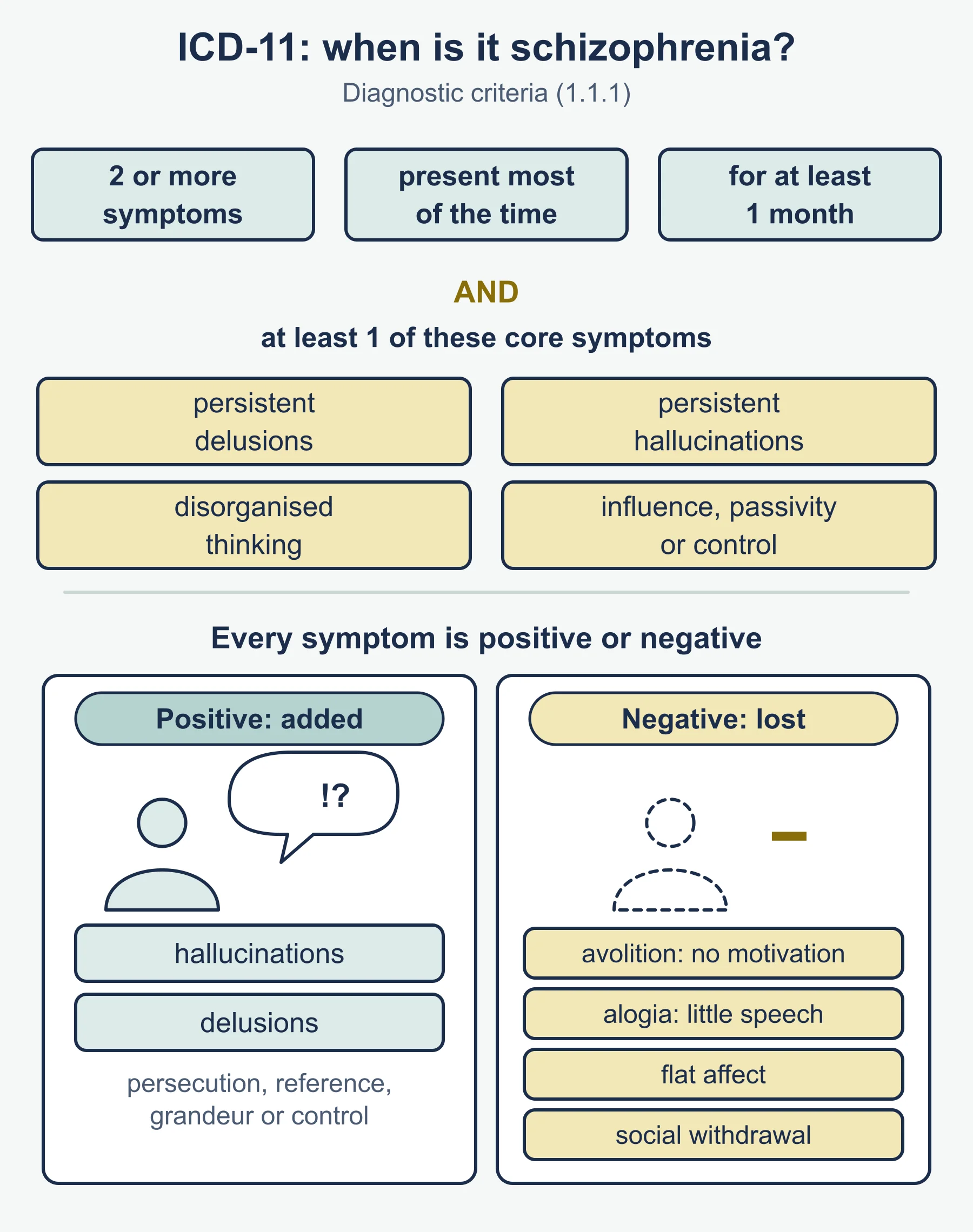
ICD-11 criteria. At least two symptoms must be present for most of the time during a period of one month or more, and at least one must come from a core group: persistent delusions, persistent hallucinations, thought disorder (disorganised thinking), or experiences of influence, passivity or control. Other symptoms include negative symptoms and grossly disorganised behaviour. The symptoms must not be better explained by another condition or by the effects of a substance.
Positive symptoms add something to normal experience: hallucinations (most often hearing voices), delusions, disorganised speech. Negative symptoms take something away: avolition (lack of drive), alogia (poverty of speech), flat or blunted affect, anhedonia (loss of pleasure) and social withdrawal. The distinction matters for evaluation, because explanations and treatments that work for positive symptoms often work less well for negative ones.
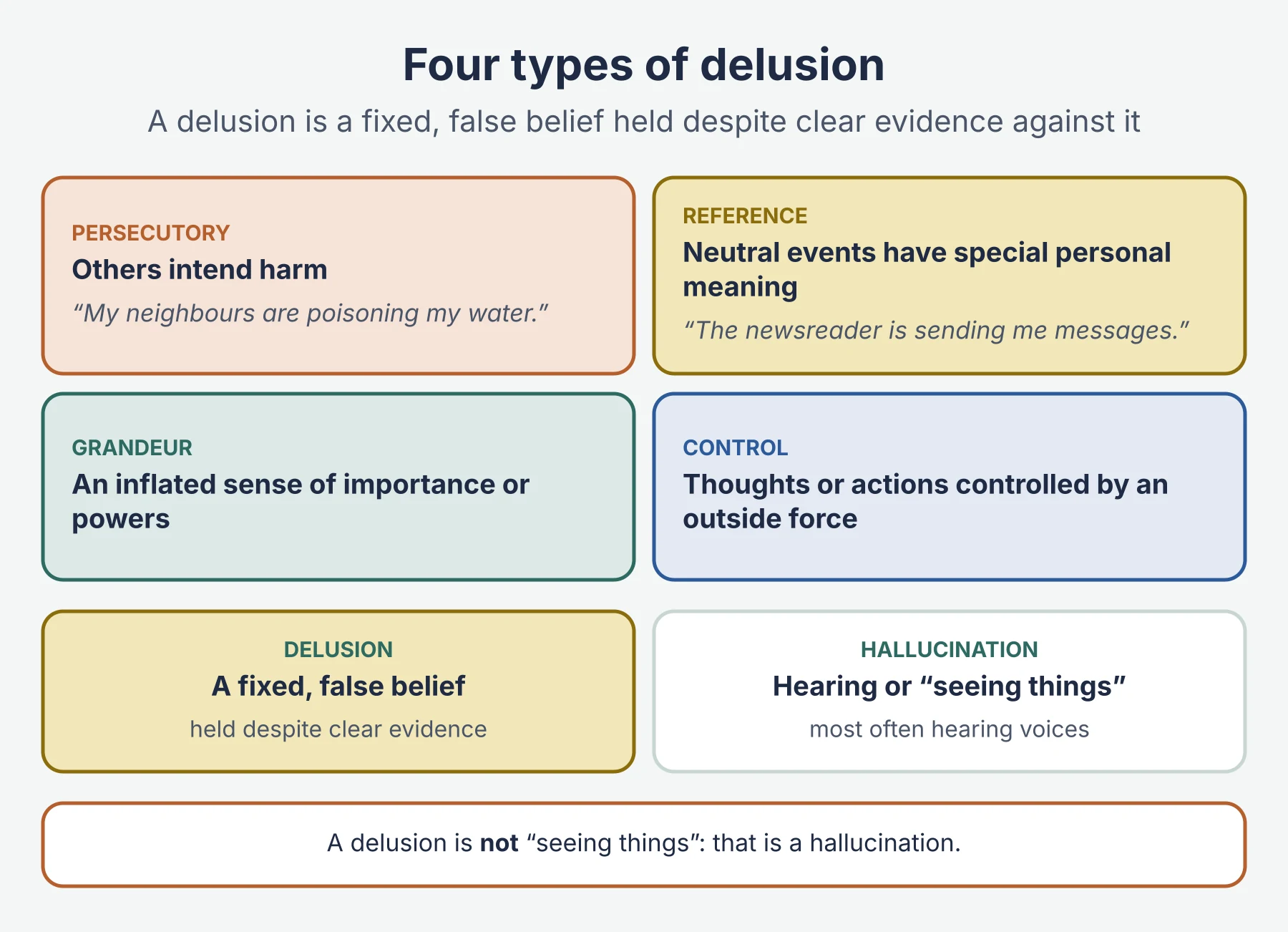
Types of delusion. A delusion is a fixed, false belief held despite clear evidence against it. The syllabus asks for types:
- Persecutory: others intend harm (“my neighbours are poisoning my water”).
- Reference: neutral events have special personal meaning (“the newsreader is sending me messages”).
- Grandeur: an inflated sense of importance or powers.
- Control: thoughts or actions are being controlled by an outside force.
A case study. A classic case study is the Genain quadruplets, four genetically identical sisters studied by Rosenthal (1963), all of whom were diagnosed with schizophrenia. They differed in severity and course, which suggests that even with identical genes, environmental experiences shape how the disorder develops. As a case study it offers rich, long-term detail but cannot be generalised: four people from one unusual family are not representative.
Key study: Freeman et al. (2003)
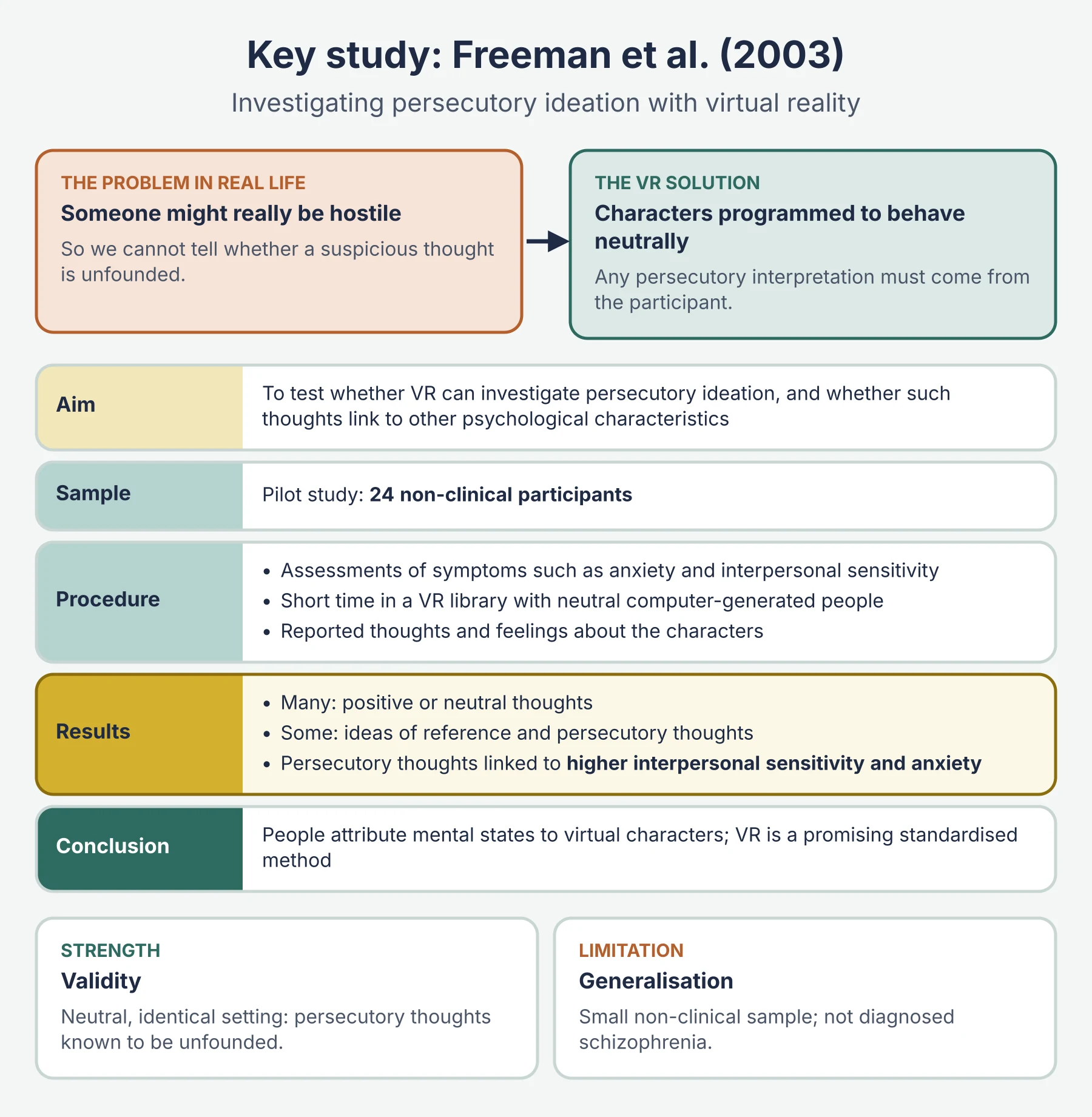
Context. Persecutory ideas are common in the general population as well as in schizophrenia. Studying them is difficult because it is hard to tell whether a suspicious thought is unfounded: in real social situations someone might really be hostile. Virtual reality (VR) solves this, because the characters can be programmed to behave neutrally, so any persecutory interpretation must come from the participant.
Aim. To test whether VR can be used to investigate persecutory ideation, and whether such thoughts are linked to other psychological characteristics.
Design and procedure. A pilot study with 24 non-clinical participants. They completed assessments of psychiatric symptoms such as anxiety and interpersonal sensitivity, spent a short time in a VR library containing computer-generated people who behaved neutrally, and reported their thoughts and feelings about the characters.
Results. Many participants had positive or neutral thoughts about the characters, but some reported ideas of reference and persecutory thoughts. Those with persecutory thoughts scored higher on interpersonal sensitivity and anxiety.
Conclusions. People attribute mental states to virtual characters, VR is a promising standardised method for studying persecutory ideation, and anxiety and interpersonal sensitivity may contribute to paranoid thinking.
Evaluation.
- Validity: the neutral, identical environment means persecutory thoughts are known to be unfounded, a major improvement over real-life settings.
- Generalisation: a small, non-clinical sample cannot show what happens in people with diagnosed schizophrenia.
- Ethics: exposure was brief and the situation neutral, so harm was minimal, but participants with suspicious thoughts might need reassurance in a debrief.
- Individual and situational explanations: since the situation was the same for everyone, differences in response point to individual factors.
1.1.2 Explanations
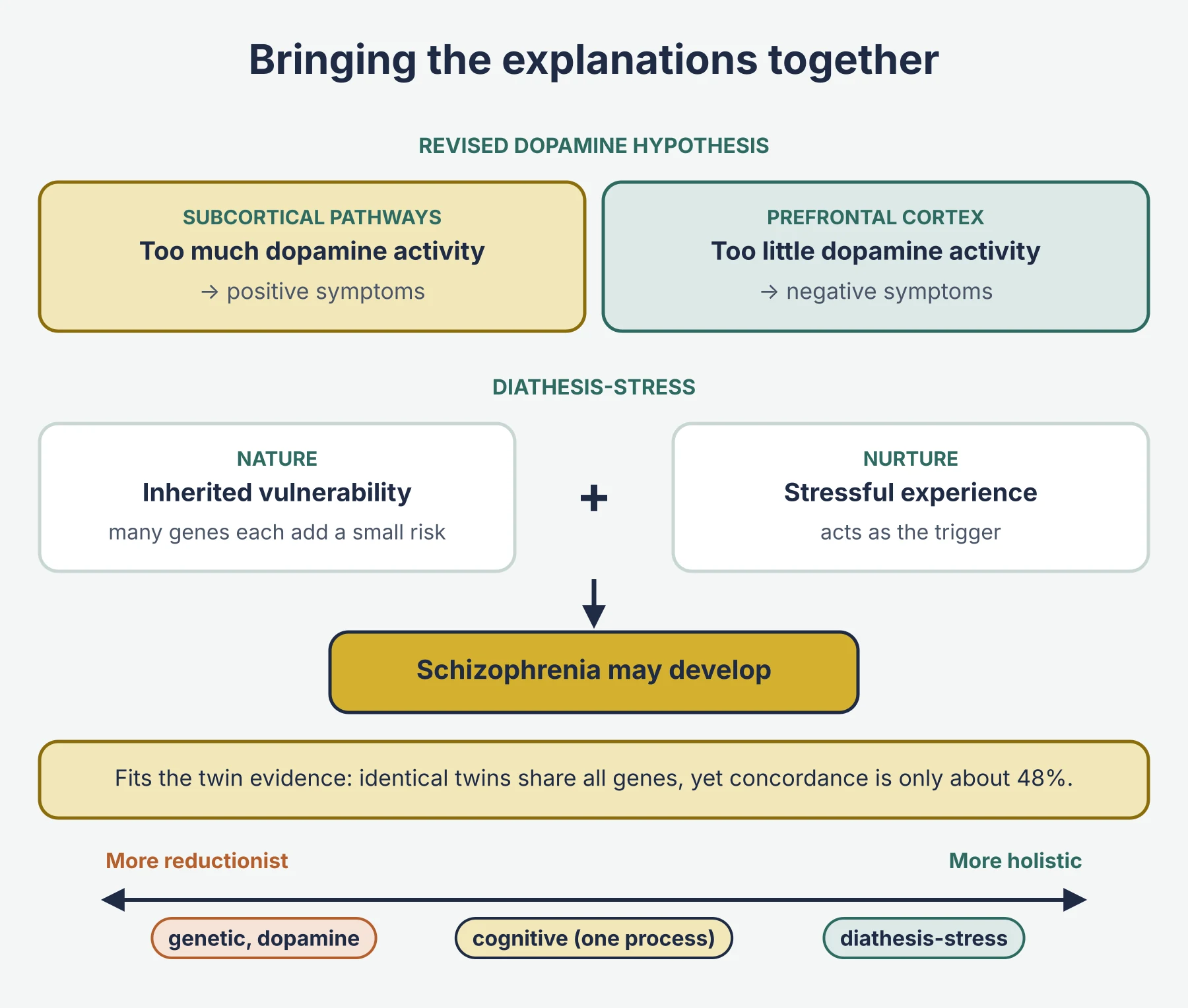
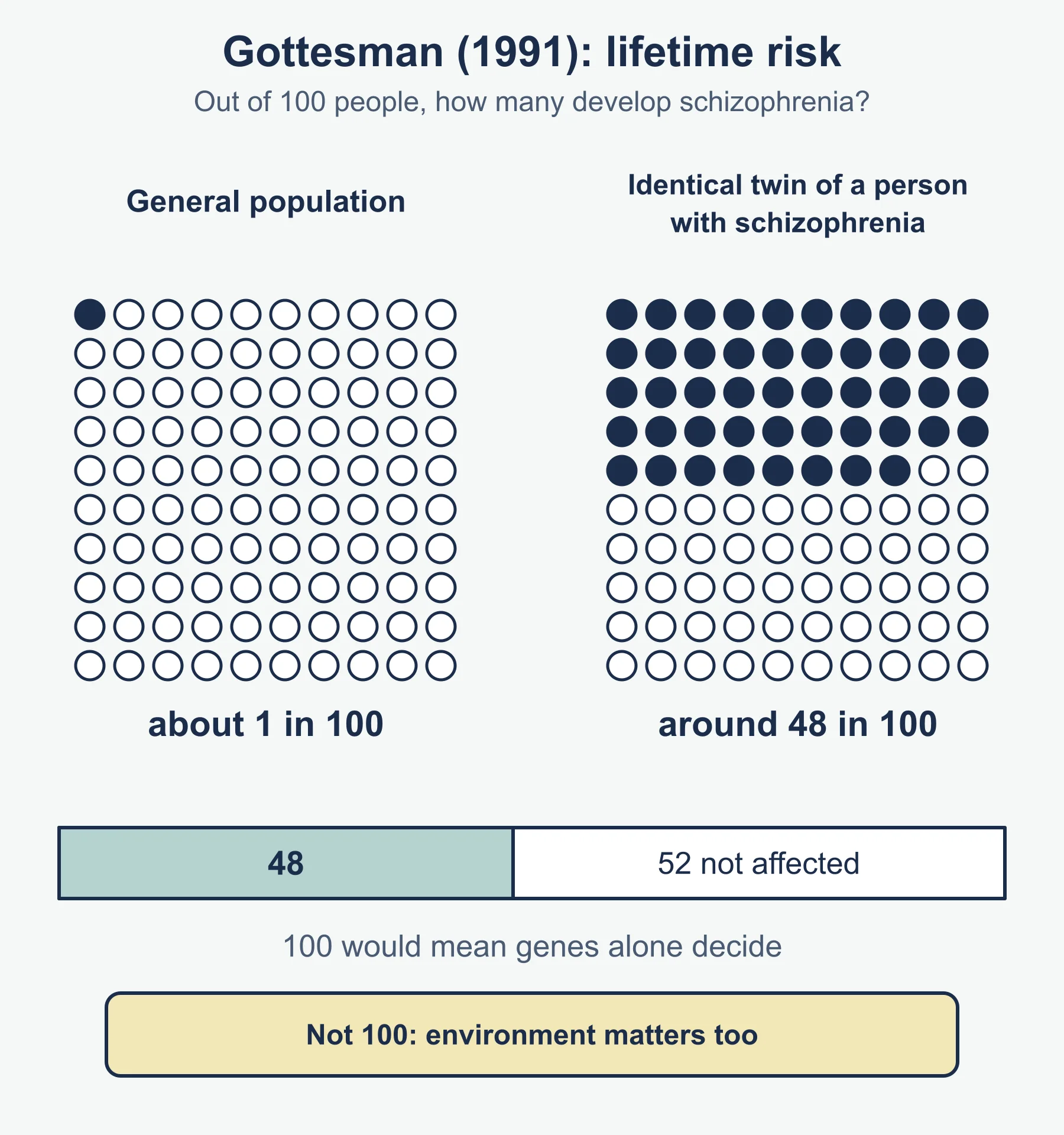
Genetic. Family, twin and adoption studies show that risk rises with genetic closeness to an affected relative. Gottesman (1991) summarised lifetime risks of about 48% for an identical twin of someone with schizophrenia, about 17% for a non-identical twin and about 1% in the general population. Because identical twins share all their genes but concordance is far below 100%, genes cannot be the whole explanation; many genes each add a small risk.
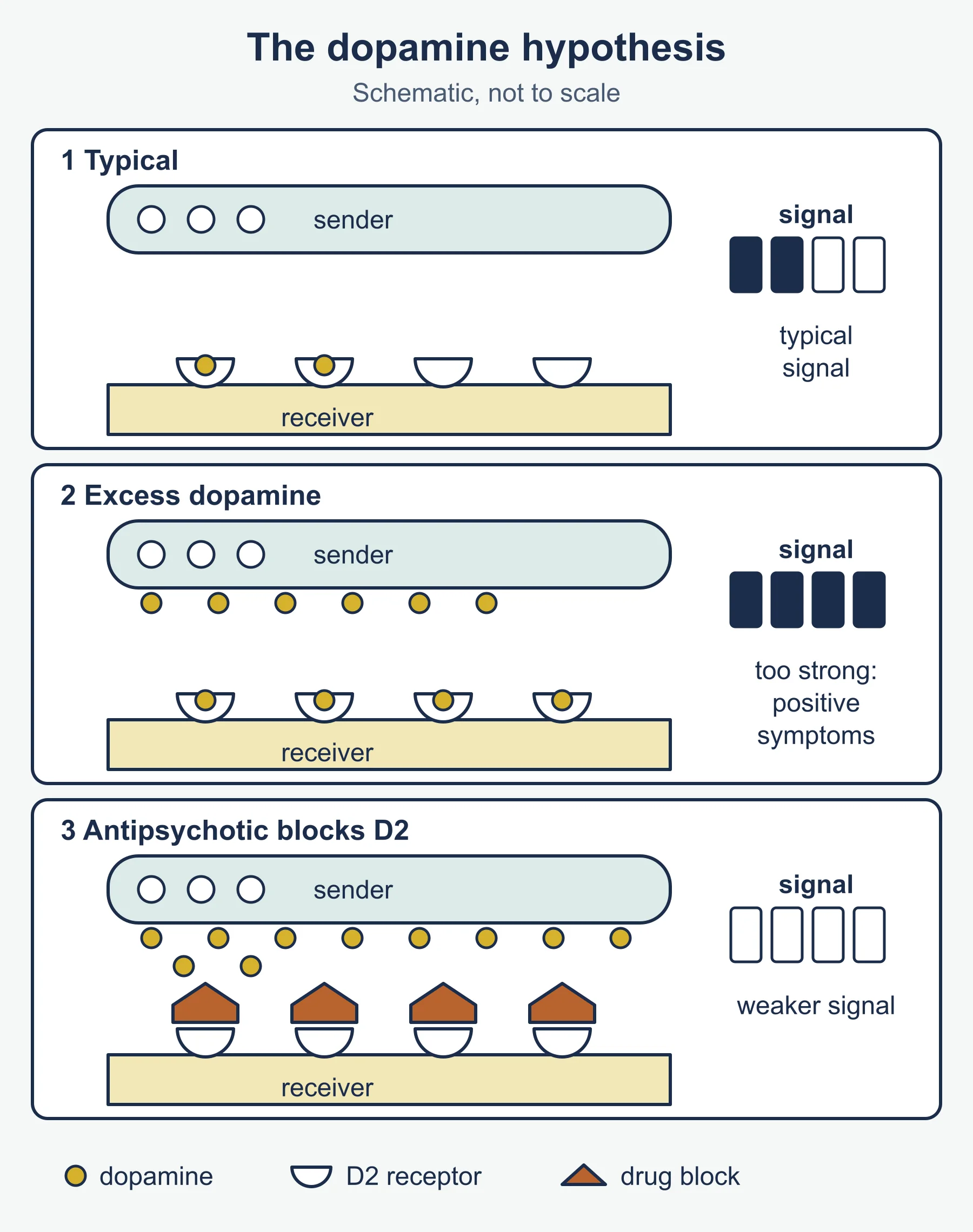
Biochemical: the dopamine hypothesis. The original hypothesis proposed excess dopamine activity, or over-sensitive D2 receptors. Evidence: drugs that increase dopamine, such as amphetamines, can produce psychotic symptoms, and antipsychotics that block D2 receptors reduce positive symptoms. A revised version proposes too much dopamine activity in subcortical pathways (positive symptoms) but too little in the prefrontal cortex (negative symptoms), which deals with one criticism of the original.
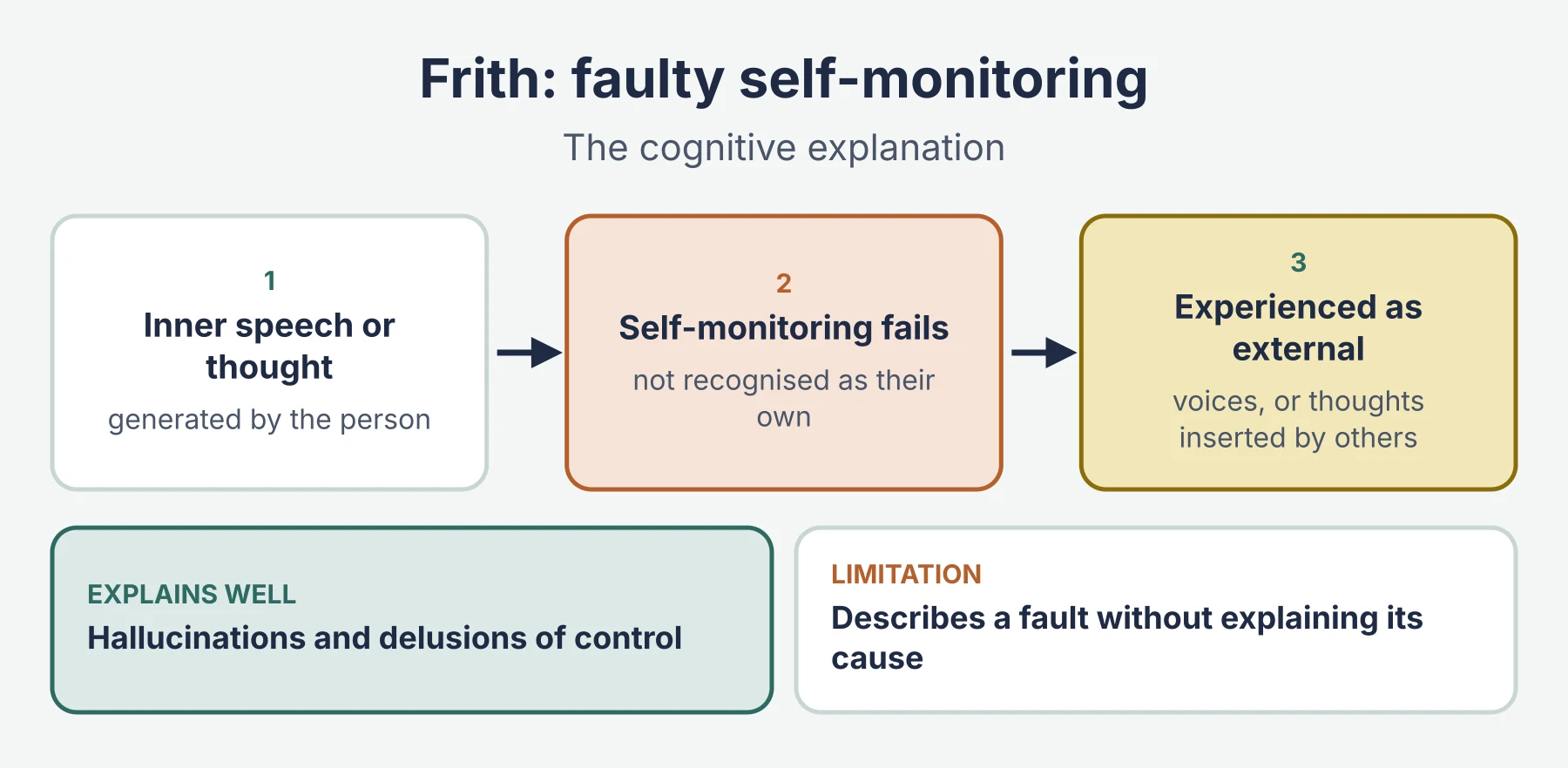
Cognitive. Frith’s account proposes faulty self-monitoring: the person fails to recognise internally generated thoughts and inner speech as their own, so they experience them as voices or thoughts inserted by others. This explains hallucinations and delusions of control well, but it describes a fault without explaining its cause.
Evaluating explanations. The genetic and dopamine explanations are reductionist and imply a deterministic view; the cognitive explanation is less reductionist but still focuses on one process. The diathesis-stress idea, that an inherited vulnerability is triggered by stressful experience, brings nature and nurture together, which fits the twin evidence.
1.1.3 Treatment and management
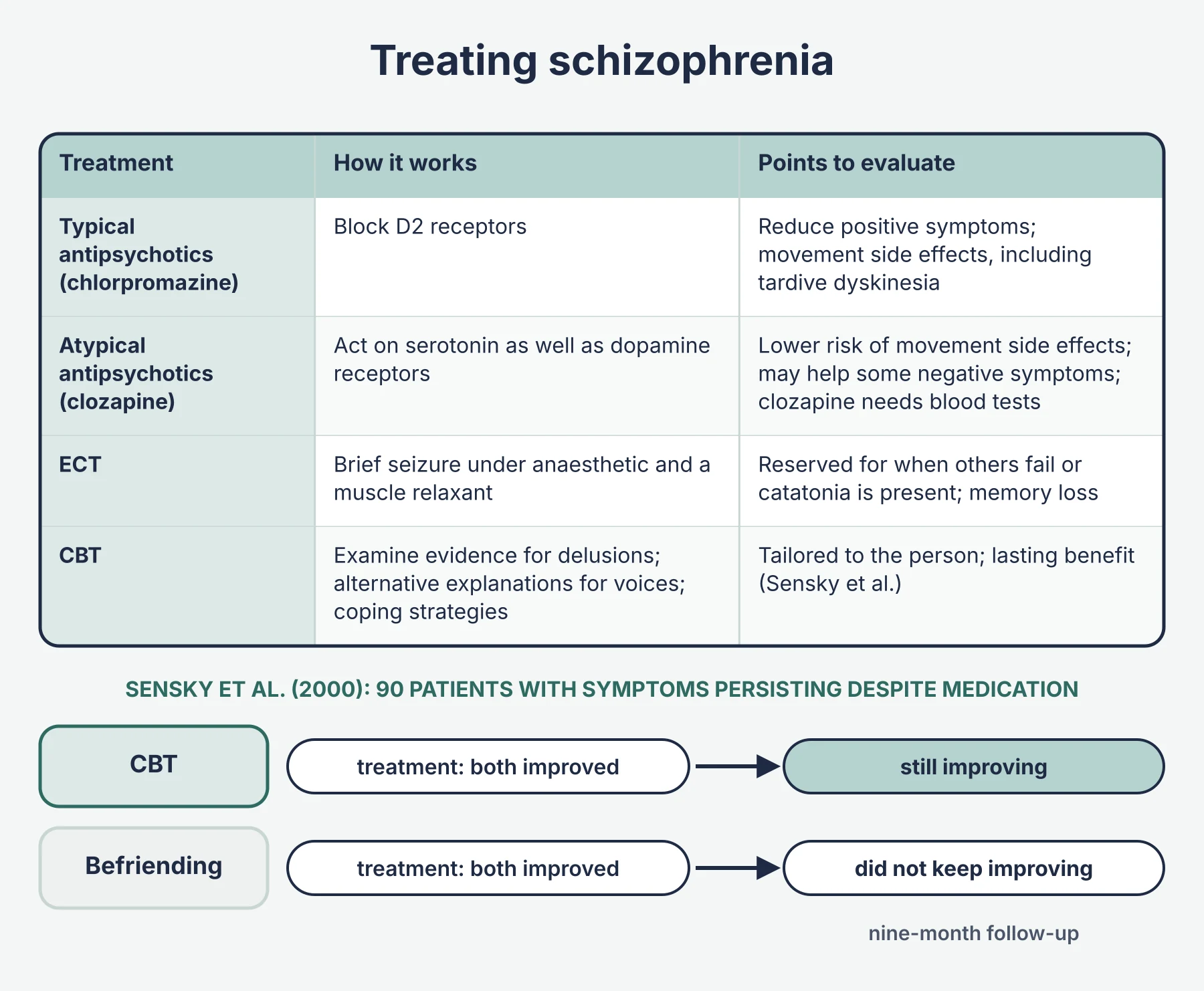
Typical antipsychotics (for example chlorpromazine) block D2 receptors. They reduce positive symptoms but can cause movement side effects, including tardive dyskinesia.
Atypical antipsychotics (for example clozapine) act on serotonin as well as dopamine receptors, carry a lower risk of movement side effects and may help some negative symptoms. Clozapine requires regular blood tests because of a risk to white blood cells.
Electro-convulsive therapy (ECT) induces a brief seizure under anaesthetic and a muscle relaxant. It is reserved for cases where other treatments have failed or where catatonia is present; side effects include memory loss.
CBT helps the person examine evidence for delusional beliefs, develop alternative explanations for voices and build coping strategies. Sensky et al. (2000) compared CBT with a befriending control for 90 patients whose symptoms persisted despite medication; both groups improved during treatment, but only the CBT group continued to improve at the nine-month follow-up. The study is a randomised comparison with a longitudinal follow-up, so it is strong evidence, though the patients were people with long-standing, medication-resistant symptoms.
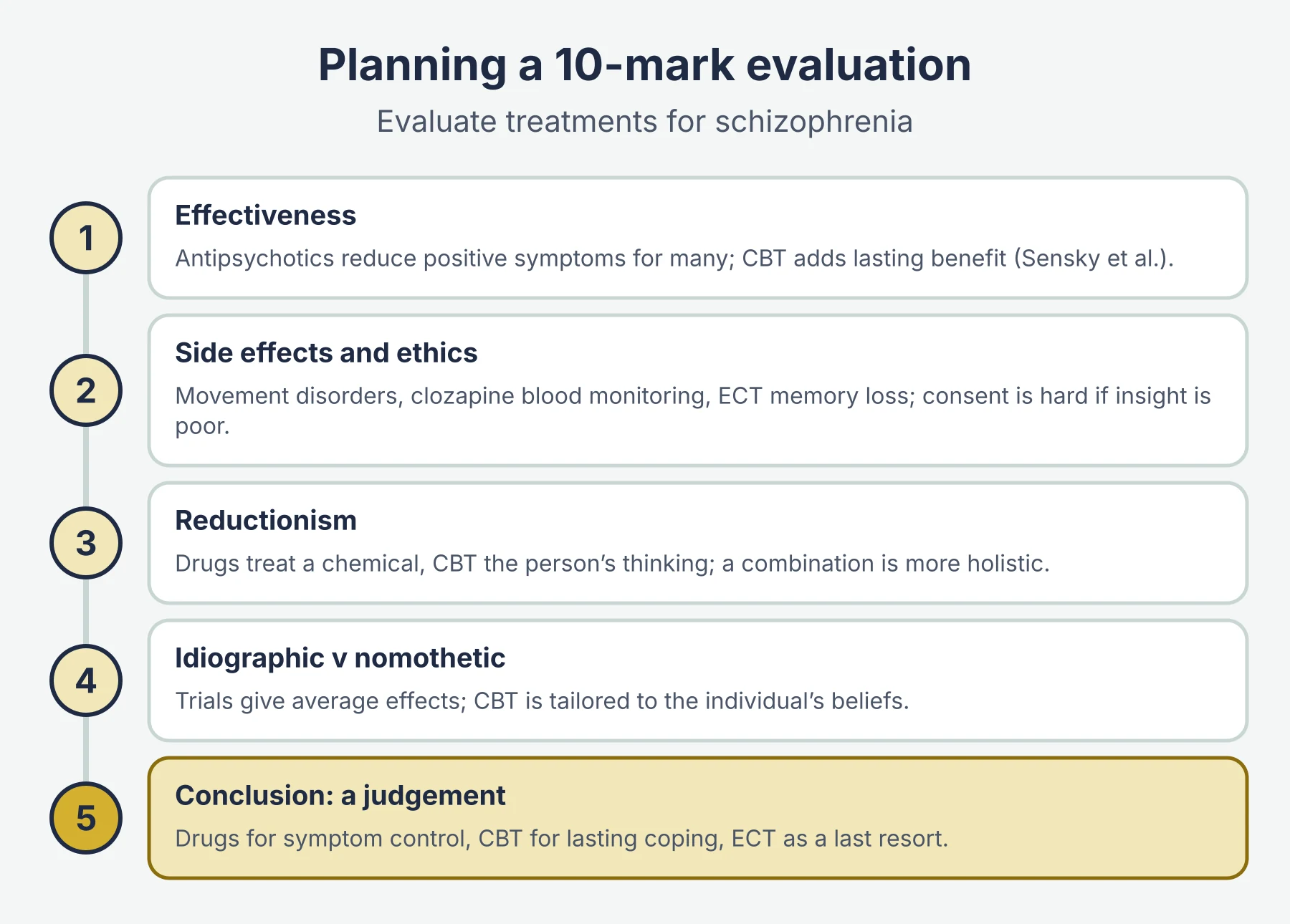
Annotated 10-mark plan: evaluate treatments for schizophrenia
- Effectiveness: antipsychotics reduce positive symptoms for many patients; CBT adds lasting benefit (Sensky et al.).
- Side effects and ethics: movement disorders with typicals; blood monitoring with clozapine; memory loss with ECT; consent is difficult if insight is poor.
- Reductionism: drugs treat a chemical, CBT the person’s thinking; a combination is more holistic.
- Idiographic versus nomothetic: trials give average effects; CBT is tailored to the individual’s beliefs.
- Conclusion: drugs for symptom control, CBT for lasting coping, ECT as a last resort.
Common mistakes
- Describing a delusion as “seeing things”; that is a hallucination.
- Saying the dopamine hypothesis is “proven” by antipsychotics: a drug working does not show the cause.
- Giving the Freeman et al. sample as patients: they were non-clinical.
- Forgetting the duration criterion of one month.
Exam technique
On Paper 3, short questions often ask you to outline a symptom or describe an explanation; the structured essay’s part (b) asks you to evaluate, so use the issues and debates listed above and finish with a judgement. On Paper 4, Section A focuses on the key study (Freeman et al.) and research methods, and Section B may ask you to plan a study, for example a VR study with a clinical sample.
Official syllabus
Cambridge International AS & A Level Psychology 9990 syllabus for 2024, 2025 and 2026, Specialist Option 1: Clinical Psychology, 1.1 Schizophrenia — cambridgeinternational.org.
More resources on this topic
Related resources
-
Practice questions
Cambridge International AS & A Level Psychology (9990): 1.1 Schizophrenia – Practice Questions
Original Paper 3 and Paper 4 style questions with mark-scheme answers on 9990 topic 1.1 Schizophrenia: diagnosis, Freeman et al., explanations and treatments.
Psychology · Cambridge · A Level
Try questions -
Revision notes
Cambridge International AS & A Level Psychology (9990): 1.1 Schizophrenia – Revision Notes
Revision notes for 9990 topic 1.1 Schizophrenia: ICD-11 criteria, delusion types, Freeman et al., explanations, treatments, key terms and a self-test.
Psychology · Cambridge · A Level
Revise topic -
Study guides
Cambridge A Level Psychology 9990: Clinical Psychology (Specialist Option 1)
Study guide to Cambridge A Level Psychology 9990 Clinical Psychology: diagnosis, explanations and treatments for topics 1.1 to 1.5, with all five key studies.
Psychology · Cambridge · A Level
Read guide
Studying Psychology?
This page is free and stays free. Marlbridge is not offering Psychology classes at the moment, so there is no tuition to book for it. The free study resources stay open to everyone.
Get free revision emails (optional)
Occasional emails with practice questions, worked explanations and links to free resources for the qualification and subjects you choose. No spam, and you can unsubscribe from any email. The free tools on this site never need an email.