
Revision Notes
Cambridge International AS & A Level Psychology (9990): 1.1 Schizophrenia – Revision Notes
Revision notes for 9990 topic 1.1 Schizophrenia: ICD-11 criteria, delusion types, Freeman et al., explanations, treatments, key terms and a self-test.
- Subject
- Psychology
- Level
- A LEVEL
- Topic
- Specialist Option 1: Clinical Psychology
- Author
- Marlbridge Academic Team
- Updated
- Reviewed by
- Kanwal Aslam (what this means)
Aligned to Cambridge A Level Psychology (9990), 2024-2026. Official specification .
Syllabus page (what it covers and how it is assessed): Cambridge A Level Psychology.
Syllabus points this page covers
9990 (A Level)
- 1.1 Schizophrenia
These notes condense topic 1.1 Schizophrenia from Specialist Option 1, Clinical Psychology, of Cambridge International AS & A Level Psychology (9990), syllabus for 2024 to 2026. The topic has three parts: diagnosis, explanations, and treatment and management. Use the schizophrenia study guide for full explanations and the schizophrenia practice questions to test yourself.
1.1.1 Diagnosis in brief
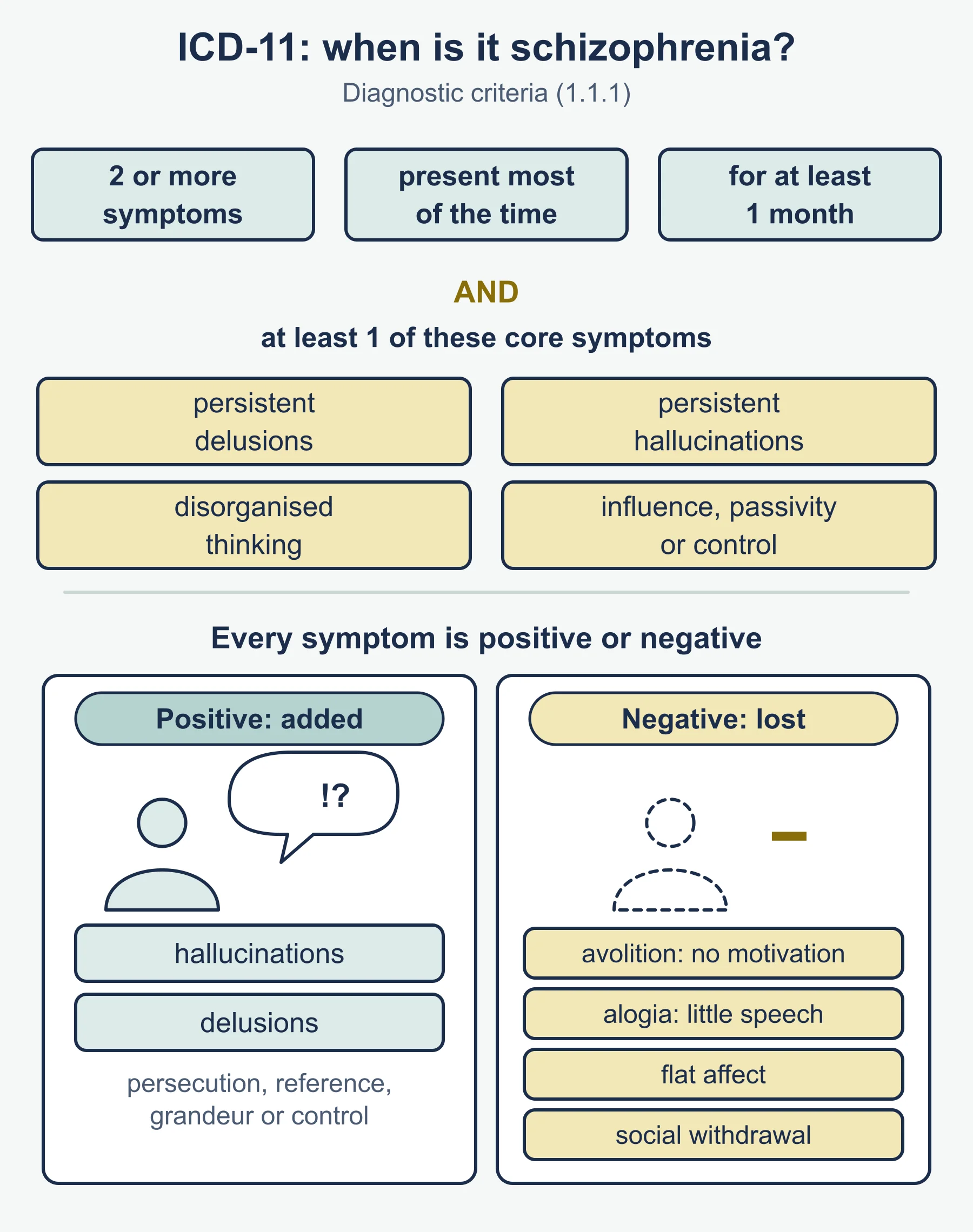
- Duration: symptoms most of the time for at least one month.
- Number: at least two symptoms.
- Core group (at least one): persistent delusions; persistent hallucinations; thought disorder; experiences of influence, passivity or control.
- Exclusion: not better explained by another condition or a substance.
| Positive symptoms (additions) | Negative symptoms (losses) |
|---|---|
| Hallucinations, especially auditory | Avolition |
| Delusions | Alogia |
| Disorganised speech and behaviour | Flat or blunted affect |
| Experiences of control | Anhedonia; social withdrawal |
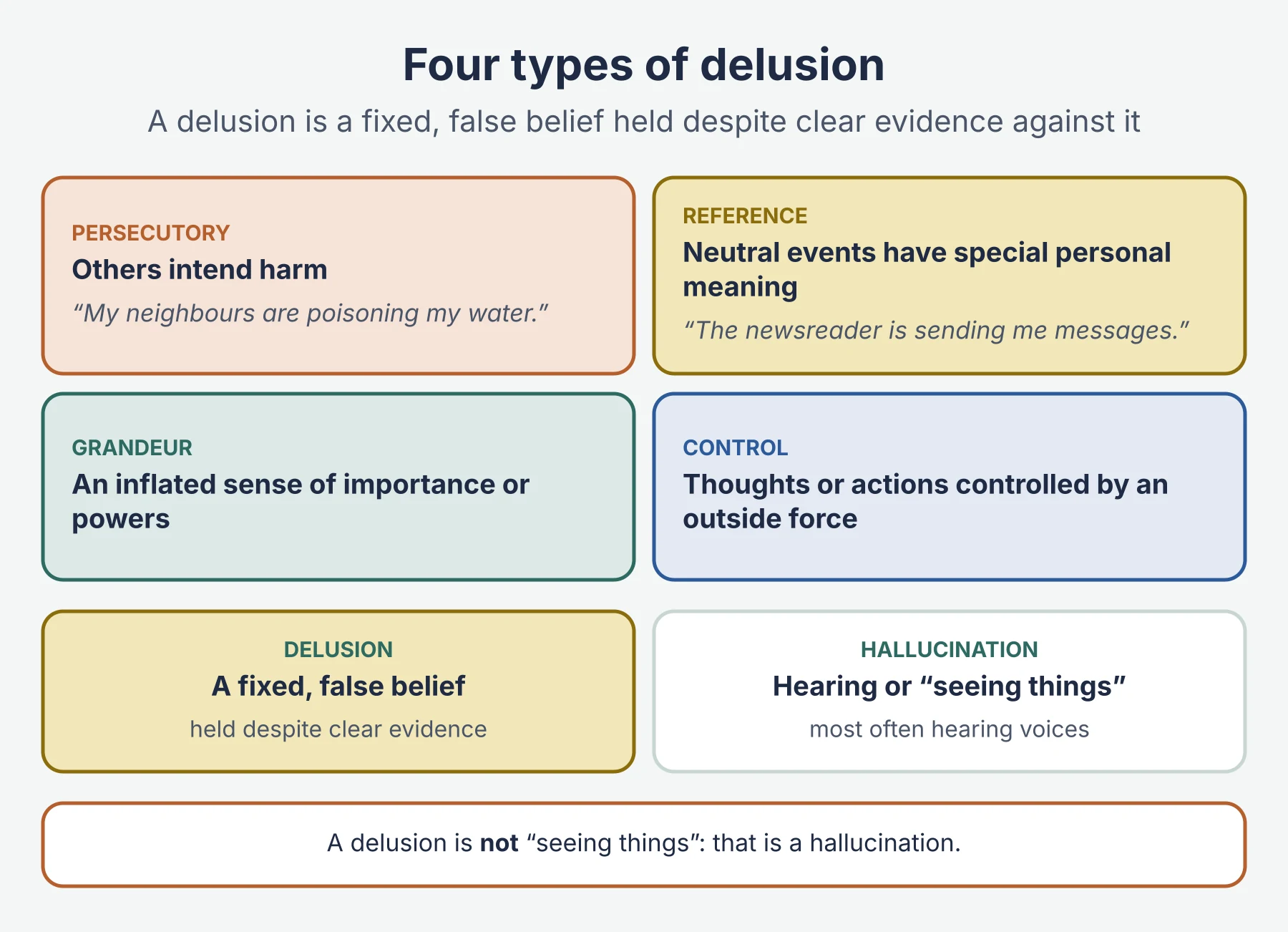
Delusion types: persecutory, reference, grandeur, control.
Case study: the Genain quadruplets (Rosenthal, 1963): identical sisters all diagnosed, but differing in severity, so environment matters.
Key study: Freeman et al. (2003)
| Element | Detail |
|---|---|
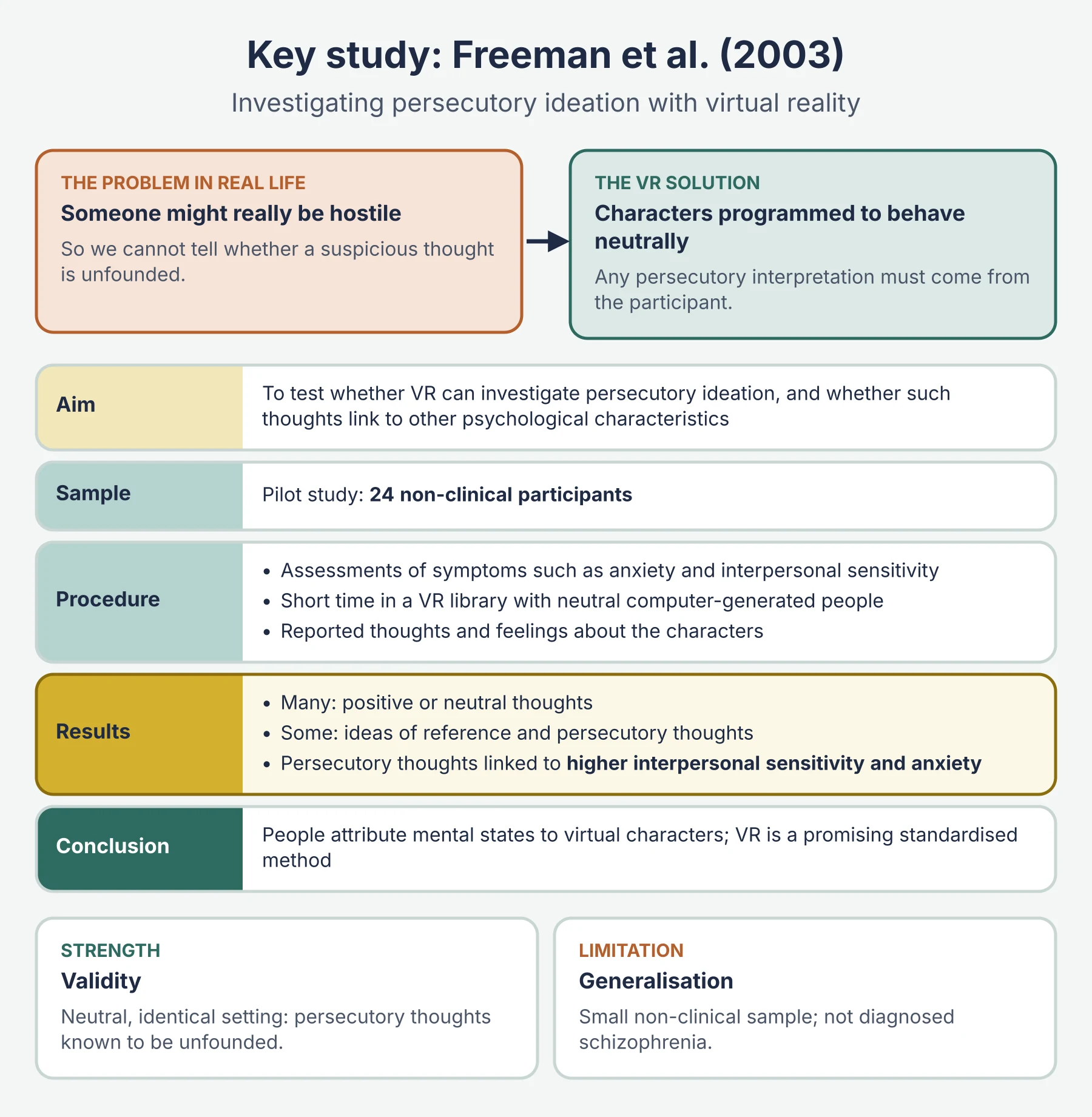
| Aim | Can VR be used to investigate persecutory ideation? |
| Design | Pilot study; 24 non-clinical participants |
| Procedure | Symptom assessments; short time in a neutral VR library with computer-generated people; thoughts about the characters reported |
| Results | Most thoughts positive or neutral; some persecutory; these people had higher interpersonal sensitivity and anxiety |
| Conclusion | People attribute mental states to avatars; VR is a useful method; anxiety may feed paranoia |
| Strength | Neutral, standardised scene, so persecutory thoughts are known to be unfounded |
| Weakness | Small non-clinical sample; cannot generalise to diagnosed patients |
1.1.2 Explanations
| Explanation | Claim | Support | Criticism |
|---|---|---|---|
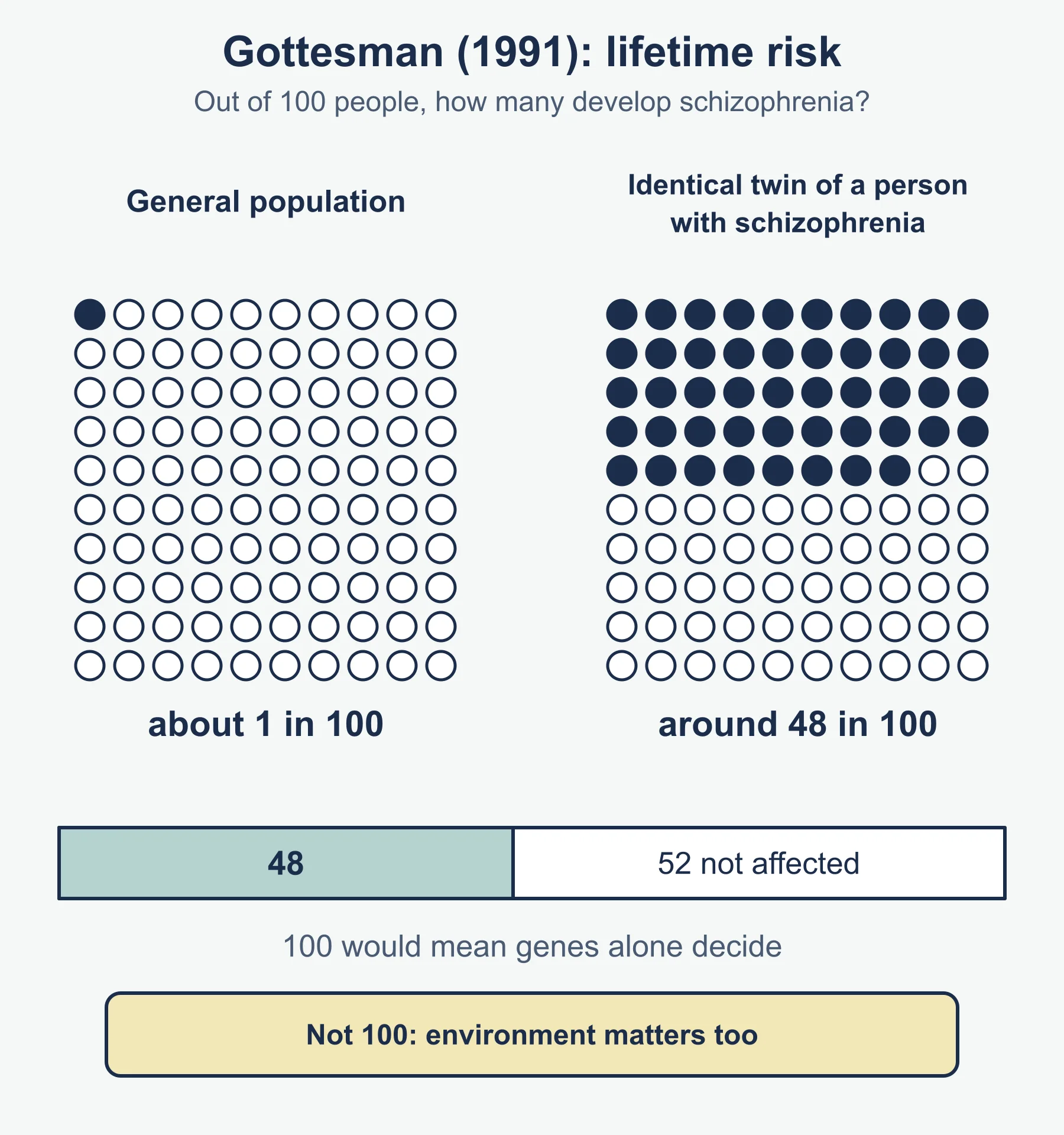
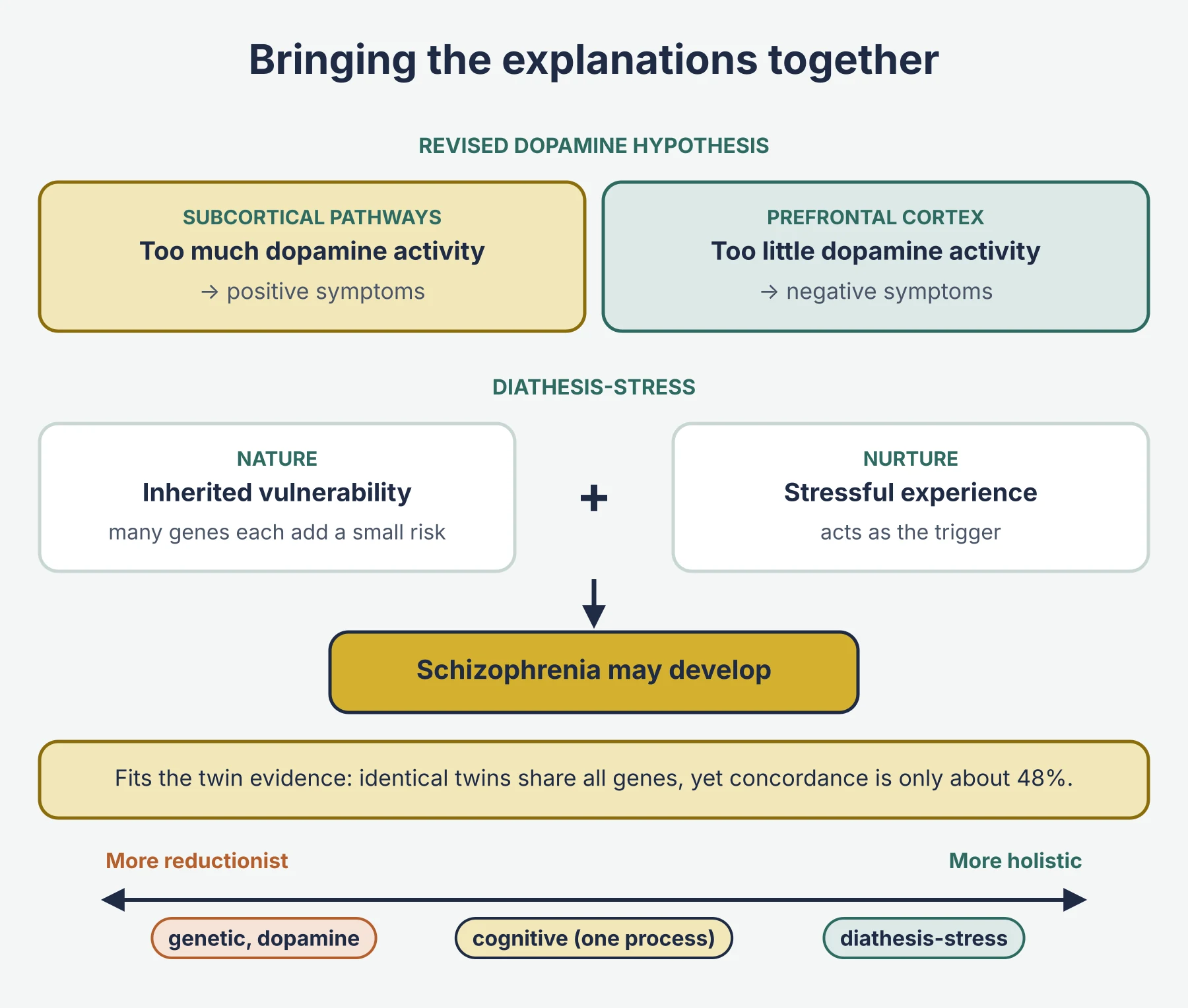
| Genetic | Inherited vulnerability, many genes | Gottesman (1991): about 48% identical twin, 17% non-identical twin, 1% general population | Concordance far below 100%; shared environments in families |
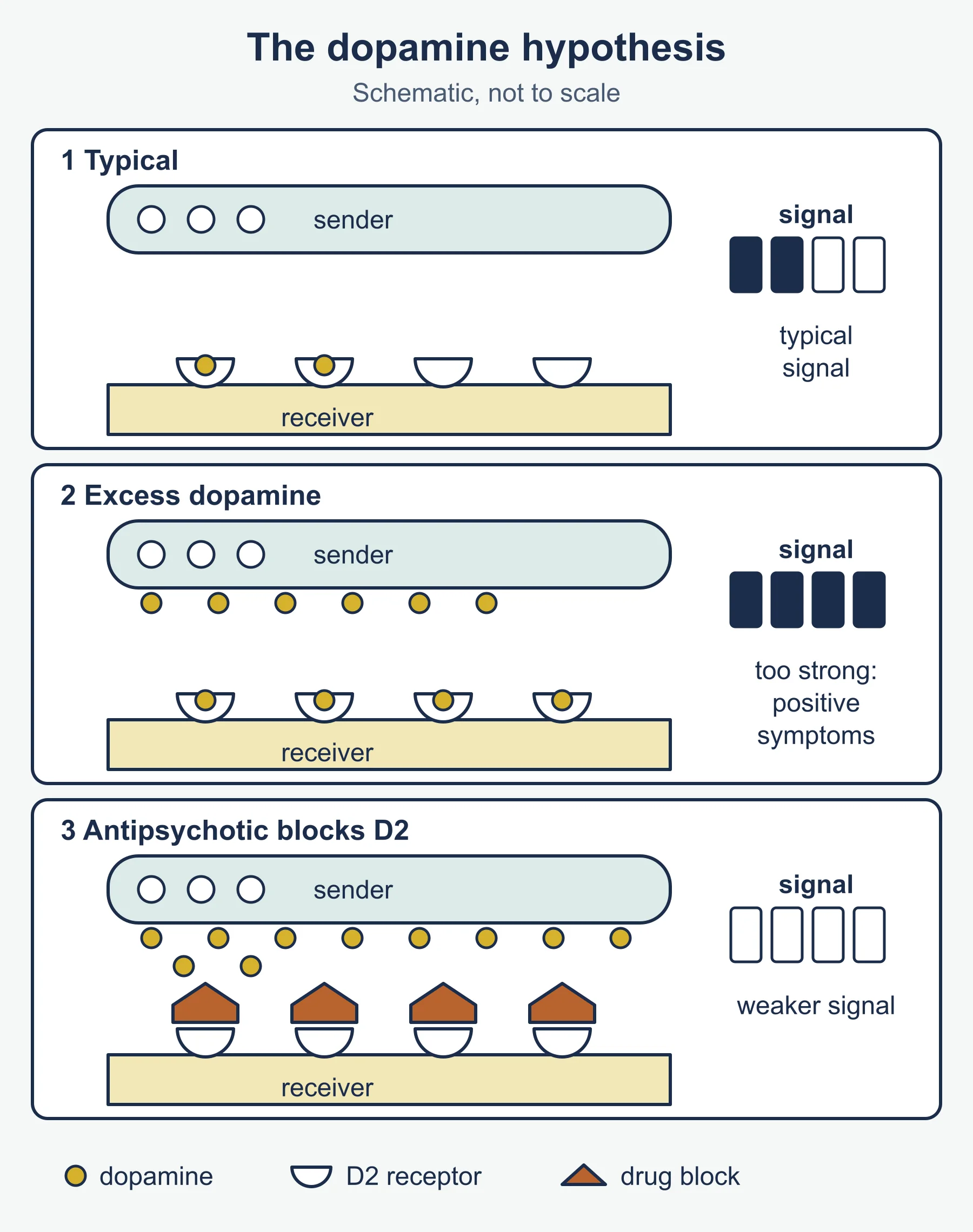
| Dopamine hypothesis | Excess dopamine or D2 sensitivity; revised: high subcortical, low prefrontal | Amphetamines cause psychosis; D2 blockers reduce positive symptoms | Drug effects do not prove cause; original version fits negative symptoms poorly |
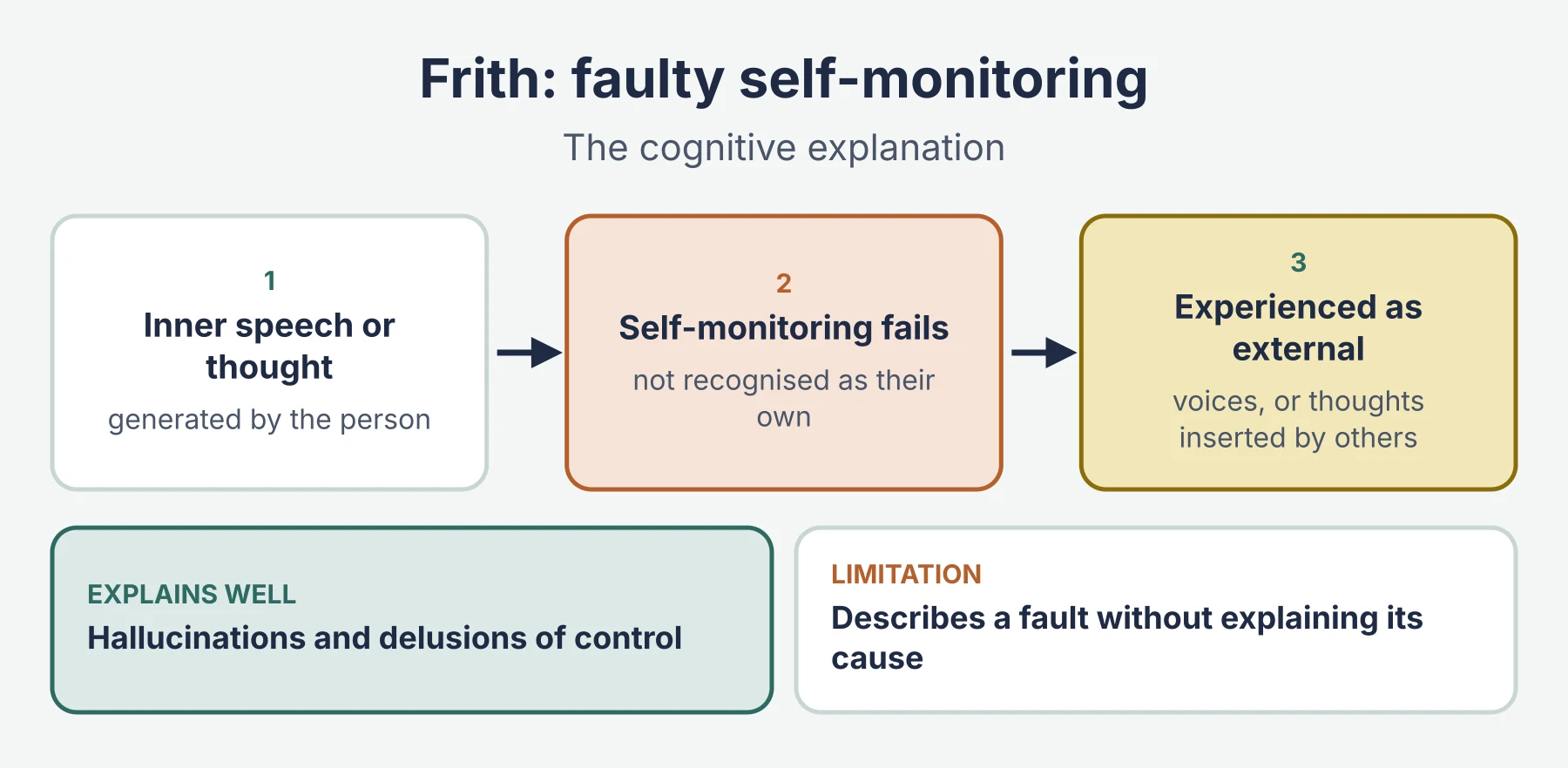
| Cognitive (Frith) | Faulty self-monitoring: inner speech experienced as external | Explains voices and thoughts of control | Describes, does not explain the cause; could itself be biological |
Diathesis-stress: vulnerability plus stressful triggers, combining nature and nurture.
1.1.3 Treatments
| Treatment | How it works | Main drawback |
|---|---|---|
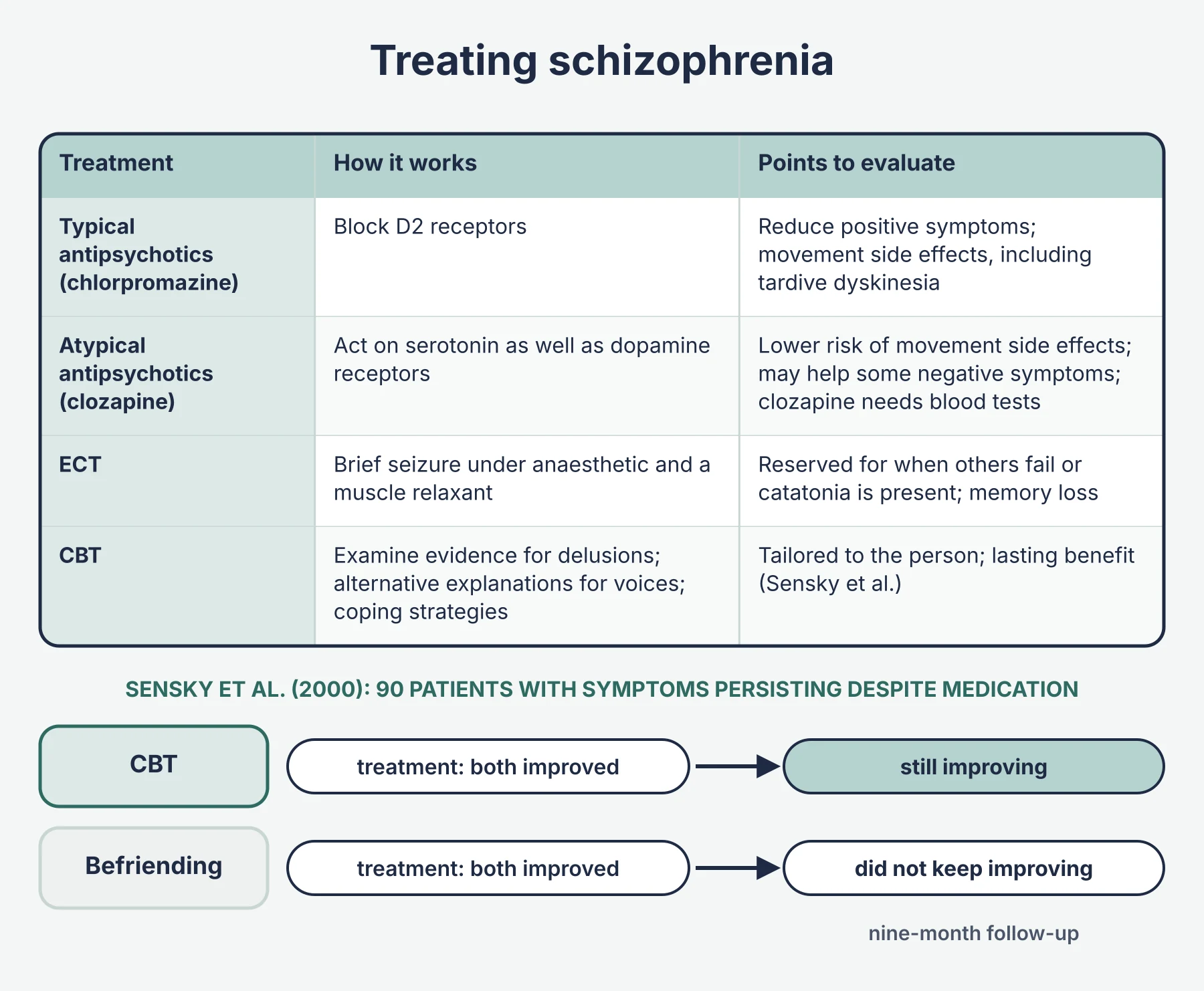
| Typical antipsychotics (e.g. chlorpromazine) | Block D2 receptors | Movement side effects, tardive dyskinesia |
| Atypical antipsychotics (e.g. clozapine) | Act on dopamine and serotonin | Clozapine needs blood monitoring; weight gain with several atypicals |
| ECT | Brief induced seizure under anaesthetic | Memory loss; used mainly when other treatments fail or for catatonia |
| CBT | Test evidence for beliefs; reattribute voices; coping strategies | Needs engagement and insight |
Sensky et al. (2000): 90 patients with medication-resistant symptoms; CBT or befriending; both improved during treatment; only CBT kept improving at nine-month follow-up.
Key terms
| Term | Meaning |
|---|---|
| Hallucination | Perception without an external stimulus |
| Delusion | Fixed false belief held despite evidence |
| Avolition | Lack of motivation to start or keep up activities |
| Alogia | Poverty of speech |
| Concordance | Proportion of twin pairs where both have the disorder |
| D2 receptor | Dopamine receptor blocked by antipsychotics |
| Tardive dyskinesia | Involuntary movements, a long-term side effect of typical antipsychotics |
| Self-monitoring | Recognising one’s own thoughts and actions as self-generated |
| Pilot study | Small trial run to test a method |
| Befriending | Control condition giving social contact without therapy |
Issues and debates hooks
- Nature versus nurture: twin concordance below 100%; the Genain sisters’ differing outcomes.
- Reductionism: dopamine hypothesis versus multi-factor explanations.
- Determinism: genetic and biochemical accounts imply limited control; CBT assumes the person can change their thinking.
- Idiographic versus nomothetic: case studies (Genain) versus trials (Sensky et al.).
- Individual and situational: Freeman et al. kept the situation constant, so differences reflect the individual.
Exam traps
- Confusing delusions (beliefs) with hallucinations (perceptions).
- Calling negative symptoms “bad” symptoms.
- Saying antipsychotics cure schizophrenia: they reduce symptoms.
- Treating the dopamine hypothesis as a single version; mention the revision when evaluating.
- Writing that Freeman et al. used patients with schizophrenia.
Self-test
- What is the minimum duration for an ICD-11 diagnosis of schizophrenia?
- Name the four core-group symptoms.
- Give two negative symptoms.
- Define a delusion of reference.
- Why did Freeman et al. use a neutral VR environment?
- What characteristics were linked to persecutory thoughts in Freeman et al.?
- Give Gottesman’s lifetime risk figure for an identical twin.
- What does the revised dopamine hypothesis add?
- What does Frith’s cognitive explanation propose?
- How do typical antipsychotics work?
- Give one disadvantage of clozapine.
- What did Sensky et al. find at follow-up?
Answers: (1) one month. (2) persistent delusions; persistent hallucinations; thought disorder; experiences of influence, passivity or control. (3) any two of avolition, alogia, flat affect, anhedonia, social withdrawal. (4) believing neutral events have special personal meaning. (5) so any persecutory thoughts were unfounded and every participant had the same situation. (6) higher interpersonal sensitivity and anxiety. (7) about 48%. (8) low dopamine activity in the prefrontal cortex, linked to negative symptoms. (9) faulty self-monitoring, so inner speech is experienced as coming from outside. (10) they block dopamine D2 receptors. (11) it needs regular blood tests because of a risk to white blood cells. (12) only the CBT group continued to improve at nine months.
Official syllabus
Cambridge International AS & A Level Psychology 9990 syllabus for 2024, 2025 and 2026, Specialist Option 1, 1.1 Schizophrenia — cambridgeinternational.org.
More resources on this topic
Related resources
-
Study guides
Cambridge A Level Psychology 9990: Clinical Psychology (Specialist Option 1)
Study guide to Cambridge A Level Psychology 9990 Clinical Psychology: diagnosis, explanations and treatments for topics 1.1 to 1.5, with all five key studies.
Psychology · Cambridge · A Level
Read guide -
Practice questions
Cambridge A Level Psychology 9990: Clinical Psychology — Practice Questions
Original Paper 3 and Paper 4 style questions with mark-scheme answers for Cambridge 9990 Clinical Psychology, from schizophrenia and mood disorders to OCD.
Psychology · Cambridge · A Level
Try questions -
Revision notes
Cambridge A Level Psychology 9990: Clinical Psychology — Revision Notes
Condensed revision notes for Cambridge 9990 Clinical Psychology: ICD-11 criteria, measures, explanations, treatments and key studies for topics 1.1 to 1.5.
Psychology · Cambridge · A Level
Revise topic
Studying Psychology?
This page is free and stays free. Marlbridge is not offering Psychology classes at the moment, so there is no tuition to book for it. The free study resources stay open to everyone.
Get free revision emails (optional)
Occasional emails with practice questions, worked explanations and links to free resources for the qualification and subjects you choose. No spam, and you can unsubscribe from any email. The free tools on this site never need an email.