
Revision Notes
Cambridge International AS & A Level Psychology (9990): Social approach – Revision Notes
Revision notes for the 9990 social approach: Milgram, Perry et al. and Piliavin et al. in a grid, key figures and terms, exam traps and a 12-question self-test.
- Subject
- Psychology
- Level
- AS LEVEL
- Topic
- Paper 1 – Approaches, Issues and Debates
- Author
- Marlbridge Academic Team
- Updated
- Reviewed by
- Kanwal Aslam (what this means)
Aligned to Cambridge A Level Psychology (9990), 2024-2026. Official specification .
Syllabus page (what it covers and how it is assessed): Cambridge A Level Psychology.
Syllabus points this page covers
9990 (AS Level)
- Social approach
These notes condense the social approach of Cambridge International AS & A Level Psychology (9990), syllabus for 2024 to 2026. Learn the two assumptions, the key numbers from Milgram and Piliavin et al., the person-by-situation finding of Perry et al., and an ethical point with a methodological justification for each study. For the full detail read the social approach study guide; then try the social approach practice questions.
Assumptions
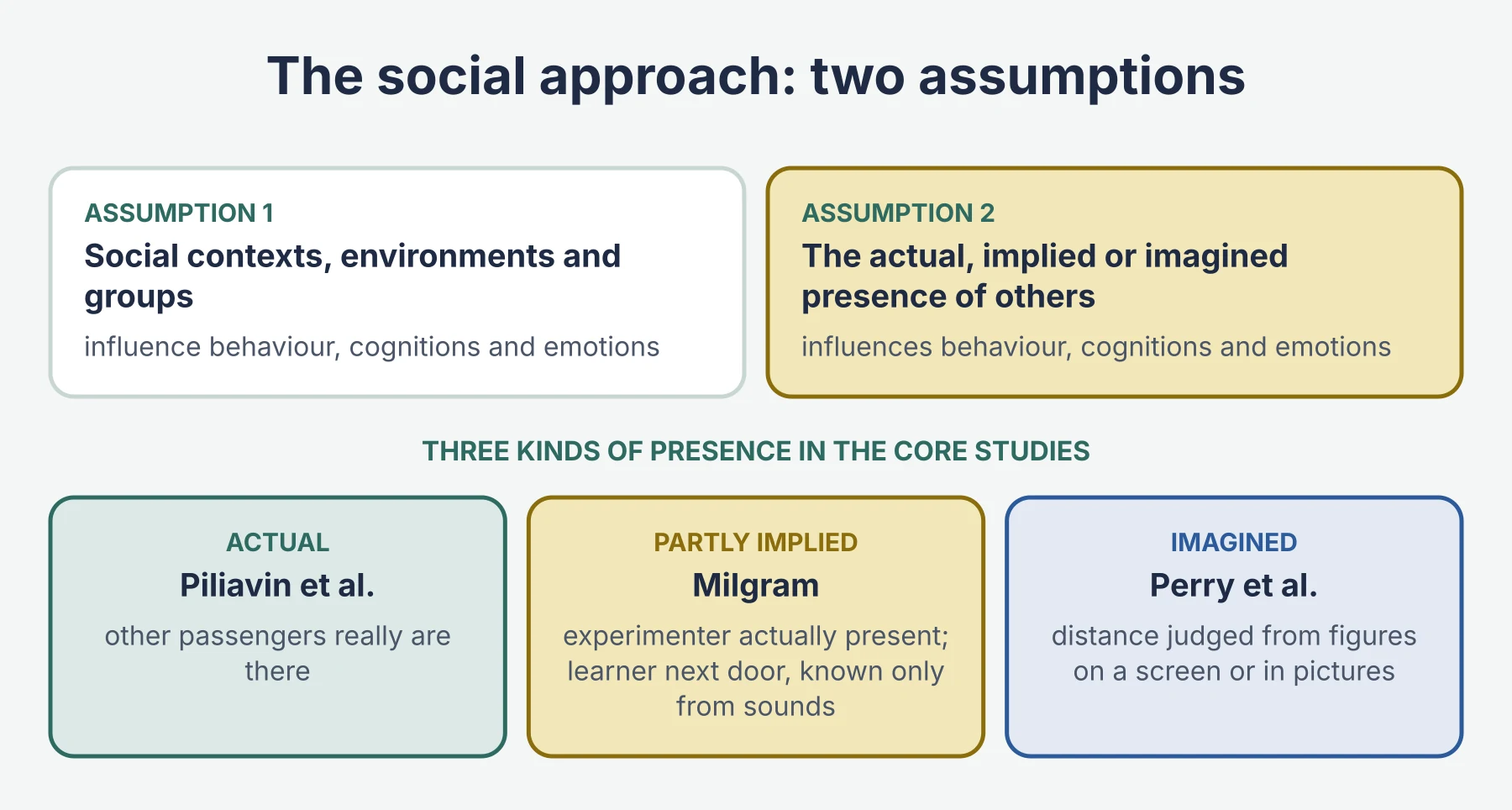
- Behaviour, cognitions and emotions are influenced by social contexts, social environments and groups.
- They are influenced by the actual, implied or imagined presence of others.
| Kind of presence | Best example |
|---|---|
| Actual | Other passengers in Piliavin et al.; the experimenter in Milgram |
| Implied | The learner, heard but not seen, in Milgram |
| Imagined | The approaching figure or pictured person in Perry et al. |
Core studies grid
| Element | Milgram (1963) | Perry et al. (2015) | Piliavin et al. (1969) |
|---|---|---|---|
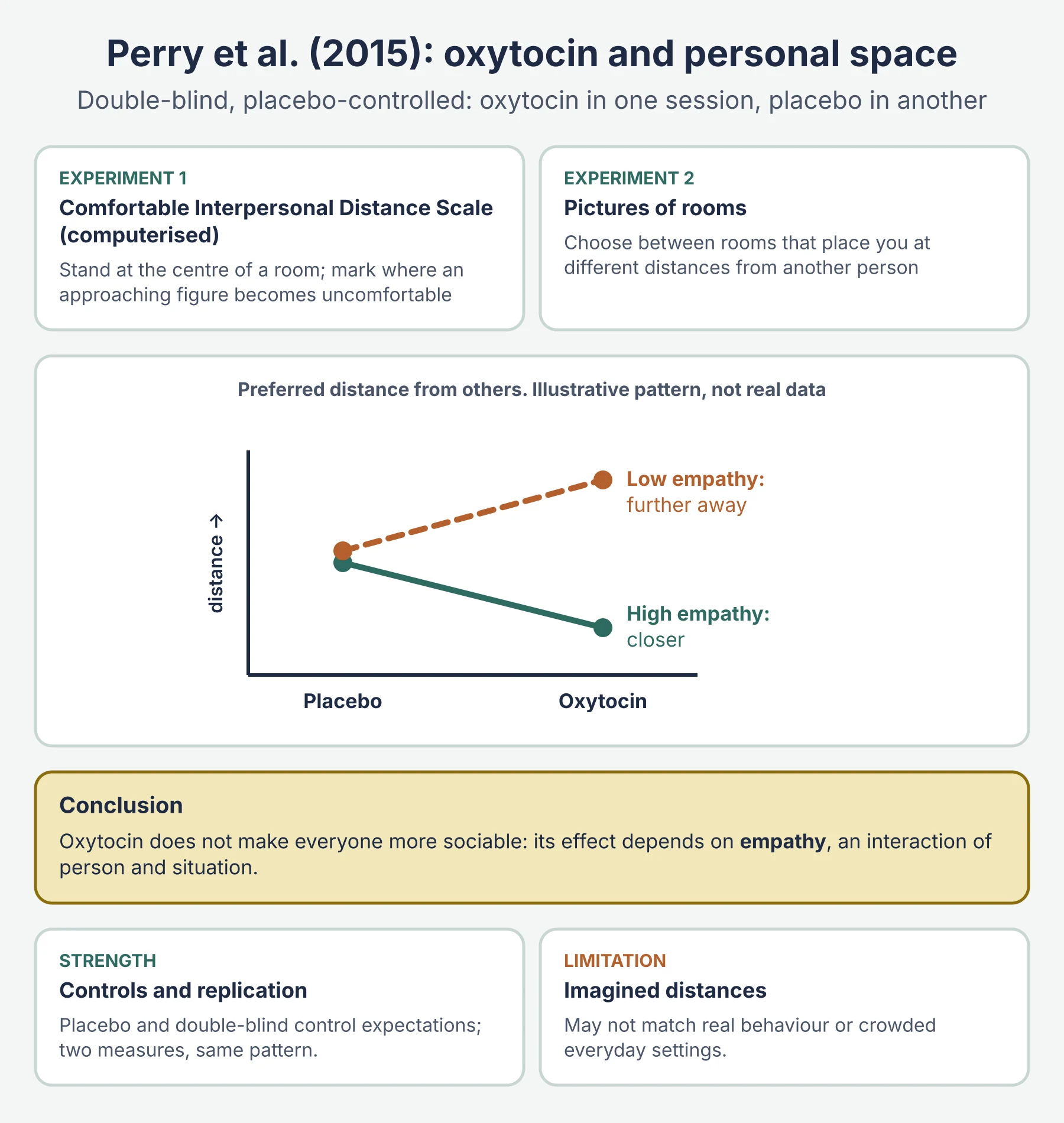
| Psychology | Obedience; social pressure | Interpersonal distance; social hormones; empathy | Bystander apathy; diffusion of responsibility |
| Method | Laboratory; DV measured but no IV in the main study; observation and interview | Two double-blind placebo-controlled experiments; questionnaires | Field experiment; observation |
| Sample | 40 men aged 20–50, newspaper advert and direct mail | Participants divided by empathy score | About 4,450 subway passengers, 103 trials |
| Key measure | Maximum voltage given | Preferred distance (CIDS in Experiment 1; room pictures in Experiment 2) | Frequency and speed of help; race and sex of helpers |
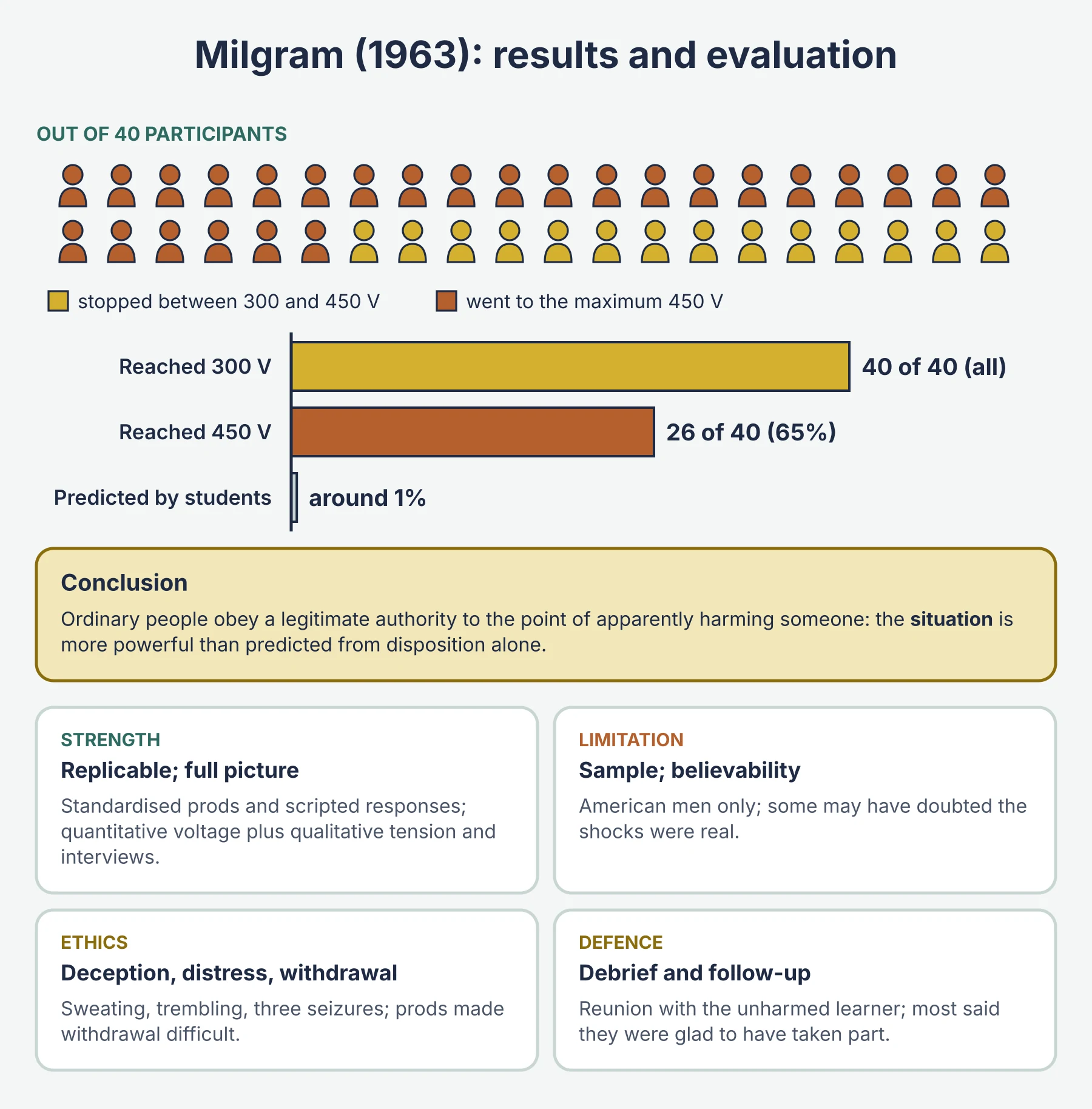
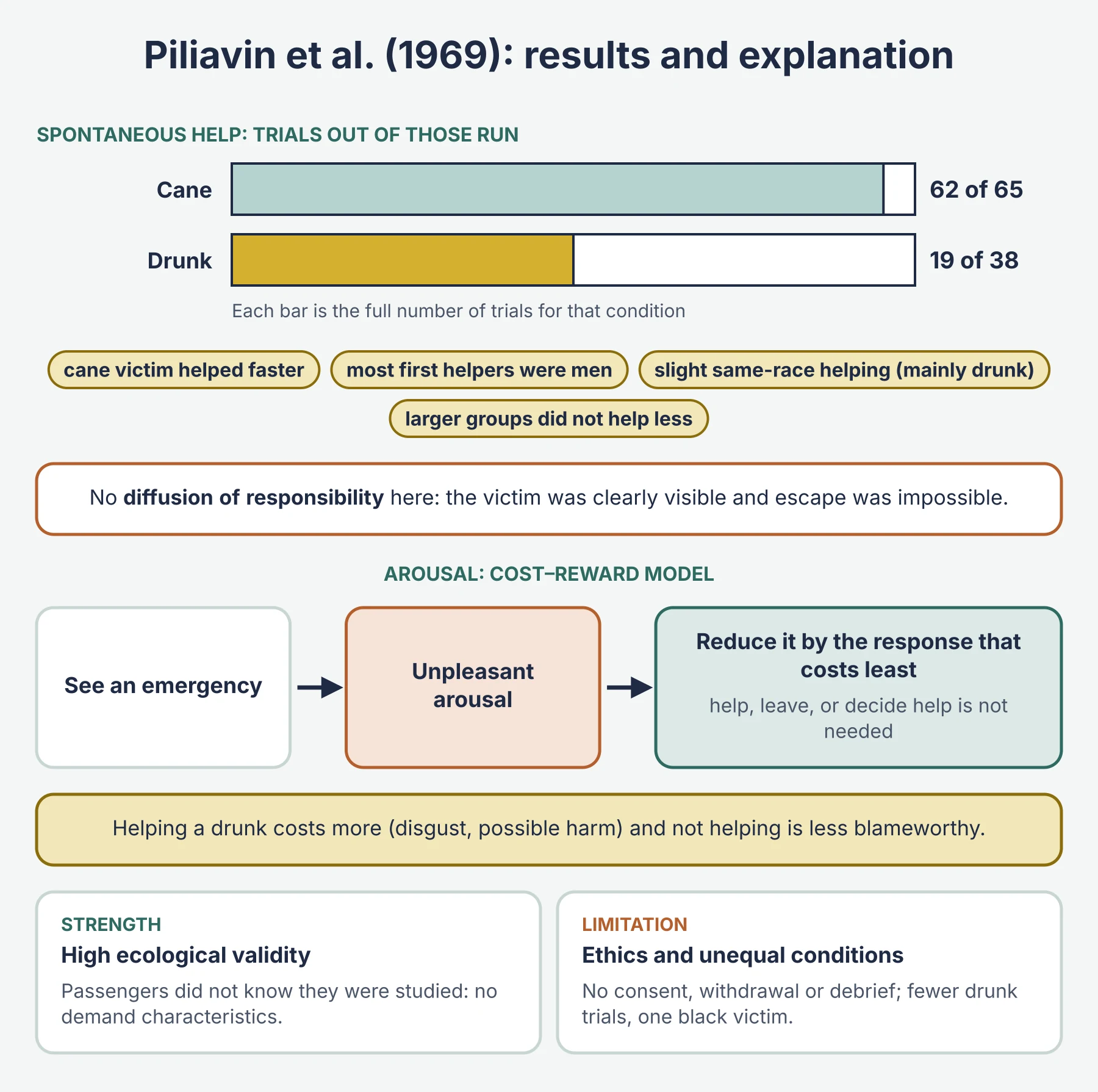
| Key result | All reached 300 V; 26 of 40 (65%) reached 450 V | Oxytocin: high empathy closer, low empathy further away | Cane victim helped on 62 of 65 trials; drunk on 19 of 38 |
| Conclusion | Situational pressure from authority is powerful | Hormone effect depends on the individual | No diffusion of responsibility; arousal: cost–reward model |
Milgram: numbers to know
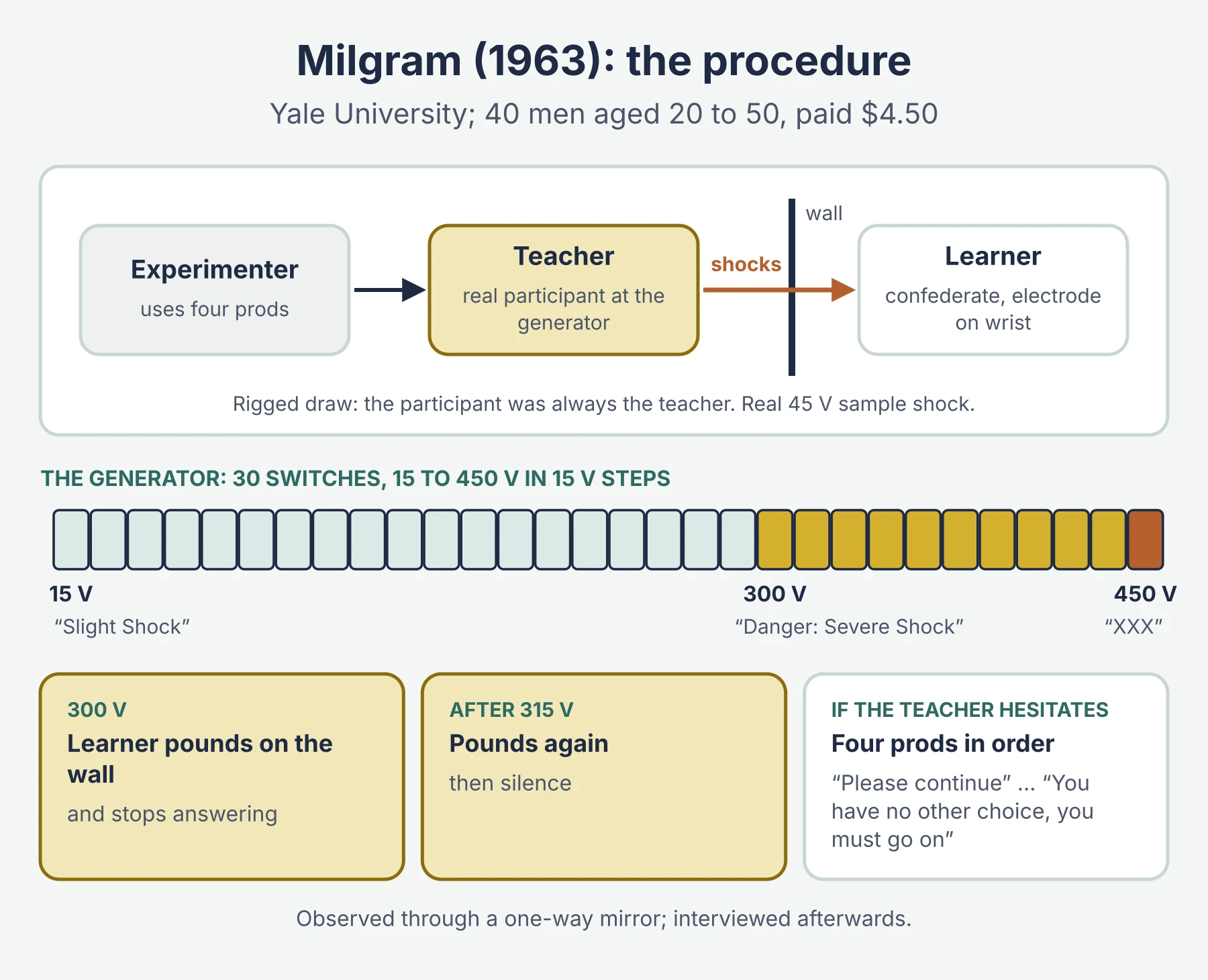
- 30 switches, 15 V to 450 V in 15 V steps.
- Sample shock to the teacher: 45 V.
- Learner pounds on the wall at 300 V and again after 315 V, then silence.
- 4 prods, used in order.
- Payment: $4.50.
- Prediction by students beforehand: about 1% would go to the end.
Piliavin: set-up to know
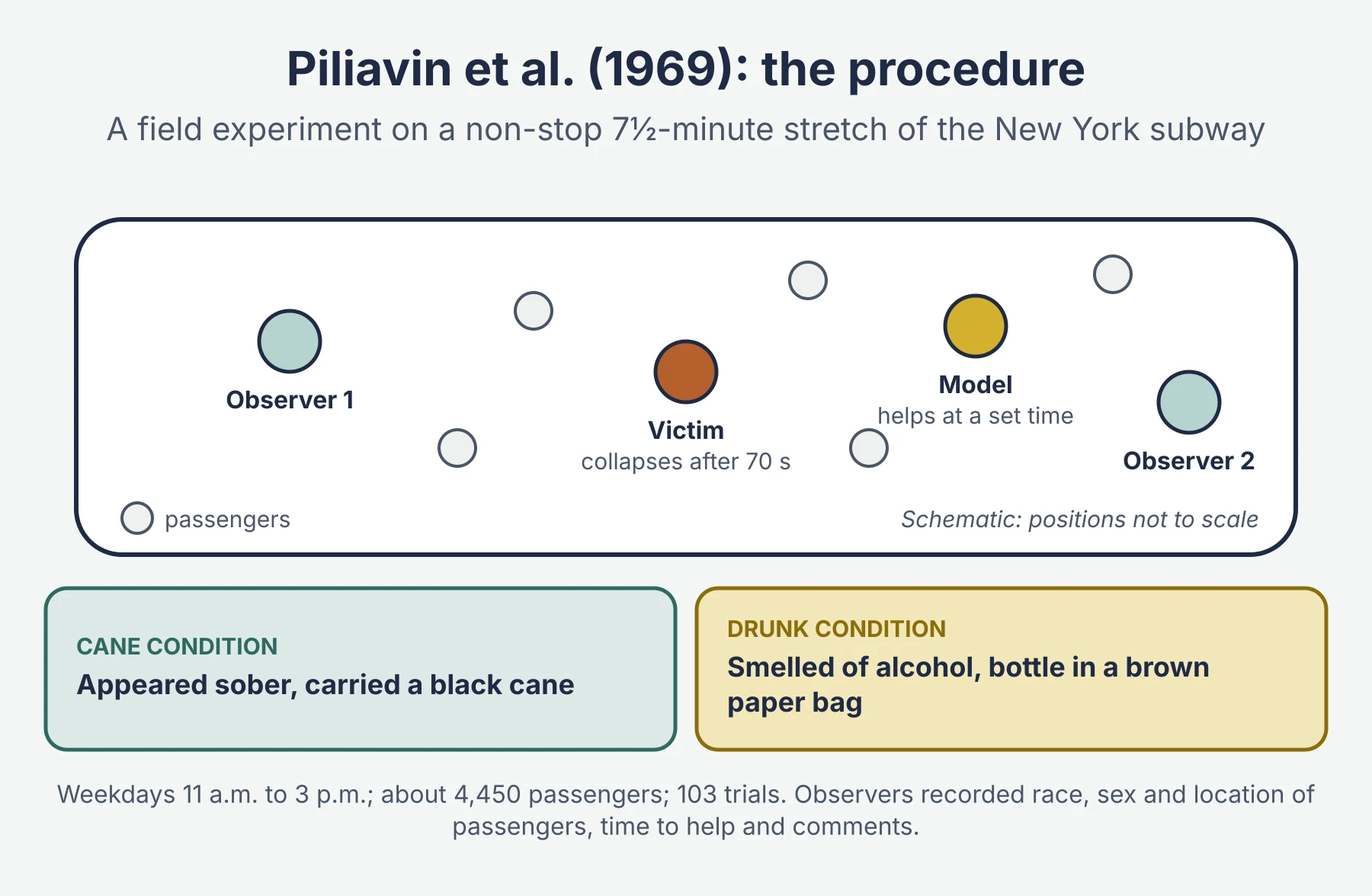
- Non-stop journey of about 7.5 minutes; weekdays, 11 a.m. to 3 p.m.
- Teams of four: victim, model (both male), two female observers.
- Collapse 70 seconds after leaving the station.
- Victim conditions: cane (sober) or drunk (smell of alcohol, bottle in a paper bag); white or black victim.
Key terms
| Term | Meaning |
|---|---|
| Obedience | Following a direct instruction from an authority figure |
| Dispositional hypothesis | Behaviour is caused by personality or other internal traits |
| Situational hypothesis | Behaviour is caused by features of the setting |
| Confederate | A person who plays a role in the study under the researcher’s instruction |
| Prod | A standard verbal instruction used to encourage continuation |
| Oxytocin | A hormone linked to social bonding |
| Interpersonal distance | The space a person prefers between themselves and others |
| Empathy | Ability to understand and share another person’s feelings |
| Double-blind | Neither participants nor the researcher testing them know the condition |
| Bystander apathy | Failure of onlookers to help in an emergency |
| Diffusion of responsibility | Each bystander feels less responsible when others are present |
| Arousal: cost–reward model | Bystanders reduce unpleasant arousal by the least costly response |
Evaluation hooks
- Milgram: standardised and replicable; quantitative and qualitative data; but deception, distress and pressure against withdrawal; sample of American men only.
- Perry et al.: placebo and double-blind control; replicated across two experiments; but imagined or pictured distance may differ from real behaviour.
- Piliavin et al.: real setting, unaware participants, no demand characteristics; but no consent or debrief, and unequal numbers of trials across conditions.
Issues and debates links
- Individual and situational explanations: Milgram (situational power of authority), Perry et al. (interaction of hormone and empathy), Piliavin et al. (costs of helping in the situation).
- Nature versus nurture: oxytocin and empathy in Perry et al. combine biological and learned factors.
- Application to everyday life: obedience in workplaces and the military; understanding personal space; encouraging bystanders to help.
Exam traps
- Saying Milgram’s learner screamed: in this version there was no voice feedback, only pounding.
- Saying 65% “stopped”: 65% went to 450 V.
- Calling Milgram’s study a field experiment: it was in a laboratory at Yale.
- Saying Perry et al. used only one experiment, or that oxytocin had the same effect on everyone.
- Writing “diffusion of responsibility was found” for Piliavin et al.
- Giving Piliavin et al.’s sample as 103: that was the number of trials.
Self-test
- State the two assumptions of the social approach.
- How were Milgram’s participants recruited?
- Why did teachers receive a sample shock?
- What happened at 300 V?
- How many participants went to 450 V?
- What did Perry et al. compare oxytocin with, and why?
- Name the measure of interpersonal distance used in Experiment 1.
- Describe the effect of oxytocin on participants low in empathy.
- Why did Piliavin et al. choose the express stretch of the line?
- How often did the cane victim receive spontaneous help?
- Did group size reduce helping in Piliavin et al.?
- Explain the cost of helping the drunk victim in terms of the cost–reward model.
Answers: (1) behaviour, cognitions and emotions are influenced by social contexts, environments and groups, and by the actual, implied or imagined presence of others. (2) newspaper advertisement and direct mail. (3) to make the generator and shocks believable. (4) the learner pounded on the wall and stopped answering. (5) 26 of 40. (6) a placebo nasal spray, to control for expectation effects. (7) a computerised Comfortable Interpersonal Distance Scale. (8) they preferred greater distance from others. (9) passengers could not leave for about 7.5 minutes, so their reactions could be observed throughout. (10) on 62 of 65 trials. (11) no. (12) helping risks disgust, embarrassment or harm, and not helping carries less blame because the victim seems responsible for his state.
Official syllabus
Cambridge International AS & A Level Psychology 9990 syllabus for 2024, 2025 and 2026, section 3.1.1, Social approach — cambridgeinternational.org.
More resources on this topic
Related resources
-
Practice questions
Approaches, Issues and Debates: Practice Questions
Practice questions with worked answers on the four approaches, 12 core studies and AS issues and debates for Cambridge AS & A Level Psychology 9990 Paper 1.
Psychology · Cambridge · AS Level
Try questions -
Study guides
A Level Psychology: Approaches, Issues and Debates (Cambridge 9990)
The Biological, Cognitive, Learning and Social Approaches – the full content of Paper 1 for Cambridge AS & A Level Psychology 9990.
Psychology · Cambridge · AS Level
Read guide -
Revision notes
A Level Psychology: Approaches, Issues and Debates — Revision Notes
Revision notes on the four approaches, the 12 core studies and the five AS Level issues and debates for Cambridge AS & A Level Psychology 9990 Paper 1.
Psychology · Cambridge · AS Level
Revise topic
Studying Psychology?
This page is free and stays free. Marlbridge is not offering Psychology classes at the moment, so there is no tuition to book for it. The free study resources stay open to everyone.
Get free revision emails (optional)
Occasional emails with practice questions, worked explanations and links to free resources for the qualification and subjects you choose. No spam, and you can unsubscribe from any email. The free tools on this site never need an email.