
Study Guides
Cambridge International AS & A Level Psychology (9990): Social approach
Cambridge 9990 Psychology social approach: its two assumptions and the Milgram, Perry et al. and Piliavin et al. core studies, with evaluation.
- Subject
- Psychology
- Level
- AS LEVEL
- Topic
- Paper 1 – Approaches, Issues and Debates
- Author
- Marlbridge Academic Team
- Updated
- Reviewed by
- Kanwal Aslam (what this means)
Aligned to Cambridge A Level Psychology (9990), 2024-2026. Official specification .
Syllabus page (what it covers and how it is assessed): Cambridge A Level Psychology.
Syllabus points this page covers
9990 (AS Level)
- Social approach
The social approach is the fourth group of core studies in Cambridge International AS & A Level Psychology (9990). It contains Milgram (1963) on obedience, Perry et al. (2015) on oxytocin, empathy and personal space, and Piliavin et al. (1969) on helping in an emergency on the New York subway. All three ask how the presence of other people, or a social role, changes what an individual does. This guide goes through each study in detail and builds the evaluation you need; the Paper 1 Approaches, Issues and Debates overview sets it among the other approaches.
Afterwards, use the social approach revision notes and the social approach practice questions.
The assumptions
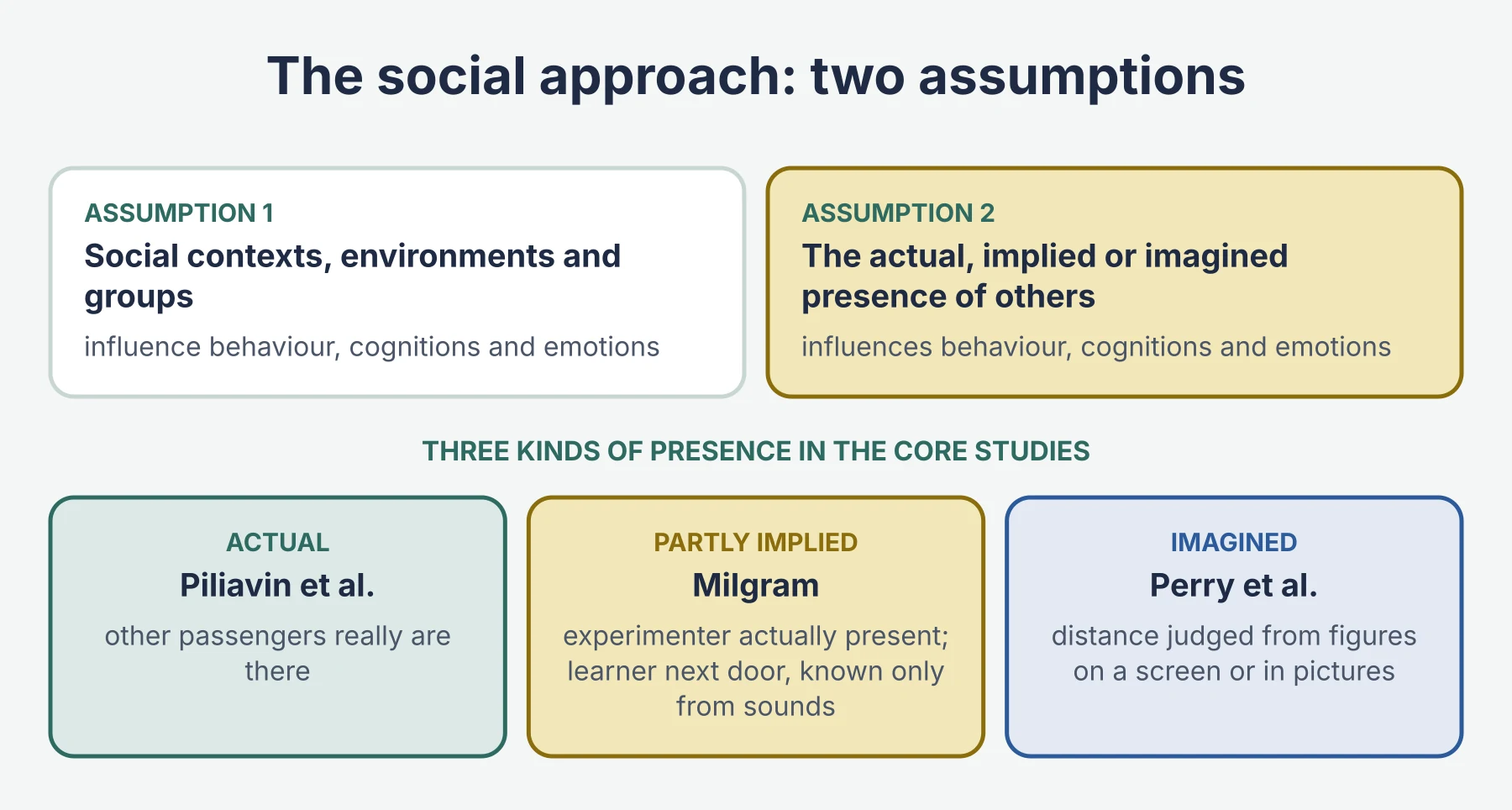
- Behaviour, cognitions and emotions are influenced by social contexts, social environments and groups.
- Behaviour, cognitions and emotions are influenced by the actual, implied or imagined presence of others.
The three kinds of presence in the second assumption map onto the studies. In Piliavin et al. the presence of other passengers is actual. In Milgram the experimenter’s authority is actual, but the “learner” in the next room is a presence known only from sounds, which makes it partly implied. In Perry et al., participants judged distances from figures on a screen or in pictures, so the other person is imagined.
Milgram (1963): obedience
Aim. To investigate how far people would go in obeying an instruction to harm another person, and the conflict between obedience to authority and personal conscience. The syllabus asks you to consider dispositional and situational hypotheses: are some people simply obedient types, or does the situation produce obedience?
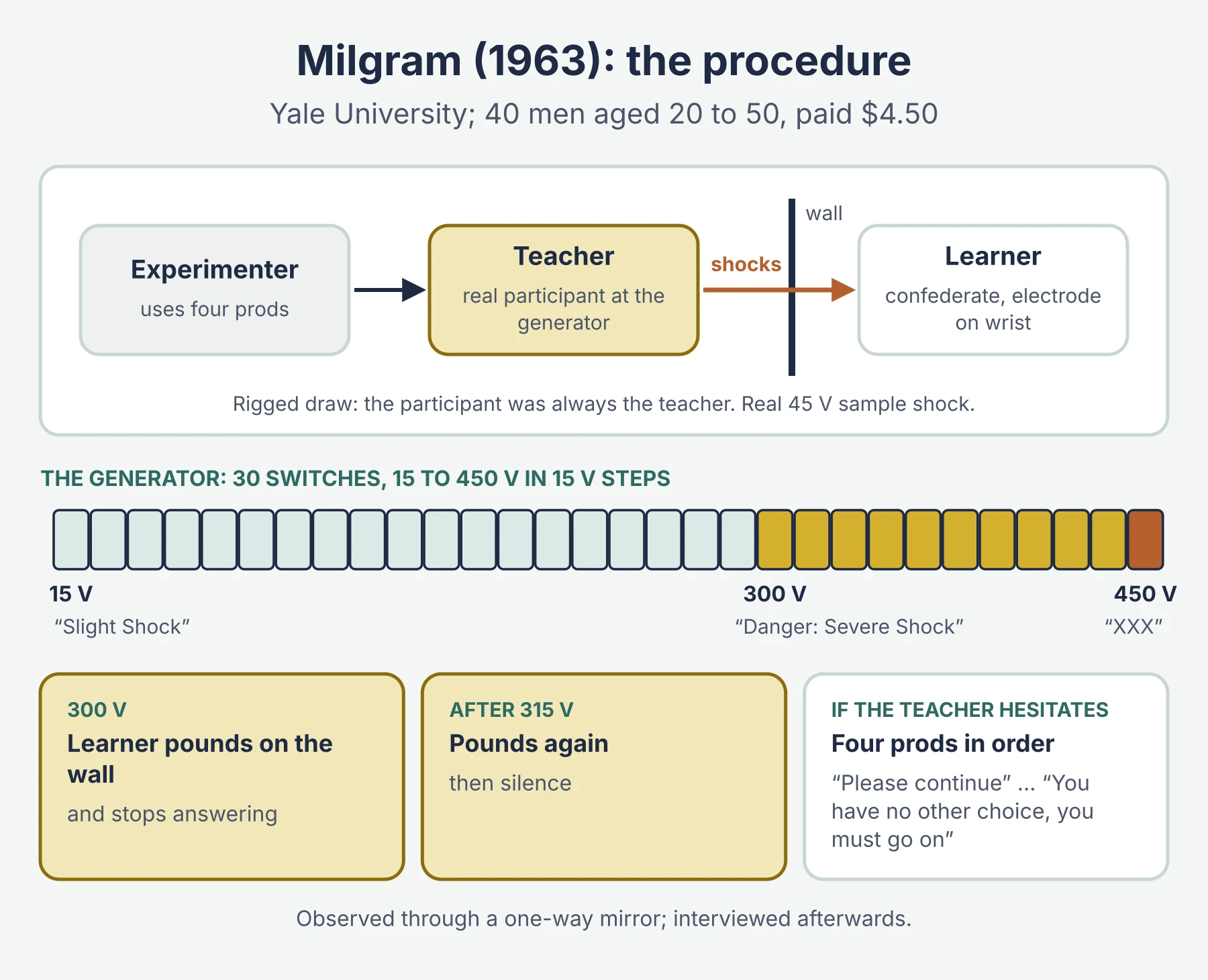
Sample. Forty men aged 20 to 50 from the New Haven area, recruited by newspaper advertisement and direct mail, in a range of occupations. They were paid $4.50 for attending, and told the money was theirs whatever happened.
Procedure. At Yale University, each participant met the “learner”, a confederate, and drew lots that were rigged so the participant was always the “teacher”. The learner was strapped into a chair in the next room with an electrode on his wrist. The teacher received a real sample shock of 45 volts to make the generator believable. The generator had 30 switches from 15 to 450 volts in 15-volt steps, labelled from “Slight Shock” to “Danger: Severe Shock” and finally “XXX”. The teacher read word pairs and gave a shock, one step higher, for each wrong answer. At 300 volts the learner pounded on the wall and stopped answering; after 315 volts he pounded again and then went silent. When teachers hesitated, the experimenter used four standard prods in order, from “Please continue” to “You have no other choice, you must go on”. Observers recorded behaviour through a one-way mirror, and participants were interviewed afterwards.
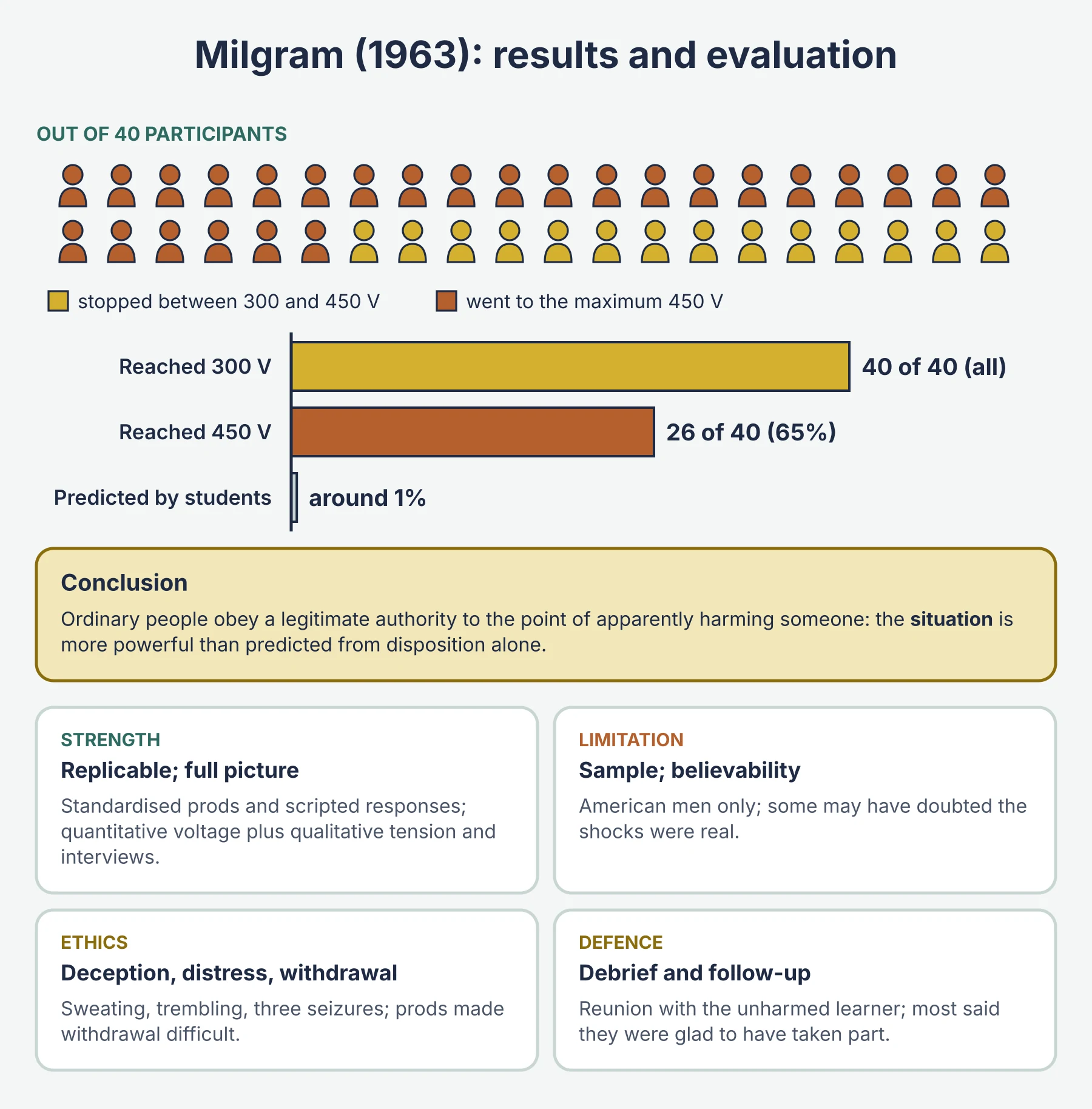
Results. All 40 participants continued to at least 300 volts; 26 (65%) went to the maximum 450 volts. Many showed extreme tension: sweating, trembling, groaning and nervous laughter, and three had uncontrollable seizures. Before the study, a group of psychology students had predicted that very few people, around 1%, would go to the end.
Conclusions. Ordinary people will obey a legitimate authority figure to the point of apparently harming someone, so the situation is more powerful than predicted from disposition alone. Milgram suggested features that made obedience likely: the prestige of Yale, the participant’s voluntary agreement, payment, and the novelty of the situation.
Evaluation.
- Strengths: standardised prods, scripted learner responses and a fixed generator make the study highly replicable; quantitative data (maximum voltage) plus qualitative data (signs of tension, interview comments) give a full picture.
- Weaknesses: a single sample of American men limits generalisation; some participants may have doubted that the shocks were real.
- Ethics: deception about the shocks and the purpose; severe distress; the prods made withdrawal difficult. Milgram’s defence was the debrief, a reunion with the unharmed learner, and a follow-up questionnaire in which most participants said they were glad to have taken part.
Perry et al. (2015): personal space
Aim. To test how oxytocin, a social hormone, affects interpersonal distance, and whether its effect depends on how empathic a person is.
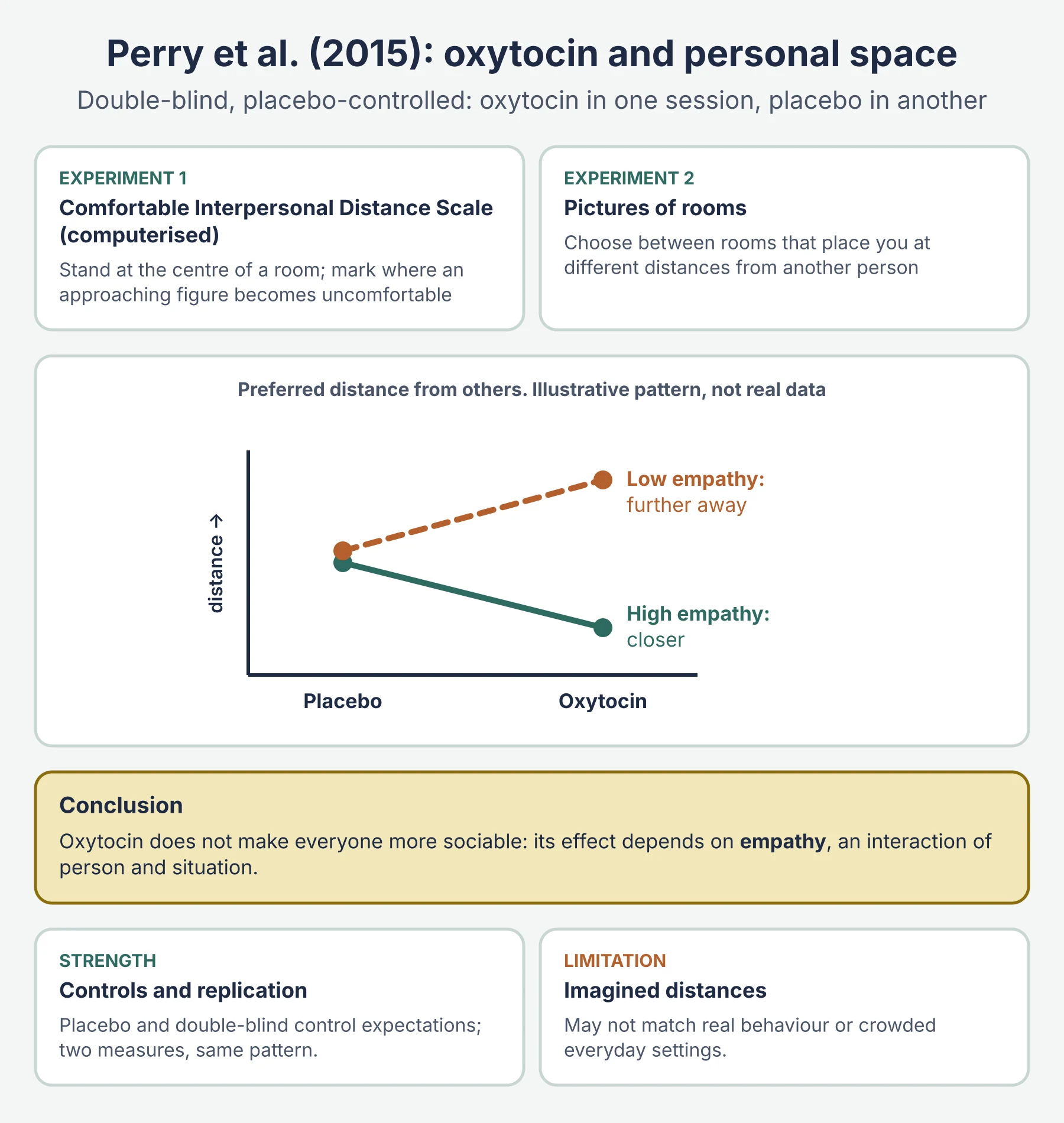
Design. Two experiments with a double-blind, placebo-controlled design. Participants received an oxytocin nasal spray in one session and a placebo in another, and completed questionnaires measuring empathy, so they could be divided into higher and lower empathy groups.
Procedure. Experiment 1 used a computerised version of the Comfortable Interpersonal Distance Scale: participants imagined standing at the centre of a room and indicated the point at which an approaching figure made them feel uncomfortable. Experiment 2 asked participants to choose between pictures of different rooms that placed them at different distances from another person.
Results. Under oxytocin, participants high in empathy preferred to be closer to others than under placebo, whereas those low in empathy preferred greater distance.
Conclusions. Oxytocin does not simply make everyone more sociable. Its effect depends on an individual difference, empathy, so social behaviour comes from an interaction of the person and the situation.
Evaluation. The placebo and double-blind procedure control expectation effects, and two experiments with different measures showing the same pattern add confidence. But imagined or pictured distances may not match real behaviour, and the effect on a laboratory scale may not hold in crowded everyday settings.
Piliavin et al. (1969): subway Samaritans
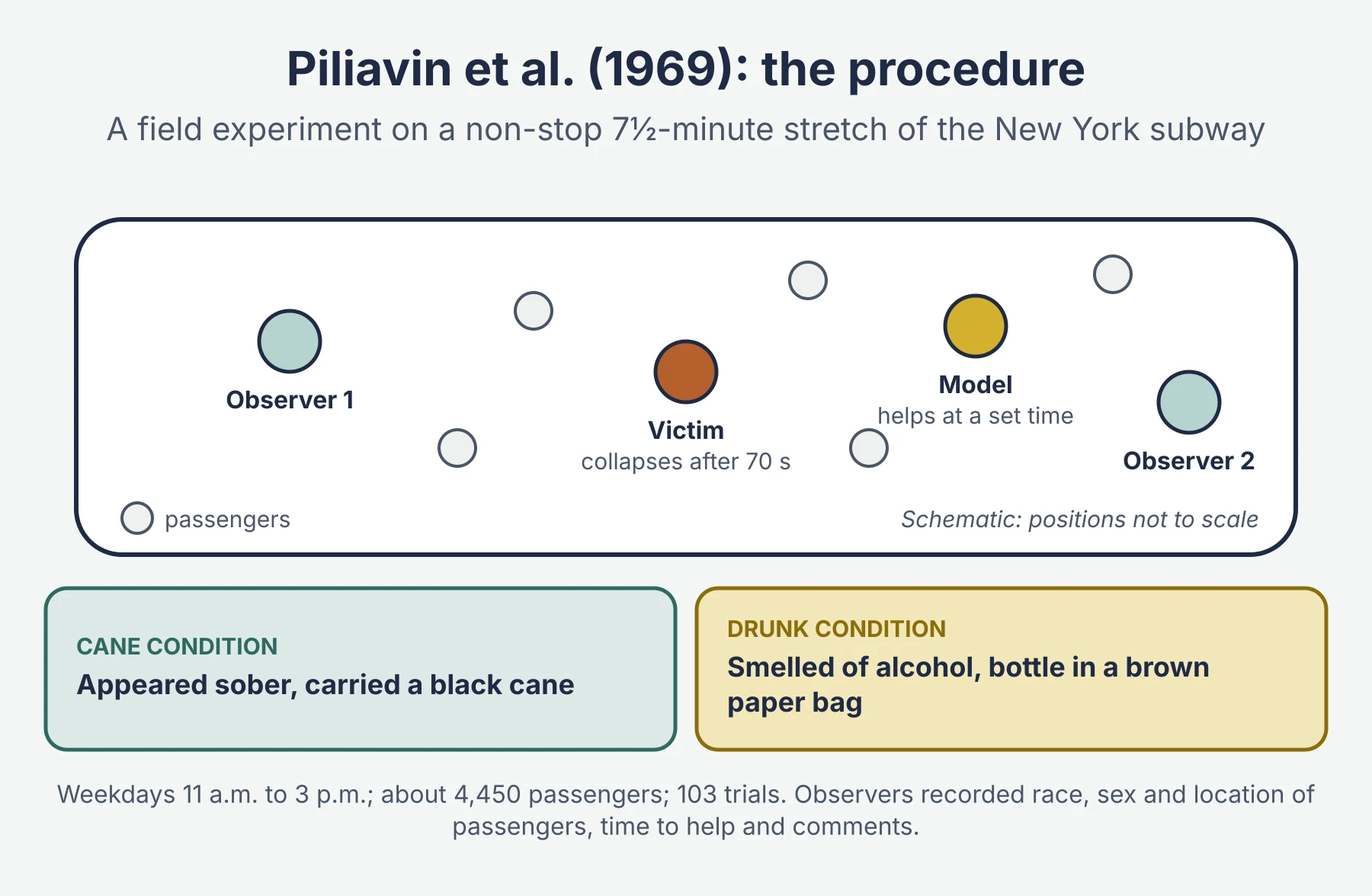
Aim. To investigate helping in a real emergency and the factors that affect it, including the type of victim, the victim’s race, the presence of a model who helps, and group size, and to test diffusion of responsibility.
Procedure. A field experiment on a non-stop seven-and-a-half-minute stretch of the New York subway, on weekdays between 11 a.m. and 3 p.m., with an estimated 4,450 passengers over 103 trials. Teams of four took part: a male victim, a male model and two female observers. Seventy seconds after the train left a station, the victim staggered and collapsed. In the cane condition he appeared sober and carried a black cane; in the drunk condition he smelled of alcohol and carried a bottle in a brown paper bag. If no one helped, the model stepped in at a set time. Observers recorded the race, sex and location of passengers, the time taken to help, and any comments.
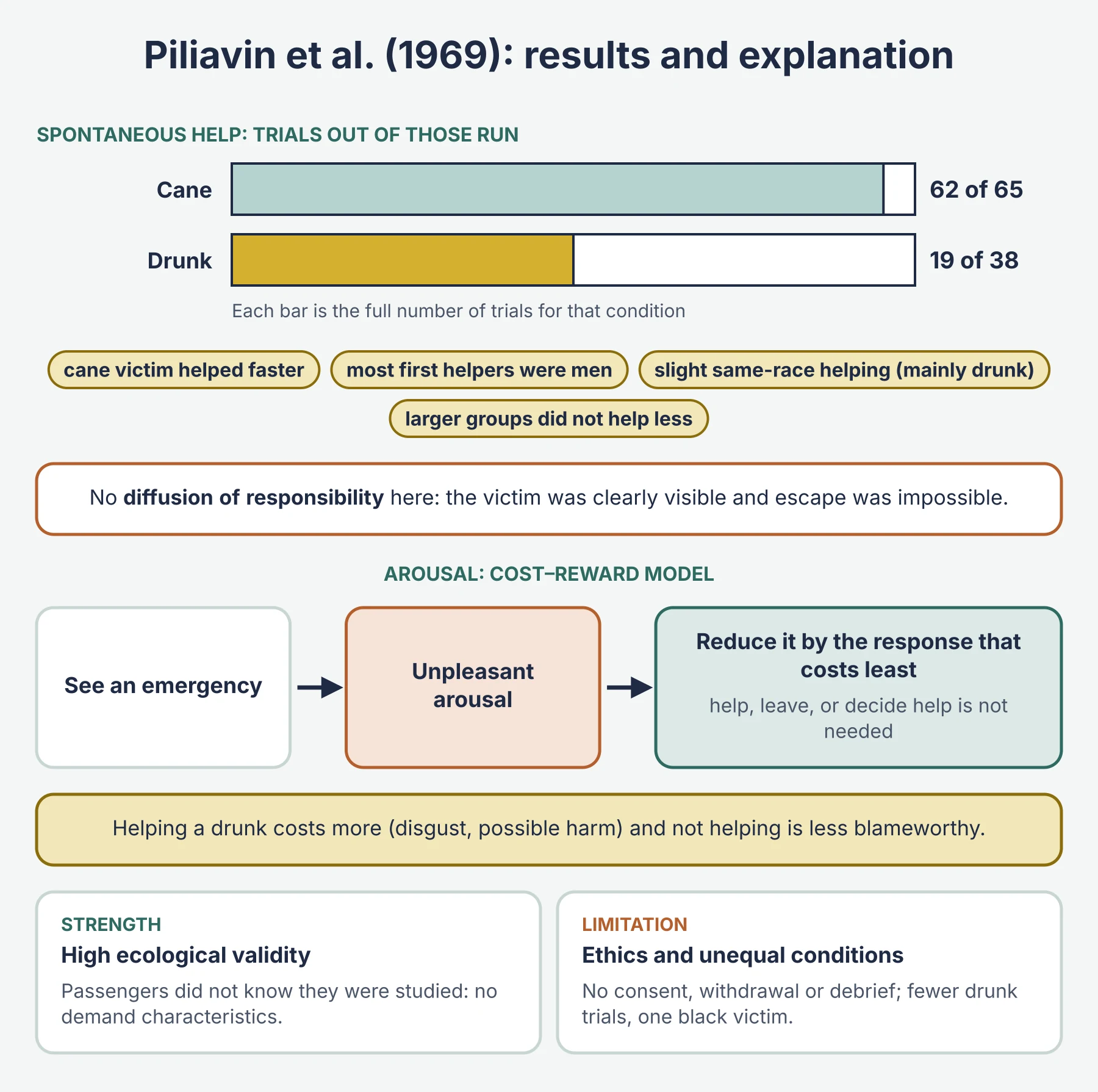
Results. The cane victim received spontaneous help on 62 of 65 trials; the drunk victim on 19 of 38. Help was given faster to the cane victim, most first helpers were men, and there was a slight tendency for same-race helping, mainly in the drunk condition. Larger groups did not help less.
Conclusions. Diffusion of responsibility did not appear in this setting, probably because the victim was clearly visible and escape was impossible. The researchers proposed the arousal: cost–reward model: seeing an emergency causes unpleasant arousal, which the bystander reduces by the response that costs least, such as helping, leaving or deciding help is not needed. Helping a drunk is more costly (disgust, possible harm) and not helping is less blameworthy.
Evaluation. High ecological validity and no demand characteristics, because passengers did not know they were being studied. But there was no consent, no right to withdraw and no debrief, and conditions were not perfectly equal (fewer drunk trials and only one black victim).
Annotated answer
Question: Explain why Milgram’s study is described as having a dependent variable but no independent variable. [2]
“Milgram measured obedience as the maximum voltage each participant gave (1), but in the main study every participant experienced the same conditions, so nothing was manipulated to compare conditions (1).”
Common mistakes
- Writing that Milgram’s teachers heard the learner’s voice protesting: in this version the learner only pounded on the wall.
- Saying Perry et al. found oxytocin makes everyone want to be closer.
- Claiming Piliavin et al. confirmed diffusion of responsibility: they did not.
- Forgetting that Piliavin et al. had four researchers per trial with different roles.
Exam technique
The social approach gives the clearest material for individual and situational explanations: the situation in Milgram, the person-by-situation interaction in Perry et al., and situational costs in Piliavin et al. For compare, contrast the settings: a laboratory (Milgram, Perry et al.) against a field experiment (Piliavin et al.). For evaluate, always pair an ethical point with the methodological reason for the procedure.
Official syllabus
Cambridge International AS & A Level Psychology 9990 syllabus for 2024, 2025 and 2026, section 3.1.1 The core studies, Social approach — cambridgeinternational.org.
More resources on this topic
Related resources
-
Practice questions
Cambridge International AS & A Level Psychology (9990): Social approach – Practice Questions
Original Paper 1 style questions with mark-scheme answers on the 9990 social approach: Milgram, Perry et al. and Piliavin et al., plus issues and debates.
Psychology · Cambridge · AS Level
Try questions -
Revision notes
Cambridge International AS & A Level Psychology (9990): Social approach – Revision Notes
Revision notes for the 9990 social approach: Milgram, Perry et al. and Piliavin et al. in a grid, key figures and terms, exam traps and a 12-question self-test.
Psychology · Cambridge · AS Level
Revise topic -
Practice questions
Approaches, Issues and Debates: Practice Questions
Practice questions with worked answers on the four approaches, 12 core studies and AS issues and debates for Cambridge AS & A Level Psychology 9990 Paper 1.
Psychology · Cambridge · AS Level
Try questions
Studying Psychology?
This page is free and stays free. Marlbridge is not offering Psychology classes at the moment, so there is no tuition to book for it. The free study resources stay open to everyone.
Get free revision emails (optional)
Occasional emails with practice questions, worked explanations and links to free resources for the qualification and subjects you choose. No spam, and you can unsubscribe from any email. The free tools on this site never need an email.