
Revision Notes
Cambridge International AS & A Level Psychology (9990): Learning approach – Revision Notes
Revision notes for the 9990 learning approach: conditioning and social learning terms, the three core studies in a grid, exam traps and a 12-question self-test.
- Subject
- Psychology
- Level
- AS LEVEL
- Topic
- Paper 1 – Approaches, Issues and Debates
- Author
- Marlbridge Academic Team
- Updated
- Reviewed by
- Kanwal Aslam (what this means)
Aligned to Cambridge A Level Psychology (9990), 2024-2026. Official specification .
Syllabus page (what it covers and how it is assessed): Cambridge A Level Psychology.
Syllabus points this page covers
9990 (AS Level)
- Learning approach
These notes condense the learning approach of Cambridge International AS & A Level Psychology (9990), syllabus for 2024 to 2026. The approach is examined through three core studies, each built on a different learning process. Learn the terms precisely, because marks often depend on applying one exact term to one exact step of a study. Full explanations are in the learning approach study guide; test yourself with the learning approach practice questions.
Assumptions
- We begin life as a blank slate; experience and the environment shape behaviour, and changes are directly observable.
- We learn through operant conditioning, classical conditioning and social learning, understood with the stimulus–response model.
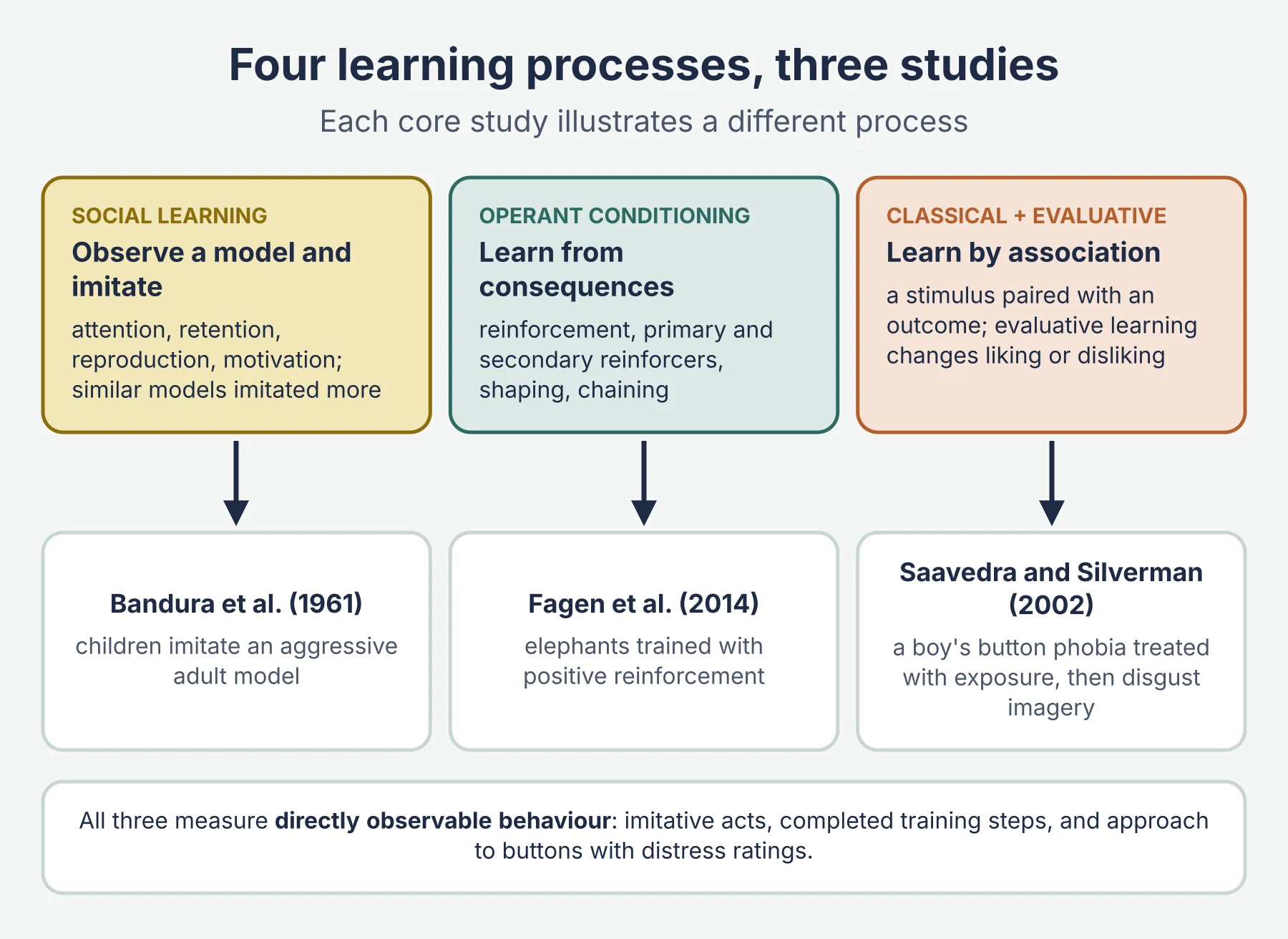
Which process goes with which study?
| Study | Main process | Other processes |
|---|---|---|
| Bandura et al. (1961) | Social learning (observation and imitation) | Same-sex model identification |
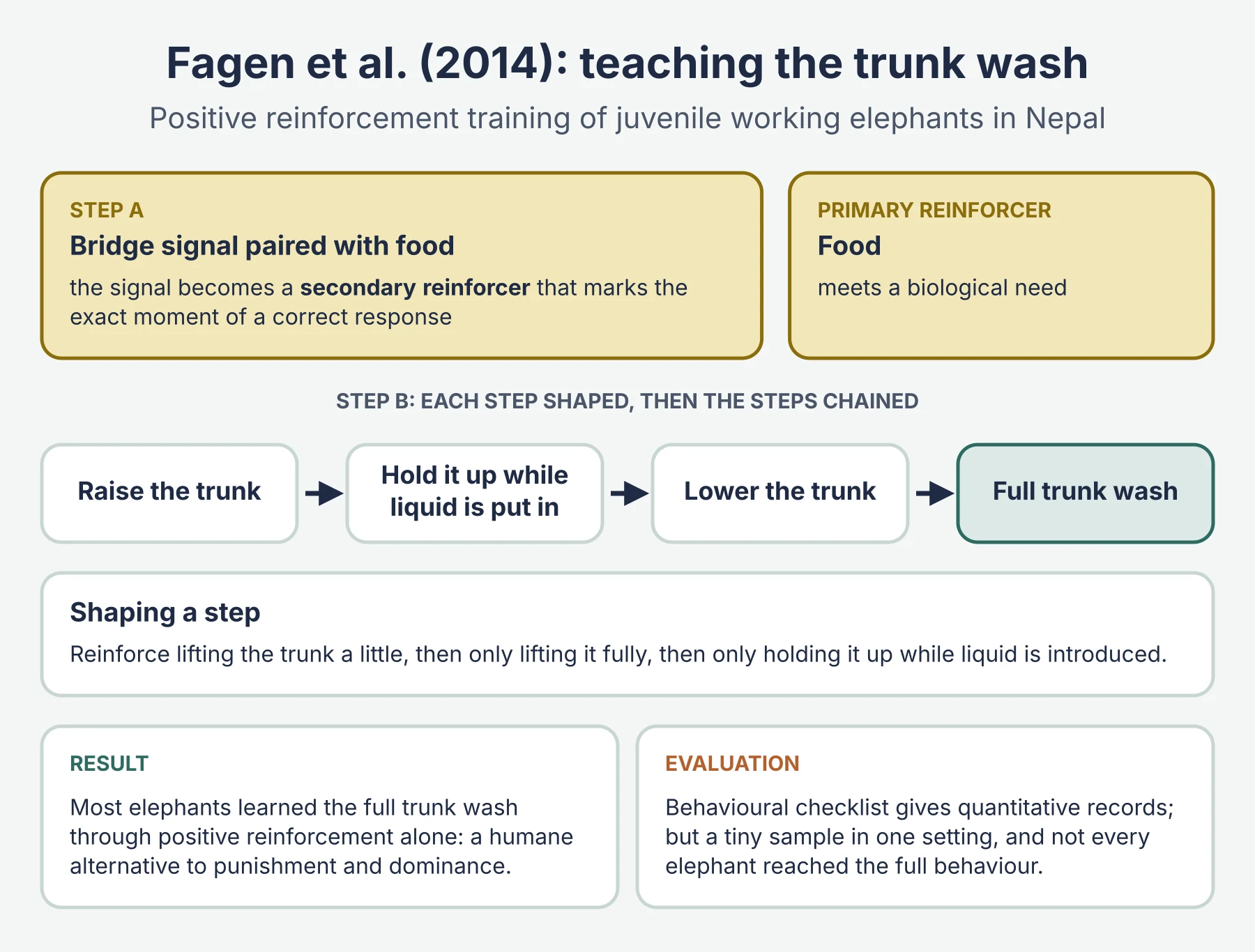
| Fagen et al. (2014) | Operant conditioning: positive reinforcement | Primary and secondary reinforcers; shaping; behavioural chaining |
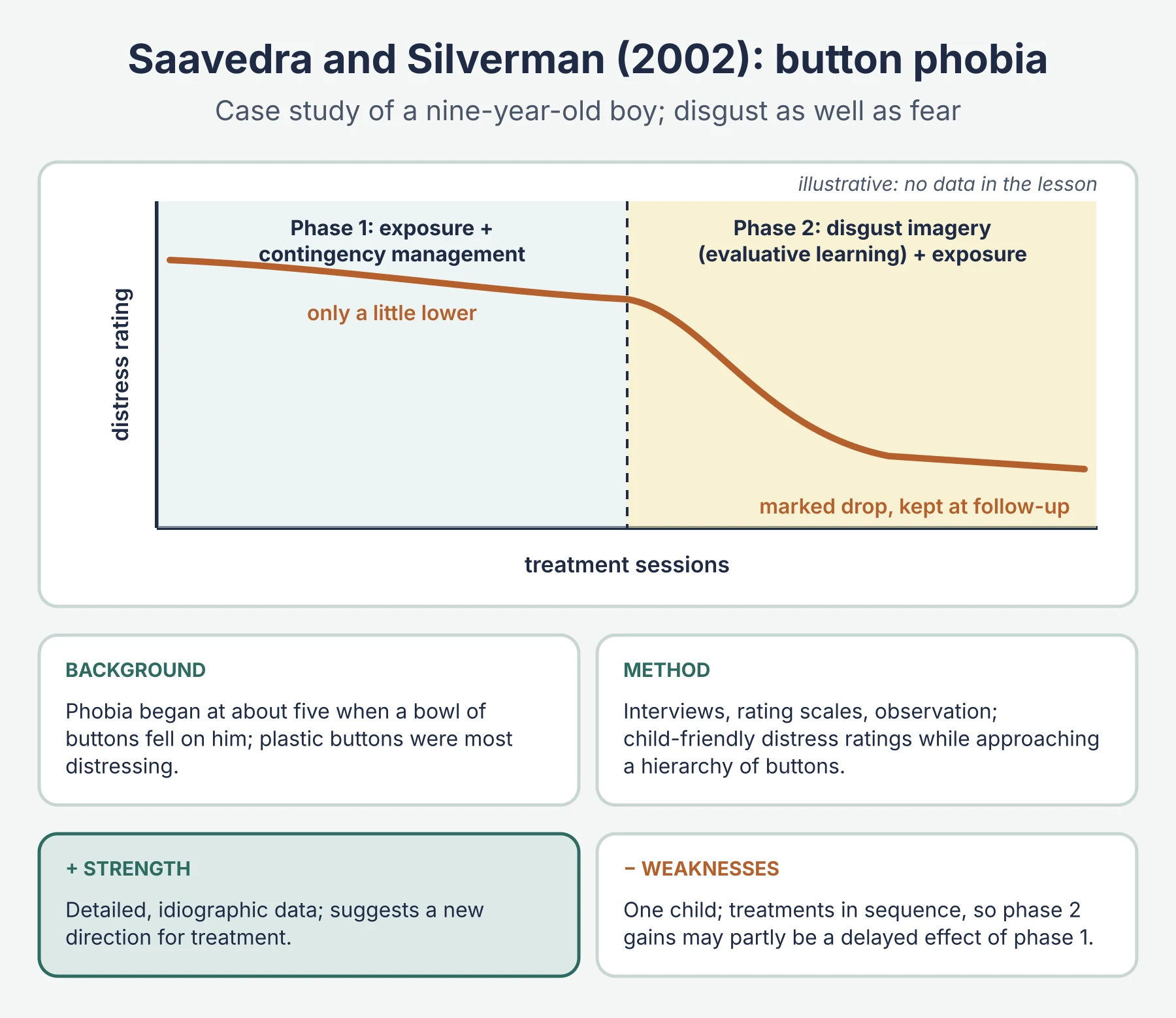
| Saavedra and Silverman (2002) | Classical conditioning and evaluative learning | Operant conditioning through contingency management |
Core studies grid
| Element | Bandura et al. | Fagen et al. | Saavedra and Silverman |
|---|---|---|---|
| Method | Laboratory experiment; observation through a one-way mirror | Observation using a behavioural checklist | Case study; interviews, scales, observations |
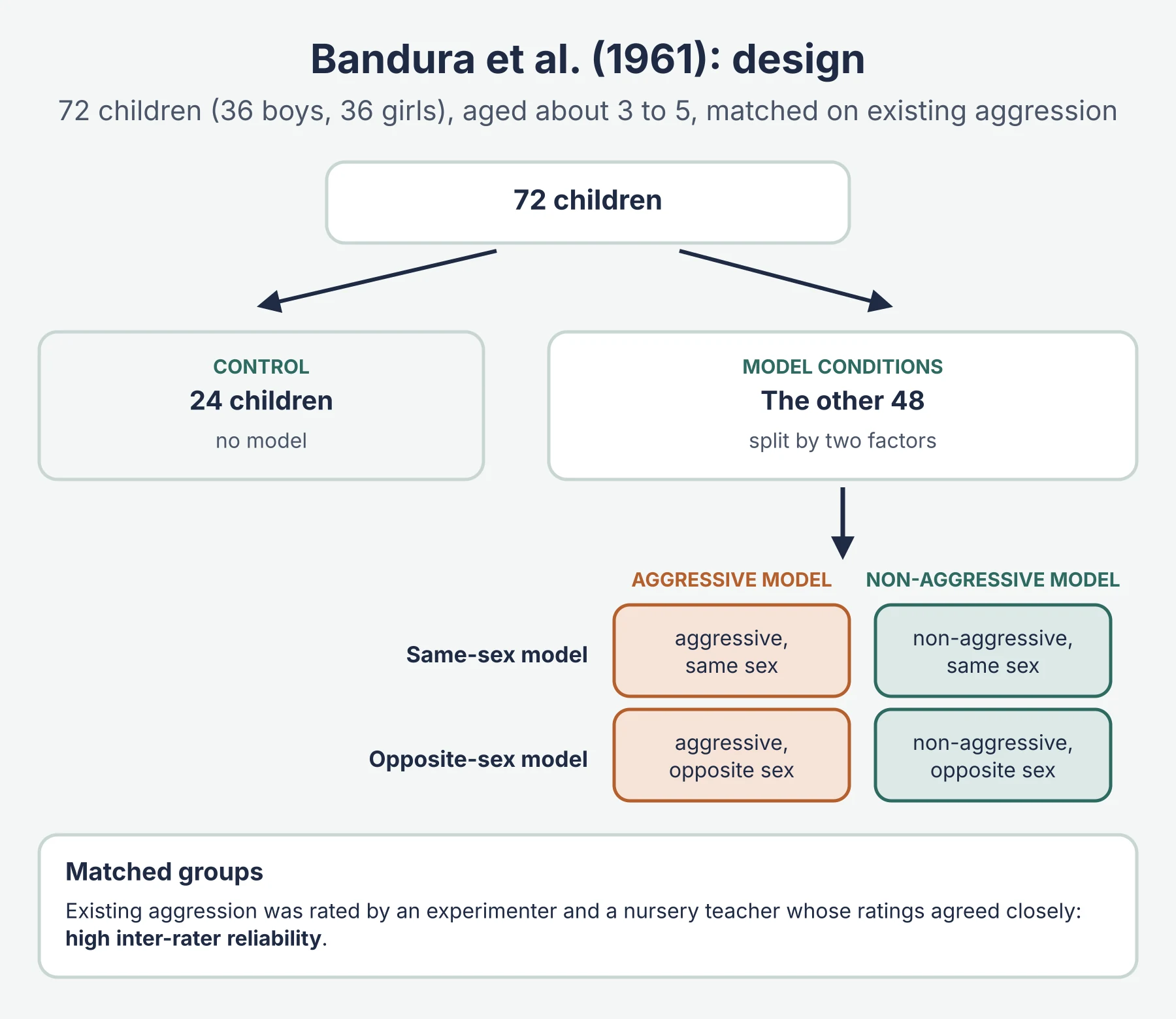
| Sample | 72 nursery children (36 boys, 36 girls) | Juvenile working elephants in Nepal | One nine-year-old boy |
| Key manipulation or treatment | Aggressive, non-aggressive or no model; same- or opposite-sex model | Positive reinforcement training of trunk-wash steps | Exposure with reinforcement, then disgust-focused imagery |
| Key result | Aggressive-model children imitated more aggression; boys more physical aggression | Most elephants learned the full trunk wash | Exposure alone gave a small reduction; adding disgust imagery gave a large, lasting reduction |
| Conclusion | Aggression can be learned by observation alone | Reward-based training is a humane alternative | Disgust needs targeting in phobia treatment |
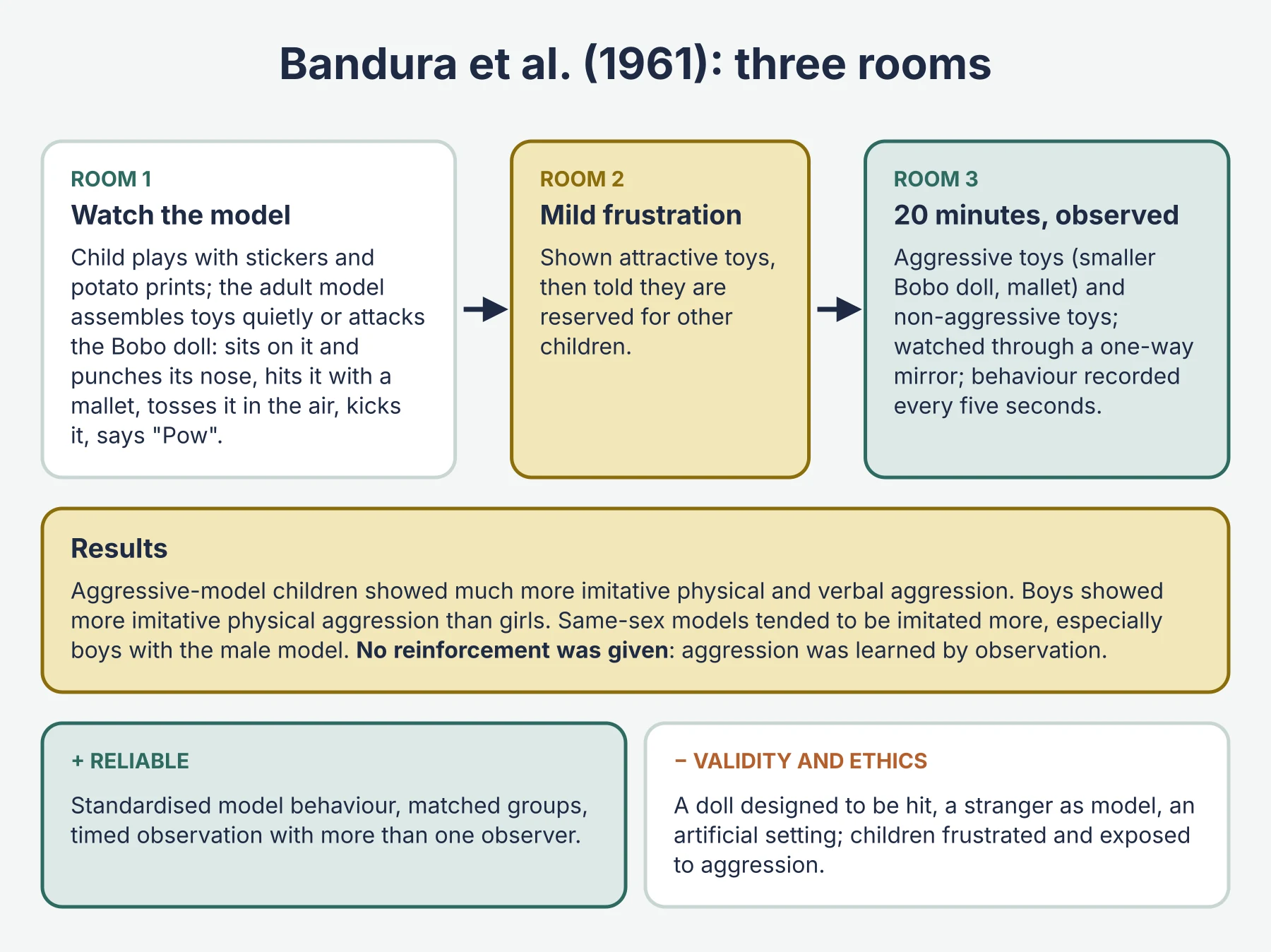
Bandura’s three phases
- Modelling (10 minutes): child plays at a table; adult model behaves aggressively or not towards a large Bobo doll.
- Mild aggression arousal: child is shown attractive toys, then told they are for other children.
- Test (20 minutes): room with aggressive and non-aggressive toys; observed every 5 seconds.
Key terms
| Term | Meaning |
|---|---|
| Blank slate | The idea that no behaviour is inborn; all is learned |
| Unconditioned stimulus | Produces a response without learning |
| Conditioned stimulus | A previously neutral stimulus that now produces a learned response |
| Extinction | Loss of a learned response when the association or reinforcement stops |
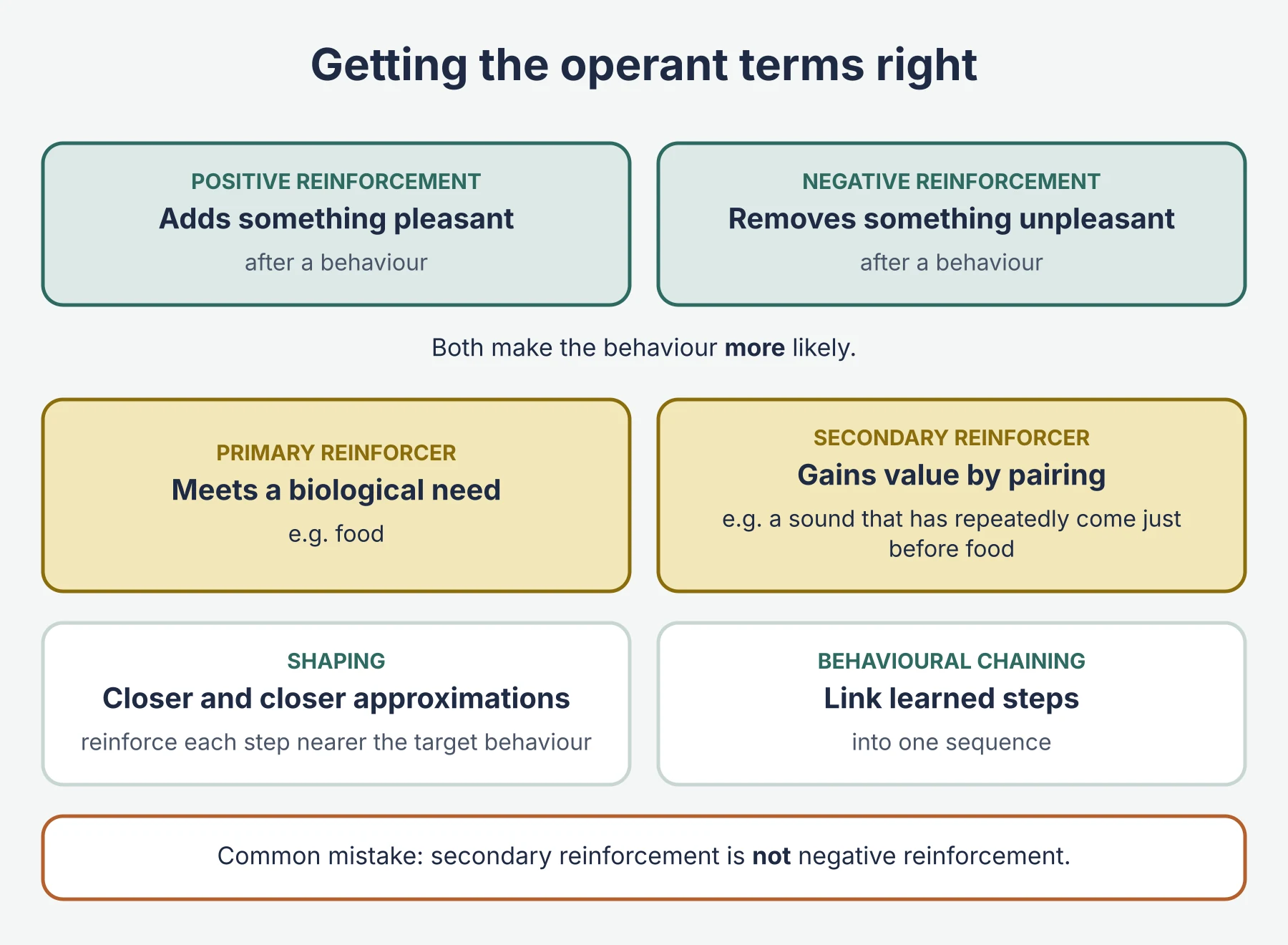
| Positive reinforcement | Adding something pleasant after a behaviour, making it more likely |
| Negative reinforcement | Removing something unpleasant after a behaviour, making it more likely |
| Primary reinforcer | Satisfies a biological need, e.g. food |
| Secondary reinforcer | Gains value through pairing with a primary reinforcer, e.g. a bridge signal |
| Shaping | Reinforcing successive approximations to a target behaviour |
| Behavioural chaining | Linking learned steps into a sequence |
| Social learning | Learning by observing and imitating a model |
| Evaluative learning | Changing how much a stimulus is liked by pairing it with a positive or negative stimulus |
| Contingency management | Giving rewards that depend on a target behaviour |
Evaluation hooks
- Bandura et al.: matching, standardised modelling and timed observation (reliable); but a Bobo doll invites hitting, the model was a stranger, and children were frustrated and taught aggression.
- Fagen et al.: objective checklist data; humane method; but very small sample in one setting and not every animal completed the chain.
- Saavedra and Silverman: rich detail; treatment tailored to the child; but one participant, and the order of treatments is a confounding variable.
Issues and debates links
- Nature versus nurture: all three emphasise nurture, though boys’ greater physical aggression in Bandura et al. could partly reflect nature.
- Use of children: Bandura et al. (frustration, learning aggression); Saavedra and Silverman (distress during exposure, balanced by therapeutic benefit).
- Use of animals: Fagen et al. replaced aversive methods with reward.
- Application to everyday life: media violence and role models; elephant welfare and veterinary care; phobia treatment.
- Individual and situational explanations: the model’s behaviour is situational; the child’s sex is individual.
Exam traps
- “Negative reinforcement is punishment”: it is removal of something unpleasant and increases behaviour.
- Calling the bridge signal a primary reinforcer: it is secondary.
- Leaving out the frustration phase or the reason for it.
- Saying Bandura’s children were rewarded for copying.
- Treating Saavedra and Silverman as an experiment: it is a case study.
- Writing that disgust responds to exposure like fear does: the study suggests it does not.
Self-test
- State the two assumptions of the learning approach.
- How many children took part in Bandura et al., and how many were in the control group?
- Why were Bandura’s children matched on aggression?
- Why were the children mildly frustrated before the test phase?
- How often was each child’s behaviour recorded in the test phase?
- What was the aim of the trunk wash in Fagen et al.?
- Give an example of a primary reinforcer and a secondary reinforcer in Fagen et al.
- Define behavioural chaining.
- What was the origin of the boy’s button phobia?
- What emotion, besides fear, was central to the boy’s phobia?
- What was the first treatment phase and what was its effect?
- Name the learning process targeted in the second treatment phase.
Answers: (1) blank slate shaped by observable experience; learning through operant conditioning, classical conditioning and social learning (stimulus–response). (2) 72; 24 in the control group. (3) so differences between groups could not be due to existing differences in aggression. (4) to make aggression more likely, so imitation could show. (5) every five seconds over 20 minutes. (6) to collect a sample for tuberculosis testing. (7) food (primary); a bridge signal paired with food (secondary). (8) linking several learned behaviours into a sequence. (9) at about age five, buttons fell on him at school. (10) disgust. (11) exposure with positive reinforcement for approach; distress fell only a little. (12) evaluative learning.
Official syllabus
Cambridge International AS & A Level Psychology 9990 syllabus for 2024, 2025 and 2026, section 3.1.1, Learning approach — cambridgeinternational.org.
More resources on this topic
Related resources
-
Study guides
Cambridge International AS & A Level Psychology (9990): Social approach
Cambridge 9990 Psychology social approach: its two assumptions and the Milgram, Perry et al. and Piliavin et al. core studies, with evaluation.
Psychology · Cambridge · AS Level
Read guide -
Practice questions
Cambridge International AS & A Level Psychology (9990): Social approach – Practice Questions
Original Paper 1 style questions with mark-scheme answers on the 9990 social approach: Milgram, Perry et al. and Piliavin et al., plus issues and debates.
Psychology · Cambridge · AS Level
Try questions -
Revision notes
Cambridge International AS & A Level Psychology (9990): Social approach – Revision Notes
Revision notes for the 9990 social approach: Milgram, Perry et al. and Piliavin et al. in a grid, key figures and terms, exam traps and a 12-question self-test.
Psychology · Cambridge · AS Level
Revise topic
Studying Psychology?
This page is free and stays free. Marlbridge is not offering Psychology classes at the moment, so there is no tuition to book for it. The free study resources stay open to everyone.
Get free revision emails (optional)
Occasional emails with practice questions, worked explanations and links to free resources for the qualification and subjects you choose. No spam, and you can unsubscribe from any email. The free tools on this site never need an email.