
Study Guides
Cambridge International AS & A Level Psychology (9990): Learning approach
Cambridge 9990 Psychology learning approach: blank-slate assumptions, conditioning and social learning, and the Bandura, Fagen and Saavedra core studies.
- Subject
- Psychology
- Level
- AS LEVEL
- Topic
- Paper 1 – Approaches, Issues and Debates
- Author
- Marlbridge Academic Team
- Updated
- Reviewed by
- Kanwal Aslam (what this means)
Aligned to Cambridge A Level Psychology (9990), 2024-2026. Official specification .
Syllabus page (what it covers and how it is assessed): Cambridge A Level Psychology.
Syllabus points this page covers
9990 (AS Level)
- Learning approach
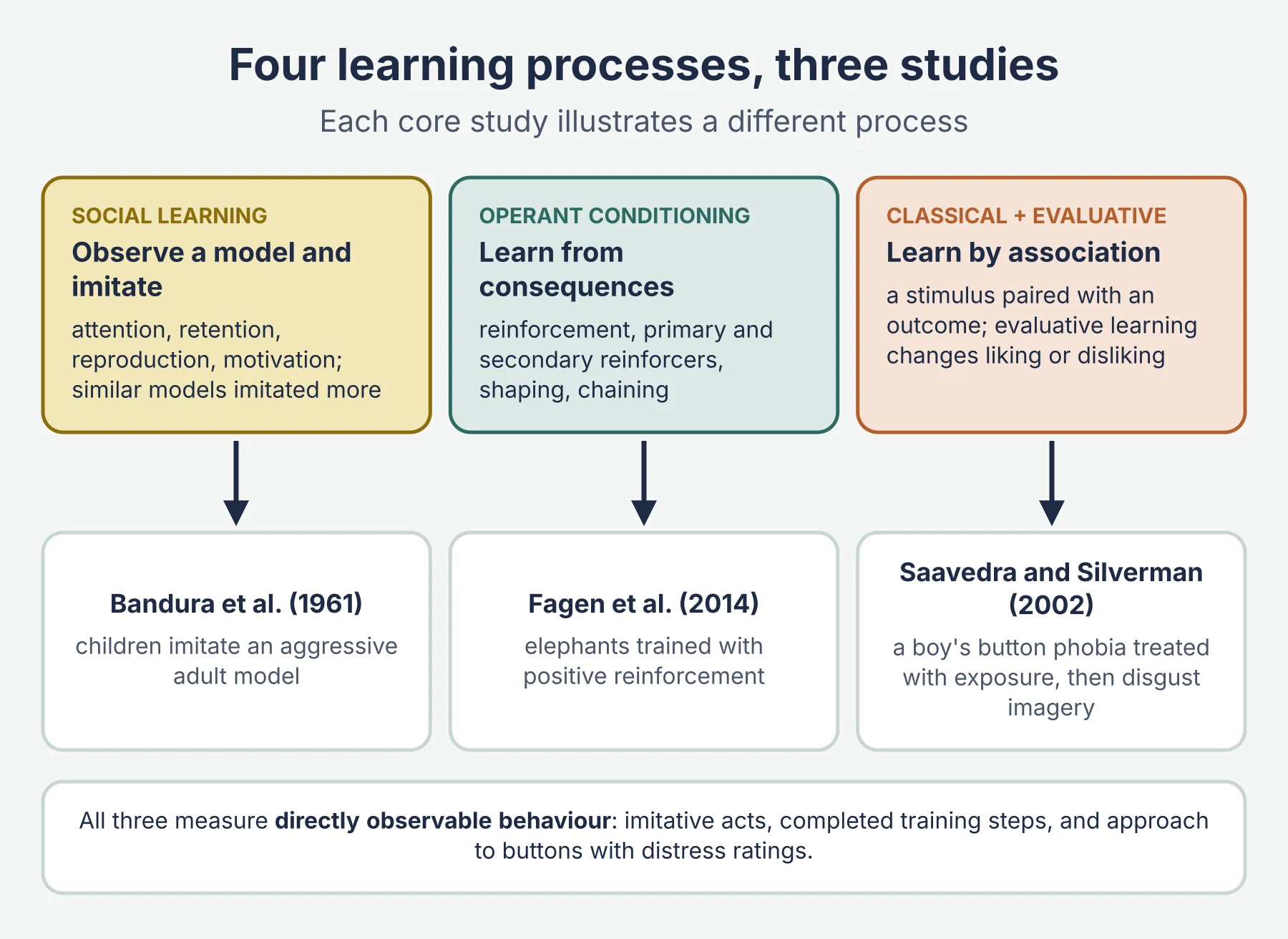
The learning approach is the third group of core studies in Cambridge International AS & A Level Psychology (9990). Its three compulsory studies are Bandura et al. (1961) on the imitation of aggression, Fagen et al. (2014) on positive reinforcement training of working elephants, and Saavedra and Silverman (2002) on a child’s phobia of buttons. Each one illustrates a different learning process, so this guide explains the processes first and then applies them study by study. The Paper 1 Approaches, Issues and Debates overview gives the wider picture.
Condense this guide with the learning approach revision notes and test yourself with the learning approach practice questions.
The assumptions
- We all begin life as a blank slate. Experiences and interactions with the environment shape behaviour, and these changes are directly observable.
- We learn through operant conditioning, classical conditioning and social learning, which can be understood using the stimulus–response model.
“Directly observable” explains why all three studies measure behaviour rather than thoughts: imitative acts in Bandura et al., completed training steps in Fagen et al., and approach to buttons and distress ratings in Saavedra and Silverman.
The learning processes you must be able to explain
Classical conditioning is learning by association. A neutral stimulus is paired with an unconditioned stimulus that already produces a response; after pairing, the neutral stimulus alone produces a conditioned response. A phobia can be acquired this way, and extinction happens when the conditioned stimulus is repeatedly met without the unpleasant outcome, which is the logic of exposure therapy.
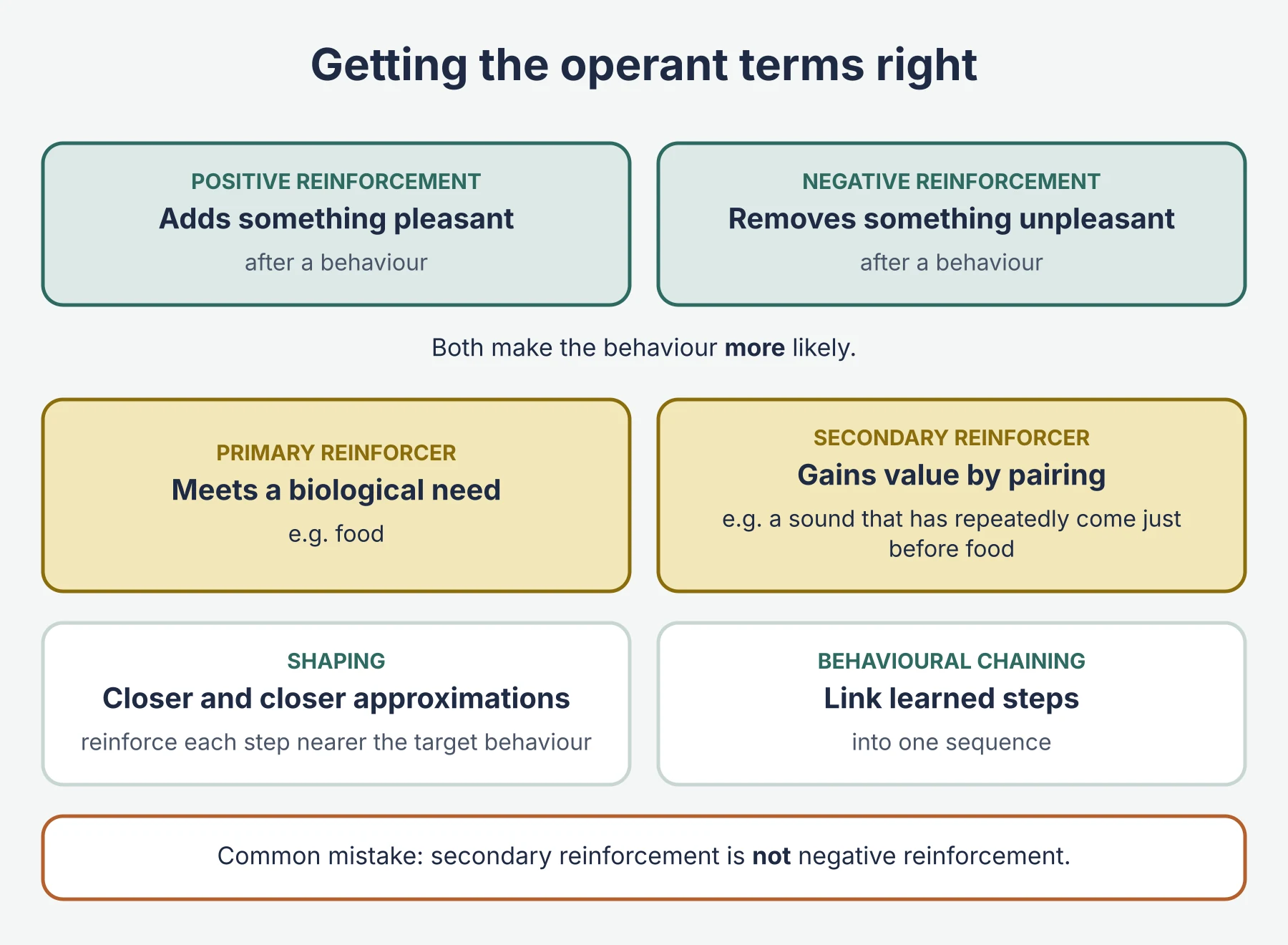
Operant conditioning is learning from consequences. Positive reinforcement adds something pleasant after a behaviour; negative reinforcement removes something unpleasant; both make the behaviour more likely. Primary reinforcers meet a biological need, such as food. Secondary reinforcers gain their value by being paired with a primary reinforcer, such as a sound that has repeatedly come just before food. Shaping reinforces closer and closer approximations to a target behaviour, and behavioural chaining links several learned steps into a sequence.
Social learning is learning by observing a model and imitating. Attention to the model, retention, ability to reproduce the act and motivation all matter, and a model who is similar to the observer, such as the same sex, is more likely to be imitated.
Evaluative learning, named by the syllabus for Saavedra and Silverman, is a form of classical conditioning in which the liking or disliking of a stimulus changes because it is paired with something pleasant or unpleasant. It is relevant because disgust, unlike fear, does not reduce easily with exposure alone.
Bandura et al. (1961): transmission of aggression
Aim. To test whether children would imitate aggression they had seen an adult perform, even when the model was no longer present, and whether the sex of the model and the child mattered.
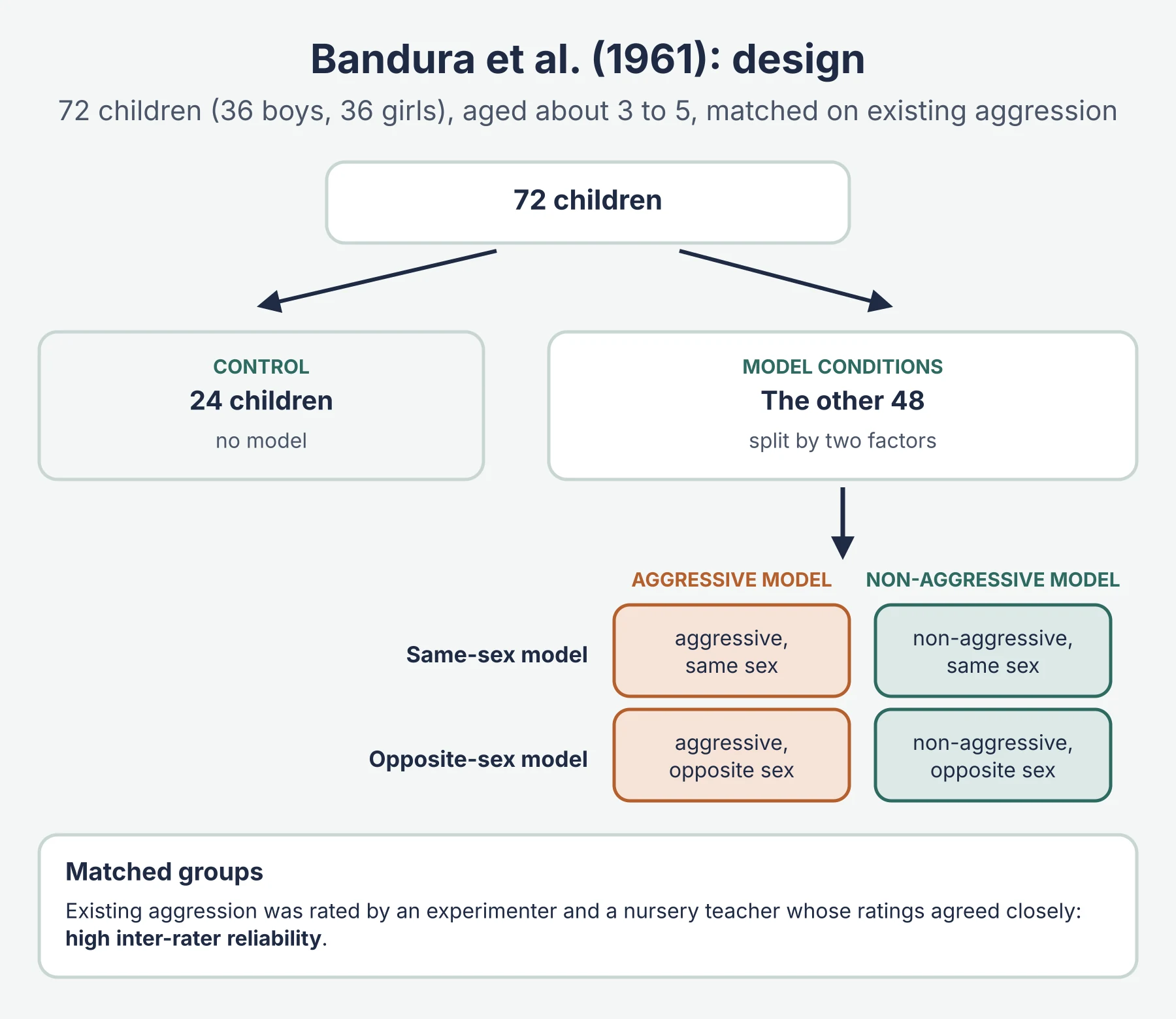
Sample and design. Seventy-two children (36 boys and 36 girls) aged roughly three to five from a university nursery school. Twenty-four formed a control group with no model; the others were split by aggressive or non-aggressive model and by same-sex or opposite-sex model. Children were matched on their existing levels of aggression, rated by an experimenter and a nursery teacher whose ratings agreed closely (high inter-rater reliability).
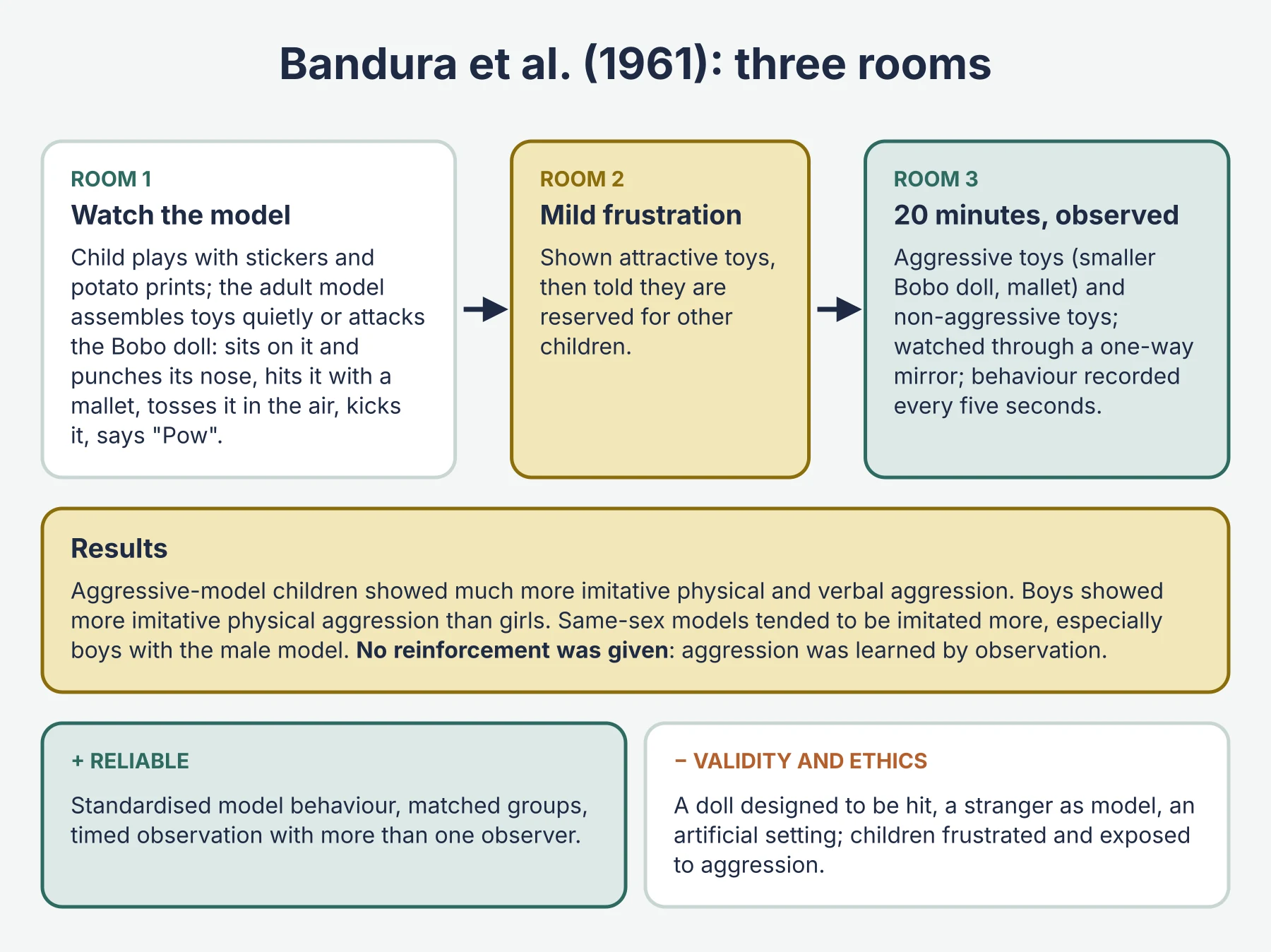
Procedure. In the first room, each child played with stickers and potato prints while an adult model in another corner either assembled toys quietly or attacked a large inflatable Bobo doll in distinctive ways: sitting on it and punching its nose, hitting it with a mallet, tossing it in the air and kicking it, with phrases such as “Pow”. Then each child was mildly frustrated by being shown attractive toys and told they were reserved for other children. Finally, each child spent 20 minutes in a third room containing aggressive toys (including a smaller Bobo doll and a mallet) and non-aggressive toys, observed through a one-way mirror, with behaviour recorded every five seconds.
Results. Children who saw the aggressive model showed much more imitative physical and verbal aggression than the other groups. Boys showed more imitative physical aggression than girls. Same-sex models tended to be imitated more, especially by boys with the male model. Children who saw the non-aggressive model showed little aggression.
Conclusion. Aggression can be learned through observation without any reinforcement of the child, supporting social learning theory.
Evaluation. The standardised model behaviour, matched groups and timed observation with more than one observer make the study reliable. But the Bobo doll is designed to be hit, the model was a stranger, and the setting was artificial, so the findings may not show how children learn aggression from family or media. Ethically, children were deliberately frustrated and exposed to aggression that they might repeat.
Fagen et al. (2014): elephant learning
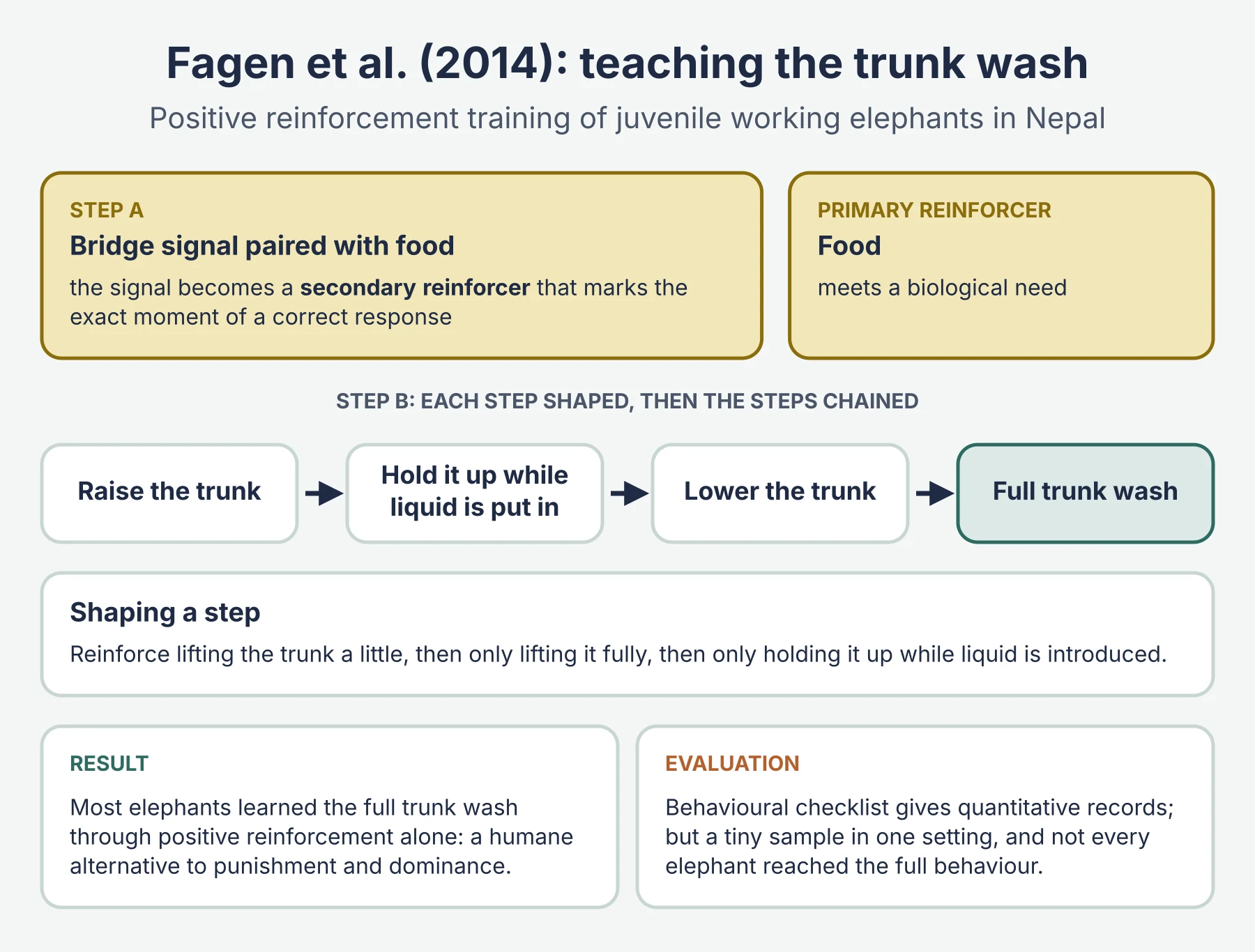
Aim. To test whether positive reinforcement training could teach working juvenile elephants in Nepal to take part in a trunk wash, a procedure for testing for tuberculosis, as a humane alternative to traditional training based on punishment and dominance.
Procedure. A small group of young elephants was trained, with their handlers (mahouts) involved. A bridge signal was first paired with food so it became a secondary reinforcer, marking the exact moment a correct response occurred. Food was the primary reinforcer. The trunk wash was broken into steps such as raising the trunk, holding it up while liquid was put into it, and lowering it. Each step was shaped and the steps were then chained. An observation with a behavioural checklist recorded whether each step was performed correctly in each session.
Results and conclusion. Most of the elephants learned the full trunk wash through positive reinforcement alone. The study shows that operant conditioning can improve captive management and welfare.
Evaluation. The behavioural checklist gives clear, quantitative records of progress. However, the sample is tiny and specific to one setting, and not every elephant reached the full behaviour, so results may not generalise. Ethically, replacing aversive methods with reward meets the guideline on minimising harm and on reward, deprivation and aversive stimuli.
Saavedra and Silverman (2002): button phobia
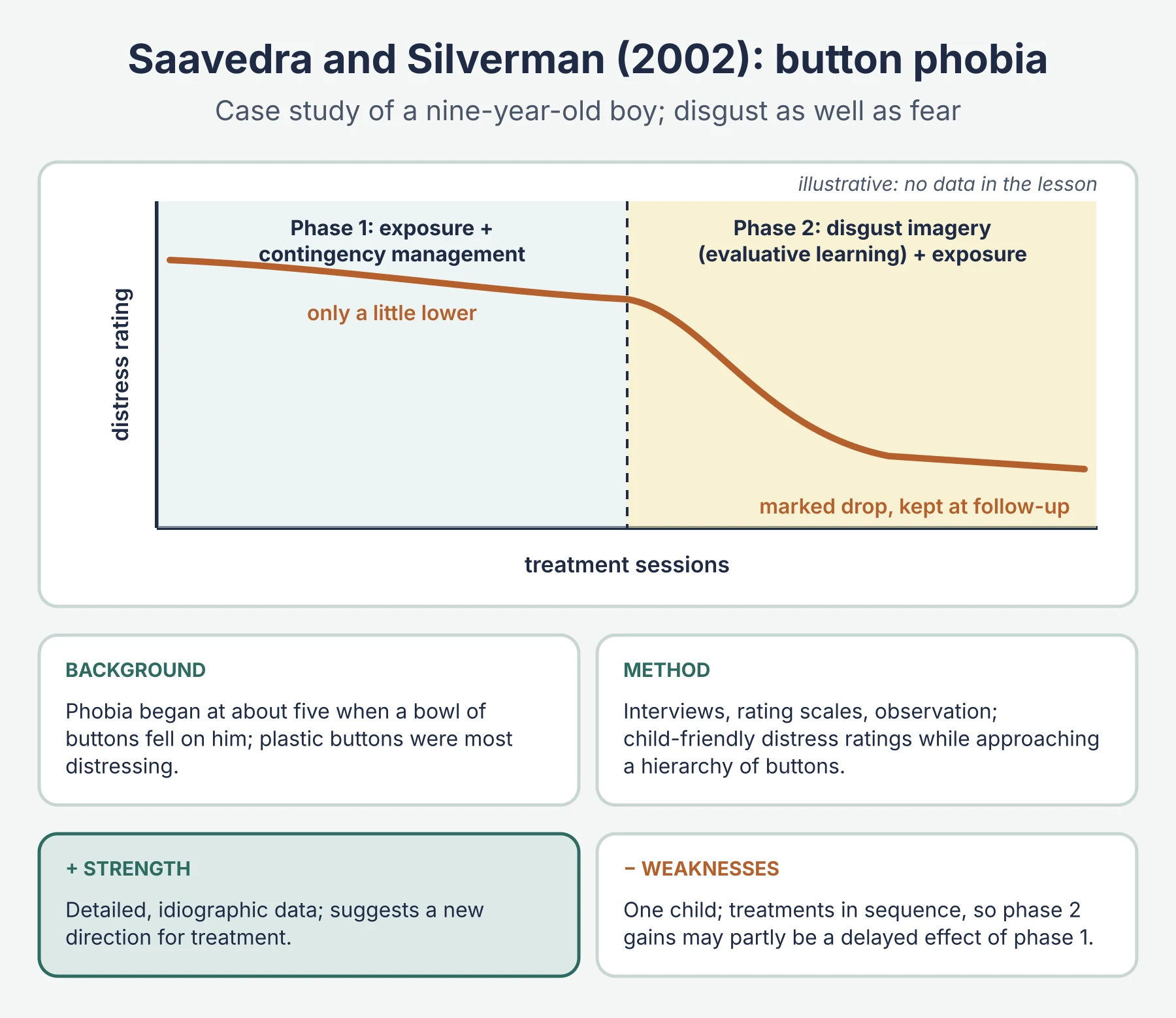
Background. A nine-year-old boy had developed a phobia of buttons after an incident at school when he was about five, when a bowl of buttons fell on him. His response involved disgust as well as fear; plastic buttons were the most distressing.
Method. A case study using interviews, rating scales and observation. The boy rated his distress on a child-friendly scale as he approached buttons in a hierarchy from least to most distressing.
Treatment. First, exposure-based therapy with contingency management: he worked up the hierarchy and was positively reinforced for approaching buttons. This reduced his distress only a little. Next came disgust-focused imagery, an evaluative learning technique, in which he imagined buttons touching him while thinking about his disgust reactions, alongside further exposure. After this his distress ratings dropped markedly and improvement was maintained at follow-up.
Evaluation. The case study gives detailed, idiographic data and suggests a new direction for treatment. But one child cannot represent all phobias, and as the two treatments happened in sequence, improvement in the second phase could partly be the delayed effect of the first.
Annotated answer
Question: Using the study by Fagen et al., explain what is meant by shaping. [2]
“Shaping is reinforcing successive approximations to a target behaviour (1). For example, an elephant might first be reinforced for lifting its trunk a little, then only for lifting it fully, then only for holding it up while liquid was introduced, until the full trunk-wash step was produced (1).”
Common mistakes
- Mixing up secondary reinforcement with negative reinforcement.
- Saying Bandura’s children were rewarded for imitating: they were not reinforced.
- Claiming Saavedra and Silverman cured the phobia with exposure alone.
- Forgetting the frustration phase when describing Bandura’s procedure.
Exam technique
Explain questions on this approach usually need a learning term and an application to the study. For the issues and debates, the learning approach is the clearest nurture position; Bandura et al. and Saavedra and Silverman are your examples of the use of children; Fagen et al. of the use of animals; and all three apply to everyday life (media violence, animal welfare, and therapy). In compare questions, contrast the methods: an experiment, an observation and a case study.
Official syllabus
Cambridge International AS & A Level Psychology 9990 syllabus for 2024, 2025 and 2026, section 3.1.1 The core studies, Learning approach — cambridgeinternational.org.
More resources on this topic
Related resources
-
Practice questions
Cambridge International AS & A Level Psychology (9990): Learning approach – Practice Questions
Original Paper 1 style questions with answers on the 9990 learning approach: Bandura et al., Fagen et al. and Saavedra and Silverman, plus learning terms.
Psychology · Cambridge · AS Level
Try questions -
Revision notes
Cambridge International AS & A Level Psychology (9990): Learning approach – Revision Notes
Revision notes for the 9990 learning approach: conditioning and social learning terms, the three core studies in a grid, exam traps and a 12-question self-test.
Psychology · Cambridge · AS Level
Revise topic -
Study guides
Cambridge International AS & A Level Psychology (9990): Social approach
Cambridge 9990 Psychology social approach: its two assumptions and the Milgram, Perry et al. and Piliavin et al. core studies, with evaluation.
Psychology · Cambridge · AS Level
Read guide
Studying Psychology?
This page is free and stays free. Marlbridge is not offering Psychology classes at the moment, so there is no tuition to book for it. The free study resources stay open to everyone.
Get free revision emails (optional)
Occasional emails with practice questions, worked explanations and links to free resources for the qualification and subjects you choose. No spam, and you can unsubscribe from any email. The free tools on this site never need an email.