
Revision Notes
Cambridge International AS & A Level Psychology (9990): Cognitive approach – Revision Notes
Revision notes for the 9990 cognitive approach: assumptions, Andrade, Baron-Cohen et al. and Pozzulo et al. in a grid, key terms, traps and a self-test.
- Subject
- Psychology
- Level
- AS LEVEL
- Topic
- Paper 1 – Approaches, Issues and Debates
- Author
- Marlbridge Academic Team
- Updated
- Reviewed by
- Kanwal Aslam (what this means)
Aligned to Cambridge A Level Psychology (9990), 2024-2026. Official specification .
Syllabus page (what it covers and how it is assessed): Cambridge A Level Psychology.
Syllabus points this page covers
9990 (AS Level)
- Cognitive approach
These notes condense the cognitive approach of Cambridge International AS & A Level Psychology (9990), syllabus for 2024 to 2026. Learn the input – process – output assumption, the individual-differences assumption, and the eight syllabus elements of each of the three core studies. The cognitive approach study guide explains each point in full; the cognitive approach practice questions let you test yourself.
Assumptions
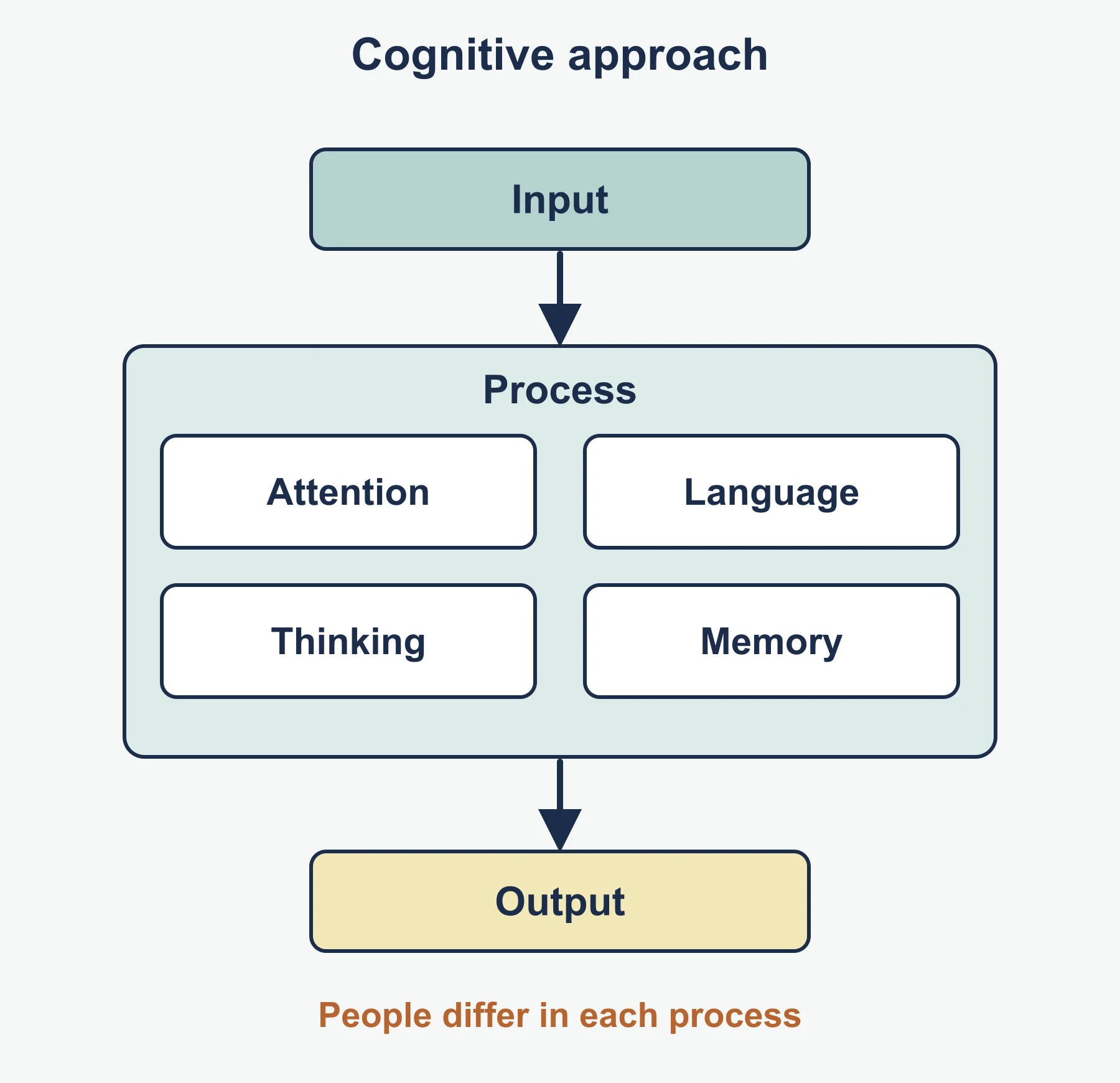
- Same route in all humans: input – process – output, like a computer.
- Individual differences in attention, language, thinking and memory help explain behaviour and emotion.
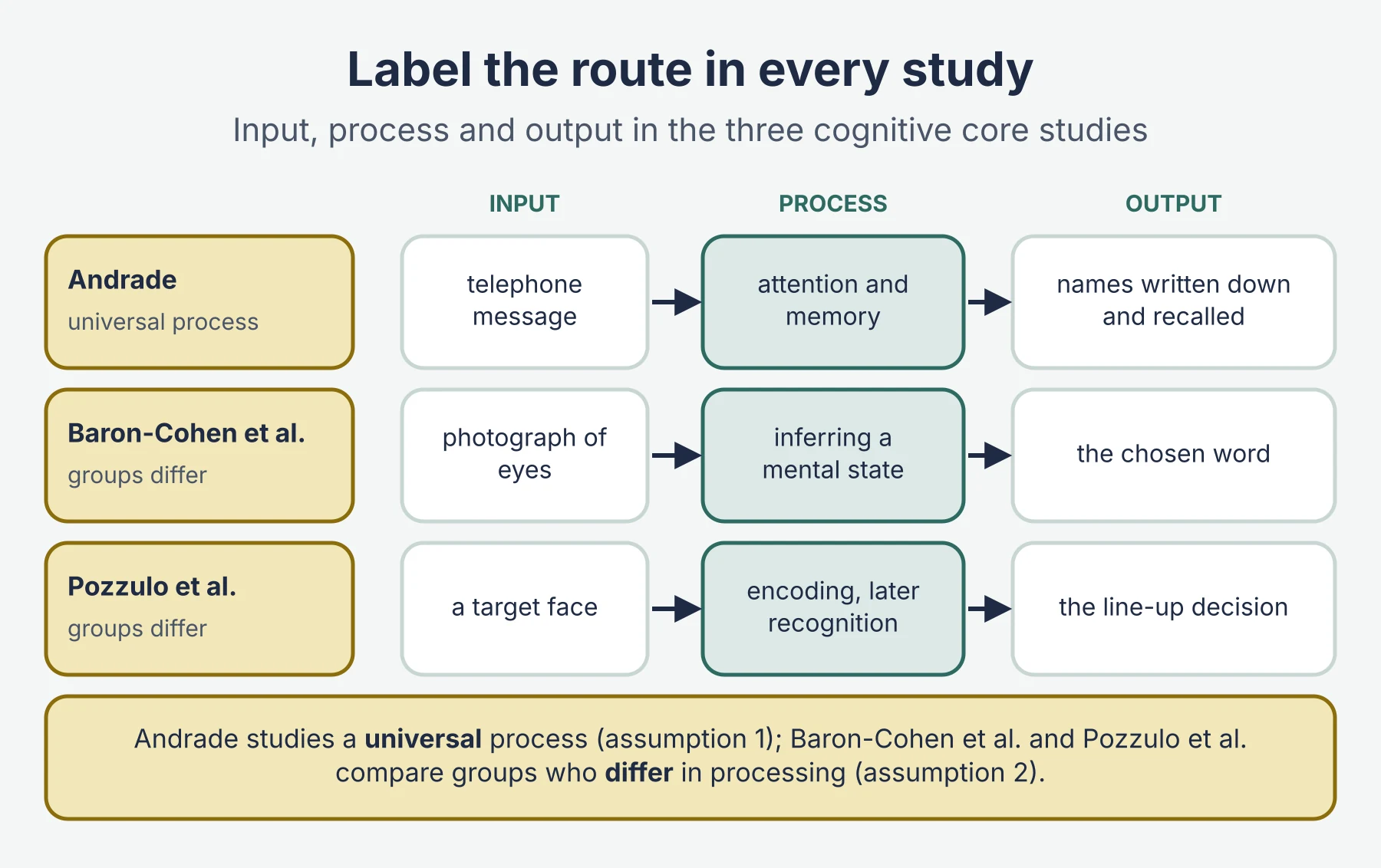
| Study | Input | Process | Output |
|---|---|---|---|
| Andrade | Dull telephone message | Attention, memory | Names monitored; items recalled |
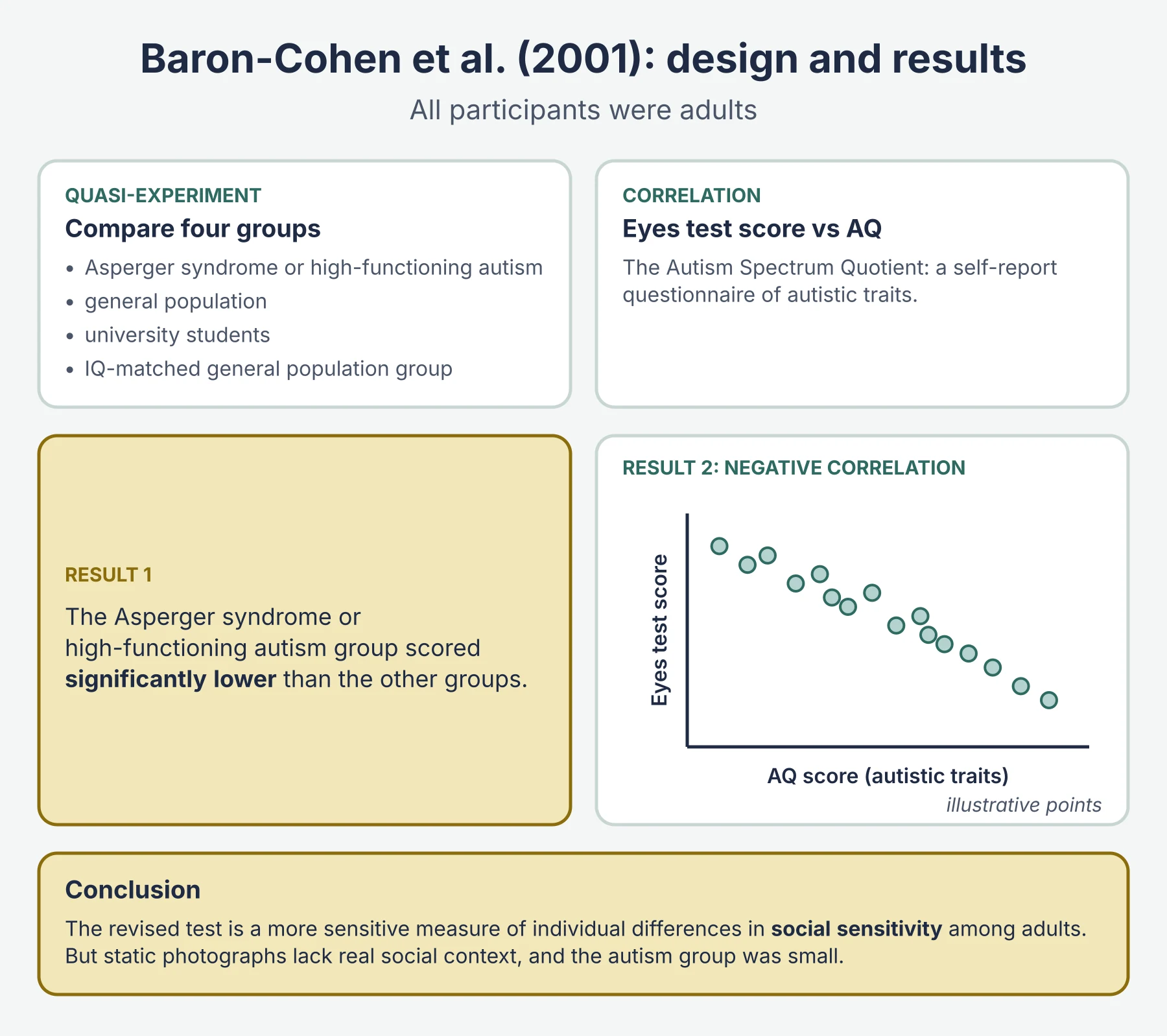
| Baron-Cohen et al. | Photograph of eyes | Inferring a mental state | Chosen word from four |
| Pozzulo et al. | Target face (cartoon or human) | Encoding and recognition | Line-up decision |
Core studies grid
| Element | Andrade (2010) | Baron-Cohen et al. (2001) | Pozzulo et al. |
|---|---|---|---|
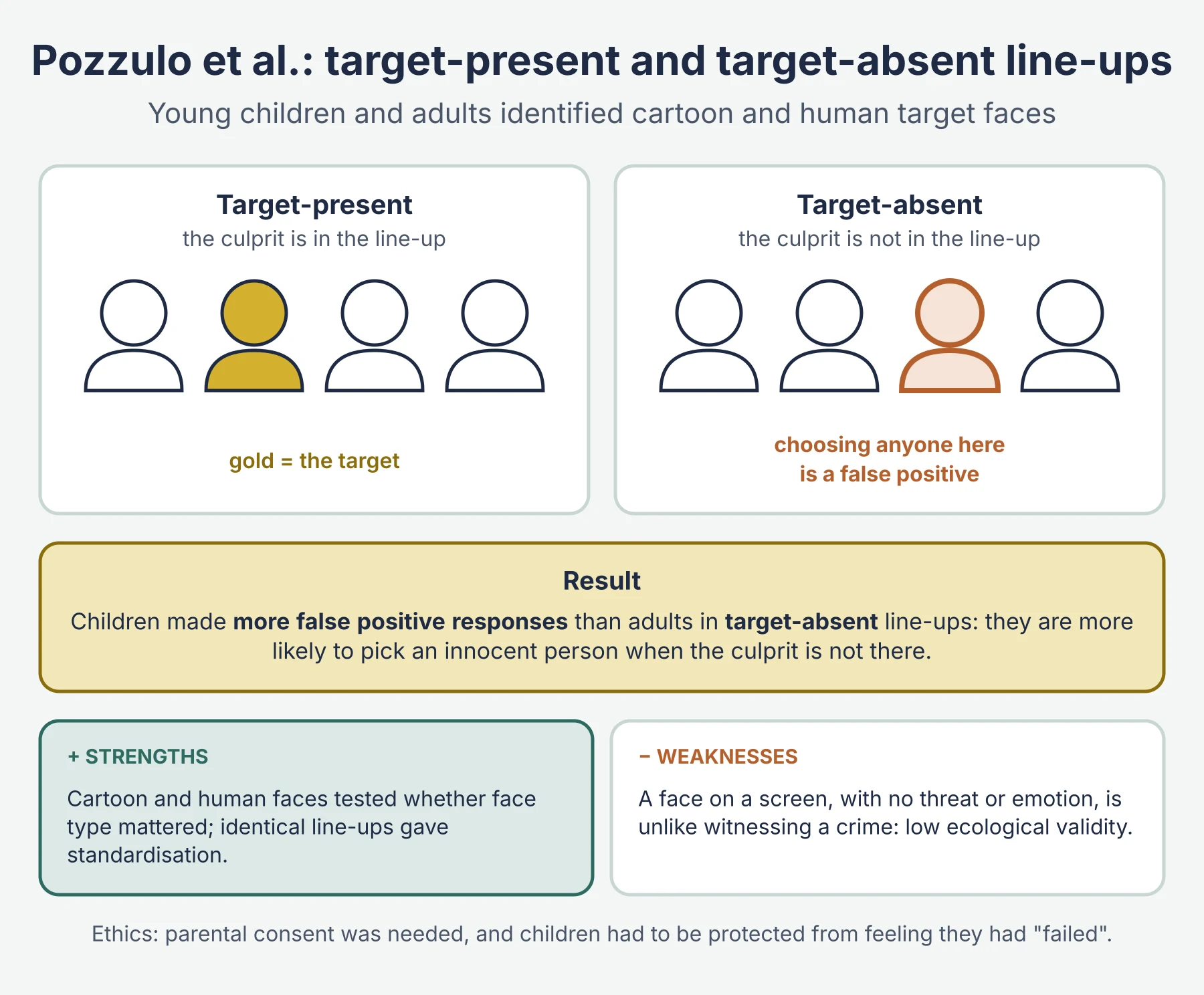
| Psychology | Attention; memory | Theory of mind; social sensitivity | False positive responses; eyewitness testimony |
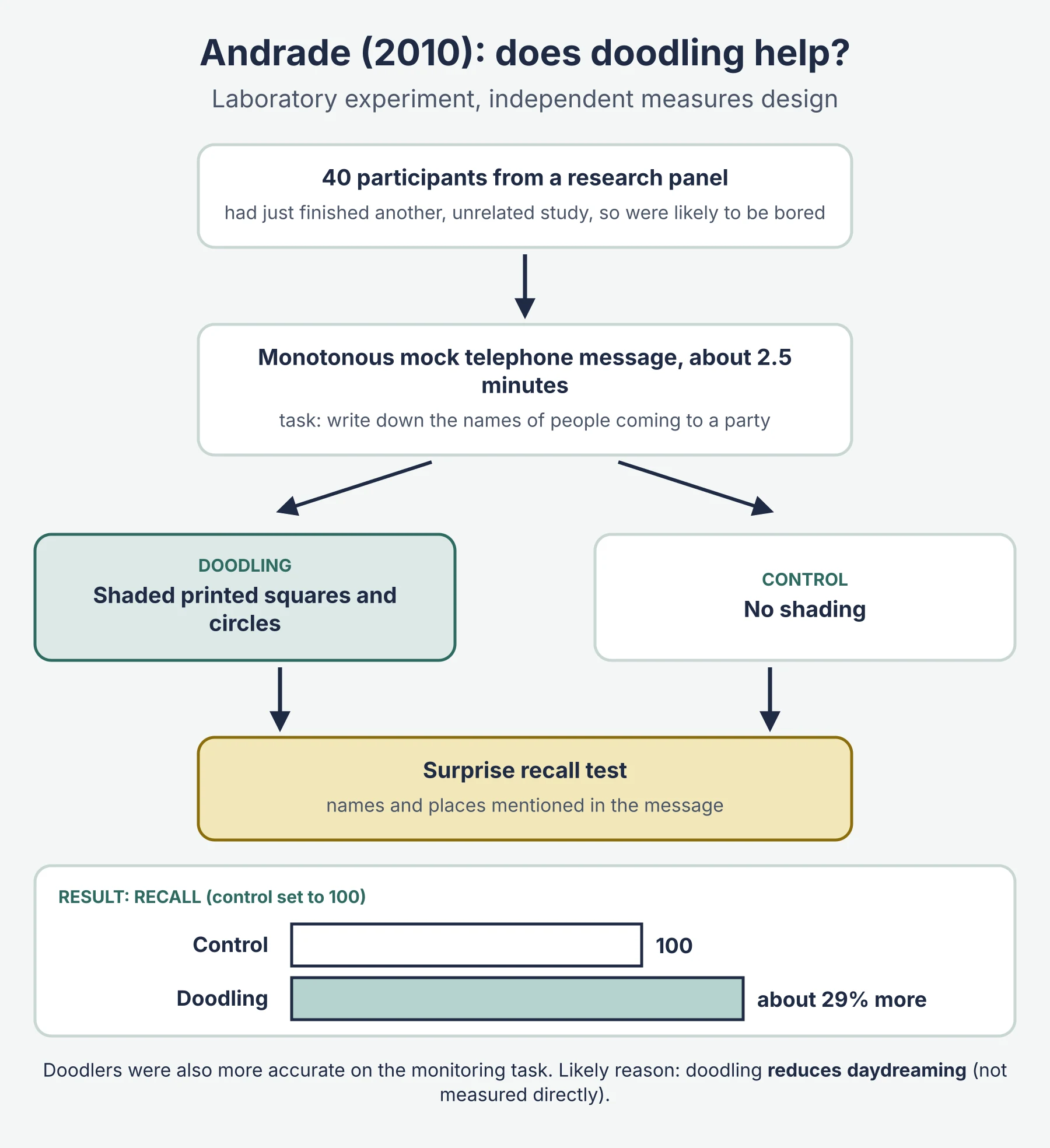
| Method | Laboratory experiment, independent measures | Experiment (group comparison) and correlation; questionnaire | Laboratory experiment comparing children and adults; interviews and questionnaires |
| Sample | 40 participants from a research panel | Four adult groups, including adults with Asperger syndrome or high-functioning autism | Young children and adults |
| IV | Doodling (shading shapes) or not | Group | Age group; type of face; target-present or target-absent |
| DV | Names monitored; recall of names and places | Eyes test score; AQ score | Identification accuracy; false positives |
| Key result | Doodlers recalled about 29% more | Autism group scored lower; Eyes scores negatively correlated with AQ | Children made more false positives in target-absent line-ups |
| Conclusion | Doodling may reduce daydreaming and aid attention | The revised test detects subtle differences in adult theory of mind | Children are vulnerable to choosing an innocent person |
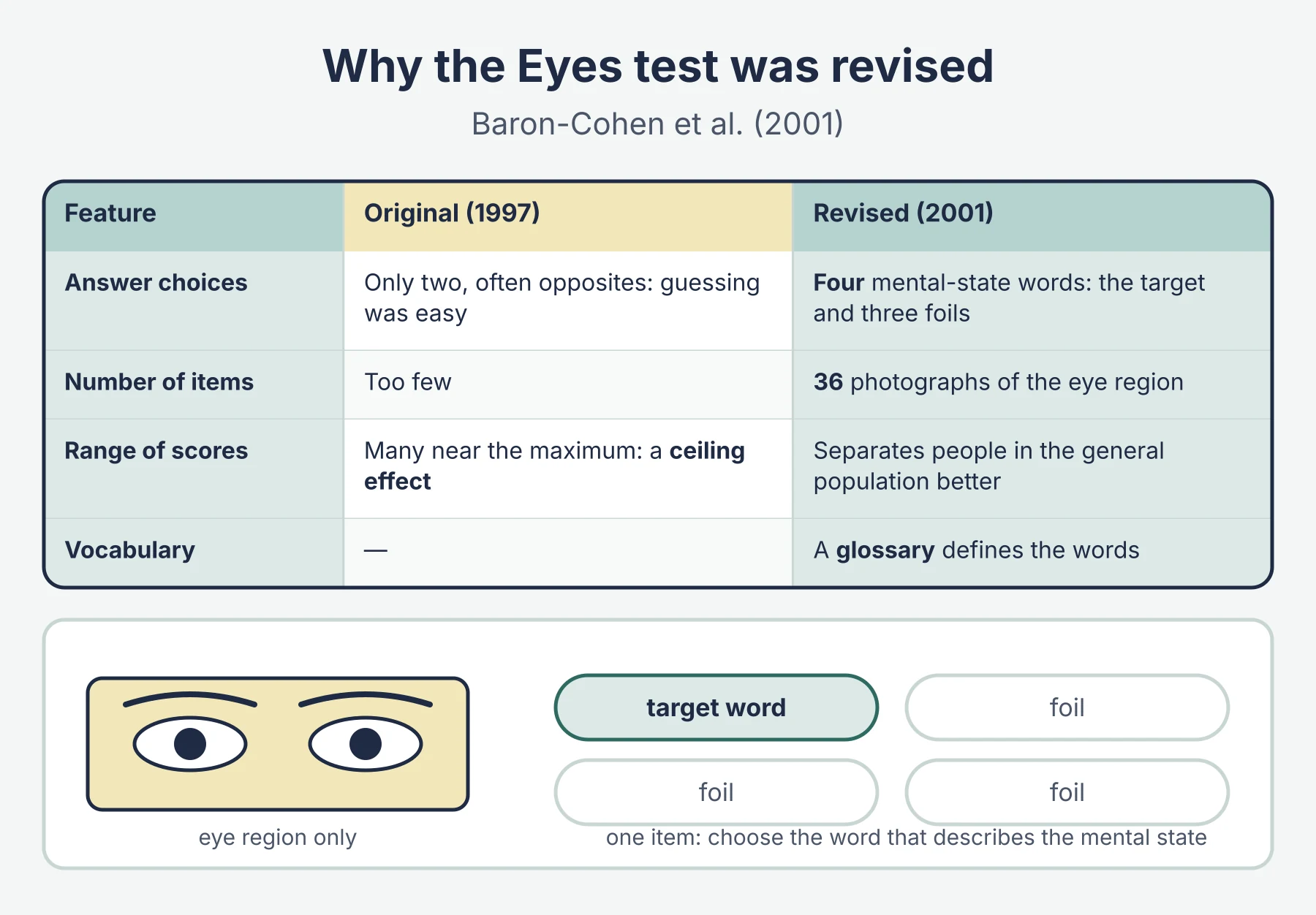
Revised Eyes test: what changed
- Items increased to 36 photographs of the eye region.
- Choices increased from two to four words (one target, three foils).
- A glossary of word meanings was provided.
- Aim: remove guessing and the ceiling effect that made the original too easy for most adults.
Key terms
| Term | Meaning |
|---|---|
| Theory of mind | Understanding that others have beliefs, desires and feelings different from one’s own |
| Social sensitivity | Ability to pick up social and emotional cues from others |
| Autism Spectrum Quotient | Self-report questionnaire measuring autistic traits |
| Foil | An incorrect answer option |
| Ceiling effect | Most participants score near the maximum, so differences cannot show |
| Daydreaming | Thoughts unrelated to the task, which take processing capacity |
| Monitoring task | Writing down target information while listening |
| Target-present line-up | The culprit is among the faces shown |
| Target-absent line-up | The culprit is not among the faces shown |
| False positive | Choosing someone from a target-absent line-up |
| Correct rejection | Saying the culprit is not there in a target-absent line-up |
| Quasi-experiment | Groups based on an existing characteristic rather than allocation by the researcher |
Evaluation hooks
- Andrade: standard recording and identical task give reliability; surprise test stops rehearsal; but shading is not natural doodling and daydreaming was not measured.
- Baron-Cohen et al.: four choices and a glossary improve validity; correlation with AQ supports the measure; but static eyes lack context and the autism group was small.
- Pozzulo et al.: controlled comparison of age groups with target-present and target-absent line-ups; but no real crime or stress, so low ecological validity.
Issues and debates links
- Use of children: Pozzulo et al. needed parental consent and care not to make children feel they had failed.
- Individual and situational explanations: theory of mind as an individual difference (Baron-Cohen et al.); the situation of a boring task (Andrade); line-up composition as a situational factor (Pozzulo et al.).
- Application to everyday life: doodling in meetings and classrooms; supporting diagnosis; warning police about child witnesses and target-absent line-ups.
- Nature versus nurture: age differences in Pozzulo et al. could reflect maturation (nature) or experience (nurture).
Exam traps
- Calling the Eyes test a “face test”: only the eye region was shown.
- Saying Andrade’s doodlers were told to doodle freely: they shaded printed shapes.
- Forgetting the surprise element of Andrade’s recall test.
- Writing that Baron-Cohen et al. found a positive correlation with AQ: it was negative.
- Defining a false positive as any wrong choice: it is choosing someone when the culprit is absent.
- Saying children are always worse witnesses: the key result concerns target-absent line-ups.
Self-test
- State the input – process – output assumption.
- Why were Andrade’s participants likely to be bored before the study began?
- What were the doodling participants asked to do?
- Why was the recall test a surprise?
- By roughly how much did doodlers’ recall exceed controls’?
- What does the Eyes test measure?
- Give two changes made in the revised Eyes test.
- What was the direction of the correlation between Eyes test and AQ scores?
- Why is Baron-Cohen et al.’s group comparison a quasi-experiment?
- Define a target-absent line-up.
- Which group made more false positive responses in Pozzulo et al.?
- Give one ethical issue raised by Pozzulo et al.
Answers: (1) information is processed through the same route in all humans, input – process – output, like a computer. (2) they had just finished another study. (3) shade printed squares and circles while listening. (4) so they would not rehearse the information, making recall a fairer measure of attention. (5) about 29%. (6) theory of mind, or social sensitivity, in adults. (7) any two of: 36 items; four word choices; a glossary; foils chosen to reduce guessing. (8) negative. (9) participants were in groups because of an existing characteristic (diagnosis), not allocated by the researchers. (10) a line-up in which the culprit is not present. (11) children. (12) children cannot give informed consent themselves, so parents had to consent, and children must not be distressed by “getting it wrong”.
Official syllabus
Cambridge International AS & A Level Psychology 9990 syllabus for 2024, 2025 and 2026, section 3.1.1, Cognitive approach — cambridgeinternational.org.
More resources on this topic
Related resources
-
Study guides
Cambridge International AS & A Level Psychology (9990): Learning approach
Cambridge 9990 Psychology learning approach: blank-slate assumptions, conditioning and social learning, and the Bandura, Fagen and Saavedra core studies.
Psychology · Cambridge · AS Level
Read guide -
Practice questions
Cambridge International AS & A Level Psychology (9990): Learning approach – Practice Questions
Original Paper 1 style questions with answers on the 9990 learning approach: Bandura et al., Fagen et al. and Saavedra and Silverman, plus learning terms.
Psychology · Cambridge · AS Level
Try questions -
Revision notes
Cambridge International AS & A Level Psychology (9990): Learning approach – Revision Notes
Revision notes for the 9990 learning approach: conditioning and social learning terms, the three core studies in a grid, exam traps and a 12-question self-test.
Psychology · Cambridge · AS Level
Revise topic
Studying Psychology?
This page is free and stays free. Marlbridge is not offering Psychology classes at the moment, so there is no tuition to book for it. The free study resources stay open to everyone.
Get free revision emails (optional)
Occasional emails with practice questions, worked explanations and links to free resources for the qualification and subjects you choose. No spam, and you can unsubscribe from any email. The free tools on this site never need an email.