
Study Guides
Cambridge International AS & A Level Psychology (9990): Cognitive approach
Cambridge 9990 Psychology cognitive approach: the input-process-output assumption and the Andrade, Baron-Cohen et al. and Pozzulo et al. core studies.
- Subject
- Psychology
- Level
- AS LEVEL
- Topic
- Paper 1 – Approaches, Issues and Debates
- Author
- Marlbridge Academic Team
- Updated
- Reviewed by
- Kanwal Aslam (what this means)
Aligned to Cambridge A Level Psychology (9990), 2024-2026. Official specification .
Syllabus page (what it covers and how it is assessed): Cambridge A Level Psychology.
Syllabus points this page covers
9990 (AS Level)
- Cognitive approach
The cognitive approach is the second group of core studies in Cambridge International AS & A Level Psychology (9990). Its three compulsory studies are Andrade (2010) on doodling, Baron-Cohen et al. (2001) on the revised “Reading the Mind in the Eyes” Test, and Pozzulo et al. on children’s and adults’ line-up identifications. This guide works through each study element by element and shows how cognitive questions are marked. The Paper 1 Approaches, Issues and Debates overview places the approach alongside the other three.
Use the cognitive approach revision notes to condense it and the cognitive approach practice questions to test it.
The assumptions and what they mean in practice
The syllabus gives two main assumptions:
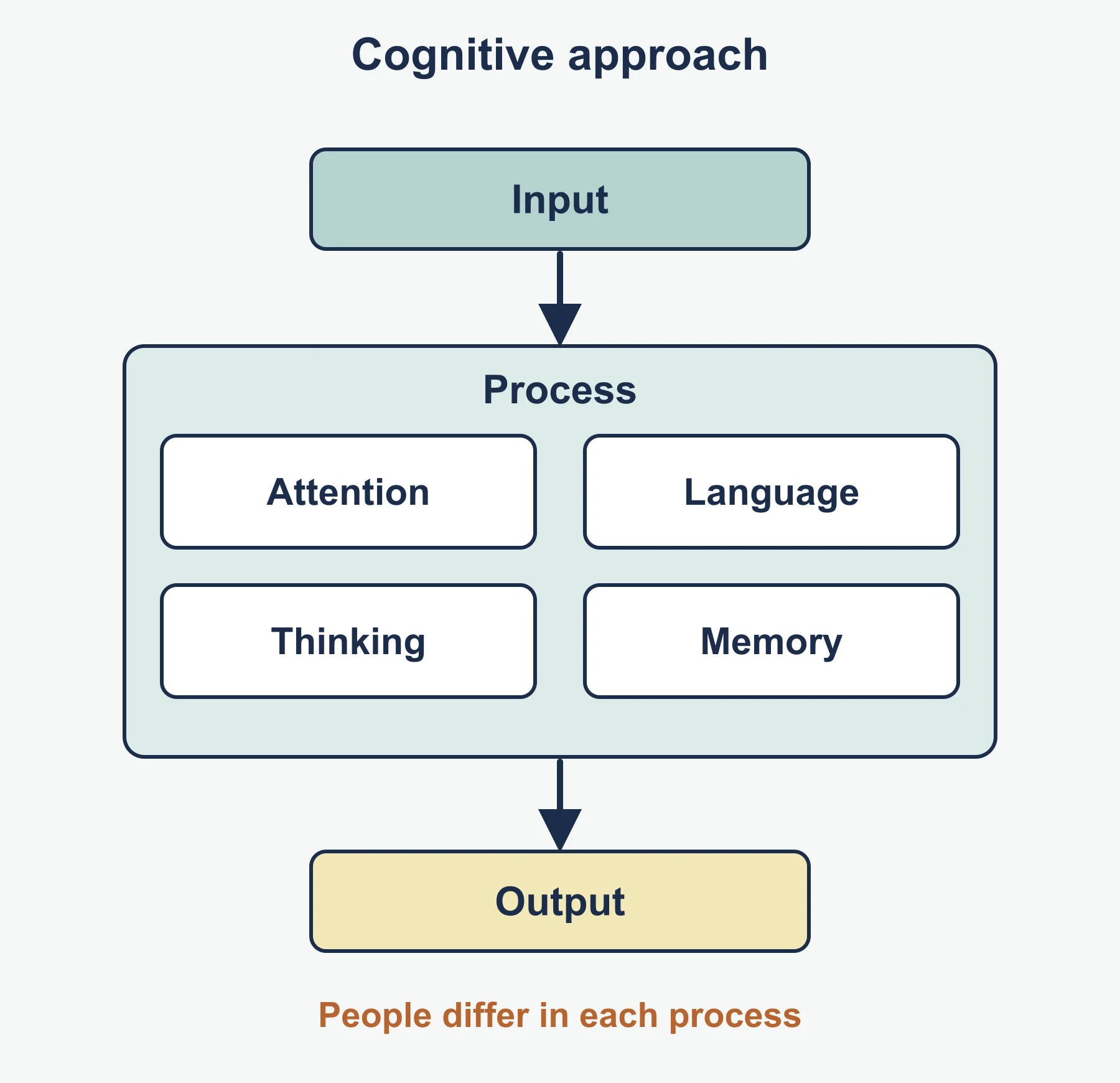
- Information is processed through the same route in all humans: input – process – output, in a similar way to a computer.
- People have individual differences in their cognitive processing, such as attention, language, thinking and memory, and these processes help explain behaviour and emotion.
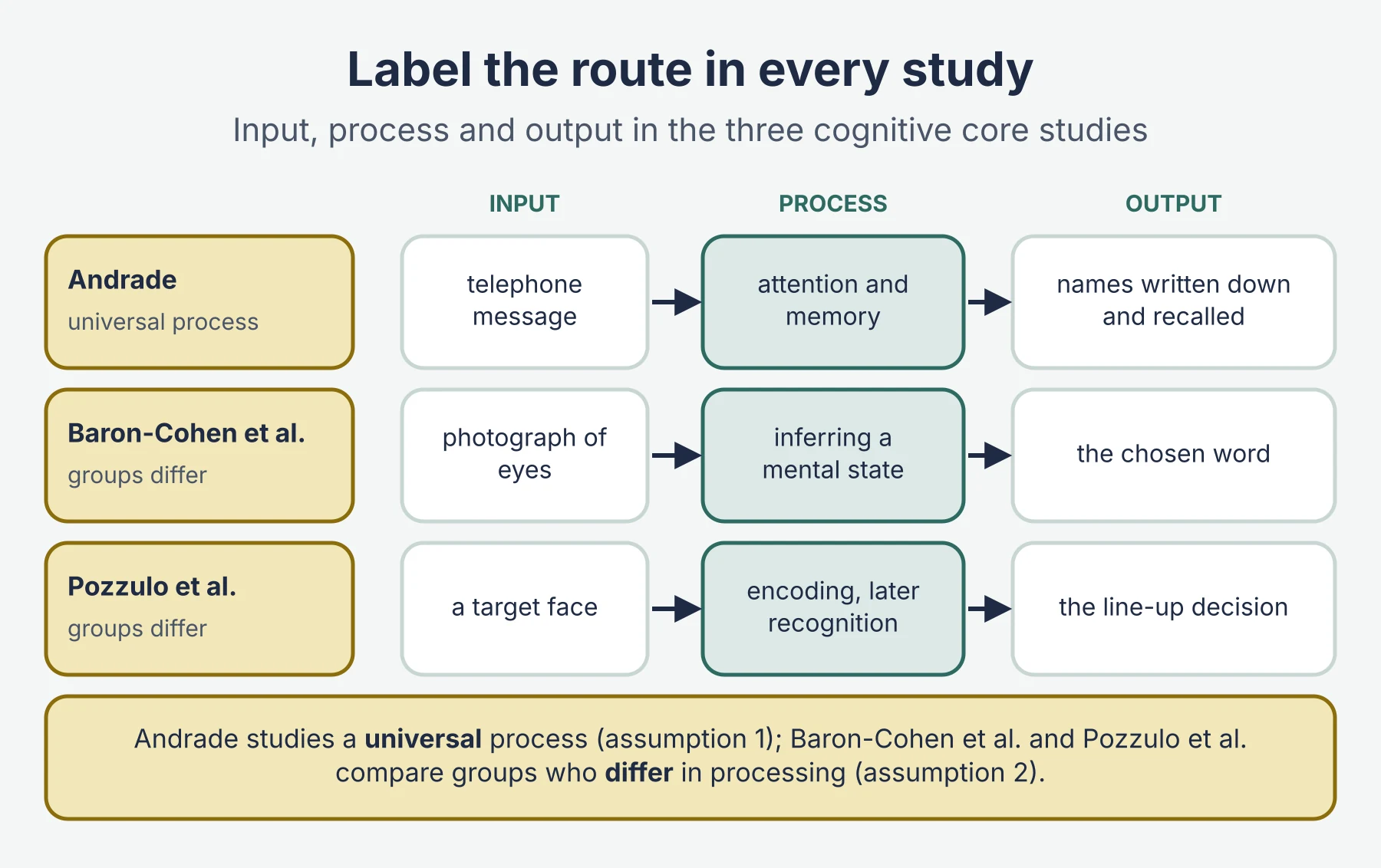
The first assumption is about what is universal: everyone takes in information, works on it and produces a response. The second is about variation within that route. The three studies divide neatly between the two. Andrade looks at a universal process (attention to a boring message) and how a simple activity changes it. Baron-Cohen et al. and Pozzulo et al. both compare groups who differ in processing: adults with and without Asperger syndrome or high-functioning autism, and children compared with adults.
A useful habit is to label the input, process and output in each study. For Andrade the input is the telephone message, the process is attention and memory, and the output is the names written down and recalled. For Baron-Cohen et al. the input is a photograph of eyes, the process is inferring a mental state, and the output is the chosen word. For Pozzulo et al. the input is a target face, the process is encoding and later recognition, and the output is the line-up decision.
Andrade (2010): doodling
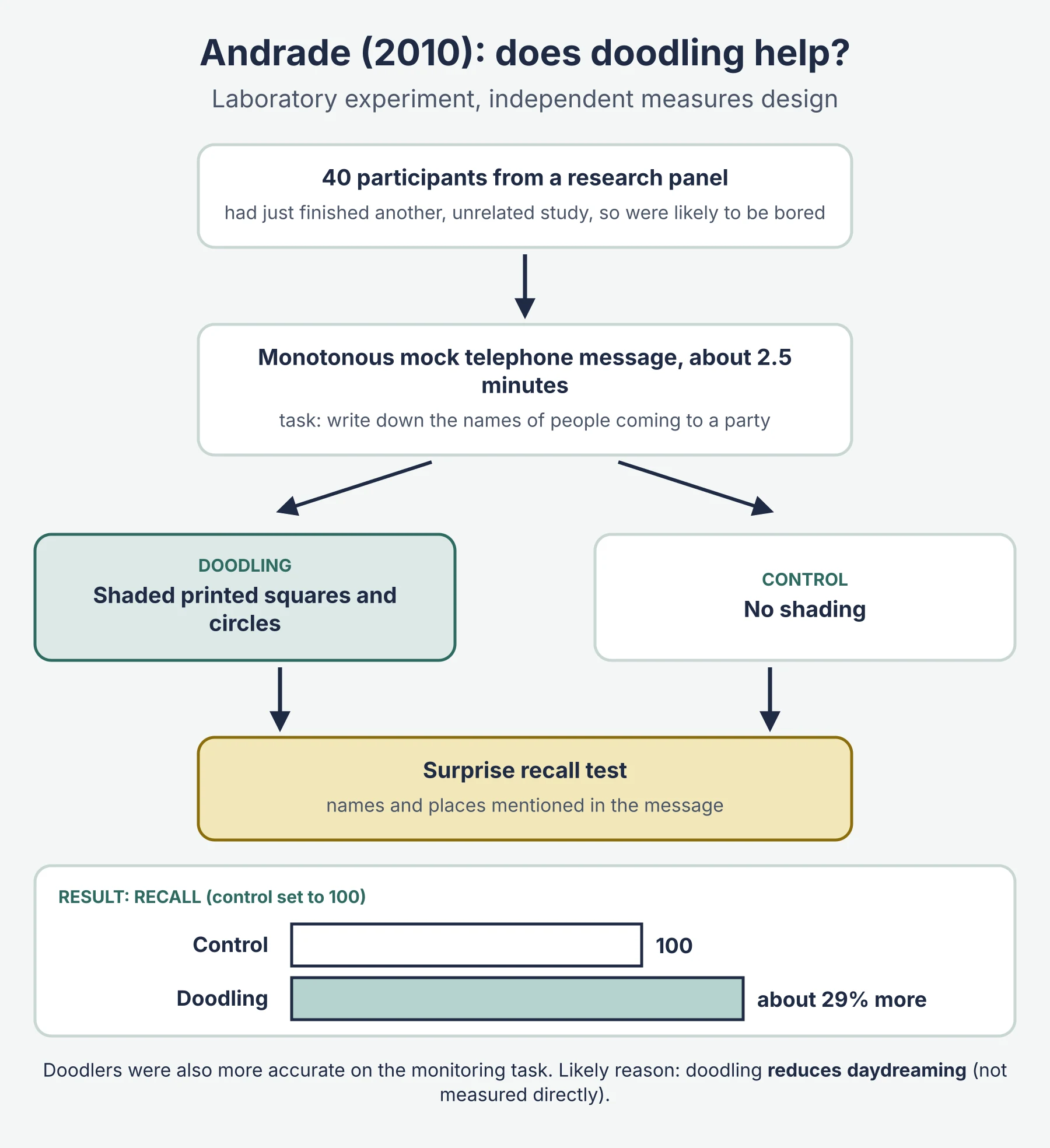
Psychology investigated. Attention and memory. When a task is boring, people may daydream, which uses up the processing capacity needed for the task. Doodling might help by giving just enough to do to stop the mind wandering.
Procedure. Forty participants from a research participant panel took part, having just completed another, unrelated study, so they were likely to be bored. In a laboratory experiment with an independent measures design, each listened to a monotonous mock telephone message of about two and a half minutes about a party. Their task was to write down the names of the people who would be coming. Half the participants also shaded printed squares and circles on a sheet while listening (the doodling condition); the other half did not. After the message, participants were given a surprise test of recall of the names and of the places mentioned.
Results. The doodling group was more accurate on the monitoring task and, on the surprise test, recalled about 29% more information than the control group.
Conclusions. Doodling can aid concentration and memory during a dull task, probably by reducing daydreaming rather than by distracting from the task.
Evaluation.
- Strengths: a standard recorded message, a fixed shading task and the same recall test for everyone make it a well-controlled and replicable laboratory experiment. The surprise test reduces the chance that participants rehearsed the information.
- Weaknesses: the shading task is not free doodling, and listening to a recorded message in a laboratory differs from a real call or lecture, so ecological validity is limited. Daydreaming was not measured directly, so the explanation is inferred.
- Ethics: the surprise test is a mild deception, justified because telling participants would have changed the dependent variable; a debrief removed any harm.
Baron-Cohen et al. (2001): the eyes test
Psychology investigated. Theory of mind: the ability to attribute mental states such as beliefs and feelings to others. The syllabus also names social sensitivity.
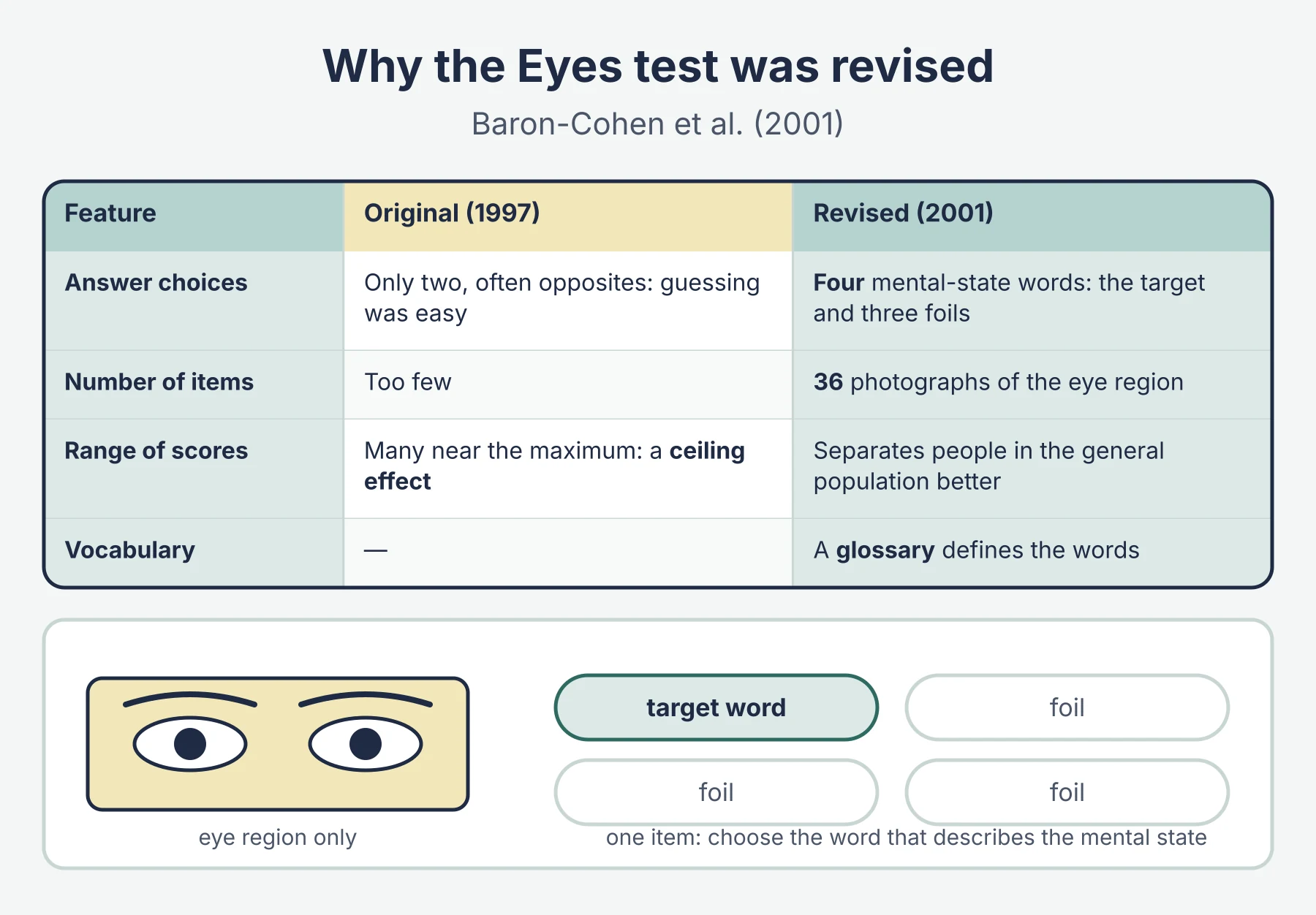
Background. The original 1997 version of the test had problems: only two answer choices (often opposites), so guessing was easy; too few items; and many people scored near the maximum (a ceiling effect), so it did not separate people in the general population well.
The revised test. It used 36 photographs showing only the eye region of a face. Each came with four mental-state words: the target and three foils. A glossary defining the words was available so that vocabulary did not hold people back.
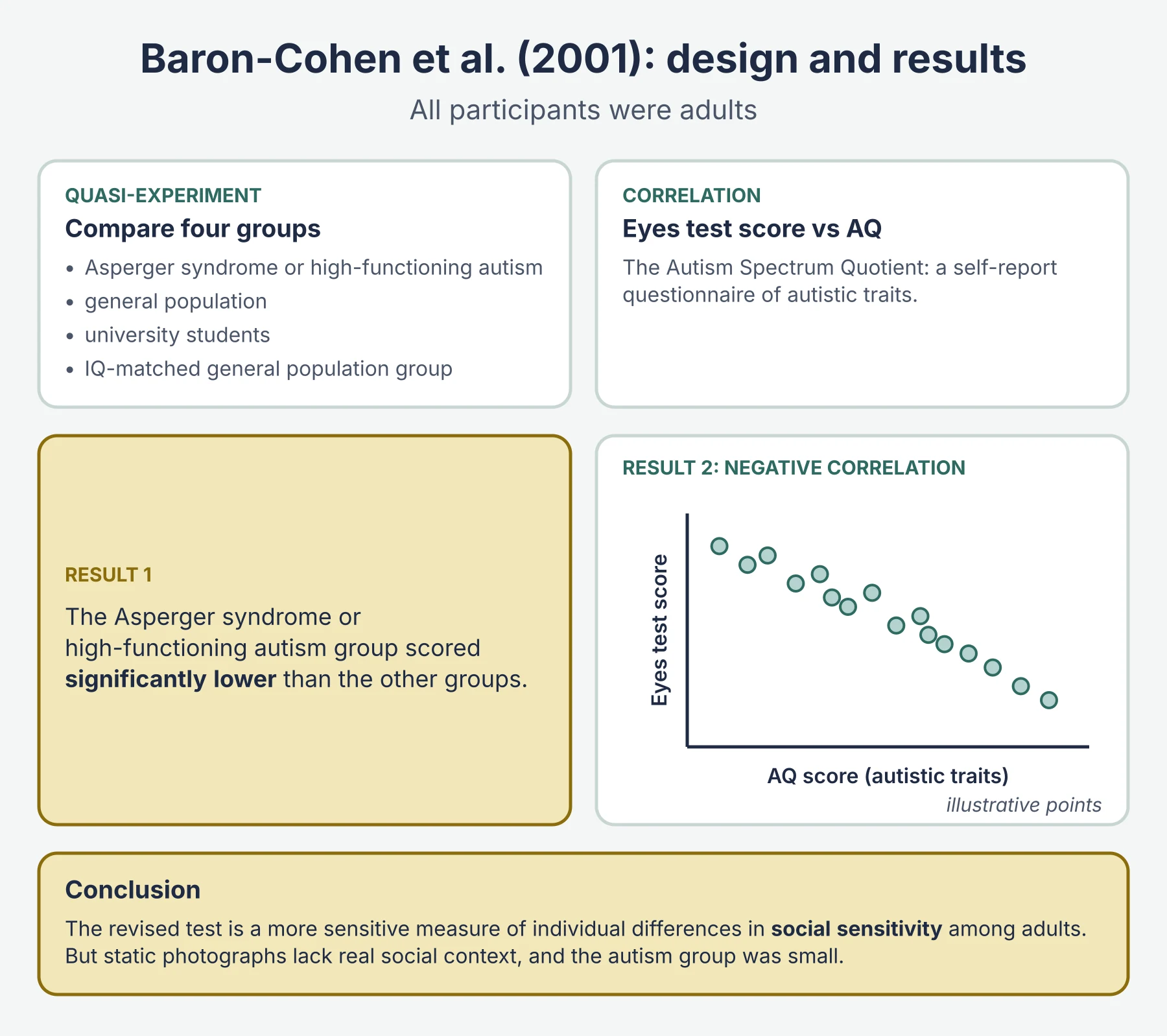
Sample and design. There were four groups: adults with Asperger syndrome or high-functioning autism; adults from the general population; university students; and a smaller general-population group matched on IQ to the autism group. Participants also completed the Autism Spectrum Quotient (AQ), a self-report questionnaire of autistic traits. Comparing groups is the experimental part (a quasi-experiment, since group membership could not be manipulated); relating Eyes test scores to AQ is the correlational part.
Results and conclusions. The group with Asperger syndrome or high-functioning autism scored significantly lower than the other groups. Across participants, Eyes test scores were negatively correlated with AQ scores: the more autistic traits, the lower the score. The revised test was judged a more sensitive measure of individual differences in social sensitivity among adults.
Evaluation. Four answer choices and 36 items reduce guessing and ceiling effects, improving validity. However, photographs of eyes are static and lack the context of real social situations, so the test may not reflect everyday theory of mind. The autism group was small, which limits generalisation.
Pozzulo et al.: line-ups
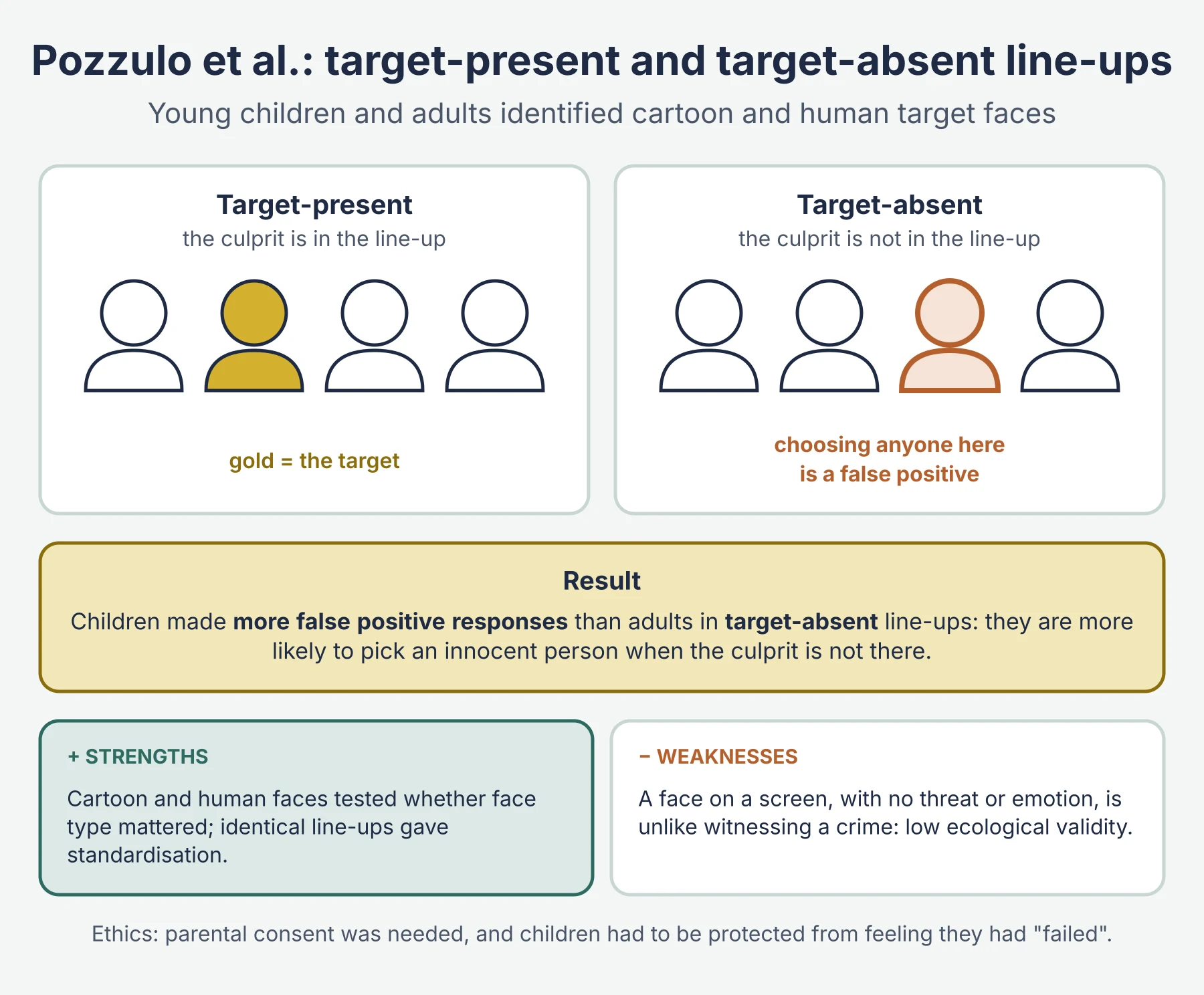
Psychology investigated. Eyewitness testimony and false positive responses. A false positive is choosing someone from a line-up when the culprit is not in it.
Procedure. In a laboratory experiment, young children and adults were shown target faces, including cartoon characters and human faces, and then made identifications from line-ups. Some line-ups contained the target (target-present) and others did not (target-absent). Interviews and questionnaires were used as techniques alongside the identification task.
Results and conclusion. Children made more false positive responses than adults in target-absent line-ups. This shows that young children are more likely to pick an innocent person when the culprit is not present, which matters for how police use child witnesses.
Evaluation. Using both cartoon and human faces allowed the researchers to see whether the type of face mattered, and identical line-ups for every participant gave standardisation. However, seeing a face on a screen with no threat or emotion is very different from witnessing a crime, so ecological validity is low. Ethically, children cannot give informed consent themselves, so parental consent was needed, and they had to be protected from feeling they had “failed”.
Annotated answer
Question: Explain how the study by Andrade supports the second assumption of the cognitive approach. [2]
“The second assumption says people differ in cognitive processing such as attention and memory (1). In Andrade’s study, participants who shaded shapes while listening recalled about 29% more information than those who did not, showing that differences in attention during a task produce differences in memory (1).”
The answer states the assumption, then gives a specific finding and links it back. Simply describing the procedure would not earn the second mark.
Common mistakes
- Calling Andrade’s task “free doodling”: participants shaded printed shapes.
- Writing that Baron-Cohen et al. tested children: all participants were adults.
- Describing the Eyes test as having two choices: that was the original version; the revised one has four.
- Confusing target-present and target-absent line-ups, or defining a false positive as “picking the wrong person in any line-up”.
- Ignoring the correlational element of Baron-Cohen et al., which the syllabus names.
Exam technique
For outline and describe questions, give the specific features: Andrade’s 40 participants, two conditions and surprise test; the 36 items with four words in the Eyes test; the target-absent line-ups in Pozzulo et al. For evaluate, the cognitive studies give strong material on laboratory control against ecological validity. For the issues and debates, Pozzulo et al. is your main cognitive example of the use of children; Baron-Cohen et al. links to individual explanations of behaviour; and all three support the application of psychology to everyday life (classrooms, diagnosis and police line-ups). In Section B compare questions, contrast the measures used: recall scores, chosen words from a test, and identification decisions.
Official syllabus
Cambridge International AS & A Level Psychology 9990 syllabus for 2024, 2025 and 2026, section 3.1.1 The core studies, Cognitive approach — cambridgeinternational.org.
More resources on this topic
Related resources
-
Practice questions
Cambridge International AS & A Level Psychology (9990): Cognitive approach – Practice Questions
Original Paper 1 style questions with mark-scheme answers on the 9990 cognitive approach: Andrade, Baron-Cohen et al. and Pozzulo et al.
Psychology · Cambridge · AS Level
Try questions -
Revision notes
Cambridge International AS & A Level Psychology (9990): Cognitive approach – Revision Notes
Revision notes for the 9990 cognitive approach: assumptions, Andrade, Baron-Cohen et al. and Pozzulo et al. in a grid, key terms, traps and a self-test.
Psychology · Cambridge · AS Level
Revise topic -
Study guides
Cambridge International AS & A Level Psychology (9990): Learning approach
Cambridge 9990 Psychology learning approach: blank-slate assumptions, conditioning and social learning, and the Bandura, Fagen and Saavedra core studies.
Psychology · Cambridge · AS Level
Read guide
Studying Psychology?
This page is free and stays free. Marlbridge is not offering Psychology classes at the moment, so there is no tuition to book for it. The free study resources stay open to everyone.
Get free revision emails (optional)
Occasional emails with practice questions, worked explanations and links to free resources for the qualification and subjects you choose. No spam, and you can unsubscribe from any email. The free tools on this site never need an email.