
Revision Notes
Cambridge International AS & A Level Psychology (9990): Biological approach – Revision Notes
Revision notes for the 9990 biological approach: assumptions, key figures from the three core studies, key terms, exam traps and a 12-question self-test.
- Subject
- Psychology
- Level
- AS LEVEL
- Topic
- Paper 1 – Approaches, Issues and Debates
- Author
- Marlbridge Academic Team
- Updated
- Reviewed by
- Kanwal Aslam (what this means)
Aligned to Cambridge A Level Psychology (9990), 2024-2026. Official specification .
Syllabus page (what it covers and how it is assessed): Cambridge A Level Psychology.
Syllabus points this page covers
9990 (AS Level)
- Biological approach
These notes condense the biological approach of Cambridge International AS & A Level Psychology (9990), syllabus for 2024 to 2026. Learn the two assumptions, the three core studies element by element, and the link from each study to the issues and debates. For fuller explanations and a worked answer, read the biological approach study guide; then try the biological approach practice questions.
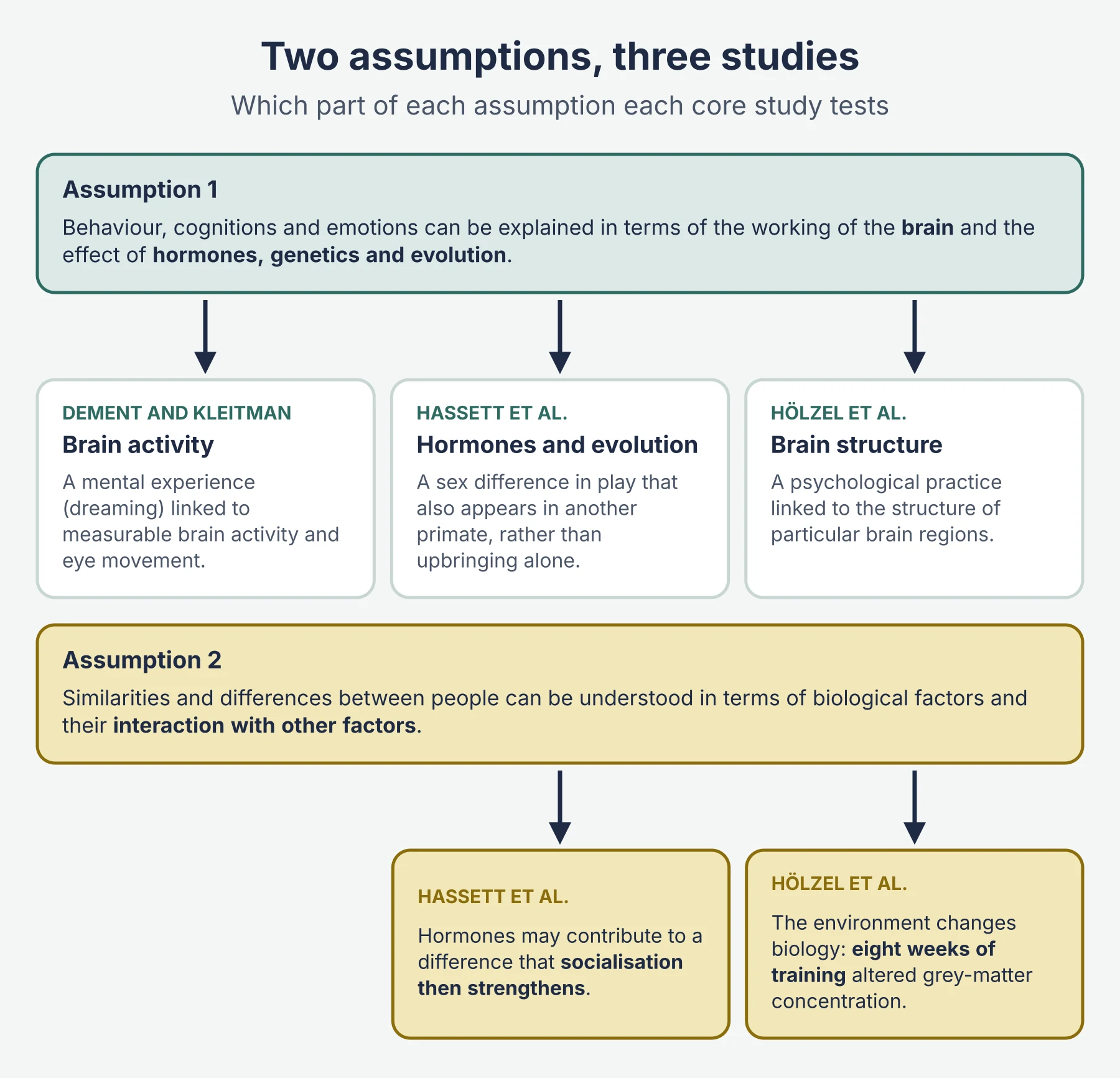
The two assumptions in one line each
- Behaviour, cognitions and emotions are explained by the brain, hormones, genetics and evolution.
- Similarities and differences between people come from biological factors and their interaction with other factors.
Match each study to the part of the assumption it best supports: Dement and Kleitman (brain activity and cognition), Hassett et al. (hormones and evolution), Hölzel et al. (brain structure and its interaction with experience).
Core studies grid
| Element | Dement and Kleitman (1957) | Hassett et al. (2008) | Hölzel et al. (2011) |
|---|---|---|---|
| Psychology | Sleep, dreaming, ultradian rhythms | Sex differences, socialisation, play, hormones | Mindfulness, localisation of function |
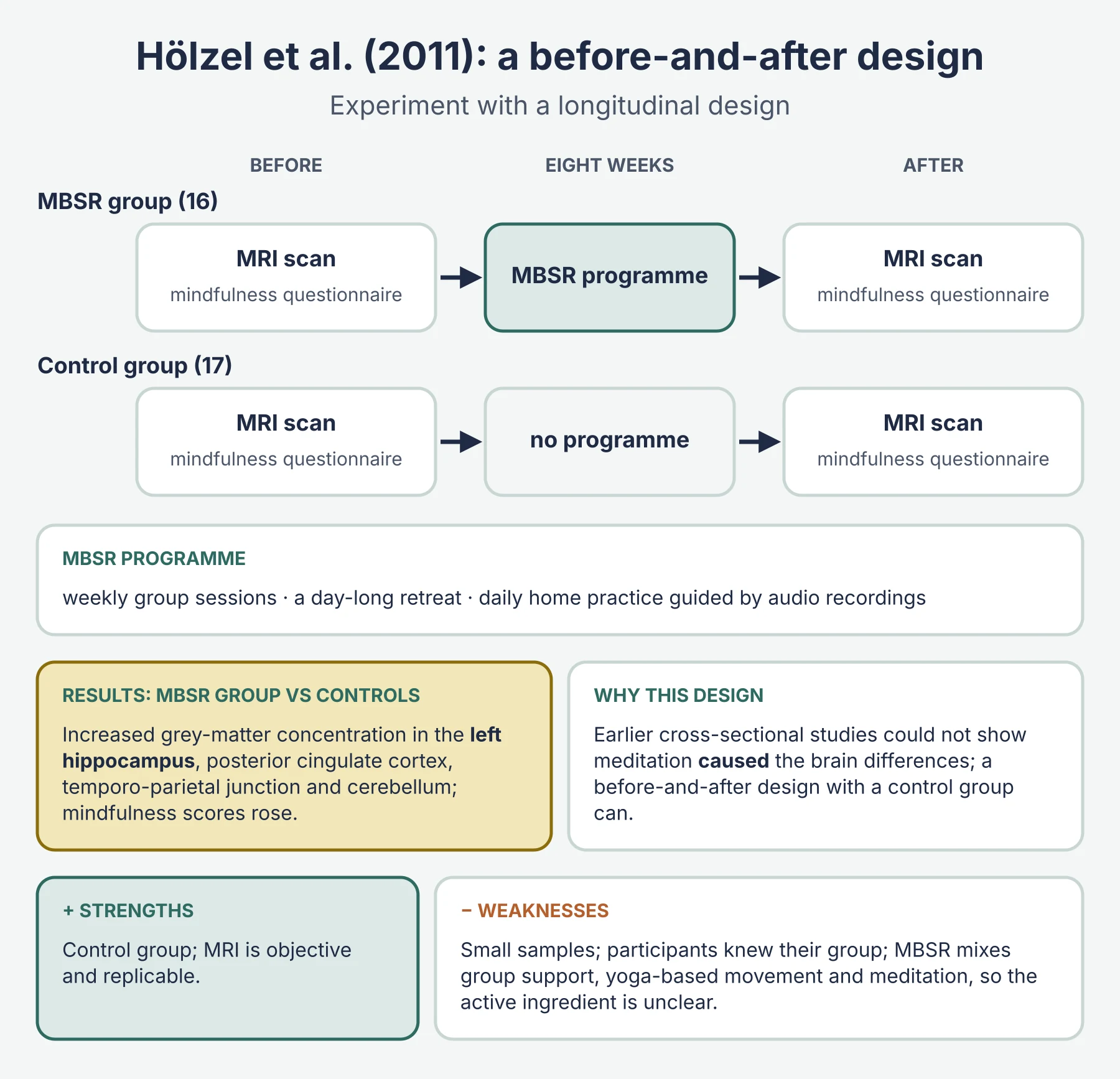
| Method | Laboratory; experimental and correlational; interview technique | Experiment using observation and a behavioural checklist | Experiment with longitudinal design; MRI; self-report; correlations |
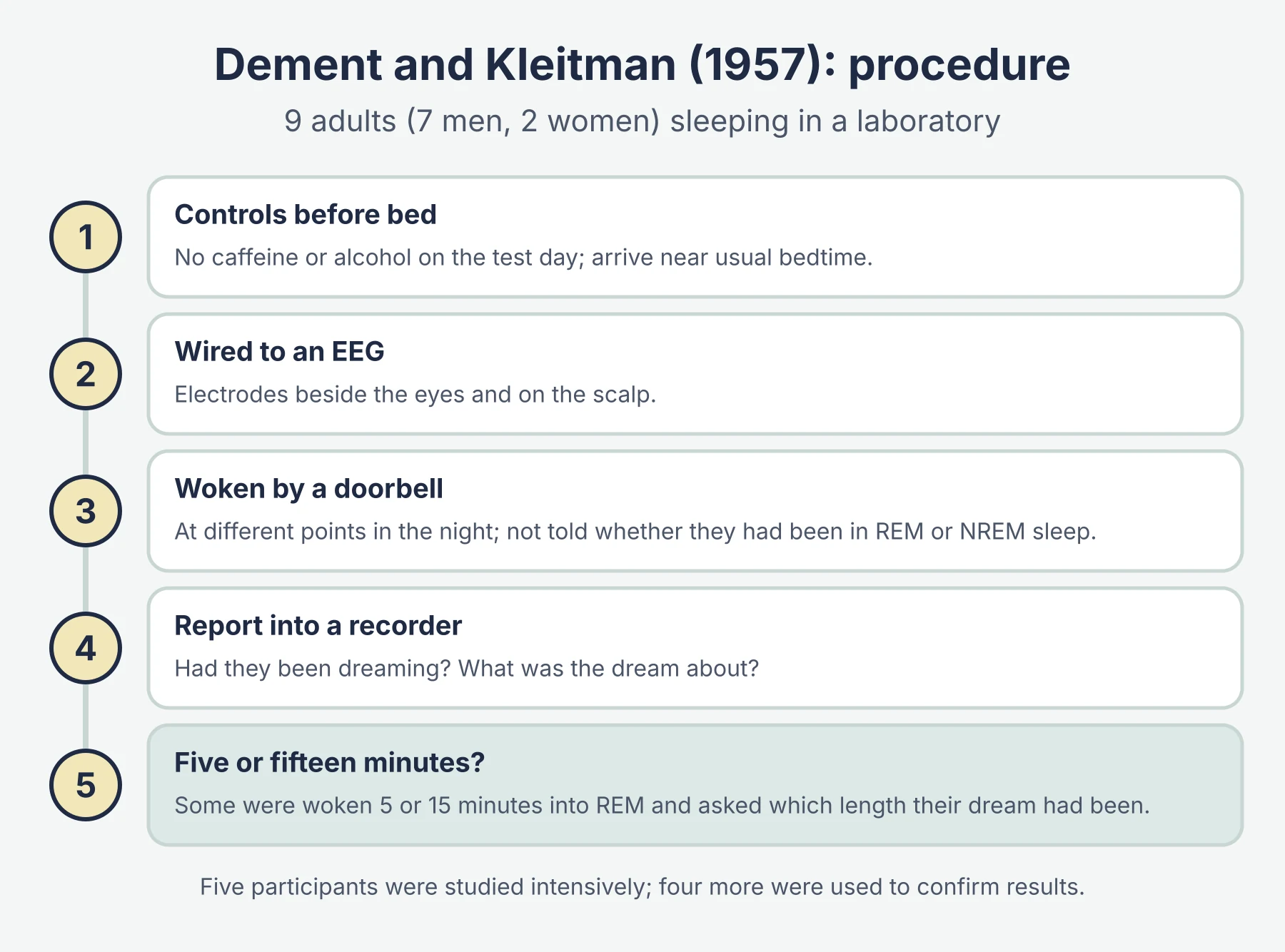
| Sample | 9 adults (7 men, 2 women); 5 studied intensively | A troop of rhesus monkeys at a field station | 16 in MBSR group, 17 controls |
| IV / DV | REM vs NREM waking; dream recall | Sex of monkey; interaction with wheeled vs plush toys | MBSR vs no MBSR; grey-matter concentration |
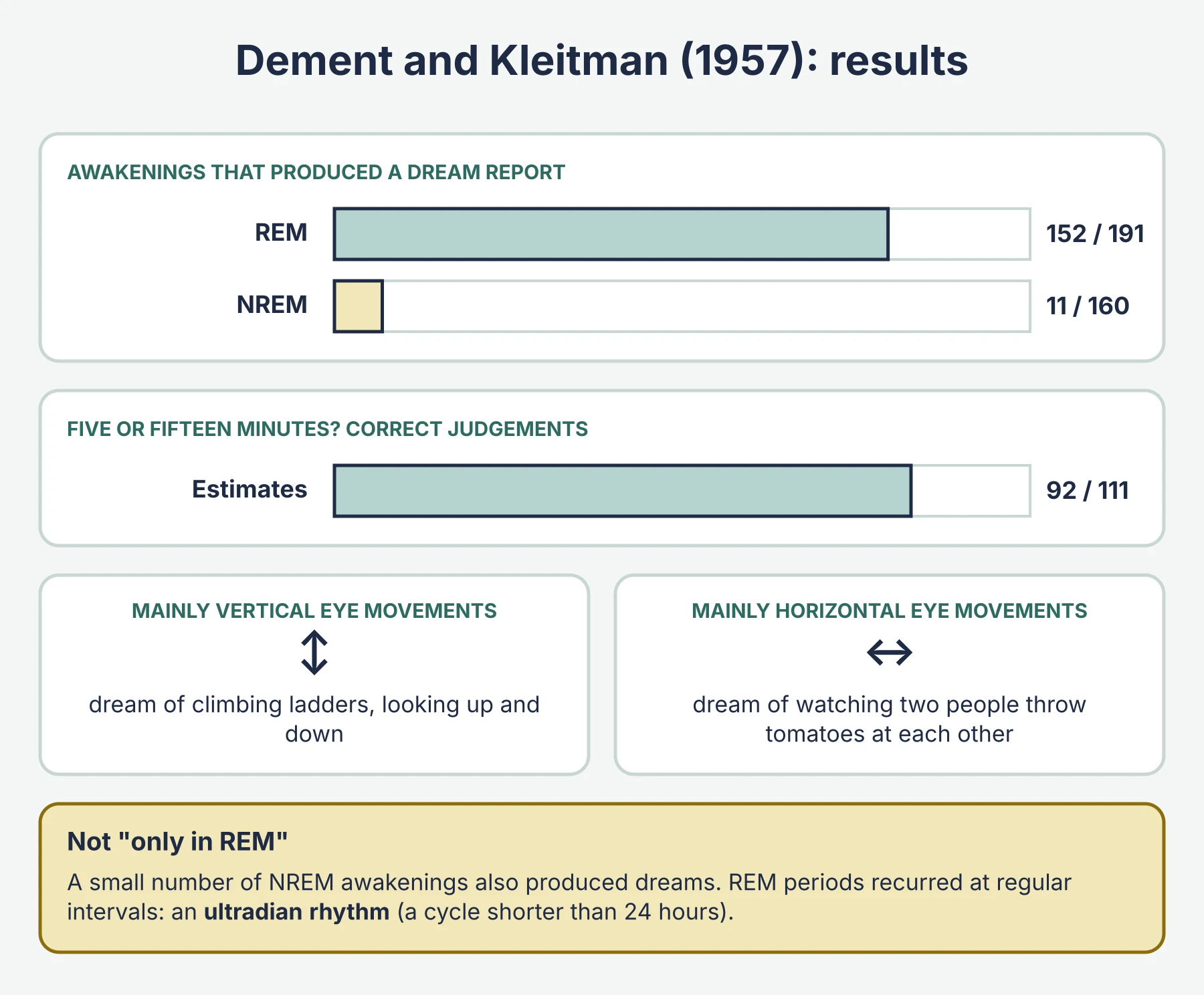
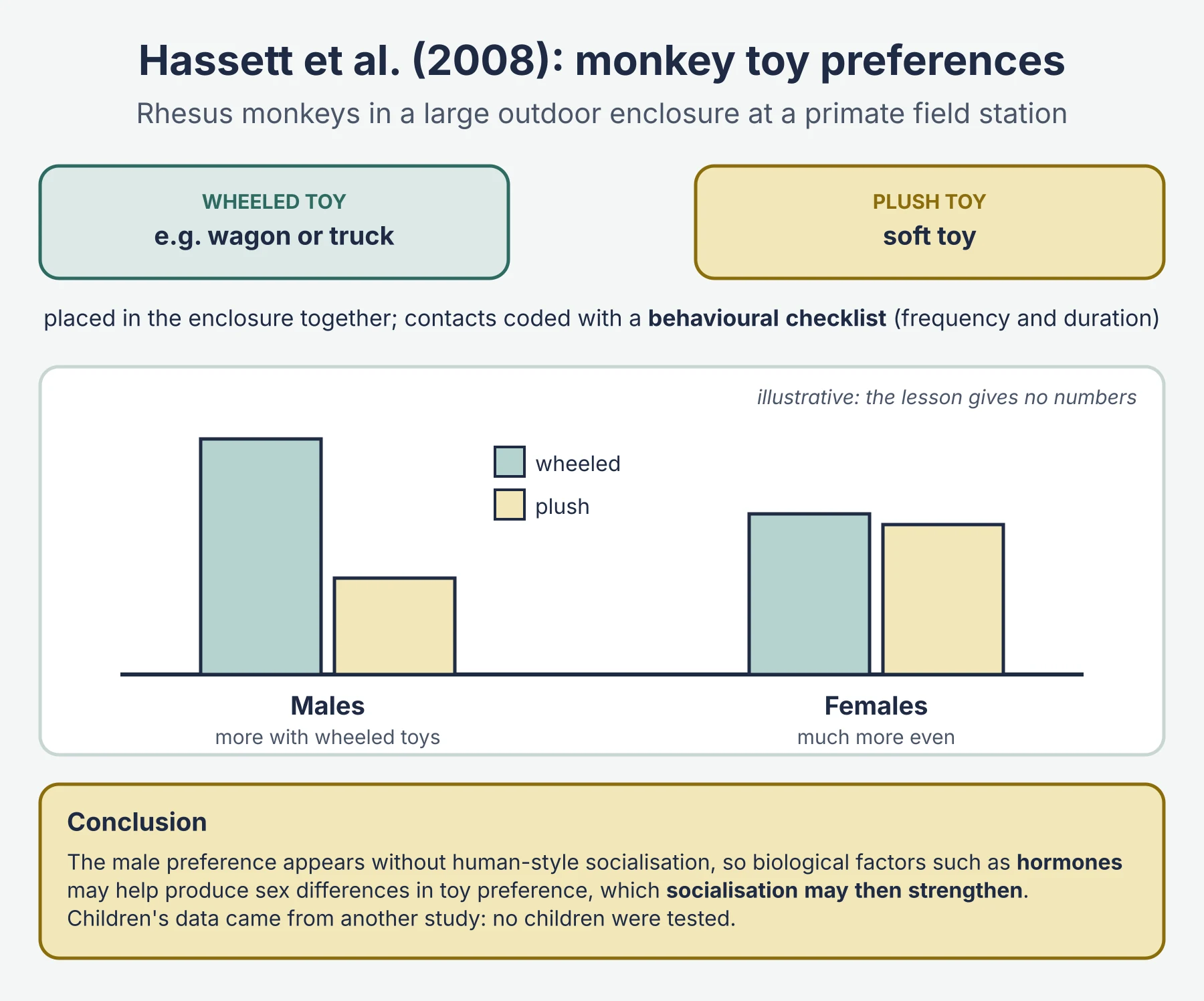
| Key results | 152 of 191 REM awakenings gave dreams; 11 of 160 NREM; 92 of 111 duration estimates correct | Males preferred wheeled toys; females used both more evenly | Grey matter increased in left hippocampus, posterior cingulate, temporo-parietal junction, cerebellum |
| Conclusion | REM is linked to dreaming; eye movements may reflect dream content | Biological factors may contribute to sex-typed toy preference | Mindfulness practice changes brain structure |
Key terms
| Term | Meaning |
|---|---|
| EEG | Electroencephalograph: records electrical brain activity through scalp electrodes |
| REM sleep | Stage with rapid eye movements and an active EEG, linked to vivid dreaming |
| NREM sleep | All other sleep stages; slower brain waves, few dream reports |
| Ultradian rhythm | A biological cycle shorter than 24 hours, such as the sleep cycle |
| Behavioural checklist | A list of defined behaviours that observers tally or time |
| Socialisation | Learning the norms of a group, including gender roles, from others |
| Androgens | Hormones such as testosterone, higher in males |
| Grey matter | Brain tissue made mainly of neuron cell bodies |
| MRI | Magnetic resonance imaging: a structural scan of the brain |
| MBSR | Mindfulness-Based Stress Reduction, an eight-week group programme |
| Localisation of function | The idea that particular brain areas carry out particular functions |
| Longitudinal design | The same participants are measured more than once over time |
Evaluation hooks
- Dement and Kleitman: objective EEG and standardised waking (reliable), but small sample, artificial sleeping conditions and subjective dream reports.
- Hassett et al.: checklist coding allows inter-observer checks; monkeys in their social group; but monkeys learn from each other and may not generalise to children.
- Hölzel et al.: before-and-after scans with a control group show change over time; but small groups, no blinding, and MBSR has several ingredients.
Issues and debates links
- Nature versus nurture: Hassett et al. supports nature; Hölzel et al. shows nurture (practice) changing biology.
- Use of animals: Hassett et al. used monkeys in their normal group with no harm or deprivation.
- Individual and situational explanations: sex is an individual factor in Hassett et al.; mindfulness training is a situational intervention in Hölzel et al.
- Application to everyday life: REM research informs sleep studies; mindfulness programmes for stress; toy design and marketing.
Exam traps
- “People only dream in REM”: false; 11 NREM awakenings produced dreams.
- Saying Dement and Kleitman had a large sample: only nine participants.
- Including children as participants in Hassett et al.: they came from another study’s data.
- Writing that Hölzel et al. measured stress only: the main dependent variable was grey-matter concentration from MRI.
- Labelling all three as laboratory experiments: Hassett et al. took place in the monkeys’ outdoor enclosure.
- Evaluating with generic points (“it lacks ecological validity”) without saying what was artificial.
Self-test
- State the two main assumptions of the biological approach.
- Why were Dement and Kleitman’s participants asked to avoid caffeine and alcohol?
- How were participants woken and how did they record dreams?
- Give the proportion of REM awakenings that produced a dream report.
- What did participants estimate in the duration part of the study, and how accurate were they?
- Which eye-movement pattern went with a dream of climbing ladders?
- Why did Hassett et al. study monkeys rather than children?
- Describe the difference between male and female monkeys’ toy interactions.
- Name the technique used to code the monkeys’ behaviour.
- How many participants were in Hölzel et al.’s MBSR group and control group?
- Name the self-report measure used by Hölzel et al.
- Which brain region was a main focus of Hölzel et al., and why is it relevant?
Answers: (1) behaviour, cognitions and emotions are explained by the brain, hormones, genetics and evolution; similarities and differences come from biological factors and their interaction with other factors. (2) these substances affect sleep, so avoiding them controlled a variable that could change sleep patterns. (3) by a doorbell; they spoke into a recorder beside the bed. (4) 152 of 191. (5) whether the dream had lasted five or fifteen minutes; 92 of 111 estimates were correct. (6) mainly vertical eye movements. (7) monkeys are assumed to be less influenced by human gender socialisation, so a sex difference suggests a biological contribution. (8) males interacted more with wheeled than plush toys; females interacted with both more evenly. (9) a behavioural checklist. (10) 16 and 17. (11) the Five Facet Mindfulness Questionnaire. (12) the left hippocampus, linked to learning, memory and emotional regulation.
Official syllabus
Cambridge International AS & A Level Psychology 9990 syllabus for 2024, 2025 and 2026, section 3.1.1, Biological approach — cambridgeinternational.org.
More resources on this topic
Related resources
-
Study guides
Cambridge International AS & A Level Psychology (9990): Cognitive approach
Cambridge 9990 Psychology cognitive approach: the input-process-output assumption and the Andrade, Baron-Cohen et al. and Pozzulo et al. core studies.
Psychology · Cambridge · AS Level
Read guide -
Practice questions
Cambridge International AS & A Level Psychology (9990): Cognitive approach – Practice Questions
Original Paper 1 style questions with mark-scheme answers on the 9990 cognitive approach: Andrade, Baron-Cohen et al. and Pozzulo et al.
Psychology · Cambridge · AS Level
Try questions -
Revision notes
Cambridge International AS & A Level Psychology (9990): Cognitive approach – Revision Notes
Revision notes for the 9990 cognitive approach: assumptions, Andrade, Baron-Cohen et al. and Pozzulo et al. in a grid, key terms, traps and a self-test.
Psychology · Cambridge · AS Level
Revise topic
Studying Psychology?
This page is free and stays free. Marlbridge is not offering Psychology classes at the moment, so there is no tuition to book for it. The free study resources stay open to everyone.
Get free revision emails (optional)
Occasional emails with practice questions, worked explanations and links to free resources for the qualification and subjects you choose. No spam, and you can unsubscribe from any email. The free tools on this site never need an email.