
Study Guides
Cambridge International AS & A Level Psychology (9990): Biological approach
Cambridge 9990 Psychology biological approach: the two main assumptions and the Dement and Kleitman, Hassett et al. and Hölzel et al. core studies.
- Subject
- Psychology
- Level
- AS LEVEL
- Topic
- Paper 1 – Approaches, Issues and Debates
- Author
- Marlbridge Academic Team
- Updated
- Reviewed by
- Kanwal Aslam (what this means)
Aligned to Cambridge A Level Psychology (9990), 2024-2026. Official specification .
Syllabus page (what it covers and how it is assessed): Cambridge A Level Psychology.
Syllabus points this page covers
9990 (AS Level)
- Biological approach
The biological approach is one of the four groups of core studies in Cambridge International AS & A Level Psychology (9990). The syllabus gives it two main assumptions and three compulsory core studies: Dement and Kleitman (1957) on sleep and dreams, Hassett et al. (2008) on monkey toy preferences, and Hölzel et al. (2011) on mindfulness and brain scans. This guide goes deeper into those three studies than the Paper 1 Approaches, Issues and Debates overview, and shows how each one is examined.
When you have read it, condense it with the biological approach revision notes and test yourself with the biological approach practice questions.
What the syllabus asks you to know
For every core study the syllabus lists the same eight elements: the psychology being investigated, the background, the aims, the procedure (including research method, sample, design, controls, question types, data-collection technique and variables), the ethical issues, the results, the conclusions, and the strengths and weaknesses of every element. You must also be able to describe and evaluate the methodology and relate each study to the AS Level issues and debates.
The syllabus summaries are worth learning closely because they tell you which methods it expects you to name:
| Study | Methods named in the syllabus | Psychology being investigated |
|---|---|---|
| Dement and Kleitman | EEG; experimental and correlational methods; interview technique | Sleep; dreaming; ultradian rhythms |
| Hassett et al. | Experiment; observation coded with a behavioural checklist; data on children taken from another study | Sex differences; socialisation; play; role of hormones |
| Hölzel et al. | Experiment with a longitudinal design; MRI scans; self-reports; correlations | Mindfulness; localisation of function |
The two assumptions, applied
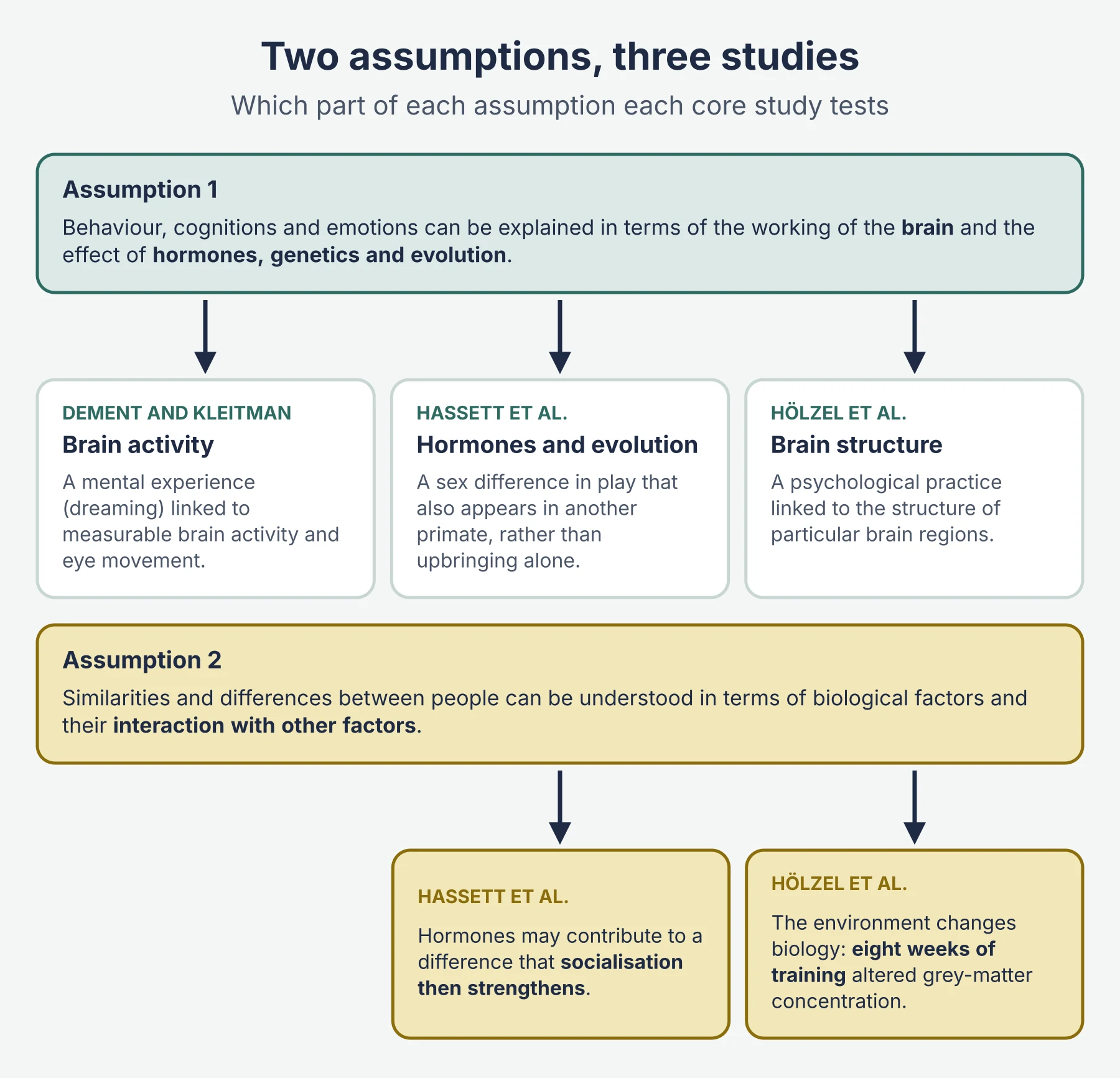
The first assumption is that behaviour, cognitions and emotions can be explained in terms of the working of the brain and the effect of hormones, genetics and evolution. Each study tests a different part of this sentence. Dement and Kleitman link a mental experience (dreaming) to measurable brain activity and eye movement. Hassett et al. look for a sex difference in play that appears in another primate, which points to hormones and evolution rather than upbringing. Hölzel et al. link a psychological practice to the structure of particular brain regions.
The second assumption is that similarities and differences between people can be understood in terms of biological factors and their interaction with other factors. The phrase “interaction with other factors” matters. Hölzel et al. show the environment changing biology: eight weeks of training altered grey-matter concentration. Hassett et al. do not claim socialisation is irrelevant; they argue that hormones may contribute to a difference that socialisation then strengthens.
Dement and Kleitman (1957): sleep and dreams
Background. Earlier work had found that sleepers show periods of rapid eye movement (REM), alternating with periods of slower brain waves. If REM could be shown to go with dreaming, dreams could be studied objectively rather than relying only on what people remember the next morning.
Aims. The researchers tested three ideas: that dream recall is more likely after waking from REM than from non-REM (NREM) sleep; that people’s estimates of how long they had been dreaming relate to how long the REM period had lasted; and that the pattern of eye movements relates to what the dream was about.
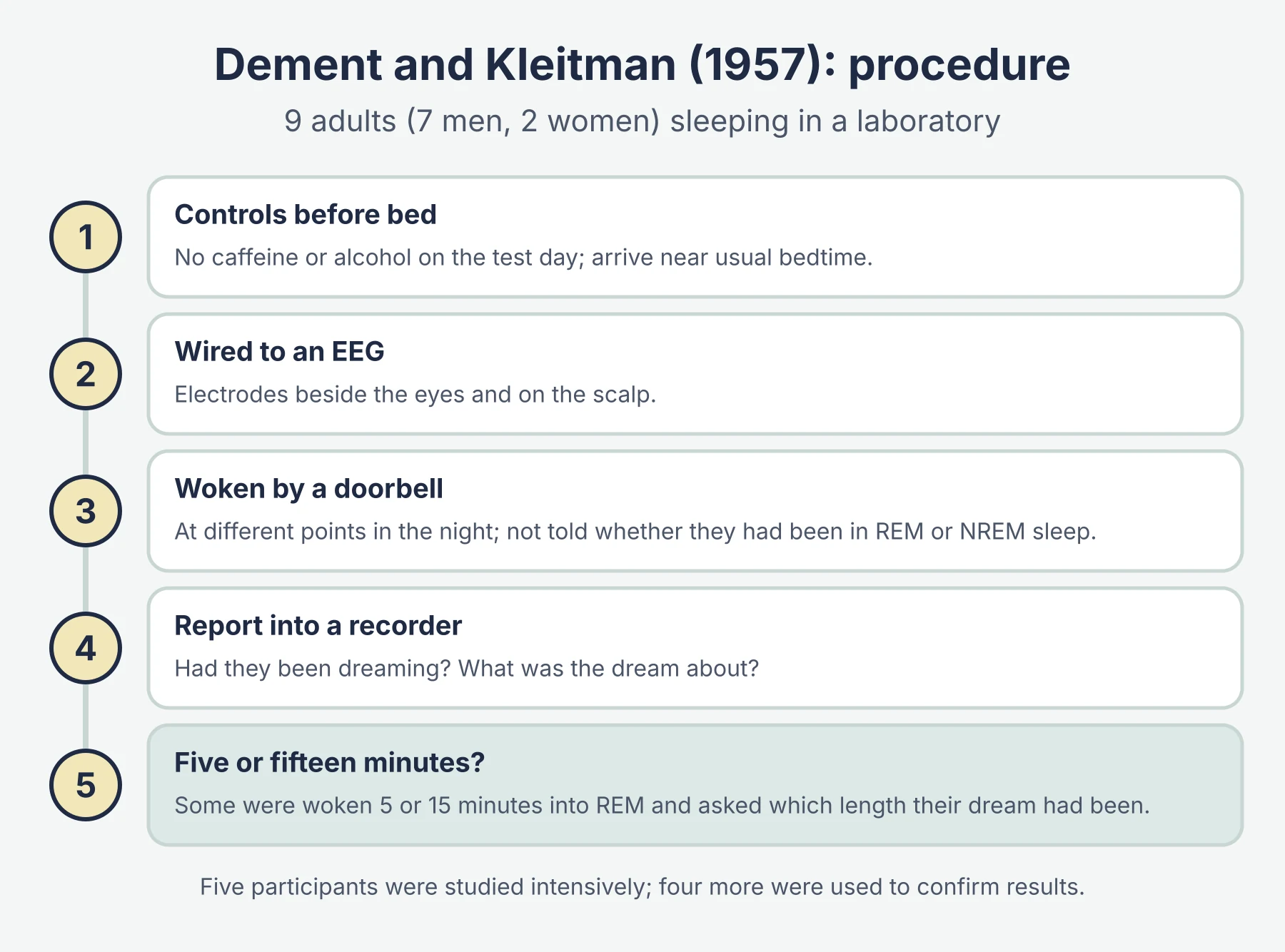
Procedure. Nine adults (seven men and two women) slept in a laboratory; five were studied intensively and four more were used to confirm results. They avoided caffeine and alcohol on the day of testing, arrived near their usual bedtime and had electrodes placed beside the eyes and on the scalp, connected to an EEG. A doorbell woke them at different points in the night and they spoke into a recorder by the bed, saying whether they had been dreaming and describing the content. They were not told whether they had been in REM or NREM sleep. In one part of the study they were woken either five or fifteen minutes into a REM period and asked which length they thought their dream had been.
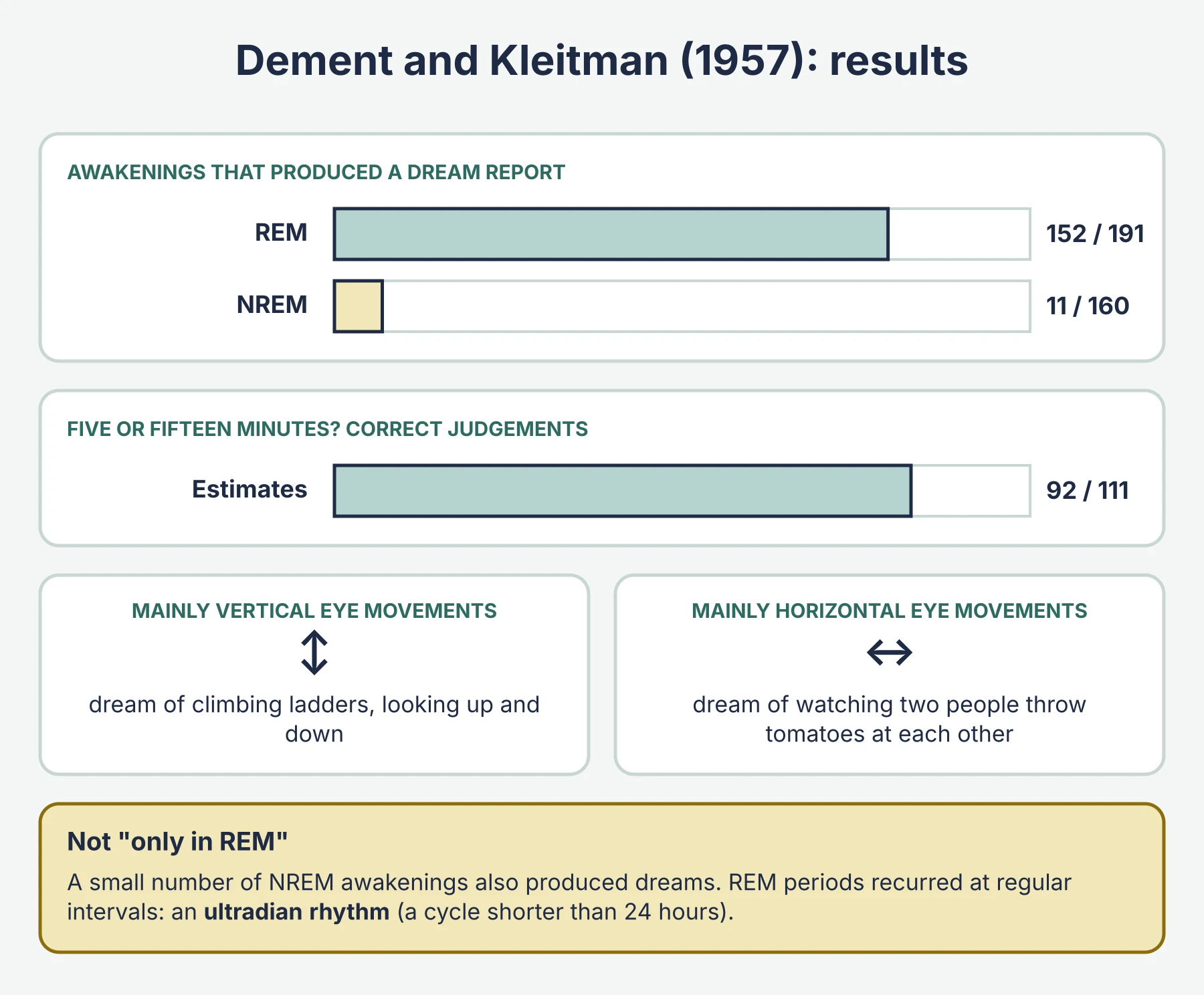
Results. Of 191 awakenings from REM, 152 produced a dream report; of 160 awakenings from NREM, only 11 did. For the five-or-fifteen-minute estimates, 92 of 111 judgements were correct. Eye-movement patterns matched reported content: mainly vertical movements went with a dream of climbing ladders and looking up and down, and mainly horizontal movements with a dream of watching two people throw tomatoes at each other.
Conclusions. REM sleep is closely associated with dreaming, the length of REM relates to perceived dream length, and eye movements may reflect where the dreamer is “looking” in the dream. REM periods recurred at regular intervals through the night, an example of an ultradian rhythm (a cycle shorter than 24 hours).
Evaluation.
- Strengths: the EEG gives objective, quantitative data; controls such as the doorbell and the recorder standardise the waking and reporting procedure, so it is replicable.
- Weaknesses: the sample is small and the sleeping conditions (electrodes, an unfamiliar room, repeated waking) are unlike normal sleep, which lowers ecological validity. Dream reports are subjective self-reports and cannot be checked directly.
- Ethics: risk of harm was low, but repeated waking disrupts sleep, so participants needed to know this beforehand and be able to withdraw.
Hassett et al. (2008): monkey toy preferences
Background. Boys and girls tend to prefer different toys. Socialisation explains this through parents and peers rewarding “sex-appropriate” play; a hormonal explanation says prenatal androgens influence preferences. Rhesus monkeys are assumed to be less affected by human gender socialisation, so a similar difference in monkeys would support a biological contribution.
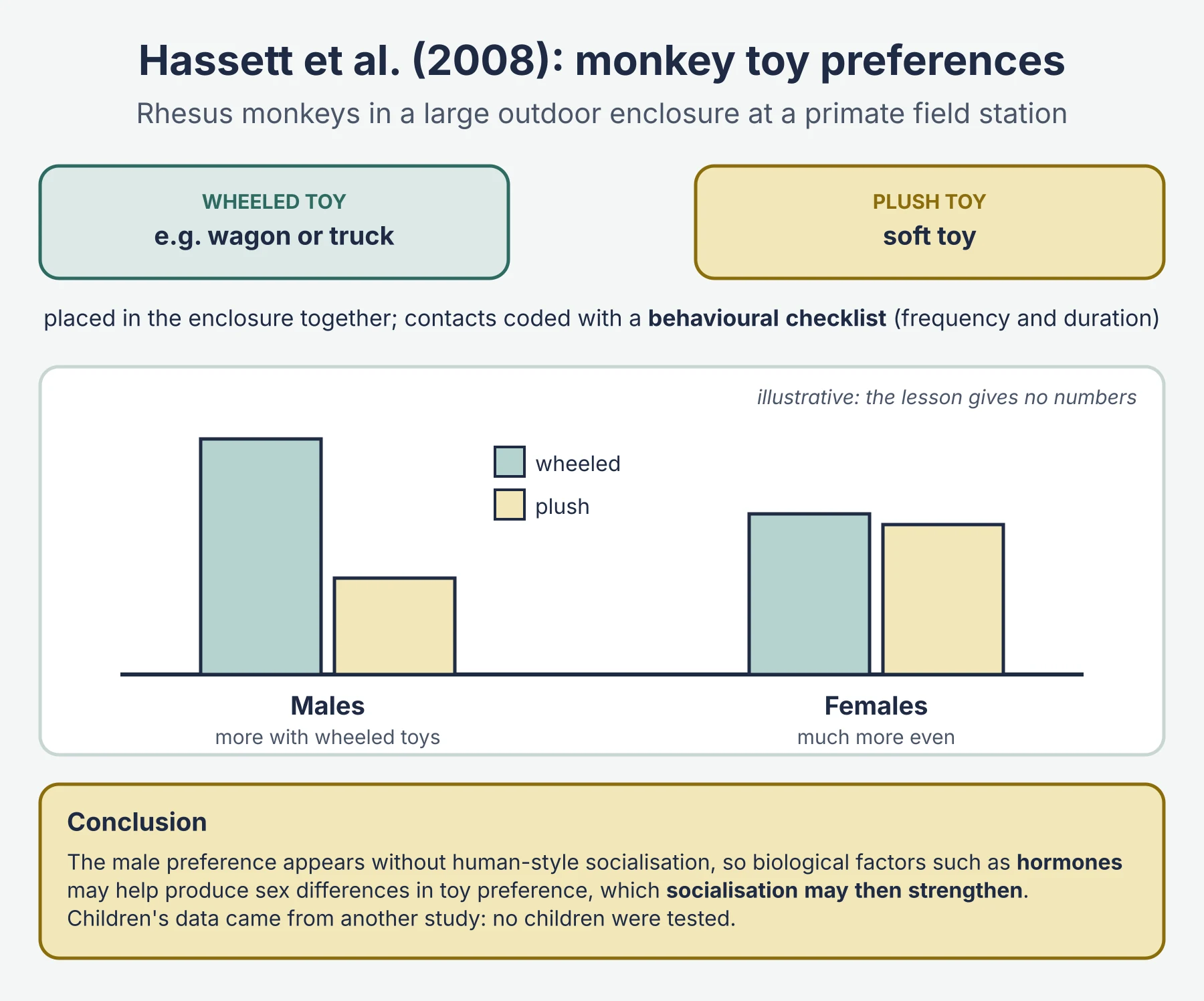
Procedure. A troop of rhesus monkeys living in a large outdoor enclosure at a primate research field station was given a choice between a wheeled toy (such as a wagon or truck) and a plush (soft) toy, placed in the enclosure together. Interactions were recorded and coded using a behavioural checklist, and the frequency and duration of contact with each toy type were compared for males and females. The monkeys’ results were then compared with data on children from another study.
Results and conclusions. Male monkeys interacted more with wheeled toys than with plush toys, as boys tend to. Female monkeys interacted with both types much more evenly. Because the male preference appears without human-style socialisation, the researchers concluded that biological factors, such as hormonal influences, may help produce sex differences in toy preference, which socialisation may then strengthen.
Evaluation. Coding with a behavioural checklist allows two observers to check inter-observer reliability. Monkeys living in their normal social group give high ecological validity for monkey behaviour, but generalising from rhesus monkeys to children is questionable, and monkeys do learn socially from each other, so socialisation is not fully removed. Ethically, the animals were not harmed or deprived, and observing them in their normal social group fits the guideline on housing.
Hölzel et al. (2011): mindfulness and brain scans
Background. Mindfulness meditation was known to reduce stress and improve well-being, and cross-sectional studies had found brain differences between experienced meditators and non-meditators. Those studies could not show that meditation caused the differences; a before-and-after design could.
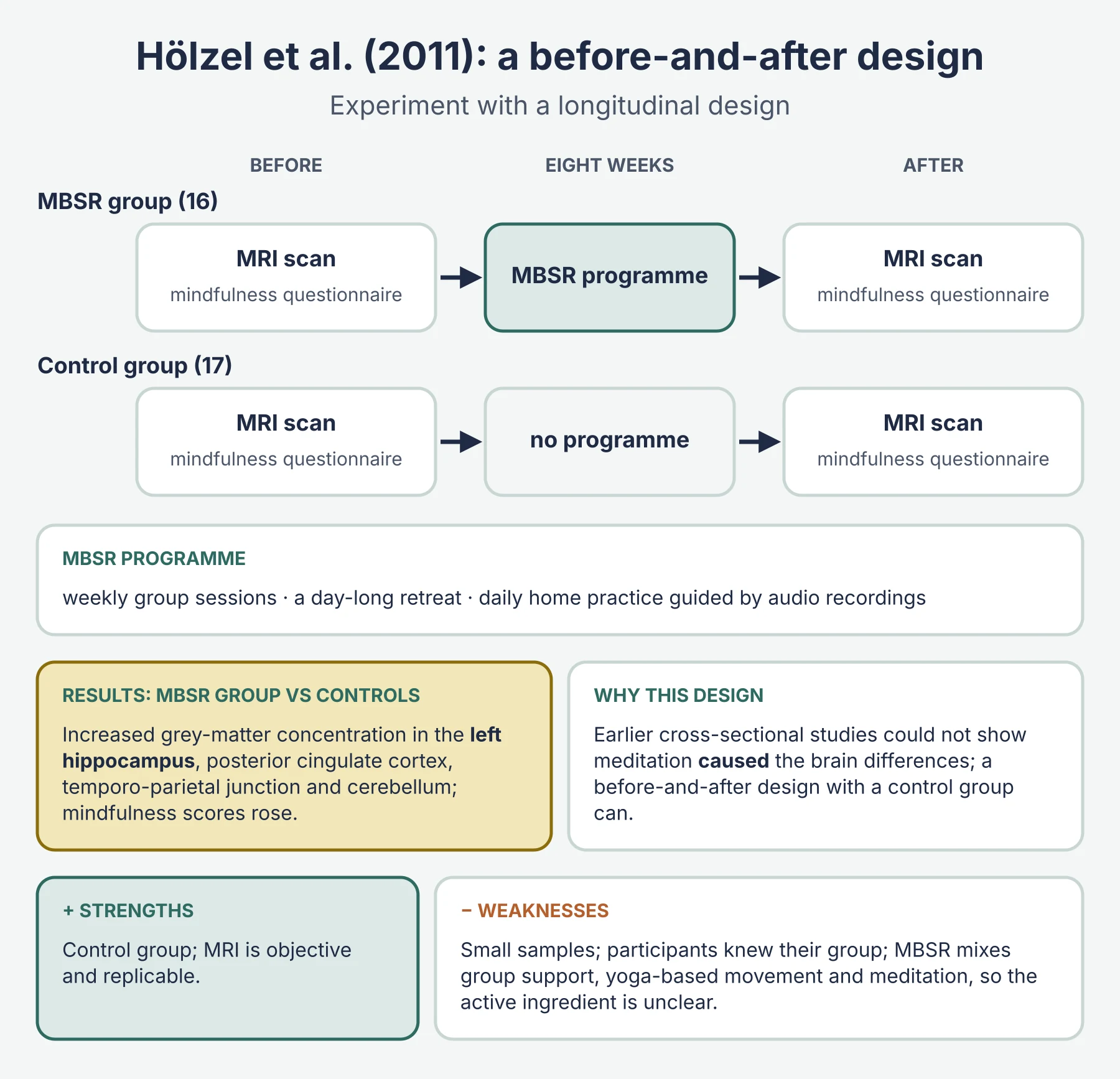
Procedure. Sixteen participants took part in an eight-week Mindfulness-Based Stress Reduction (MBSR) programme of weekly group sessions, a day-long retreat and daily home practice guided by audio recordings. A control group of seventeen people did not take the programme during the study. Both groups had MRI scans of brain structure before and after the eight weeks, and completed a self-report mindfulness questionnaire (the Five Facet Mindfulness Questionnaire).
Results. Compared with controls, the MBSR group showed increased grey-matter concentration in the left hippocampus and in other regions including the posterior cingulate cortex, the temporo-parietal junction and the cerebellum. Mindfulness questionnaire scores rose in the MBSR group.
Conclusions. Mindfulness practice is associated with structural change in regions involved in learning and memory, emotional regulation and perspective taking. This supports localisation of function and shows that experience can change brain structure.
Evaluation. The longitudinal (before-and-after) design with a control group lets changes be attributed to the programme more convincingly than a one-off comparison. MRI is objective and replicable. However, the samples were small, participants knew which group they were in, and MBSR combines several activities (group support, yoga-based movement and meditation), so the active ingredient is unclear.
Worked example
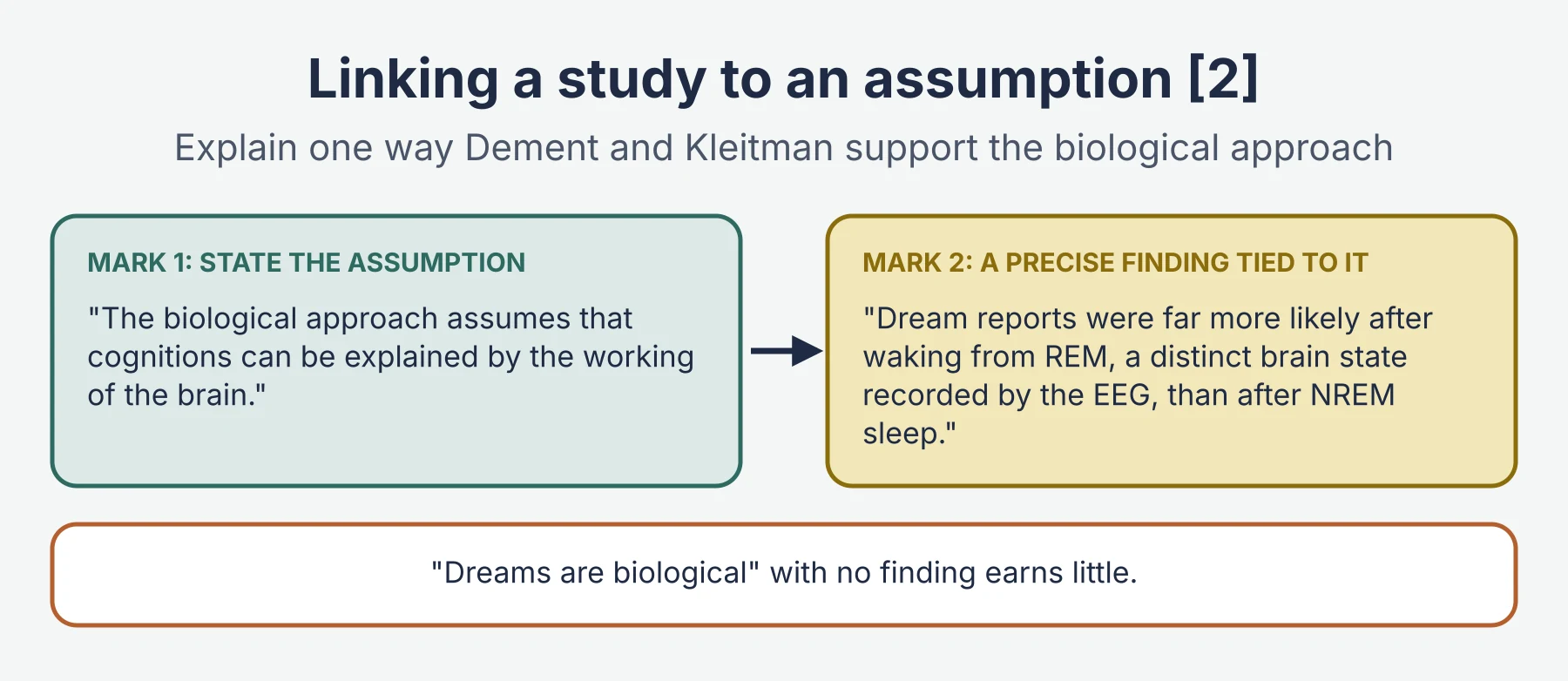
Question: Explain one way in which the study by Dement and Kleitman supports the main assumptions of the biological approach. [2]
A strong answer: “The biological approach assumes that cognitions can be explained by the working of the brain (1). Dement and Kleitman found that dream reports were far more likely after waking from REM sleep, a distinct pattern of brain activity recorded by the EEG, than after NREM sleep, so a mental experience is linked to a measurable brain state (1).”
The first mark comes from stating the assumption accurately; the second from a precise finding tied to it. Writing “dreams are biological” without the finding earns little.
Common mistakes
- Saying Dement and Kleitman found people only dream in REM sleep. A small number of NREM awakenings also produced dreams.
- Describing Hassett et al. as studying children. No human participants were tested; children’s data came from another study.
- Calling Hölzel et al. a correlation only. The main design is an experiment with a longitudinal design; correlations were also used.
- Forgetting that the second assumption includes interaction with other factors, which is how you avoid sounding purely reductionist.
Exam technique for this approach
Describe needs the main features, such as the sample, procedure and results, without evaluation. Explain needs a reason or link, usually “because” followed by evidence from the study. Evaluate needs a judgement: say whether the point is a strength or a weakness and why it matters for this study. Compare questions in Section B may set one biological study against another core study, so prepare similarities and differences in method (for example laboratory EEG measures versus an animal observation) as well as in findings. For the issues and debates, Hassett et al. is your main example of the use of animals, Hölzel et al. of nurture changing biology, and all three of the application of psychology to everyday life (sleep, toy marketing and stress reduction).
Official syllabus
Cambridge International AS & A Level Psychology 9990 syllabus for 2024, 2025 and 2026, section 3.1.1 The core studies, Biological approach — cambridgeinternational.org.
More resources on this topic
Related resources
-
Practice questions
Cambridge International AS & A Level Psychology (9990): Biological approach – Practice Questions
Original Paper 1 style questions with mark-scheme answers on the 9990 biological approach: Dement and Kleitman, Hassett et al. and Hölzel et al.
Psychology · Cambridge · AS Level
Try questions -
Revision notes
Cambridge International AS & A Level Psychology (9990): Biological approach – Revision Notes
Revision notes for the 9990 biological approach: assumptions, key figures from the three core studies, key terms, exam traps and a 12-question self-test.
Psychology · Cambridge · AS Level
Revise topic -
Study guides
Cambridge International AS & A Level Psychology (9990): Cognitive approach
Cambridge 9990 Psychology cognitive approach: the input-process-output assumption and the Andrade, Baron-Cohen et al. and Pozzulo et al. core studies.
Psychology · Cambridge · AS Level
Read guide
Studying Psychology?
This page is free and stays free. Marlbridge is not offering Psychology classes at the moment, so there is no tuition to book for it. The free study resources stay open to everyone.
Get free revision emails (optional)
Occasional emails with practice questions, worked explanations and links to free resources for the qualification and subjects you choose. No spam, and you can unsubscribe from any email. The free tools on this site never need an email.