
Study Guides
Cambridge A Level Psychology (9990): The patient–practitioner relationship
Cambridge 9990 topic 3.1 in depth: clothing and jargon, diagnosis errors, Savage and Armstrong (1990), delay, Munchausen and malingering.
- Subject
- Psychology
- Level
- A LEVEL
- Topic
- Specialist Option 3: Health Psychology
- Author
- Marlbridge Academic Team
- Updated
- Reviewed by
- Kanwal Aslam (what this means)
Aligned to Cambridge A Level Psychology (9990), 2024-2026. Official specification .
Syllabus page (what it covers and how it is assessed): Cambridge A Level Psychology.
Syllabus points this page covers
9990 (A Level)
- 3.1 The patient–practitioner relationship
Topic 3.1, The patient–practitioner relationship, is the first of five topics in Specialist Option 3 (Health Psychology) of Cambridge International A Level Psychology 9990, syllabus for 2024 to 2026. It examines how doctors and patients communicate (3.1.1), how a diagnosis is made and delivered and which consultation style patients prefer (3.1.2), and how people misuse health services by delaying or by feigning illness (3.1.3). The key study is Savage and Armstrong (1990).
The Health Psychology study guide summarises the whole option. This page goes deeper into 3.1. When you have worked through it, condense it with the patient–practitioner relationship revision notes and apply it in the patient–practitioner relationship practice questions.
Syllabus content for 3.1
| Sub-topic | Content | Named study |
|---|---|---|
| 3.1.1 Interpersonal skills | Non-verbal communication, focusing on practitioner clothing; verbal communication, focusing on understanding medical terminology | e.g. McKinstry and Wang (1991); e.g. McKinlay (1975) |
| 3.1.2 Diagnosis and style | Making a diagnosis (disclosure, false positive and false negative) and presenting it; doctor-centred (directed) and patient-centred (sharing) consultation | Key study Savage and Armstrong (1990) |
| 3.1.3 Misusing health services | Reasons for delay in seeking treatment; alternative explanations such as the health belief model; Munchausen syndrome versus malingering, essential and supporting features | e.g. Safer et al. (1979); e.g. Aleem and Ajarim (1995) |
3.1.1 Non-verbal and verbal communication
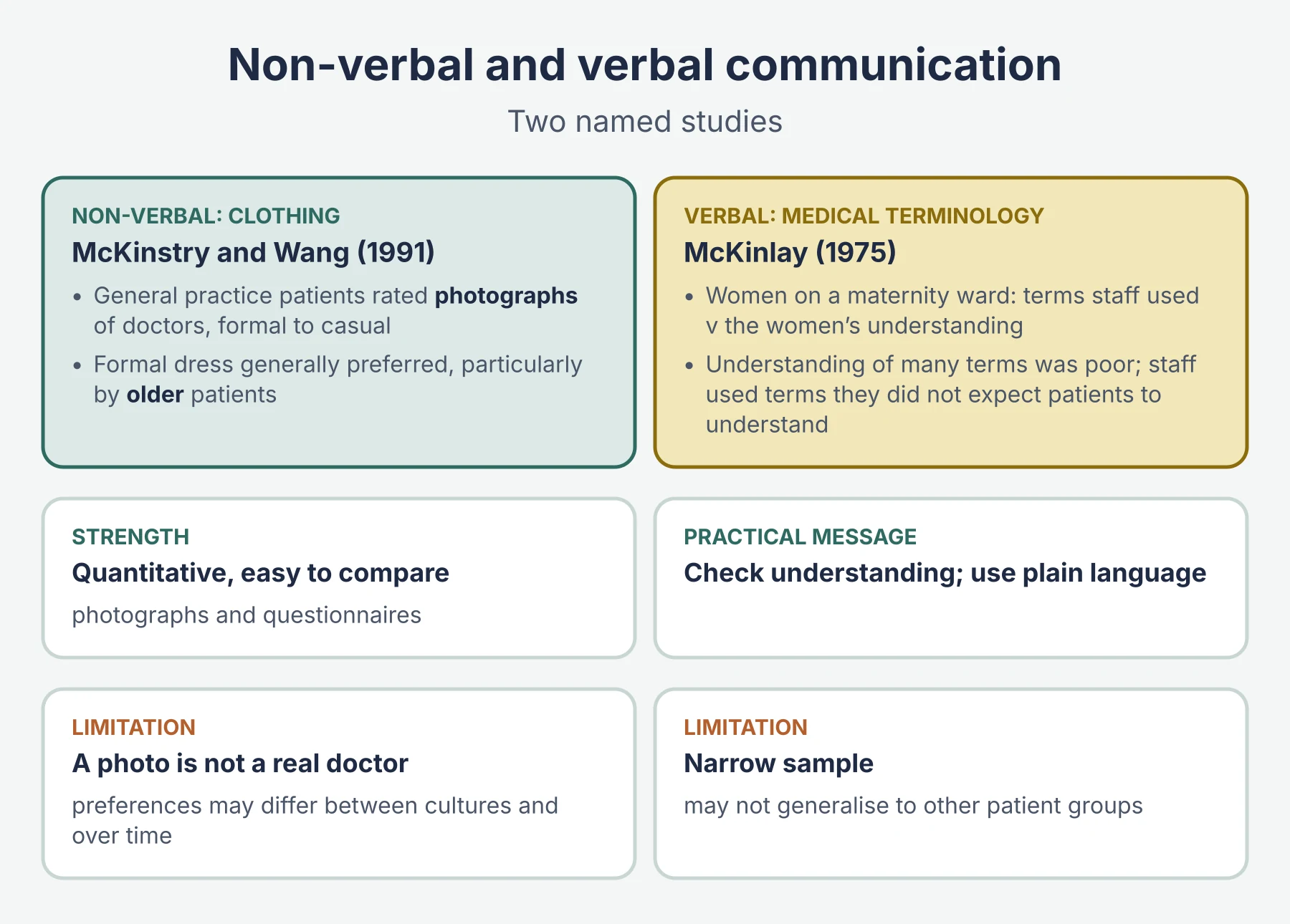
Clothing. What a practitioner wears is a non-verbal signal of professionalism and approachability. McKinstry and Wang (1991) showed patients in general practices photographs of doctors dressed in different styles, from formal to casual, and asked which they preferred and how confident they would feel. Formal dress was generally preferred, particularly by older patients. The study used photographs and questionnaires, giving quantitative data that is easy to compare, but rating a photograph is not the same as meeting a real doctor, and preferences may differ between cultures and over time.
Medical terminology. Jargon can block understanding. McKinlay (1975) studied women on a maternity ward, comparing the medical terms staff used with them against the women’s understanding of those terms. Understanding of many terms was poor, and staff used terms even when they did not expect patients to understand them. The practical message is that practitioners should check understanding and use plain language, but the sample was narrow, so it may not generalise to other patient groups.
3.1.2 Making and presenting a diagnosis
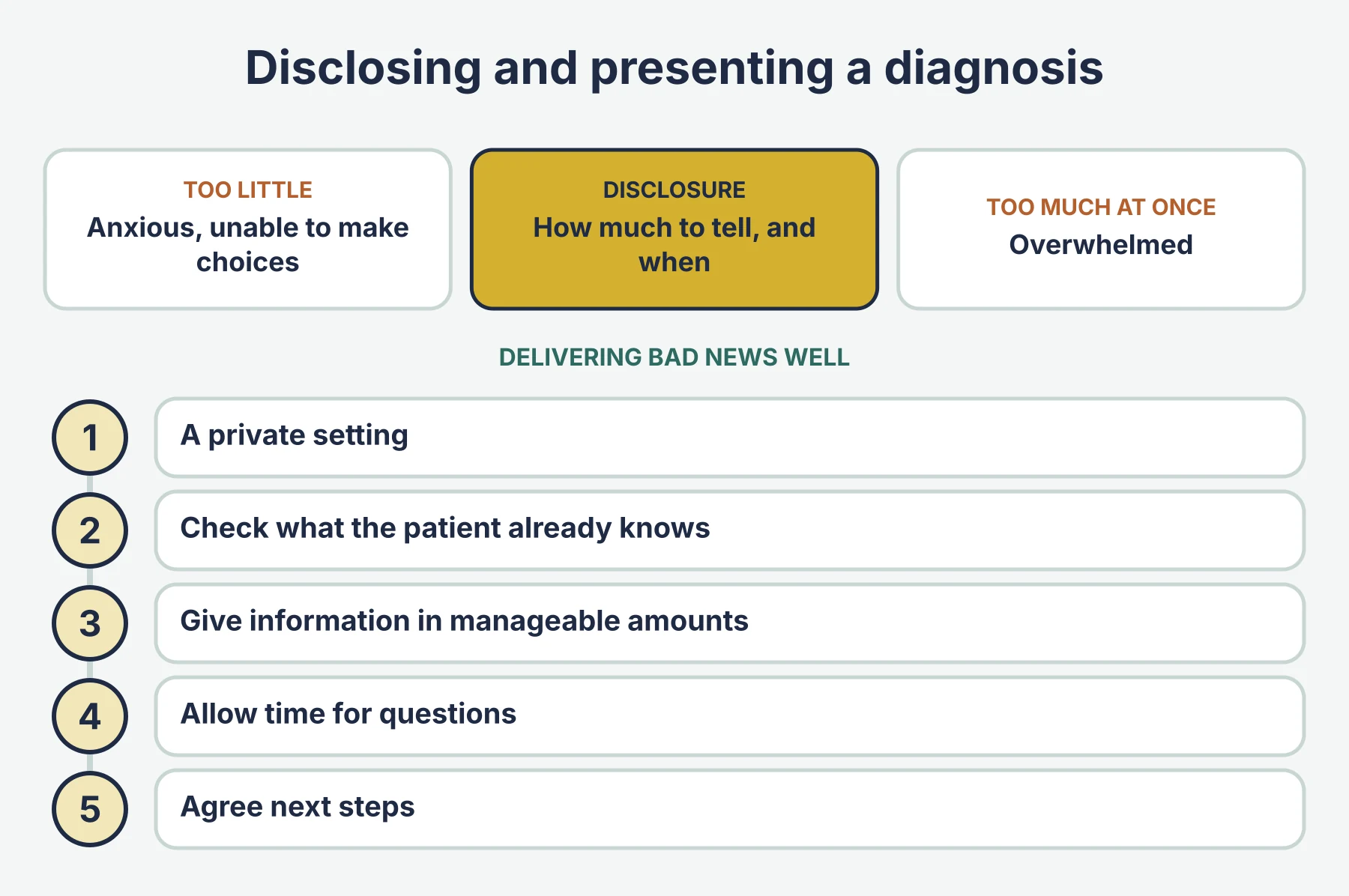
Disclosure. The practitioner decides how much to tell the patient and when. Too little information can leave the patient anxious and unable to make choices; too much at once can overwhelm them.
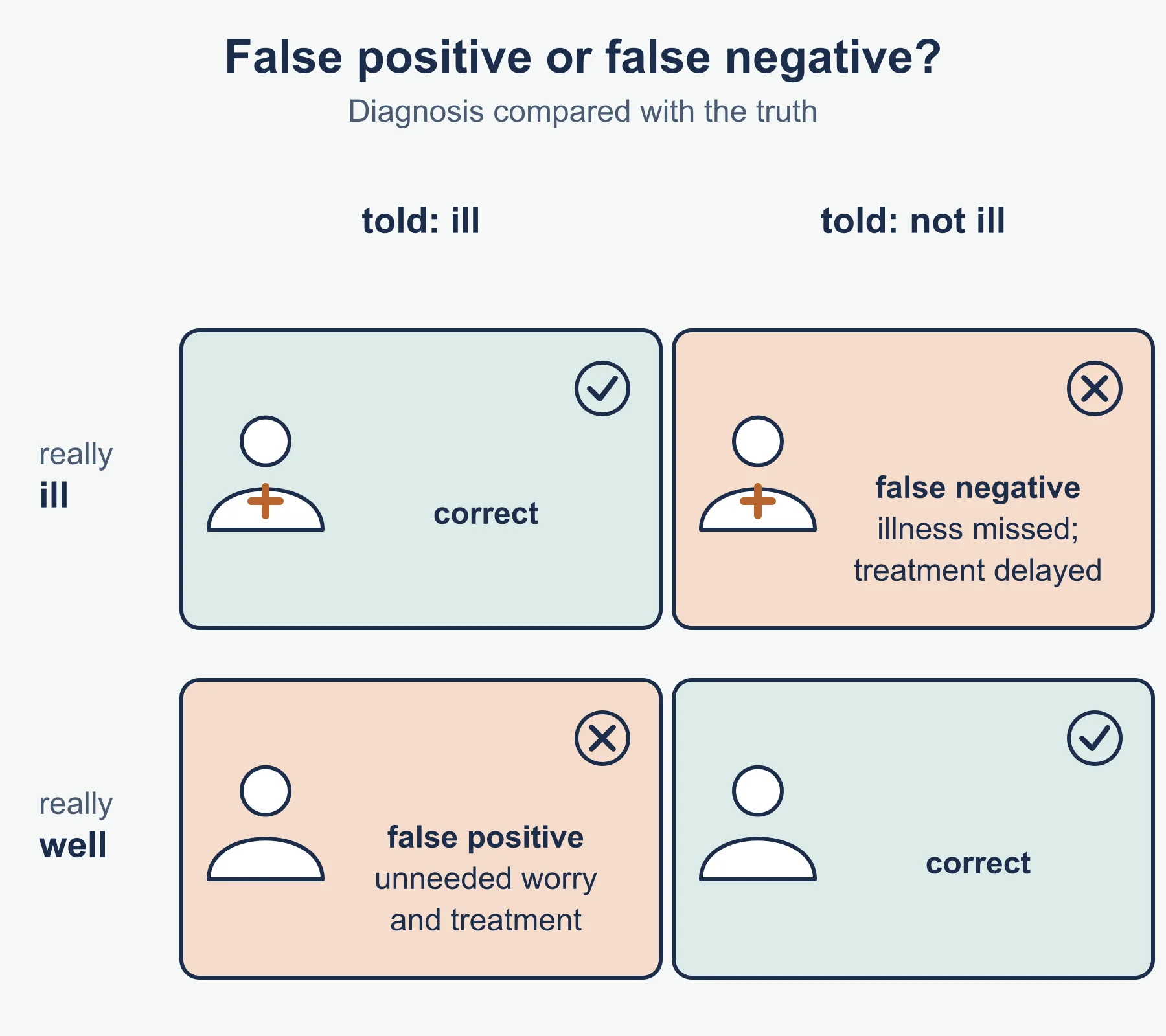
False positives and false negatives.
| Patient has the illness | Patient does not have the illness | |
|---|---|---|
| Diagnosed as ill | Correct diagnosis | False positive |
| Diagnosed as well | False negative | Correct diagnosis |
A false negative can delay treatment, which is dangerous for serious illnesses. A false positive can cause worry, unnecessary tests and side effects of treatment. Practitioners may prefer to risk a false positive when an illness is serious and treatable.
Presenting a diagnosis. Delivering bad news well involves a private setting, checking what the patient already knows, giving information in manageable amounts, allowing time for questions and agreeing next steps.
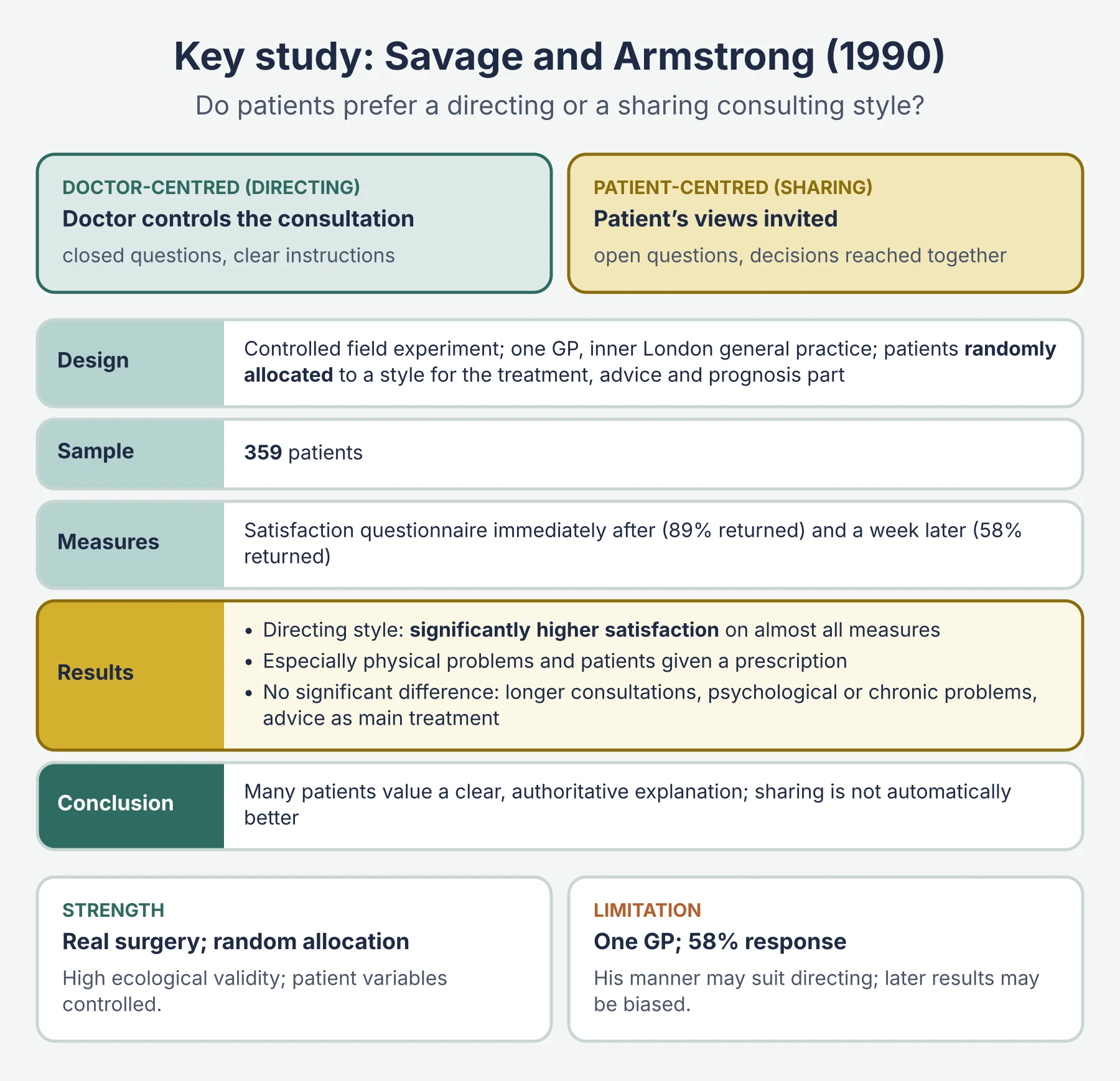
Practitioner style. A doctor-centred (directed) style has the doctor controlling the consultation, asking closed questions and giving clear instructions. A patient-centred (sharing) style invites the patient’s views, uses open questions and reaches decisions together.
Key study: Savage and Armstrong (1990)
Context. By 1990 many guides to consulting recommended the sharing style. Savage and Armstrong tested whether patients actually preferred it.
Aim. To compare patients’ satisfaction with a directing and a sharing consulting style.
Design. A controlled field experiment in an inner London general practice, with one GP. Patients were randomly allocated to receive a directing or a sharing style for the part of the consultation about treatment, advice and prognosis.
Sample. 359 patients consulting the GP.
Data collection. Patients completed a satisfaction questionnaire immediately after the consultation and another a week later. Response rates were 89% and 58%.
Results. Patients who received the directing style reported significantly higher satisfaction on almost all measures, particularly patients with physical problems and patients who were given a prescription. There was no significant difference for longer consultations, for patients with psychological or chronic problems, or where the main treatment was advice.
Conclusion. Many patients value a clear, authoritative explanation; the sharing style is not automatically better.
Evaluation.
- Validity: real patients in a real surgery give high ecological validity; random allocation controls patient variables.
- Generalisation: one GP in one practice; his personal manner may have suited the directing style.
- Response rate: only 58% returned the second questionnaire, so the later results may be biased towards certain patients.
- Individual and situational explanations: the best style depended on the type of problem, a situational factor, and on patients’ preferences.
- Cultural differences: preferences for authority in medicine vary between cultures.
- Determinism versus free will: random allocation meant patients did not choose their style, which raises an ethical point but was necessary for control.
3.1.3 Misusing health services
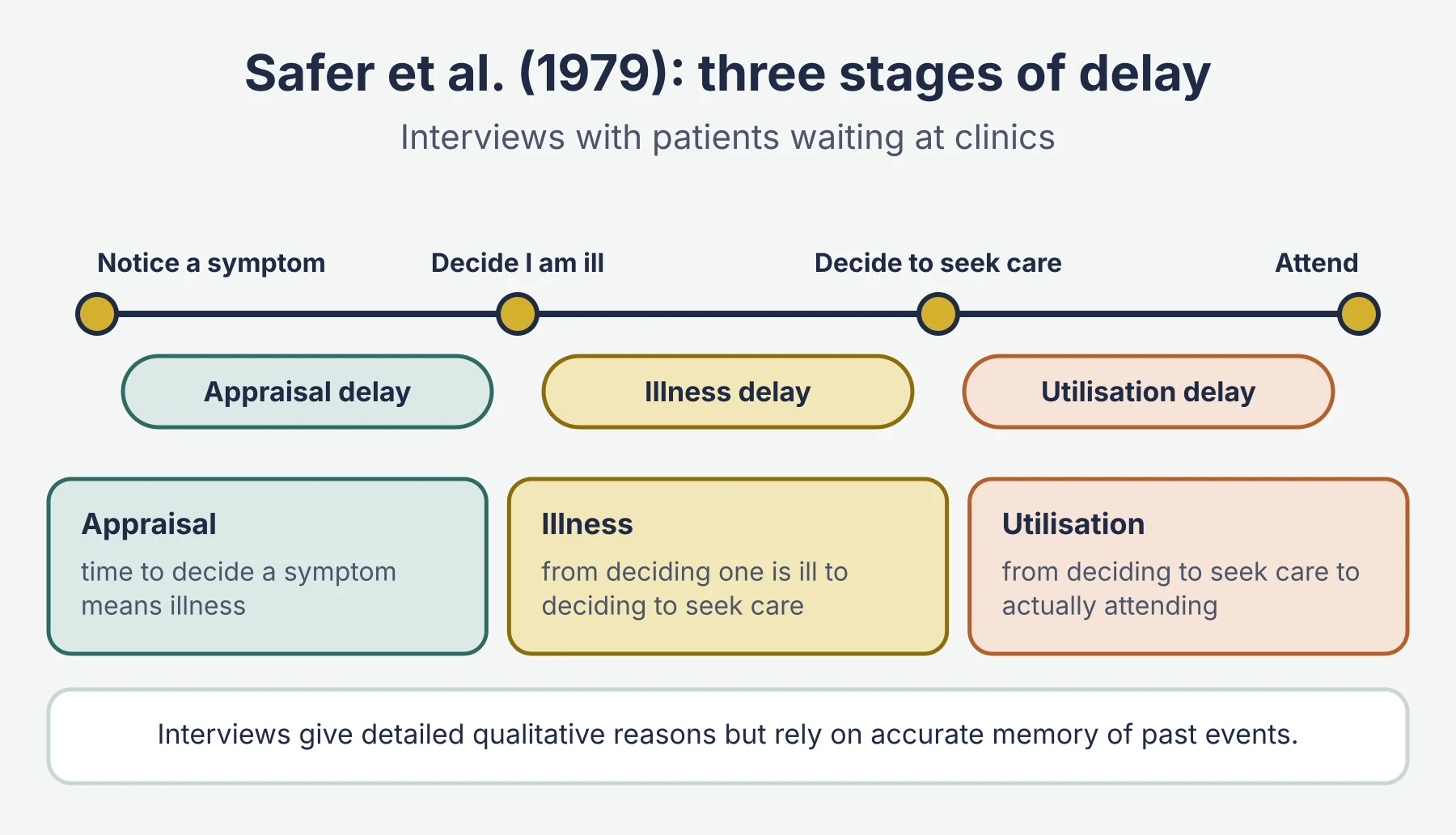
Delay in seeking treatment. Safer et al. (1979) interviewed patients waiting at clinics about the time between noticing a symptom and attending. They divided delay into stages:
- Appraisal delay: the time taken to decide that a symptom means illness.
- Illness delay: the time from deciding one is ill to deciding to seek care.
- Utilisation delay: the time from deciding to seek care to actually attending.
Interviews gave detailed, qualitative reasons, but they rely on accurate memory of past events.
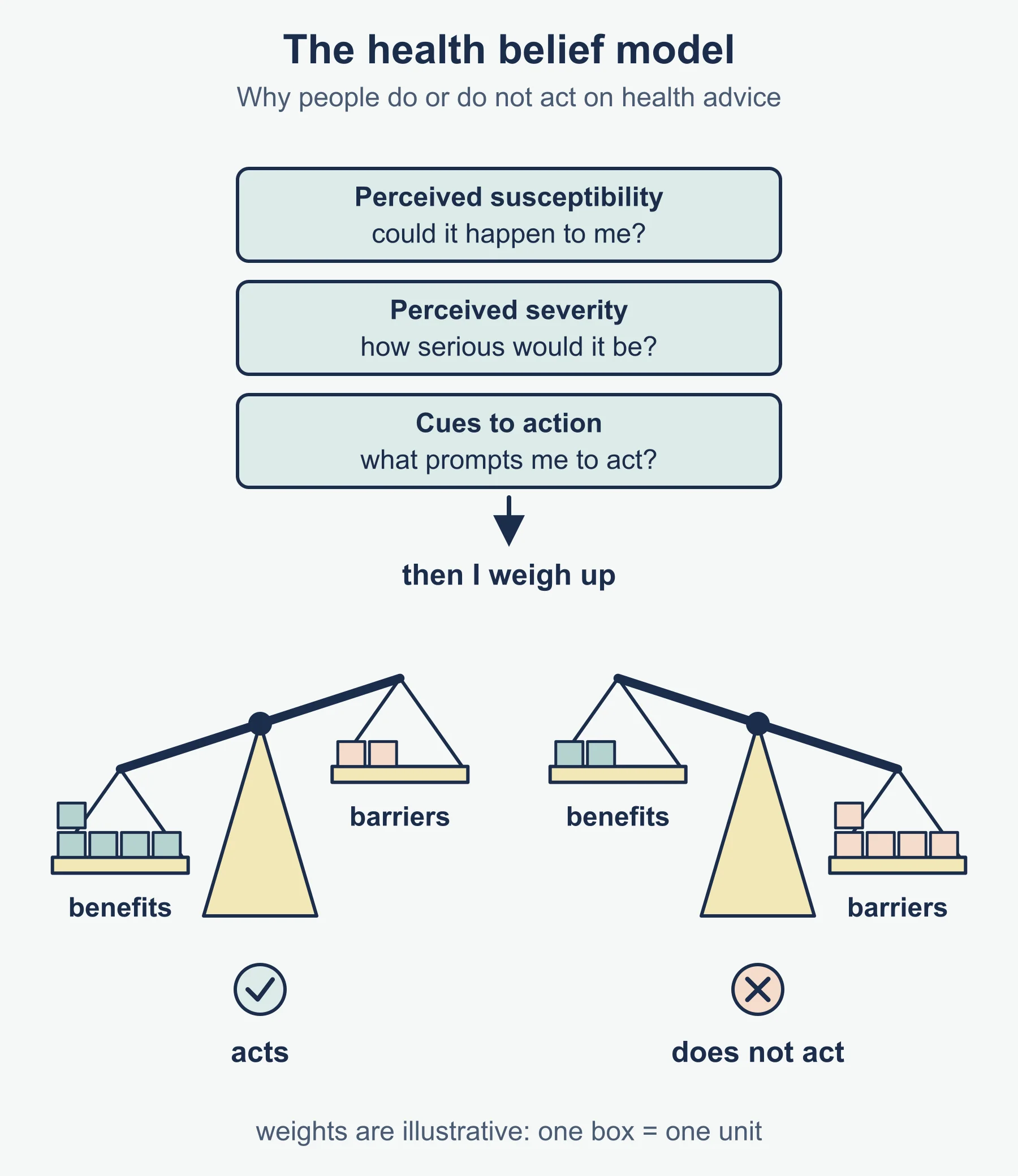
The health belief model as an alternative explanation. A person’s action depends on perceived susceptibility (am I at risk?), perceived severity (how bad is it?), perceived benefits weighed against perceived barriers (cost, time, fear), and cues to action (a symptom getting worse, a reminder). A person who believes a lump is harmless (low perceived severity) or cannot take time off work (high barriers) will delay.
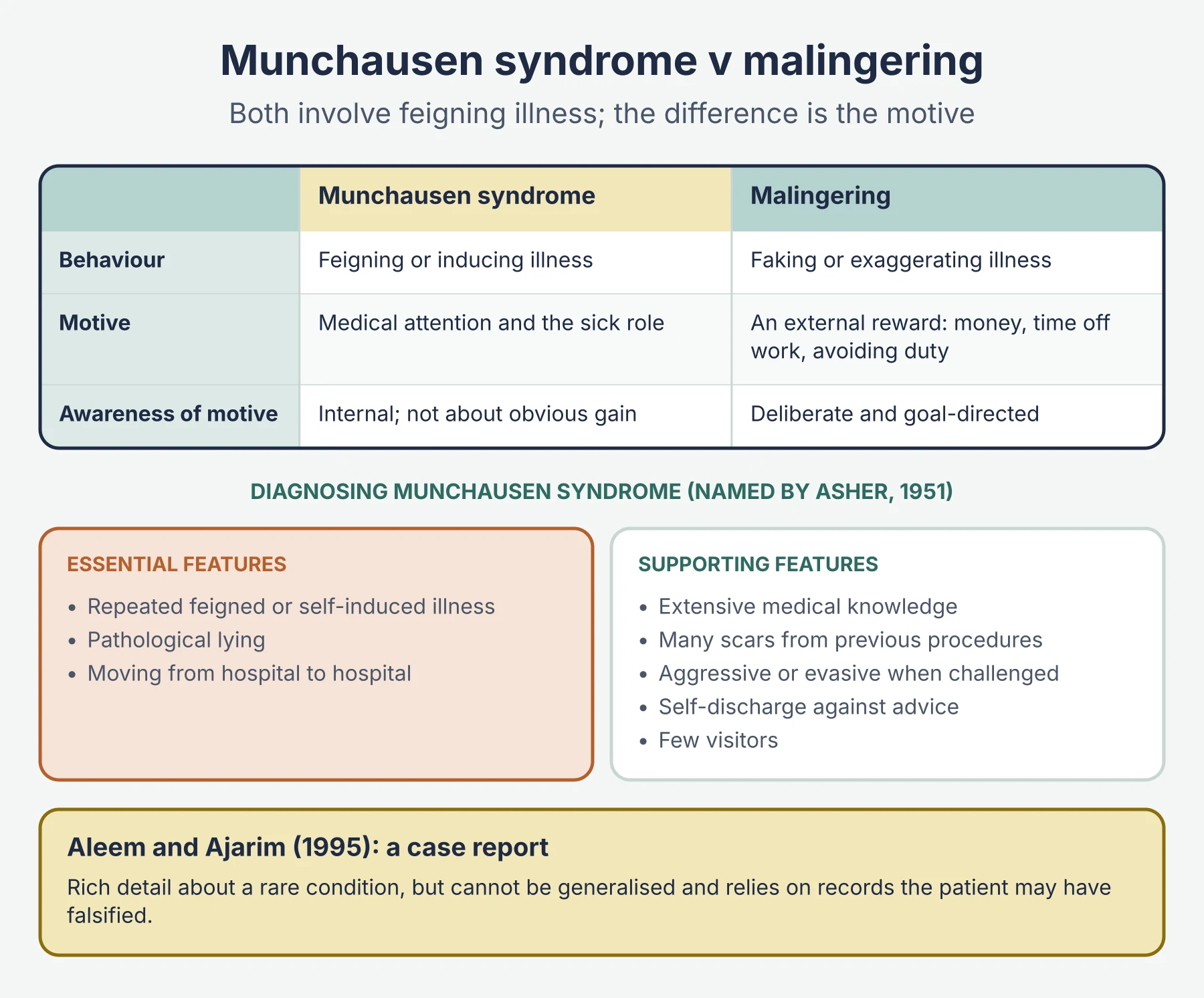
Munchausen syndrome versus malingering.
| Munchausen syndrome | Malingering | |
|---|---|---|
| Behaviour | Feigning or inducing illness | Faking or exaggerating illness |
| Motive | To gain medical attention and the sick role | An external reward such as money, time off work or avoiding duty |
| Awareness of motive | Motive is internal and not about obvious gain | Deliberate and goal-directed |
Diagnostic features of Munchausen syndrome. Essential features: repeated feigned or self-induced illness, pathological lying, and moving from hospital to hospital. Supporting features: extensive medical knowledge, many scars from previous procedures, aggressive or evasive behaviour when challenged, discharging oneself against advice, and few visitors. The name was given by Asher (1951). Aleem and Ajarim (1995) is the syllabus example of a case report. Case studies give rich detail about a rare condition but cannot be generalised, and they rely on records that the patient may have falsified.
Worked example: a 4-mark application
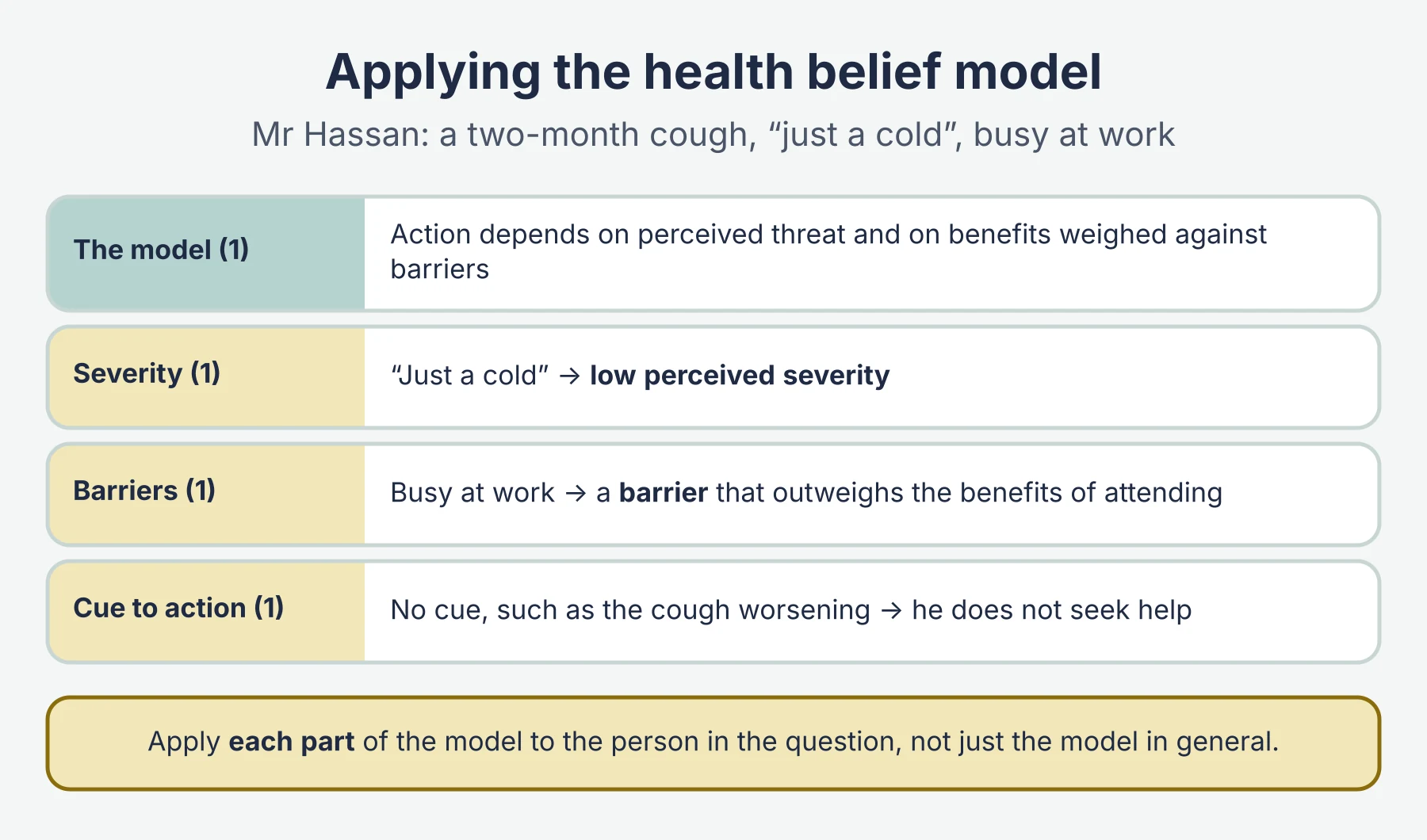
Mr Hassan has had a cough for two months but has not seen a doctor. He says he is busy at work and thinks it is “just a cold”. Using the health belief model, explain his delay. [4]
“The health belief model says action depends on perceived threat and on benefits weighed against barriers (1). Mr Hassan sees the cough as ‘just a cold’, so perceived severity is low (1). Being busy at work is a perceived barrier that outweighs the benefits of attending (1). He has had no cue to action, such as the cough worsening, so he does not seek help (1).”
Common mistakes
- Defining a false positive as “a positive result that is wrong” without saying the patient is diagnosed with an illness they do not have.
- Saying Savage and Armstrong found patients preferred sharing. They preferred directing overall.
- Mixing up Munchausen syndrome and malingering. The difference is the motive.
- Giving the health belief model without applying each part to the person in the question.
Exam technique
Describe questions on Savage and Armstrong need the design, sample, measures, both time points and the pattern of results. Compare questions on Munchausen and malingering need a similarity (both involve feigning illness) and a difference (the motive). Evaluate questions should use the issues the syllabus lists, such as idiographic versus nomothetic for 3.1.3 case studies, or cultural differences and validity for 3.1.2.
More resources on this topic
- The patient–practitioner relationship revision notes
- The patient–practitioner relationship practice questions
- Health Psychology study guide
Official syllabus
Cambridge International AS & A Level Psychology 9990 syllabus for 2024, 2025 and 2026, Specialist Option 3: Health Psychology, topic 3.1 — cambridgeinternational.org.
Related resources
-
Practice questions
Cambridge A Level Psychology (9990): The patient–practitioner relationship – Practice Questions
Original Paper 3 and Paper 4 style questions on Cambridge 9990 topic 3.1: communication, diagnosis, style and misuse, with mark schemes.
Psychology · Cambridge · A Level
Try questions -
Revision notes
Cambridge A Level Psychology (9990): The patient–practitioner relationship – Revision Notes
Revision notes for Cambridge 9990 topic 3.1: communication, diagnosis, Savage and Armstrong (1990), delay and Munchausen, with a self-test.
Psychology · Cambridge · A Level
Revise topic -
Study guides
Cambridge A Level Psychology 9990: Health Psychology (Specialist Option 3)
Study guide to Cambridge A Level Psychology 9990 Health Psychology: patient–practitioner relationship, adherence, pain, stress and health promotion, 3.1 to 3.5.
Psychology · Cambridge · A Level
Read guide
Studying Psychology?
This page is free and stays free. Marlbridge is not offering Psychology classes at the moment, so there is no tuition to book for it. The free study resources stay open to everyone.
Get free revision emails (optional)
Occasional emails with practice questions, worked explanations and links to free resources for the qualification and subjects you choose. No spam, and you can unsubscribe from any email. The free tools on this site never need an email.