
Revision Notes
Cambridge A Level Psychology (9990): The patient–practitioner relationship – Revision Notes
Revision notes for Cambridge 9990 topic 3.1: communication, diagnosis, Savage and Armstrong (1990), delay and Munchausen, with a self-test.
- Subject
- Psychology
- Level
- A LEVEL
- Topic
- Specialist Option 3: Health Psychology
- Author
- Marlbridge Academic Team
- Updated
- Reviewed by
- Kanwal Aslam (what this means)
Aligned to Cambridge A Level Psychology (9990), 2024-2026. Official specification .
Syllabus page (what it covers and how it is assessed): Cambridge A Level Psychology.
Syllabus points this page covers
9990 (A Level)
- 3.1 The patient–practitioner relationship
These notes condense topic 3.1, The patient–practitioner relationship, from Specialist Option 3 of Cambridge International A Level Psychology 9990 (syllabus for 2024 to 2026). Organise your revision around three questions: how do practitioners communicate, how do they diagnose and consult, and why do patients misuse services?
The patient–practitioner relationship study guide has the full explanations and a worked example. Test yourself afterwards with the patient–practitioner relationship practice questions.
The topic at a glance
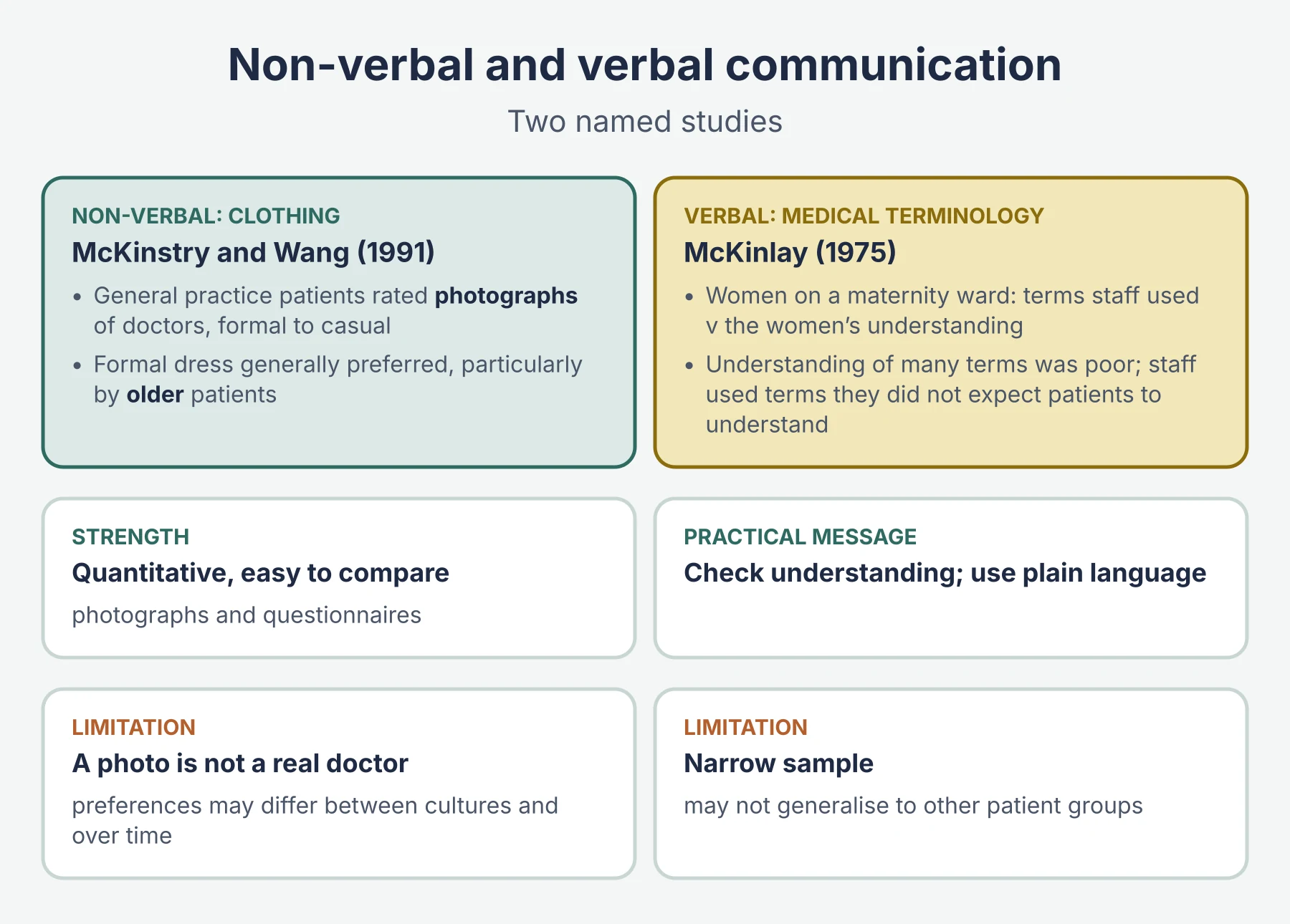
- 3.1.1 Interpersonal skills: non-verbal (practitioner clothing, e.g. McKinstry and Wang, 1991); verbal (understanding medical terminology, e.g. McKinlay, 1975).
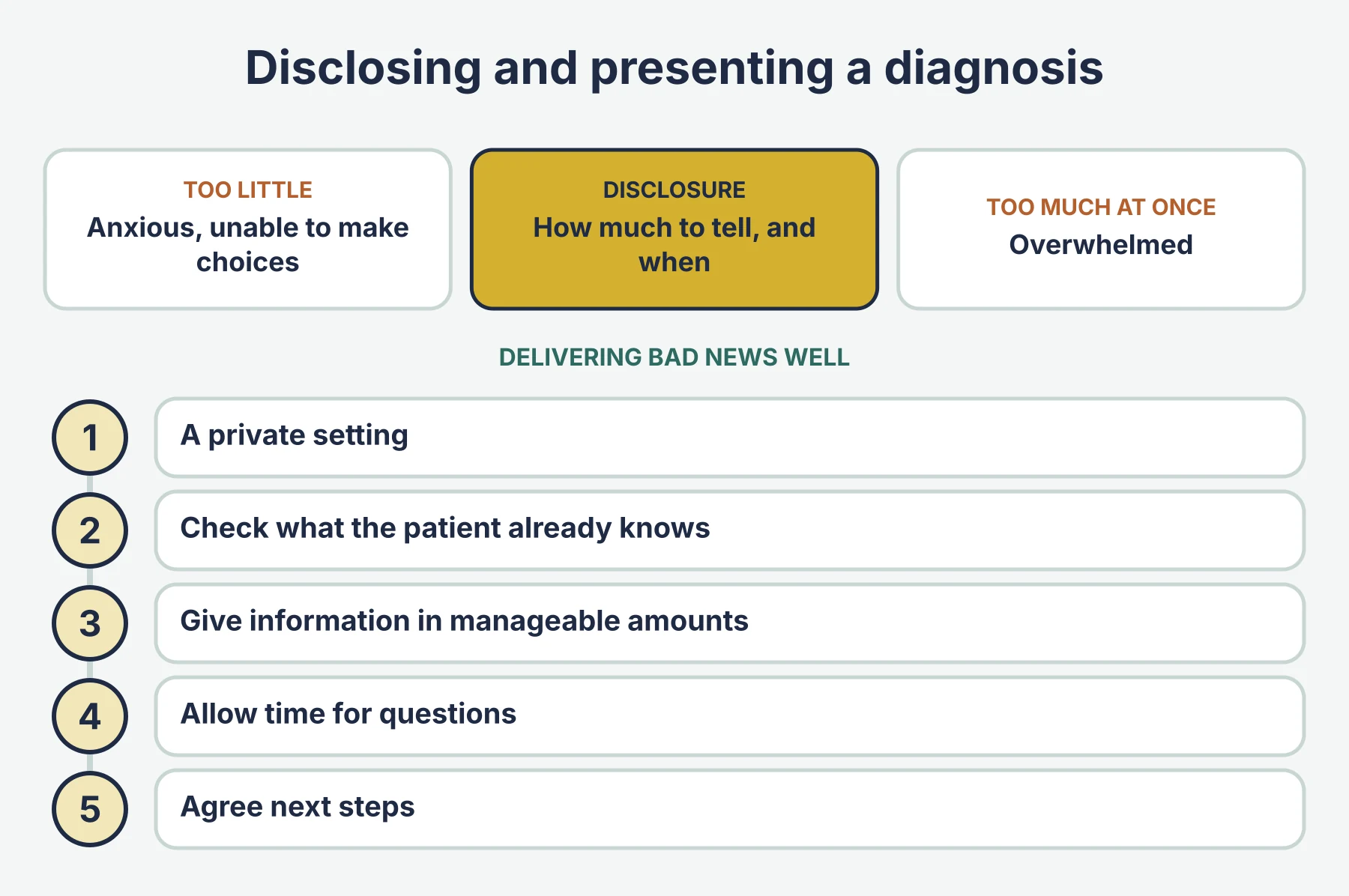
- 3.1.2 Diagnosis and style: disclosure, false positive and false negative, presenting a diagnosis; doctor-centred (directed) and patient-centred (sharing) styles; key study Savage and Armstrong (1990).
- 3.1.3 Misusing services: reasons for delay (e.g. Safer et al., 1979); the health belief model as an alternative; Munchausen syndrome versus malingering, essential and supporting features (e.g. Aleem and Ajarim, 1995).
Key terms
| Term | Definition |
|---|---|
| Non-verbal communication | Messages sent without words, such as clothing, posture and eye contact |
| Medical terminology (jargon) | Technical words that patients may not understand |
| Disclosure | How much diagnostic information is given to the patient, and when |
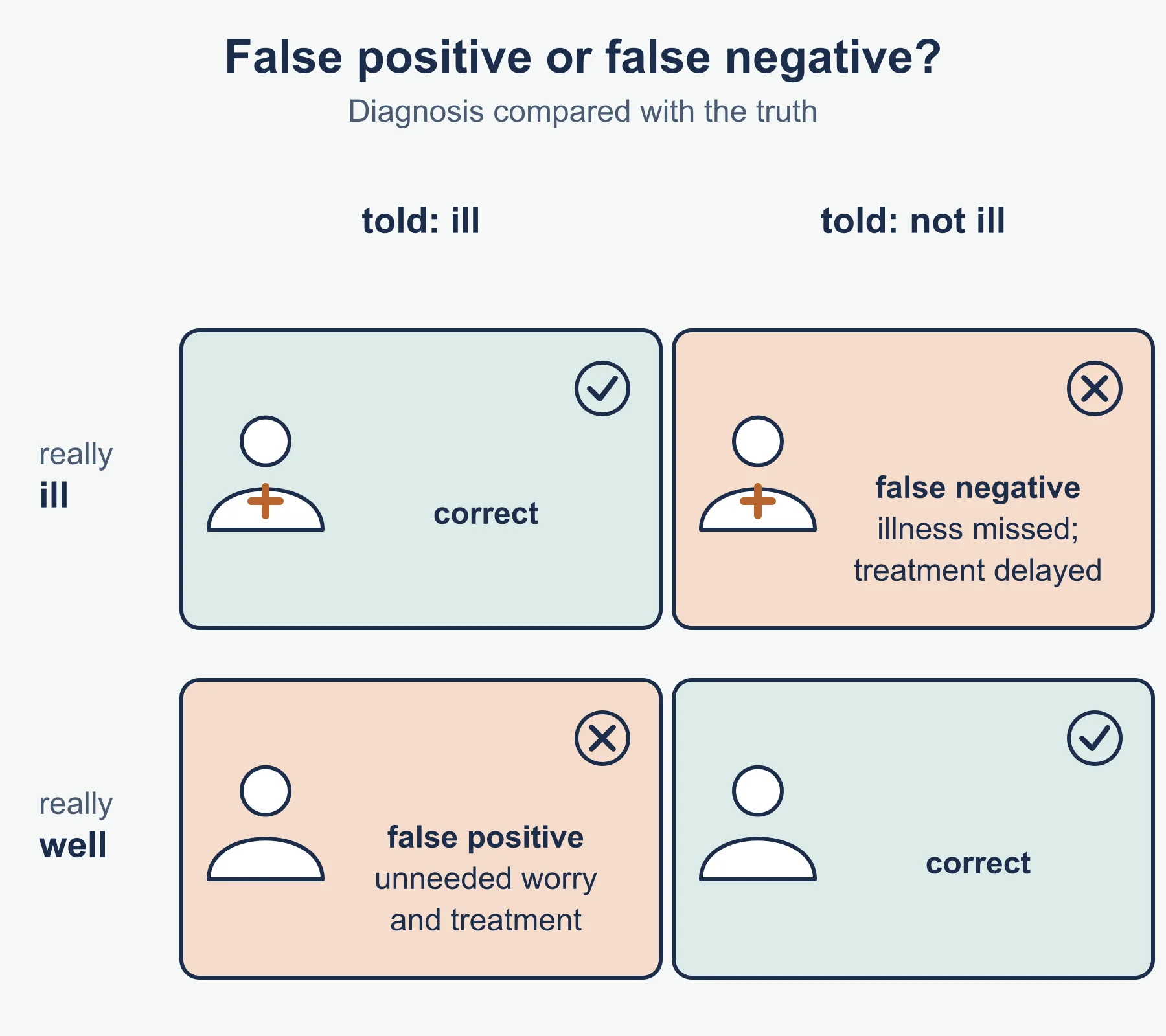
| False positive | Diagnosing an illness the patient does not have |
| False negative | Failing to diagnose an illness the patient does have |
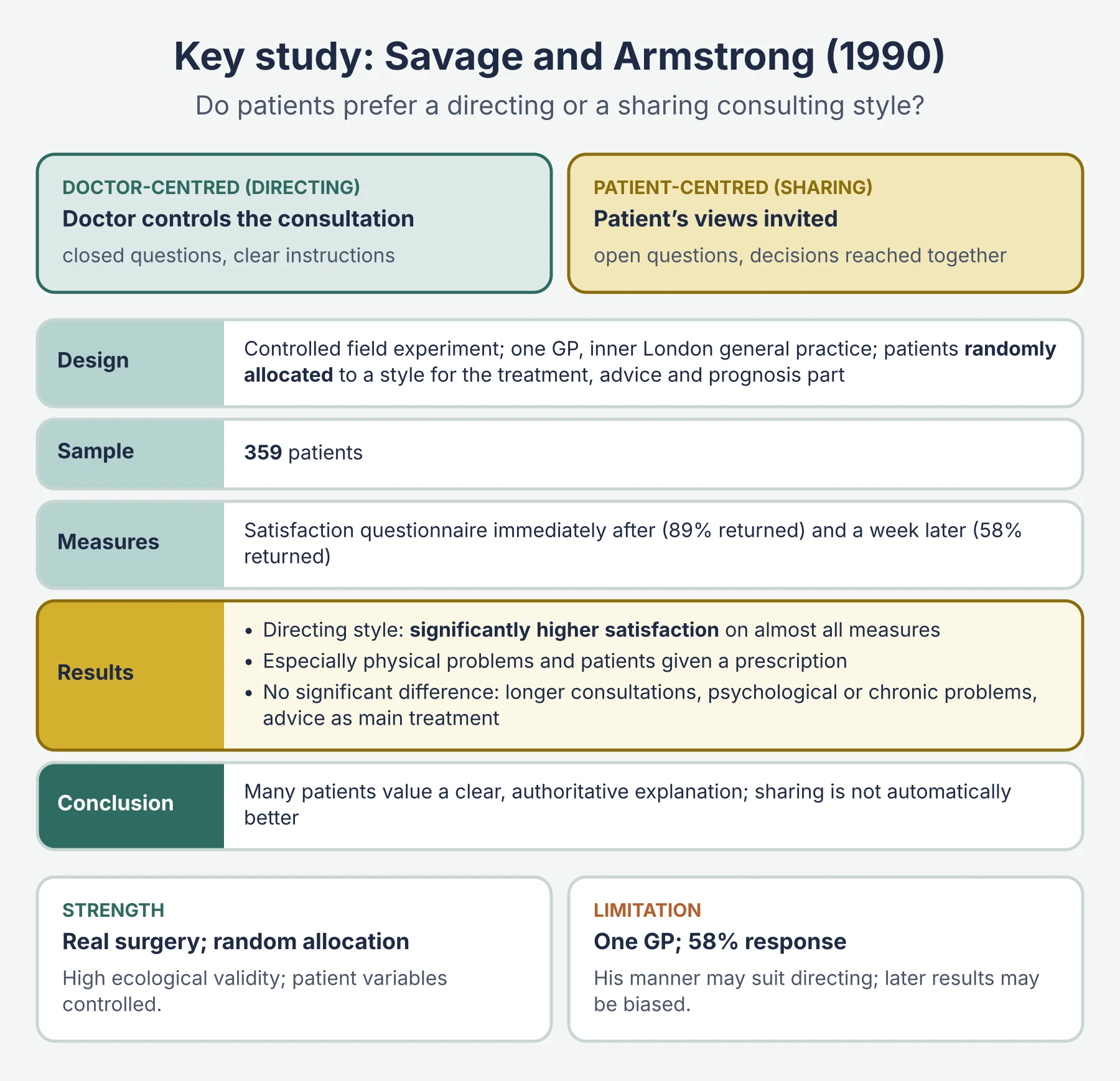
| Doctor-centred (directed) style | Doctor controls the consultation and gives instructions |
| Patient-centred (sharing) style | Doctor seeks the patient’s views and decides with them |
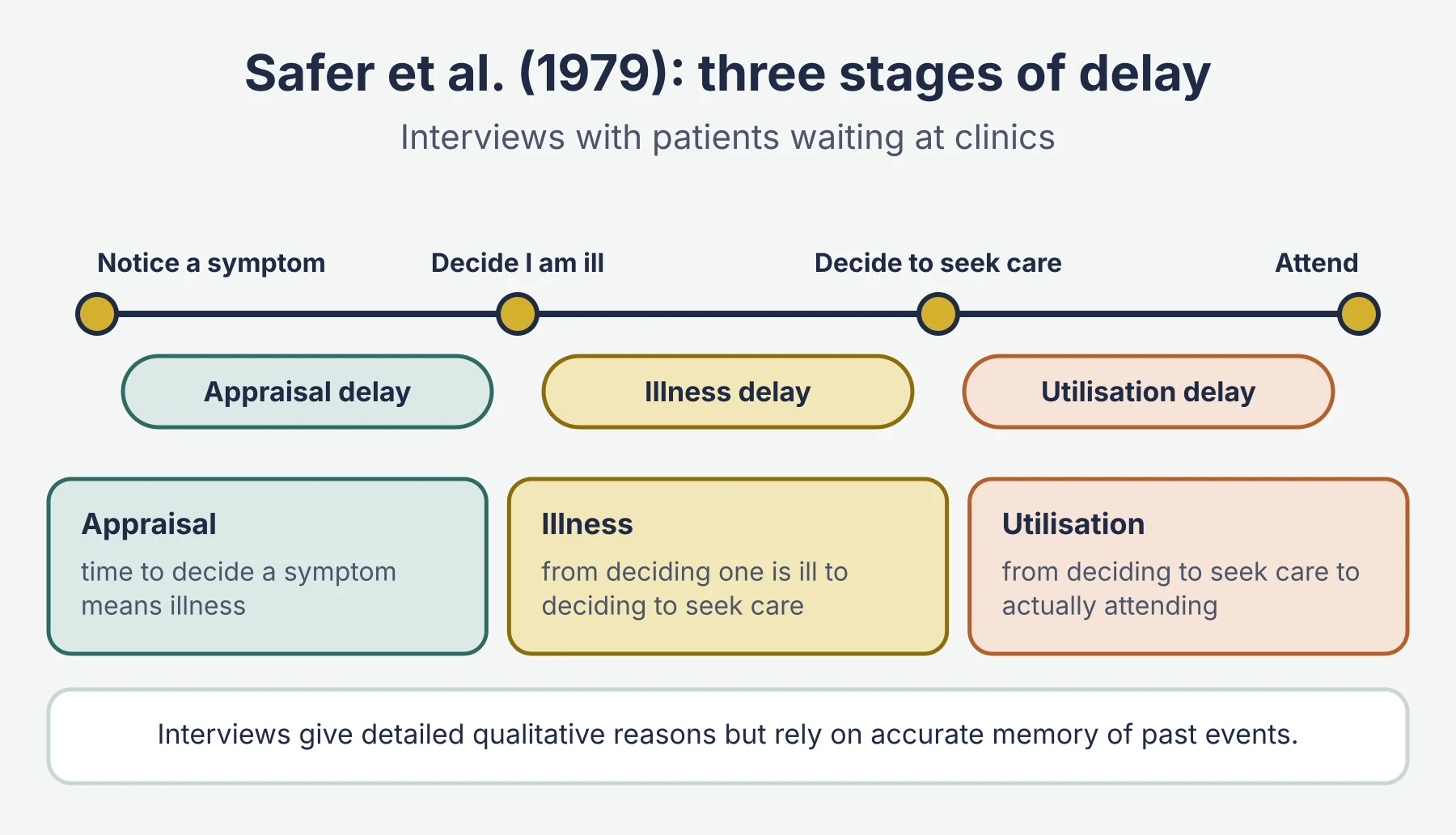
| Appraisal delay | Time to decide a symptom means illness |
| Illness delay | Time from deciding one is ill to deciding to seek care |
| Utilisation delay | Time from deciding to seek care to attending |
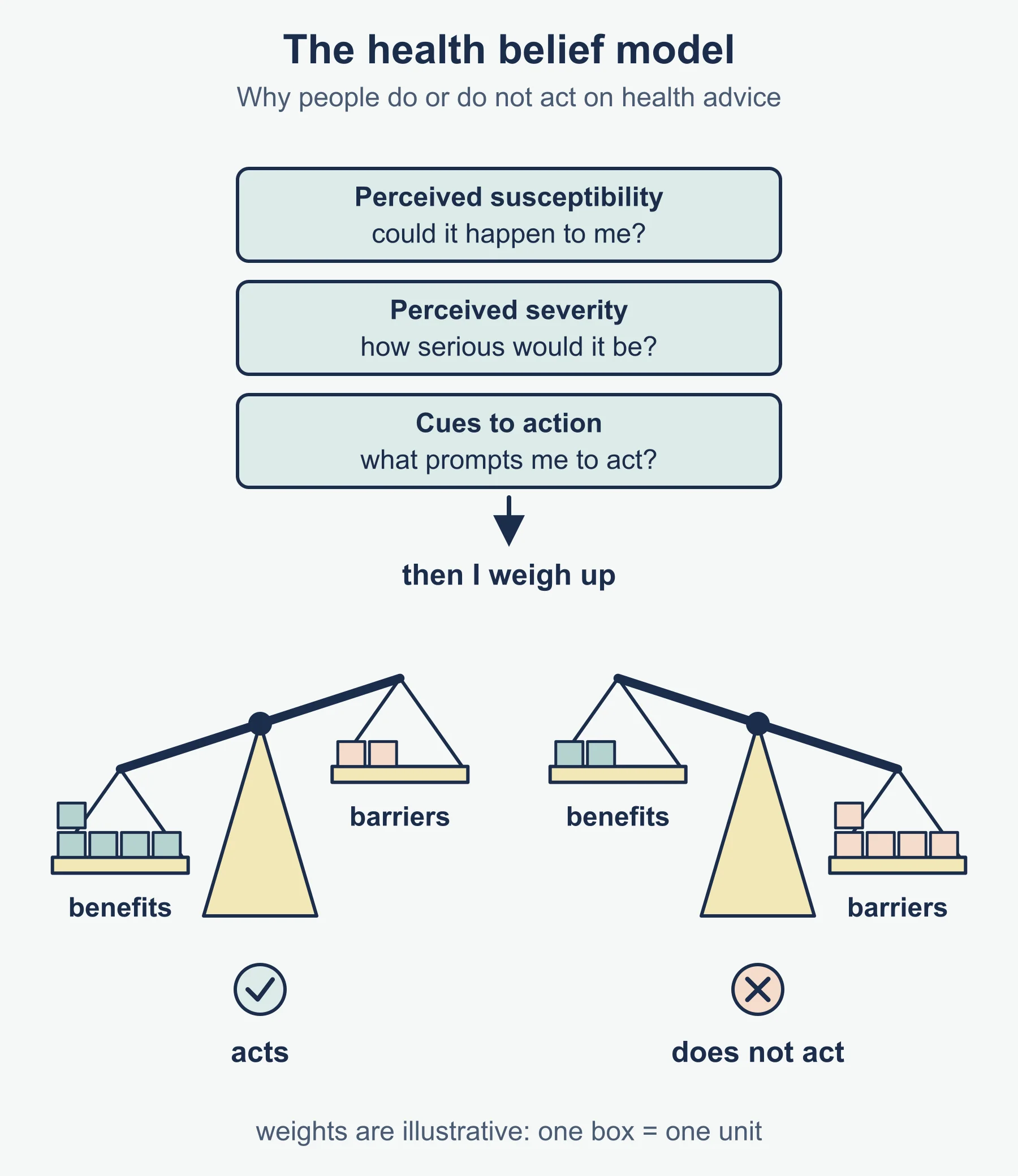
| Perceived barriers | Costs of acting, such as time, money or fear |
| Cue to action | A trigger that prompts health behaviour |
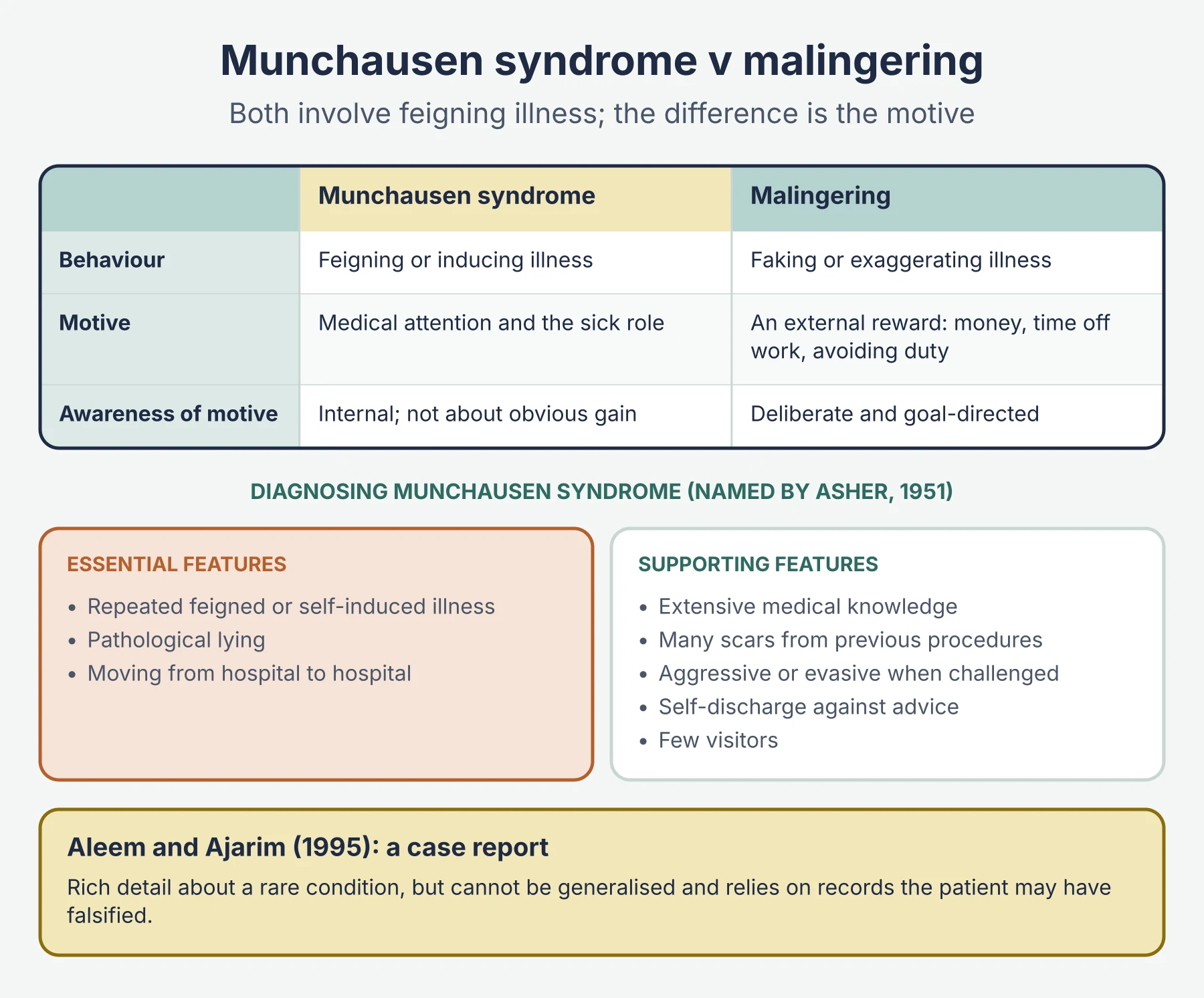
| Munchausen syndrome | Repeatedly feigning or inducing illness to gain medical attention and the sick role |
| Malingering | Faking illness for an external reward |
Key study grid: Savage and Armstrong (1990)
| Feature | Detail |
|---|---|
| Aim | Compare satisfaction with directing and sharing consultation styles |
| Method | Field experiment; random allocation to style |
| Setting and sample | One GP, inner London practice; 359 patients |
| Measures | Satisfaction questionnaire immediately and one week later (89% and 58% returned) |
| Results | Directing style gave higher satisfaction on almost all measures, especially for physical problems and prescriptions |
| No difference | Longer consultations, psychological or chronic problems, advice as main treatment |
| Strengths | Real patients; random allocation |
| Weaknesses | One GP; falling response rate; self-report |
The three stages of delay (Safer et al., 1979)
| Stage | Question the patient is answering | Example of what lengthens it |
|---|---|---|
| Appraisal | “Is this symptom a sign of illness?” | A painless symptom that seems minor |
| Illness | “Do I need professional help?” | Believing it will go away |
| Utilisation | “When will I actually go?” | Cost, transport or fear of the visit |
Munchausen syndrome features
- Essential: repeated feigned or self-induced illness; pathological lying; moving between hospitals.
- Supporting: detailed medical knowledge; many scars; evasive or aggressive when challenged; self-discharge; few visitors.
- Contrast with malingering: same behaviour of faking, different motive (internal need for the sick role versus external gain).
Linking to issues and debates
- Idiographic versus nomothetic (3.1.1, 3.1.3): case reports of Munchausen syndrome are idiographic; questionnaire studies of clothing are nomothetic.
- Cultural differences (3.1.2): preferences for an authoritative doctor may differ between cultures.
- Individual and situational explanations (3.1.2): satisfaction with style depended on the type of problem.
- Reductionism versus holism (3.1.3): the health belief model reduces delay to a few beliefs; emotion and social pressure also matter.
- Generalisations from findings (3.1.1, 3.1.3): narrow samples (one ward, one GP, single cases).
Exam traps
- Directing won in Savage and Armstrong. Do not write that patients preferred sharing.
- Response rates were 89% then 58%; the drop is an evaluation point, not a result.
- False negative is usually the more dangerous error for serious illness; explain why.
- Delay stages are in order: appraisal, illness, utilisation.
- Munchausen and malingering differ in motive, not in whether the person fakes illness.
- When asked about non-verbal communication, stay with clothing unless the question allows more; it is the syllabus focus.
Quick self-test
- Which aspect of non-verbal communication does the syllabus focus on?
- What did McKinlay (1975) find about understanding of medical terms?
- Define a false negative diagnosis and give one consequence.
- Give two features of a patient-centred consultation.
- How were patients allocated to styles in Savage and Armstrong (1990)?
- When did patients complete questionnaires in Savage and Armstrong?
- For which patients did style make no significant difference?
- Name the three stages of delay.
- Name the four parts of the health belief model.
- Give two essential features of Munchausen syndrome.
- What motivates a malingerer?
- Give one weakness of using a case report to study Munchausen syndrome.
Answers
- Practitioner clothing.
- Understanding was often poor, and staff used terms even when they did not expect patients to understand them.
- Failing to diagnose an illness the patient has; treatment is delayed and the illness may worsen.
- Any two: open questions; asking the patient’s views; shared decisions; explaining options.
- Random allocation to a directing or a sharing style.
- Immediately after the consultation and one week later.
- Longer consultations; psychological or chronic problems; where advice was the main treatment.
- Appraisal, illness, utilisation.
- Perceived susceptibility, perceived severity, perceived benefits versus barriers, cues to action.
- Any two: repeated feigned or self-induced illness; pathological lying; moving between hospitals.
- An external reward, such as money, time off work or avoiding duty.
- One person cannot be generalised from, and records may be unreliable because the patient lies about their history.
More resources on this topic
Related resources
-
Study guides
Cambridge A Level Psychology 9990: Health Psychology (Specialist Option 3)
Study guide to Cambridge A Level Psychology 9990 Health Psychology: patient–practitioner relationship, adherence, pain, stress and health promotion, 3.1 to 3.5.
Psychology · Cambridge · A Level
Read guide -
Practice questions
Cambridge A Level Psychology 9990: Health Psychology — Practice Questions
Original Paper 3 and Paper 4 style questions with mark-scheme answers for Cambridge 9990 Health Psychology: consultations, adherence, pain, stress, promotion.
Psychology · Cambridge · A Level
Try questions -
Revision notes
Cambridge A Level Psychology 9990: Health Psychology — Revision Notes
Condensed revision notes for Cambridge 9990 Health Psychology: key terms, measures, theories, the five key studies and exam traps for topics 3.1 to 3.5.
Psychology · Cambridge · A Level
Revise topic
Studying Psychology?
This page is free and stays free. Marlbridge is not offering Psychology classes at the moment, so there is no tuition to book for it. The free study resources stay open to everyone.
Get free revision emails (optional)
Occasional emails with practice questions, worked explanations and links to free resources for the qualification and subjects you choose. No spam, and you can unsubscribe from any email. The free tools on this site never need an email.