
Study Guides
Cambridge A Level Psychology (9990): Adherence to medical advice
Cambridge 9990 topic 3.2 in depth: types of and reasons for non-adherence, subjective, objective and biological measures, and Yokley and Glenwick (1984).
- Subject
- Psychology
- Level
- A LEVEL
- Topic
- Specialist Option 3: Health Psychology
- Author
- Marlbridge Academic Team
- Updated
- Reviewed by
- Kanwal Aslam (what this means)
Aligned to Cambridge A Level Psychology (9990), 2024-2026. Official specification .
Syllabus page (what it covers and how it is assessed): Cambridge A Level Psychology.
Syllabus points this page covers
9990 (A Level)
- 3.2 Adherence to medical advice
Topic 3.2, Adherence to medical advice, is part of Specialist Option 3 (Health Psychology) in Cambridge International A Level Psychology 9990, syllabus for 2024 to 2026. It asks three questions: why do patients not follow medical advice (3.2.1), how can we tell whether they are adhering (3.2.2), and what improves adherence (3.2.3)? The key study is Yokley and Glenwick (1984), a community intervention to increase immunisation.
The Health Psychology study guide gives a short account of each sub-topic. This guide adds detail, comparisons and exam practice for 3.2 only. Use it with the adherence revision notes and the adherence practice questions.
What the syllabus lists for 3.2
| Sub-topic | Content | Named study |
|---|---|---|
| 3.2.1 Types and reasons | Failure to follow treatments and failure to attend appointments; problems caused by non-adherence; rational non-adherence; the Health Belief Model | e.g. Laba et al. (2012) |
| 3.2.2 Measuring non-adherence | Subjective: clinical and semi-structured interviews; objective: pill counting and medication dispensers; biological: blood and urine samples | e.g. Riekert and Drotar (1999); e.g. Chung and Naya (2000) |
| 3.2.3 Improving adherence | Improving adherence in children; contracts, prompts and customising treatment; community interventions | e.g. Chaney et al. (2004); key study Yokley and Glenwick (1984) |
3.2.1 Types of non-adherence and why it matters
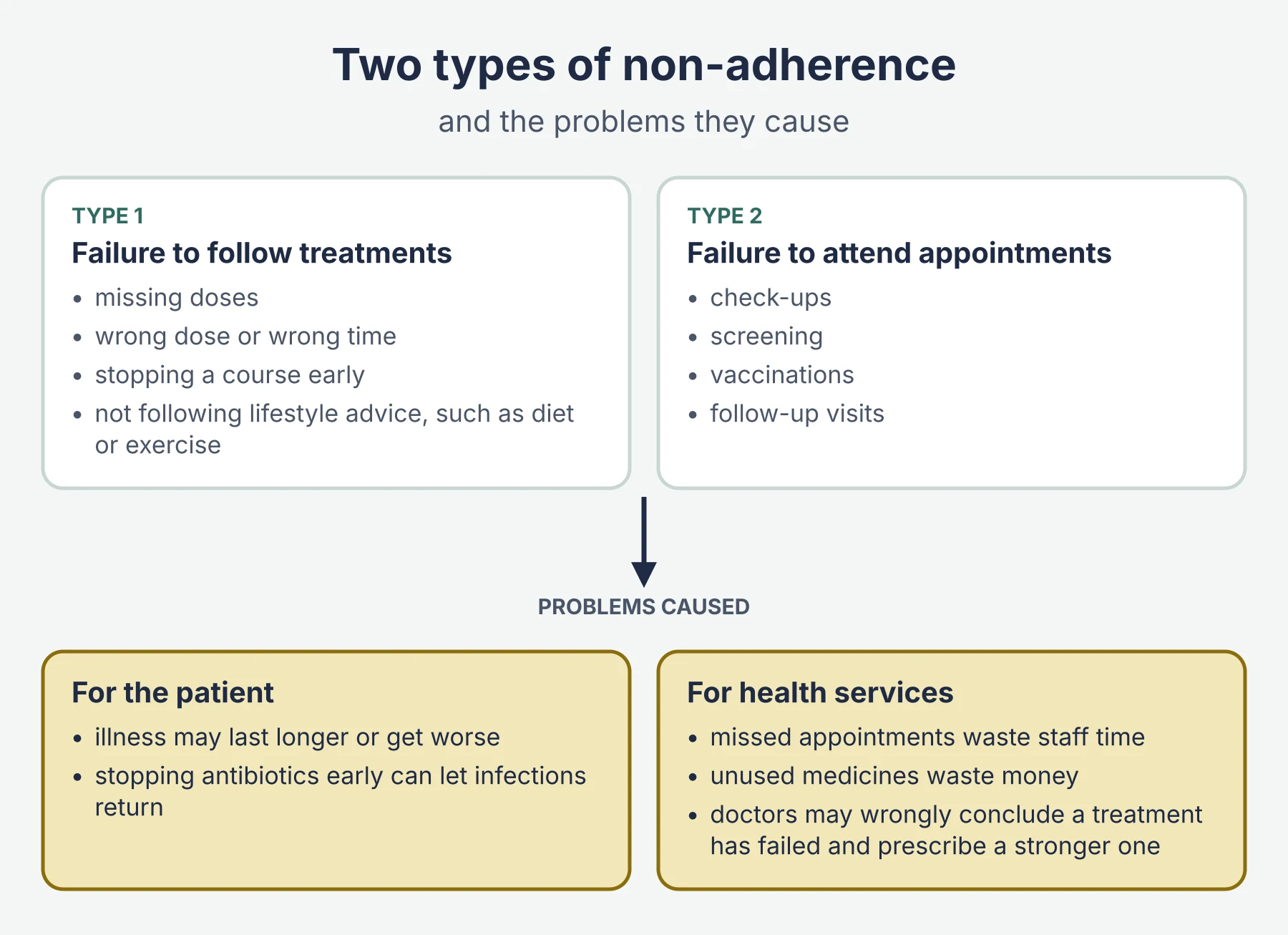
Adherence means following the treatment or advice agreed with a practitioner. The syllabus names two types of non-adherence:
- Failure to follow treatments: missing doses, taking the wrong dose or at the wrong time, stopping a course early, or not following lifestyle advice such as diet or exercise.
- Failure to attend appointments: missing check-ups, screening, vaccinations or follow-up visits.
Problems caused. For the patient, illness may last longer or worsen, and stopping antibiotics early can allow infections to return. For health services, missed appointments waste staff time, unused medicines waste money, and doctors may wrongly conclude a treatment has failed and prescribe a stronger one.
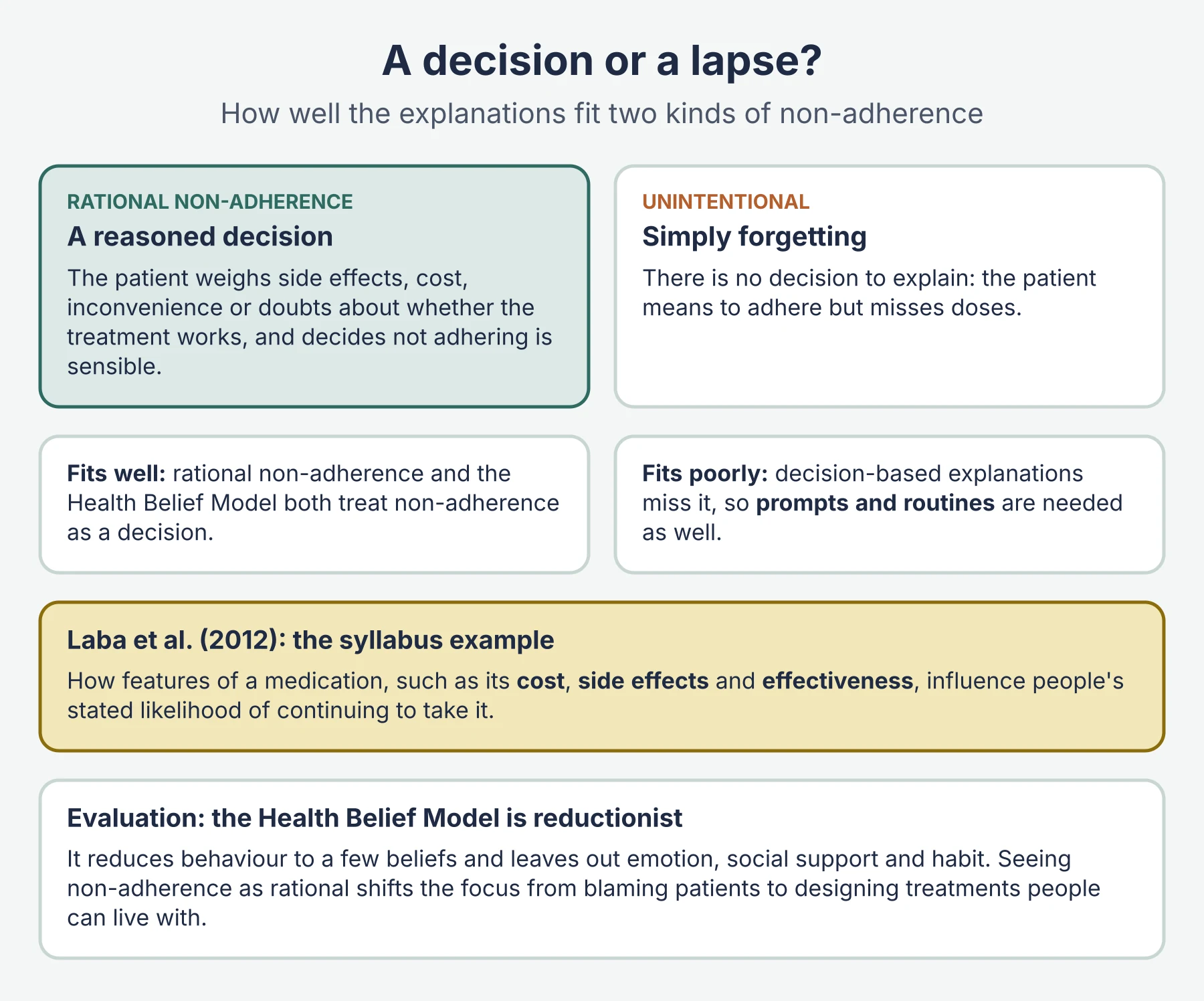
Rational non-adherence. Some non-adherence is a reasoned decision. A patient may weigh side effects, cost, inconvenience or doubts about whether the treatment works, and decide that not adhering is the sensible choice. Laba et al. (2012) is the syllabus example; it investigated how features of a medication, such as its cost, side effects and effectiveness, influence people’s stated likelihood of continuing to take it. Seeing non-adherence as rational shifts the focus from blaming patients to designing treatments people can live with.
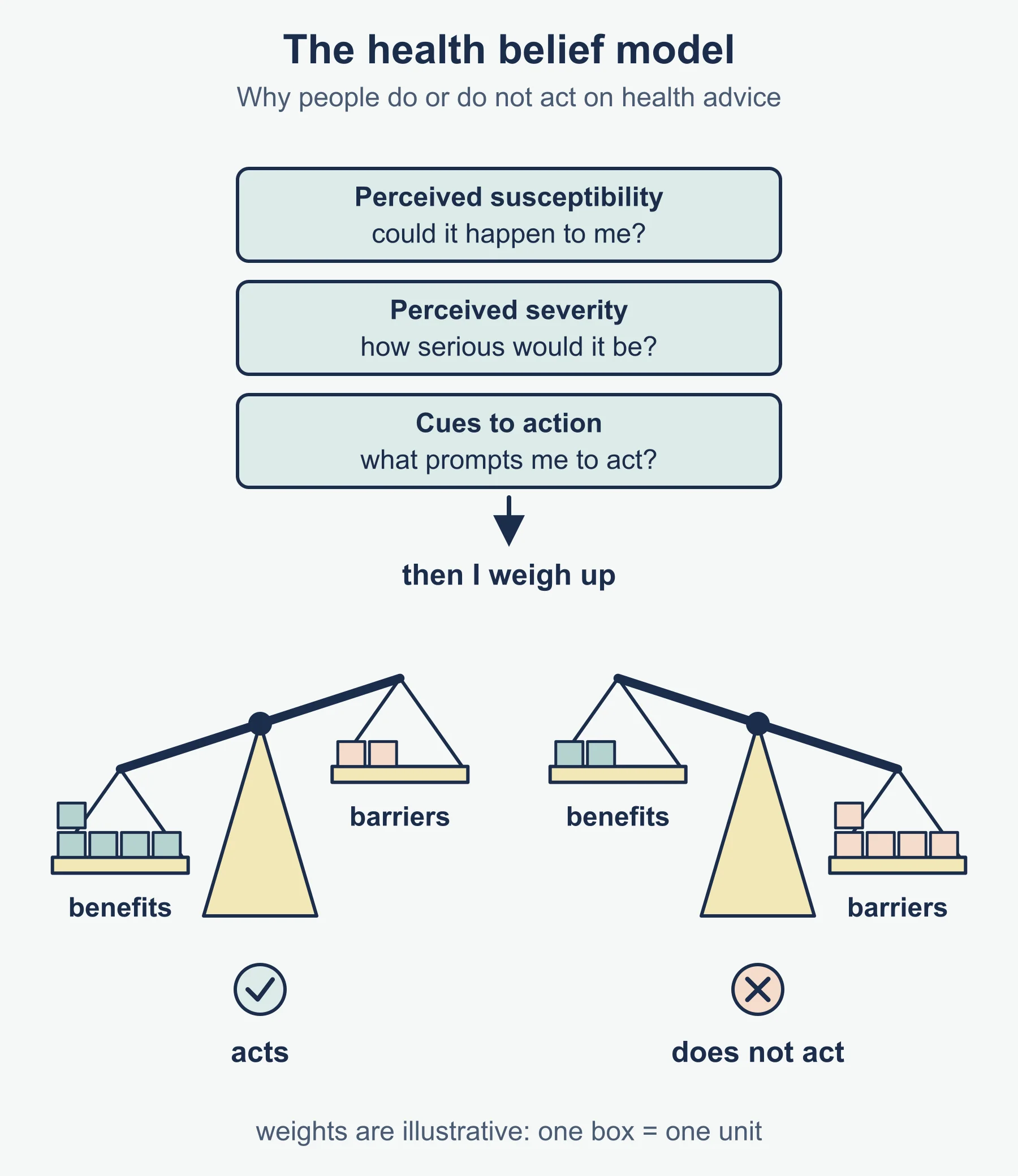
The Health Belief Model. Adherence is predicted by:
| Component | Question | Non-adherence when… |
|---|---|---|
| Perceived susceptibility | “Am I at risk?” | The patient feels at low risk once symptoms ease |
| Perceived severity | “How serious is this?” | The condition seems mild |
| Perceived benefits | “Will treatment help?” | The patient doubts it works |
| Perceived barriers | “What does it cost me?” | Side effects, cost or inconvenience are high |
| Cues to action | “What prompts me?” | There are no reminders or symptoms |
Evaluating the explanations. Both explain non-adherence as a decision, which suits patients who stop deliberately. Neither explains unintentional non-adherence well, such as simply forgetting, so prompts and routines are needed as well. The Health Belief Model is reductionist: it reduces behaviour to a few beliefs and leaves out emotion, social support and habit.
3.2.2 Measuring non-adherence
| Type | Examples | Strengths | Weaknesses |
|---|---|---|---|
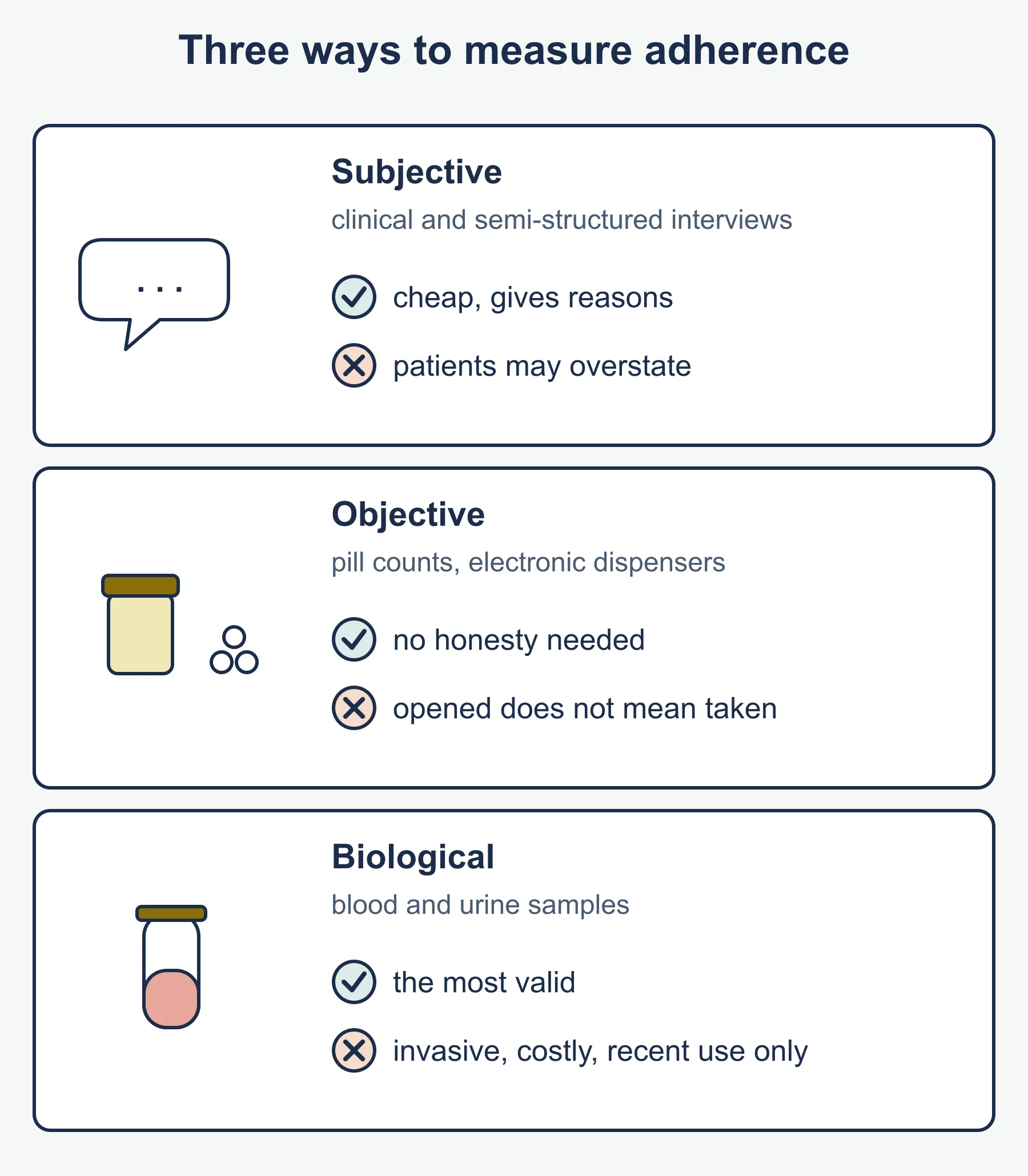
| Subjective | Clinical interviews; semi-structured interviews | Cheap; give reasons and context; qualitative depth | Patients overstate adherence to please the doctor or because they forget missed doses |
| Objective | Pill counting; electronic medication dispensers | Do not rely on honesty or memory; quantitative | Pills can be removed without being taken; a dispenser opening does not prove a dose was swallowed |
| Biological | Blood and urine samples | Most direct evidence the drug is in the body | Invasive, costly; show only recent use; drugs are metabolised at different rates |
Interviews. A clinical interview is a conversation with a practitioner, often following a set of standard questions. A semi-structured interview has planned questions but allows follow-up, so a nurse can ask “What happens on days you miss your inhaler?” Riekert and Drotar (1999) is the syllabus example of research in which adherence is assessed through what patients and families report.
Pill counting and dispensers. A pill count compares the number of pills left with the number that should be left. An electronic dispenser, such as a cap with a microchip, records the date and time of every opening. Chung and Naya (2000) is the syllabus example of using an electronic device to monitor medication-taking, which can reveal missed doses and irregular timing that patients do not report.
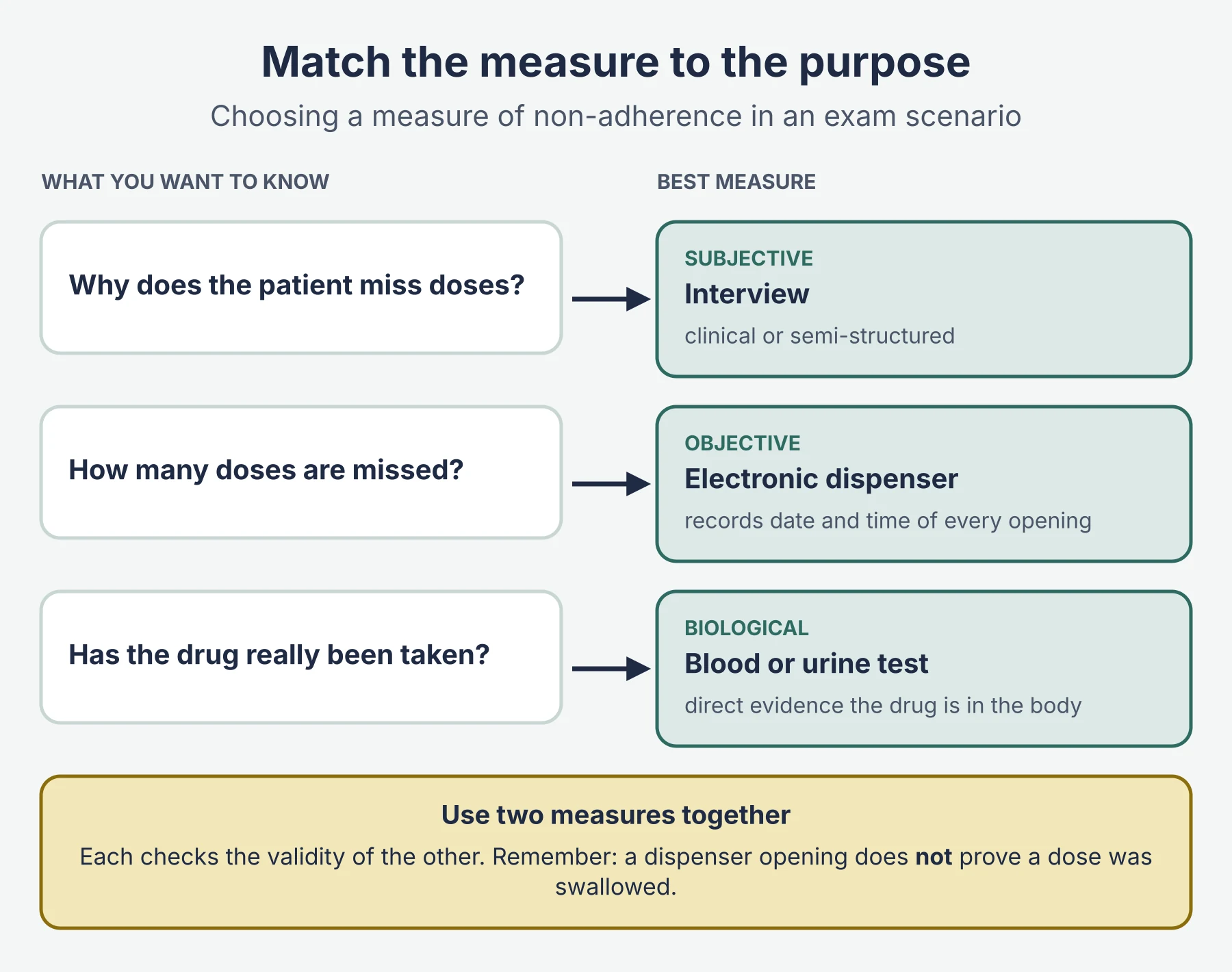
Choosing a measure. In an exam scenario, match the measure to the purpose. To find out why a patient misses doses, use an interview. To find out how many doses are missed, use a dispenser. To confirm that the drug has been taken, use a biological test. Using two measures together allows each to check the validity of the other.
3.2.3 Improving adherence
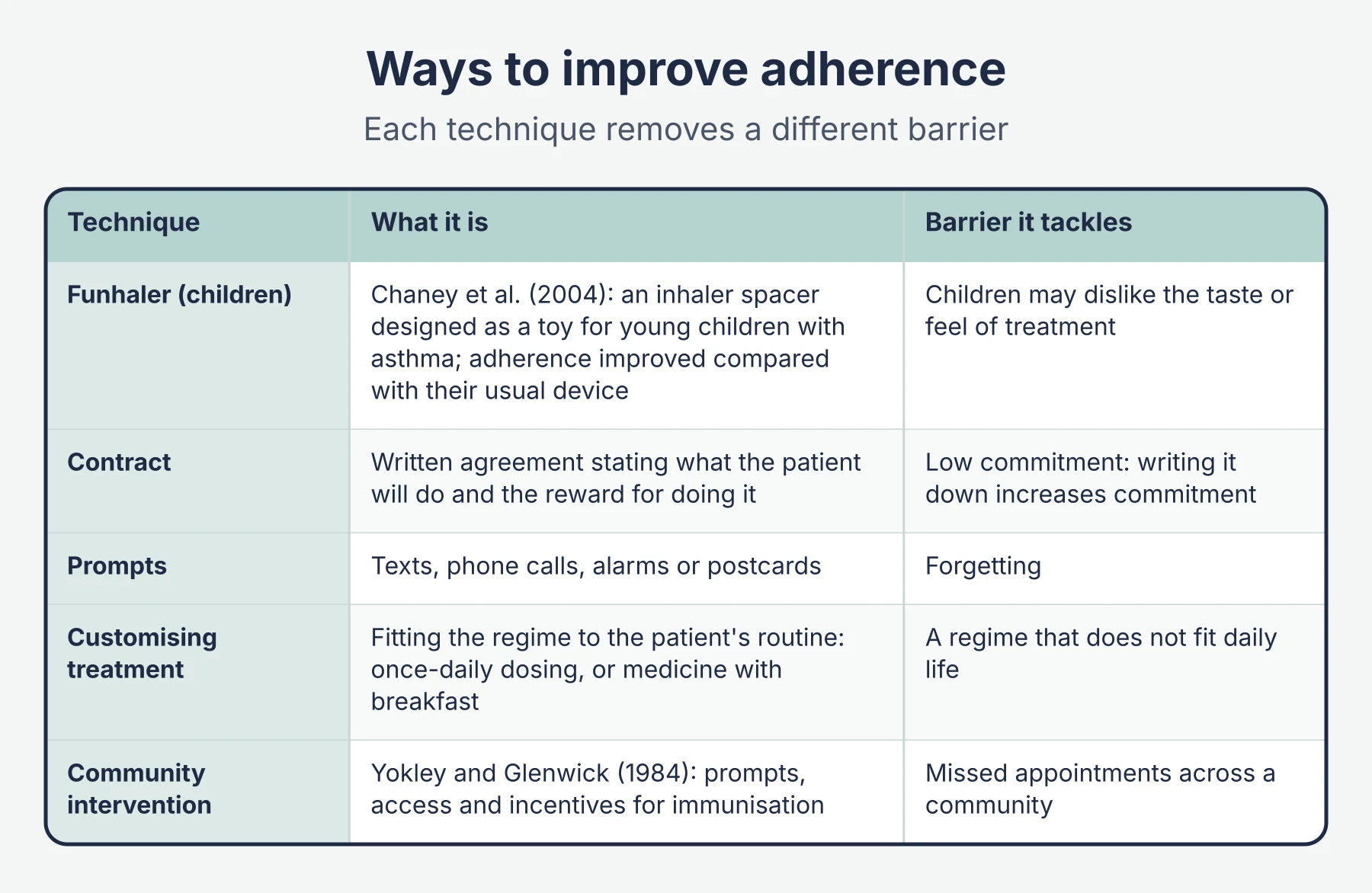
Children. Children depend on parents, may dislike the taste or feel of treatment, and may not understand why it matters. Chaney et al. (2004) gave young children with asthma a spacer device for their inhaler designed as a toy, the Funhaler, and found that adherence improved compared with their usual device. Making treatment enjoyable reduces a barrier.
Individual behavioural techniques.
- Contracts: a written agreement between patient and practitioner stating what the patient will do and the reward for doing it. Writing it down increases commitment.
- Prompts: reminders such as texts, phone calls, alarms or postcards. They target forgetting.
- Customising treatment: fitting the regime to the patient’s routine, for example once-daily rather than three-times-daily dosing, or taking medicine with breakfast.
Key study: Yokley and Glenwick (1984).
- Aim: to compare the effectiveness of community interventions for increasing the immunisation of preschool children.
- Sample: families of 1,133 preschool children in a public health setting whose immunisations were incomplete.
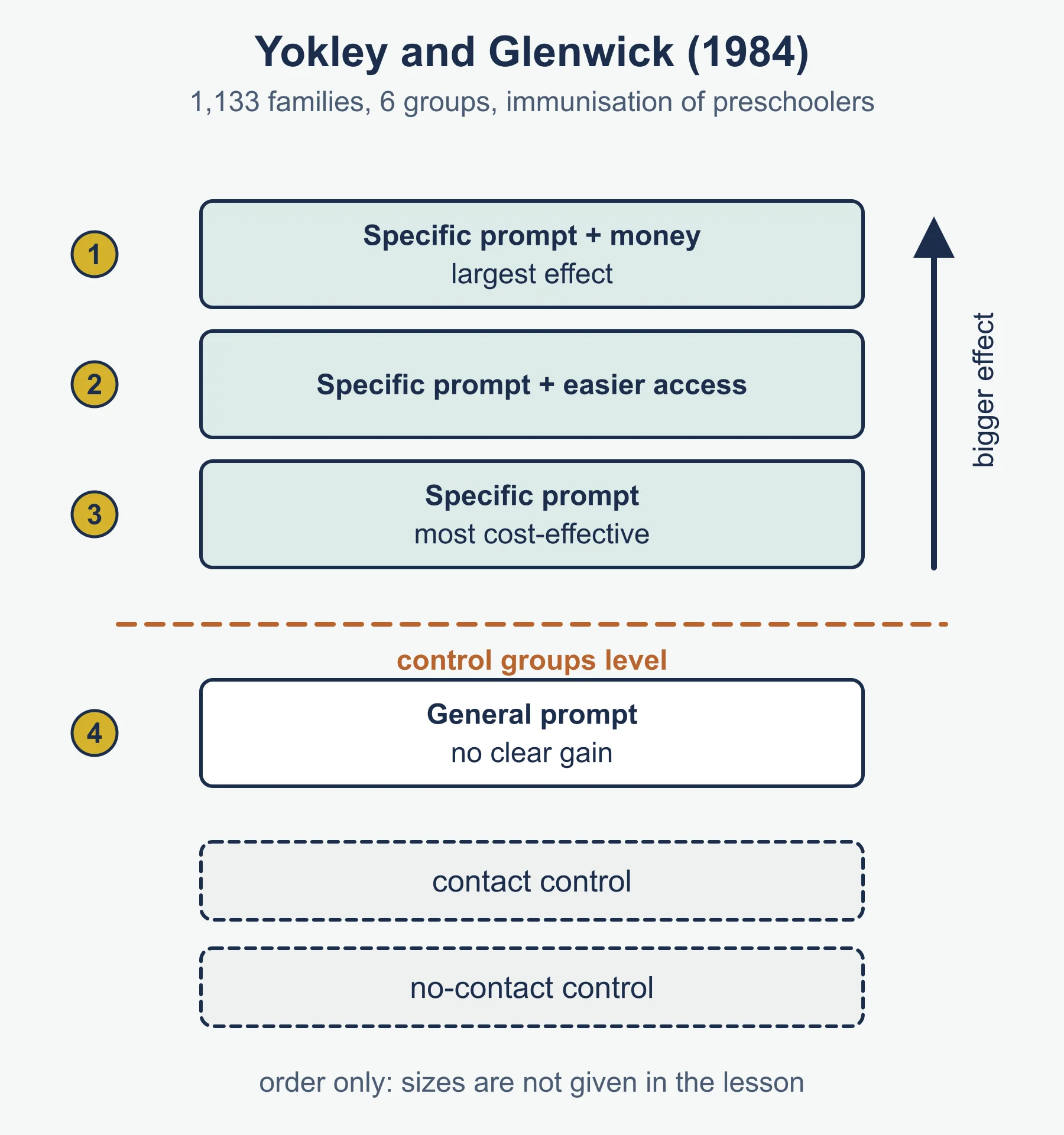
- Design: a field experiment with random allocation to six conditions: general prompt; client-specific prompt; specific prompt plus increased access to the clinic; specific prompt plus a monetary incentive; contact control; no-contact control.
- Measure: immunisation records, an objective measure of attendance.
- Results: all the interventions except the general prompt produced improvements compared with the control groups. The monetary incentive produced the largest effect, followed by increased access, the specific prompt and the general prompt. Specific prompts on their own were the most cost-effective.
- Conclusion: simple, targeted prompts are an efficient way to improve attendance, while incentives and better access produce larger gains at greater cost.
- Evaluation: large sample and random allocation support generalisation and causal conclusions; immunisation records avoid self-report bias; the study was in one community and one era, so cultural and service differences may limit generalisation; the use of children’s records requires parental consent and confidentiality.

Worked example: a 6-mark describe answer
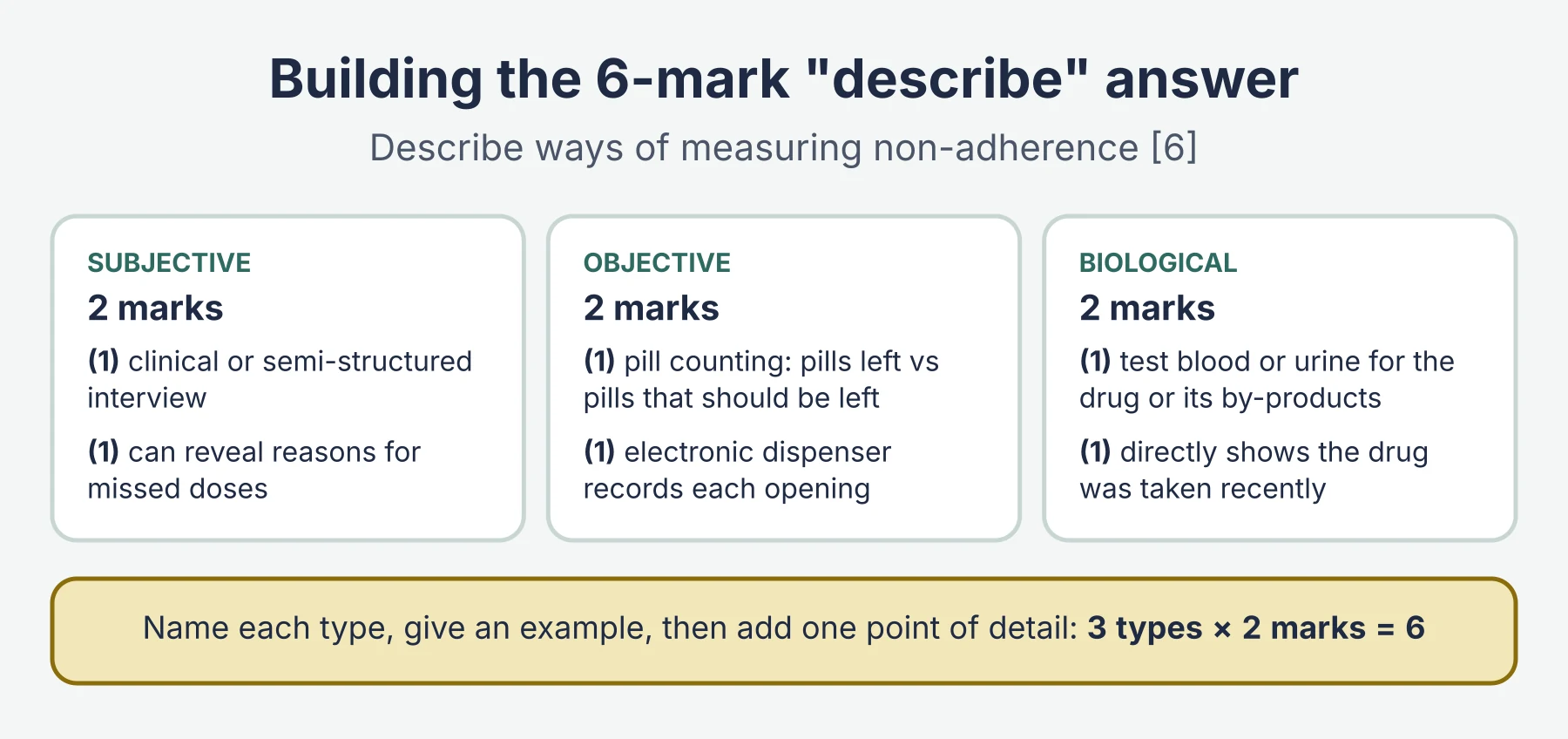
Describe ways of measuring non-adherence. [6]
“Subjective measures ask patients about their adherence, for example in a clinical or semi-structured interview (1), which can reveal reasons for missed doses (1). Objective measures include pill counting, comparing pills left with pills that should be left (1), and electronic medication dispensers that record each time the container is opened (1). Biological measures test blood or urine samples for the drug or its by-products (1), which directly shows whether the drug has been taken recently (1).”
Common mistakes
- Treating all non-adherence as forgetting. The syllabus stresses rational non-adherence.
- Saying a medication dispenser proves a pill was swallowed. It shows only that the container was opened.
- Getting the order of Yokley and Glenwick’s results wrong: incentive, then access, then specific prompt, then general prompt.
- Saying general prompts were the most cost-effective. It was specific prompts.
Exam technique
Compare questions on measures want a similarity and a difference, such as “pill counts and dispensers are both objective, but dispensers record timing”. Evaluate questions can use the issues the syllabus lists for 3.2.2, including validity, reliability, quantitative and qualitative data, and idiographic versus nomothetic. Suggest questions about a scenario need a technique named, applied to the patient and justified.
More resources on this topic
Official syllabus
Cambridge International AS & A Level Psychology 9990 syllabus for 2024, 2025 and 2026, Specialist Option 3: Health Psychology, topic 3.2 — cambridgeinternational.org.
Related resources
-
Practice questions
Cambridge A Level Psychology (9990): Adherence to medical advice – Practice Questions
Original Paper 3 and Paper 4 style questions on Cambridge 9990 topic 3.2: reasons for non-adherence, measuring it and improving it, with full mark schemes.
Psychology · Cambridge · A Level
Try questions -
Revision notes
Cambridge A Level Psychology (9990): Adherence to medical advice – Revision Notes
Revision notes for Cambridge 9990 topic 3.2: non-adherence types and reasons, measures compared, ways to improve adherence and Yokley and Glenwick (1984).
Psychology · Cambridge · A Level
Revise topic -
Study guides
Cambridge A Level Psychology (9990): Health promotion
Cambridge 9990 topic 3.5 in depth: fear arousal, information, healthy eating, workplace safety, optimism and Shoshani and Steinmetz (2014).
Psychology · Cambridge · A Level
Read guide
Studying Psychology?
This page is free and stays free. Marlbridge is not offering Psychology classes at the moment, so there is no tuition to book for it. The free study resources stay open to everyone.
Get free revision emails (optional)
Occasional emails with practice questions, worked explanations and links to free resources for the qualification and subjects you choose. No spam, and you can unsubscribe from any email. The free tools on this site never need an email.