
Revision Notes
Cambridge A Level Psychology (9990): Adherence to medical advice – Revision Notes
Revision notes for Cambridge 9990 topic 3.2: non-adherence types and reasons, measures compared, ways to improve adherence and Yokley and Glenwick (1984).
- Subject
- Psychology
- Level
- A LEVEL
- Topic
- Specialist Option 3: Health Psychology
- Author
- Marlbridge Academic Team
- Updated
- Reviewed by
- Kanwal Aslam (what this means)
Aligned to Cambridge A Level Psychology (9990), 2024-2026. Official specification .
Syllabus page (what it covers and how it is assessed): Cambridge A Level Psychology.
Syllabus points this page covers
9990 (A Level)
- 3.2 Adherence to medical advice
These notes condense topic 3.2, Adherence to medical advice, from Specialist Option 3 of Cambridge International A Level Psychology 9990 (syllabus for 2024 to 2026). The topic follows a simple sequence: why patients do not adhere, how we measure it, and how we improve it.
For full explanations and a model answer, read the adherence study guide. For exam-style questions, use the adherence practice questions.
The topic in three lines
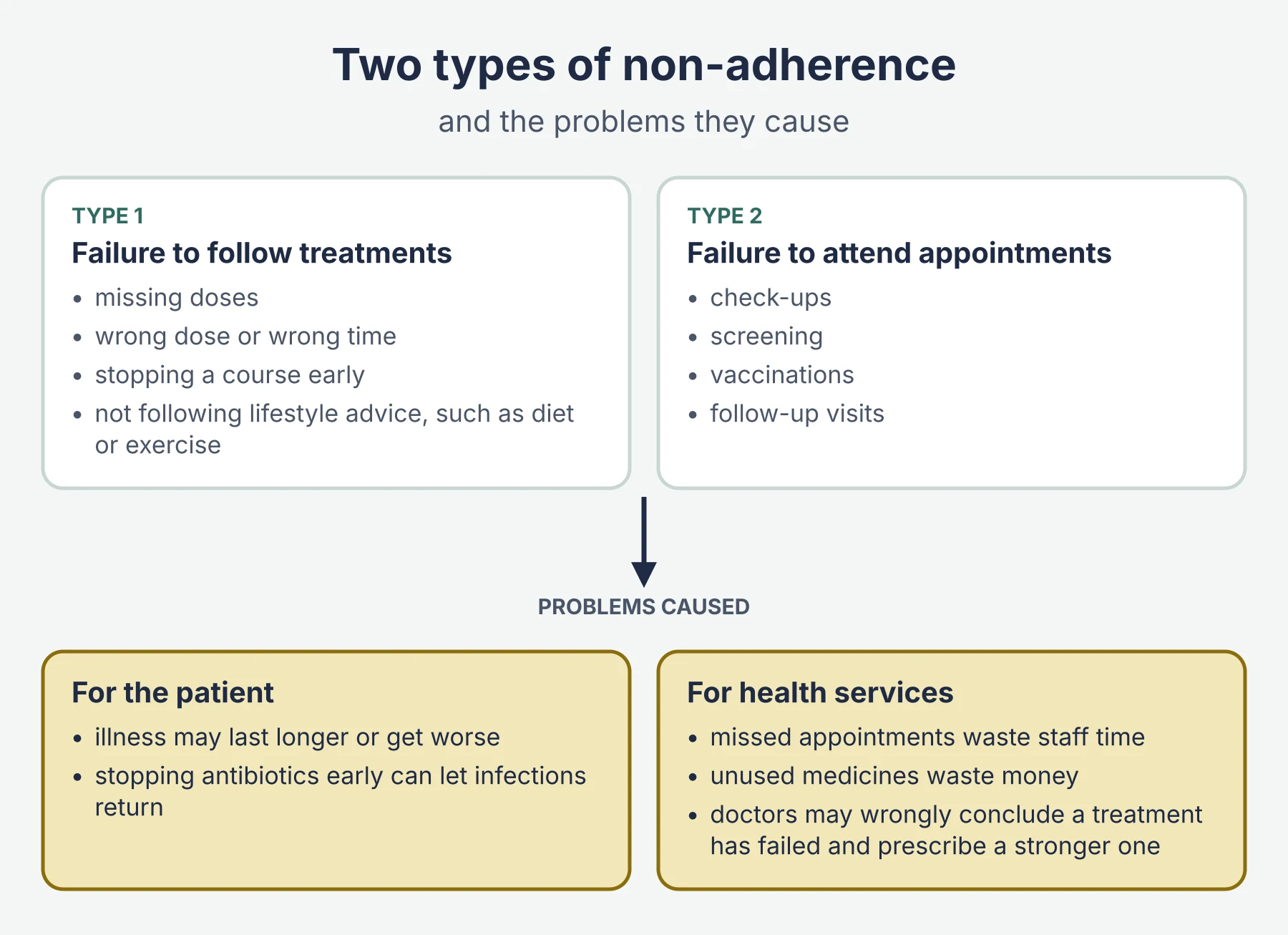
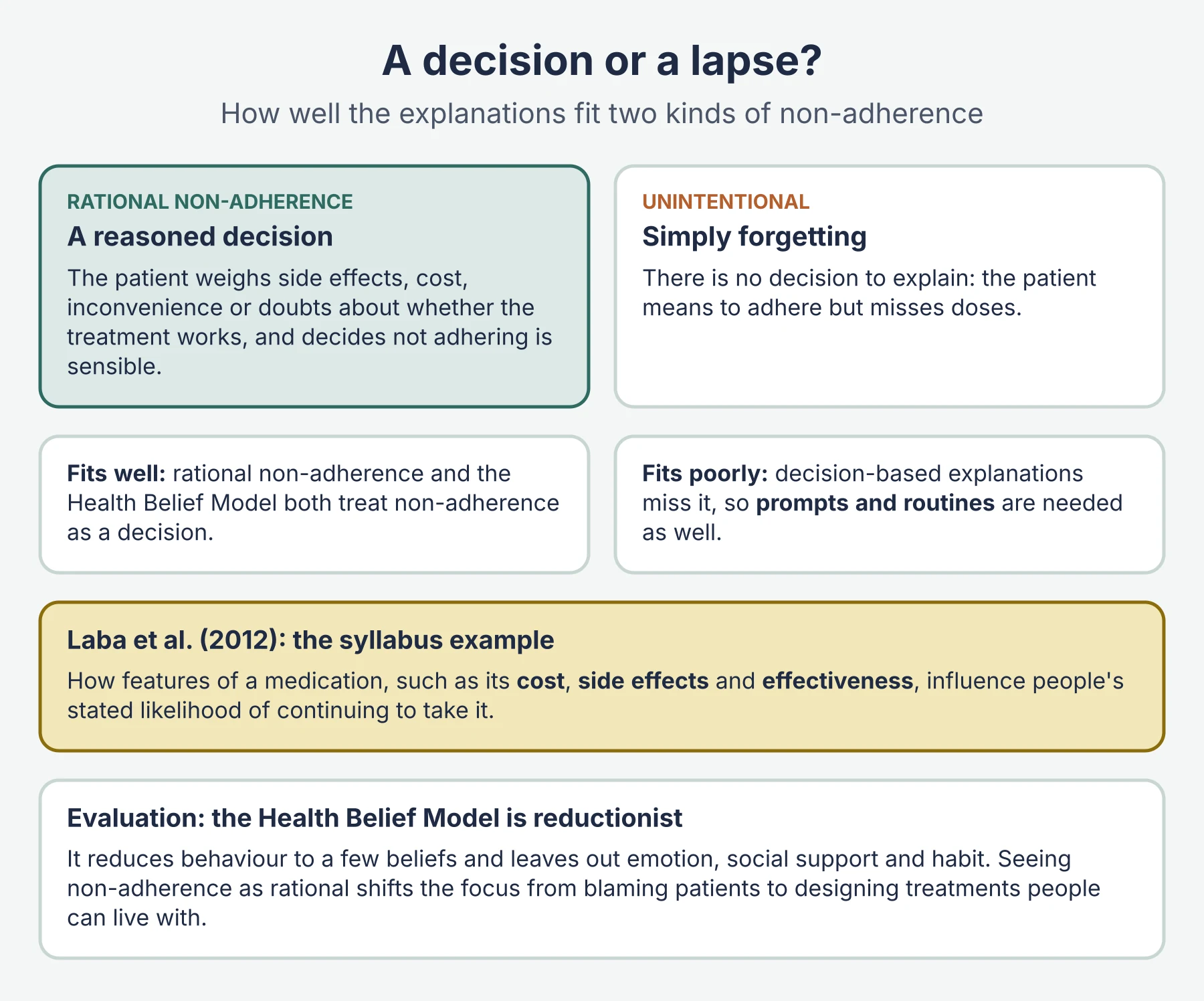
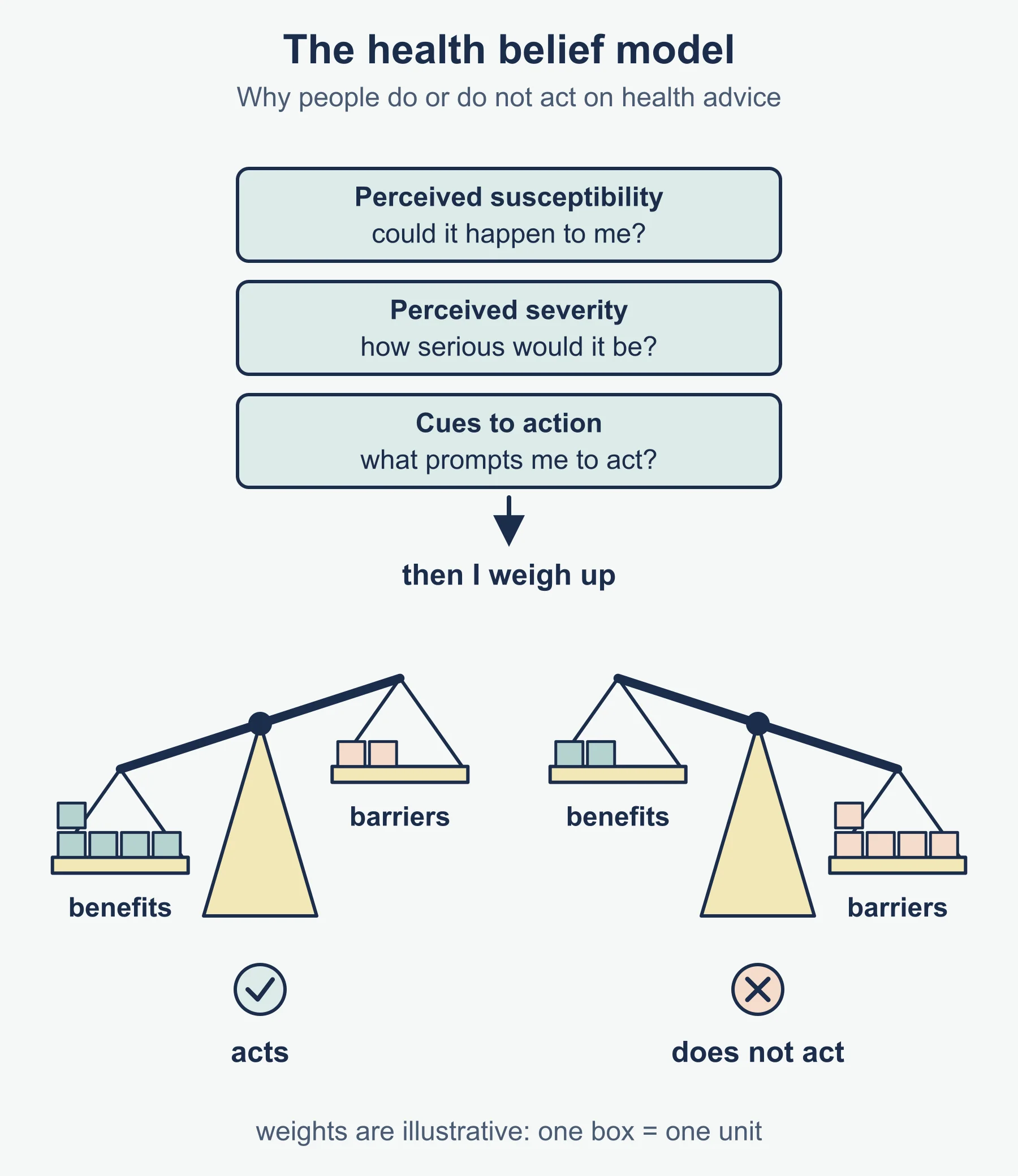
- 3.2.1 Why? Two types (treatments, appointments); rational non-adherence (e.g. Laba et al., 2012); the Health Belief Model.
- 3.2.2 How do we know? Subjective (clinical and semi-structured interviews, e.g. Riekert and Drotar, 1999); objective (pill counts, dispensers, e.g. Chung and Naya, 2000); biological (blood, urine).
- 3.2.3 How do we improve it? Children (e.g. Chaney et al., 2004); contracts, prompts, customising treatment; community interventions, key study Yokley and Glenwick (1984).
Key terms
| Term | Definition |
|---|---|
| Adherence | Following the treatment or advice agreed with a practitioner |
| Failure to follow treatment | Missing, altering or stopping doses or advice |
| Failure to attend | Missing appointments, screening or vaccinations |
| Rational non-adherence | A reasoned decision not to adhere, e.g. because of side effects or cost |
| Health Belief Model | Behaviour depends on susceptibility, severity, benefits versus barriers and cues |
| Clinical interview | A practitioner’s structured conversation with the patient about their health and treatment |
| Semi-structured interview | Set questions with freedom to follow up answers |
| Pill count | Comparing pills remaining with the number expected |
| Medication dispenser | A device recording the date and time each container is opened |
| Biological measure | Testing blood or urine for a drug or its by-products |
| Contract | A written agreement setting out behaviour and rewards |
| Prompt | A reminder, such as a text or call |
| Customising treatment | Fitting the regime to the patient’s lifestyle |
| Community intervention | A programme delivered to many people through public services |
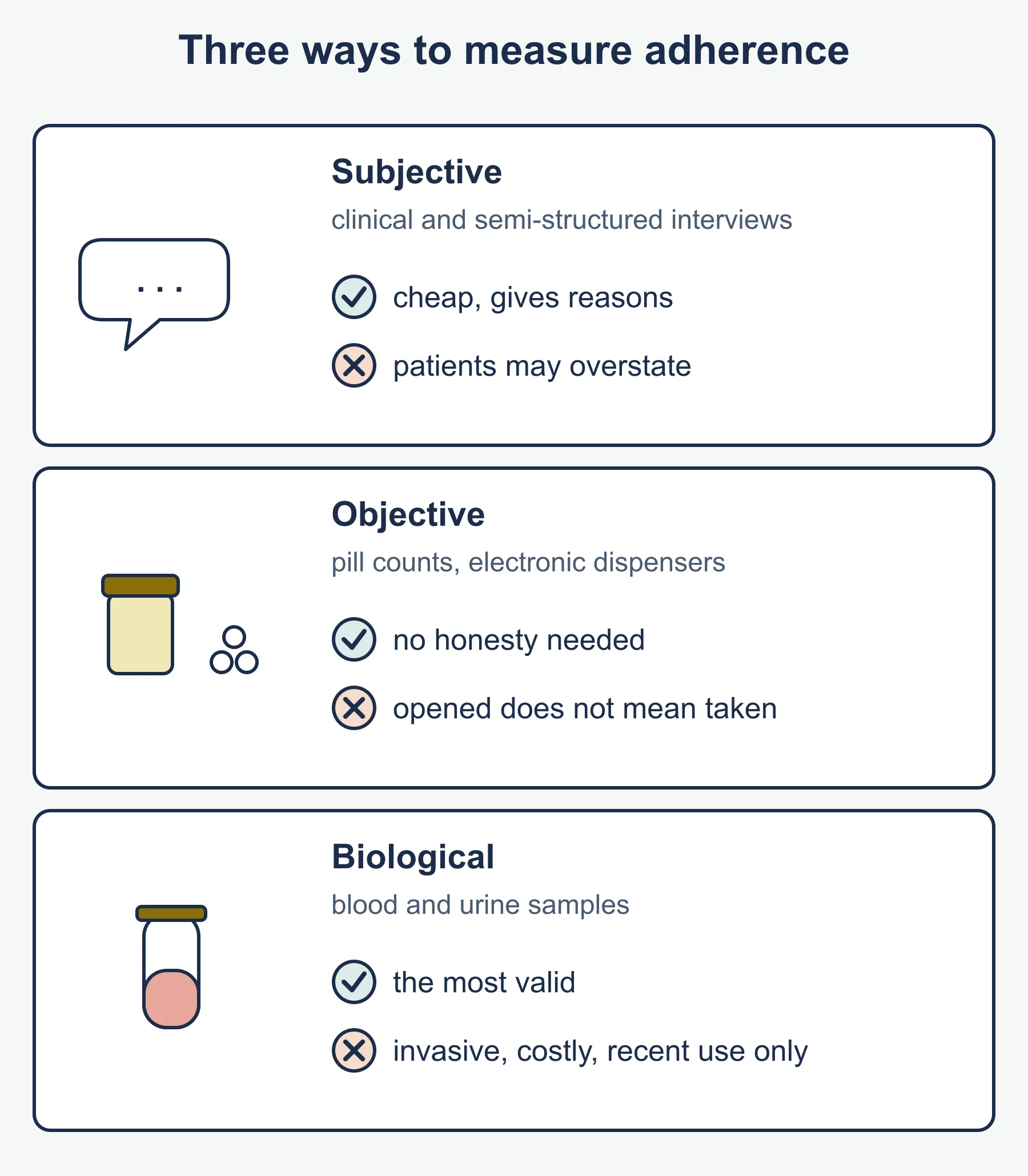
Measures: which is best for what?
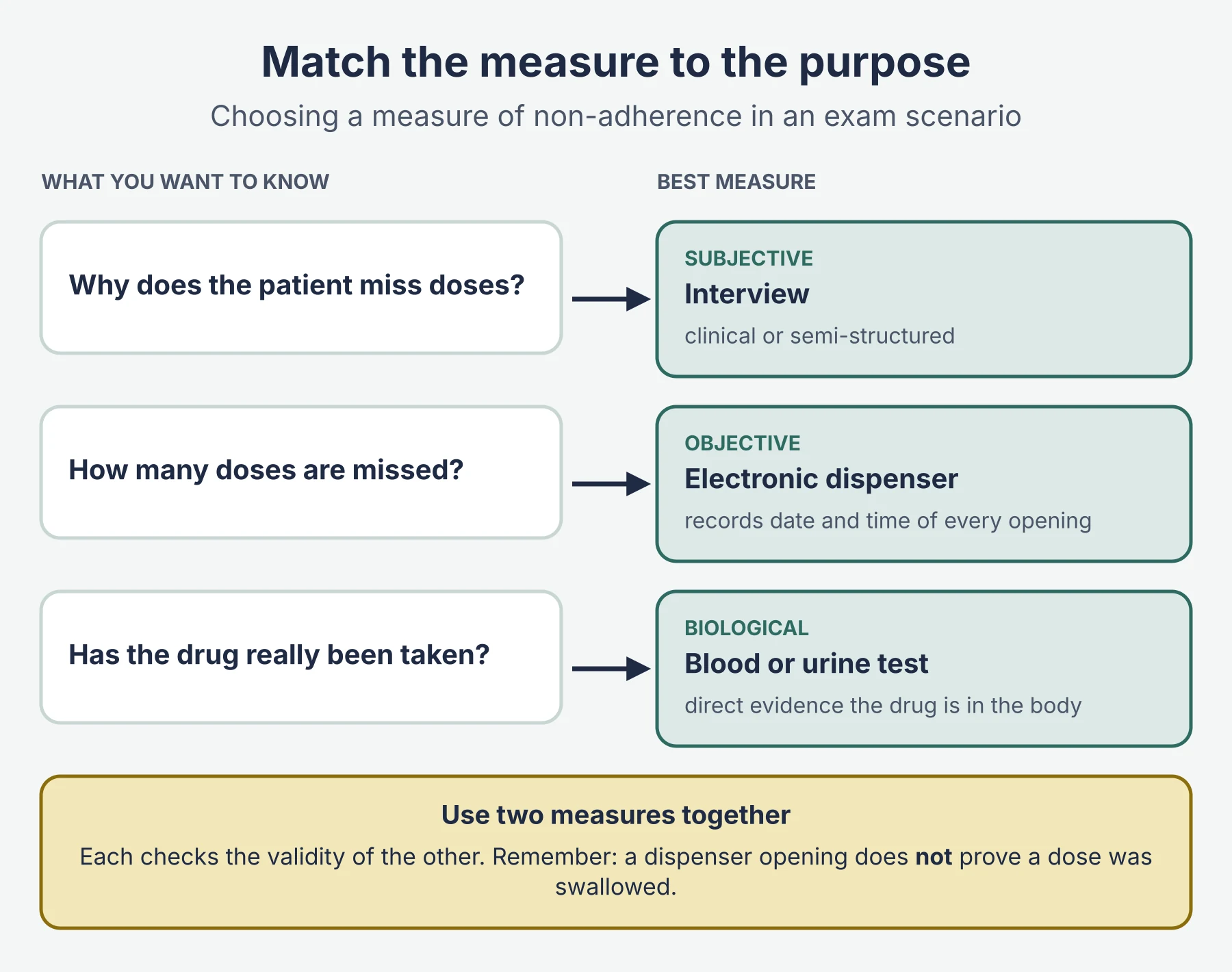
| Purpose | Best measure | Why |
|---|---|---|
| Finding the reasons | Semi-structured interview | Follow-up questions reveal beliefs and barriers |
| Counting missed doses | Electronic dispenser | Records each opening without relying on memory |
| Confirming the drug was taken | Blood or urine test | Detects the drug in the body |
| Cheap screening of many patients | Pill count or short interview | Low cost and quick |
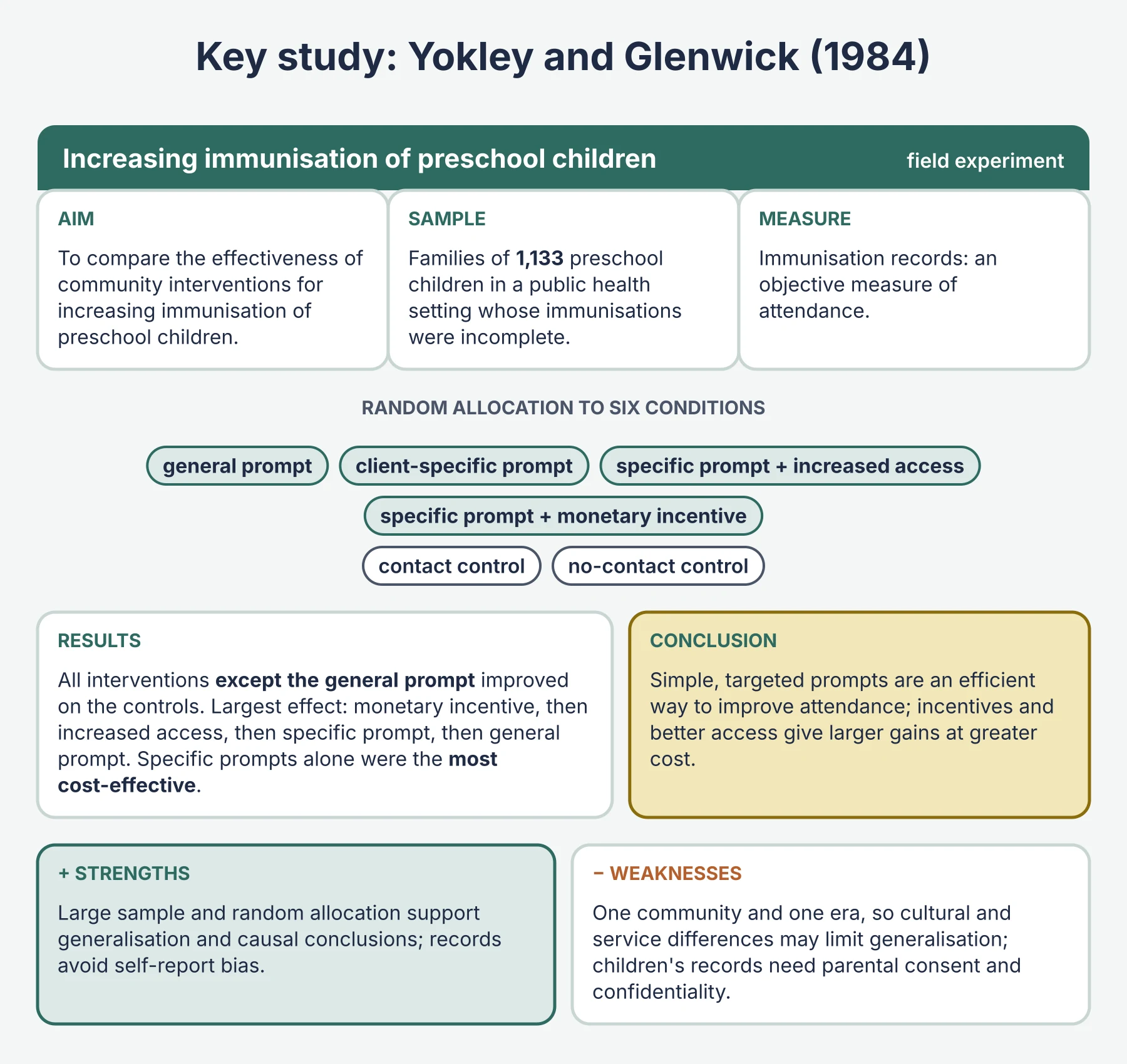
Key study grid: Yokley and Glenwick (1984)
| Feature | Detail |
|---|---|
| Aim | Compare community interventions to raise preschool immunisation |
| Sample | Families of 1,133 preschool children with incomplete immunisations |
| Design | Field experiment; random allocation to six conditions |
| Conditions | General prompt; specific prompt; specific prompt plus access; specific prompt plus money; contact control; no-contact control |
| Measure | Clinic immunisation records (objective) |
| Ranking of effect | Money incentive, then increased access, then specific prompt, then general prompt |
| Key conclusion | All but the general prompt beat the controls; specific prompts most cost-effective |
| Issues | Children in research; generalisation to other communities; validity of records |
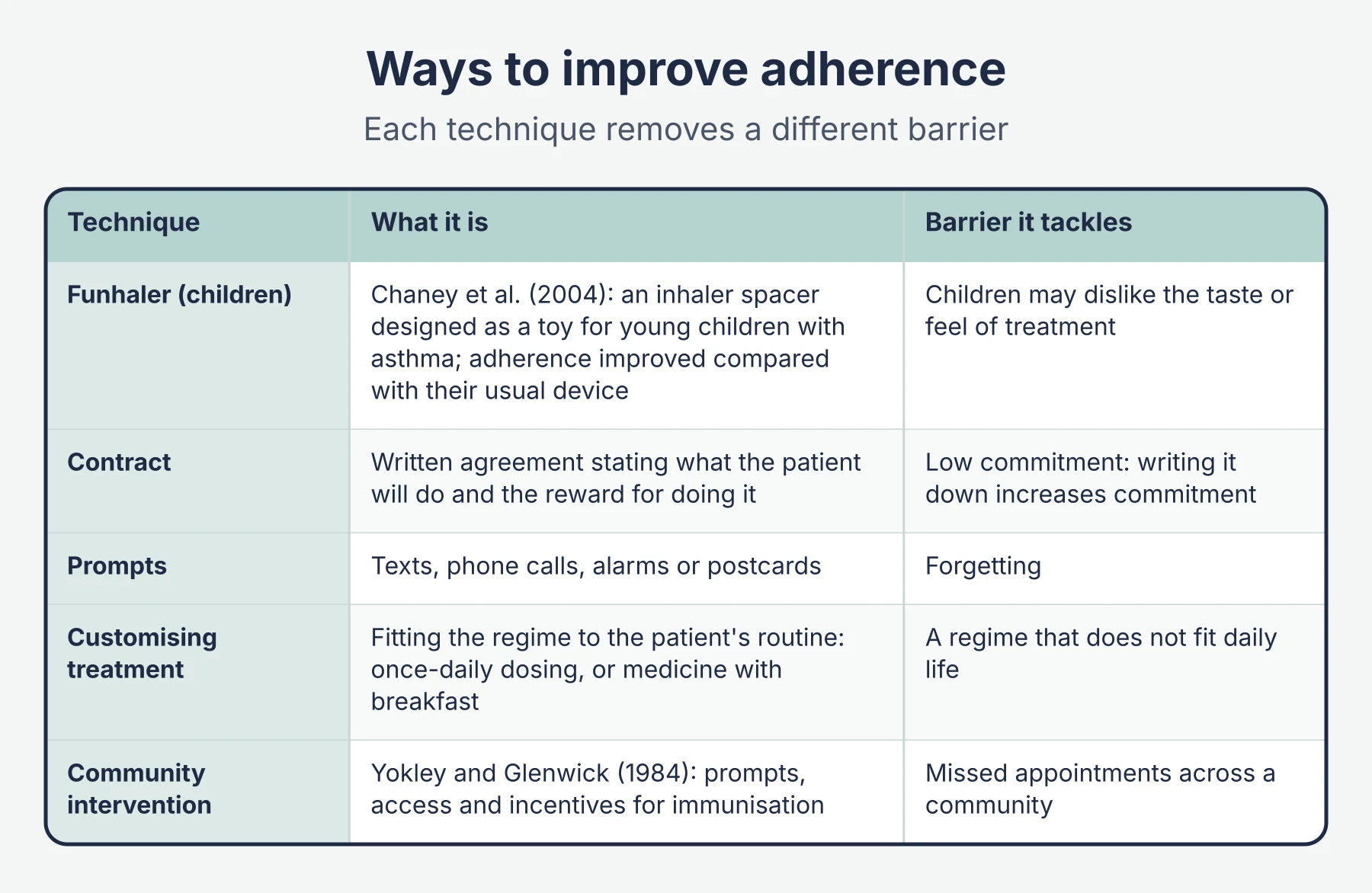
Techniques matched to causes
| Cause of non-adherence | Technique |
|---|---|
| Forgetting | Prompts, alarms, dispensers with reminders |
| Complex regime | Customising treatment, e.g. once-daily dosing |
| Low motivation | Contracts with rewards; incentives |
| Treatment unpleasant for a child | Making it fun, e.g. the Funhaler |
| Difficulty getting to the clinic | Increased access, e.g. longer opening hours |
Linking to issues and debates
- Application to everyday life: prompts and dispensers are used in real health services.
- Individual and situational explanations: beliefs (individual) versus cost and access (situational).
- Reductionism versus holism: the Health Belief Model reduces adherence to a few beliefs.
- Validity and reliability: self-report is less valid than biological tests; dispensers are reliable but can be “fooled”.
- Use of children in research: Chaney et al. and Yokley and Glenwick need parental consent.
Exam traps
- Two types of non-adherence are on the syllabus: treatments and appointments. Give both when asked for types.
- Rational non-adherence is not irrational behaviour. It is a reasoned choice.
- Objective does not mean perfect. A dispenser opening is not proof of a dose taken.
- Yokley and Glenwick used six conditions, including two control groups.
- Do not reverse the cost-effectiveness finding: specific prompts were the most cost-effective, the money incentive the most effective.
Quick self-test
- Name the two types of non-adherence on the syllabus.
- Give two problems caused by non-adherence.
- Define rational non-adherence.
- Which part of the Health Belief Model explains non-adherence due to side effects?
- Give one strength and one weakness of semi-structured interviews for measuring adherence.
- Why might a pill count overestimate adherence?
- What does an electronic dispenser record?
- Give one weakness of biological measures.
- What was the Funhaler, and what did Chaney et al. (2004) find?
- Define a contract as a way to improve adherence.
- How many conditions were in Yokley and Glenwick (1984)?
- Which intervention was most effective, and which most cost-effective?
Answers
- Failure to follow treatments; failure to attend appointments.
- Any two: illness worsens; wasted appointments; wasted medicines; doctors may wrongly change treatment.
- A reasoned decision not to adhere, for example because of side effects, cost or doubts about the treatment.
- Perceived barriers.
- Strength: reveals reasons through follow-up questions. Weakness: patients may overstate adherence.
- Patients may throw pills away before a count, or remove them without taking them.
- The date and time each time the container is opened.
- Any one: invasive; costly; shows only recent use.
- A spacer for an asthma inhaler designed as a toy; adherence improved compared with the usual device.
- A written agreement between patient and practitioner stating what the patient will do and the reward.
- Six.
- Most effective: monetary incentive. Most cost-effective: specific prompts.
More resources on this topic
Related resources
-
Study guides
Cambridge A Level Psychology (9990): Health promotion
Cambridge 9990 topic 3.5 in depth: fear arousal, information, healthy eating, workplace safety, optimism and Shoshani and Steinmetz (2014).
Psychology · Cambridge · A Level
Read guide -
Practice questions
Cambridge A Level Psychology (9990): Health promotion – Practice Questions
Original Paper 3 and Paper 4 style questions on Cambridge 9990 topic 3.5: fear appeals, schools, worksites, optimism and positive psychology, with mark schemes.
Psychology · Cambridge · A Level
Try questions -
Revision notes
Cambridge A Level Psychology (9990): Health promotion – Revision Notes
Revision notes for Cambridge 9990 topic 3.5: fear appeals, information, Food Dudes, token economies, optimism and positive psychology.
Psychology · Cambridge · A Level
Revise topic
Studying Psychology?
This page is free and stays free. Marlbridge is not offering Psychology classes at the moment, so there is no tuition to book for it. The free study resources stay open to everyone.
Get free revision emails (optional)
Occasional emails with practice questions, worked explanations and links to free resources for the qualification and subjects you choose. No spam, and you can unsubscribe from any email. The free tools on this site never need an email.