
Revision Notes
Cambridge A Level Psychology (9990): Health promotion – Revision Notes
Revision notes for Cambridge 9990 topic 3.5: fear appeals, information, Food Dudes, token economies, optimism and positive psychology.
- Subject
- Psychology
- Level
- A LEVEL
- Topic
- Specialist Option 3: Health Psychology
- Author
- Marlbridge Academic Team
- Updated
- Reviewed by
- Kanwal Aslam (what this means)
Aligned to Cambridge A Level Psychology (9990), 2024-2026. Official specification .
Syllabus page (what it covers and how it is assessed): Cambridge A Level Psychology.
Syllabus points this page covers
9990 (A Level)
- 3.5 Health promotion
These notes condense topic 3.5, Health promotion, from Specialist Option 3 of Cambridge International A Level Psychology 9990 (syllabus for 2024 to 2026). Think of the topic as three levels: messages aimed at everyone (3.5.1), programmes in settings such as schools and workplaces (3.5.2), and the individual’s own beliefs (3.5.3).
The health promotion study guide explains each study fully. Try the health promotion practice questions once you have learned these notes.
Topic map
- 3.5.1 Strategies: fear arousal, e.g. Janis and Feshbach (1953); providing information, e.g. Lewin et al. (1992).
- 3.5.2 Settings: schools and healthy eating, e.g. Tapper et al. (2003); worksites and safety, e.g. Fox et al. (1987).
- 3.5.3 Individual factors: unrealistic optimism, e.g. Weinstein (1980); positive psychology and its three focuses, e.g. Seligman (2004); application, key study Shoshani and Steinmetz (2014).
Key terms
| Term | Definition |
|---|---|
| Health promotion | Any planned attempt to help people improve their health |
| Fear arousal | Using frightening information about consequences to motivate change |
| Providing information | Telling people what to do and how, so they can improve their health |
| Modelling | Learning by imitating others, especially admired models |
| Positive reinforcement | A reward that makes a behaviour more likely to be repeated |
| Token economy | Tokens earned for target behaviour and exchanged for goods |
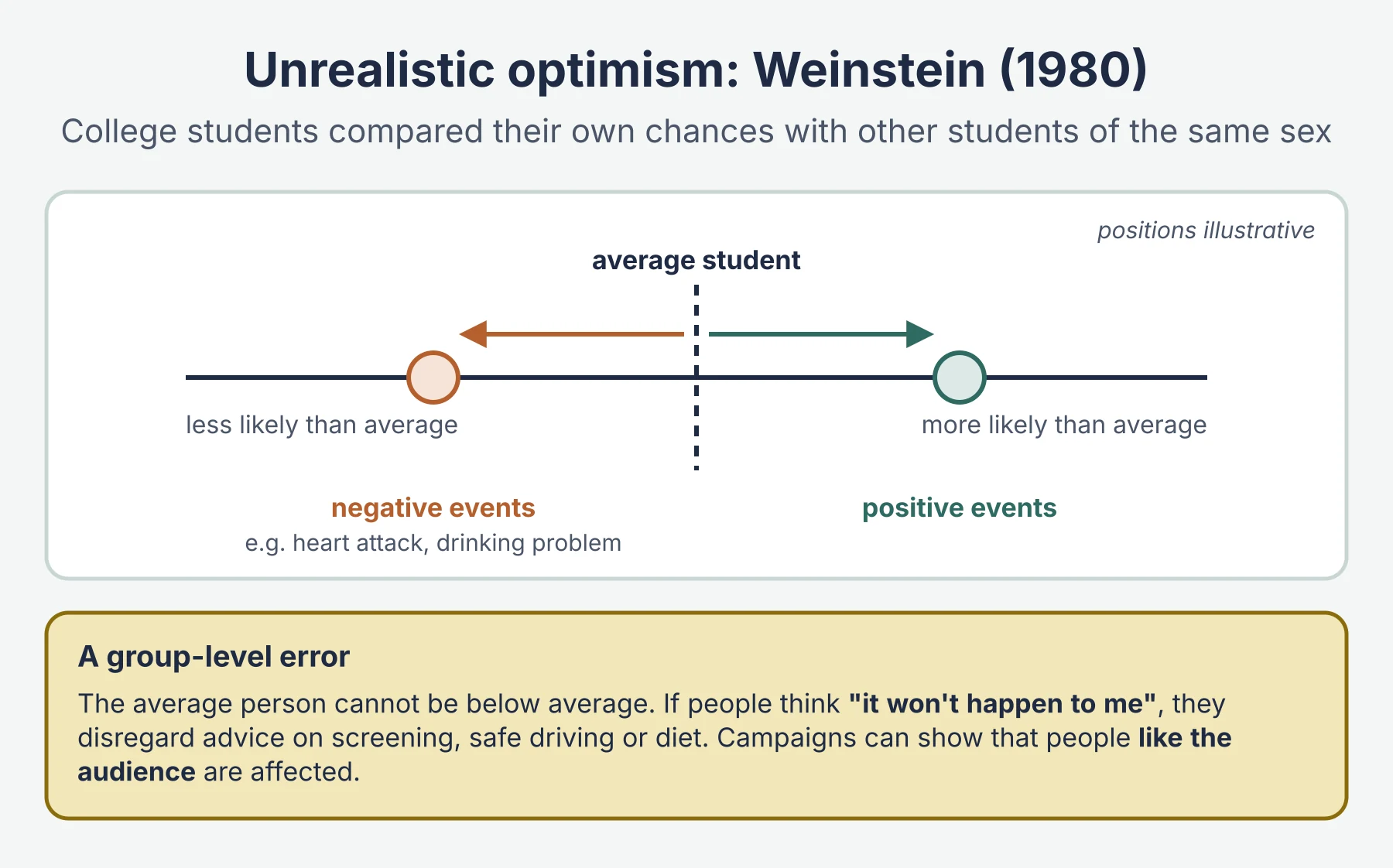
| Unrealistic optimism | Believing bad events are less likely to happen to you than to others |
| Positive psychology | The study of strengths, well-being and what makes life worth living |
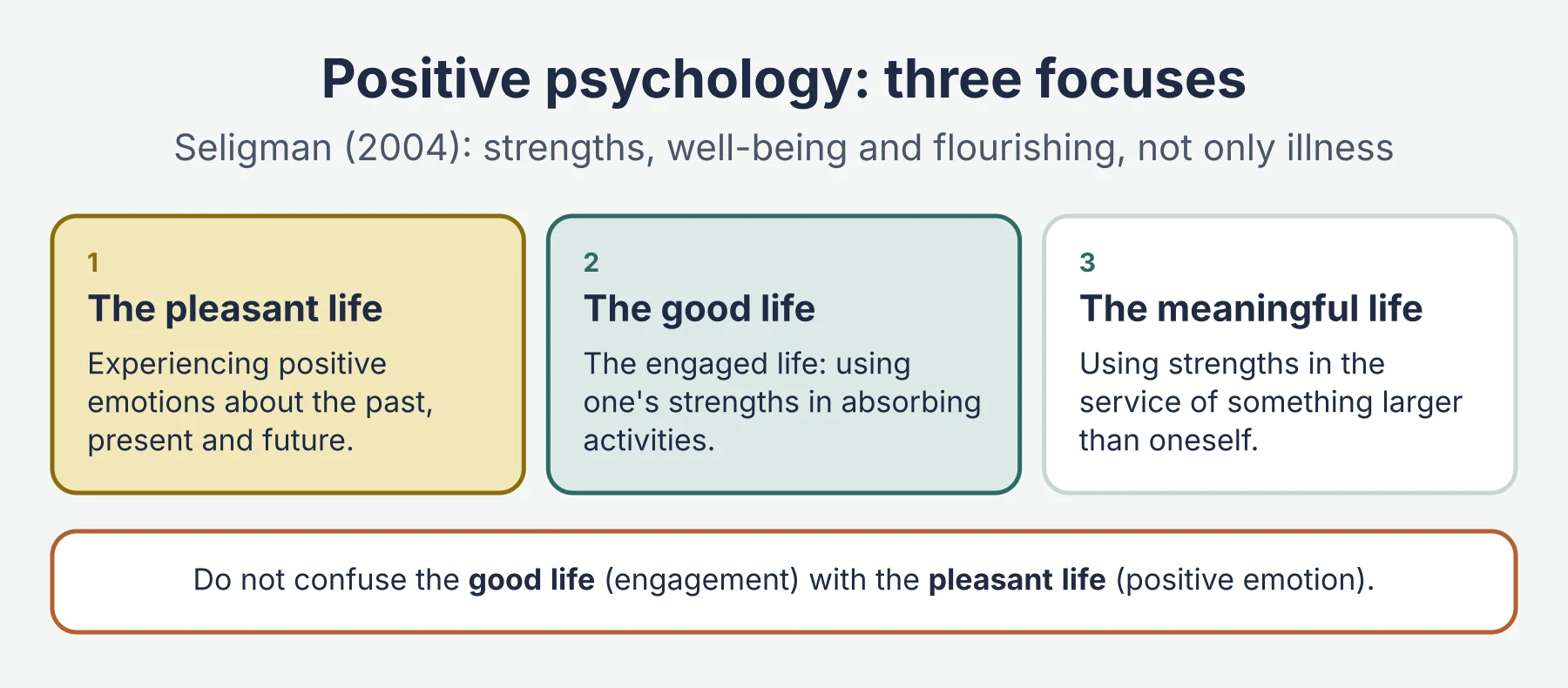
| Pleasant life | Experiencing positive emotions |
| Good life | Engagement through using one’s strengths |
| Meaningful life | Using strengths in the service of something larger than oneself |
Studies to name
| Study | Strategy | Main finding |
|---|---|---|
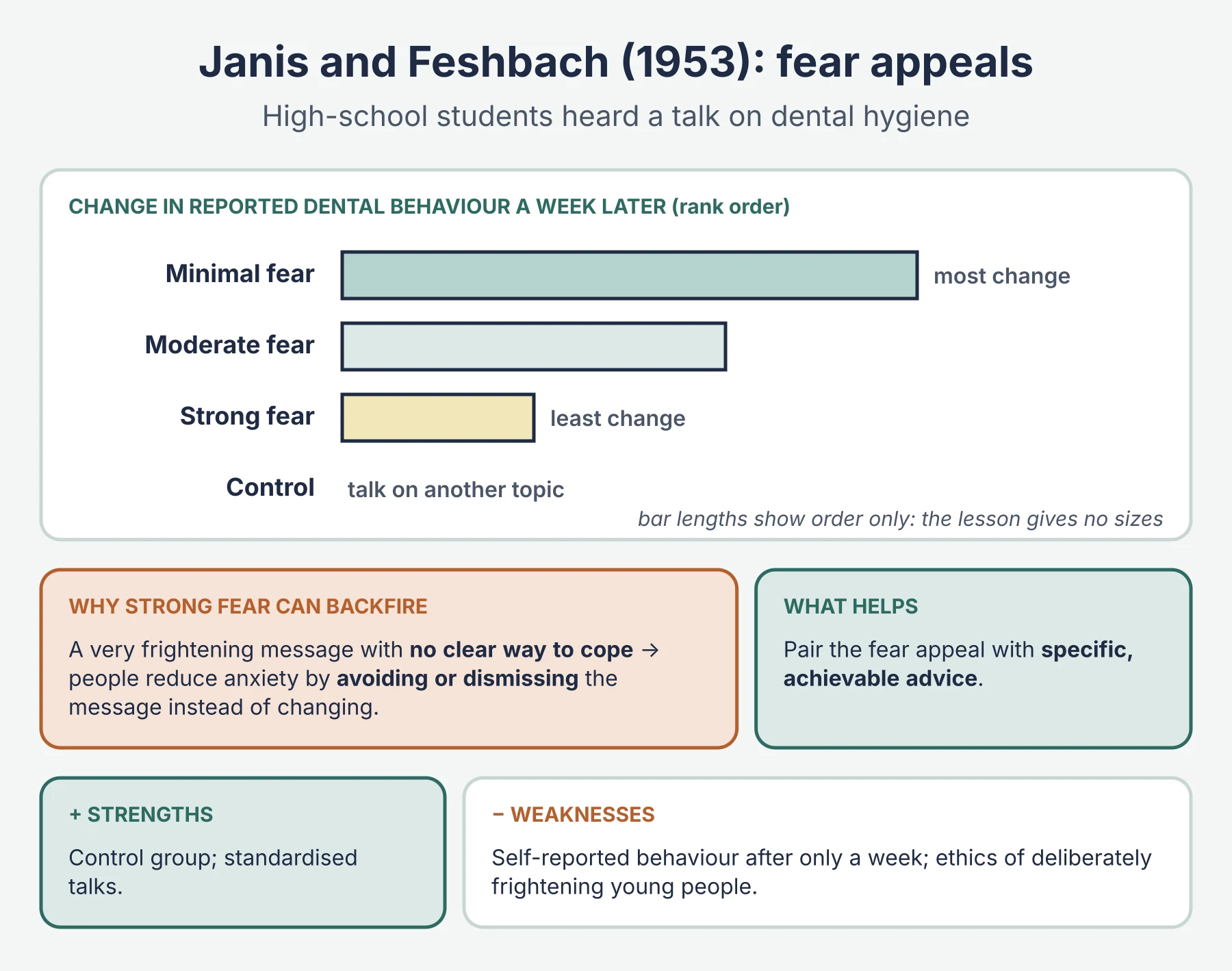
| Janis and Feshbach (1953) | Fear arousal | Minimal fear produced the most reported change in dental behaviour; strong fear the least |
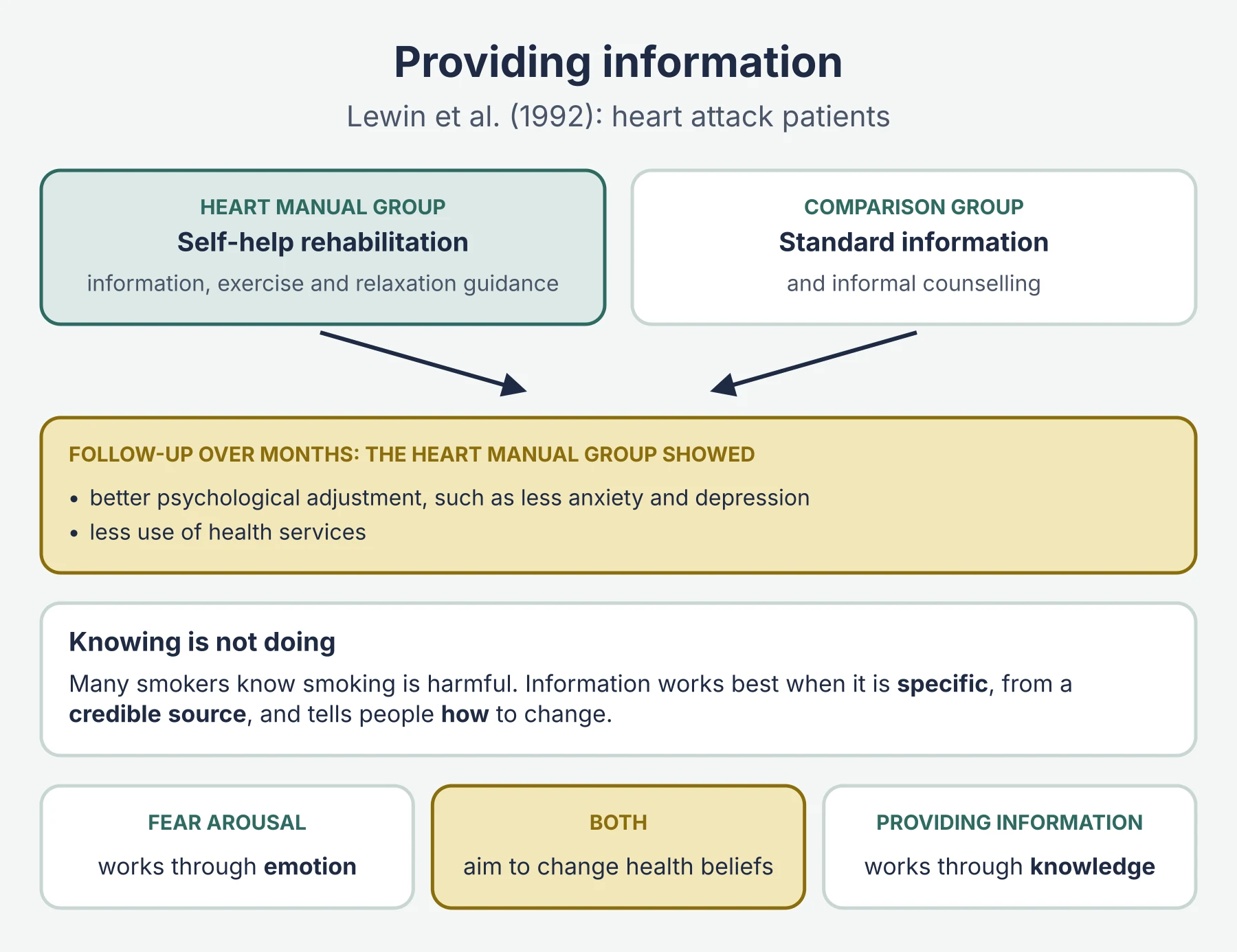
| Lewin et al. (1992) | Information | Heart Manual improved psychological adjustment after a heart attack |
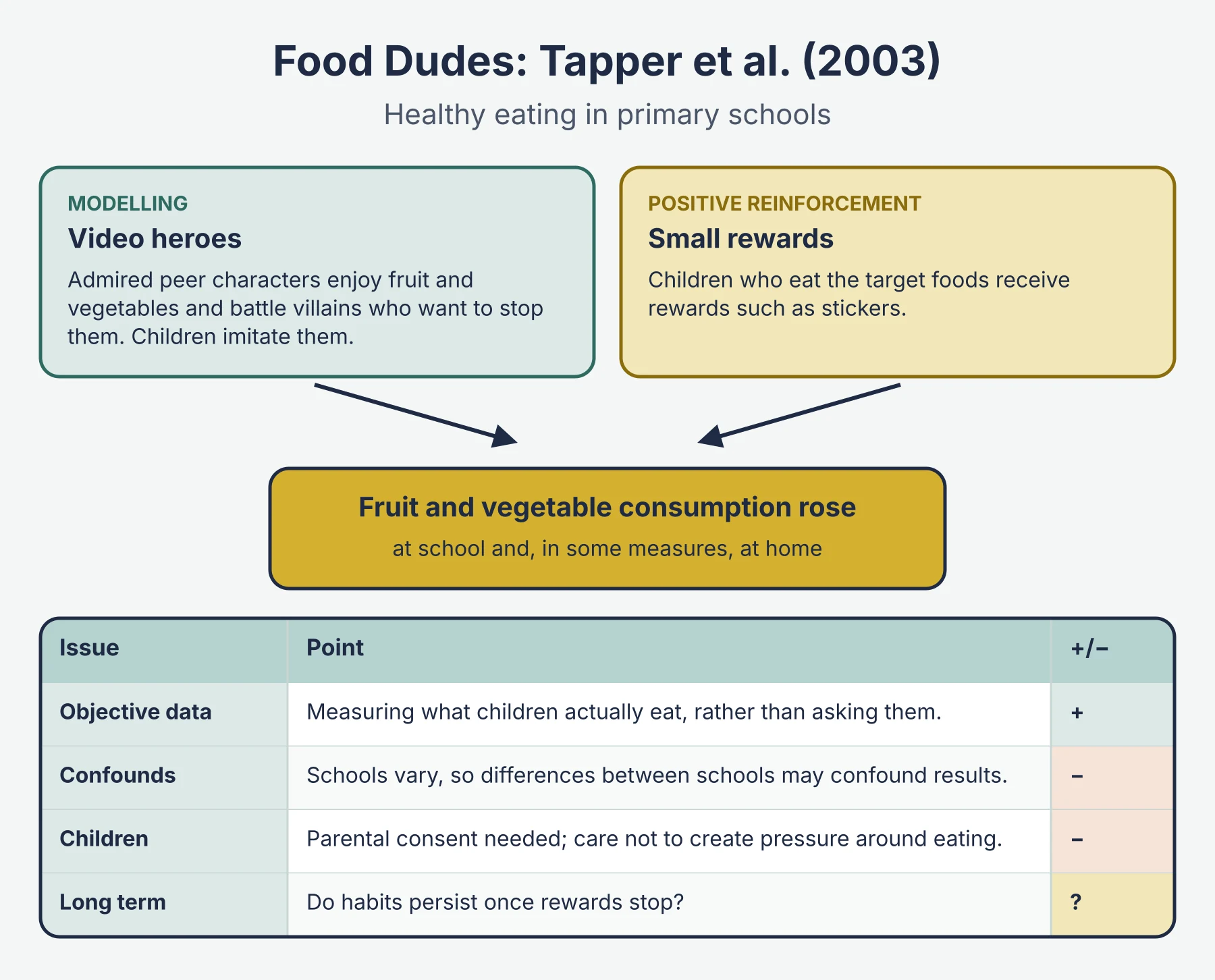
| Tapper et al. (2003) | School healthy eating | Food Dudes videos and rewards increased fruit and vegetable eating |
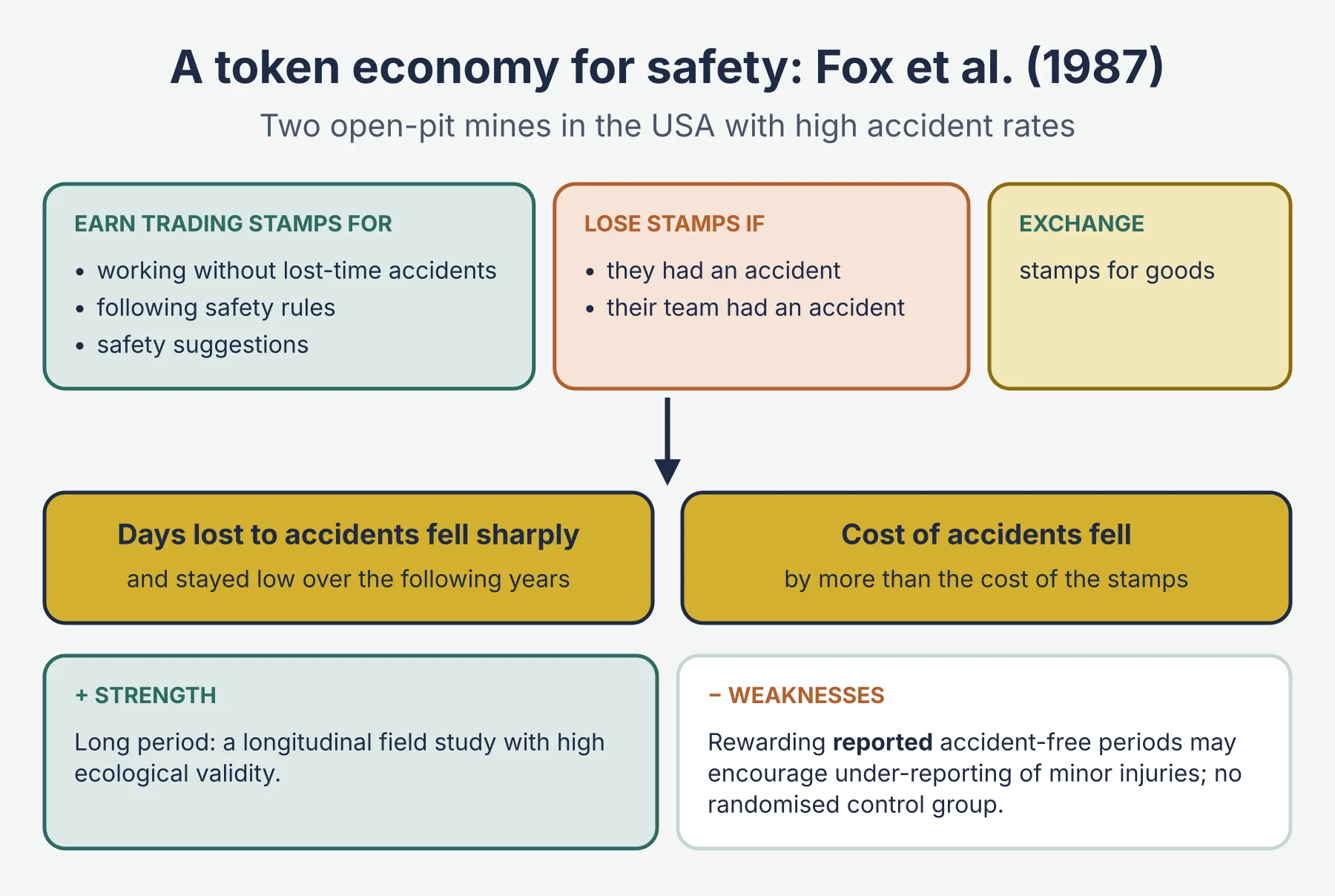
| Fox et al. (1987) | Worksite safety | Token economy reduced days lost to accidents in two mines over years |
| Weinstein (1980) | Unrealistic optimism | Students rated own risk of negative events below average |
| Seligman (2004) | Positive psychology | Three focuses: pleasant, good, meaningful life |
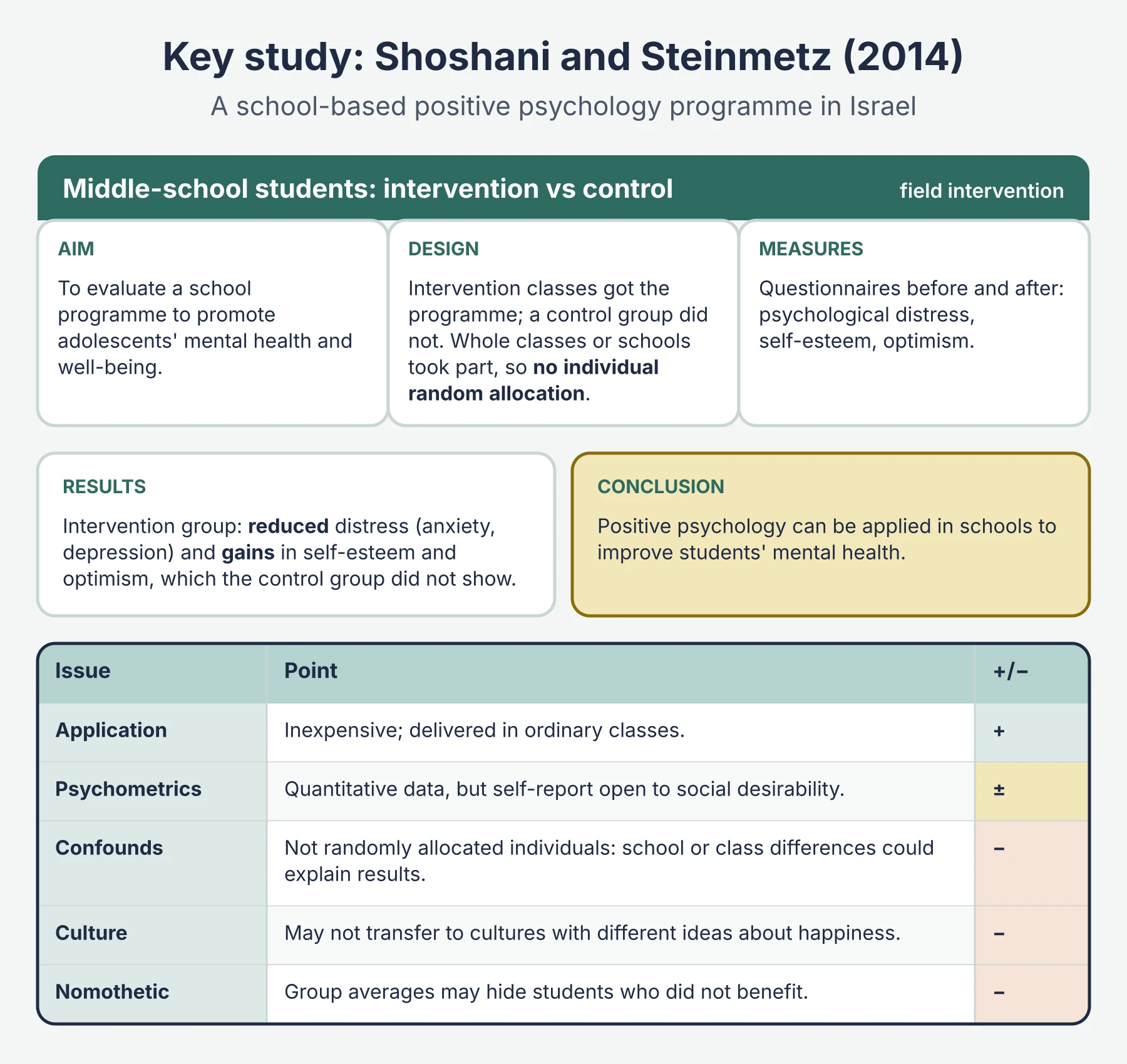
| Shoshani and Steinmetz (2014) | Applying positive psychology | School programme reduced distress symptoms and increased well-being measures |
Key study grid: Shoshani and Steinmetz (2014)
| Feature | Detail |
|---|---|
| Aim | Evaluate a school-based positive psychology programme for adolescents’ mental health |
| Setting | Middle schools in Israel |
| Design | Intervention group versus control group; whole classes or schools, not individual random allocation |
| Measures | Psychometric questionnaires before and after the programme |
| Results | Fewer distress symptoms (e.g. anxiety, depression); gains in self-esteem and optimism; no such change in controls |
| Strengths | Real classrooms; standardised measures; applied value |
| Weaknesses | Possible confounds between groups; self-report bias; culture-specific |
Why might each strategy fail?
| Strategy | Possible reason for failure |
|---|---|
| Strong fear appeal | People avoid or dismiss the message to reduce anxiety |
| Information alone | Knowing is not doing; barriers remain |
| School rewards | Behaviour may stop when rewards stop |
| Token economy | Encourages under-reporting of minor accidents |
| Any campaign | Unrealistic optimism: “it won’t happen to me” |
Linking to issues and debates
- Individual and situational explanations (3.5.1, 3.5.3): campaigns change situations; optimism and well-being are individual.
- Cultural differences (3.5.1, 3.5.3): fear appeals and ideas of happiness vary between cultures.
- Longitudinal studies (3.5.1, 3.5.2): Fox et al. followed accident data over years; Lewin et al. followed patients for months.
- Use of children in research (3.5.2): Tapper et al. and Shoshani and Steinmetz need parental consent.
- Ethics (3.5.1): deliberately frightening people may cause distress.
- Psychometrics (3.5.3): well-being questionnaires must be reliable and valid.
Exam traps
- Minimal fear worked best in Janis and Feshbach.
- Unrealistic optimism is about comparison with others, not general cheerfulness.
- Seligman’s three focuses are pleasant, good and meaningful; the good life is about engagement.
- Shoshani and Steinmetz is the key study, so know aim, design, measures, results and conclusion.
- A token economy is operant conditioning; name the reinforcement.
Quick self-test
- Name the two strategies for promoting health in 3.5.1.
- Which fear level was most effective in Janis and Feshbach (1953)?
- Give one reason why strong fear appeals can fail.
- What was the Heart Manual?
- Name two psychological principles used in the Food Dudes programme.
- What did workers earn in Fox et al. (1987), and for what?
- Give one weakness of using recorded accidents to evaluate a token economy.
- Define unrealistic optimism.
- Who did Weinstein (1980) ask to compare their chances with?
- Name Seligman’s three focuses.
- Where did Shoshani and Steinmetz (2014) carry out their study?
- Give one reason why the results of Shoshani and Steinmetz might not be caused by the programme.
Answers
- Fear arousal and providing information.
- Minimal fear.
- People may avoid or deny the message to reduce their anxiety, especially if no clear way to cope is offered.
- A self-help rehabilitation programme for heart attack patients (Lewin et al., 1992).
- Modelling (heroic peers) and positive reinforcement (rewards).
- Trading stamps, for periods of work without lost-time accidents; stamps were exchanged for goods.
- Workers may stop reporting minor accidents to keep their tokens.
- Believing negative events are less likely to happen to oneself than to others.
- Other students of the same sex at their college.
- The pleasant life, the good life and the meaningful life.
- Middle schools in Israel.
- Groups were not randomly allocated individuals, so differences between schools or classes, or self-report bias, could explain the results.
More resources on this topic
Related resources
-
Study guides
Cambridge A Level Psychology (9990): Pain
Cambridge 9990 topic 3.3 in depth: types and theories of pain, phantom limb pain, McGill, VAS and UAB measures, Brudvik et al. (2016) and pain management.
Psychology · Cambridge · A Level
Read guide -
Practice questions
Cambridge A Level Psychology (9990): Pain – Practice Questions
Original Paper 3 and Paper 4 style questions on Cambridge 9990 topic 3.3 Pain: theories, measures, Brudvik et al. and management, with answers.
Psychology · Cambridge · A Level
Try questions -
Revision notes
Cambridge A Level Psychology (9990): Pain – Revision Notes
Revision notes for Cambridge 9990 topic 3.3 Pain: types, theories, four measures, Brudvik et al. (2016) and management, with a self-test.
Psychology · Cambridge · A Level
Revise topic
Studying Psychology?
This page is free and stays free. Marlbridge is not offering Psychology classes at the moment, so there is no tuition to book for it. The free study resources stay open to everyone.
Get free revision emails (optional)
Occasional emails with practice questions, worked explanations and links to free resources for the qualification and subjects you choose. No spam, and you can unsubscribe from any email. The free tools on this site never need an email.