
Revision Notes
Cambridge A Level Psychology (9990): Pain – Revision Notes
Revision notes for Cambridge 9990 topic 3.3 Pain: types, theories, four measures, Brudvik et al. (2016) and management, with a self-test.
- Subject
- Psychology
- Level
- A LEVEL
- Topic
- Specialist Option 3: Health Psychology
- Author
- Marlbridge Academic Team
- Updated
- Reviewed by
- Kanwal Aslam (what this means)
Aligned to Cambridge A Level Psychology (9990), 2024-2026. Official specification .
Syllabus page (what it covers and how it is assessed): Cambridge A Level Psychology.
Syllabus points this page covers
9990 (A Level)
- 3.3 Pain
These notes condense topic 3.3, Pain, from Specialist Option 3 of Cambridge International A Level Psychology 9990 (syllabus for 2024 to 2026). Revise it in three blocks: what pain is and how it is explained, how it is measured, and how it is managed.
For full explanations, theory evaluation and an annotated answer, read the pain study guide. For timed practice, use the pain practice questions.
The topic at a glance
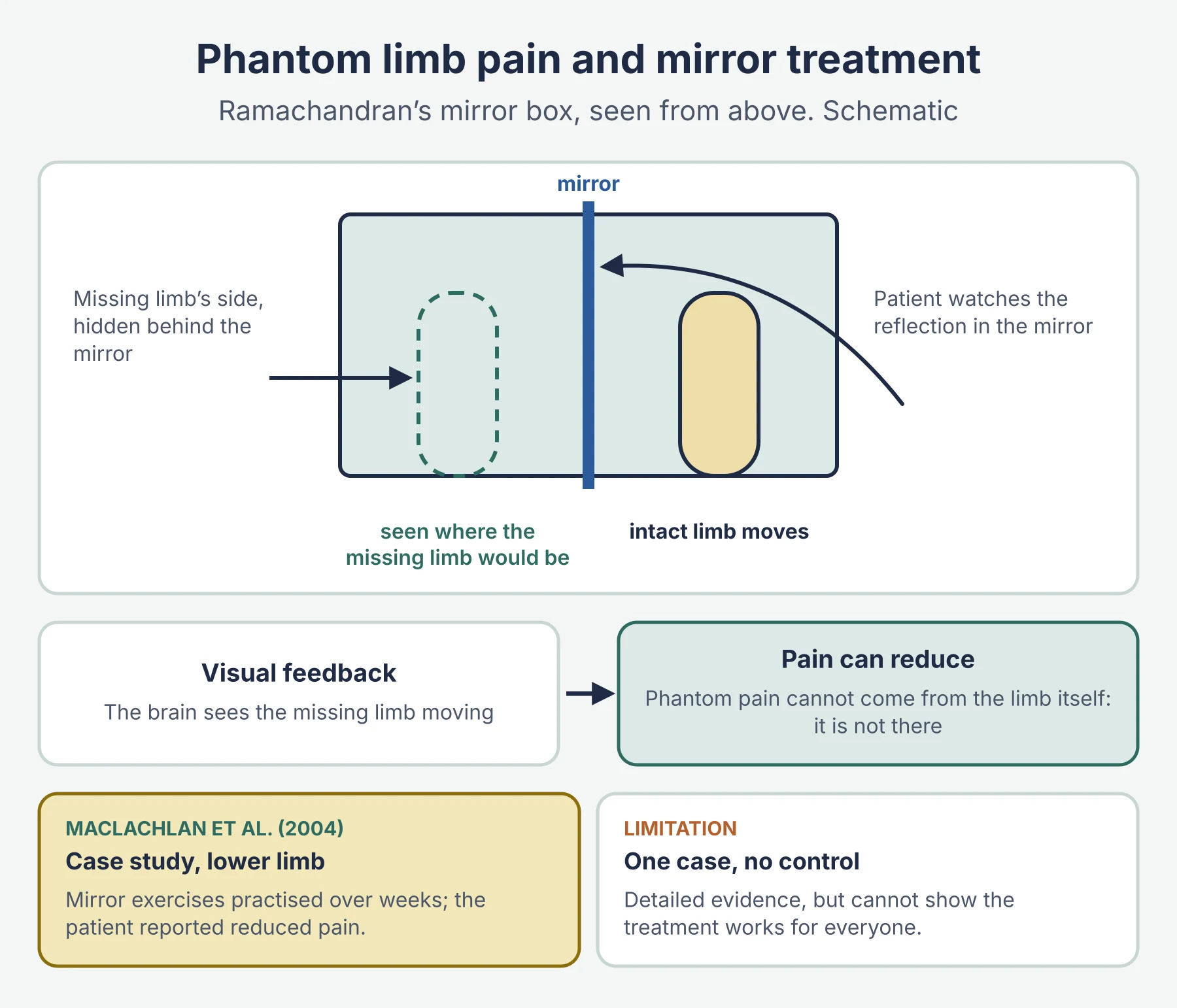
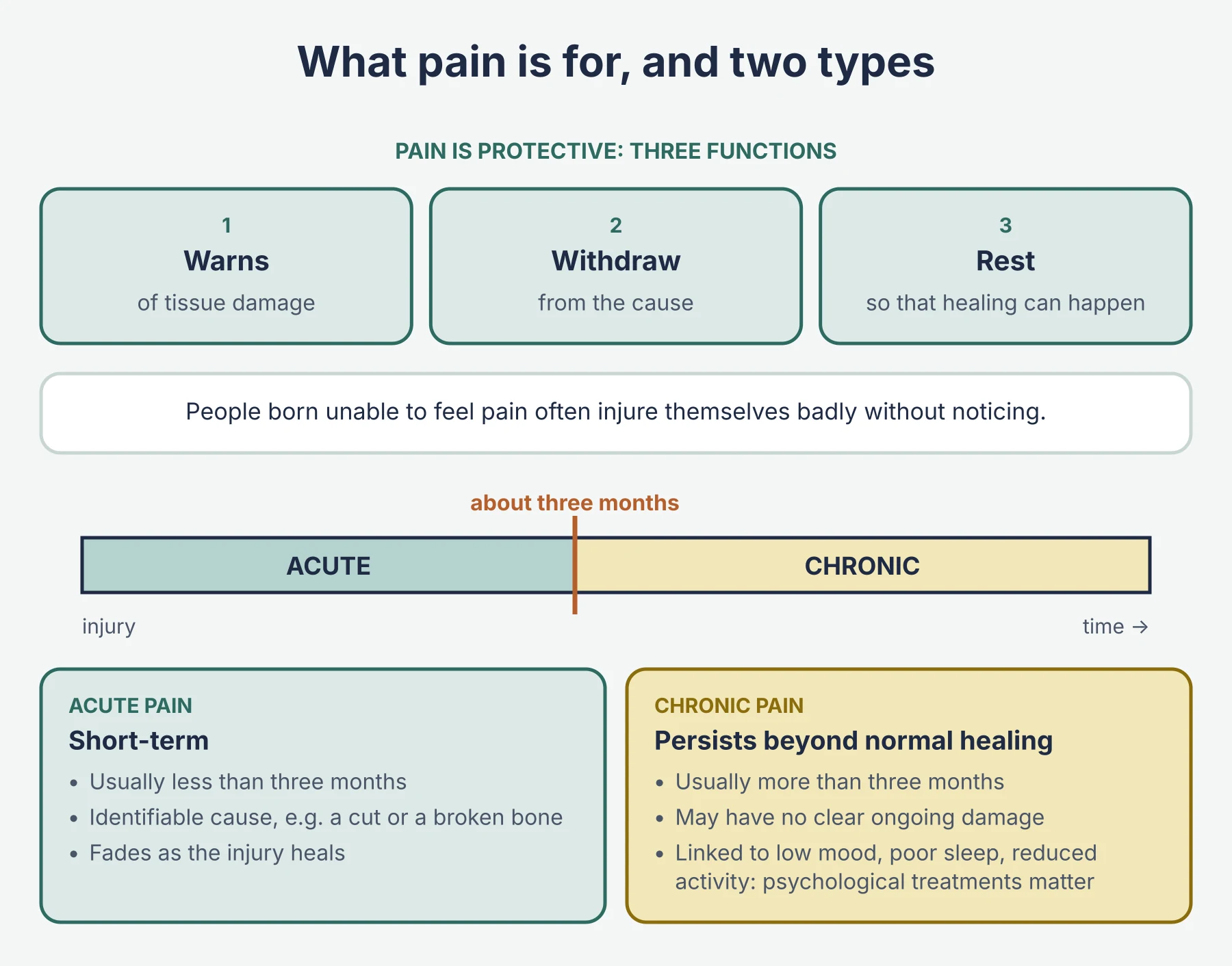
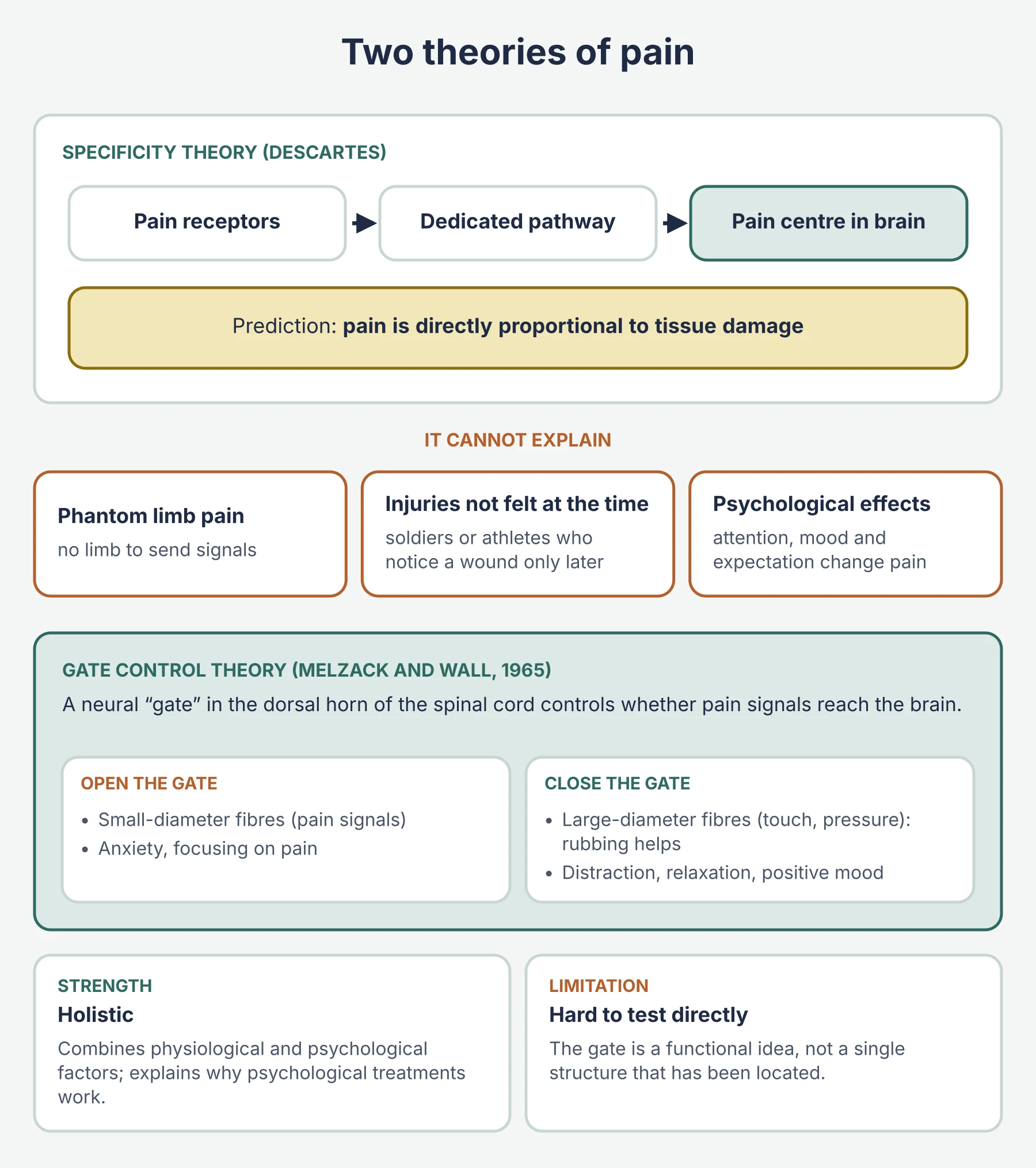
- 3.3.1: functions of pain; acute and chronic; phantom limb pain and mirror treatment (e.g. MacLachlan et al., 2004, case study); specificity theory; gate control theory.
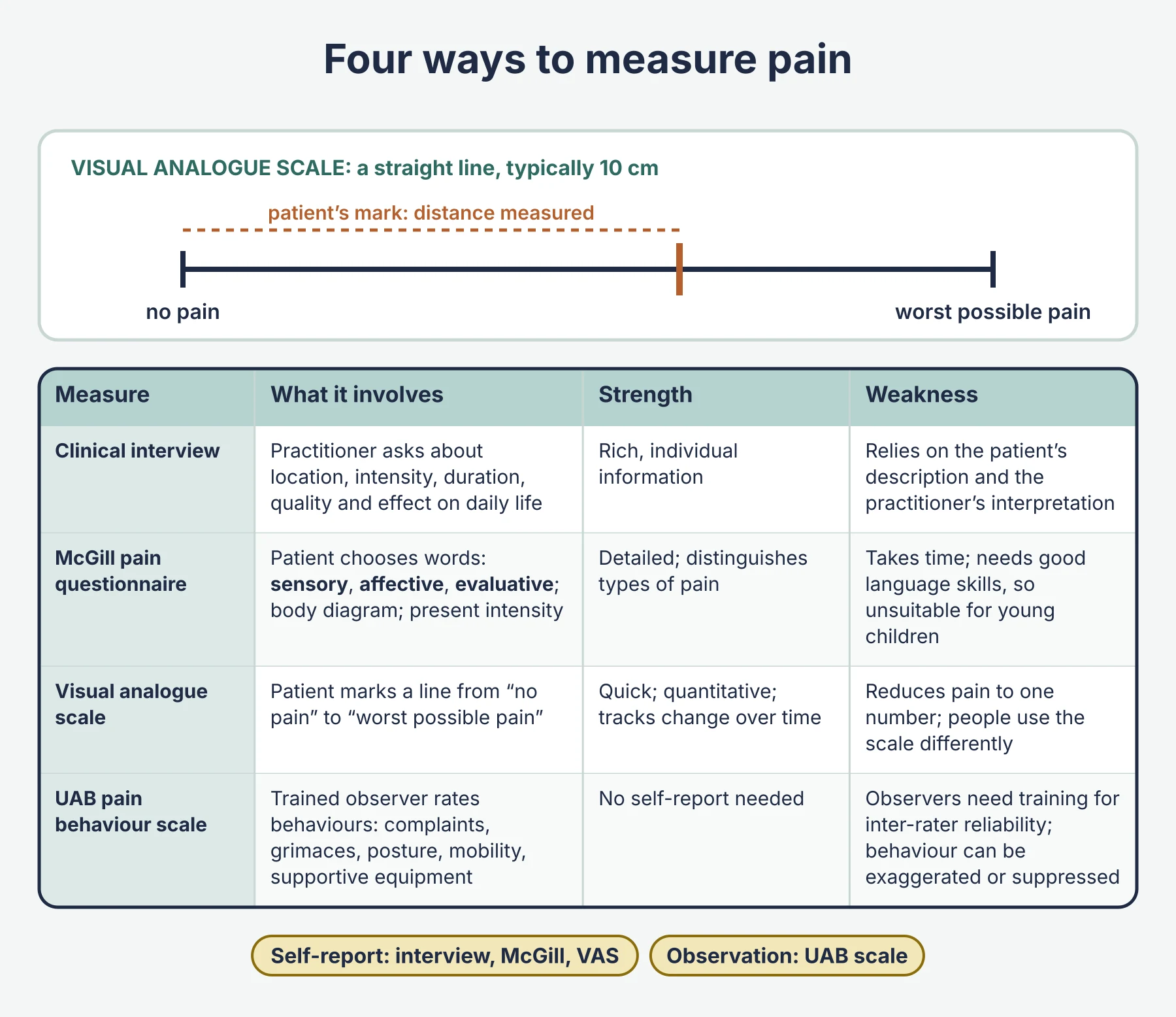
- 3.3.2: clinical interview; McGill pain questionnaire; visual analogue scale (key study Brudvik et al., 2016); UAB pain behaviour scale.
- 3.3.3: biochemical treatment; attention diversion, non-pain imagery, cognitive redefinition; acupuncture and TENS.
Key terms
| Term | Definition |
|---|---|
| Acute pain | Short-term pain with a clear cause, fading as healing occurs |
| Chronic pain | Pain persisting beyond normal healing, usually more than three months |
| Phantom limb pain | Pain felt as if in a limb that has been amputated |
| Mirror treatment | Using the reflection of the intact limb to give visual feedback in place of the missing one |
| Specificity theory | Dedicated receptors and pathway; pain proportional to damage |
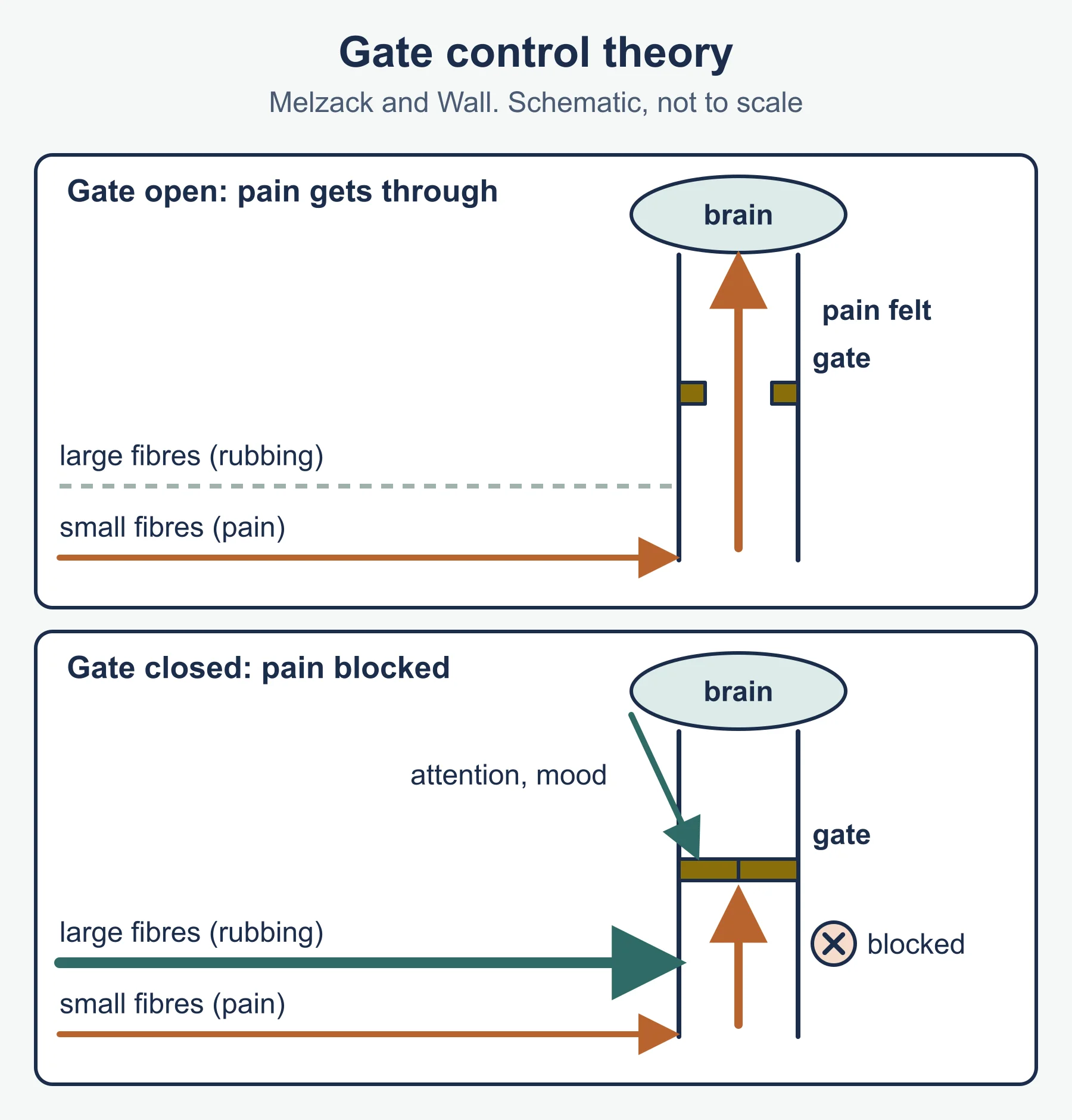
| Gate control theory | A spinal “gate” opened by small fibres and closed by large fibres and brain signals |
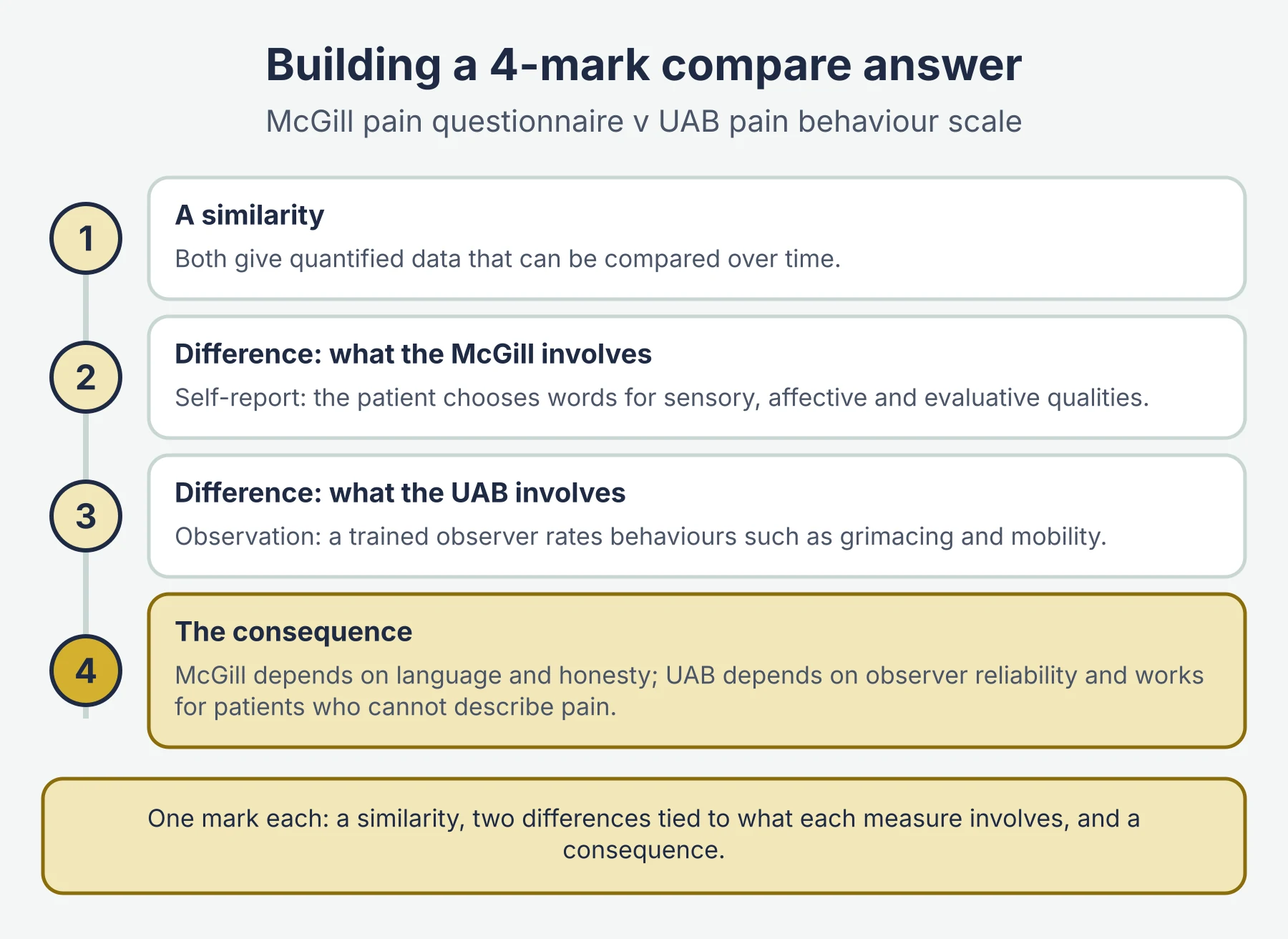
| McGill pain questionnaire | Word lists describing sensory, affective and evaluative qualities of pain |
| Visual analogue scale | A line from “no pain” to “worst pain” on which the patient marks intensity |
| UAB pain behaviour scale | Observer ratings of pain behaviours such as grimacing and mobility |
| Attention diversion | Focusing attention away from pain |
| Non-pain imagery | Imagining a pleasant scene incompatible with pain |
| Cognitive redefinition | Reinterpreting pain in a more rational, less threatening way |
| TENS | Transcutaneous electrical nerve stimulation through skin electrodes |
Theories compared
| Specificity theory | Gate control theory | |
|---|---|---|
| Mechanism | Direct pathway from receptors to a pain centre | Gate in the spinal cord modulates signals |
| Role of psychology | None | Brain signals (attention, mood) open or close the gate |
| Explains phantom limb pain? | No | Partly, as pain can arise centrally |
| Explains rubbing an injury? | No | Yes: large fibres close the gate |
| Debate | Reductionist | More holistic |
Measures compared
| Measure | Type | Strength | Weakness |
|---|---|---|---|
| Clinical interview | Subjective | Rich, individual detail | Depends on description and interpretation |
| McGill questionnaire | Psychometric | Distinguishes qualities of pain | Needs good vocabulary; slow |
| Visual analogue scale | Visual rating | Quick; quantitative | Reduces pain to one number |
| UAB scale | Observational | No self-report needed | Needs trained observers; behaviour can be faked |
Key study grid: Brudvik et al. (2016)
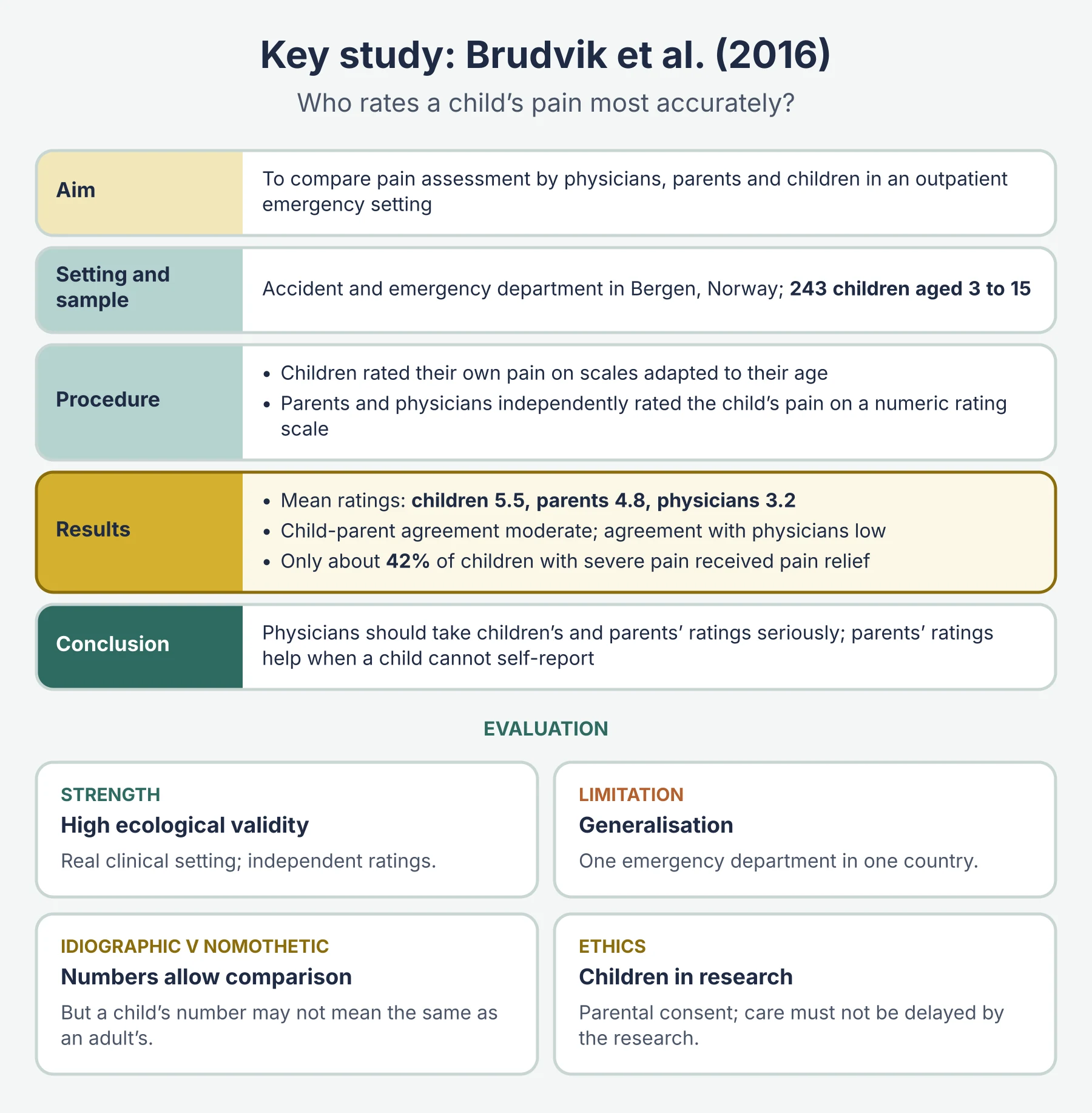
| Feature | Detail |
|---|---|
| Aim | Compare children’s, parents’ and physicians’ ratings of children’s pain |
| Setting | Accident and emergency department, Bergen, Norway |
| Sample | 243 children aged 3 to 15 |
| Measures | Age-adapted self-report scales for children; numeric rating scale for parents and physicians |
| Mean ratings | Children 5.5; parents 4.8; physicians 3.2 |
| Agreement | Child–parent moderate; with physicians low |
| Treatment | Only about 42% of children with severe pain received pain relief |
| Conclusion | Physicians underestimate children’s pain; listen to children and parents |
Management linked to gate control theory
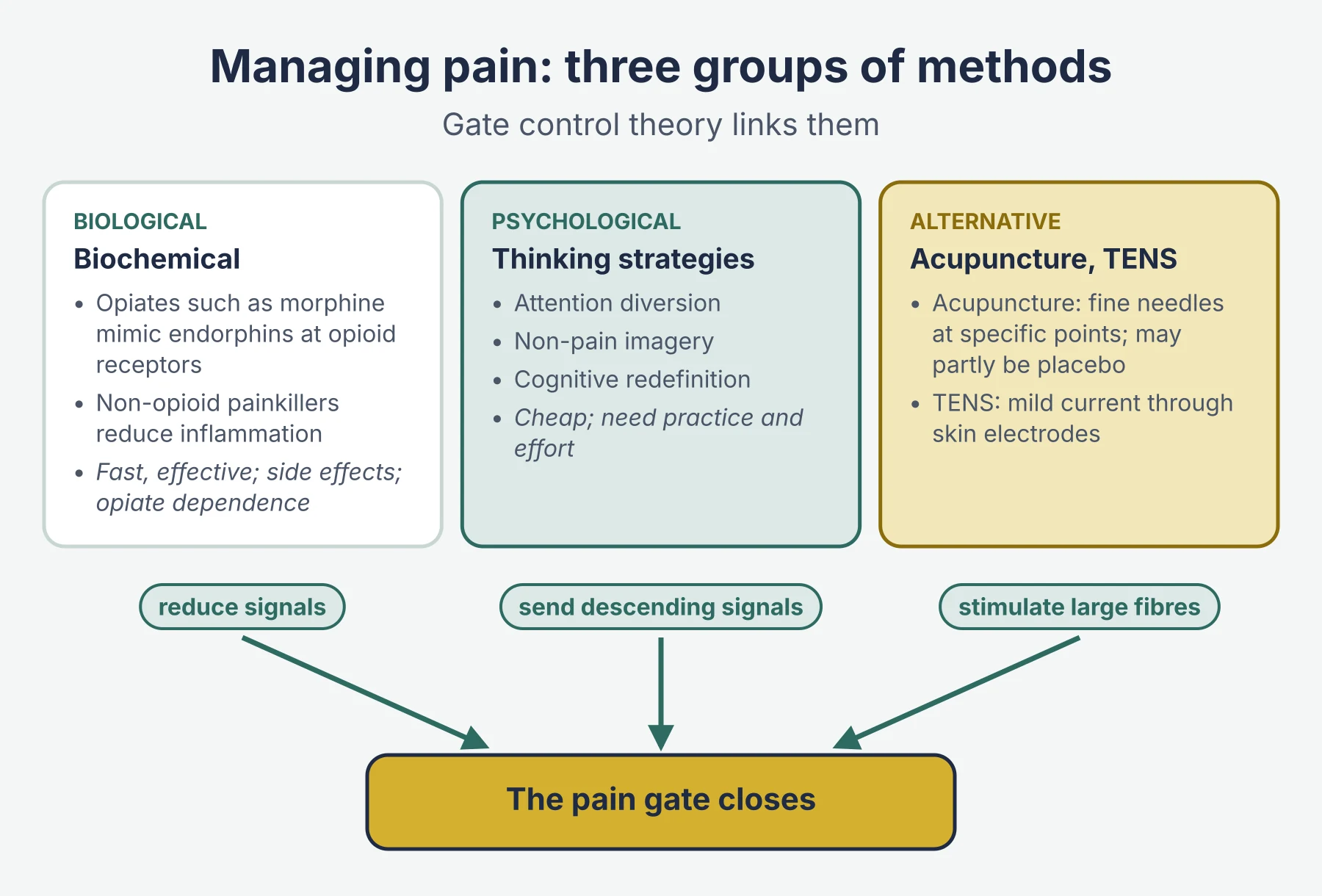
- Biochemical: reduces pain signals or mimics endorphins.
- Psychological strategies: descending signals from the brain close the gate.
- TENS: stimulates large fibres, closing the gate.
- Acupuncture: may stimulate endorphin release; placebo effects are hard to rule out.
Linking to issues and debates
- Nature versus nurture (3.3.1): pain receptors are biological, but learned expectations and culture shape how pain is felt and shown.
- Reductionism versus holism (3.3.1, 3.3.3): specificity theory and biochemical treatment are reductionist; gate control theory is more holistic.
- Idiographic versus nomothetic (3.3.2): McGill descriptors capture individual experience; numeric scales allow comparison.
- Cultural differences (3.3.3): acceptance of acupuncture and of showing pain varies between cultures.
- Case study (3.3.1): MacLachlan et al. gives depth but no generalisation.
Exam traps
- Phantom limb pain is real pain, not imagined; say it is experienced in a limb that is absent.
- Gate control has three inputs: small fibres, large fibres and the brain. Missing the brain loses the psychological point.
- The VAS is not the same as a numeric rating scale; it is an unmarked line.
- Brudvik et al. was conducted in Norway, not the UK.
- Cognitive redefinition is not distraction. It changes how the pain is thought about.
Quick self-test
- Give two functions of pain.
- Distinguish acute from chronic pain.
- How does mirror treatment work?
- Give two things specificity theory cannot explain.
- Where is the “gate” in gate control theory?
- Which fibres close the gate?
- Name the three types of word group in the McGill pain questionnaire.
- Who rates behaviour on the UAB pain behaviour scale?
- What were the mean pain ratings of children, parents and physicians in Brudvik et al.?
- What proportion of children with severe pain received pain relief in Brudvik et al.?
- Define non-pain imagery.
- How might TENS reduce pain, according to gate control theory?
Answers
- Any two: warns of damage; prompts withdrawal; encourages rest for healing.
- Acute: short-term with a clear cause; chronic: persists beyond healing, usually more than three months.
- The patient sees the intact limb’s reflection in place of the missing one; moving it gives visual feedback that can reduce phantom pain.
- Any two: phantom limb pain; injuries not felt at the time; effects of attention or mood.
- In the dorsal horn of the spinal cord.
- Large-diameter fibres (and descending signals from the brain).
- Sensory, affective and evaluative.
- A trained observer.
- Children 5.5; parents 4.8; physicians 3.2.
- About 42%.
- Imagining a pleasant scene that is incompatible with pain.
- It stimulates large fibres, which close the gate to pain signals.
More resources on this topic
Related resources
-
Study guides
Cambridge A Level Psychology (9990): Stress
Cambridge 9990 topic 3.4 in depth: the GAS model, life events, work and Type A, biological and self-report measures, biofeedback, Bridge et al. (1988) and SIT.
Psychology · Cambridge · A Level
Read guide -
Practice questions
Cambridge A Level Psychology (9990): Stress – Practice Questions
Original Paper 3 and Paper 4 style questions on Cambridge 9990 topic 3.4 Stress: sources, measures, biofeedback, imagery and SIT, with full mark-scheme answers.
Psychology · Cambridge · A Level
Try questions -
Revision notes
Cambridge A Level Psychology (9990): Stress – Revision Notes
Revision notes for Cambridge 9990 topic 3.4 Stress: GAS, life events, Type A, measures, biofeedback, Bridge et al. (1988) and SIT, with a self-test.
Psychology · Cambridge · A Level
Revise topic
Studying Psychology?
This page is free and stays free. Marlbridge is not offering Psychology classes at the moment, so there is no tuition to book for it. The free study resources stay open to everyone.
Get free revision emails (optional)
Occasional emails with practice questions, worked explanations and links to free resources for the qualification and subjects you choose. No spam, and you can unsubscribe from any email. The free tools on this site never need an email.