
Study Guides
Cambridge A Level Psychology (9990): Pain
Cambridge 9990 topic 3.3 in depth: types and theories of pain, phantom limb pain, McGill, VAS and UAB measures, Brudvik et al. (2016) and pain management.
- Subject
- Psychology
- Level
- A LEVEL
- Topic
- Specialist Option 3: Health Psychology
- Author
- Marlbridge Academic Team
- Updated
- Reviewed by
- Kanwal Aslam (what this means)
Aligned to Cambridge A Level Psychology (9990), 2024-2026. Official specification .
Syllabus page (what it covers and how it is assessed): Cambridge A Level Psychology.
Syllabus points this page covers
9990 (A Level)
- 3.3 Pain
Topic 3.3, Pain, is part of Specialist Option 3 (Health Psychology) in Cambridge International A Level Psychology 9990, syllabus for 2024 to 2026. It covers what pain is for and the types of pain, including phantom limb pain (3.3.1); two theories of pain; how pain is measured (3.3.2); and how it is managed (3.3.3). The key study is Brudvik et al. (2016), which compared ratings of children’s pain by the children, their parents and physicians.
The Health Psychology study guide gives the outline. This page builds on it with fuller explanations of the theories and measures, comparisons and an annotated answer. Use it with the pain revision notes and the pain practice questions.
Syllabus content for 3.3
| Sub-topic | Content | Named study |
|---|---|---|
| 3.3.1 Types and theories | Functions of pain; acute and chronic pain; phantom limb pain and mirror treatment; specificity theory and gate control theory | e.g. MacLachlan et al. (2004), a case study |
| 3.3.2 Measuring pain | Subjective: clinical interview; psychometric and visual rating scales: McGill pain questionnaire, visual analogue scale; behavioural and observational: UAB pain behaviour scale | Key study Brudvik et al. (2016) |
| 3.3.3 Managing and controlling pain | Biological: biochemical; psychological: attention diversion, non-pain imagery, cognitive redefinition; alternative: acupuncture, stimulation therapy (TENS) | none named |
3.3.1 What pain is for, and types of pain
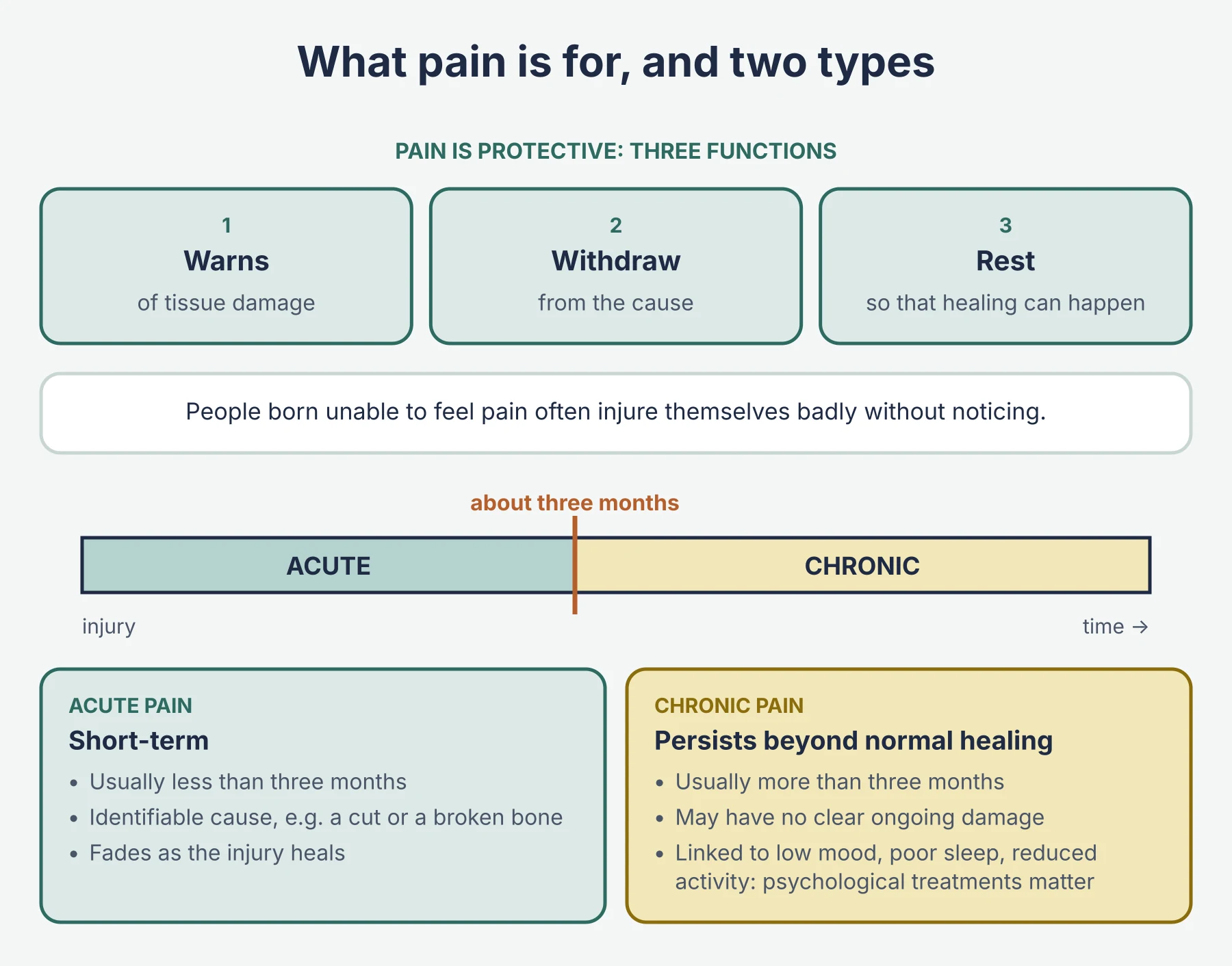
Functions. Pain is protective. It warns of tissue damage, makes us withdraw from the cause, and encourages rest so that healing can happen. People born unable to feel pain often injure themselves badly without noticing, which shows how important this warning is.
Acute and chronic pain. Acute pain is short-term, usually lasting less than three months, and has an identifiable cause such as a cut or a broken bone. It fades as the injury heals. Chronic pain persists beyond normal healing time, usually more than three months, and may have no clear ongoing damage. Chronic pain is often linked to low mood, poor sleep and reduced activity, so psychological treatments are particularly important.
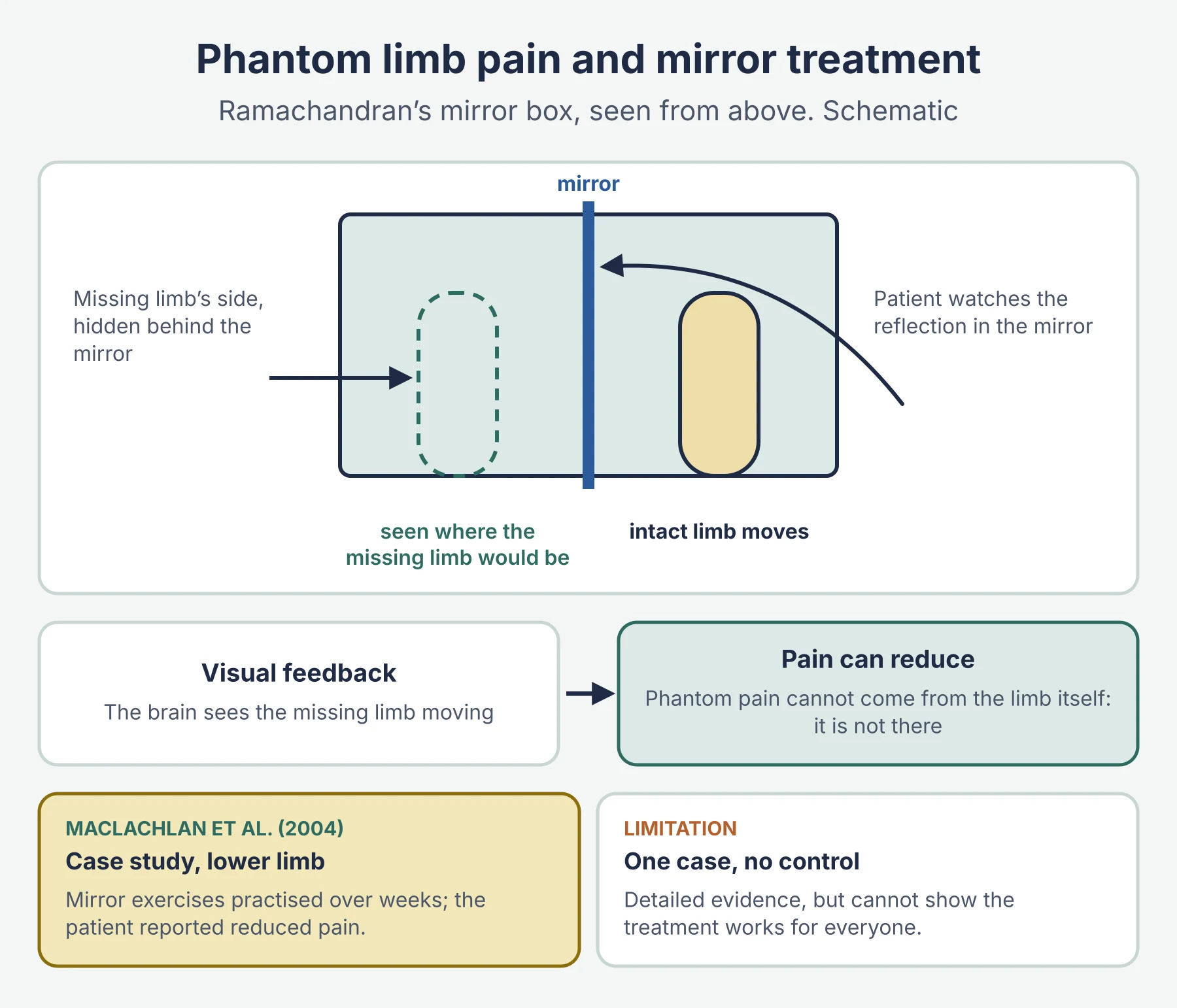
Phantom limb pain is pain that feels as if it is in a limb that has been amputated. It cannot be explained by damage in the limb, because the limb is not there. Mirror treatment, developed by Ramachandran, places a mirror so the patient sees the reflection of their intact limb where the missing limb would be. Moving the intact limb gives visual feedback that the missing limb is moving, which can reduce the pain. MacLachlan et al. (2004) is the syllabus example: a case study of mirror treatment for phantom pain in a lower limb, in which the patient practised mirror exercises over a period of weeks and reported reduced pain. Case studies give detailed evidence but cannot show that the treatment would work for everyone, and they lack a control condition.
Theories of pain
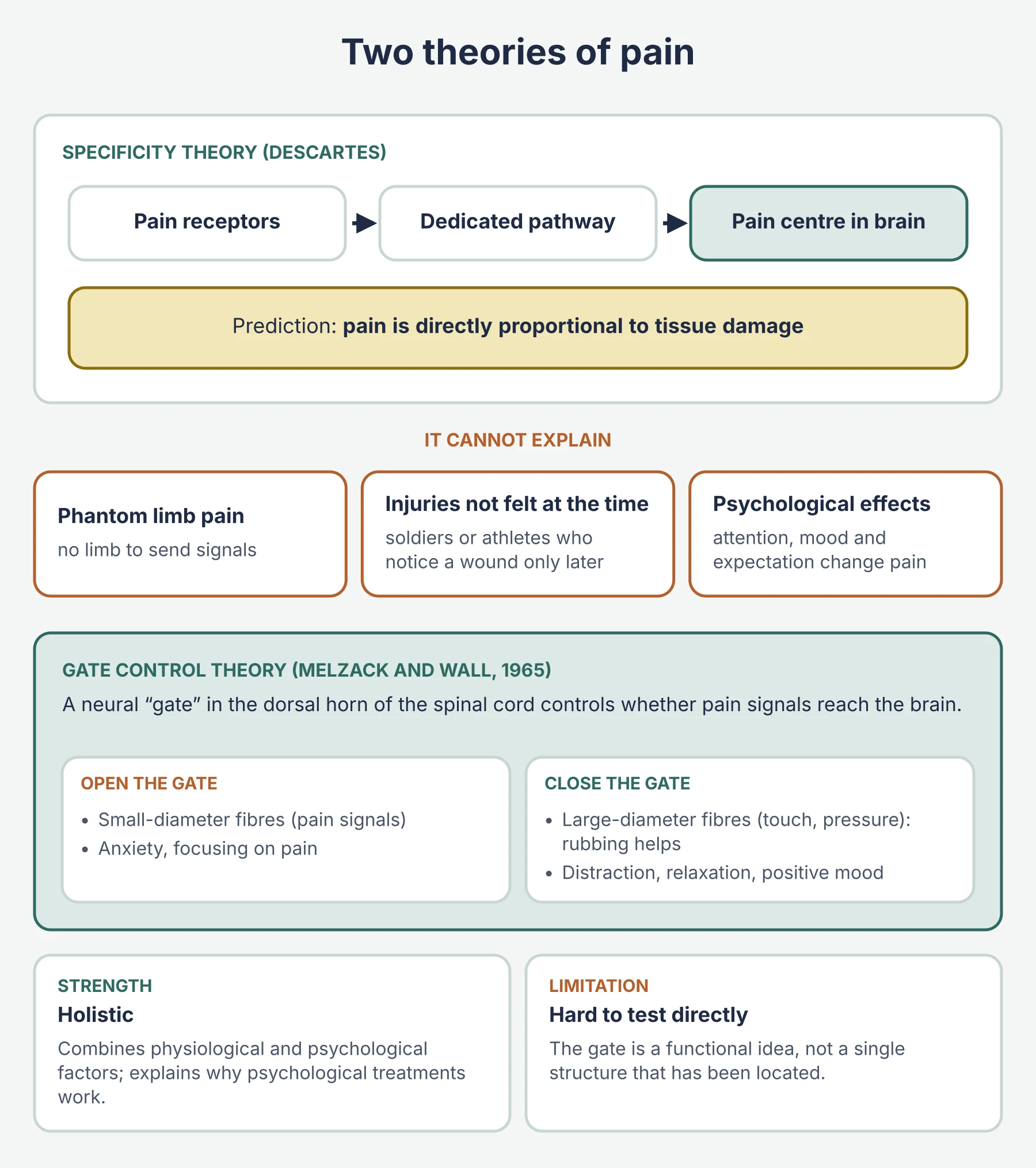
Specificity theory. Associated with Descartes, this theory proposes that specific pain receptors send signals along a dedicated pathway to a pain centre in the brain, so the amount of pain is directly proportional to the amount of tissue damage. It explains why pain follows injury, but it cannot explain:
- phantom limb pain, where there is no limb to send signals;
- injuries that are not felt at the time, such as soldiers or athletes who notice a wound only later;
- the effect of attention, mood and expectation on pain.
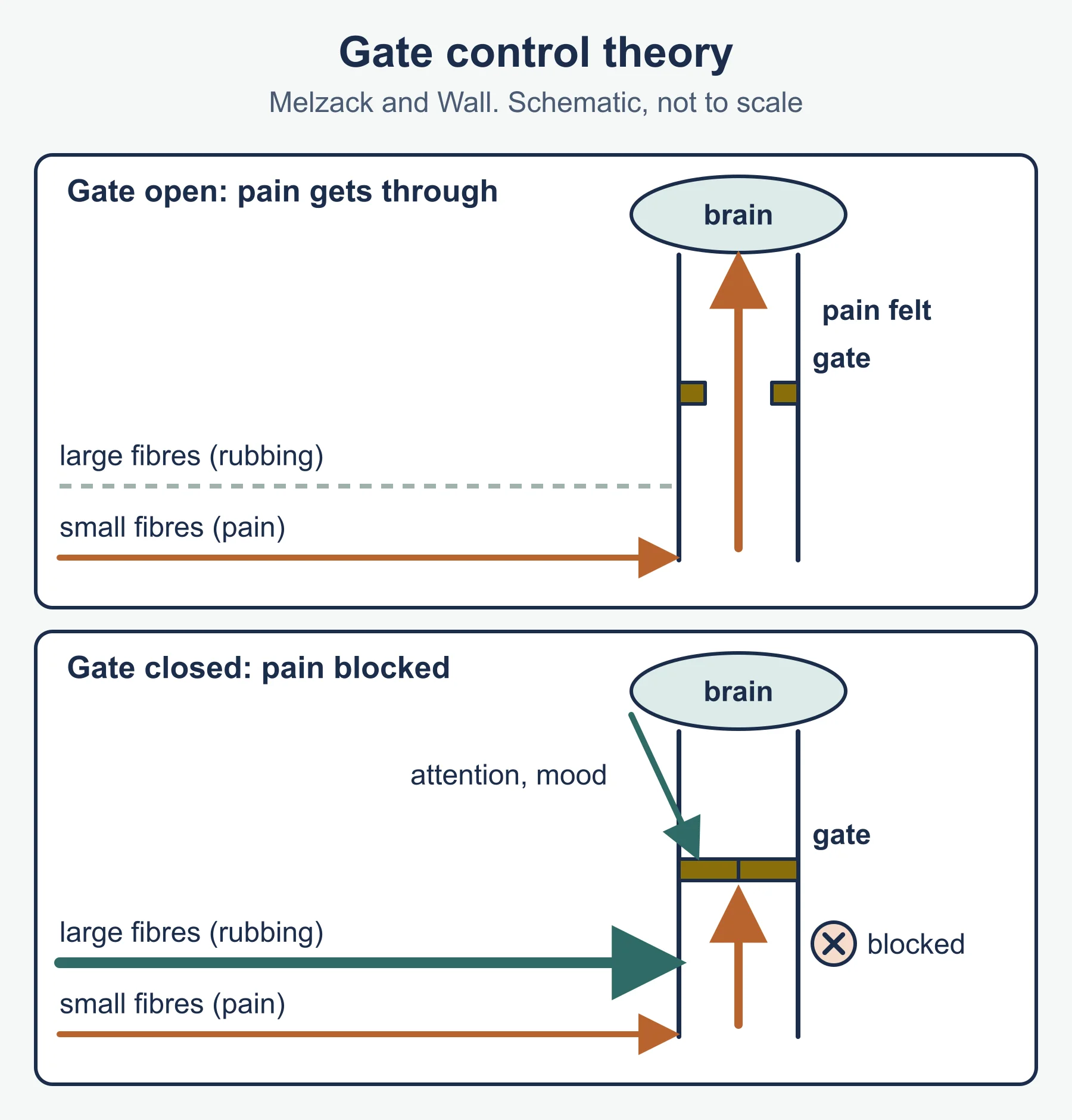
Gate control theory (Melzack and Wall, 1965) proposes a neural “gate” in the dorsal horn of the spinal cord that controls whether pain signals reach the brain.
- Small-diameter fibres carry pain signals and tend to open the gate.
- Large-diameter fibres carry touch and pressure signals and tend to close it; this explains why rubbing an injury helps.
- Descending signals from the brain can open or close the gate. Anxiety and focusing on pain open it; distraction, relaxation and positive mood close it.
Gate control theory is more holistic, combining physiological and psychological factors, and it explains why psychological treatments work. Its weakness is that the “gate” is a functional idea, not a single structure that has been located, so the theory is hard to test directly.
3.3.2 Measuring pain
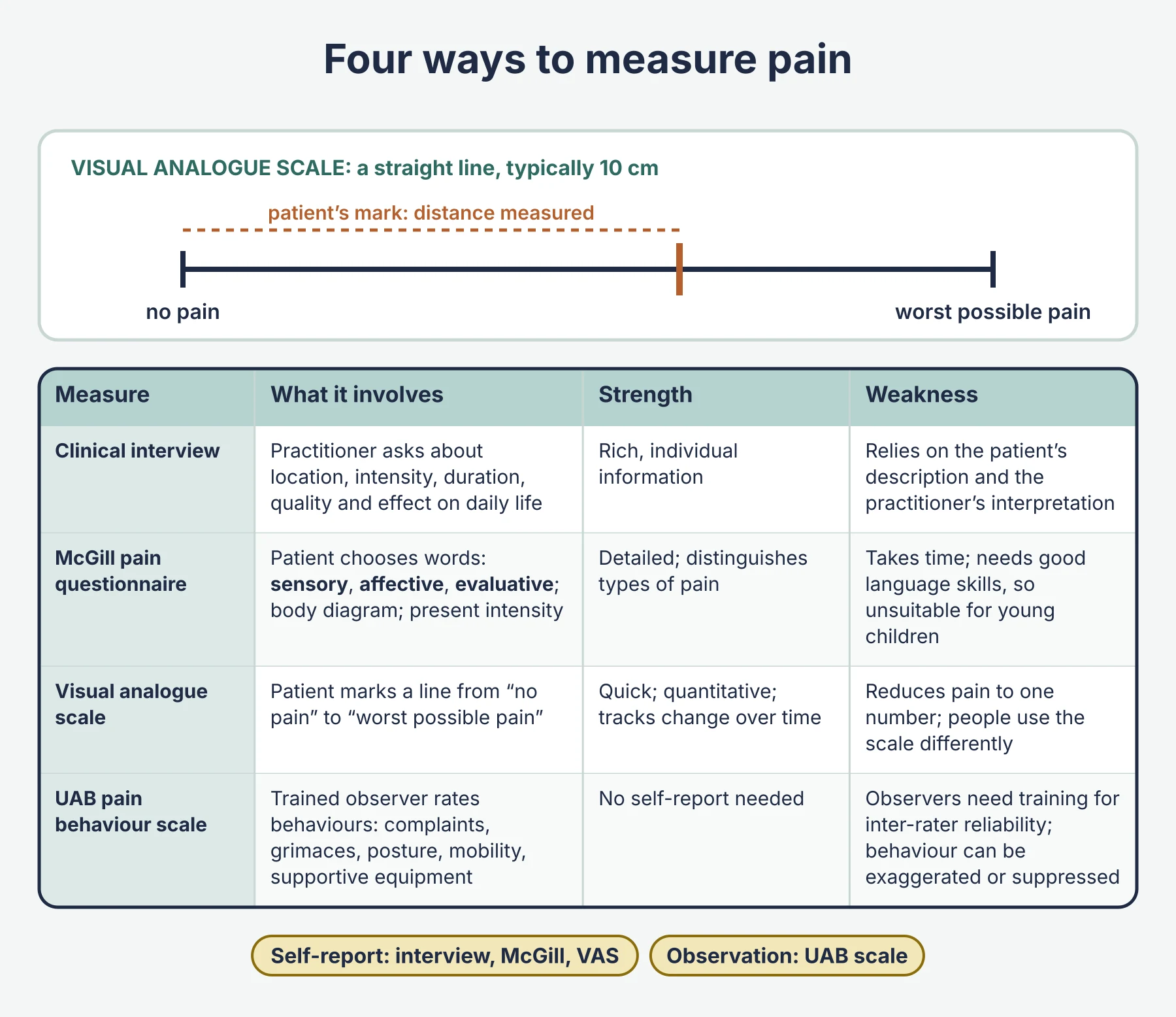
Clinical interview. A practitioner asks about the location, intensity, duration and quality of the pain and how it affects daily life. It gives rich, individual information but relies on the patient’s ability to describe pain and on the practitioner’s interpretation.
McGill pain questionnaire (Melzack). Patients choose words from groups that describe the sensory quality (such as throbbing, stabbing), the affective quality (such as exhausting, frightful) and the evaluative intensity of their pain. It includes a body diagram for location and a rating of present pain intensity. It is detailed and distinguishes types of pain, but it takes time and requires good language skills, so it is unsuitable for young children.
Visual analogue scale (VAS). A straight line, typically 10 cm, with “no pain” at one end and “worst possible pain” at the other. The patient marks the line and the distance is measured. It is quick and gives quantitative data that can track change over time, but it reduces pain to a single number and people may use the scale differently.
UAB pain behaviour scale. A trained observer rates a set of pain behaviours, such as vocal and non-verbal complaints, facial grimaces, posture, mobility and use of supportive equipment, on a simple scale. It does not depend on self-report, so it can be used with people who cannot describe their pain, but observers must be trained to ensure inter-rater reliability, and behaviour can be exaggerated or suppressed.
Key study: Brudvik et al. (2016)
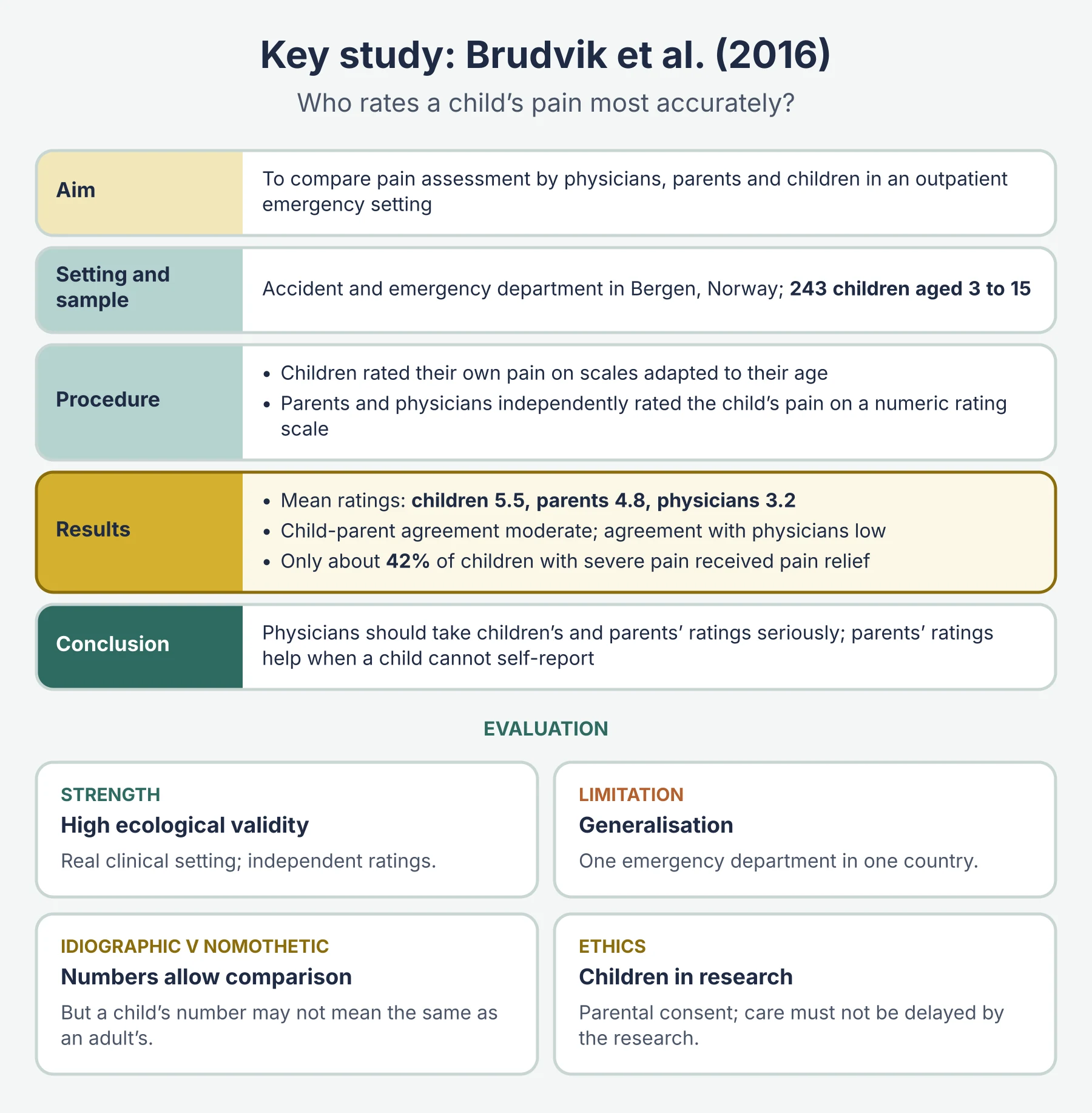
- Aim: to compare pain assessment by physicians, parents and children in an outpatient emergency setting.
- Setting and sample: an accident and emergency department in Bergen, Norway; 243 children aged 3 to 15.
- Procedure: children rated their own pain using scales adapted to their age; parents and physicians independently rated the child’s pain using a numeric rating scale.
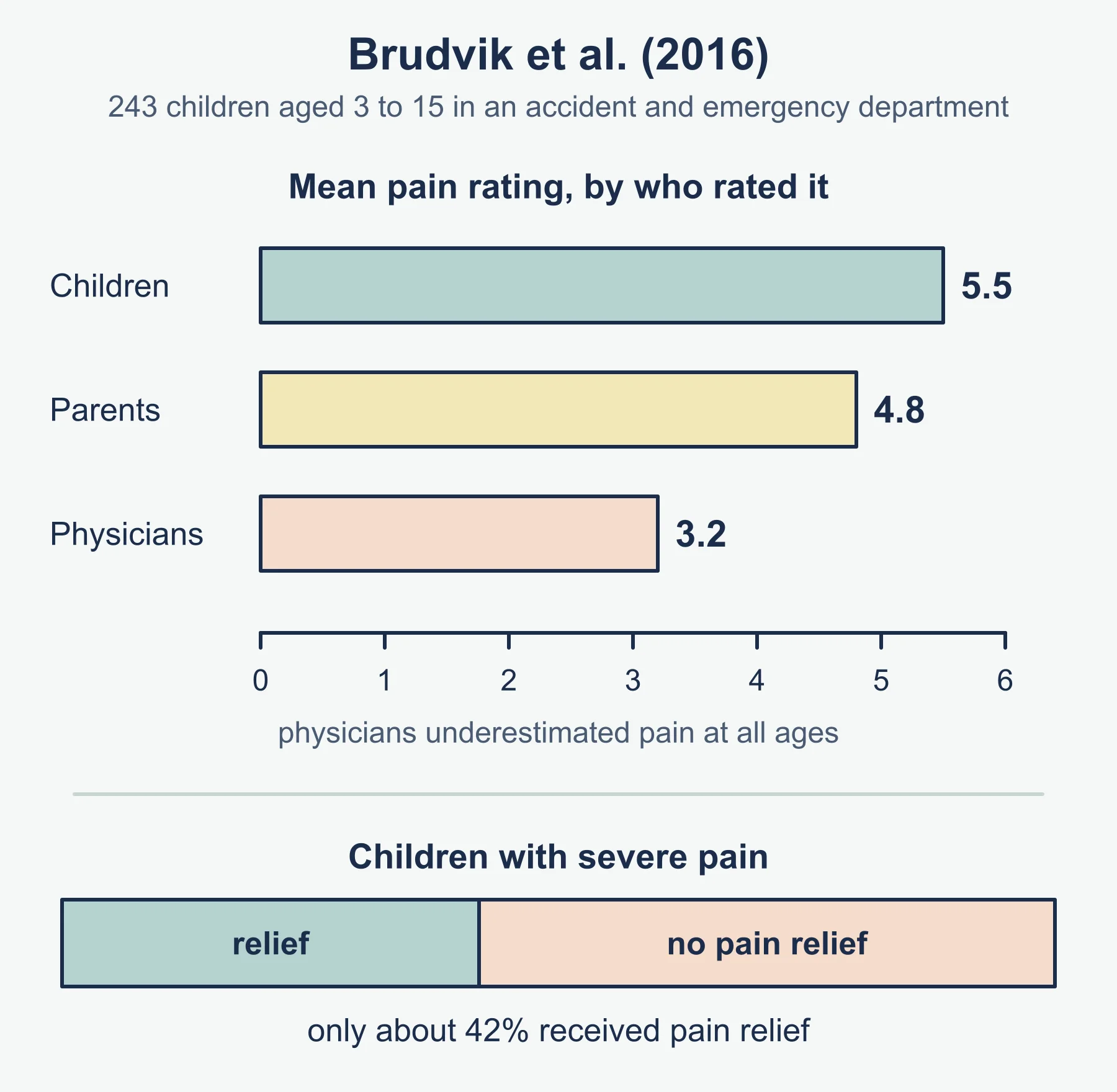
- Results: mean ratings were 5.5 from children, 4.8 from parents and 3.2 from physicians. Agreement between children and parents was moderate, but agreement with physicians was low; physicians underestimated pain across all ages and conditions. Only about 42% of children with severe pain received pain relief.
- Conclusion: physicians should take children’s and parents’ ratings seriously, and parents’ ratings are useful when a child cannot self-report.
Evaluation.
- Validity: a real clinical setting gives high ecological validity; ratings were independent, so one rater did not influence another.
- Idiographic versus nomothetic: a numeric scale allows group comparisons, but pain is personal, and a child’s number may not mean the same as an adult’s.
- Generalisation: one emergency department in one country; practices in other hospitals or cultures may differ.
- Use of children in research: parental consent was needed, and children in pain must not be delayed in receiving care because of the research.
3.3.3 Managing and controlling pain
| Type | Method | How it works | Evaluation |
|---|---|---|---|
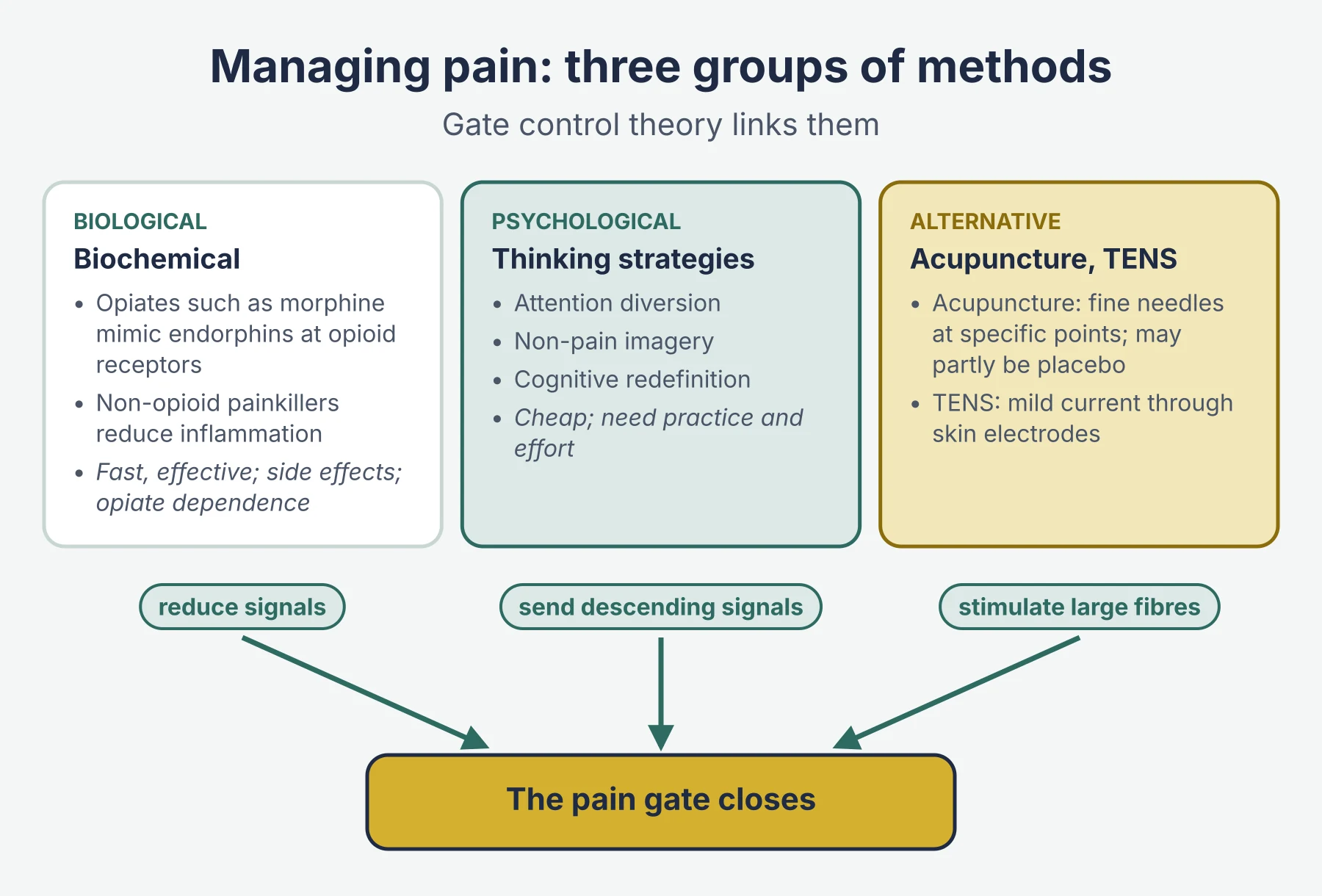
| Biological | Biochemical: opiates such as morphine; non-opioid painkillers | Opiates mimic endorphins at opioid receptors; others reduce inflammation | Effective and fast; side effects; risk of dependence with opiates |
| Psychological | Attention diversion | Focusing on something other than the pain | Cheap; works for mild or brief pain |
| Psychological | Non-pain imagery | Imagining a pleasant scene incompatible with pain | Needs practice and imagination |
| Psychological | Cognitive redefinition | Thinking about the pain more rationally and less fearfully | Useful for chronic pain; requires effort and training |
| Alternative | Acupuncture | Fine needles inserted at specific points | Effects may partly be placebo; needs a trained practitioner |
| Alternative | TENS | Mild electrical current through skin electrodes | Fits gate control theory (stimulating large fibres); portable, non-drug |
Gate control theory links the three groups: drugs reduce signals, psychological strategies send descending signals that close the gate, and TENS stimulates large fibres that close it.
Annotated answer: a 4-mark compare question
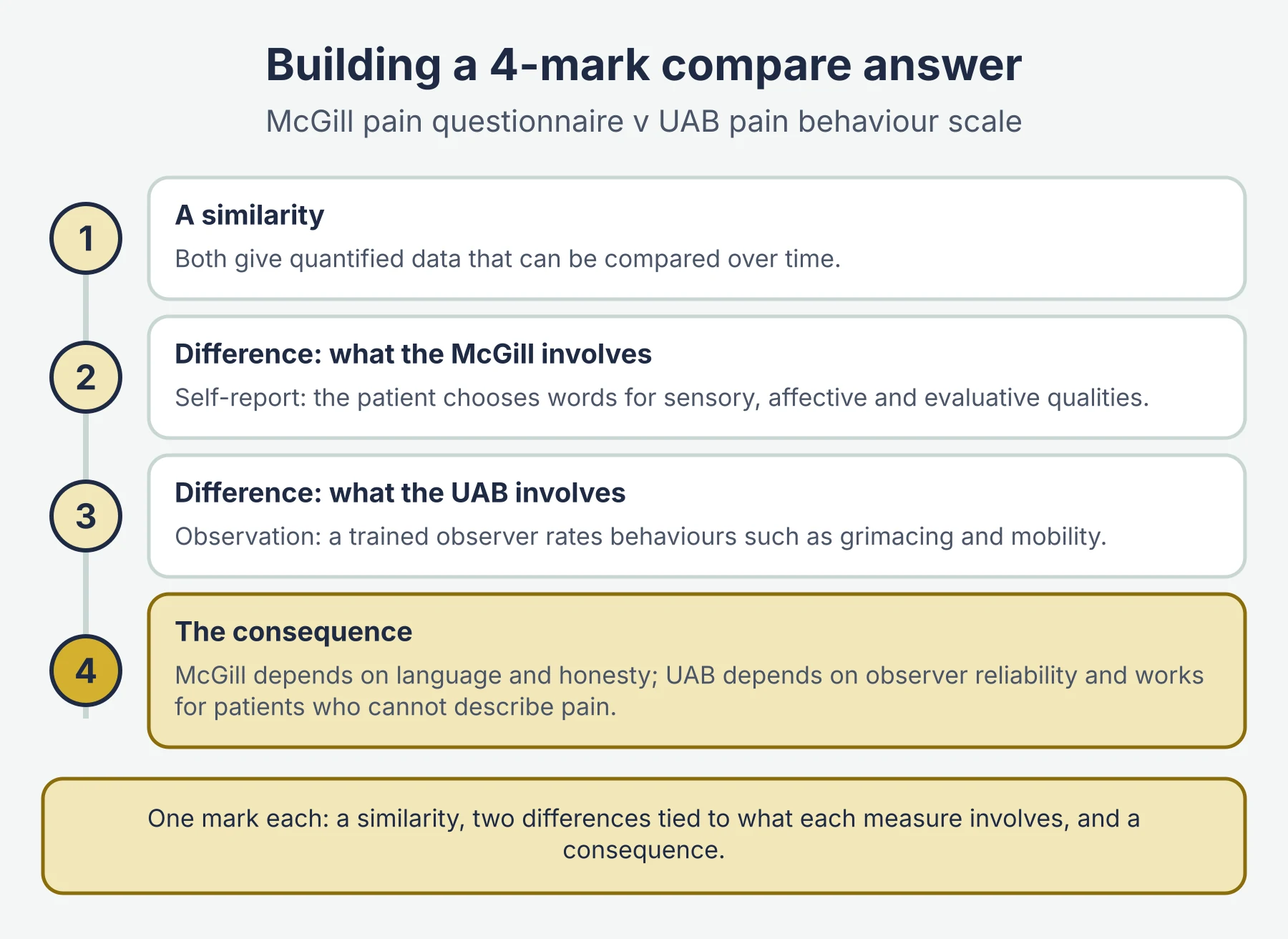
Compare the McGill pain questionnaire and the UAB pain behaviour scale as ways of measuring pain. [4]
“Both give quantified data that can be compared over time (1). The McGill questionnaire is a self-report psychometric measure in which the patient chooses words describing the sensory, affective and evaluative qualities of their pain (1), whereas the UAB scale is an observational measure in which a trained observer rates behaviours such as grimacing and mobility (1). So the McGill questionnaire depends on the patient’s language and honesty, while the UAB scale depends on the observer’s reliability and can be used with patients who cannot describe their pain (1).”
Why it scores: a similarity, then differences tied to what each measure involves and its consequences.
Common mistakes
- Saying gate control theory has been proved by finding the gate. It is a model that fits the evidence.
- Calling the VAS a questionnaire. It is a single visual rating scale.
- Getting the Brudvik ratings in the wrong order: children rated highest, physicians lowest.
- Writing that TENS is a biochemical treatment. It is an alternative stimulation therapy.
Exam technique
Describe answers on theories should include the mechanism and an example. Evaluate answers can use the debates the syllabus lists for 3.3.1, such as nature versus nurture and reductionism versus holism, and for 3.3.2, such as idiographic versus nomothetic and psychometrics. Suggest answers in Paper 4 should match a measure or treatment to the patient in the scenario, for example a behavioural scale for a child too young to self-report.
More resources on this topic
Official syllabus
Cambridge International AS & A Level Psychology 9990 syllabus for 2024, 2025 and 2026, Specialist Option 3: Health Psychology, topic 3.3 — cambridgeinternational.org.
Related resources
-
Practice questions
Cambridge A Level Psychology (9990): Pain – Practice Questions
Original Paper 3 and Paper 4 style questions on Cambridge 9990 topic 3.3 Pain: theories, measures, Brudvik et al. and management, with answers.
Psychology · Cambridge · A Level
Try questions -
Revision notes
Cambridge A Level Psychology (9990): Pain – Revision Notes
Revision notes for Cambridge 9990 topic 3.3 Pain: types, theories, four measures, Brudvik et al. (2016) and management, with a self-test.
Psychology · Cambridge · A Level
Revise topic -
Study guides
Cambridge A Level Psychology (9990): Stress
Cambridge 9990 topic 3.4 in depth: the GAS model, life events, work and Type A, biological and self-report measures, biofeedback, Bridge et al. (1988) and SIT.
Psychology · Cambridge · A Level
Read guide
Studying Psychology?
This page is free and stays free. Marlbridge is not offering Psychology classes at the moment, so there is no tuition to book for it. The free study resources stay open to everyone.
Get free revision emails (optional)
Occasional emails with practice questions, worked explanations and links to free resources for the qualification and subjects you choose. No spam, and you can unsubscribe from any email. The free tools on this site never need an email.