
Revision Notes
Cambridge A Level Psychology (9990): Stress – Revision Notes
Revision notes for Cambridge 9990 topic 3.4 Stress: GAS, life events, Type A, measures, biofeedback, Bridge et al. (1988) and SIT, with a self-test.
- Subject
- Psychology
- Level
- A LEVEL
- Topic
- Specialist Option 3: Health Psychology
- Author
- Marlbridge Academic Team
- Updated
- Reviewed by
- Kanwal Aslam (what this means)
Aligned to Cambridge A Level Psychology (9990), 2024-2026. Official specification .
Syllabus page (what it covers and how it is assessed): Cambridge A Level Psychology.
Syllabus points this page covers
9990 (A Level)
- 3.4 Stress
These notes condense topic 3.4, Stress, from Specialist Option 3 of Cambridge International A Level Psychology 9990 (syllabus for 2024 to 2026). The topic has a clear shape: where stress comes from, how we measure it, and how we manage or prevent it.
For full explanations, read the stress study guide. To practise, use the stress practice questions.
Topic map
- 3.4.1 Sources: GAS model (alarm, resistance, exhaustion); effects on health; life events (Holmes and Rahe); work (e.g. Chandola et al., 2008); Type A (Friedman and Rosenman).
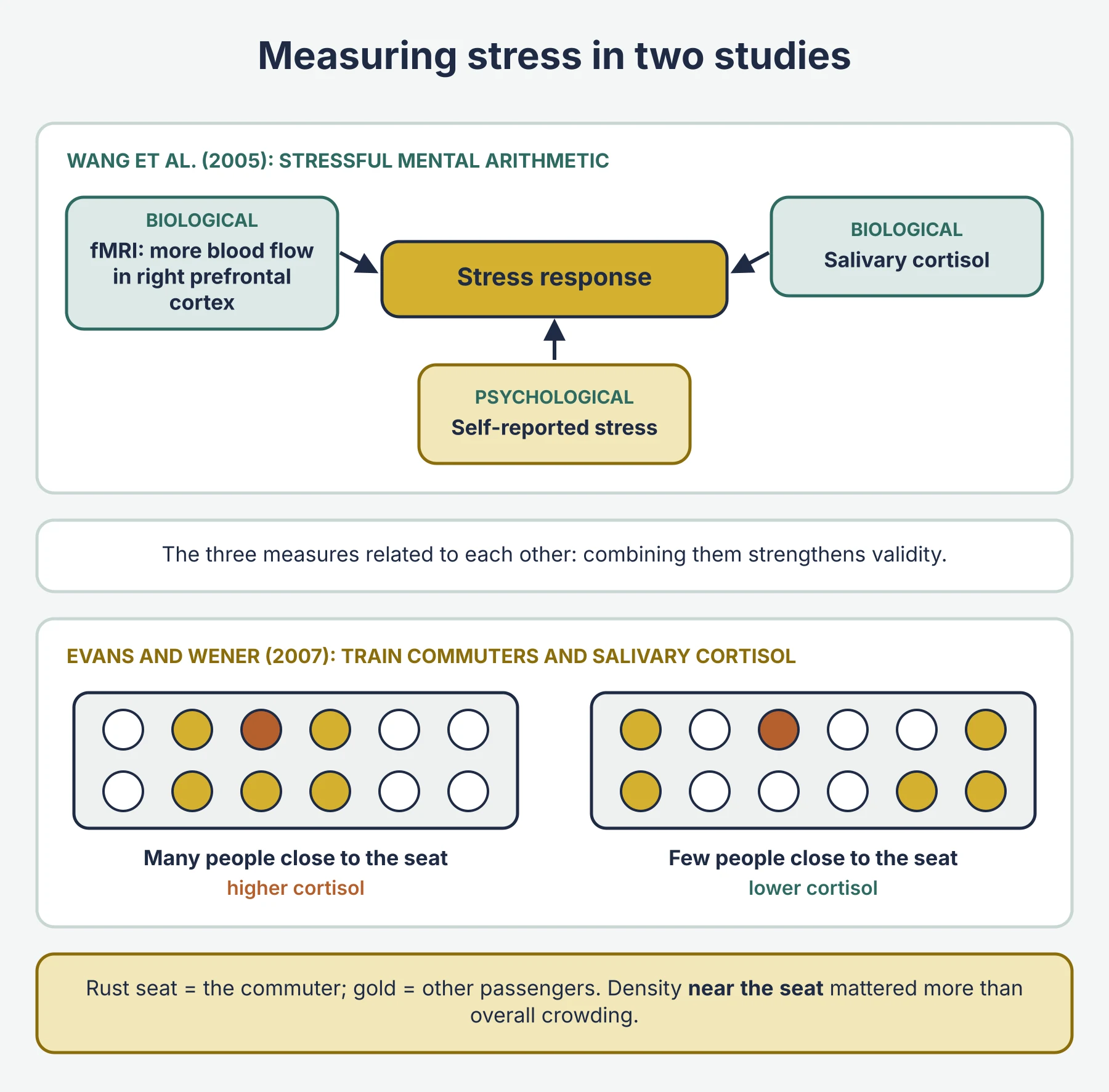
- 3.4.2 Measures: heart rate and fMRI (e.g. Wang et al., 2005); salivary cortisol (e.g. Evans and Wener, 2007); self-report questionnaires on Type A and life events.
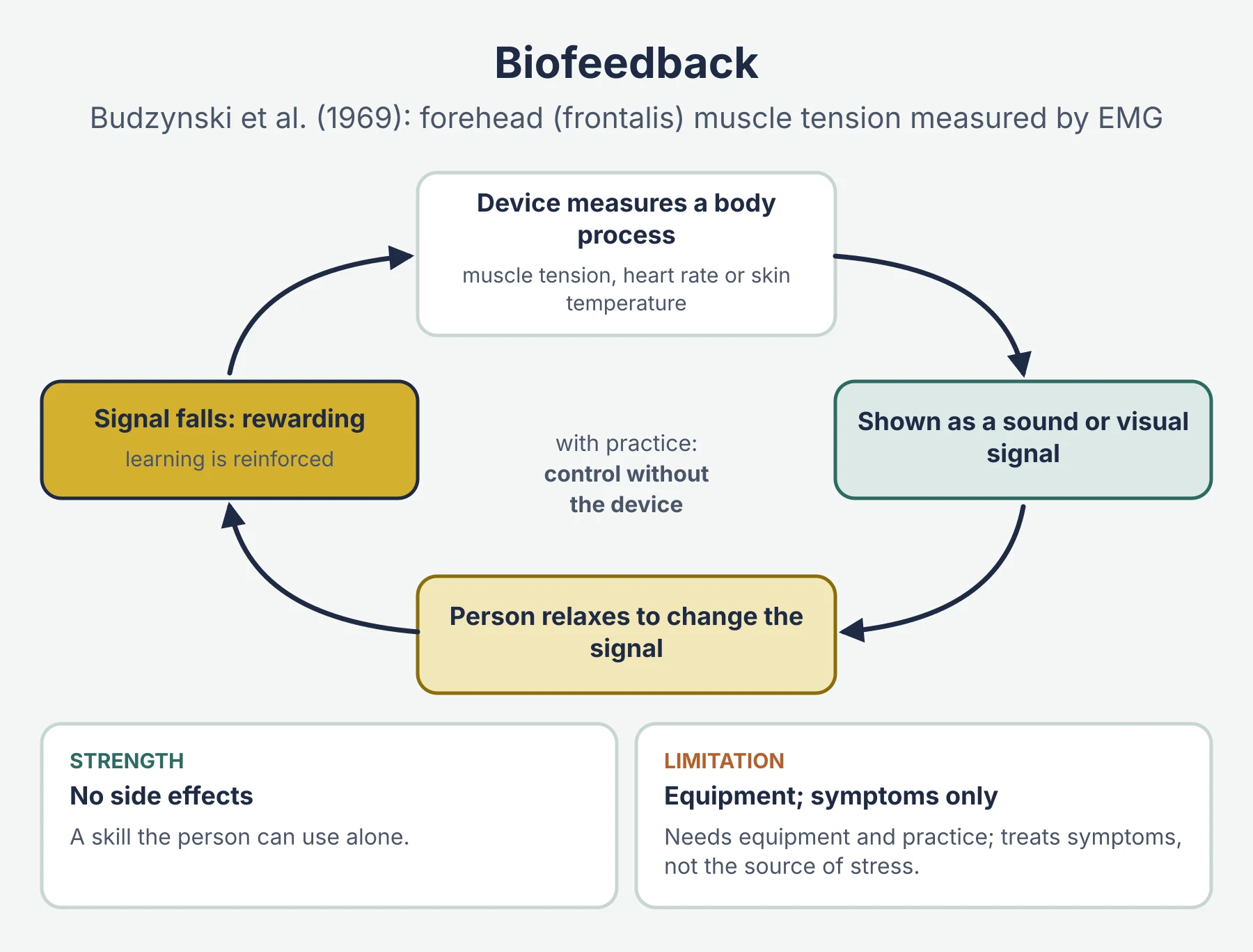
- 3.4.3 Managing: biofeedback (e.g. Budzynski et al., 1969); imagery, key study Bridge et al. (1988); stress inoculation training in three phases.
Key terms
| Term | Definition |
|---|---|
| Stressor | Any event or situation that triggers a stress response |
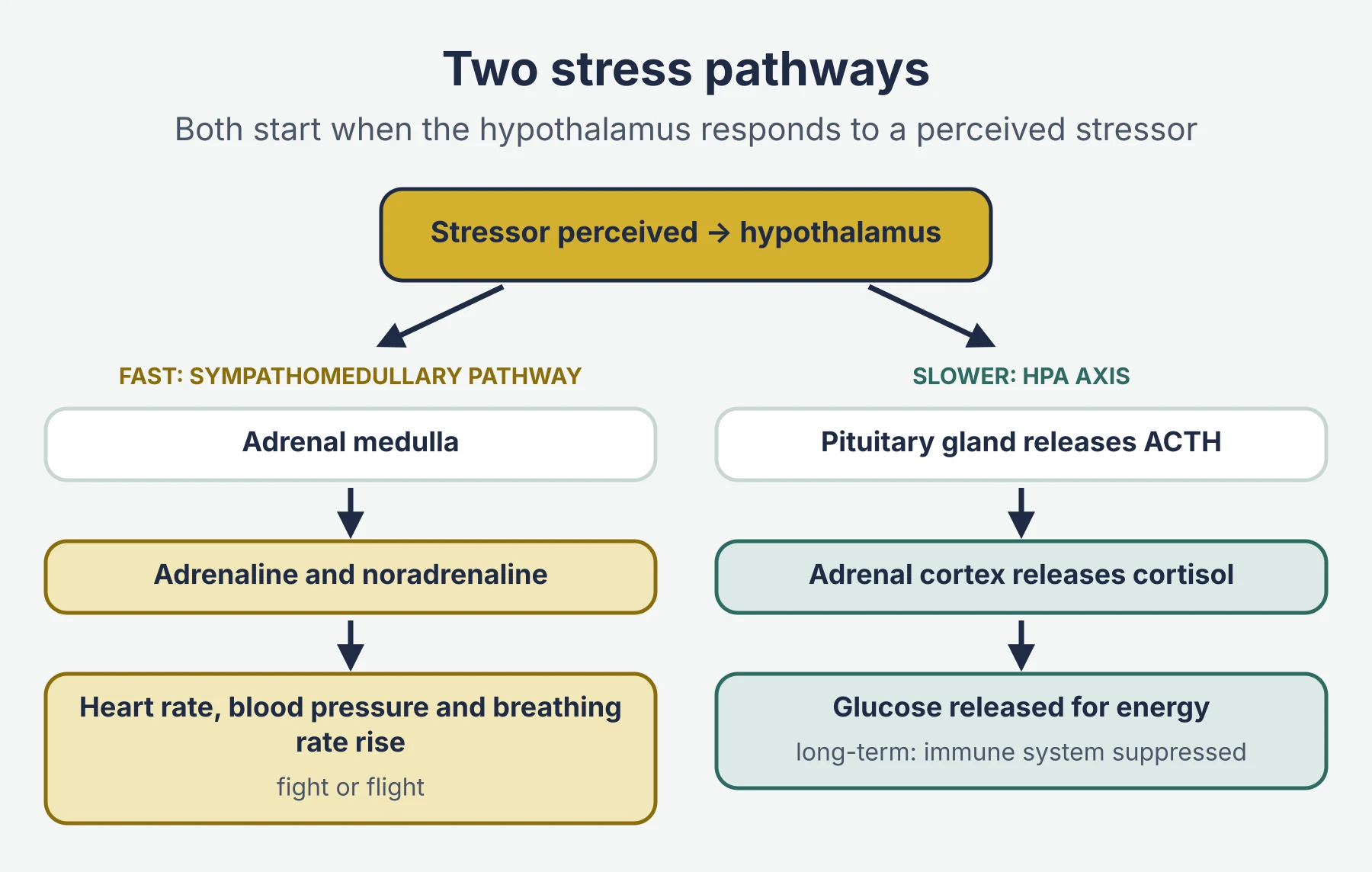
| Sympathomedullary pathway | Fast response: adrenal medulla releases adrenaline |
| HPA axis | Slower response: hypothalamus, pituitary (ACTH), adrenal cortex (cortisol) |
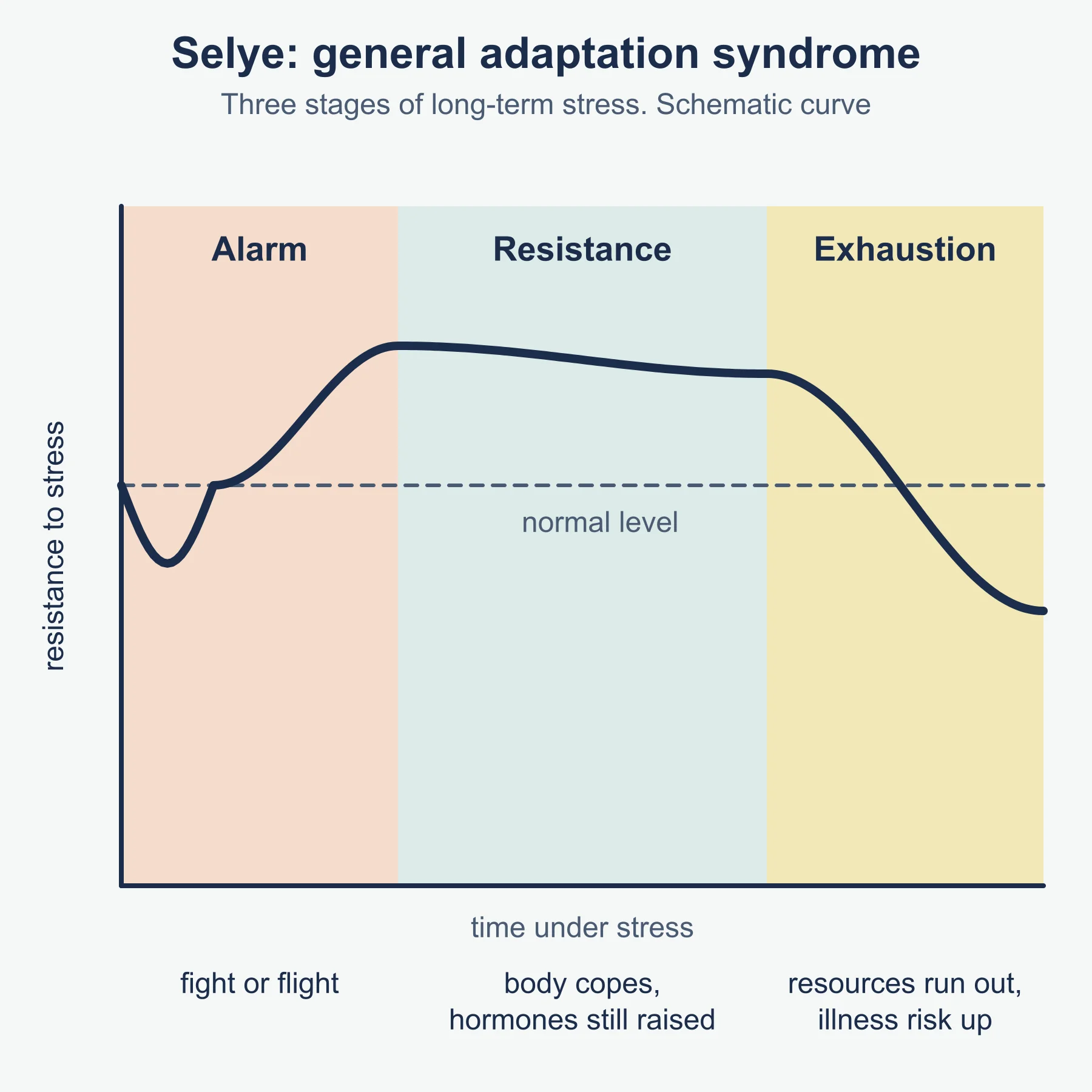
| GAS | Selye’s three-stage response to prolonged stress |
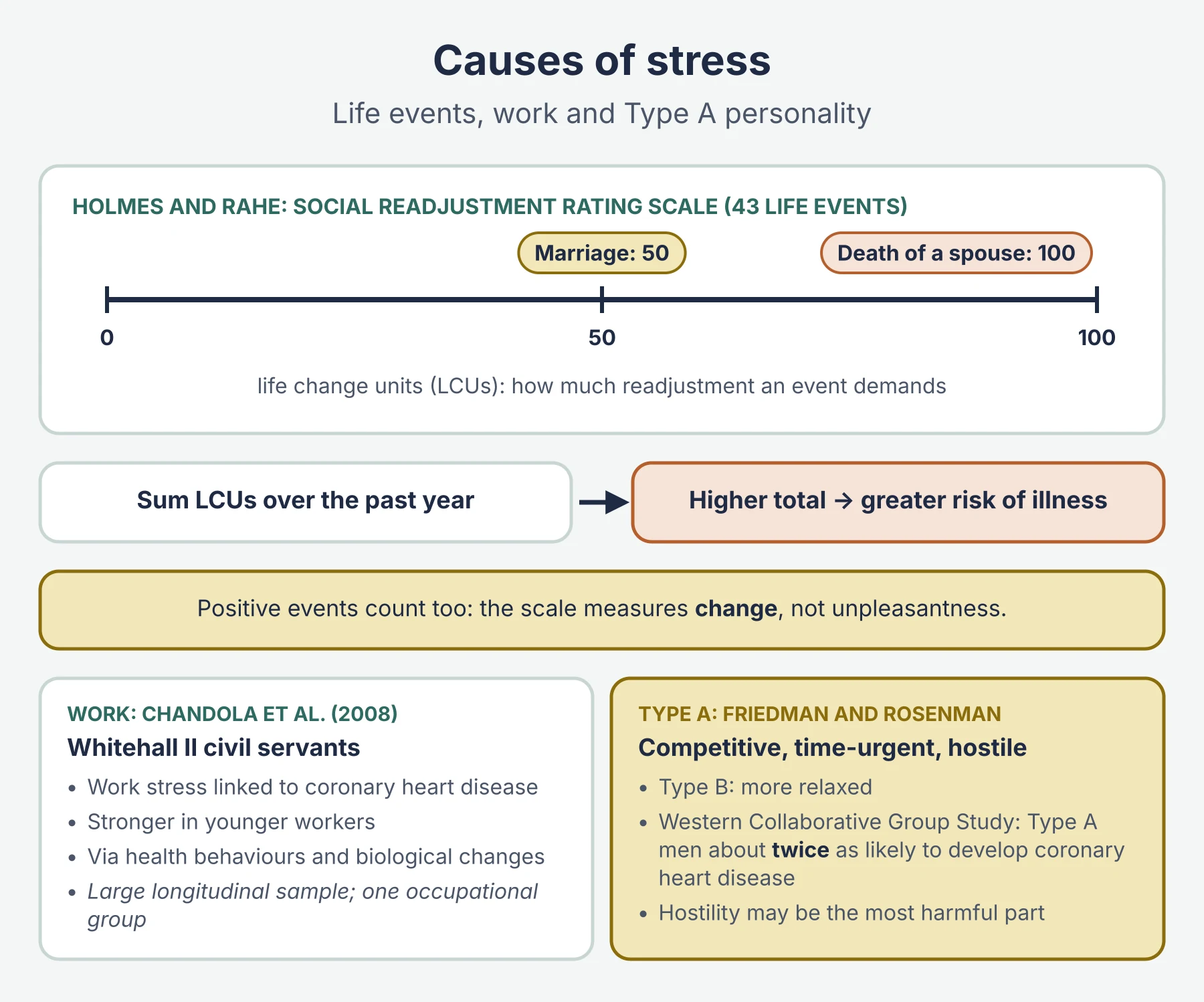
| Life change unit (LCU) | Value given to a life event on the SRRS |
| SRRS | Social Readjustment Rating Scale of 43 life events |
| Type A | Competitive, time-urgent and hostile behaviour pattern |
| fMRI | Brain imaging that detects changes in blood flow |
| Salivary cortisol | Cortisol measured in saliva as an index of HPA activity |
| Biofeedback | Learning to control a body process from real-time information about it |
| Imagery | Imagining a calm scene in detail to induce relaxation |
| Stress inoculation training | Meichenbaum’s three-phase preventive therapy |
GAS: the three stages
| Stage | What happens | Health link |
|---|---|---|
| Alarm | Stressor detected; adrenaline; arousal | Short-term arousal is adaptive |
| Resistance | Body adapts; cortisol stays high | Resources used up; immune function begins to fall |
| Exhaustion | Resources depleted | Illness more likely, e.g. infections, cardiovascular problems |
Studies to name
| Study | Sub-topic | One-line finding |
|---|---|---|
| Holmes and Rahe | 3.4.1 | Higher LCU totals linked to greater illness risk |
| Chandola et al. (2008) | 3.4.1 | Work stress linked to coronary heart disease in civil servants |
| Friedman and Rosenman | 3.4.1 | Type A men about twice as likely to develop heart disease |
| Wang et al. (2005) | 3.4.2 | Mental arithmetic stress raised blood flow in the right prefrontal cortex |
| Evans and Wener (2007) | 3.4.2 | Commuters with more people seated close by had higher cortisol |
| Budzynski et al. (1969) | 3.4.3 | Feedback of forehead muscle tension helped people relax |
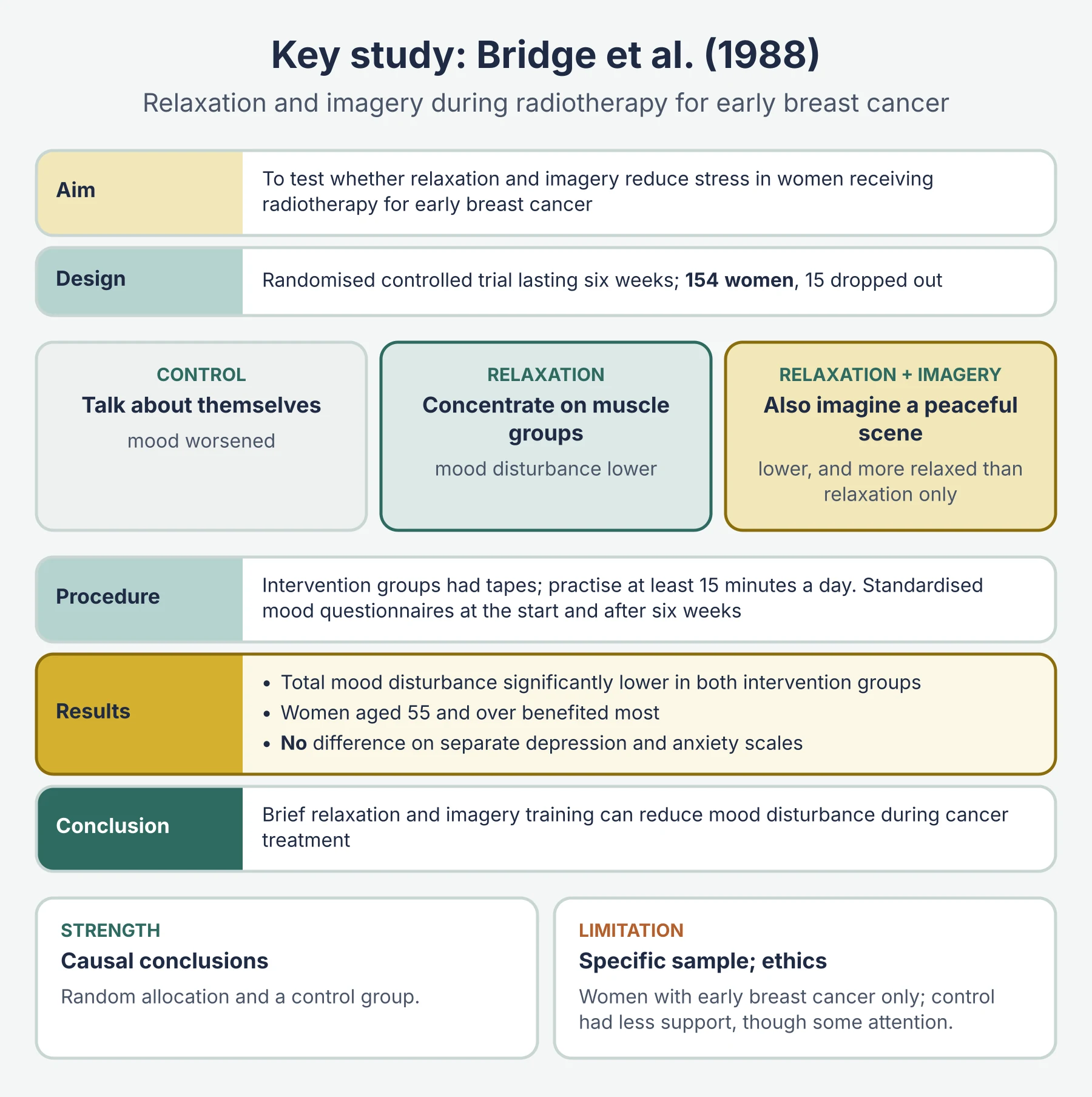
| Bridge et al. (1988) | 3.4.3 | Relaxation and imagery reduced mood disturbance during radiotherapy |
Key study grid: Bridge et al. (1988)
| Feature | Detail |
|---|---|
| Design | Randomised controlled trial, six weeks |
| Sample | 154 women with early breast cancer having radiotherapy; 15 dropped out |
| Groups | Control (talk about self); relaxation; relaxation plus imagery |
| Practice | Tapes; at least 15 minutes a day |
| Results | Lower total mood disturbance in both intervention groups; combined group most relaxed; control worsened |
| Moderator | Women aged 55 and over benefited most |
| Null result | No group difference on separate depression and anxiety scales |
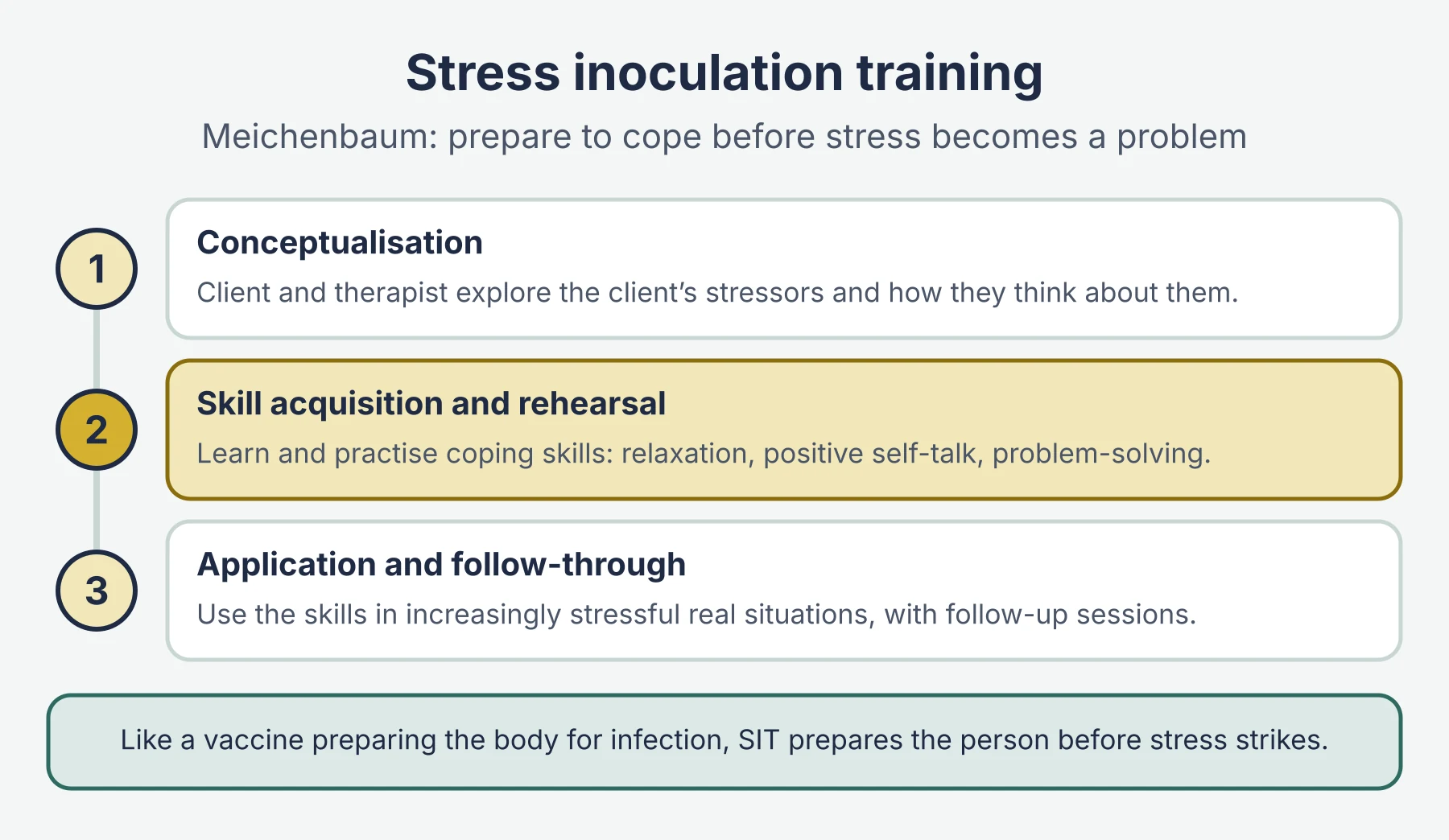
SIT in three phases
- Conceptualisation: understand the stressors and how one thinks about them.
- Skill acquisition and rehearsal: learn and practise coping skills.
- Application and follow-through: use skills in real situations, with follow-up.
Linking to issues and debates
- Individual and situational explanations (3.4.1): Type A is individual; work and life events are situational.
- Reductionism versus holism (3.4.1): the GAS reduces stress to physiology and ignores appraisal.
- Subjective and objective data (3.4.2): cortisol and fMRI are objective; questionnaires are subjective.
- Ethics (3.4.3): control groups in Bridge et al. received less help.
- Generalisations from findings (3.4.1, 3.4.3): civil servants; men in Friedman and Rosenman; women with breast cancer in Bridge et al.
Exam traps
- Cortisol comes from the adrenal cortex, adrenaline from the adrenal medulla.
- The SRRS counts positive change, such as marriage, as well as negative events.
- Friedman and Rosenman studied men; do not generalise to women without comment.
- Biofeedback treats symptoms; it does not remove the stressor.
- SIT is preventive: it is used before stress becomes overwhelming.
- Evans and Wener: it was seat density, not carriage density, that predicted cortisol.
Quick self-test
- Name the three stages of the GAS.
- Which hormone is released by the adrenal cortex in the HPA axis?
- How many events are on the SRRS, and what scores 100?
- Why does marriage appear on a stress scale?
- Which study used data from British civil servants?
- Give the three components of Type A behaviour.
- What task did Wang et al. (2005) use to create stress?
- What did Evans and Wener (2007) find about seating?
- Give one weakness of heart rate as a measure of stress.
- Describe the three groups in Bridge et al. (1988).
- Which women benefited most in Bridge et al.?
- Name the three phases of SIT.
Answers
- Alarm, resistance, exhaustion.
- Cortisol.
- 43 events; death of a spouse.
- The scale measures the amount of readjustment demanded, and positive changes also require adjustment.
- Chandola et al. (2008), using the Whitehall II study.
- Competitiveness, time urgency, hostility.
- Mental arithmetic.
- Passengers with more people seated close around them had higher cortisol, even when the carriage overall was not crowded.
- Heart rate also rises with exercise, caffeine or excitement, so a rise is not specific to stress.
- Control (encouraged to talk about themselves); relaxation; relaxation plus imagery.
- Women aged 55 and over.
- Conceptualisation; skill acquisition and rehearsal; application and follow-through.
More resources on this topic
Related resources
-
Study guides
Cambridge A Level Psychology (9990): The patient–practitioner relationship
Cambridge 9990 topic 3.1 in depth: clothing and jargon, diagnosis errors, Savage and Armstrong (1990), delay, Munchausen and malingering.
Psychology · Cambridge · A Level
Read guide -
Practice questions
Cambridge A Level Psychology (9990): The patient–practitioner relationship – Practice Questions
Original Paper 3 and Paper 4 style questions on Cambridge 9990 topic 3.1: communication, diagnosis, style and misuse, with mark schemes.
Psychology · Cambridge · A Level
Try questions -
Revision notes
Cambridge A Level Psychology (9990): The patient–practitioner relationship – Revision Notes
Revision notes for Cambridge 9990 topic 3.1: communication, diagnosis, Savage and Armstrong (1990), delay and Munchausen, with a self-test.
Psychology · Cambridge · A Level
Revise topic
Studying Psychology?
This page is free and stays free. Marlbridge is not offering Psychology classes at the moment, so there is no tuition to book for it. The free study resources stay open to everyone.
Get free revision emails (optional)
Occasional emails with practice questions, worked explanations and links to free resources for the qualification and subjects you choose. No spam, and you can unsubscribe from any email. The free tools on this site never need an email.