
Study Guides
Cambridge A Level Psychology (9990): Health promotion
Cambridge 9990 topic 3.5 in depth: fear arousal, information, healthy eating, workplace safety, optimism and Shoshani and Steinmetz (2014).
- Subject
- Psychology
- Level
- A LEVEL
- Topic
- Specialist Option 3: Health Psychology
- Author
- Marlbridge Academic Team
- Updated
- Reviewed by
- Kanwal Aslam (what this means)
Aligned to Cambridge A Level Psychology (9990), 2024-2026. Official specification .
Syllabus page (what it covers and how it is assessed): Cambridge A Level Psychology.
Syllabus points this page covers
9990 (A Level)
- 3.5 Health promotion
Topic 3.5, Health promotion, is the final topic of Specialist Option 3 (Health Psychology) in Cambridge International A Level Psychology 9990, syllabus for 2024 to 2026. It looks at strategies for persuading people to live more healthily (3.5.1), health promotion in schools and workplaces (3.5.2), and individual factors that affect whether people change their health beliefs (3.5.3). The key study is Shoshani and Steinmetz (2014), a positive psychology programme in Israeli schools.
The Health Psychology study guide summarises the topic. This page explains each strategy and study in more depth, links them to the issues the syllabus lists, and gives an annotated answer. Pair it with the health promotion revision notes and the health promotion practice questions.
Syllabus content for 3.5
| Sub-topic | Content | Named study |
|---|---|---|
| 3.5.1 Strategies for promoting health | Fear arousal; providing information so people know how to improve their health | e.g. Janis and Feshbach (1953); e.g. Lewin et al. (1992) |
| 3.5.2 Schools and worksites | Schools, with a focus on healthy eating; worksites, with a focus on health and safety | e.g. Tapper et al. (2003); e.g. Fox et al. (1987) |
| 3.5.3 Individual factors | Unrealistic optimism as a reason for disregarding health advice; positive psychology and its three focuses; application of positive psychology | e.g. Weinstein (1980); e.g. Seligman (2004); key study Shoshani and Steinmetz (2014) |
3.5.1 Fear arousal
A fear appeal tries to change behaviour by showing the harmful consequences of not changing, such as graphic images on cigarette packets.
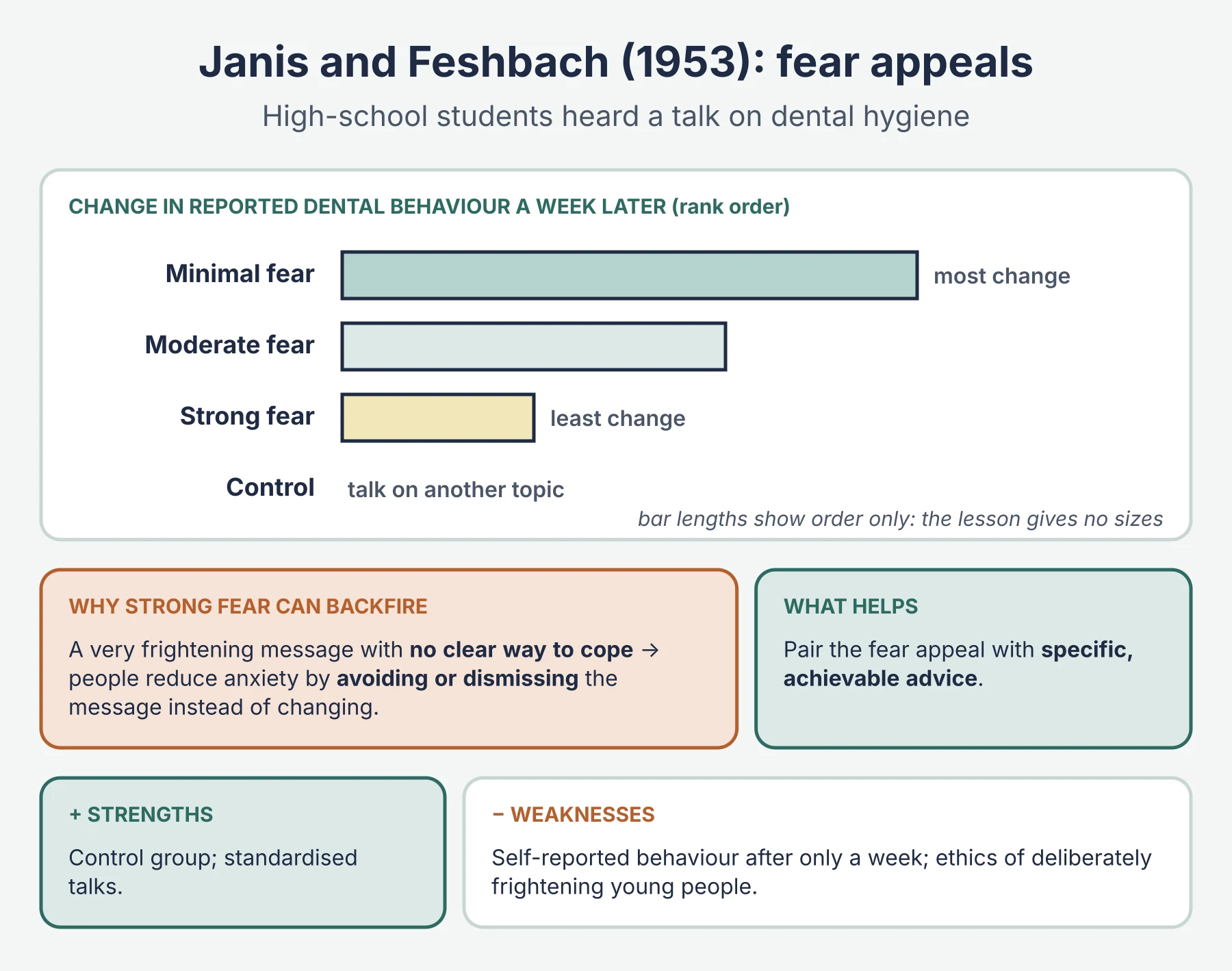
Janis and Feshbach (1953) gave groups of high-school students a talk on dental hygiene containing a strong, moderate or minimal fear appeal; a control group heard a talk on another topic. The strong appeal included vivid images of decay and disease. A week later, the minimal fear group showed the most change in reported dental behaviour, and the strong fear group the least.
Why might strong fear backfire? If a message is very frightening and offers no clear way to cope, people may reduce their anxiety by avoiding or dismissing the message rather than changing behaviour. Fear appeals seem more effective when they are paired with specific, achievable advice.
Evaluation. The experiment had a control group and standardised talks, but behaviour was self-reported and measured after only a week, so long-term effects are unknown. There are ethical concerns about deliberately frightening young people.
3.5.1 Providing information
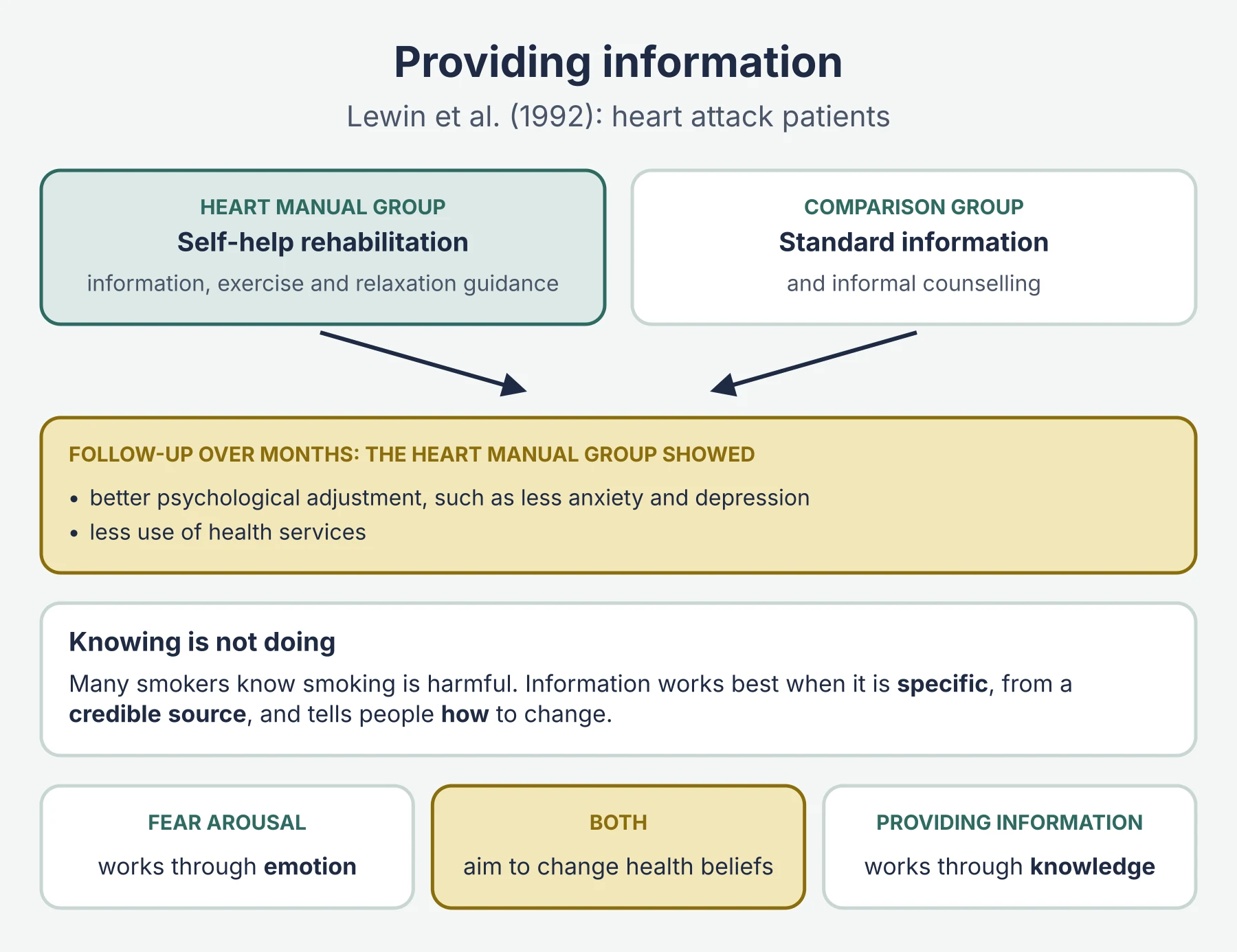
Information campaigns assume that people will change once they know what to do. Lewin et al. (1992) gave patients who had had a heart attack a self-help rehabilitation programme, the Heart Manual, which contained information, exercise and relaxation guidance. A comparison group received standard information and informal counselling. Patients with the manual showed better psychological adjustment, such as less anxiety and depression, and made less use of health services in the months that followed. The use of follow-up measures over months links to the syllabus methodology of longitudinal studies.
Limits of information. Knowing what is healthy does not guarantee action. Many smokers know smoking is harmful. Information works best when it is specific, comes from a credible source and tells people how to change.
3.5.2 Schools: healthy eating
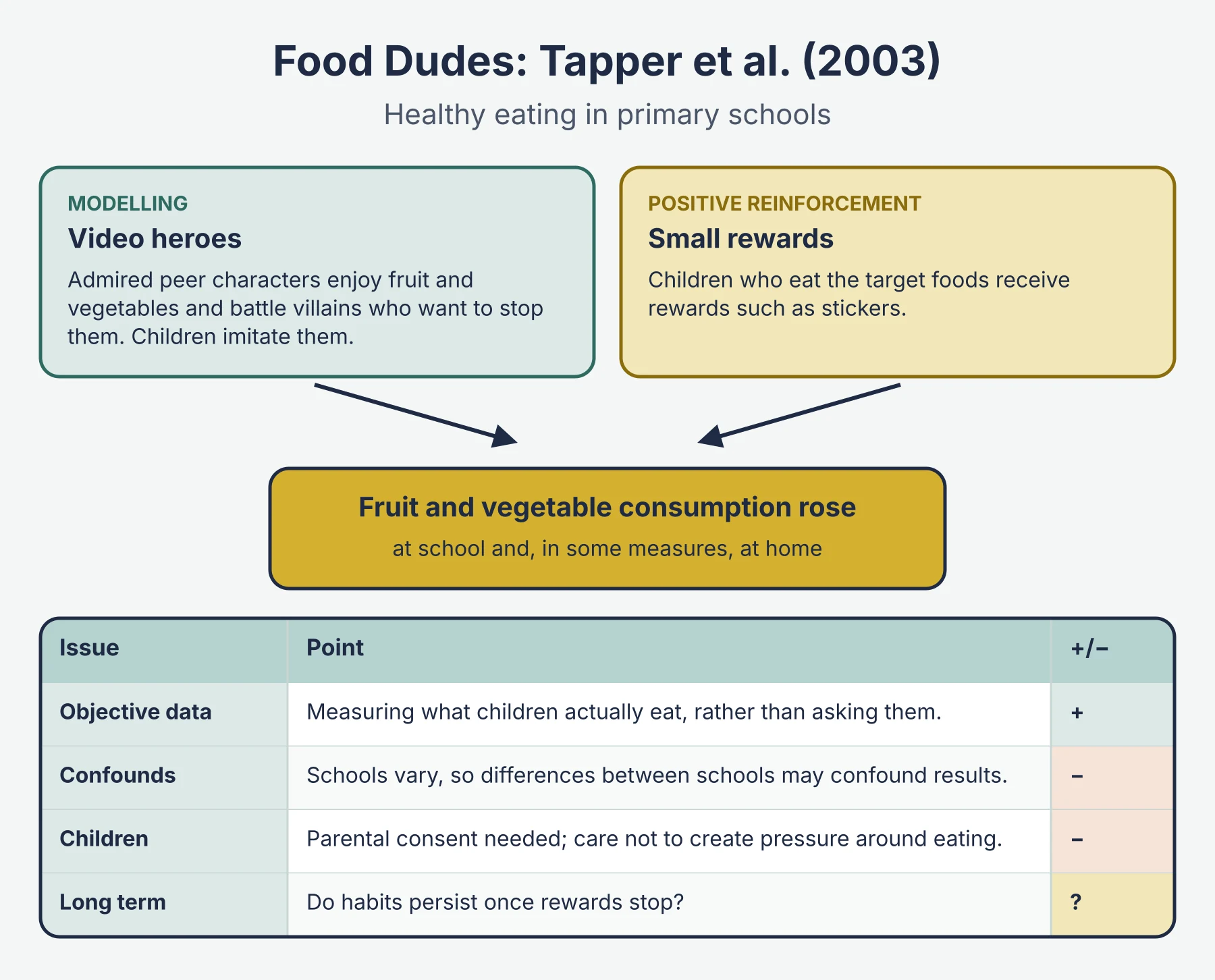
Tapper et al. (2003) evaluated the Food Dudes programme in primary schools. Children watched video episodes in which heroic peer characters, the Food Dudes, enjoyed fruit and vegetables and battled villains who wanted to stop them. Children who ate the target foods received small rewards such as stickers. Fruit and vegetable consumption increased, both at school and, in some measures, at home. The programme uses modelling from social learning theory (children imitate admired peers) and positive reinforcement (rewards).
Evaluation. Measuring how much fruit and vegetables children actually eat gives objective data, unlike asking them. Schools vary, so there may be confounding variables between schools. Ethically, the use of children in research requires parental consent and care not to create pressure around eating. Whether eating habits persist once rewards stop is a key question for any reward-based scheme.
3.5.2 Worksites: health and safety
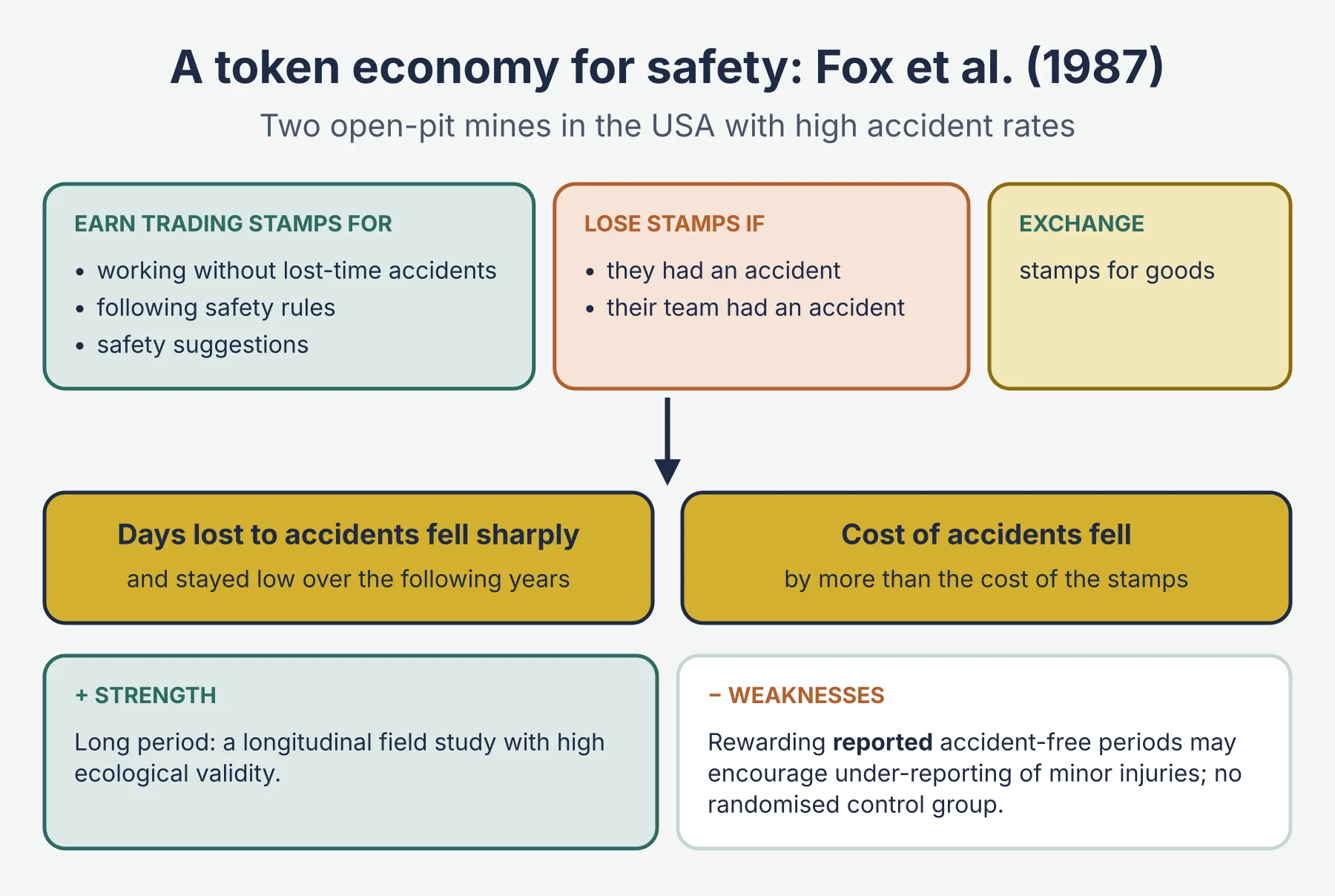
Fox et al. (1987) introduced a token economy at two open-pit mines in the USA, where accident rates had been high. Workers earned trading stamps for working without lost-time accidents, for following safety rules and for safety suggestions; stamps were lost if they or their team had an accident. Stamps could be exchanged for goods. The number of days lost to accidents fell sharply and remained low over the following years, and the cost of accidents fell by more than the cost of the stamps.
Evaluation. The long time period makes this a longitudinal field study with high ecological validity. However, a reward for reported accident-free periods could encourage workers not to report minor injuries, so some of the fall may reflect under-reporting. There was no randomised control group.
3.5.3 Unrealistic optimism
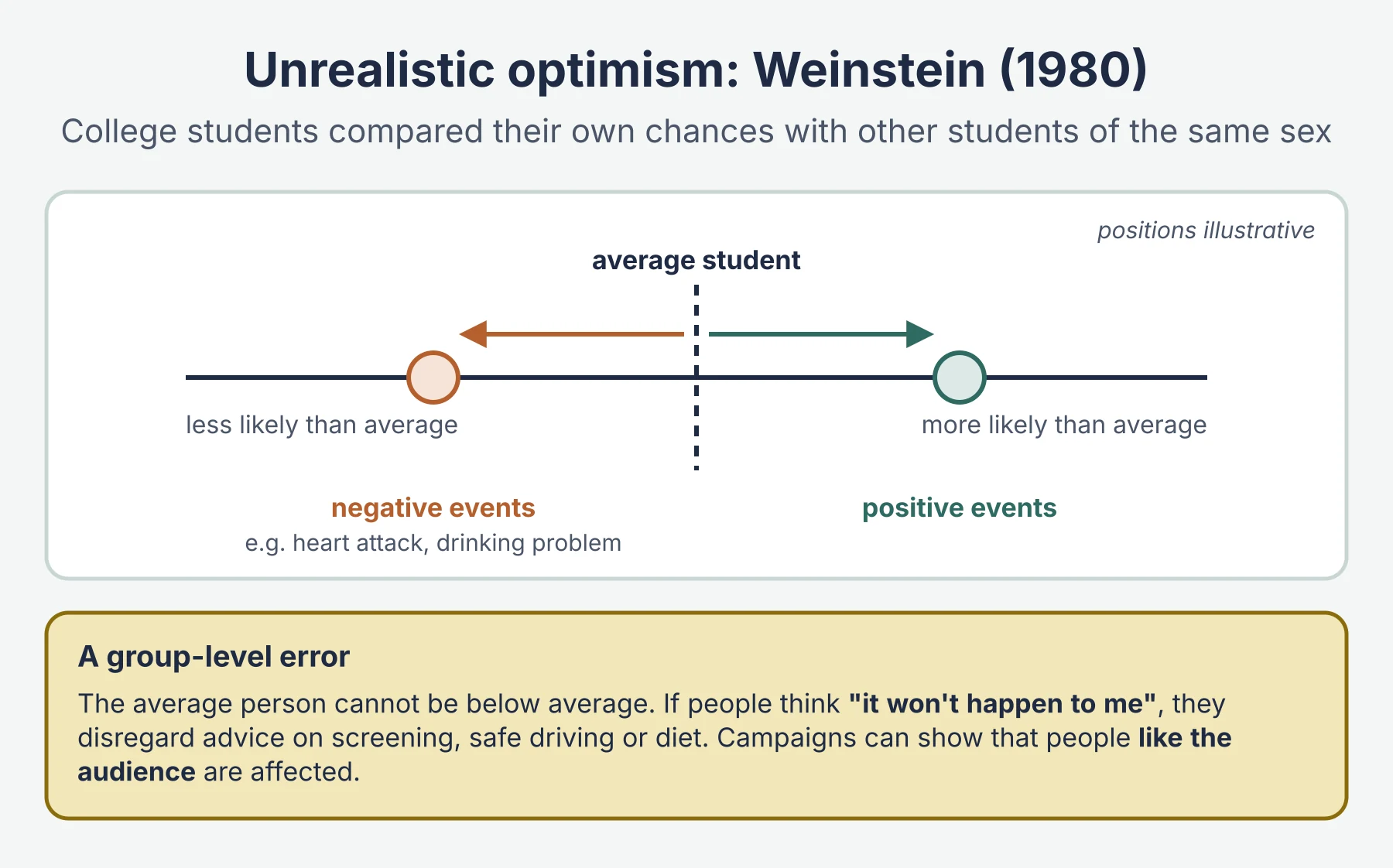
Unrealistic optimism is the belief that negative events are less likely to happen to oneself than to others. Weinstein (1980) asked college students to rate how likely a range of events was to happen to them compared with other students of the same sex at their college. On average, students rated their chances of negative events (such as a heart attack or a drinking problem) as below average and their chances of positive events as above average. Logically, the average person cannot be below average, so the bias is a group-level error.
Link to health promotion. If people think “it won’t happen to me”, they disregard advice about screening, safe driving or diet. Campaigns can counter this by showing that people like the audience are affected.
3.5.3 Positive psychology
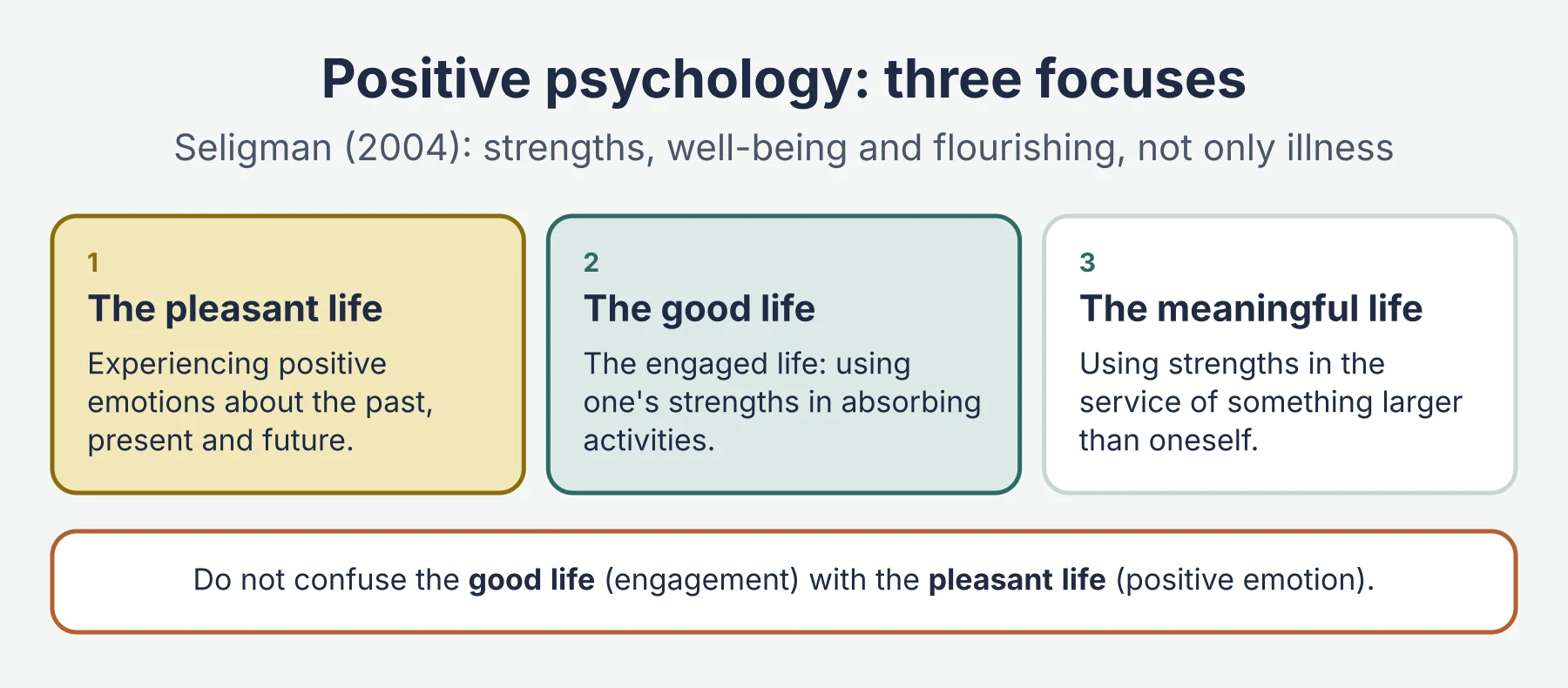
Defining positive psychology. Positive psychology is the scientific study of what makes life fulfilling, focusing on strengths, well-being and flourishing rather than only on illness. Seligman (2004) described three focuses:
- The pleasant life: experiencing positive emotions about the past, present and future.
- The good life (engaged life): using one’s strengths in absorbing activities.
- The meaningful life: using strengths in the service of something larger than oneself.
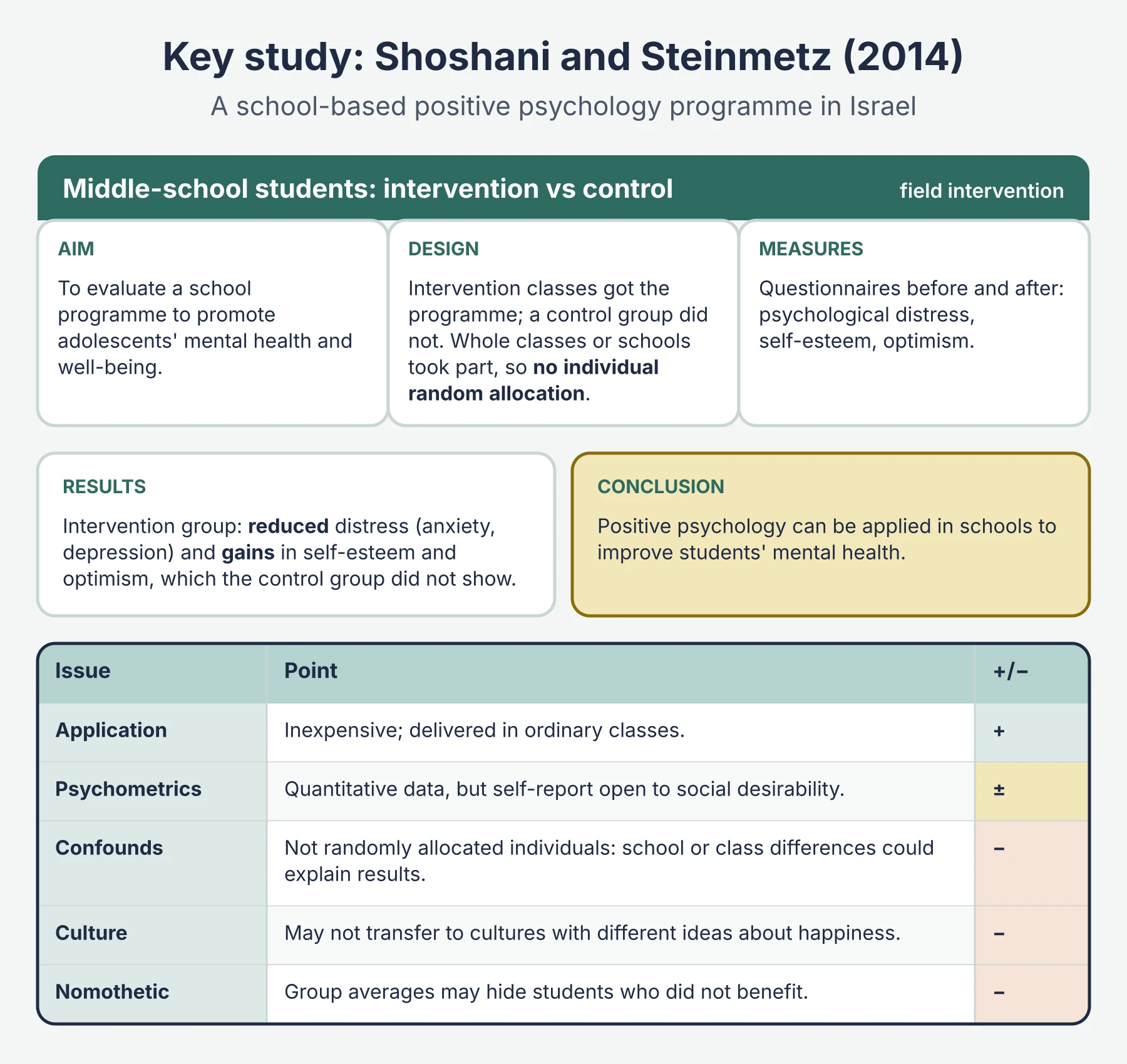
Key study: Shoshani and Steinmetz (2014).
- Aim: to evaluate a school-based positive psychology programme intended to promote adolescents’ mental health and well-being.
- Design: an intervention group of middle-school students in Israel received the programme in class; a control group did not. Groups were not individual random allocations, because whole classes or schools took part together.
- Measures: psychometric questionnaires of mental health and well-being, such as psychological distress symptoms, self-esteem and optimism, completed before and after the programme.
- Results: the intervention group showed reduced symptoms of psychological distress, such as anxiety and depression, and gains in measures such as self-esteem and optimism, which the control group did not show.
- Conclusion: positive psychology can be applied in schools to improve students’ mental health.
Evaluation.
- Application: an inexpensive programme delivered in ordinary classes.
- Psychometrics: standardised questionnaires give quantitative data, but self-report is open to social desirability, especially if students know they took part in a programme.
- Confounding variables: groups were not randomly allocated individuals, so differences between schools or classes could explain results.
- Cultural differences: a programme developed in one country may not transfer to cultures with different ideas about happiness.
- Idiographic versus nomothetic: group averages may hide students who did not benefit.
Annotated answer: a Paper 4 style suggestion
A company wants to reduce accidents in its warehouse. Using research into health promotion at worksites, suggest a programme and explain one problem with evaluating it.
“I would use a token economy like Fox et al. (1987). Workers earn tokens for each week without a lost-time accident and for following safety rules, and the whole team loses tokens if anyone has an accident, so there is peer pressure to work safely. Tokens can be exchanged for goods. This uses positive reinforcement to make safe behaviour more likely. A problem with evaluation is that workers may stop reporting minor injuries to keep their tokens, so recorded accidents could fall without a real improvement in safety. Comparing recorded accidents with first-aid records or insurance claims would help check this.”
Why it works: it names the study, describes the mechanism, applies it to the warehouse and identifies a validity problem with a solution.
Common mistakes
- Saying Janis and Feshbach found strong fear worked best. Minimal fear produced most change.
- Writing that Weinstein found students were pessimistic. They were unrealistically optimistic.
- Confusing Seligman’s “good life” (engagement) with the “pleasant life” (positive emotion).
- Calling Shoshani and Steinmetz a laboratory experiment. It was a school-based field intervention.
Exam technique
Describe questions on strategies need the method of persuasion plus a supporting study. Evaluate questions can use the issues listed for 3.5: individual and situational explanations, cultural differences, longitudinal studies, objective and subjective data, ethics, use of children in research and psychometrics. Compare fear arousal with providing information by noting that both aim to change beliefs, but one works through emotion and the other through knowledge.
More resources on this topic
Official syllabus
Cambridge International AS & A Level Psychology 9990 syllabus for 2024, 2025 and 2026, Specialist Option 3: Health Psychology, topic 3.5 — cambridgeinternational.org.
Related resources
-
Practice questions
Cambridge A Level Psychology (9990): Health promotion – Practice Questions
Original Paper 3 and Paper 4 style questions on Cambridge 9990 topic 3.5: fear appeals, schools, worksites, optimism and positive psychology, with mark schemes.
Psychology · Cambridge · A Level
Try questions -
Revision notes
Cambridge A Level Psychology (9990): Health promotion – Revision Notes
Revision notes for Cambridge 9990 topic 3.5: fear appeals, information, Food Dudes, token economies, optimism and positive psychology.
Psychology · Cambridge · A Level
Revise topic -
Study guides
Cambridge A Level Psychology (9990): Pain
Cambridge 9990 topic 3.3 in depth: types and theories of pain, phantom limb pain, McGill, VAS and UAB measures, Brudvik et al. (2016) and pain management.
Psychology · Cambridge · A Level
Read guide
Studying Psychology?
This page is free and stays free. Marlbridge is not offering Psychology classes at the moment, so there is no tuition to book for it. The free study resources stay open to everyone.
Get free revision emails (optional)
Occasional emails with practice questions, worked explanations and links to free resources for the qualification and subjects you choose. No spam, and you can unsubscribe from any email. The free tools on this site never need an email.