
Revision Notes
Cambridge A Level World History (9489): Russia from autocracy to revolution, 1881-1924 – Revision Notes
Revision notes for Cambridge 9489 History, Russia 1881-1924: chronology, key terms, 1905 and 1917 compared, Civil War factors, exam traps and a self-test.
- Subject
- World History
- Level
- AS LEVEL
- Topic
- Paper 1 and Paper 2 – European Option: Modern Europe, 1774–1924
- Author
- Marlbridge Academic Team
- Updated
- Reviewed by
- Azam Siddique (what this means)
Aligned to Cambridge A Level World History (9489), 2027-2029. Official specification .
Syllabus page (what it covers and how it is assessed): Cambridge A Level World History.
Syllabus points this page covers
9489 (AS Level)
- 3 Russia from autocracy to revolution, 1881–1924
Found an error? Report a correction.
Need help with this topic? Request a free trial class for A Level World History (9489).
These notes condense Cambridge 9489 AS topic 3, Russia from autocracy to revolution, 1881-1924, for quick recall. The key questions cover the challenges facing the regime in 1881-94 (3.1), the causes and outcomes of 1905 up to 1914 (3.2), the Bolshevik seizure of power in October 1917 (3.3) and Bolshevik consolidation to 1924 (3.4). The narrative is explained in the Russia, 1881-1924 study guide; exam practice is in the Russia, 1881-1924 practice questions. Dates for 1917 follow the Russian (Old Style) calendar used in the syllabus.
Rotation (2027-2029 syllabus): Paper 2 (Outline Study) in 2027 and 2028; Paper 1 (Historical Sources) in 2029.
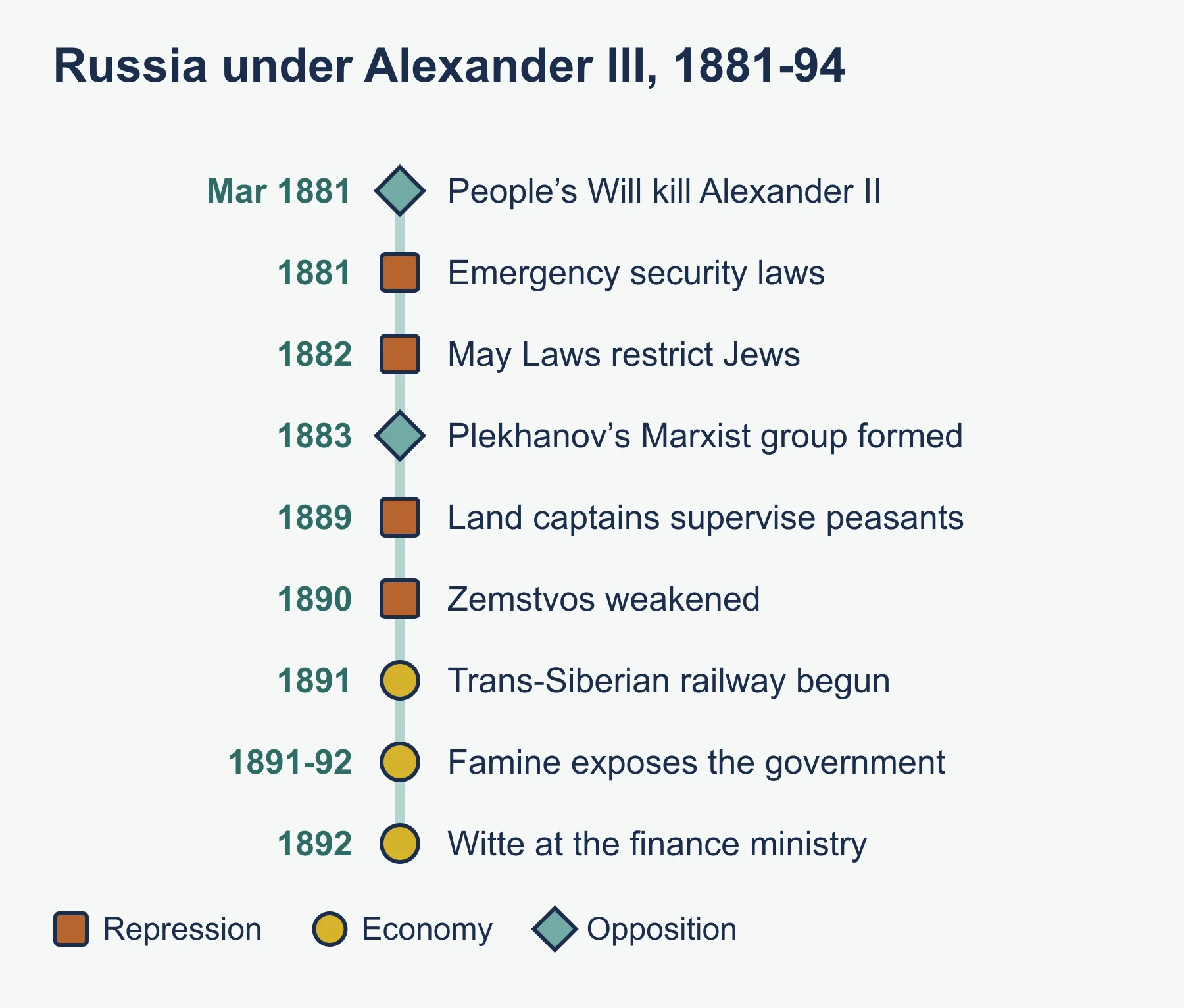
Chronology
| Date | Event |
|---|---|
| March 1881 | Alexander II assassinated; Alexander III accedes |
| 1881 | Statute on State Security (emergency powers) |
| 1881-82 | Pogroms; May Laws restrict Jews (1882) |
| 1883 | Plekhanov’s Emancipation of Labour group; Peasant Land Bank |
| 1889 / 1890 | Land captains / zemstvo powers reduced |
| 1891-92 | Famine; Trans-Siberian Railway begun (1891) |
| 1892 | Witte becomes finance minister |
| 1894 | Nicholas II accedes |
| 1897 | Rouble put on the gold standard |
| 1898 | Russian Social Democratic Labour Party founded |
| 1901-02 | Socialist Revolutionary Party formed |
| 1903 | Social Democrats split: Bolsheviks and Mensheviks |
| 1904-05 | Russo-Japanese War; Tsushima (May 1905) |
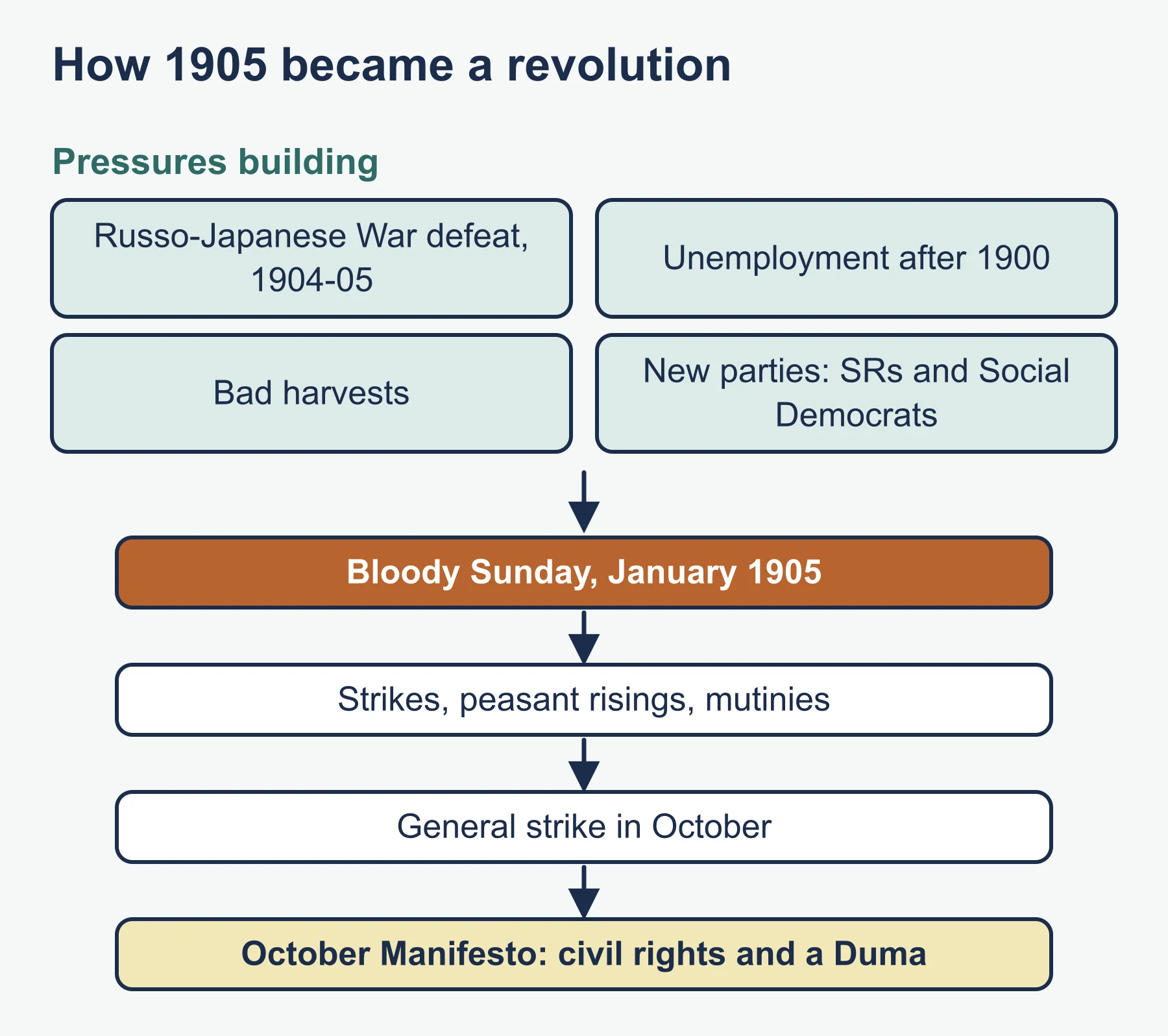
| 9 Jan 1905 | Bloody Sunday |
| June 1905 | Potemkin mutiny |
| Oct 1905 | General strike; St Petersburg Soviet; October Manifesto |
| Dec 1905 | Moscow rising crushed |
| April 1906 | Fundamental Laws; First Duma meets |
| June 1907 | Electoral law changed; Third Duma more conservative |
| 1906-11 | Stolypin’s agrarian reforms; assassinated September 1911 |
| April 1912 | Lena goldfields shootings |
| Aug 1914 | Tannenberg |
| Sept 1915 | Nicholas takes personal command |
| Dec 1916 | Rasputin murdered |
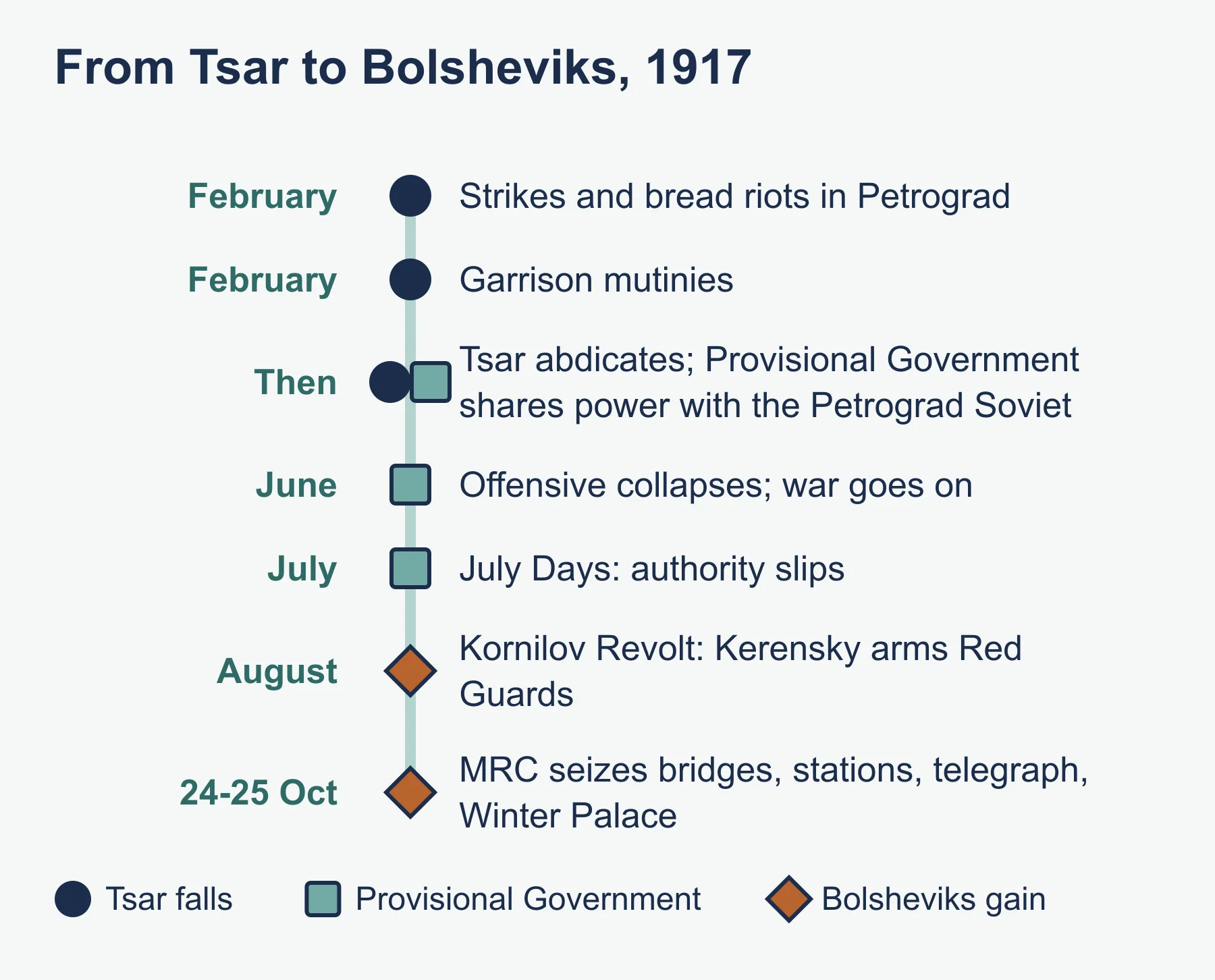
| Feb 1917 | Petrograd strikes and garrison mutiny; Nicholas abdicates (2 March) |
| April 1917 | Lenin’s April Theses |
| July 1917 | July Days |
| Aug 1917 | Kornilov affair |
| 25 Oct 1917 | Bolsheviks take power |
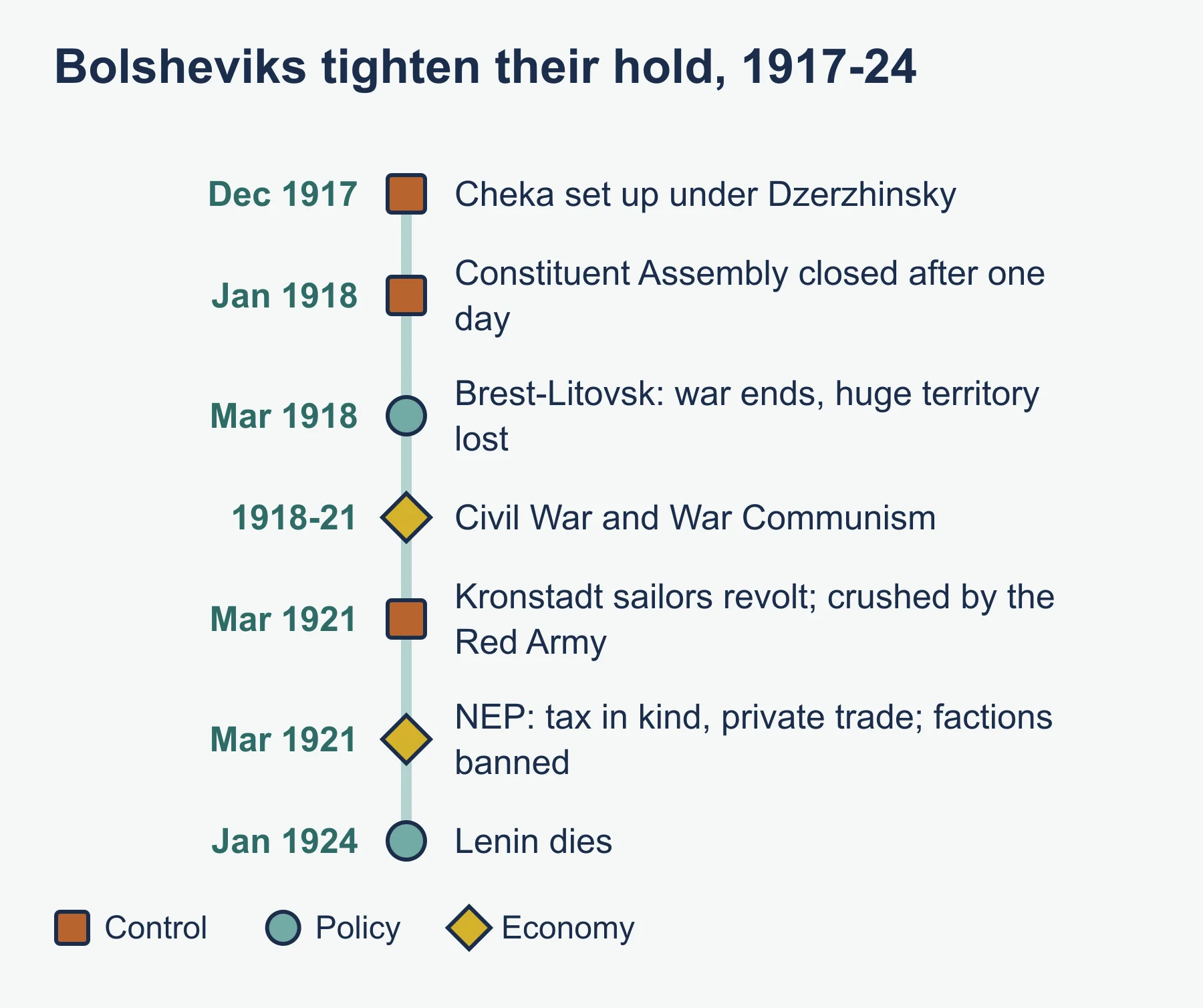
| Jan 1918 | Constituent Assembly closed after one day |
| March 1918 | Treaty of Brest-Litovsk |
| 1918-21 | Civil War; War Communism |
| March 1921 | Kronstadt rising; Tenth Party Congress adopts NEP and bans factions |
| Jan 1924 | Lenin dies |
Key terms
| Term | Meaning |
|---|---|
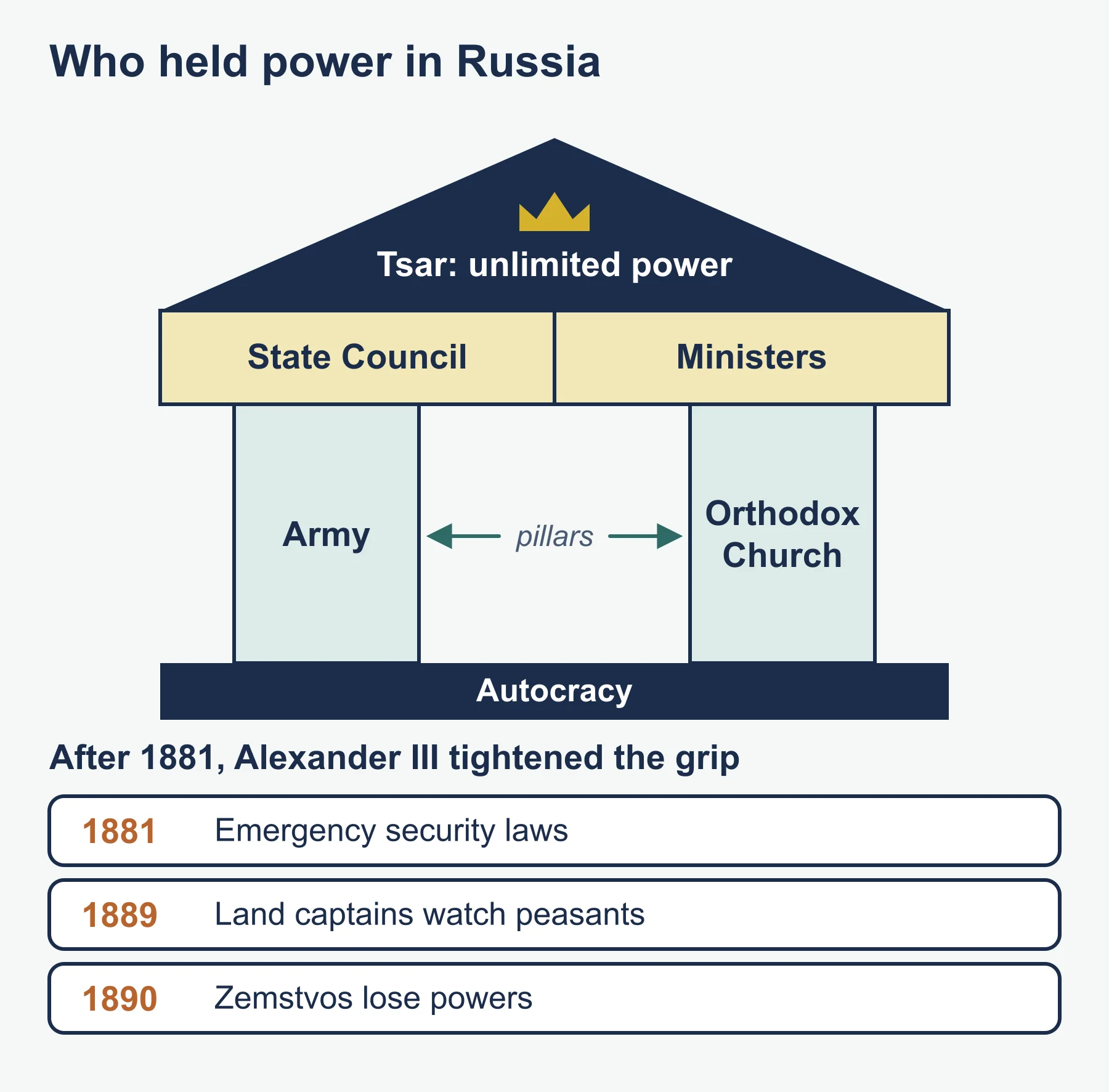
| Autocracy | Unlimited rule by the Tsar, answerable to God alone |
| Russification | Imposing Russian language, Orthodoxy and officials on non-Russian peoples |
| Land captain | Noble official with power over peasant affairs (1889) |
| Zemstvo | Elected local council, dominated by gentry |
| Mir | Peasant village commune that redistributed land |
| Redemption payments | Annual payments by peasants for land received at emancipation |
| Okhrana | Tsarist political police |
| Kadets / Octobrists | Liberal parties: Kadets wanted a full parliamentary system; Octobrists accepted the October Manifesto |
| Dual power | Shared authority of the Provisional Government and the Petrograd Soviet, 1917 |
| Order No. 1 | Soviet order of March 1917 giving soldiers’ committees control of weapons |
| April Theses | Lenin’s demands: no support for the Provisional Government, peace, land, power to the soviets |
| Sovnarkom | Council of People’s Commissars, the Bolshevik government |
| Cheka | Bolshevik political police, founded December 1917 |
| War Communism | Requisitioning, nationalisation and labour discipline, 1918-21 |
| NEP | New Economic Policy: tax in kind, private trade and small private enterprise |
Comparing 1905 and February 1917
| Factor | 1905 | February 1917 |
|---|---|---|
| War | Defeat by Japan, far from the capitals | Total war: millions of casualties, inflation, food shortages |
| Army | Mostly loyal once peace was made; used against Moscow | Petrograd garrison mutinied and joined the crowds |
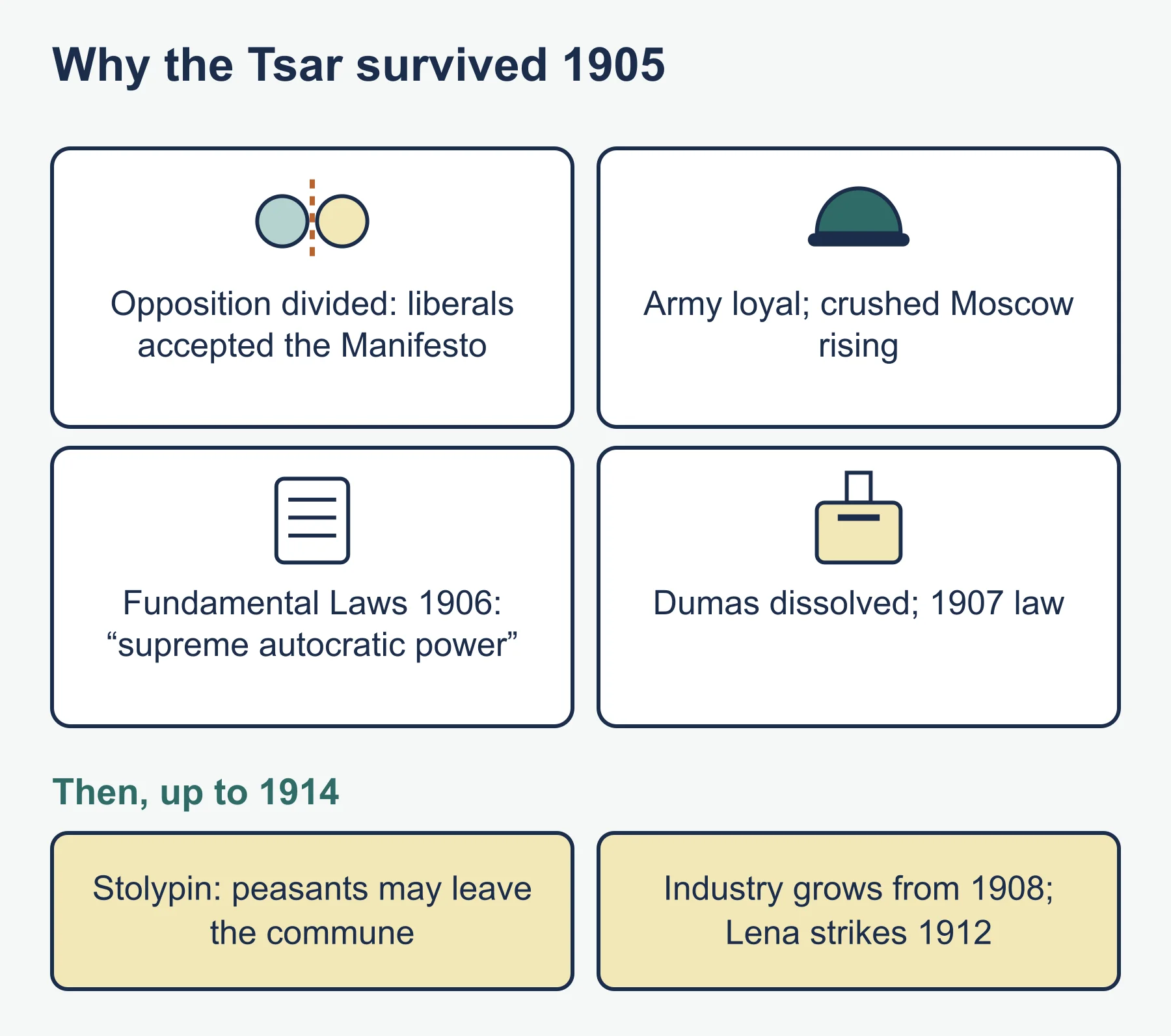
| Tsar’s response | Concession (October Manifesto) split the opposition | No concession could save him; generals and Duma advised abdication |
| Opposition | Divided: liberals accepted reform, socialists did not | United in the moment against Nicholas, divided soon after |
| Outcome | Regime survived | Monarchy ended |
This table answers “Why did the regime survive in 1905 but not in 1917?” – a classic Paper 2 part (b).
Key question summaries
3.1. Alexander III answered his father’s assassination with repression and Russification; Bunge’s reforms and then Witte’s state-led industrialisation built industry at the peasants’ expense; the 1891-92 famine discredited government; Marxism gained followers as a factory working class grew.
3.2. Causes of 1905: political frustration, new parties, economic slump and harvests, and defeat by Japan. Survival: concession, a loyal army, division in the opposition, the Fundamental Laws and Stolypin’s repression. Change to 1914: real but limited agrarian reform; industrial growth with renewed labour unrest.
3.3. The war undermined the Tsar; February was spontaneous. The Provisional Government failed on war, land and authority; the Bolsheviks offered clear slogans, a determined leader and an armed body, the Military Revolutionary Committee.
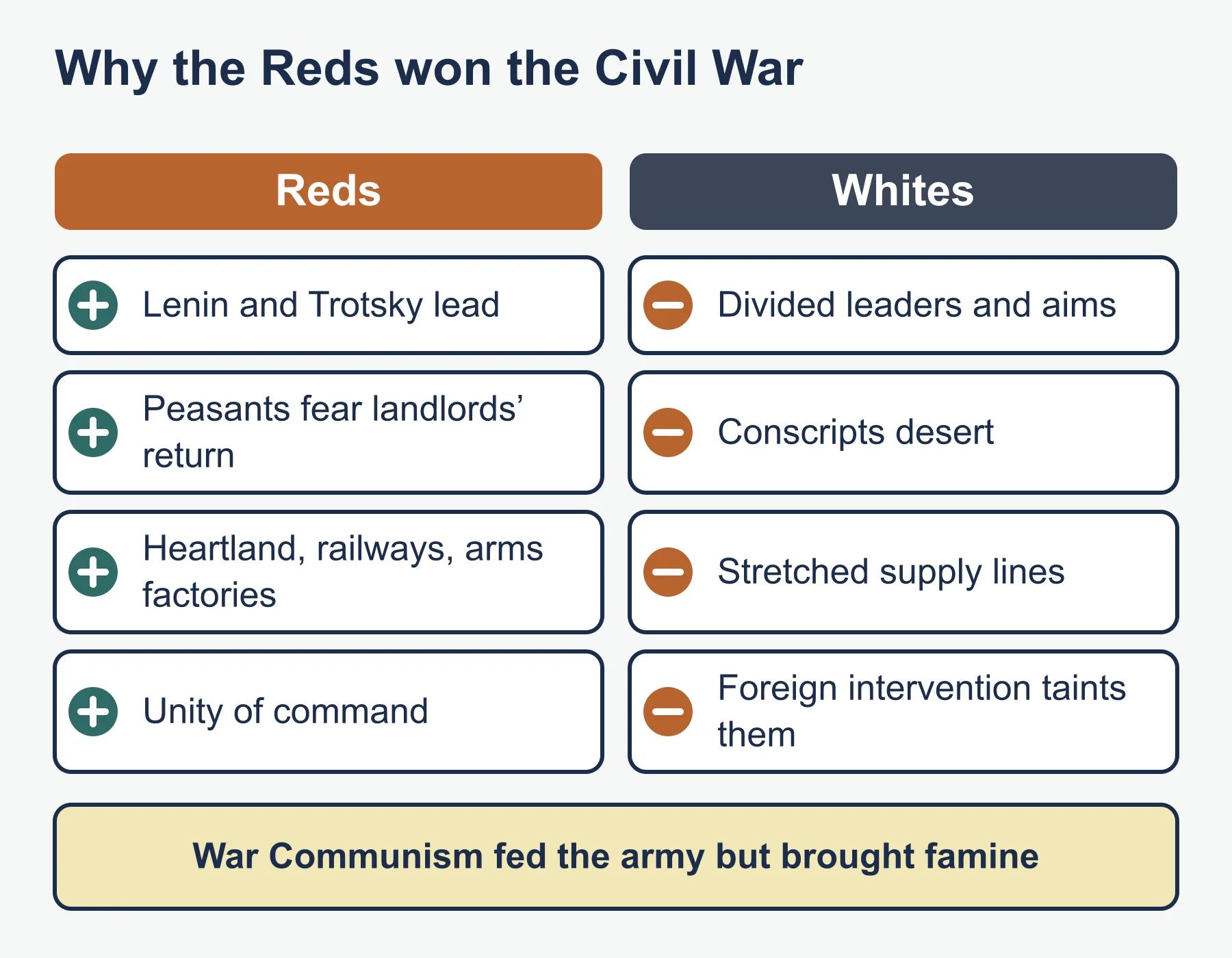
3.4. Decrees won peasants and workers; Brest-Litovsk bought survival; the Cheka and the closure of the Constituent Assembly made a one-party state. Red strengths and White weaknesses decided the Civil War. Kronstadt forced the NEP: economic retreat with political tightening.
Exam traps
- Calendar confusion. February and October are Old Style; do not give 7 November as the date of the Bolshevik rising and then mix in Old Style dates.
- Witte’s dates. He was finance minister 1892-1903; his industrialisation belongs mainly to the 1890s, not 1881-94 as a whole.
- The Duma as a parliament. The Fundamental Laws kept the Tsar’s “supreme autocratic power” and his veto; ministers answered to him.
- “The Bolsheviks overthrew the Tsar.” They did not; February was not led by any party.
- The Constituent Assembly. The Socialist Revolutionaries, not the Bolsheviks, won the most seats.
- Paper 1. Soviet memoirs written after 1917 often magnify Lenin’s role; explain purpose and hindsight.
Self-test
- Who was Procurator of the Holy Synod under Alexander III? Pobedonostsev.
- Name two reforms of Bunge. Any two: began abolishing the poll tax; Peasant Land Bank; first factory laws limiting child labour.
- What exposed the cost of forcing grain exports in the early 1890s? The famine of 1891-92.
- Give two features of Witte’s economic policy. Any two: foreign loans; protective tariffs; high indirect taxes; the gold standard (1897); state railway building.
- What divided Bolsheviks from Mensheviks in 1903? Lenin wanted a small party of professional revolutionaries; the Mensheviks a broader membership.
- Who led the procession on Bloody Sunday? Father Gapon.
- What did the October Manifesto promise? Civil rights and an elected Duma with legislative power.
- Why did the change in the electoral law of June 1907 matter? It gave more weight to landowners and produced more conservative, co-operative Dumas.
- What were the two strands of Stolypin’s policy? Agrarian reform to create prosperous independent farmers, and repression of revolutionaries.
- What did Order No. 1 do to the Provisional Government’s authority? It made military orders subject to the Soviet, weakening the government’s control of the army.
- Why did the Kornilov affair help the Bolsheviks? Kerensky armed the Red Guards and released Bolsheviks, who gained credit as defenders of Petrograd.
- What political measure accompanied the NEP at the Tenth Party Congress? The ban on factions inside the Communist Party.
Official syllabus
Cambridge International AS & A Level History (9489) syllabus for 2027, 2028 and 2029 – cambridgeinternational.org (subject content, topic 3; Topics assessed on Paper 1 and Paper 2).
Related resources
-
Study guides
Cambridge A Level World History (9489): France, 1774-1814 – Study Guide
Study guide to Cambridge 9489 History AS topic 1, France 1774-1814: causes of 1789, the road to the Republic, Terror and Directory, Napoleon's rise and fall.
World History · Cambridge · AS Level
Read guide -
Study guides
Cambridge A Level World History (9489): Liberalism and Nationalism in Germany, 1815-71 – Study Guide
Study guide to Cambridge 9489 History AS topic 2, Germany 1815-71: the Confederation, the 1848-49 revolutions, Bismarck and the wars of unification.
World History · Cambridge · AS Level
Read guide -
Study guides
A Level World History: Modern Europe, 1774-1924 (Cambridge 9489)
The European option of Cambridge AS and A Level History 9489 (2027-2029): France 1774-1814, liberalism and nationalism in Germany, and Russia 1881-1924.
World History · Cambridge · AS Level
Read guide
Get free revision emails (optional)
Occasional emails with practice questions, worked explanations and links to free resources for the qualification and subjects you choose. No spam, and you can unsubscribe from any email. The free tools on this site never need an email.