
Revision Notes
Cambridge IGCSE Urdu as a Second Language (0539): Component 5 – Speaking – Revision Notes
Quick recall for the optional 0539 Component 5 Speaking test: the three parts, marks and timings, preparing a presentation, useful Urdu phrases and a self-test.
- Subject
- Urdu Language
- Level
- IGCSE
- Topic
- Component 5 – Speaking (optional, separately endorsed)
- Author
- Marlbridge Academic Team
- Updated
- Reviewed by
- Farheen Zehra (what this means)
Aligned to Cambridge IGCSE Urdu Language (0539), 2025-2027. Official specification .
Syllabus page (what it covers and how it is assessed): Cambridge IGCSE Urdu Language.
Syllabus topics and points this page is mapped to
0539
- 3 Component 5 – Speaking (optional, separately endorsed) (topic-level mapping)
"Topic-level mapping" means this page belongs to that topic; it does not claim to cover every point in it.
Found an error? Report a correction.
Need help with this topic? Request a free trial class for IGCSE Urdu Language (0539).
Condensed notes for the optional Component 5: Speaking of Cambridge IGCSE Urdu as a Second Language (0539). For the full explanation, use the Component 5 Speaking study guide.
The test in one box
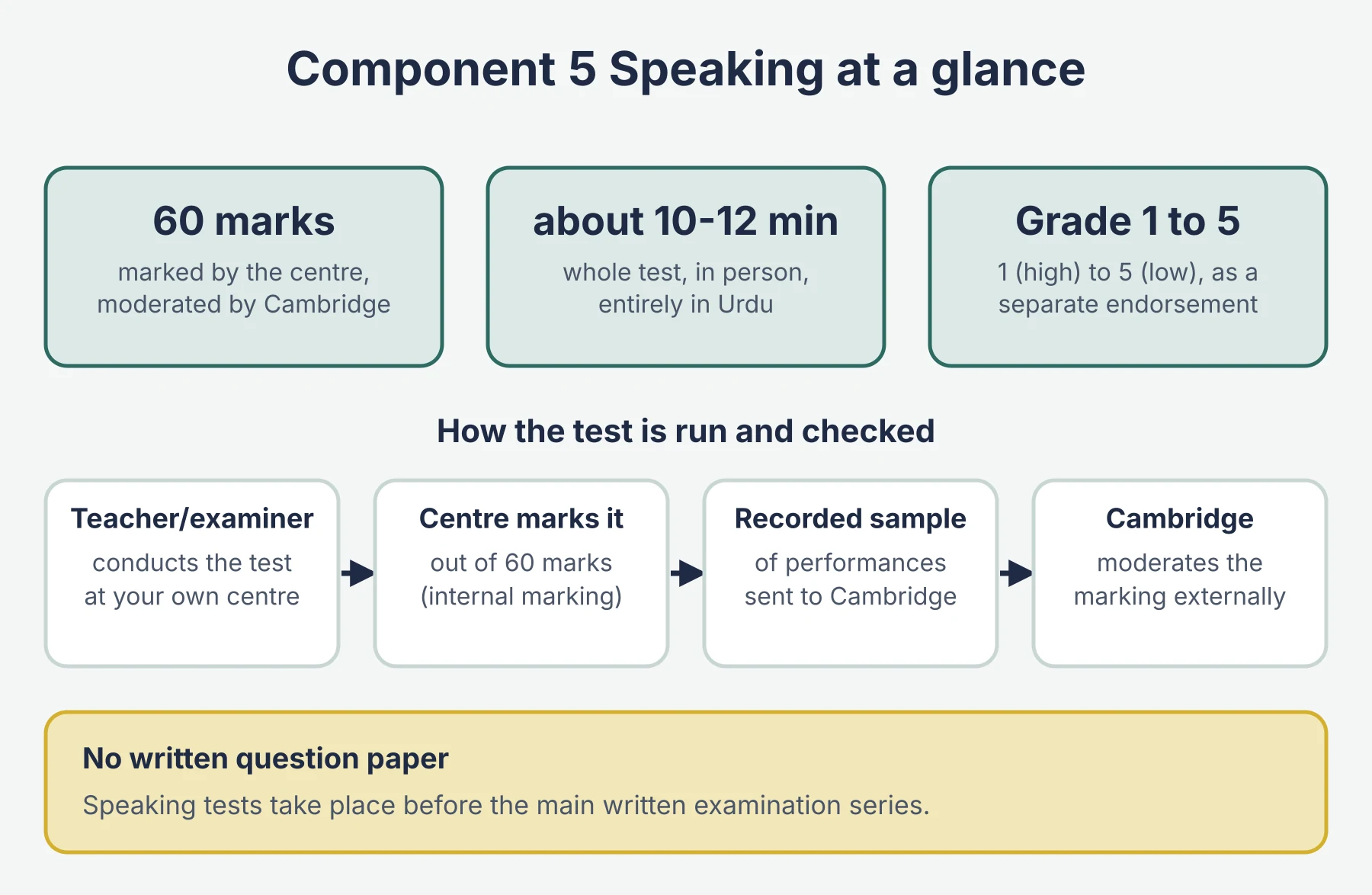
Component 5 -- Speaking          60 marks, optional
Whole test    approximately 10-12 minutes (as the syllabus gives it)
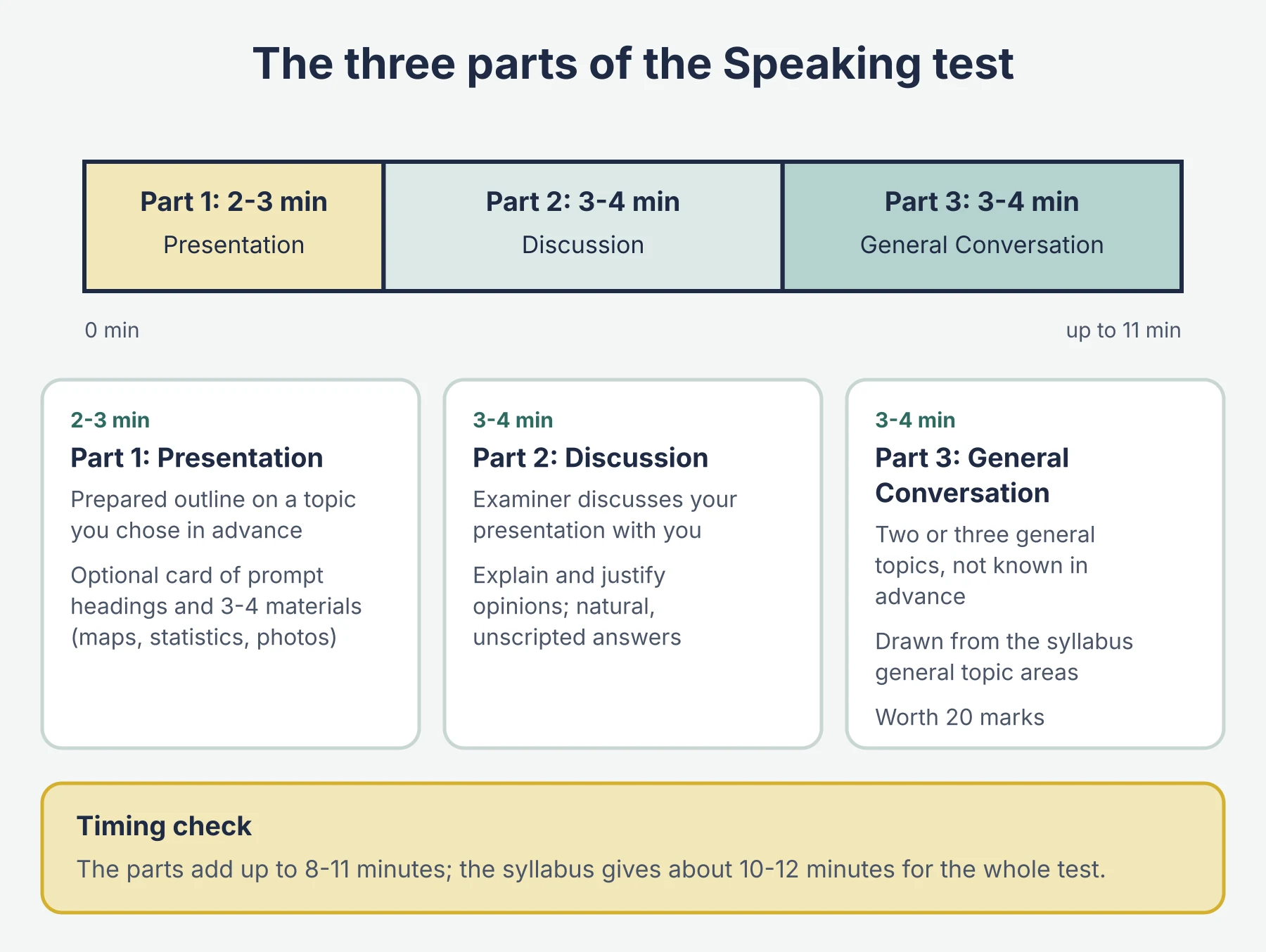
Part 1  Presentation          2-3 minutes, 20 marks
Part 2  Discussion            3-4 minutes, 20 marks
Part 3  General conversation  3-4 minutes, 20 marks
Language Urdu throughout, with your own teacher/examiner- Conducted and marked in Urdu at your own centre, then externally moderated by Cambridge.
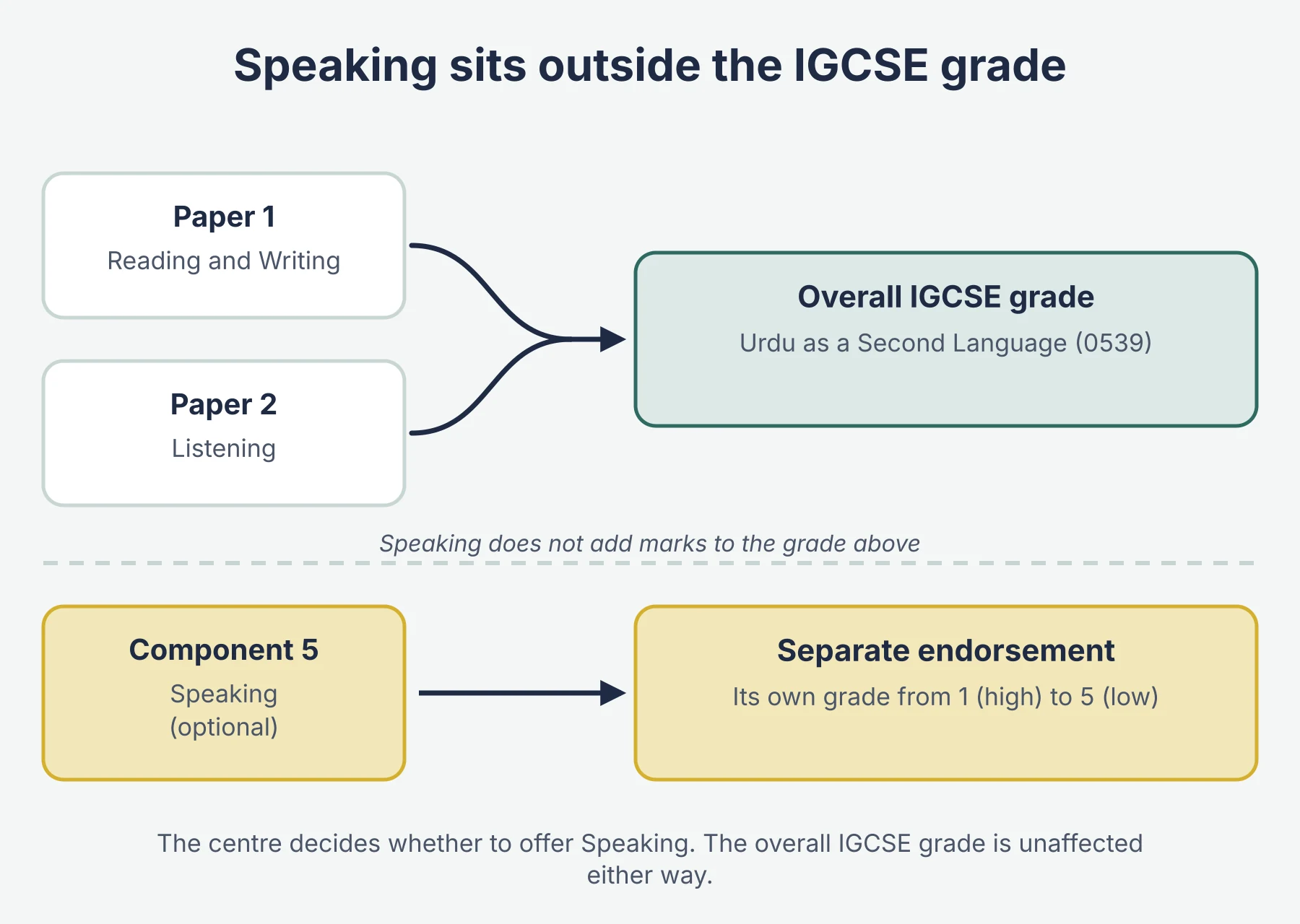
- Separately endorsed with a grade from 1 (high) to 5 (low). It does not change your overall IGCSE grade, which comes from Paper 1 and Paper 2.
- Not every centre offers it, so confirm with your teacher.
The three parts
| Part | What happens | Can you prepare it? |
|---|---|---|
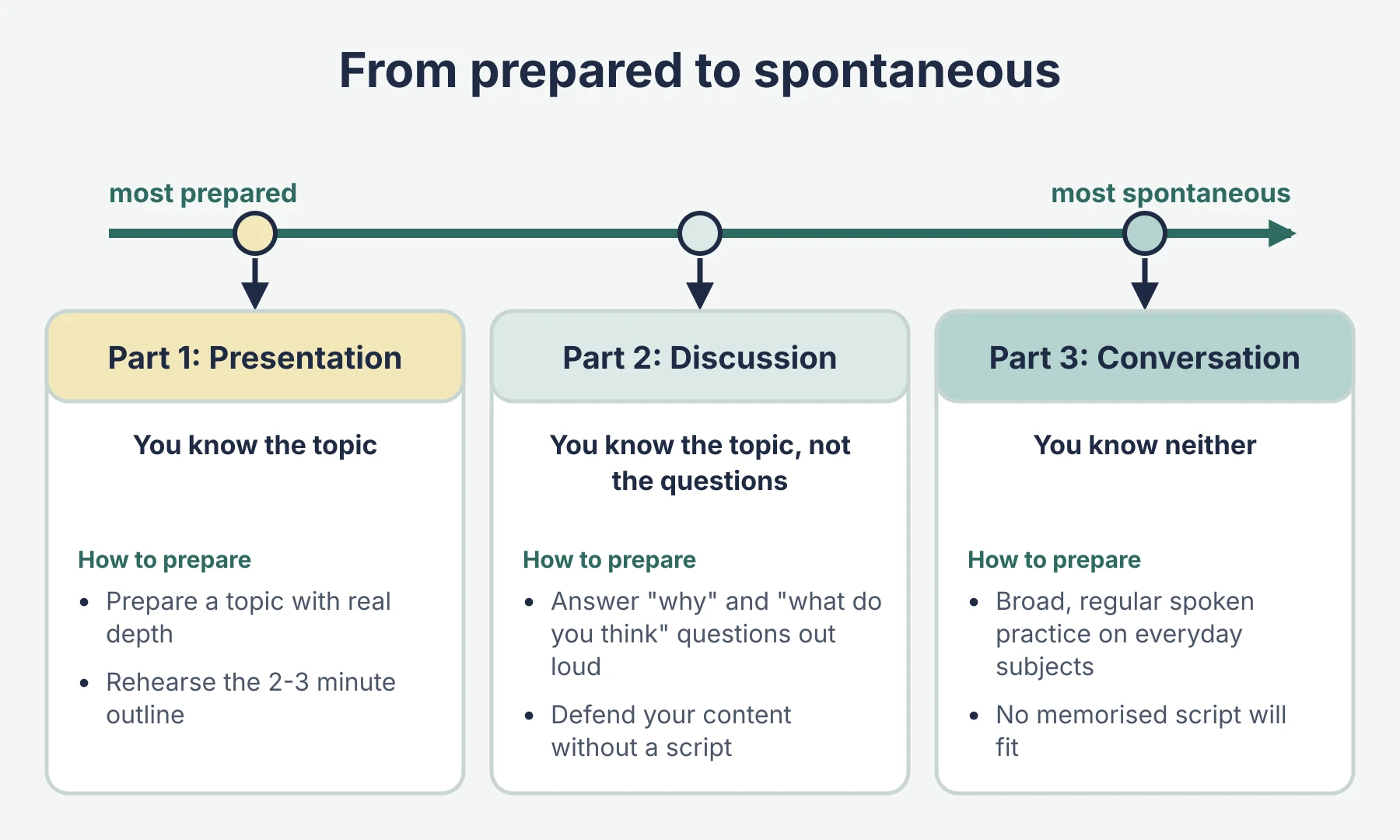
| 1 Presentation | You chose a topic in advance, related to Urdu-speaking society or culture, and give a prepared outline. A small card of prompt headings is allowed, with 3-4 illustrative materials such as maps, statistics or photographs | Yes, fully |
| 2 Discussion | The examiner discusses your presentation with you; you explain and justify opinions in natural, unscripted Urdu | Partly: know your topic, not a script |
| 3 General conversation | Two or three general topics you do not know in advance | No script possible |
Choosing a Part 1 topic
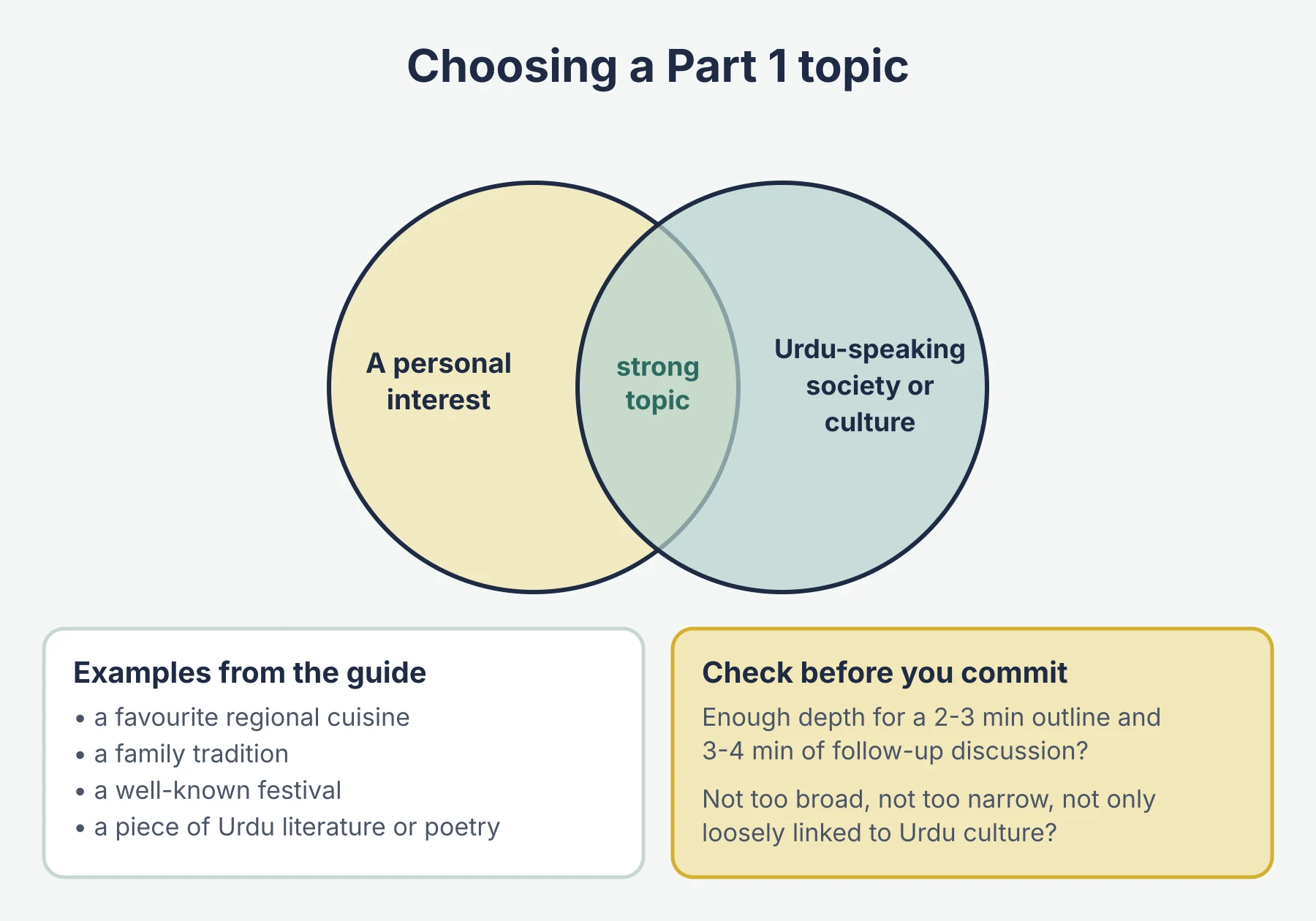
Pick a topic you can speak about in depth, with a real connection to Urdu-speaking society or culture, for example a festival, a family tradition or regional food. It must last for the 2-3 minute outline and sustain the Part 2 discussion. Depth matters more than a topic that sounds impressive.
Useful phrases
| Urdu | English |
|---|---|
| میرے خیال میں … کیونکہ … | In my opinion … because … |
| میرا خیال ہے کہ | I think that |
| مجھے پسند ہے / مجھے پسند نہیں | I like it / I do not like it |
| میں متفق ہوں / میں متفق نہیں ہوں | I agree / I disagree |
| مثال کے طور پر | for example |
| مختصر یہ کہ | in short |
| معاف کیجیے | excuse me |
| کیا آپ دوبارہ کہہ سکتے ہیں؟ | Can you say that again? |
| میں سمجھا نہیں | I did not understand (male speaker) |
Use آپ with the examiner. Give an opinion, a reason and an example: that makes an answer fuller.
A routine for the unpredictable parts
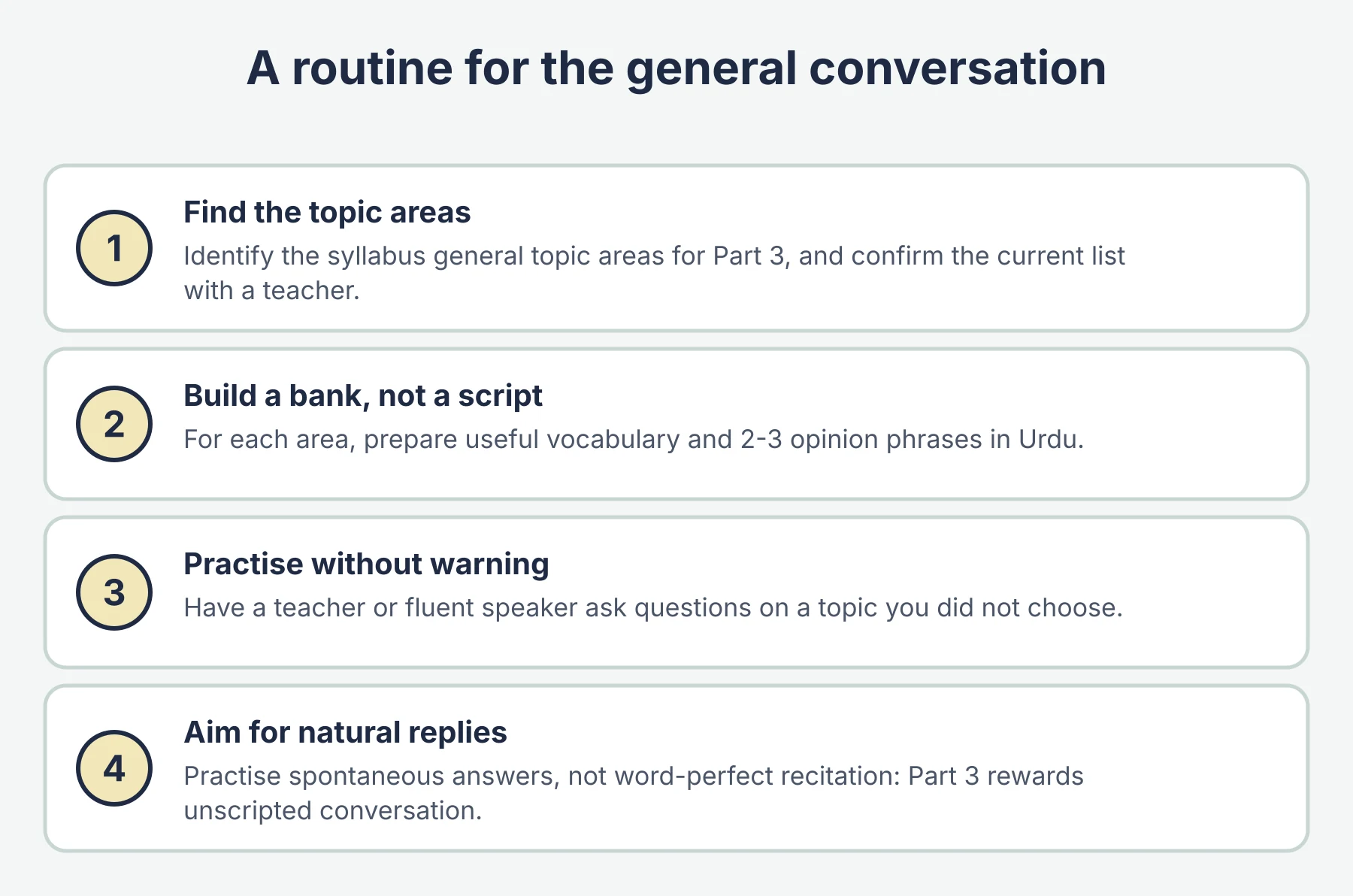
- List the general topic areas for Part 3 (confirm the exact list with your teacher, because it can change between syllabus versions).
- For each, build a small bank of vocabulary and two or three opinion phrases, not full scripts.
- Practise being asked questions without warning, aloud, with a teacher or fluent speaker.
- Practise “why” and “what do you think” questions about your Part 1 topic.
Exam traps
- A Part 1 presentation so scripted that you freeze at the examiner’s first follow-up question.
- A topic too broad or too narrow to fill the time.
- Trying to memorise Part 3.
- Answering in one short sentence instead of giving a reason and an example.
- Assuming that because Speaking is separate, it needs no preparation.
How it is marked
- The whole test is marked out of 60: 20 marks for each part (Part 1 Presentation, Part 2 Discussion and Part 3 General conversation), each marked against its own Speaking assessment criteria in the syllabus.
- Your teacher/examiner conducts and marks the test at your centre; a recorded sample is sent to Cambridge for external moderation, which checks that the centre’s marking is in line with the standard.
- Speaking tests take place before the main written examination series, so your preparation has to be ready earlier than for Paper 1 and Paper 2.
Step-by-step: building the Part 1 presentation
- Choose a topic linked to Urdu-speaking society or culture that you know from the inside.
- Collect three or four illustrative materials, such as a photograph, a map or a simple chart, and decide one thing you will say about each.
- Write five short headings for your card, not sentences. The card is a prompt, not a script.
- Speak it to time (2-3 minutes) with a timer, several times, from the headings only.
- List six questions an examiner might ask about it, especially “why” and “what do you think”, and practise answering each with an opinion, a reason and an example.
- Record yourself and listen for gender agreement and verb endings, the errors that are easiest to hear.
Worked example: a prompt card and an opening
Topic: عید الفطر ہمارے گھر میں (Eid al-Fitr in our home). Card headings: تعارف، چاند رات، عید کی صبح، کھانے، میری رائے.
آج میں آپ کو بتانا چاہتا ہوں کہ ہمارے گھر میں عید الفطر کیسے منائی جاتی ہے۔ رمضان کے آخری دن ہم سب چاند دیکھنے کا انتظار کرتے ہیں۔ چاند رات کو میری بہنیں مہندی لگاتی ہیں اور بازار سے چوڑیاں خریدتی ہیں۔ عید کی صبح ہم نئے کپڑے پہن کر نماز کے لیے جاتے ہیں۔ اس کے بعد امی شیر خرما بناتی ہیں اور رشتہ دار ہم سے ملنے آتے ہیں۔ میرے خیال میں یہ دن اس لیے خاص ہے کیونکہ پورا خاندان ایک ساتھ ہوتا ہے۔
English gloss: “Today I want to tell you how Eid al-Fitr is celebrated in our home. On the last day of Ramadan we all wait to see the moon. On the night of the moon my sisters put on henna and buy bangles from the market. On Eid morning we put on new clothes and go to prayers. After that my mother makes sheer khurma and relatives come to see us. In my opinion this day is special because the whole family is together.”
A girl giving the same opening would say بتانا چاہتی ہوں. Notice the passive منائی جاتی ہے (agreeing with the feminine عید), the sequence word اس کے بعد and the opinion with a reason at the end.
Worked example: Part 2 follow-up questions
| Examiner asks | A developed answer | English gloss |
|---|---|---|
| آپ کو عید کا کون سا حصہ سب سے زیادہ پسند ہے، اور کیوں؟ | مجھے عید کی صبح سب سے زیادہ پسند ہے کیونکہ سب لوگ خوش ہوتے ہیں۔ مثال کے طور پر، پچھلی عید پر میرے کزن کینیڈا سے آئے تھے اور ہم سب نے مل کر ناشتہ کیا۔ | I like Eid morning most because everyone is happy. For example, last Eid my cousins came from Canada and we all had breakfast together. |
| کیا آپ کے خیال میں نوجوان یہ روایات جاری رکھیں گے؟ | میرا خیال ہے کہ کچھ روایات بدل جائیں گی، مثلاً لوگ اب کارڈ کے بجائے فون پر عید مبارک کہتے ہیں، لیکن خاندان کے ساتھ وقت گزارنا ہمیشہ اہم رہے گا۔ | I think some traditions will change; for instance people now say Eid Mubarak by phone instead of with cards, but spending time with family will always matter. |
Each answer gives an opinion, a reason and a concrete example, and the second one weighs two sides with لیکن.
Part 3: from a bare answer to a full one
Question: آپ فارغ وقت میں کیا کرتے ہیں؟ (What do you do in your free time?)
- Bare: کرکٹ۔ (Cricket.)
- Developed: فارغ وقت میں میں زیادہ تر کرکٹ کھیلتا ہوں، کیونکہ اس سے صحت اچھی رہتی ہے۔ پچھلے ہفتے ہماری ٹیم نے ایک میچ جیتا۔ اگر وقت ملے تو میں تیراکی بھی سیکھنا چاہتا ہوں۔ (“In my free time I mostly play cricket, because it keeps me healthy. Last week our team won a match. If I get time, I also want to learn swimming.”)
The developed answer uses three time frames (present habit, past, future wish) without being scripted: it is a pattern you can apply to any topic the examiner chooses.
More phrases for unscripted answers
| Urdu | English |
|---|---|
| یہ ایک اچھا سوال ہے۔ | That’s a good question. |
| میں نے اس کے بارے میں پہلے کبھی نہیں سوچا، لیکن … | I’ve never thought about that before, but … |
| ایک طرف …، دوسری طرف … | on the one hand …, on the other … |
| میرے تجربے میں | in my experience |
| اس کی ایک وجہ یہ ہے کہ | one reason for this is that |
| میں سمجھی نہیں | I did not understand (female speaker) |
| کیا آپ ذرا آہستہ بول سکتے ہیں؟ | Could you speak a little more slowly? |
More exam traps
- Reading sentences from the prompt card: it should hold headings only.
- Using تم with the examiner instead of آپ.
- Mixing male and female forms of your own verbs (چاہتا / چاہتی، سمجھا / سمجھی).
- Bringing illustrative materials and never referring to them.
- Stopping after one sentence in Part 3 when a reason and an example would extend the answer naturally.
Self-test
- How many marks is Component 5 worth, and how are they split between the three parts?
- Does Component 5 count towards the IGCSE grade?
- How long is Part 1, and how long is Part 2?
- Why can Part 3 not be memorised?
- Say “in my opinion … because …” in Urdu.
- Give one phrase you could use to ask the examiner to repeat a question.
- How is the centre’s marking checked?
- What should be written on the Part 1 prompt card?
- How does a girl say “I did not understand”?
- Turn the bare answer “کرکٹ۔” into a fuller one: name three things you could add.
- Why is it منائی جاتی ہے in “عید الفطر کیسے منائی جاتی ہے”?
- When do speaking tests usually take place?
Answers: 1. 60 marks; 20 for each of the three parts. 2. No; it is separately endorsed with a grade from 1 (high) to 5 (low). 3. Part 1: 2-3 minutes; Part 2: 3-4 minutes. 4. The topics are unknown in advance, so it tests spontaneous speech. 5. میرے خیال میں … کیونکہ … 6. کیا آپ دوبارہ کہہ سکتے ہیں؟ 7. Externally moderated by Cambridge, using a recorded sample. 8. Headings only, not full sentences. 9. میں سمجھی نہیں. 10. For example: an opinion with کیونکہ, a past example (پچھلے ہفتے …), and a future wish or condition (اگر وقت ملے تو …). 11. Because عید is feminine, the passive verb agrees with it (منائی جاتی ہے). 12. Before the main written examination series.
More resources on this topic
Related resources
-
Study guides
Cambridge IGCSE Urdu as a Second Language (0539): Speaking Part 1 Presentation
How to choose a topic, build a cue card and deliver a two- to three-minute Urdu presentation for Part 1 of the optional 0539 Speaking test.
Urdu Language · Cambridge · IGCSE
Read guide -
Practice questions
Cambridge IGCSE Urdu as a Second Language (0539): Speaking Part 1 Presentation – Practice Questions
Original practice for 0539 Speaking Part 1: topic and cue-card checks, language upgrades, a full 20-mark presentation task and a self-marking exercise.
Urdu Language · Cambridge · IGCSE
Try questions -
Revision notes
Cambridge IGCSE Urdu as a Second Language (0539): Speaking Part 1 Presentation – Revision Notes
Recall notes for 0539 Speaking Part 1: rules for the topic, cue card and illustrative material, structure, linking phrases and the assessment criteria.
Urdu Language · Cambridge · IGCSE
Revise topic
Get free revision emails (optional)
Occasional emails with practice questions, worked explanations and links to free resources for the qualification and subjects you choose. No spam, and you can unsubscribe from any email. The free tools on this site never need an email.