
Revision Notes
Cambridge IGCSE World History (0470): Depth Study E: The Second World War in Europe and the Asia-Pacific, 1939-c.1945 – Revision Notes
Recall notes for Cambridge IGCSE History 0470 Depth Study E, the Second World War: Europe, the Asia-Pacific, civilians, resistance and Allied victory.
- Subject
- World History
- Level
- IGCSE
- Topic
- Depth Studies
- Author
- Marlbridge Academic Team
- Updated
- Reviewed by
- Azam Siddique (what this means)
Aligned to Cambridge IGCSE World History (0470), 2024-2026. Official specification .
Syllabus page (what it covers and how it is assessed): Cambridge IGCSE World History.
Syllabus points this page covers
0470
- 3.5 Depth study E: The Second World War in Europe and the Asia–Pacific, 1939–c.1945
Found an error? Report a correction.
Need help with this topic? Request a free trial class for IGCSE World History (0470).
These notes condense Depth Study E: The Second World War in Europe and the Asia-Pacific, 1939-c.1945 in Cambridge
IGCSE History 0470. Its four key questions ask how the war in Europe developed, how the war in the Asia-Pacific
developed, what the impact of war was on civilians, and how the Allies achieved victory. For explanation and a worked
(c) plan, read the Depth Study E study guide;
to apply the facts, try the Depth Study E practice questions.
Key question 1: How did the war in Europe develop?
German control by 1940
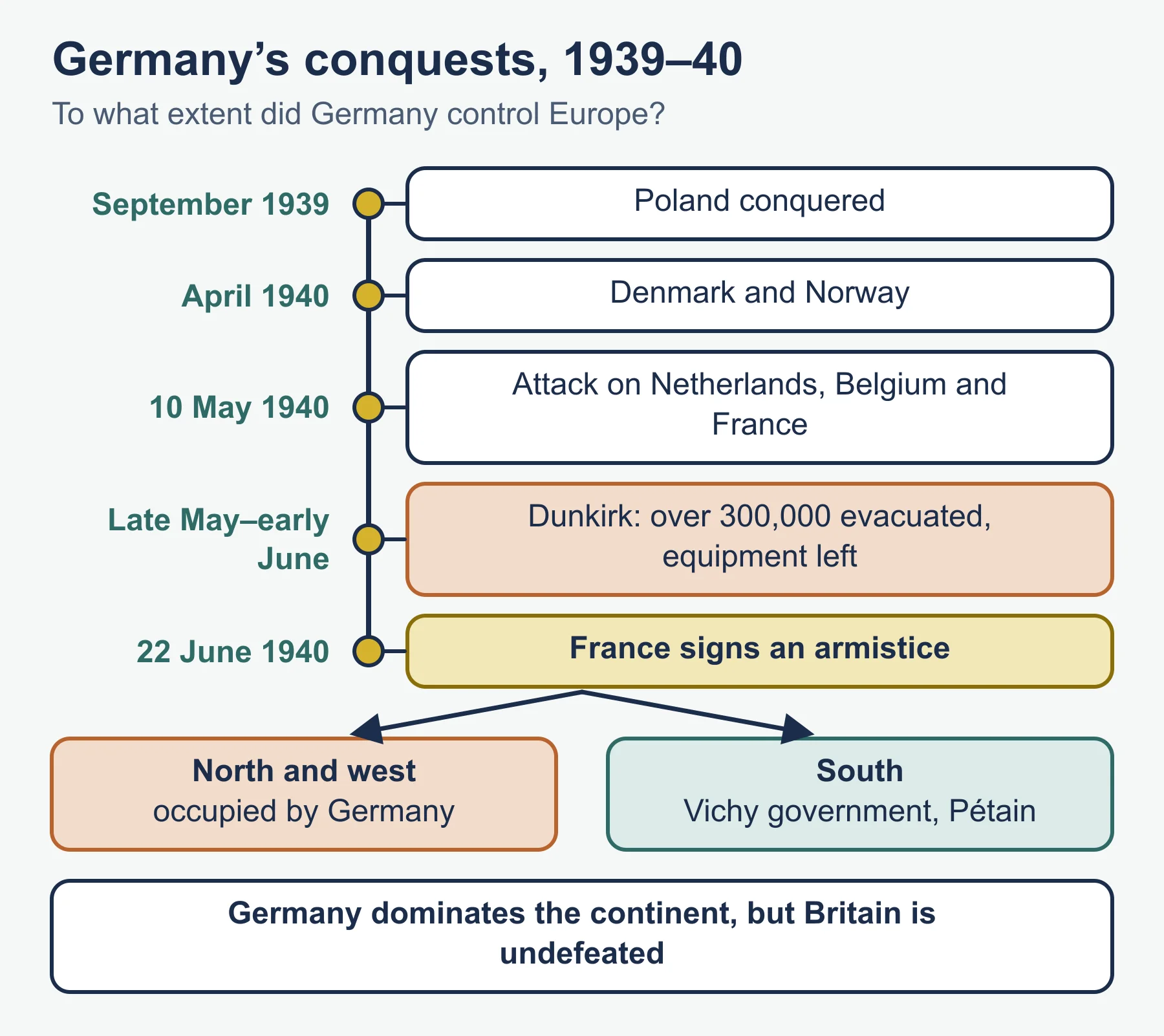
- Blitzkrieg – tanks, aircraft and motorised infantry working together – defeated Poland (September 1939).
- Denmark and Norway were invaded in April 1940; the Netherlands, Belgium and Luxembourg in May.
- The main German attack went through the Ardennes, cutting off Allied armies in Belgium.
- Dunkirk (late May-early June 1940): Operation Dynamo evacuated over 300,000 British and French troops, but their equipment was left behind.
- France signed an armistice in June 1940: the north and west were occupied; the south was governed from Vichy by Marshal Pétain, who collaborated with Germany. De Gaulle led the Free French from London.
Why Britain was not conquered
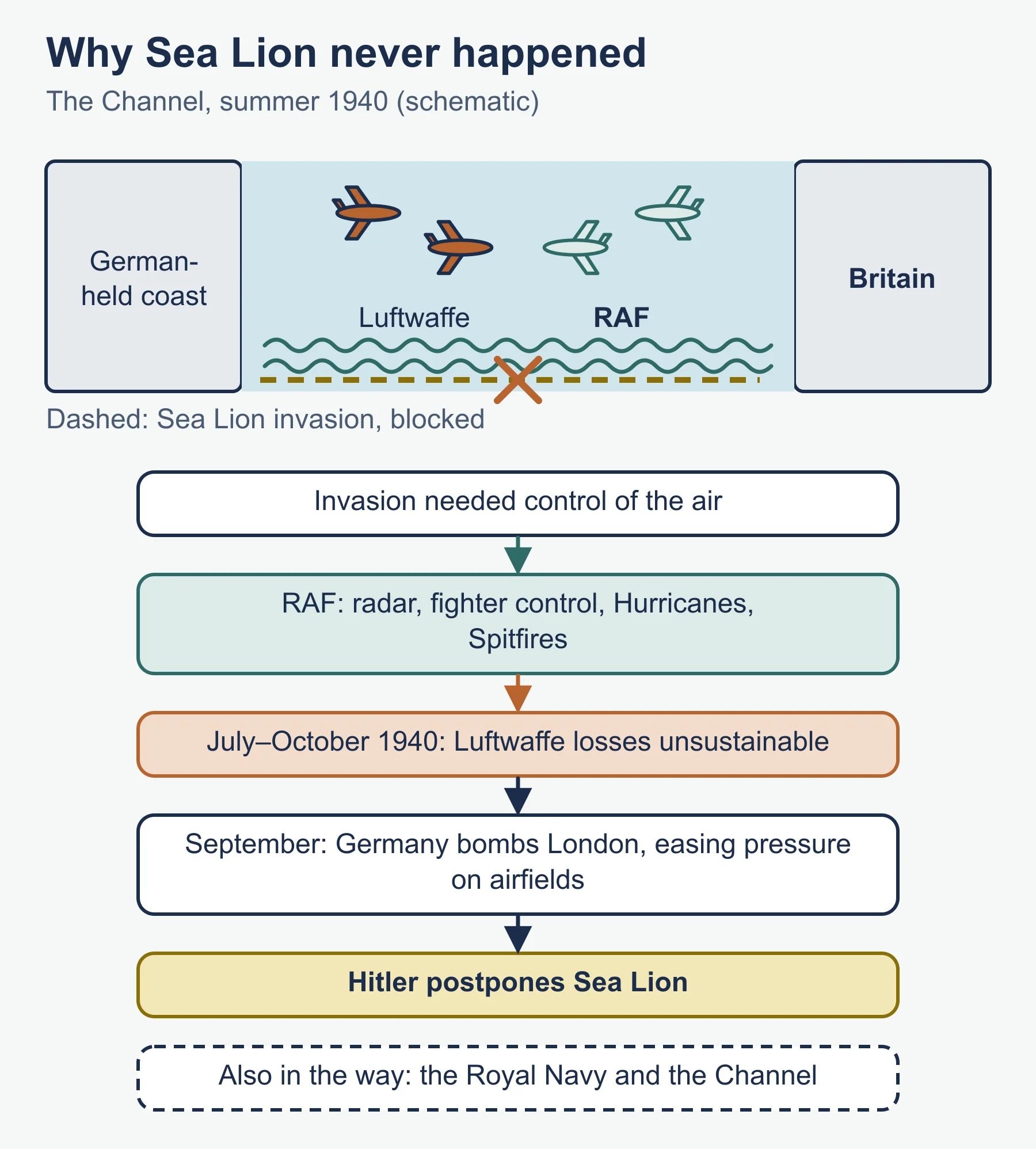
- Operation Sea Lion needed control of the air over the Channel.
- Battle of Britain (summer-autumn 1940): radar and a control system run by Dowding directed Spitfires and Hurricanes; pilots shot down over Britain could fly again, German ones were captured; the Luftwaffe switched to bombing London in September, relieving the airfields.
- The Royal Navy was far stronger than the German navy. Hitler postponed the invasion in September 1940.
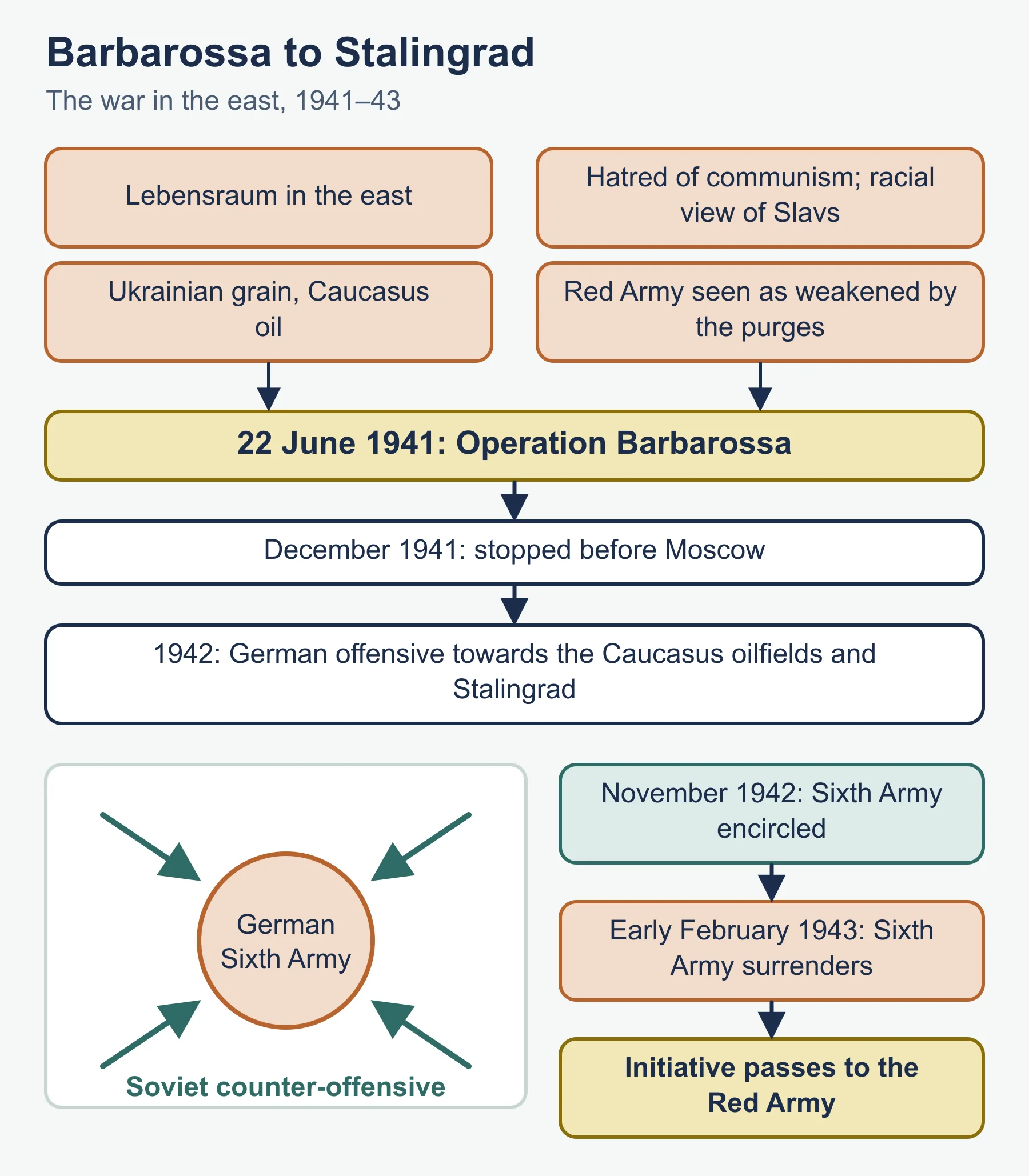
Operation Barbarossa (22 June 1941): reasons were Lebensraum, hatred of communism, the grain of Ukraine and the oil of the Caucasus, and the belief that the Red Army was weak after the Purges. Early successes took vast territory and prisoners and began the siege of Leningrad, but the advance stopped short of Moscow in December 1941 in the Russian winter.
Stalingrad (August 1942-February 1943): fighting street by street; the Soviet counter-attack, Operation Uranus (November 1942), surrounded the Sixth Army under Paulus, which surrendered in February 1943. After it, the Red Army held the initiative.
Key question 2: How did the Asia-Pacific war develop?
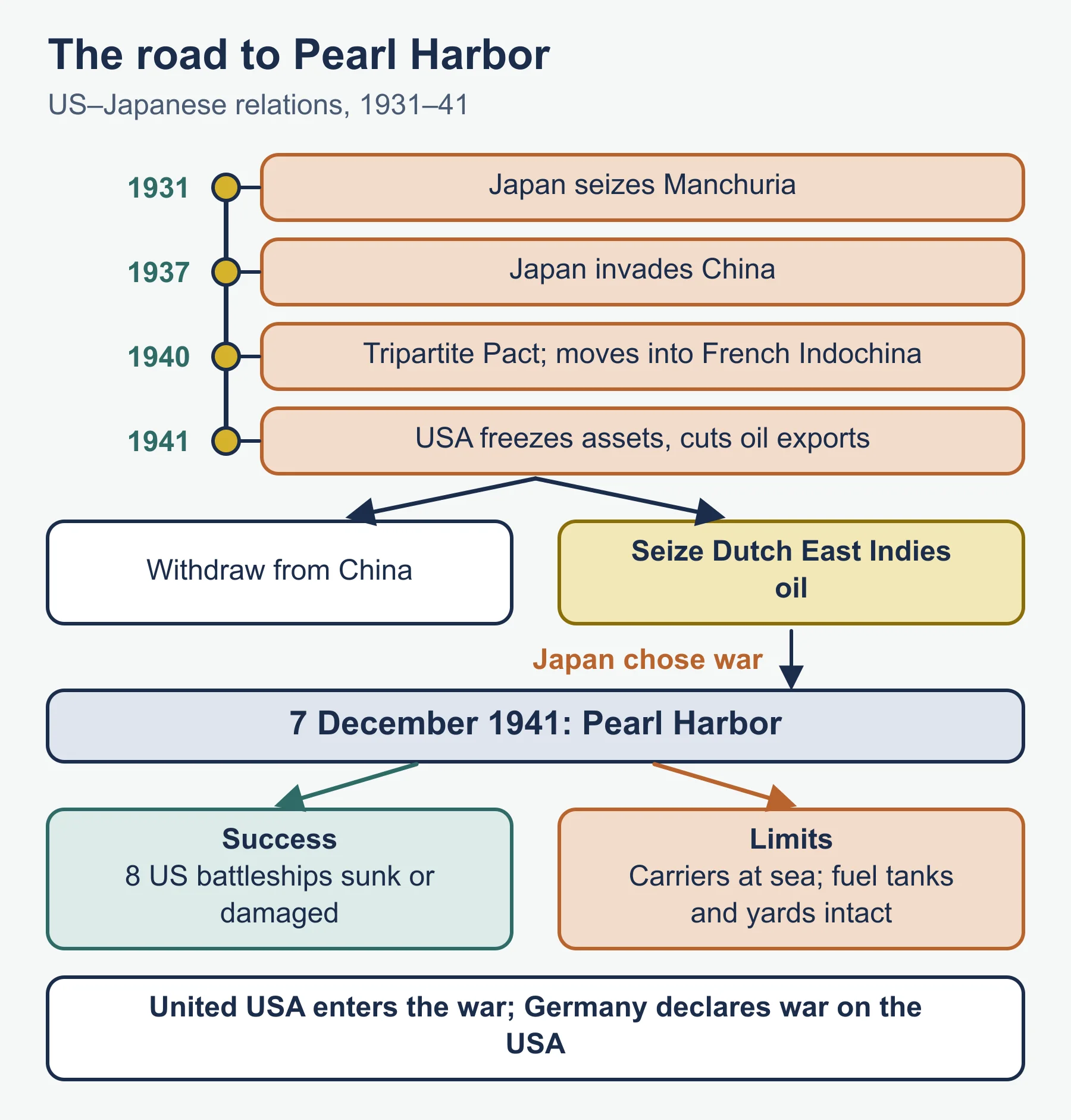
- Deteriorating relations: Japan’s war in China from 1937; Japanese troops into French Indochina (1940-41); the Tripartite Pact with Germany and Italy (September 1940); the USA froze Japanese assets and stopped oil exports (1941); talks failed and General Tojo became prime minister.
- Pearl Harbor (7 December 1941): battleships sunk or damaged and about 2,400 Americans killed; but the aircraft carriers were at sea, and fuel stores and repair yards were not destroyed. The USA entered the war, and Germany declared war on the USA days later.
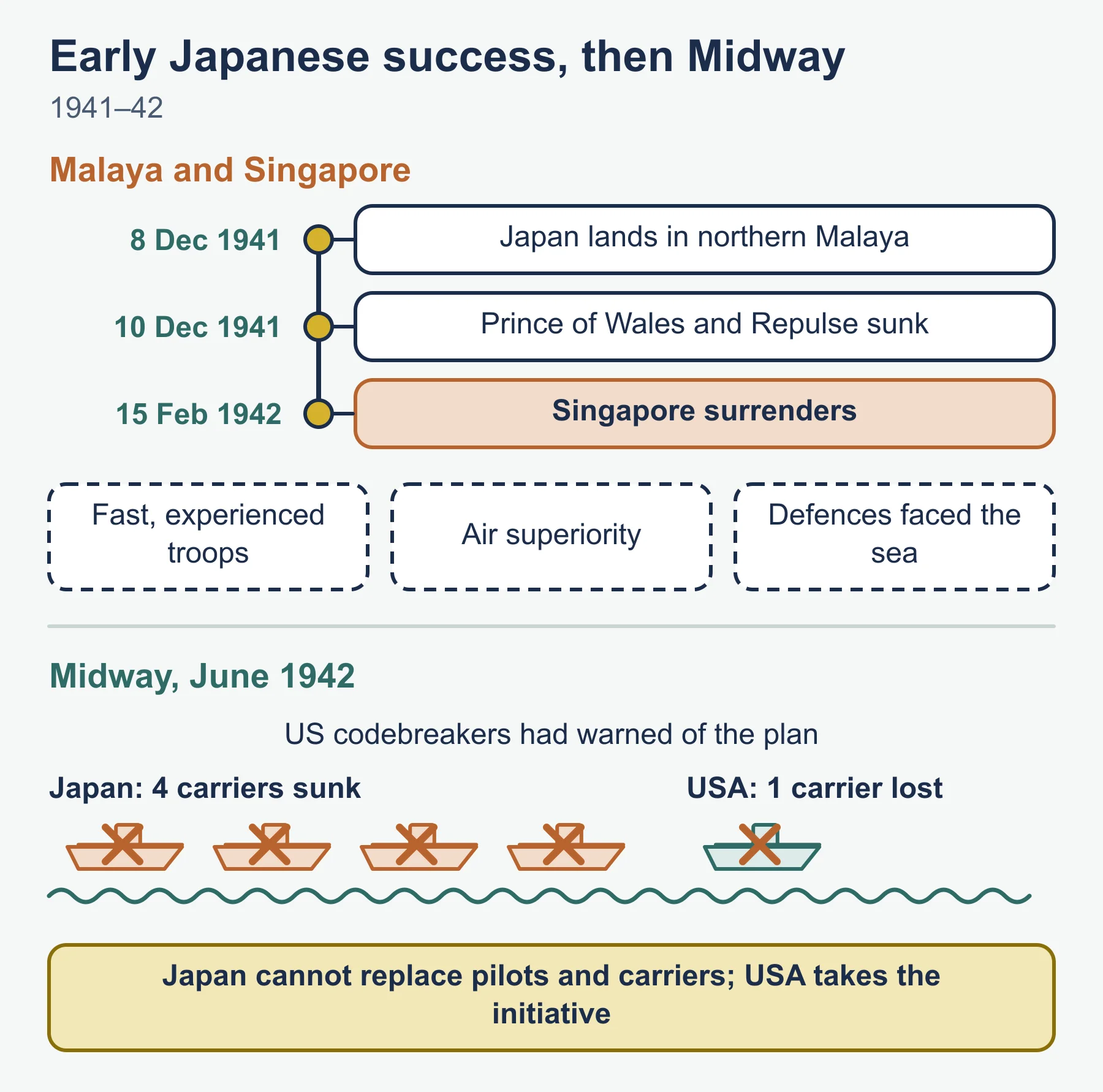
- Malaya and Singapore: landings on 8 December 1941; the battleships Prince of Wales and Repulse sunk from the air; General Yamashita’s troops moved fast through the jungle and plantations, many on bicycles, and outflanked defensive lines; Singapore surrendered on 15 February 1942, with the largest number of British and Commonwealth troops ever to surrender.
- Midway (June 1942): American code-breakers learned the plan; Admiral Nimitz ambushed the Japanese fleet; Japan lost four aircraft carriers and many experienced pilots and could not replace them as fast as the USA.
Key question 3: What was the impact of war on civilians?
| Area | Impact |
|---|---|
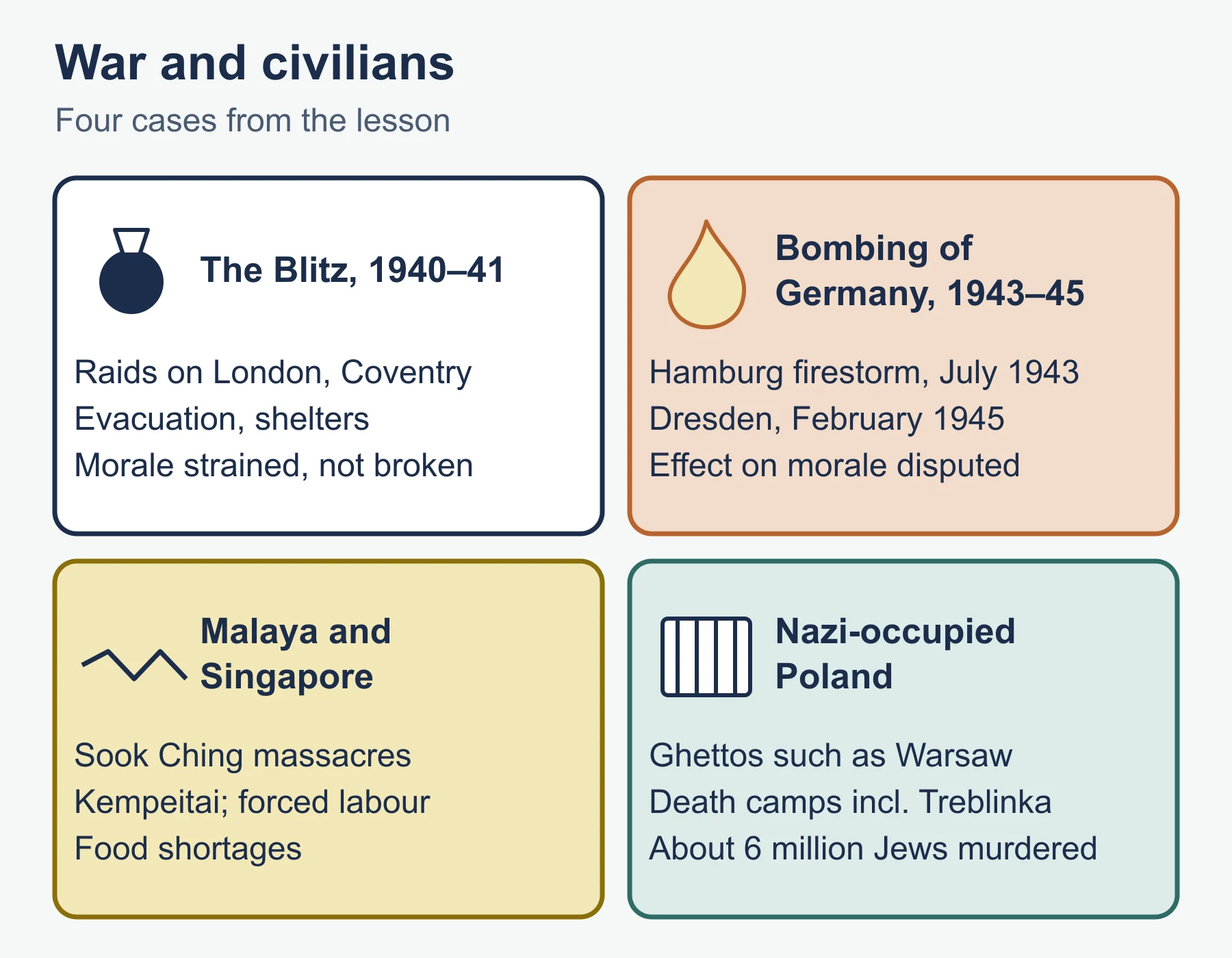
| Britain (Blitz, 1940-41) | Night raids on London and cities such as Coventry; shelters in Underground stations and gardens; evacuation of children; blackout; morale largely held |
| Germany (1943-45) | RAF night area bombing and American daylight raids; the Hamburg firestorm (1943) and Dresden (1945); huge civilian deaths and homelessness; production fell only late in the war |
| Malaya and Singapore | The Sook Ching massacres of Chinese men; the Kempeitai military police; food shortages; forced labour, including on the Burma-Thailand railway; worthless occupation currency |
| Poland | Divided with the USSR in 1939; Polish leaders, priests and teachers killed; Jews forced into ghettos such as Warsaw and Łódź; death camps such as Auschwitz-Birkenau and Treblinka; the Warsaw Ghetto rising (1943) and the Warsaw Uprising (1944) |
Circumstances leading to the Holocaust: Nazi racial ideology; Poland’s large Jewish population under German control; ghettos and starvation; mass shootings by the Einsatzgruppen after June 1941; the decision for systematic murder co-ordinated at the Wannsee Conference (January 1942).
Resistance:
- France: the Maquis in the countryside; intelligence for the Allies; sabotage of railways before and after D-Day; helping Allied airmen escape; Jean Moulin united groups before his death in 1943. German reprisals included the massacre at Oradour-sur-Glane (June 1944).
- Malaya: the communist-led Malayan People’s Anti-Japanese Army, mostly Chinese, fought a guerrilla war from the jungle with help from the British Force 136; its military effect was limited, but it ended the war armed and with growing prestige.
Key question 4: How did the Allies achieve victory?
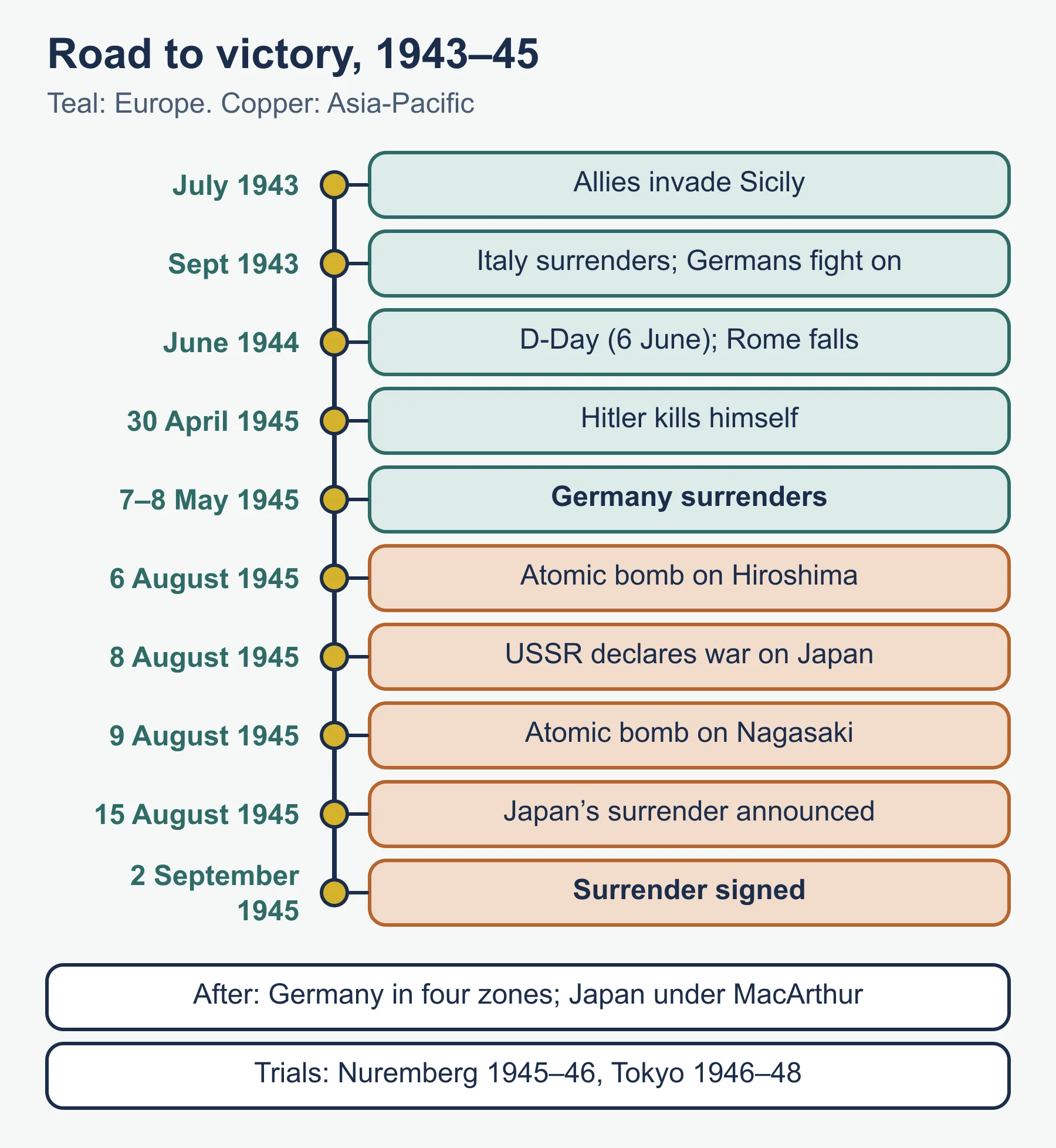
- Italy: Sicily invaded (July 1943); Mussolini overthrown; Italy surrendered (September 1943); Germany occupied the north; slow fighting at Monte Cassino; Rome taken (June 1944); German forces in Italy surrendered in May 1945. Italy tied down German divisions and gave the Allies bases for bombing.
- D-Day (6 June 1944): landings on five Normandy beaches under Eisenhower; deception made Hitler expect an attack at Calais; Mulberry harbours; Paris liberated (August 1944); the German Ardennes offensive (Battle of the Bulge, December 1944) failed; the Rhine crossed (March 1945).
- Soviet advance: the Red Army destroyed German forces in the East from 1943, reached Berlin in April 1945; Hitler killed himself on 30 April; Germany surrendered on 7-8 May 1945.
- Japan: Guadalcanal (1942-43) began the American counter-offensive; island-hopping bypassed strongholds; Iwo Jima and Okinawa (1945) were costly, with kamikaze attacks; firebombing destroyed much of Tokyo; atomic bombs on Hiroshima (6 August) and Nagasaki (9 August); the USSR declared war (8 August); Japan surrendered in August and signed on 2 September 1945.
- Consolidation: Germany divided into four zones and denazified; the Nuremberg trials of leading Nazis (1945-46); Japan occupied under General MacArthur, with a new constitution and the emperor kept as a symbol; the Tokyo trials of Japanese leaders.
Key terms
| Term | Meaning |
|---|---|
| Blitzkrieg | “Lightning war”: fast combined attacks with tanks and aircraft |
| Vichy France | Collaborating French state in the south after 1940 |
| Collaboration | Working with an occupying power |
| Island-hopping | Capturing selected islands and bypassing others |
| Kamikaze | Japanese suicide air attacks |
| Area bombing | Bombing whole urban areas rather than single targets |
| Ghetto | Sealed district where Jews were forced to live |
| Einsatzgruppen | SS mobile killing units in the East |
| Maquis | French rural resistance fighters |
| Denazification | Removing Nazi influence from German public life |
Exam traps
- Dunkirk was a retreat, though a successful evacuation; do not call it a victory.
- Pearl Harbor’s success was partial. The carriers survived.
- Singapore’s defences were not useless; the problem was the speed of the attack from the north and weak air cover.
- Civilians question covers both Europe and the Asia-Pacific. Balance your examples.
- Victory over Japan had several causes; the atomic bombs were not the only one.
Self-test
- What was Blitzkrieg? Fast attacks combining tanks, aircraft and motorised infantry.
- Why did Operation Sea Lion need the Battle of Britain to be won? Invasion barges could not cross without air superiority.
- Give two reasons for Operation Barbarossa. Lebensraum and hatred of communism; also grain and oil.
- Who commanded the German Sixth Army at Stalingrad? General Paulus.
- Why did the USA stop oil exports to Japan in 1941? Japan had moved into French Indochina.
- What did Pearl Harbor fail to destroy? The aircraft carriers, fuel stores and repair yards.
- When did Singapore surrender? 15 February 1942.
- How many Japanese carriers were sunk at Midway? Four.
- What was Sook Ching? Japanese massacres of Chinese men in Singapore and Malaya in 1942.
- Who led the Allied invasion of Normandy? General Eisenhower.
- What was island-hopping? Taking key islands while bypassing heavily defended ones.
- Where were leading Nazis tried after the war? Nuremberg.
Related resources
-
Practice questions
Depth Studies A-E (Cambridge 0470): Practice Questions
Original Paper 1 Section B questions for all five Cambridge IGCSE History 0470 depth studies, with (a), (b) and (c) parts and level-based mark schemes.
World History · Cambridge · IGCSE
Try questions -
Revision notes
IGCSE World History: Depth Studies A-E (Cambridge 0470) — Revision Notes
Recall notes on the five Cambridge IGCSE History 0470 depth studies: WWI, Germany 1918-45, Russia 1905-41, the USA 1919-41 and WWII, plus Paper 1 tips.
World History · Cambridge · IGCSE
Revise topic -
Study guides
Cambridge IGCSE World History: Depth Study A, The First World War 1914-18 (0470)
Study guide to Cambridge IGCSE History 0470 Depth Study A, the First World War 1914-18: the Western Front, the war beyond Europe and Germany's defeat in 1918.
World History · Cambridge · IGCSE
Read guide
Get free revision emails (optional)
Occasional emails with practice questions, worked explanations and links to free resources for the qualification and subjects you choose. No spam, and you can unsubscribe from any email. The free tools on this site never need an email.