
Study Guides
Cambridge O Level Sociology (2251): Research methods – How do sociologists approach the study of society?
Cambridge O Level Sociology 2251 key question 1.1 in depth: social facts, correlation and causation, objectivity, verstehen and judging research choices.
- Subject
- Sociology
- Level
- O LEVELS
- Topic
- Paper 1 – Research Methods, Identity and Inequality
- Author
- Marlbridge Academic Team
- Updated
- Reviewed by
- Naqiya Yousaf (what this means)
Aligned to Cambridge O Level Sociology (2251), 2025-2027. Official specification .
Syllabus page (what it covers and how it is assessed): Cambridge O Level Sociology.
Syllabus points this page covers
2251
- 1.1 Research methods – How do sociologists approach the study of society?
Found an error? Report a correction.
Need help with this topic? Request a free trial class for O Level Sociology (2251).
Key question 1.1 of Cambridge O Level Sociology (2251) asks How do sociologists approach the study of society? It sits at the start of the compulsory Research methods question on Paper 1, and its vocabulary is used in every other part of that question: when you criticise a source in part (a), evaluate a methodological view in part (d) or justify a research plan in part (e), you are using the ideas on this page. This guide goes beyond a simple positivism-versus-interpretivism table and explains why each approach holds the views it does, so that you can argue with the ideas rather than list them.
What the syllabus covers
| Section | Content named in the 2251 syllabus (2025–2027) |
|---|---|
| 1.1.1 The positivist approach | The scientific method; a macro view; social facts; quantitative data; causation and correlation; patterns and trends; objectivity and reliability |
| 1.1.2 The interpretivist approach | A micro view; meanings and motivations; qualitative data; in-depth; subjectivity; validity and verstehen |
| 1.1.3 Combining methods and evidence | Triangulation; longitudinal studies |
| 1.1.4 Analysing and evaluating research choices | Bias; interviewer effect; Hawthorne/observer effect; validity; reliability; representativeness; generalisability |
Positivism: why treat society like nature?
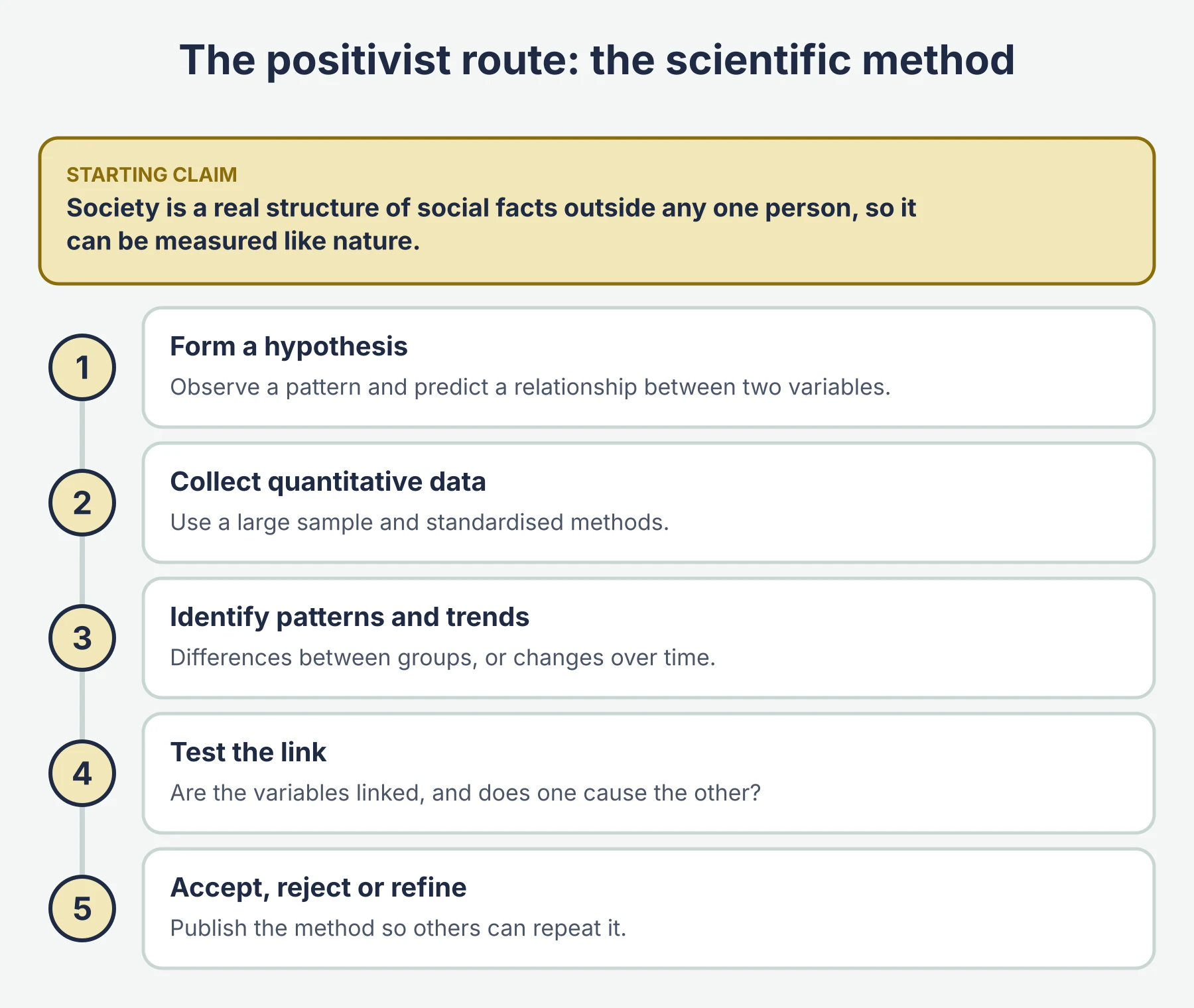
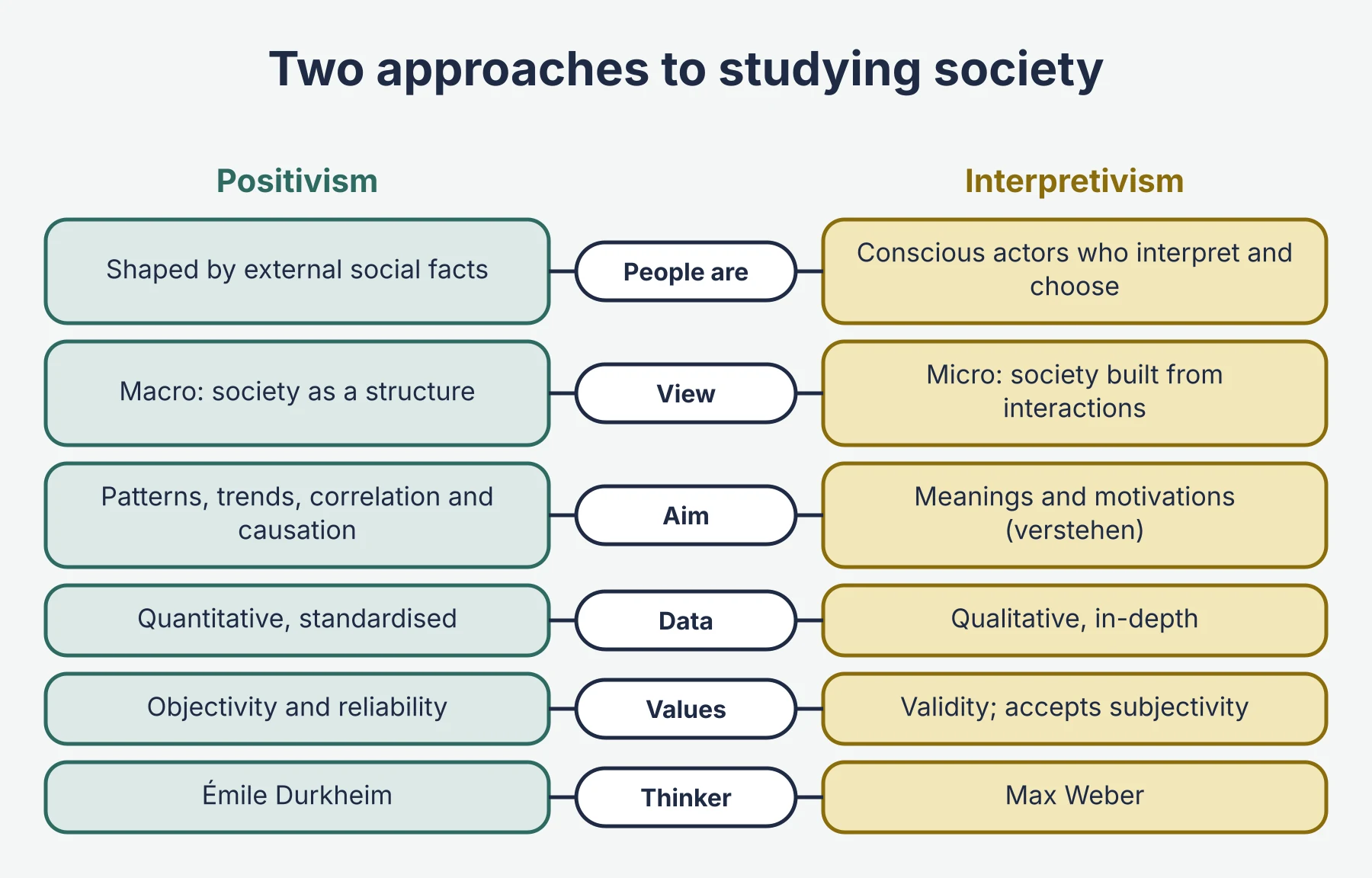
Positivists start from a claim about what society is. For them society is a real structure that exists outside any one person and pushes behaviour into regular shapes, in the way gravity shapes the movement of objects. Émile Durkheim called these external forces social facts: laws, religious rules, the economy, the shared values of a community. Because social facts are external, they can be observed and measured like any natural object, and so the scientific method can be used:
- Observe a pattern and form a hypothesis that predicts a relationship between two variables.
- Collect quantitative data from a large sample, using standardised methods.
- Identify patterns and trends, such as differences between groups or changes over time.
- Test whether the variables are linked, and whether one causes the other.
- Accept, reject or refine the hypothesis, and publish the method so others can repeat it.
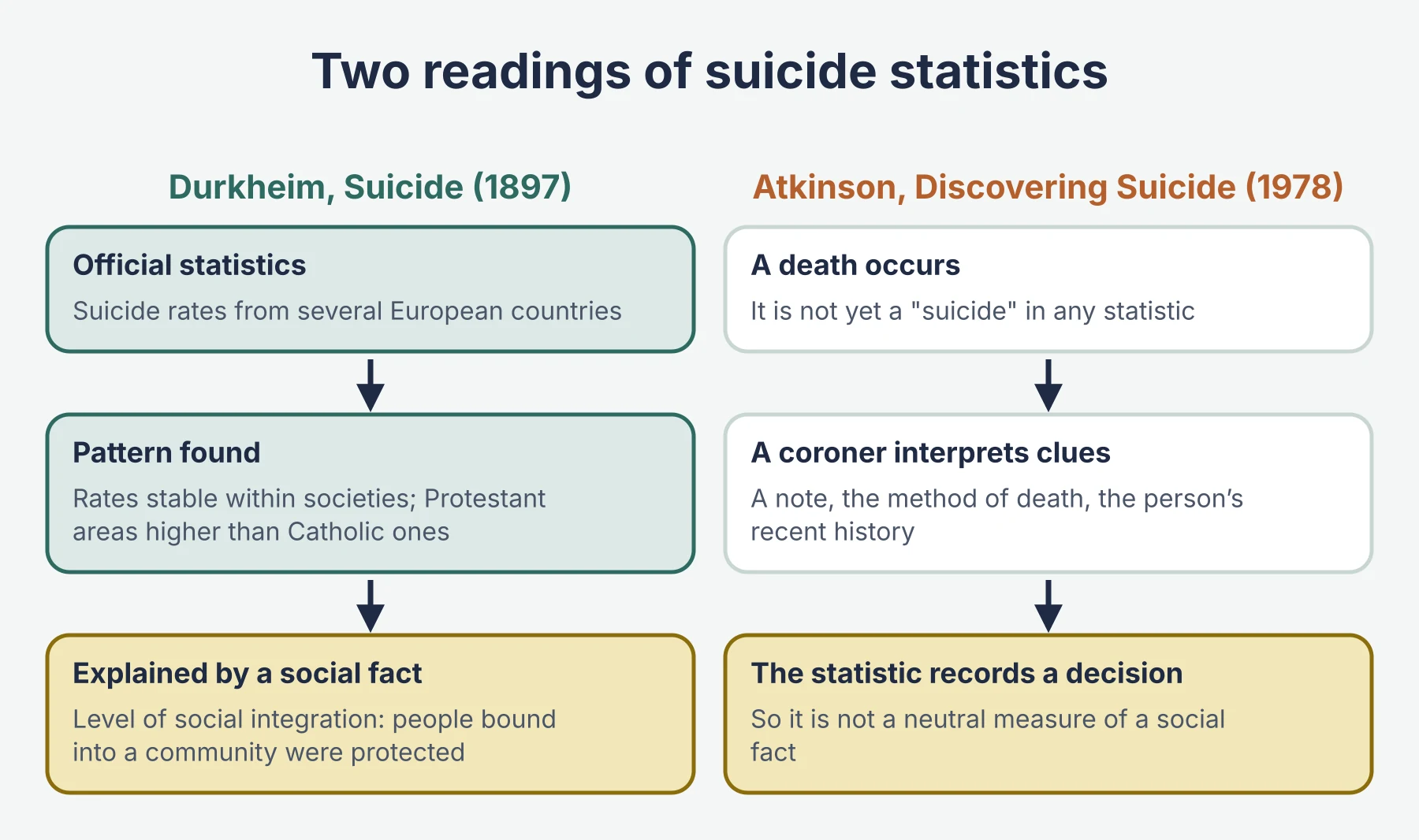
Durkheim’s Suicide (1897) is the classic illustration. Suicide looks like the most private act a person can commit, yet Durkheim used official statistics from several European countries to show that suicide rates were stable within societies and differed between them. Protestant areas, for example, had higher rates than Catholic ones. He explained the difference by the level of social integration: people bound tightly into a community were protected. The point for your exam is the logic: a social fact (integration) is used to explain a pattern in quantitative data (the rate).
Correlation is not causation
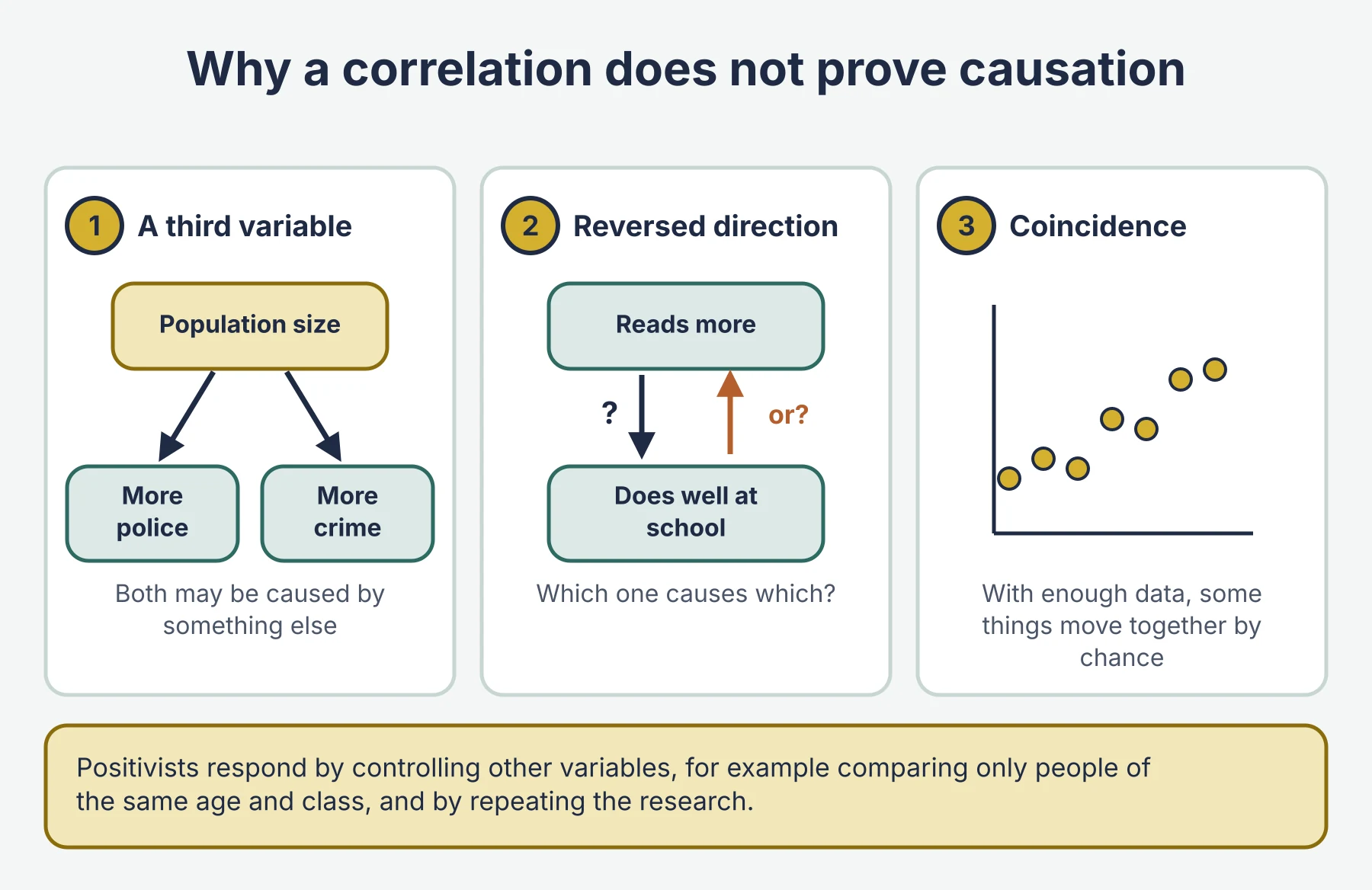
A correlation is a statistical link: two things rise or fall together. Causation means one thing actually produces the other. Positivists look for correlations as evidence of causes, but a correlation alone never proves causation, for three reasons:
- A third variable may cause both. Areas with more police officers may record more crime, but both could be caused by population size.
- The direction may be reversed. Children who read more may do better at school, or children who do well may choose to read more.
- Coincidence. With enough data, some variables will move together by chance.
Positivists answer this by controlling for other variables, for example comparing only people of the same age and class, and by repeating the research. An exam answer that names one of these three problems will score far more than one that says only “correlation does not prove causation”.
Objectivity and reliability
Objectivity means the researcher’s own values do not affect the research. Positivists try to achieve it by keeping a distance from participants and using standardised methods in which every respondent receives the same questions in the same order. Reliability means that another researcher using the same method would obtain the same results. The two ideas support each other: if a study can be repeated with the same findings, personal bias is less likely to explain them.
Interpretivism: why meanings come first
Interpretivists reject the starting claim. People are not objects that react to forces; they are conscious actors who interpret situations and choose how to act. Society is built from below, through countless small interactions, which is why interpretivists take a micro view. To explain behaviour you must understand the meanings and motivations behind it, and these cannot be read off a statistic.
Max Weber’s term verstehen describes the goal: understanding an action from the point of view of the person doing it. This requires in-depth, qualitative methods such as unstructured interviews and participant observation, in which people can describe their lives in their own words. Interpretivists accept that this involves subjectivity (the researcher’s own interpretation) and that small studies cannot easily be repeated, but they argue that the result is more valid: it gives a true picture of social life as people experience it.
The interpretivist critique of Durkheim shows the difference. J. Maxwell Atkinson’s Discovering Suicide (1978) argued that a death only becomes a “suicide” in the statistics after a coroner decides it was one, using clues such as a note, the method of death and the person’s recent history. The statistics are therefore a record of coroners’ interpretations, not a neutral measure of a social fact. To understand suicide statistics, you have to study how people construct them.
Combining approaches
Most sociologists today use whatever fits the aim, and the syllabus names two ways of combining methods and evidence.
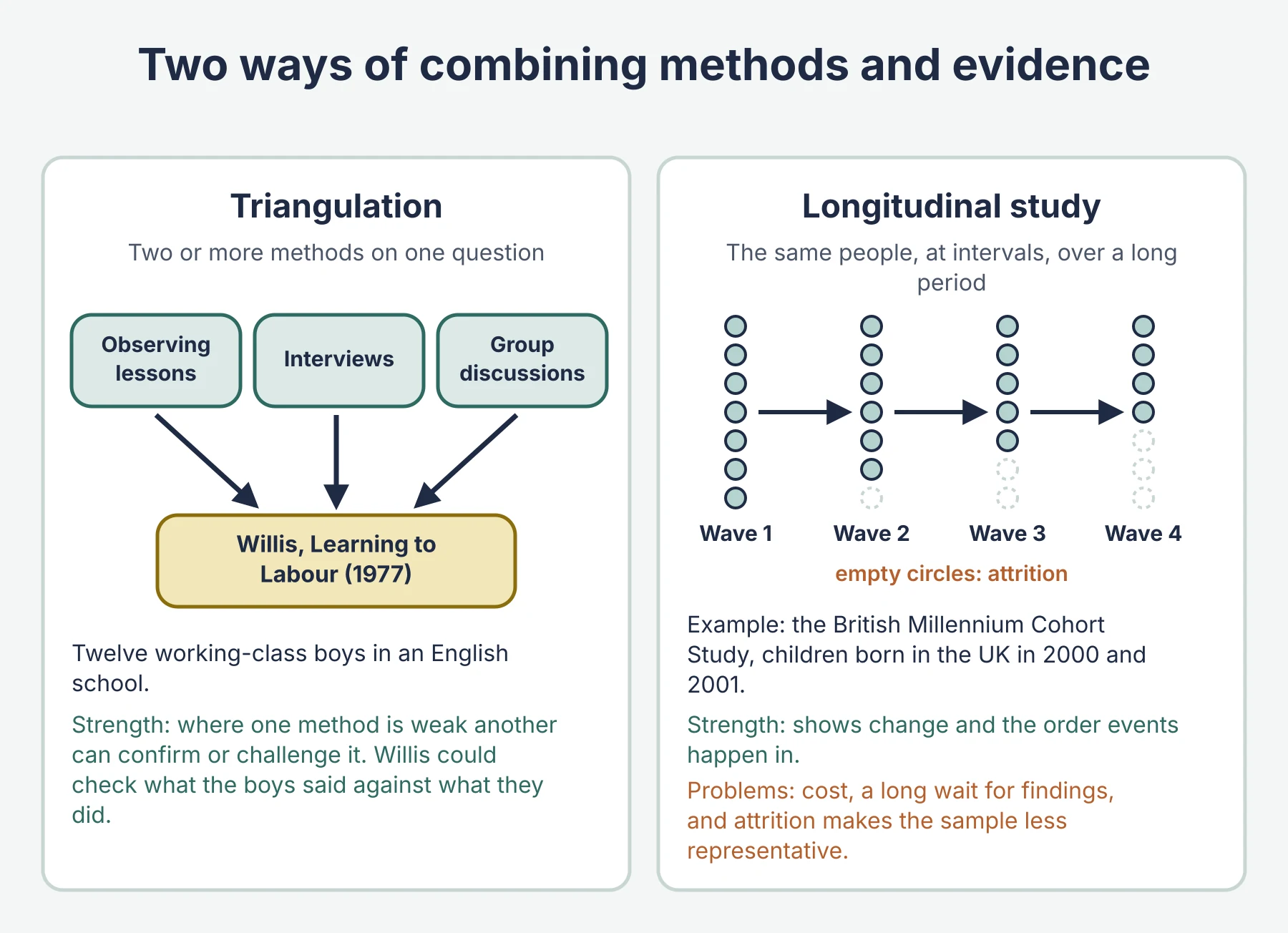
Triangulation means approaching one research question with two or more methods or sources and comparing the results, so that where one method is weak another can confirm or challenge it. Paul Willis’s Learning to Labour (1977) studied twelve working-class boys in an English school by observing them in lessons, interviewing them and holding group discussions, which let him check what the boys said against what they did.
Longitudinal studies collect data from the same people at intervals over a long period. The British Millennium Cohort Study has followed children born in the United Kingdom in 2000 and 2001. Such studies reveal change and the order in which events happen, which helps with questions of cause. Their problems are cost, the long wait for findings, and attrition: participants who drop out may differ from those who stay, so the sample becomes less representative over time.
Judging research choices: the 1.1.4 toolkit
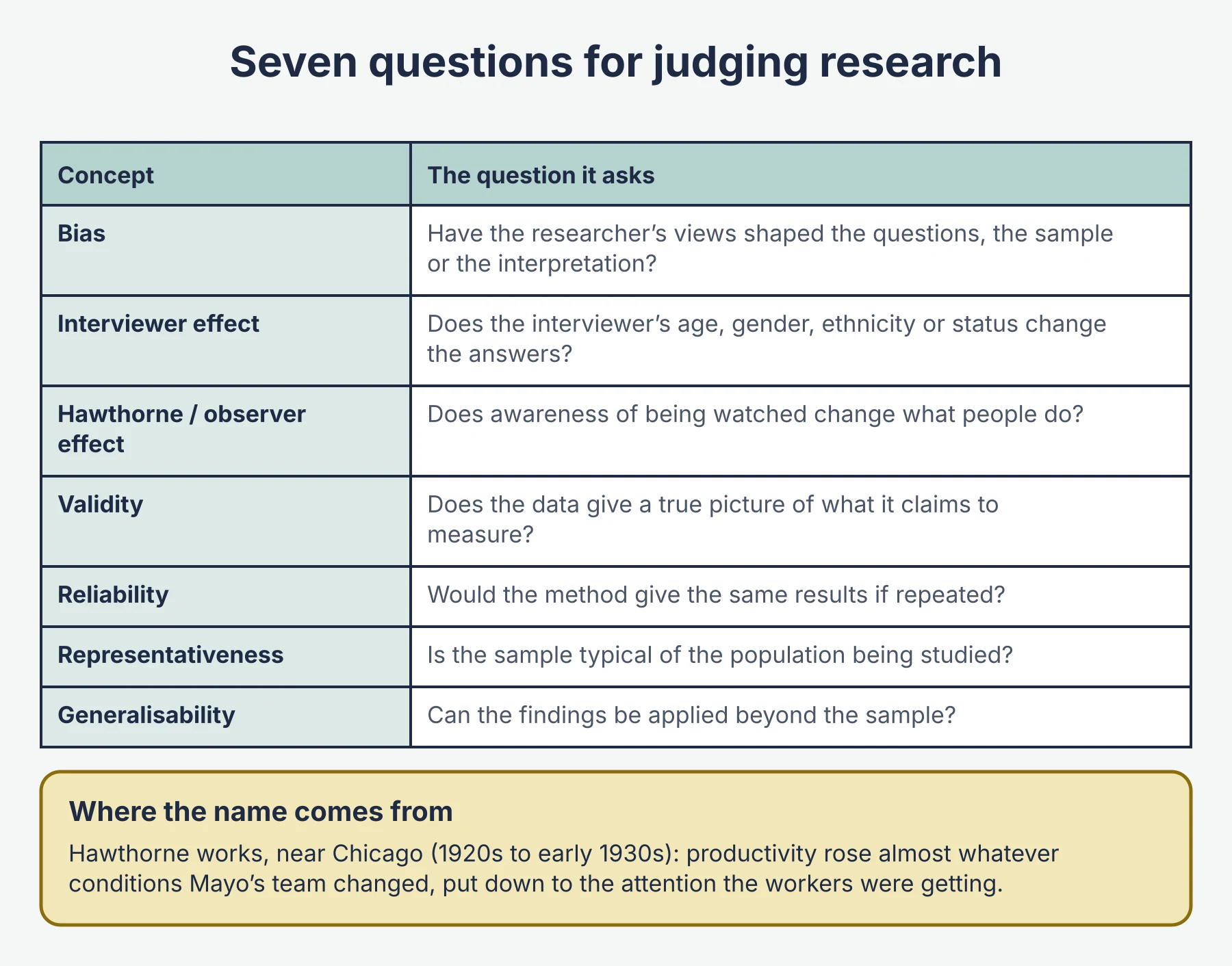
These seven concepts are your evaluation vocabulary. Each one asks a different question, so name the concept and then say exactly how it affects the research in front of you.
- Bias: have the researcher’s views shaped the questions, the sample or the interpretation?
- Interviewer effect: does something about the interviewer, such as age, gender, ethnicity or status, change the answers given?
- Hawthorne / observer effect: does awareness of being watched change what people do? The term refers to research led by Elton Mayo at the Western Electric Company’s Hawthorne works near Chicago between the 1920s and early 1930s. Productivity appeared to improve almost regardless of which working conditions the researchers altered, which was put down to the attention the workers were getting.
- Validity: does the data give a true picture of what it claims to measure?
- Reliability: would the method give the same results if repeated?
- Representativeness: is the sample typical of the population being studied?
- Generalisability: can the findings be applied beyond the sample?
Worked example: a short “explain” answer
Explain the difference between correlation and causation. (practice question)
A correlation is a statistical relationship in which two variables change together, for example pupils who are absent more often tend to gain lower grades. Causation means one variable actually produces a change in the other. Finding a correlation does not prove causation, because a third factor might cause both: here, illness or caring responsibilities at home could explain both the absence and the lower grades. Positivists therefore try to control other variables before claiming that absence causes underachievement.
Why it works: both terms are defined, a sociological example is used, and the answer explains why the distinction matters, linking it to positivist method.
Annotated plan: an evaluation answer
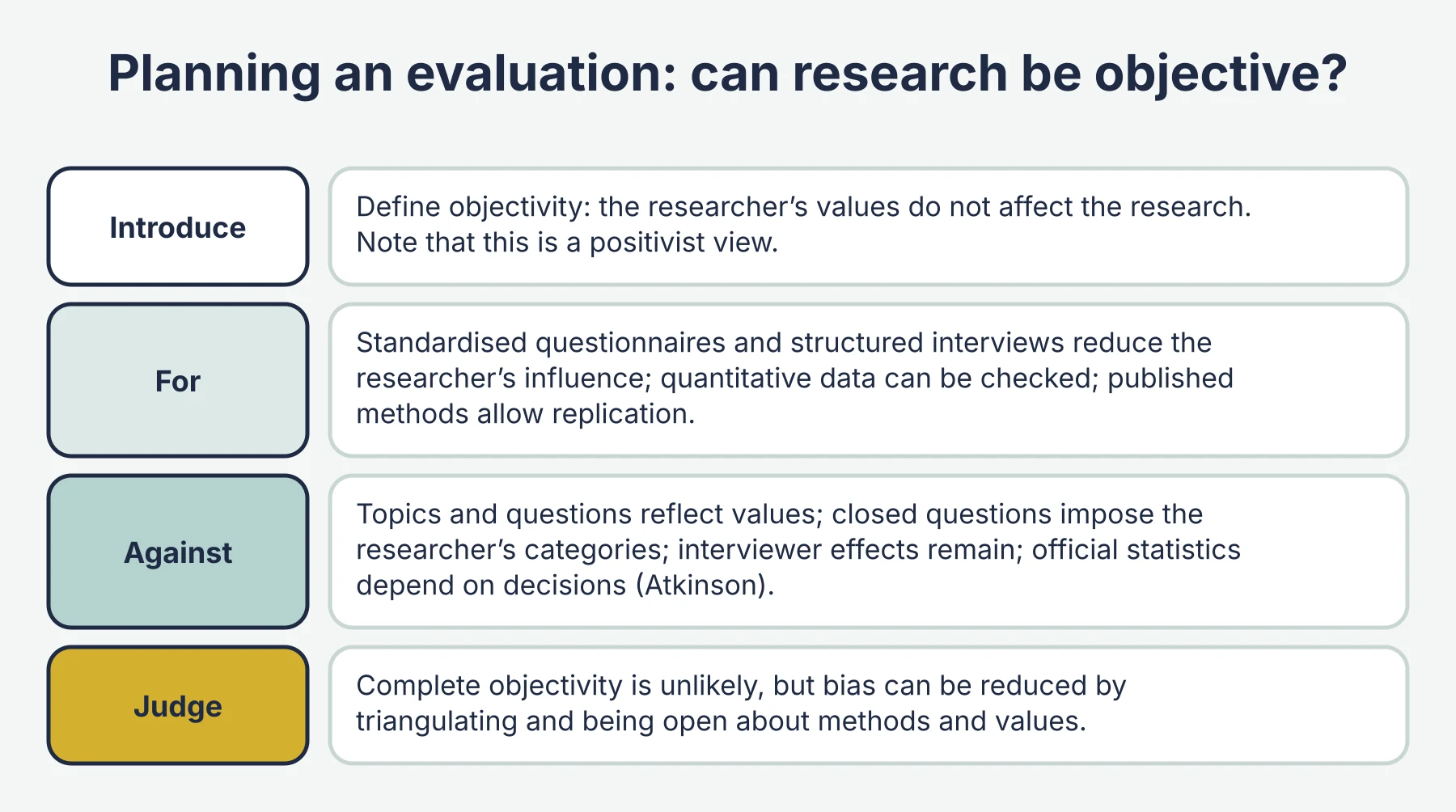
Evaluate the view that sociologists can be completely objective in their research. (practice question)
- Introduce: define objectivity and note that the view is a positivist one.
- For: standardised questionnaires and structured interviews reduce the researcher’s influence; quantitative data can be checked by others; publishing methods allows replication, so bias can be detected.
- Against: researchers choose topics and questions that reflect their own values; closed questions impose the researcher’s categories; interpretivists argue that understanding meanings requires involvement, so some subjectivity is unavoidable; interviewer effects occur even in structured interviews; even “objective” official statistics depend on people’s decisions, as Atkinson showed.
- Judge: complete objectivity is unlikely, but researchers can reduce bias by triangulating and by being open about their methods and values.
Common mistakes
- Writing “positivists use quantitative data” without explaining that this follows from their view of society as measurable social facts.
- Treating subjectivity as simply bad: interpretivists see it as the price of validity.
- Confusing reliability (repeatable) with validity (true).
- Saying a longitudinal study is “a long study”; it studies the same people repeatedly.
- Naming an evaluation concept without applying it to the research in the question.
Exam technique for 2251 command words
- Define: one precise sentence, then an example if time allows.
- Explain: make the link clear; say why or how, as in the correlation answer above.
- Describe: give the main features, for example three features of the interpretivist approach.
- Evaluate: weigh strengths against limitations and reach a judgement.
- Assess: make an informed judgement on how far a view holds.
Keep revising
For condensed recall use the O Level positivism and interpretivism revision notes, and test yourself with the O Level positivism and interpretivism practice questions. Key question 1.2 continues the topic in the guide to types of data and evidence.
Related resources
-
Study guides
Cambridge O Level Sociology (2251): Research methods – What types of data and evidence do sociologists use?
Cambridge O Level Sociology 2251 key question 1.2: judging official statistics, documents, digital and media sources, and reading tables and graphs.
Sociology · Cambridge · O Level
Read guide -
Practice questions
Cambridge O Level Sociology (2251): Research methods – What types of data and evidence do sociologists use? – Practice Questions
Original Cambridge O Level Sociology 2251 practice on key question 1.2: official statistics, documents, media content and reading tables, with full answers.
Sociology · Cambridge · O Level
Try questions -
Revision notes
Cambridge O Level Sociology (2251): Research methods – What types of data and evidence do sociologists use? – Revision Notes
Revision notes for Cambridge O Level Sociology 2251 key question 1.2: data types, secondary evidence, Scott's criteria and reading tables, with a self-test.
Sociology · Cambridge · O Level
Revise topic
Related articles
Get free revision emails (optional)
Occasional emails with practice questions, worked explanations and links to free resources for the qualification and subjects you choose. No spam, and you can unsubscribe from any email. The free tools on this site never need an email.