
Revision Notes
Pearson Edexcel International GCSE Physics (4PH1): Electric charge – Revision Notes
Recall notes on conductors, insulators, charging by friction, forces between charges and static dangers and uses, plus a self-test, for Edexcel 4PH1.
- Subject
- Physics
- Level
- IGCSE
- Topic
- Electricity
- Author
- Marlbridge Academic Team
- Updated
- Reviewed by
- Hassan (what this means)
Aligned to Pearson Edexcel IGCSE Physics (4PH1), Issue 4. Official specification .
Syllabus page (what it covers and how it is assessed): Pearson Edexcel IGCSE Physics.
Syllabus points this page covers
4PH1
- 2d Electric charge
Found an error? Report a correction.
Need help with this topic? Request a free trial class for IGCSE Physics (4PH1).
Condensed notes on sub-topic 2(d) Electric charge (statements 2.22P to 2.28P) of Pearson Edexcel International GCSE Physics (4PH1), Issue 4. All of this sub-topic is Physics-only and assessed on Paper 2P. For full explanations, use the Electric charge study guide.
Core rule
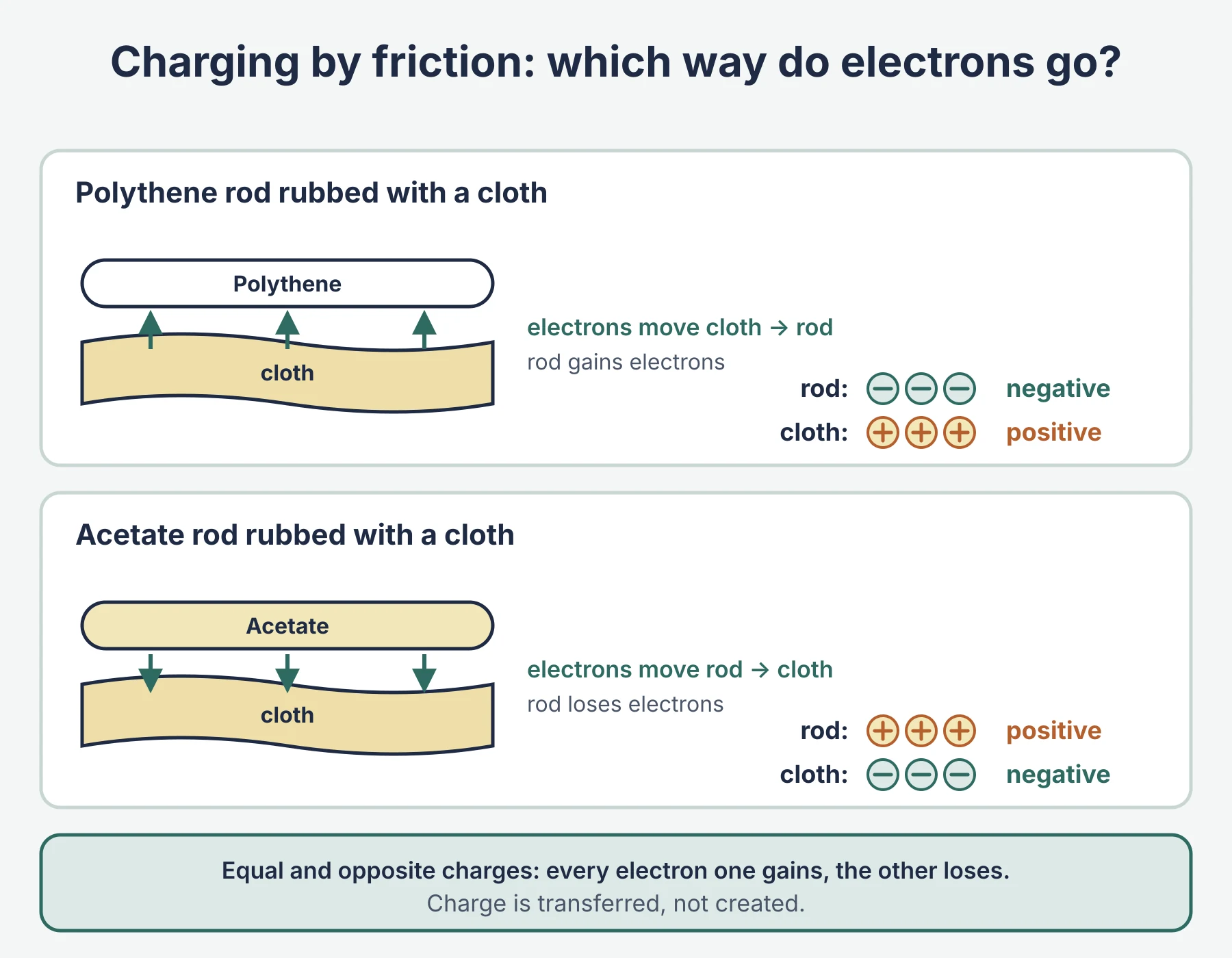
Only electrons move. Gain electrons → negative. Lose electrons → positive. Rubbing transfers charge; it does not create it. The two rubbed objects end with equal and opposite charges.
Key terms
| Term | Meaning |
|---|---|
| conductor | material through which electrons can move freely (metals, graphite) |
| insulator | material through which electrons cannot move freely (plastics, rubber, glass, wool) |
| electrostatic charge | charge held on an object, usually an insulator, that is not flowing |
| charging by friction | rubbing two insulators so electrons transfer between them |
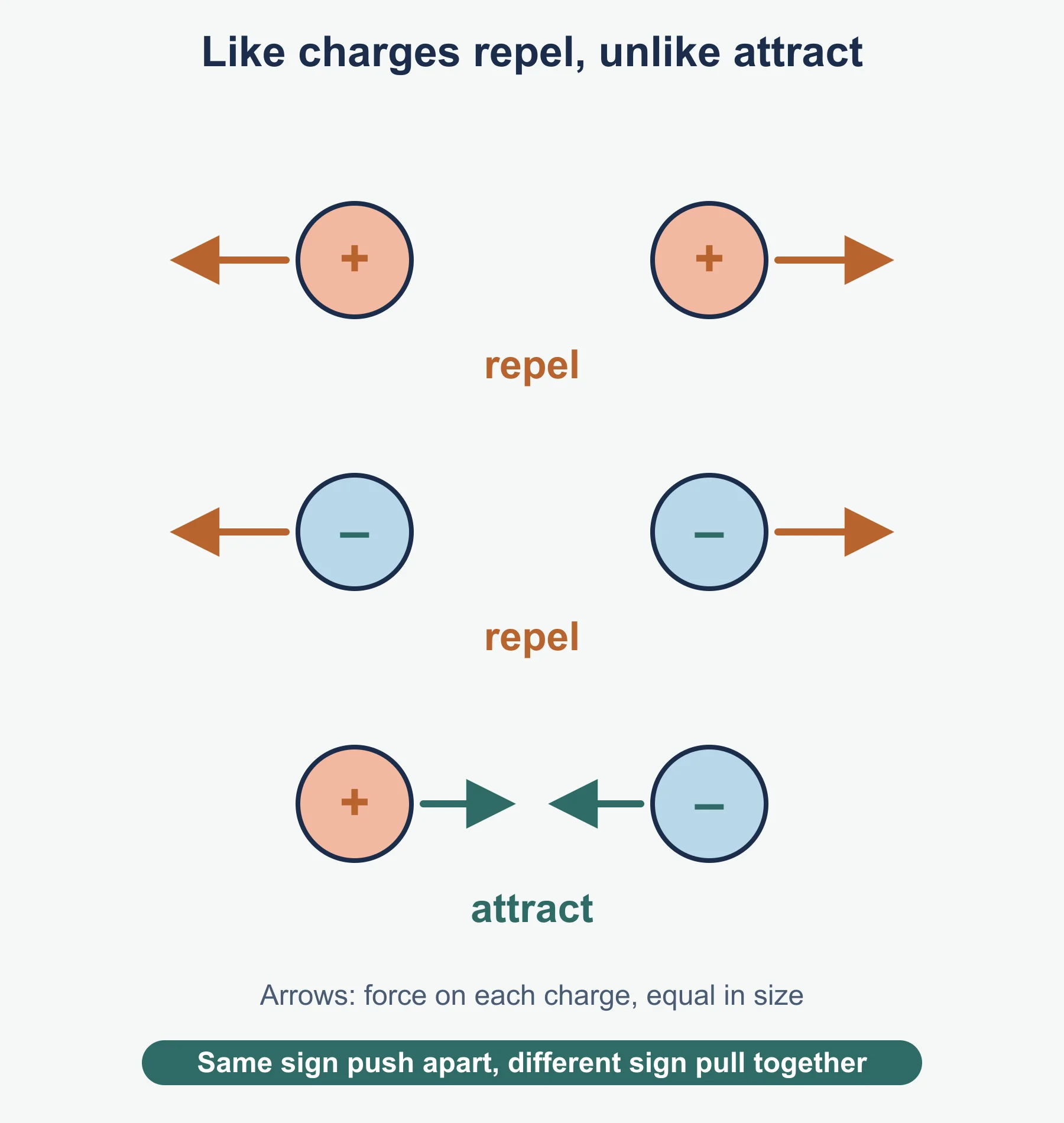
| like charges | both positive or both negative: repel |
| unlike charges | one positive, one negative: attract |
| discharge | flow of electrons that removes a build-up of charge, sometimes as a spark |
| earthing | connecting an object to the ground with a conductor so charge can flow away |
Practical 2.23P in brief
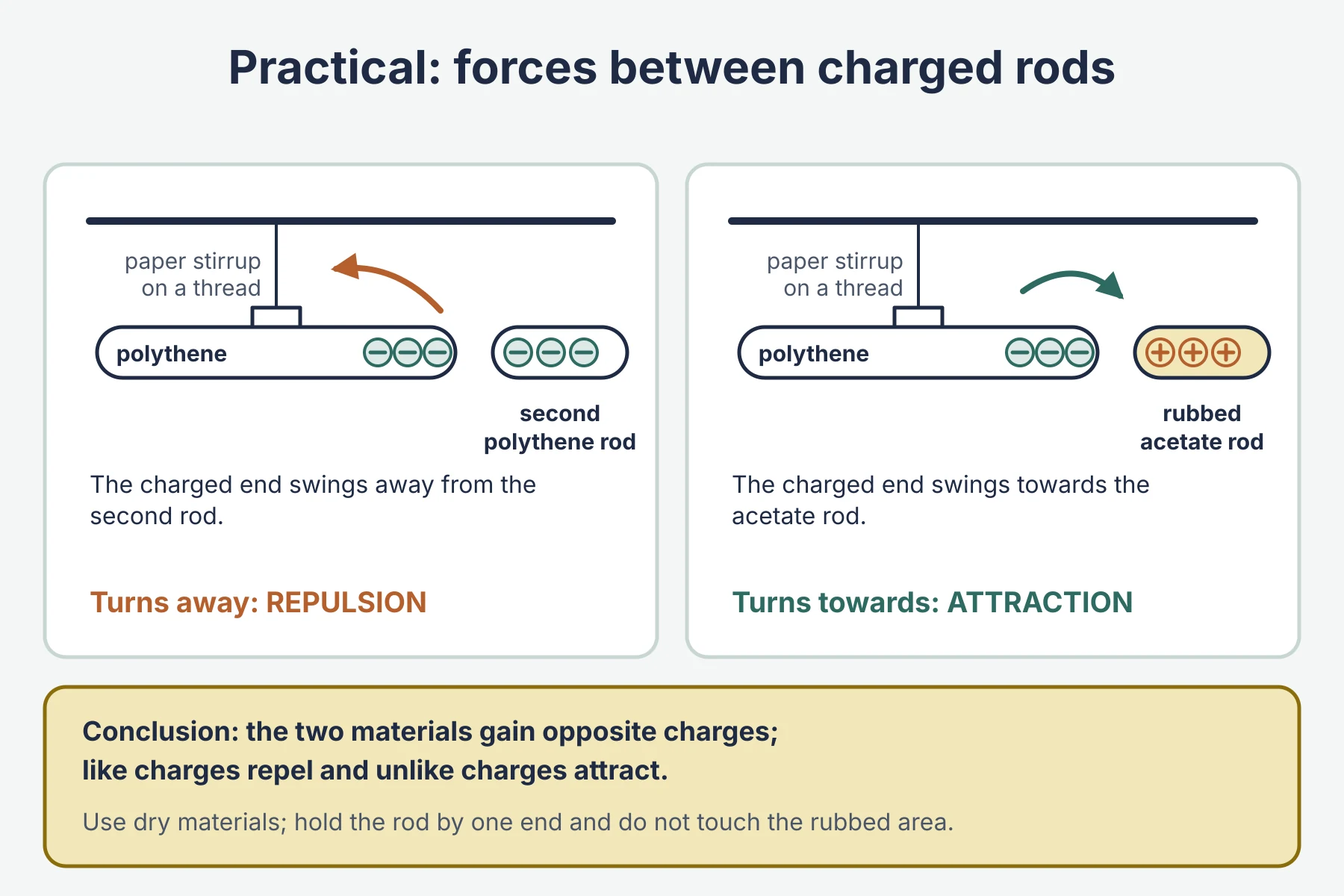
- Rub a polythene rod with a dry cloth; hang it in a paper stirrup or balance it on a watch glass so it can turn.
- Bring a second rubbed polythene rod near: repulsion (same charge).
- Bring a rubbed acetate rod near: attraction (opposite charge).
- Polythene gains electrons → negative. Acetate loses electrons → positive.
- Keep everything dry; damp air lets charge leak away.
Attraction of neutral objects
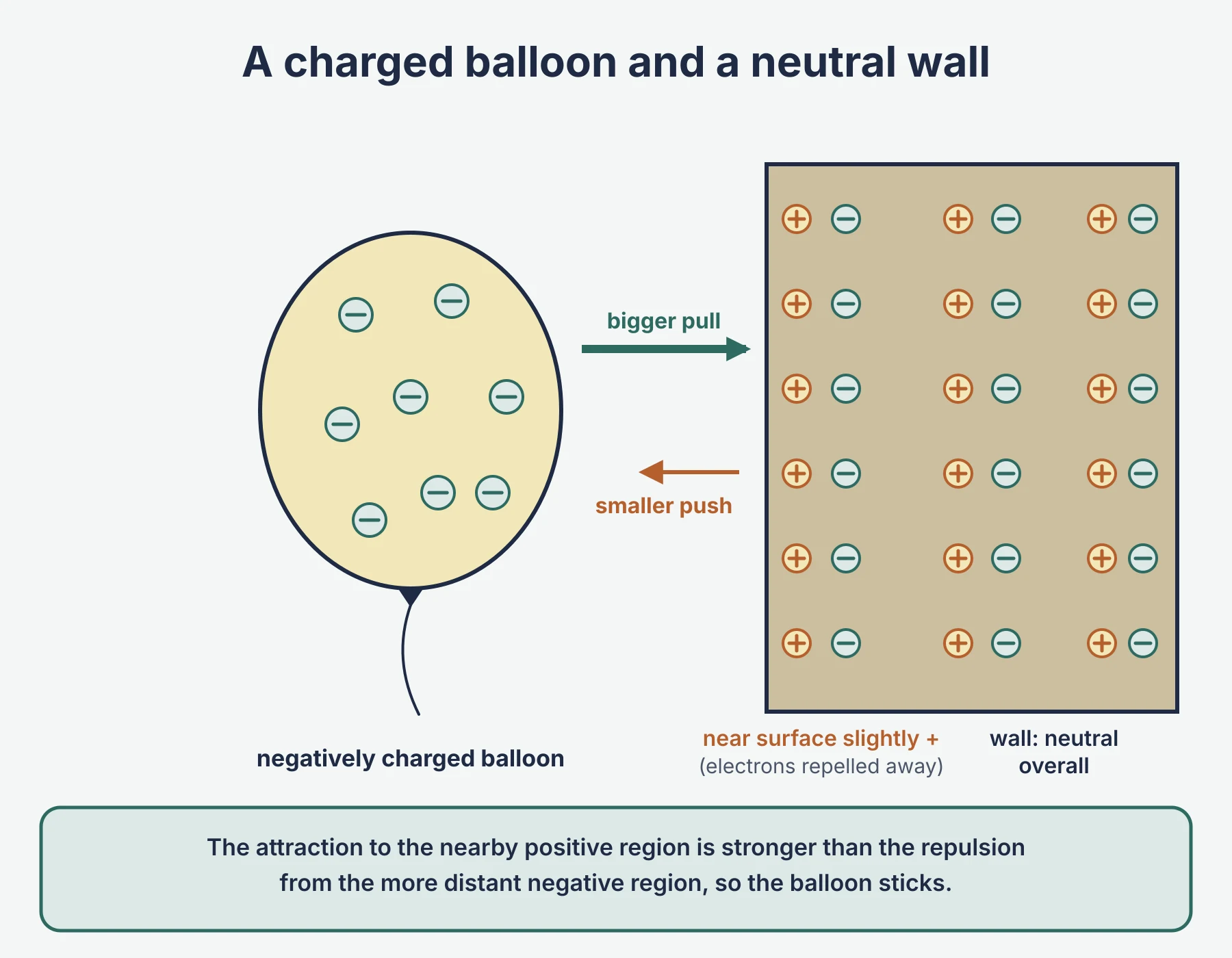
Charged object near a neutral one → electrons in the neutral object move slightly (towards a positive object, away from a negative one) → near side gets the opposite charge → attraction to the near side is stronger than repulsion from the far side → net attraction. Examples: balloon on a wall, paper scraps to a comb.
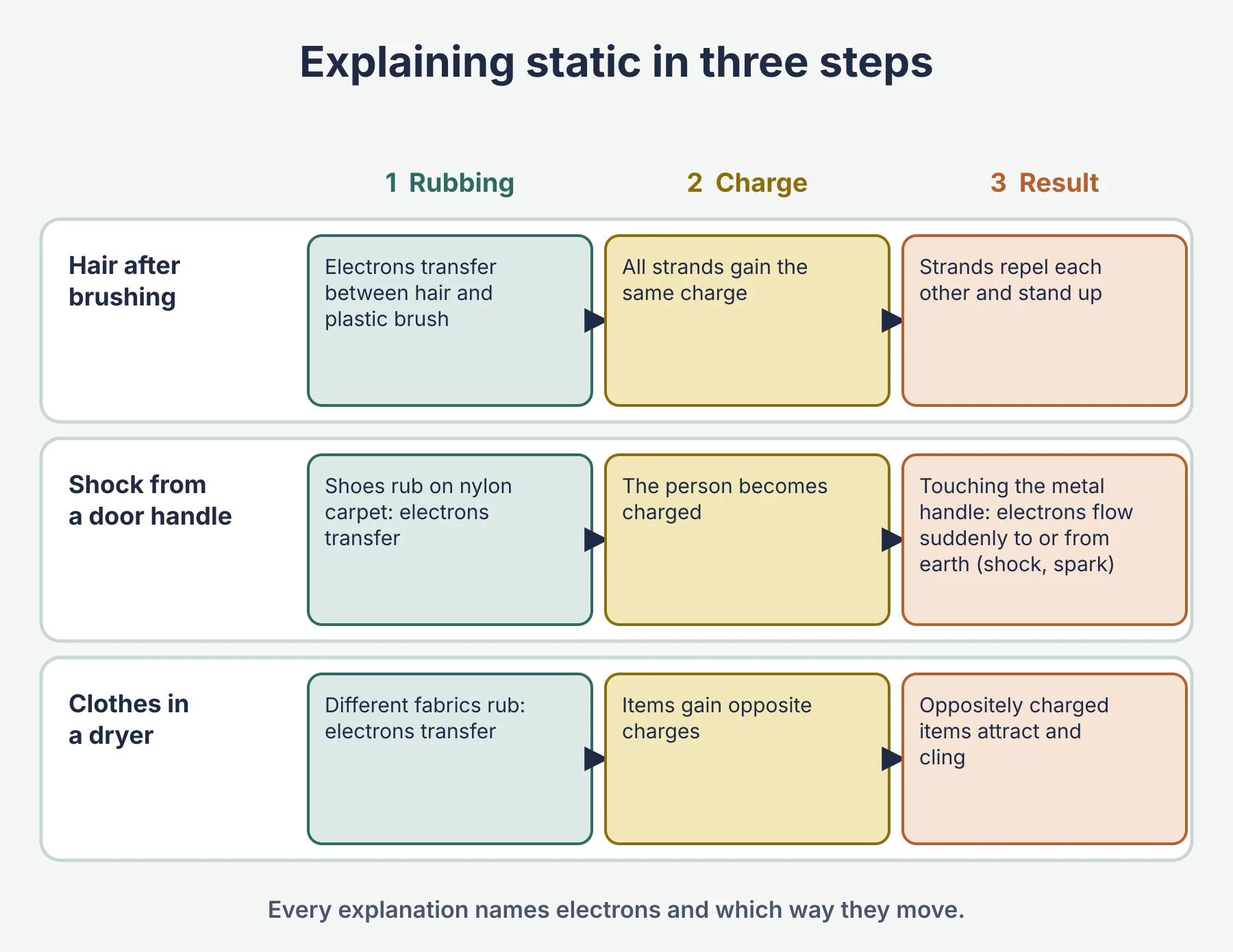
Phenomena: three-step explanations
| Phenomenon | Electrons | Result |
|---|---|---|
| hair stands up after brushing | transfer between hair and brush; strands get the same charge | strands repel |
| shock from a door handle | person charged by shoes rubbing on carpet | electrons flow through the metal handle to or from earth: shock or spark |
| clothes cling after drying | fabrics rub; electrons transfer | oppositely charged items attract |
Dangers and prevention
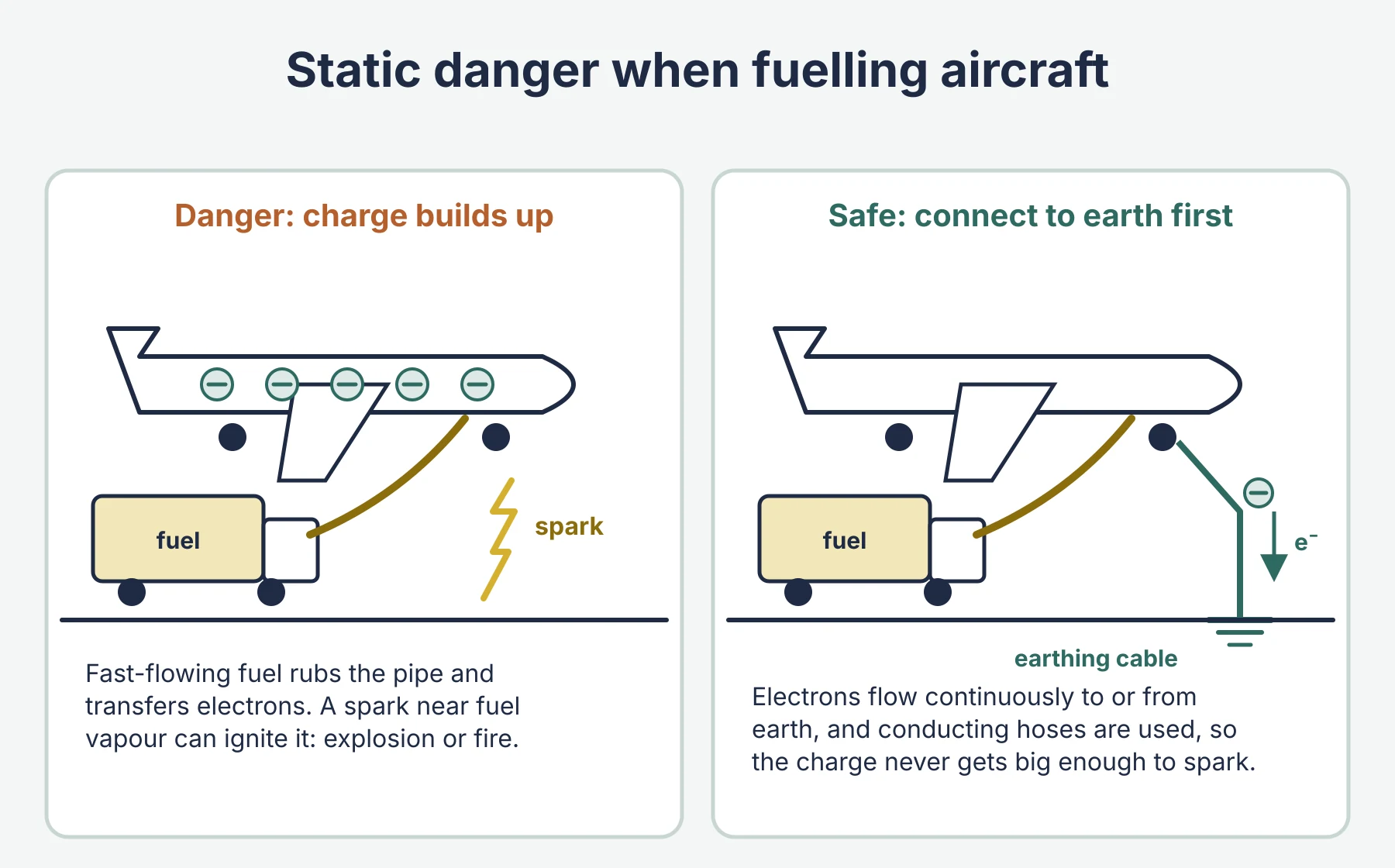
- Fuelling aircraft or tankers: fuel rubbing along the pipe transfers electrons → charge builds up → a spark can ignite fuel vapour → explosion or fire.
- Prevention: an earthing cable connects the vehicle to the ground before fuelling, and conducting hoses are used, so electrons flow steadily to or from earth and no large charge builds up.
Uses
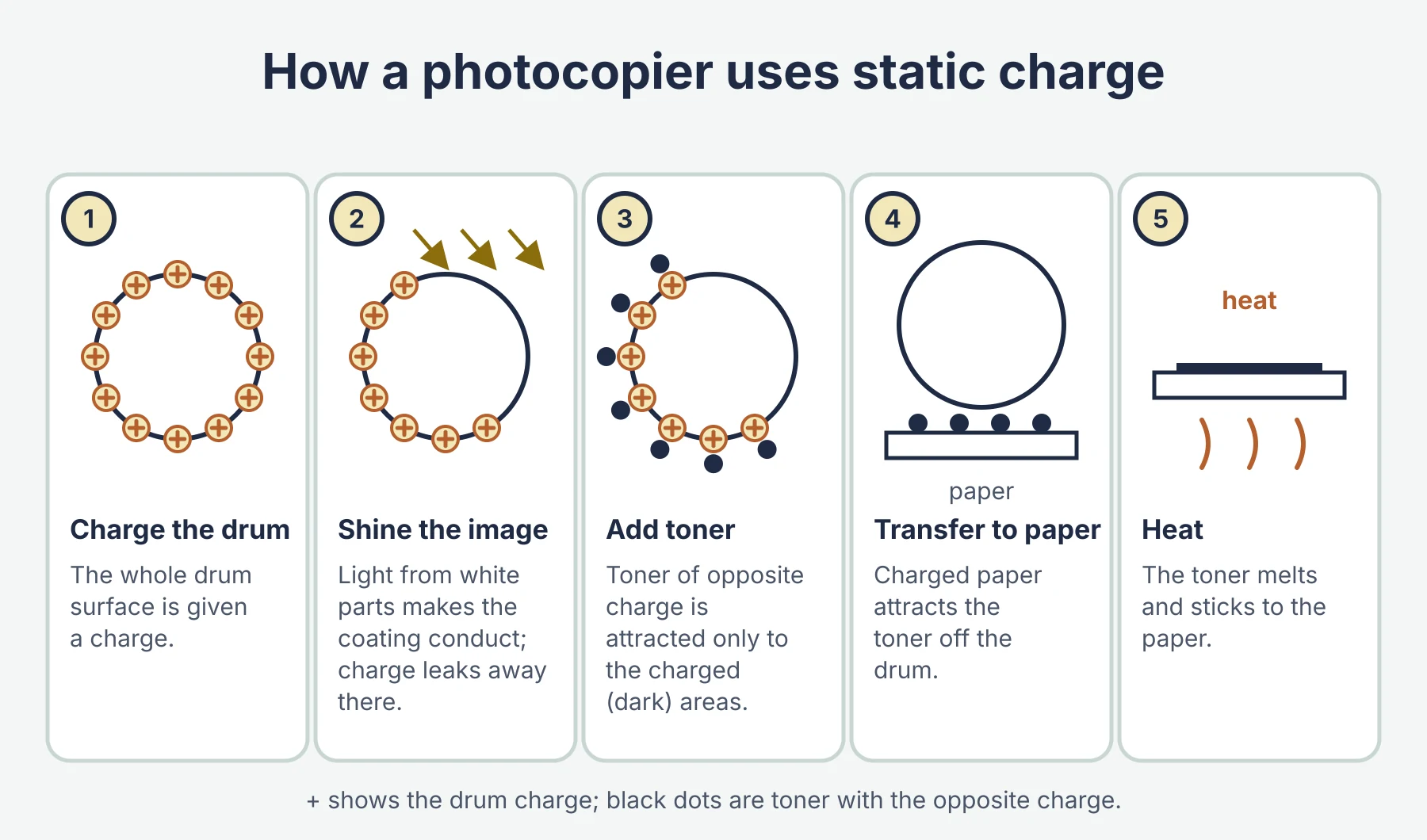
- Photocopier: charged drum; light from white areas discharges the drum; dark areas stay charged; oppositely charged toner sticks there; toner transferred to charged paper and heated to fix.
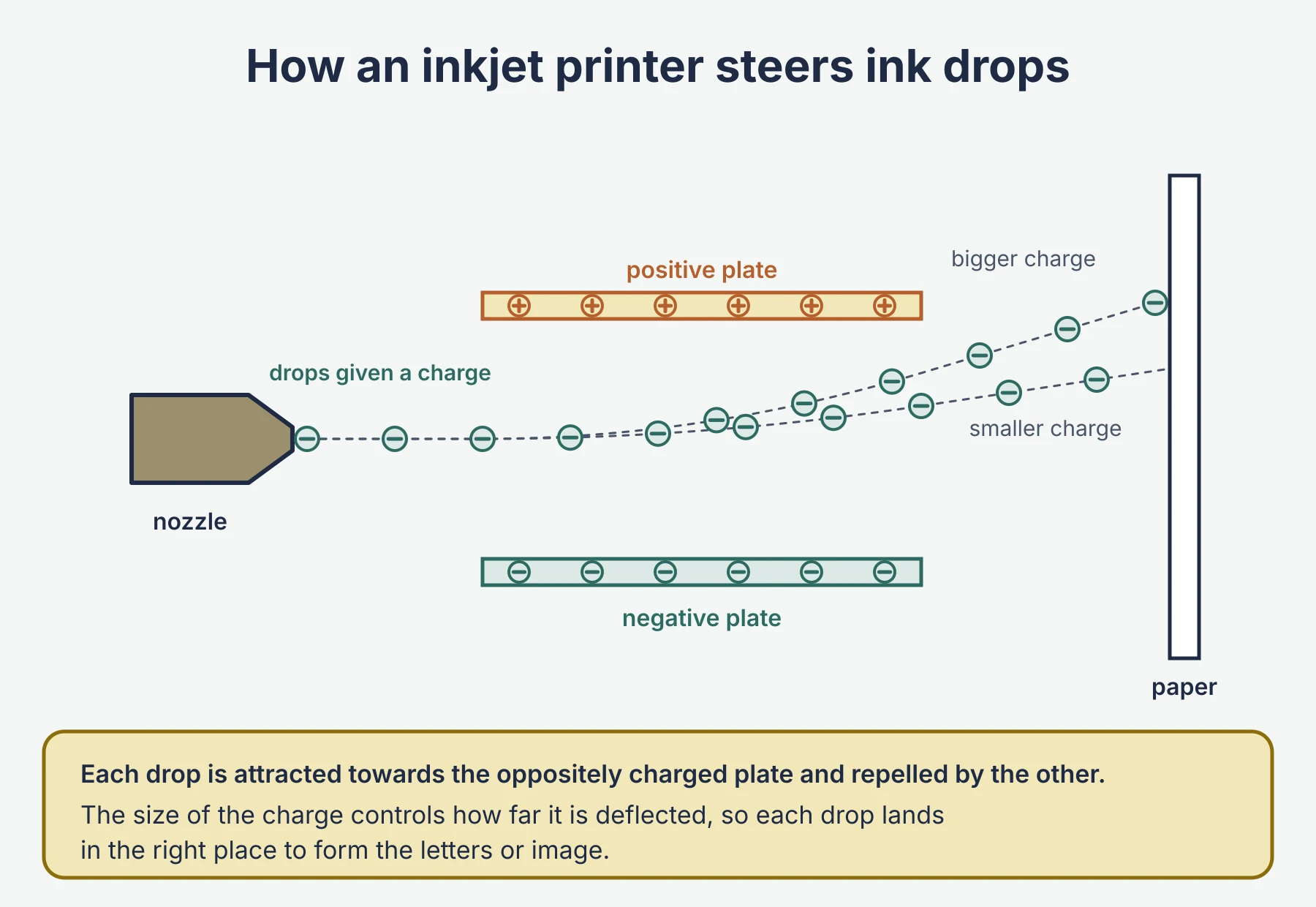
- Inkjet printer: ink drops charged at the nozzle; deflecting plates attract and repel them; the amount of charge sets the deflection and so where each drop lands.
- Spray painting: charged droplets spread out (repel each other) and are attracted to an oppositely charged object, giving an even coat.
Exam traps
- “Protons moved” or “positive charges were rubbed off”: wrong; electrons moved.
- “Rubbing creates charge”: wrong; it transfers electrons.
- A metal rod held in the hand cannot be charged by rubbing, because charge flows through it and the person to earth.
- Attraction does not prove an object is charged (neutral objects are attracted too); repulsion does prove both are charged with the same sign.
- In the fuelling answer, name the spark and the fuel vapour.
- Earthing: say electrons flow through the conductor to or from earth.
Self-test
- Name two conductors and two insulators.
- A polythene rod is rubbed with a cloth and becomes negatively charged. Explain why.
- What charge does the cloth in question 2 have, and why?
- State the force between two positively charged objects.
- Why can an insulator be charged by rubbing but a metal held in the hand cannot?
- Why should the charging practical be done in dry conditions?
- Explain why a charged balloon sticks to a neutral wall.
- Which observation proves that an object is charged: attraction to a charged rod or repulsion from it? Explain.
- Explain why refuelling an aircraft can be dangerous.
- How is the danger in question 9 reduced?
- In a photocopier, why does toner stick only to parts of the drum?
- In an inkjet printer, what decides how far a drop of ink is deflected?
Answers
- Conductors: any two of copper, aluminium, steel, iron, graphite. Insulators: any two of polythene, acetate, PVC, rubber, glass, wool.
- Friction transfers electrons from the cloth to the rod; the rod gains electrons, so it has more negative than positive charge.
- Positive, equal in size, because it lost the electrons that the rod gained.
- Repulsion.
- Electrons cannot move through an insulator, so the charge stays on it; in a metal they flow through it and through the person to earth.
- Moisture on surfaces lets the charge leak away.
- The negative balloon repels electrons in the wall slightly away, leaving the nearby surface positive; unlike charges attract, and this attraction is stronger than the repulsion from the more distant negative region.
- Repulsion: only two charged objects with like charges repel, while a neutral object can also be attracted.
- Fuel flowing through the pipe transfers electrons by friction, so charge builds up; a spark may jump to earth and ignite fuel vapour.
- Connect the aircraft to earth with a conducting cable (and use conducting hoses) so electrons flow away and charge does not build up.
- Light from white areas of the page makes the coating conduct and removes the charge there; the oppositely charged toner is attracted only to the areas that are still charged.
- The amount of charge given to the drop (with the charge on the deflecting plates).
Related resources
-
Study guides
Pearson Edexcel International GCSE Physics (4PH1): Energy and voltage in circuits
Series and parallel circuits, I-V investigations, LDRs, thermistors, V = IR, Q = It, E = QV and junctions for Edexcel International GCSE Physics 4PH1, 2c.
Physics · Pearson Edexcel · IGCSE
Read guide -
Practice questions
Pearson Edexcel International GCSE Physics (4PH1): Energy and voltage in circuits – Practice Questions
Original practice questions with answers on series and parallel circuits, I-V data, thermistors, junctions, Q = It and E = QV for Edexcel IGCSE Physics 4PH1.
Physics · Pearson Edexcel · IGCSE
Try questions -
Revision notes
Pearson Edexcel International GCSE Physics (4PH1): Energy and voltage in circuits – Revision Notes
Recall notes on series and parallel circuits, I-V graphs, LDRs, thermistors, V = IR, Q = It and E = QV, with a self-test, for Edexcel IGCSE Physics 4PH1.
Physics · Pearson Edexcel · IGCSE
Revise topic
Related articles
Get free revision emails (optional)
Occasional emails with practice questions, worked explanations and links to free resources for the qualification and subjects you choose. No spam, and you can unsubscribe from any email. The free tools on this site never need an email.