
Study Guides
Pearson Edexcel International GCSE Physics (4PH1): Forces, movement, shape and momentum
Resultant force, F = ma, stopping distance, terminal velocity, Hooke's law, momentum, Newton's third law and moments for Edexcel IGCSE Physics 4PH1, 1c.
- Subject
- Physics
- Level
- IGCSE
- Topic
- Forces and motion
- Author
- Marlbridge Academic Team
- Updated
- Reviewed by
- Hassan (what this means)
Aligned to Pearson Edexcel IGCSE Physics (4PH1), Issue 4. Official specification .
Syllabus page (what it covers and how it is assessed): Pearson Edexcel IGCSE Physics.
Syllabus points this page covers
4PH1
- 1c Forces, movement, shape and momentum
Found an error? Report a correction.
Need help with this topic? Request a free trial class for IGCSE Physics (4PH1).
This guide goes deep on sub-topic 1(c) Forces, movement, shape and momentum, statements 1.11 to 1.33 of the Pearson Edexcel International GCSE in Physics (4PH1), Issue 4. Statements 1.11 to 1.24 are core content for both papers. Statements 1.25P to 1.33P (momentum, Newton’s third law and moments) are Physics-only and are assessed on Paper 2P. For Topic 1 as a whole, see the Forces and Motion study guide.
What the specification asks
- Forces and their effects (1.11–1.16): effects of forces (changes in speed, shape or direction); types of force such as gravitational or electrostatic; vectors and scalars; force as a vector; resultant of forces along a line; friction opposes motion.
- Force and acceleration (1.17–1.18): F = m × a and W = m × g, both “know and use”.
- Stopping and falling (1.19–1.21): stopping distance = thinking distance + braking distance and the factors affecting it; forces on falling objects and terminal velocity.
- Shape (1.22–1.24): the practical on extension of helical springs, metal wires and rubber bands; Hooke’s law in the initial linear region; elastic behaviour.
- Momentum (1.25P–1.28P): p = m × v; safety features; conservation of momentum; F = (mv − mu) ÷ t.
- Newton’s third law and moments (1.29P–1.33P): third-law pairs; moment = force × perpendicular distance; centre of gravity; principle of moments; upward forces on a beam supported at its ends.
Vectors, scalars and resultant force
A scalar has size (magnitude) only: mass, distance, speed, time, energy. A vector has size and direction: force, velocity, displacement, acceleration, momentum. Because force is a vector, two forces only add simply when they act along the same line.
For forces along a line, choose one direction as positive. Forces in that direction are added; forces in the opposite direction are subtracted.
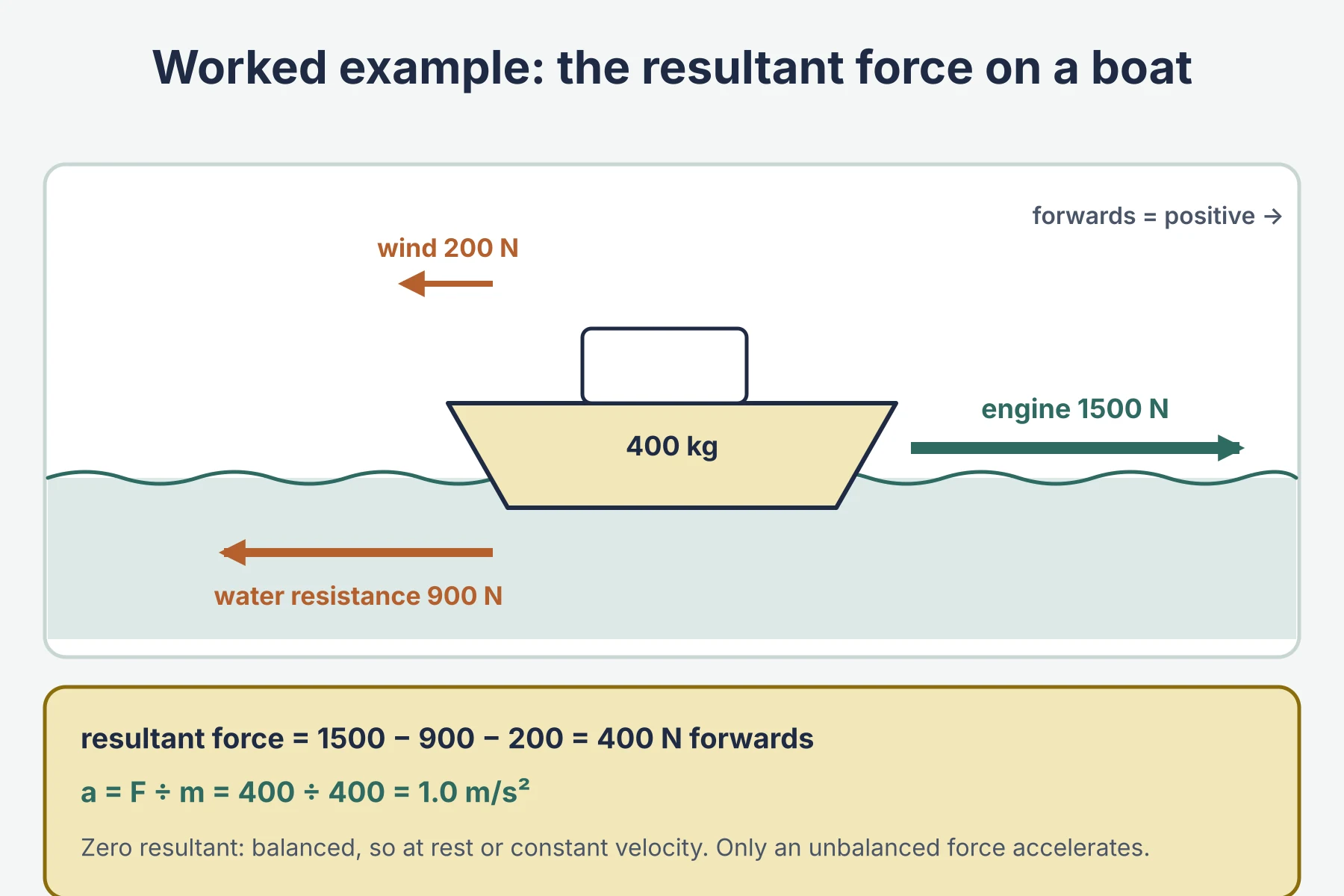
Worked example 1. A boat of mass 400 kg is pushed forward by an engine force of 1500 N. Water resistance is 900 N and wind exerts 200 N against the motion.
resultant force = 1500 − 900 − 200 = 400 N forwards
a = F / m = 400 / 400 = 1.0 m/s²
If the resultant force is zero, the forces are balanced: the object stays at rest or keeps moving at constant velocity. Only an unbalanced (resultant) force produces acceleration, which is why 1.17 says “unbalanced force” in F = m × a.
Friction always acts in the direction opposing motion (or attempted motion) between surfaces. Air resistance and water resistance (drag) are types of friction that increase with speed.
Weight
Weight is the gravitational force on a mass: W = m × g, with g = 10 N/kg on Earth. Weight acts vertically downwards through the object’s centre of gravity. On the Moon, g is smaller, so the same mass has a smaller weight, but its mass is unchanged.
Stopping distance (1.19–1.20)
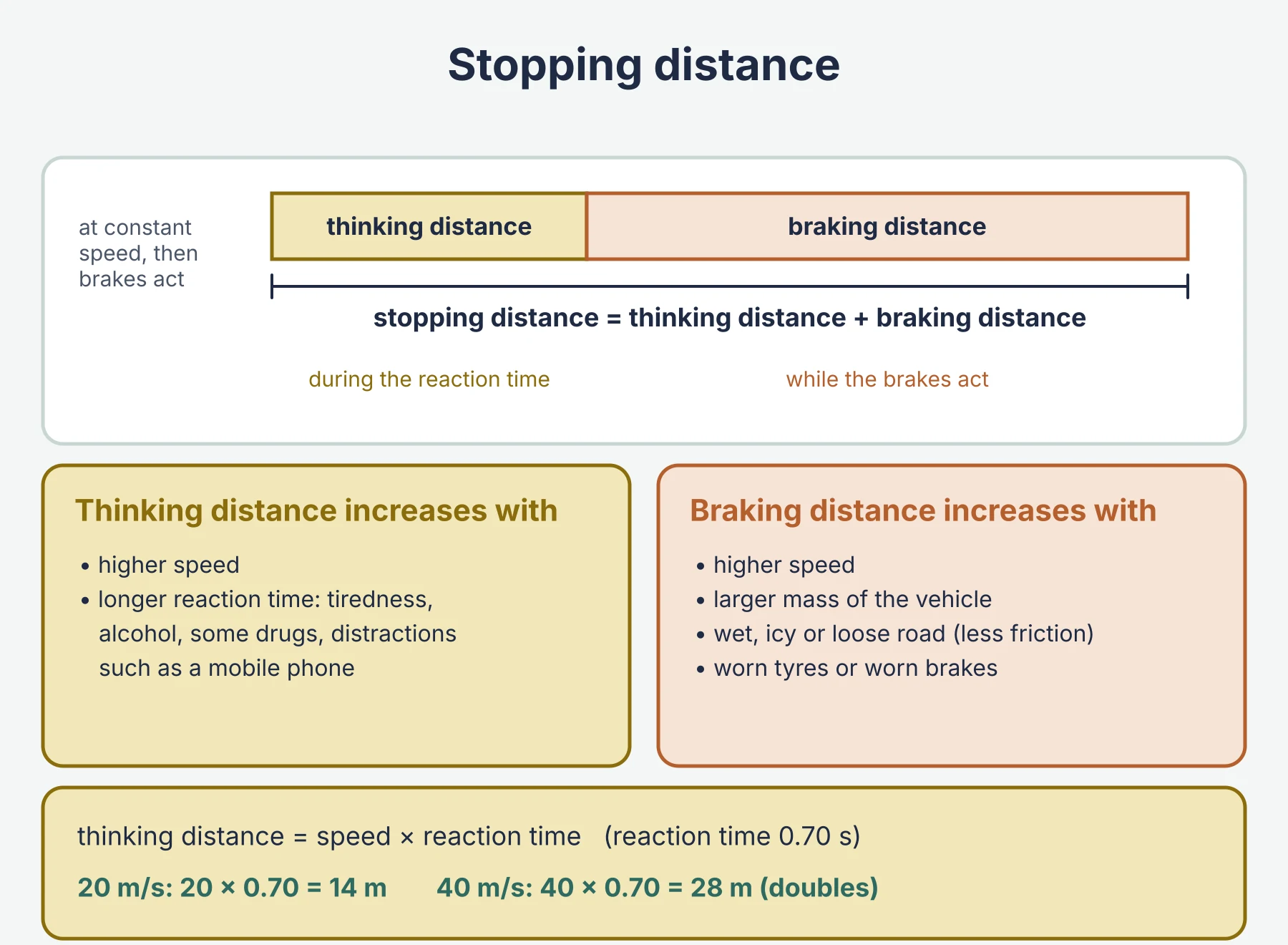
stopping distance = thinking distance + braking distanceThinking distance is the distance travelled during the driver’s reaction time, at constant speed. It increases with speed and with reaction time, which is lengthened by tiredness, alcohol, some drugs and distractions such as a mobile phone.
Braking distance is the distance travelled while the brakes act. It increases with speed, with the mass of the vehicle (a larger mass needs a larger force for the same deceleration), and with poor road conditions (wet, icy or loose surfaces reduce friction between tyres and road). Worn tyres and worn brakes also increase it.
For a given speed, thinking distance = speed × reaction time. A driver with a reaction time of 0.70 s at 20 m/s has a thinking distance of 20 × 0.70 = 14 m. At 40 m/s it doubles to 28 m.
Falling objects and terminal velocity (1.21)
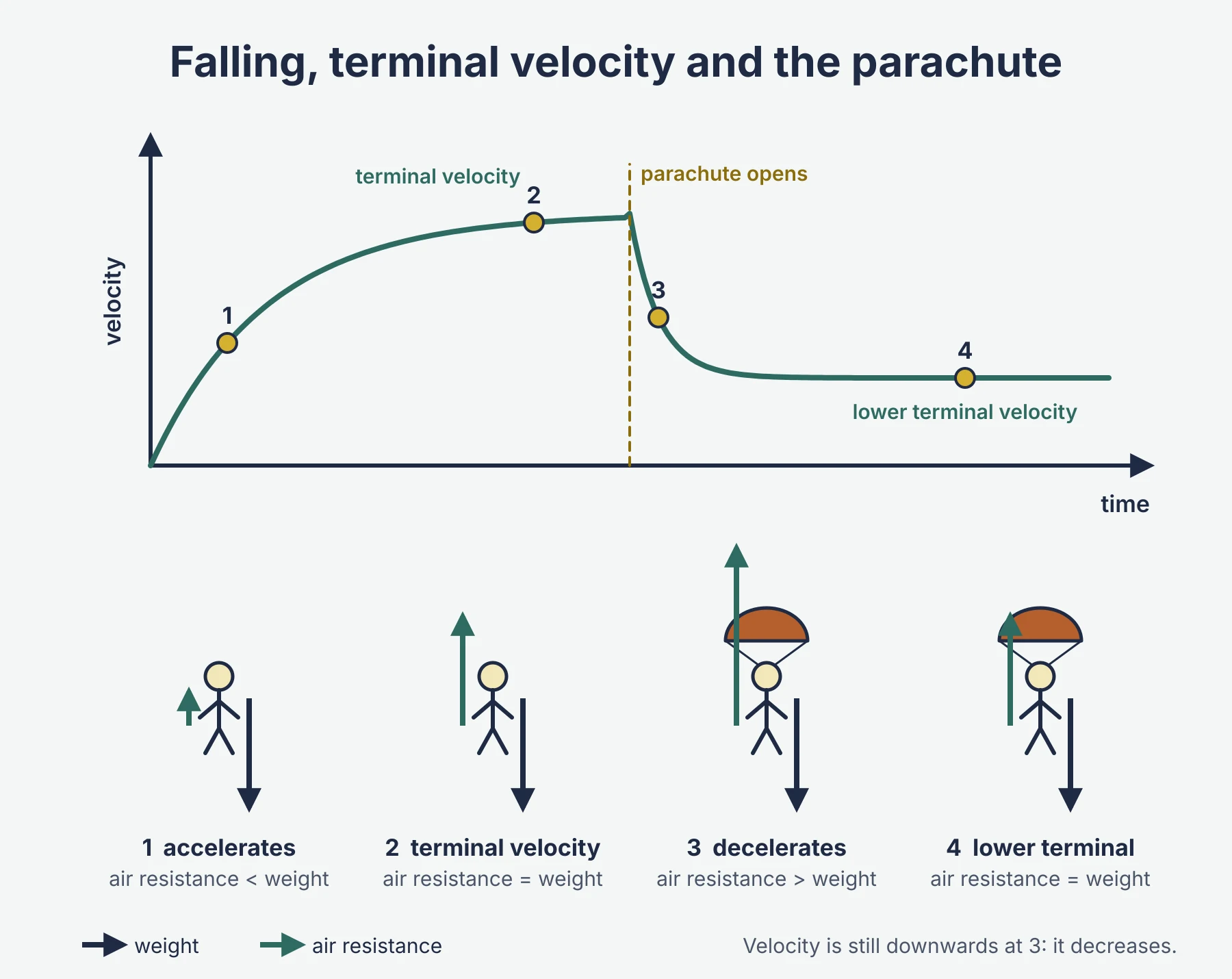
An object falling through air has two forces on it: weight downwards and air resistance upwards.
- At first, speed is low, so air resistance is small; the resultant force is downwards and the object accelerates.
- As speed increases, air resistance increases, so the resultant force and the acceleration decrease.
- Eventually air resistance equals weight; the resultant force is zero, so the acceleration is zero and the object falls at a constant terminal velocity.
Opening a parachute greatly increases the surface area and so the air resistance. Air resistance becomes larger than weight, the resultant force is upwards, and the skydiver decelerates until the forces balance again at a lower terminal velocity.
Forces and shape (1.22–1.24)
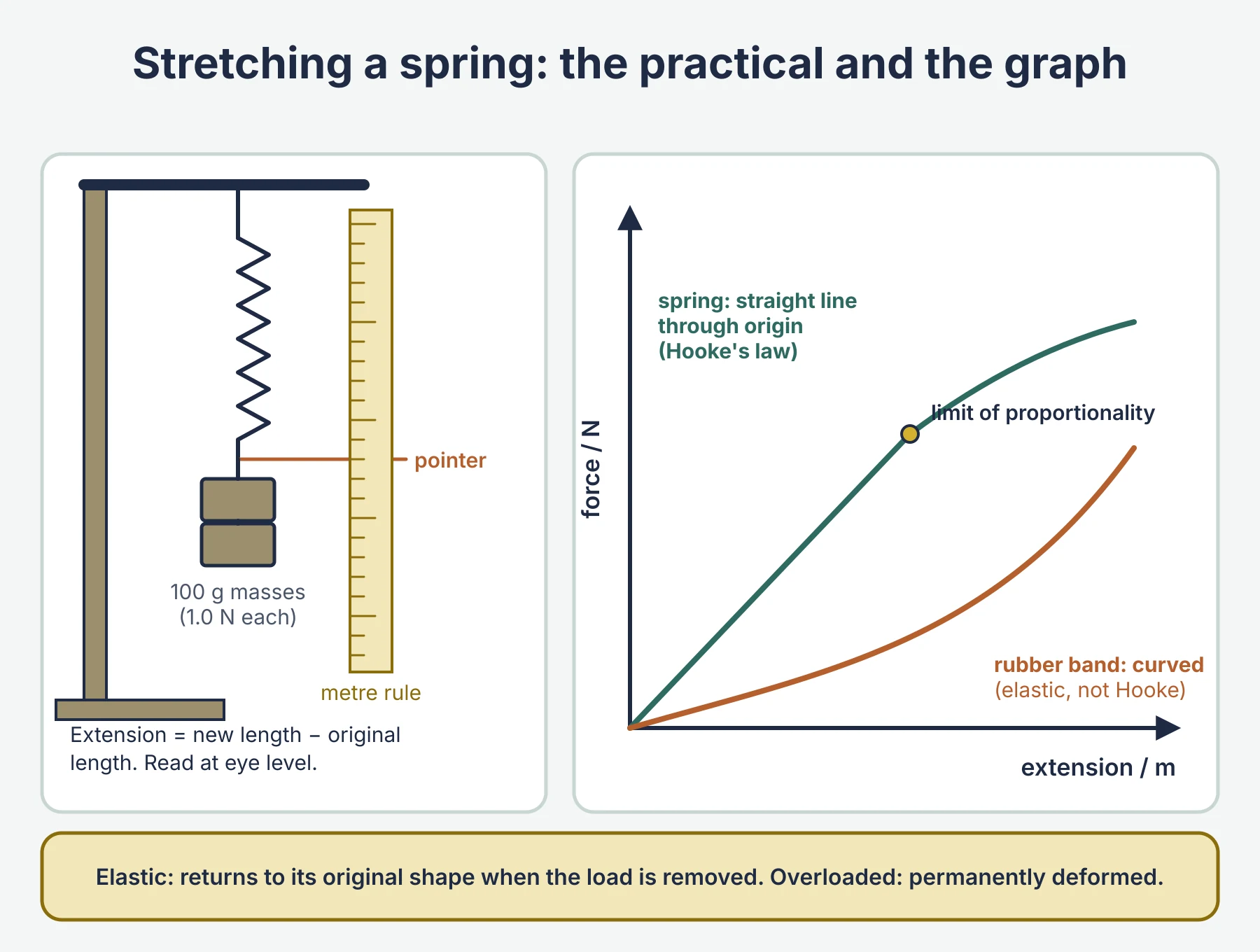
The practical. Clamp a helical spring (or rubber band) vertically next to a metre rule. Record the length with no load, then add masses in equal steps (for example 100 g, giving 1.0 N of weight each), recording the new length each time. Extension = new length − original length. Plot force on one axis against extension on the other.
- Read the rule at eye level, using a pointer fixed to the bottom of the spring, to avoid parallax error.
- Remove the masses at the end to check whether the spring returns to its original length.
- A metal wire extends very little, so it must be long (a few metres) and the extension measured with a scale fixed close to a marker on the wire.
- Wear eye protection: a stretched spring or wire can snap.
Results. For a spring and a metal wire, the graph starts as a straight line through the origin: extension is directly proportional to force. This initial linear region is associated with Hooke’s law. Beyond the limit of proportionality the graph curves. A rubber band gives a curved graph for most of its range, so it does not obey Hooke’s law, even though it is elastic.
Elastic behaviour is the ability of a material to recover its original shape after the forces causing deformation are removed. A spring loaded too far does not return to its original length: it has been permanently deformed.
Momentum (1.25P–1.28P)
momentum = mass × velocity (p = m × v), unit kg m/s. Momentum is a vector: choose a positive direction and give objects moving the other way a negative velocity.
Conservation of momentum. When objects interact (collide or push apart) with no external force, total momentum before = total momentum after.
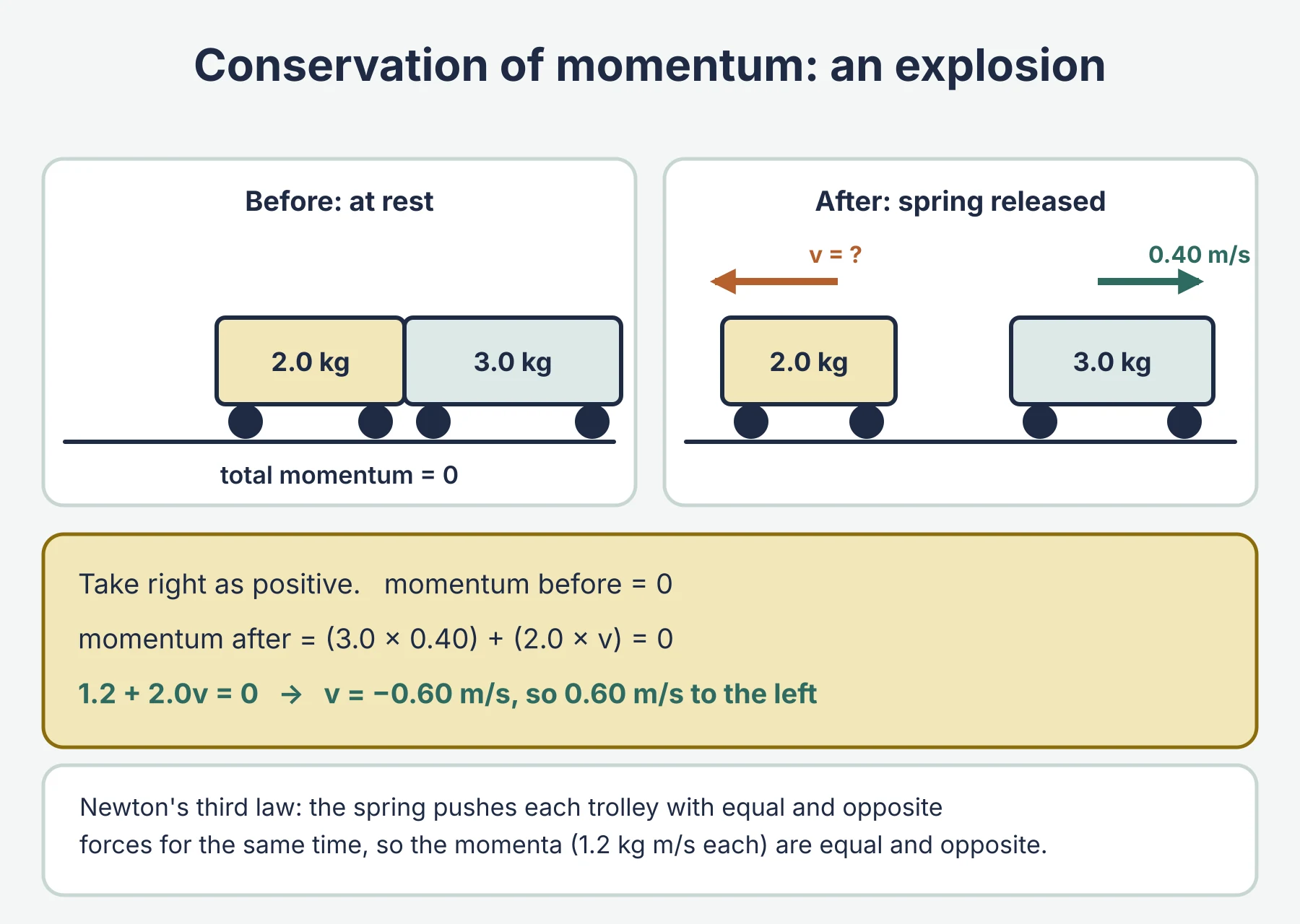
Worked example 2: an explosion. A 2.0 kg trolley and a 3.0 kg trolley are at rest, touching. A spring between them is released and the 3.0 kg trolley moves off to the right at 0.40 m/s.
momentum before = 0
momentum after  = (3.0 × 0.40) + (2.0 × v) = 0
1.2 + 2.0v = 0
v = −0.60 m/s, so 0.60 m/s to the left
The lighter trolley moves faster, and the two momenta are equal and opposite.
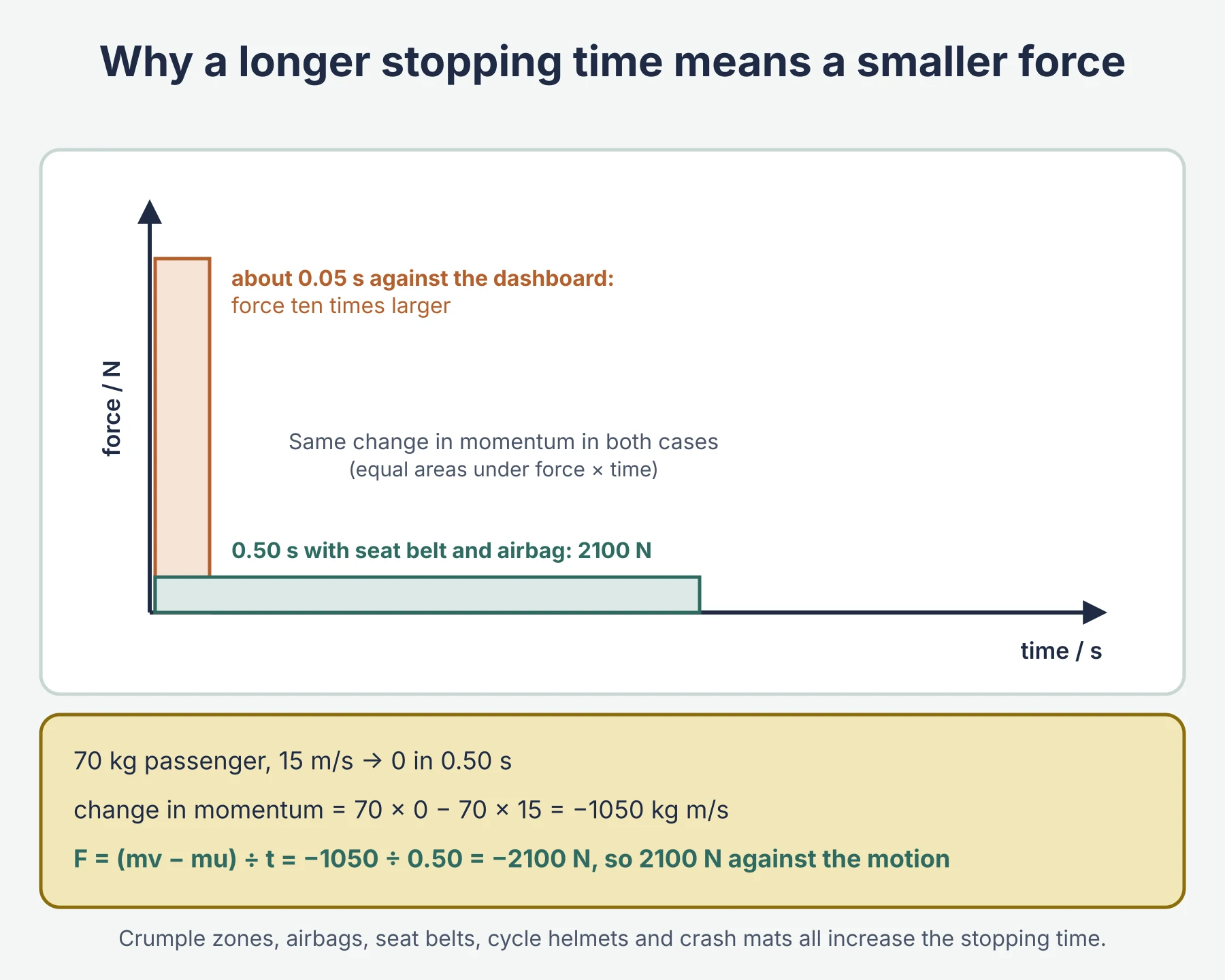
Force and change in momentum. F = (mv − mu) ÷ t. A given change in momentum produced over a longer time needs a smaller force. Safety features use this: crumple zones, airbags, seat belts, cycle helmets and crash mats all increase the time over which a person’s momentum changes to zero, which reduces the force on the person.
Worked example 3. A 70 kg passenger moving at 15 m/s is brought to rest by a seat belt and airbag in 0.50 s.
change in momentum = 70 × 0 − 70 × 15 = −1050 kg m/s
F = −1050 / 0.50 = −2100 N, so 2100 N against the motion
Without them, stopping in about 0.05 s against the dashboard would need a force ten times larger.
Newton’s third law (1.29P)
If body A exerts a force on body B, body B exerts a force on body A that is equal in size, opposite in direction and of the same type. The two forces act on different bodies, so they never cancel. In worked example 2, the spring pushes each trolley with equal and opposite forces for the same time, which is why the momenta are equal and opposite.
Moments (1.30P–1.33P)
moment = force × perpendicular distance from the pivot, unit Nm. The weight of a body acts through its centre of gravity. For a body in equilibrium, the principle of moments applies: sum of clockwise moments = sum of anticlockwise moments about any pivot.
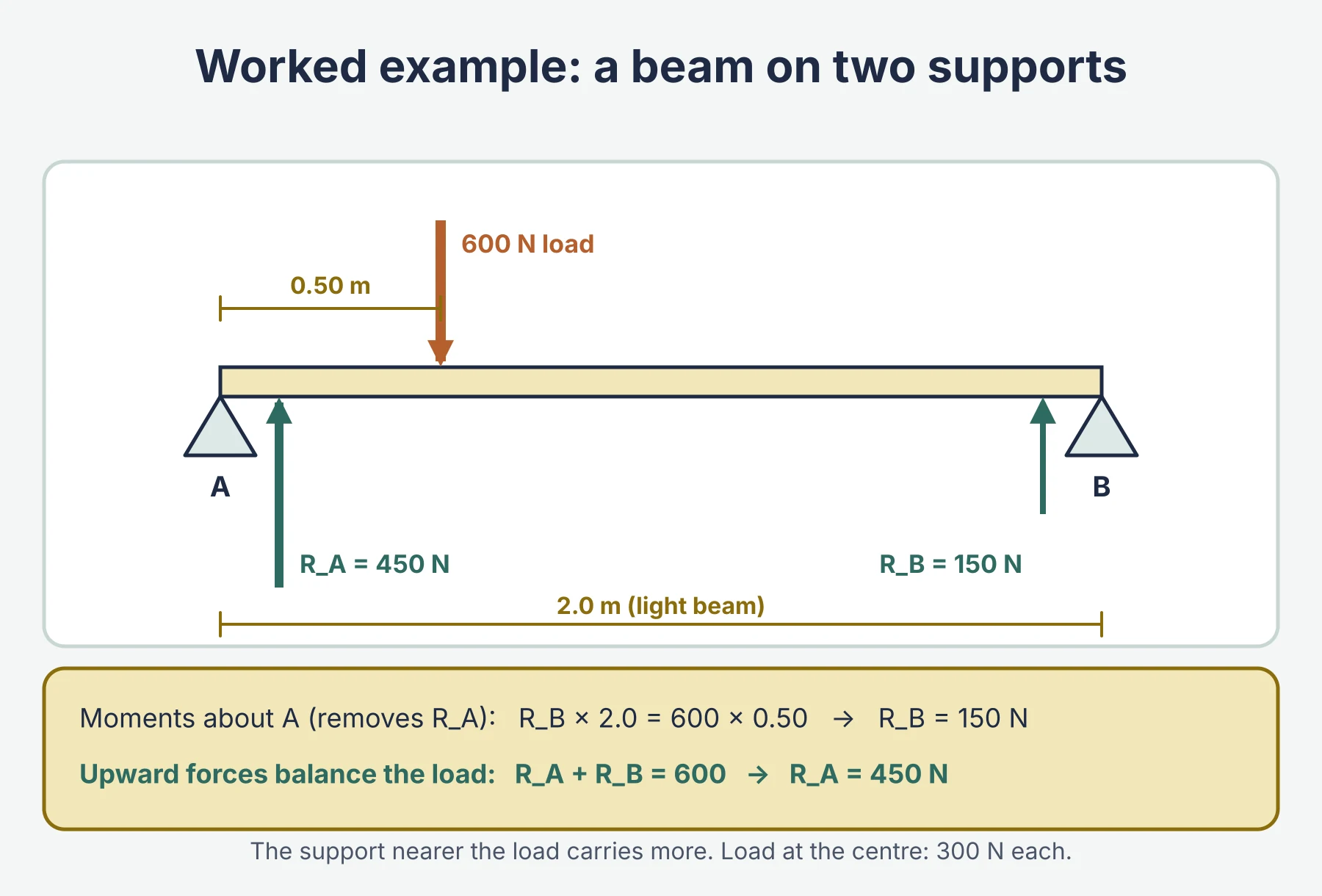
Worked example 4: a beam on two supports. A light beam 2.0 m long rests on supports at each end, A and B. A 600 N load is placed 0.50 m from A.
moments about A:  R_B × 2.0 = 600 × 0.50
                  R_B = 150 N
upward forces balance the load: R_A + R_B = 600
                  R_A = 450 N
The support nearer the load carries the larger force. As the load moves towards B, R_B increases and R_A decreases; with the load at the centre each support carries 300 N. Taking moments about one support removes that support’s unknown force from the equation, which is why you should always choose a support as the pivot.
Common mistakes
- Using total force instead of resultant force in F = m × a.
- Saying a parachute makes the skydiver “go up”. The velocity is still downwards; it decreases.
- Saying mass affects thinking distance. Mass affects braking distance only.
- Forgetting the negative sign for a velocity in the opposite direction in momentum calculations.
- Naming weight and the normal contact force as a Newton’s third law pair. They act on the same body and are different types of force.
- Using the length along a slanted lever instead of the perpendicular distance.
Exam technique with command words
- Explain terminal velocity or safety features: give a chain of linked steps, each with a reason (“so”, “because”).
- Describe the practical: give apparatus, what is measured, how, and how accuracy is improved.
- Calculate: equation, substitution, answer with unit; for momentum state the direction.
- Suggest factors in a new context: apply the stopping-distance factors to the situation described.
- Forces, movement, shape and momentum revision notes
- Forces, movement, shape and momentum practice questions
- Graphs and equations of motion: Movement and position study guide
Written against the Pearson Edexcel International GCSE in Physics (4PH1) specification, Issue 4. Always check the current specification for your examination year.
Related resources
-
Practice questions
Pearson Edexcel International GCSE Physics (4PH1): Forces, movement, shape and momentum – Practice Questions
Original questions with answers on resultant force, stopping distance, Hooke's law, momentum, Newton's third law and beams for Edexcel IGCSE Physics 4PH1.
Physics · Pearson Edexcel · IGCSE
Try questions -
Revision notes
Pearson Edexcel International GCSE Physics (4PH1): Forces, movement, shape and momentum – Revision Notes
Recall notes on resultant force, F = ma, stopping distance, Hooke's law, momentum, third-law pairs and moments, with a self-test, for Edexcel 4PH1 Physics.
Physics · Pearson Edexcel · IGCSE
Revise topic -
Study guides
Pearson Edexcel International GCSE Physics (4PH1): Movement and position
Distance-time and velocity-time graphs, average speed, acceleration, v² = u² + 2as and the motion practical for Edexcel International GCSE Physics 4PH1, 1b.
Physics · Pearson Edexcel · IGCSE
Read guide
Related articles
Get free revision emails (optional)
Occasional emails with practice questions, worked explanations and links to free resources for the qualification and subjects you choose. No spam, and you can unsubscribe from any email. The free tools on this site never need an email.