
Revision Notes
IB DP Computer Science B.3: Object Oriented Programming – Revision Notes
Revision notes on IB DP Computer Science B.3 Object oriented programming: what the 2027 subject brief says on hours, SL and HL assessment, languages, revision.
- Subject
- Computer Science
- Level
- IB
- Topic
- B.3 – Object oriented programming (OOP)
- Author
- Marlbridge Academic Team
- Updated
- Reviewed by
- Harris Khan (what this means)
Aligned to International Baccalaureate IB Diploma Programme Computer Science (DP Computer Science), First assessment 2027. Official subject brief .
Syllabus page (what it covers and how it is assessed): IB Diploma Programme Computer Science.
Found an error? Report a correction.
Need help with this topic? Request a free trial class for IB Diploma Programme Computer Science (DP Computer Science (2014) / DP Computer Science (2027)).
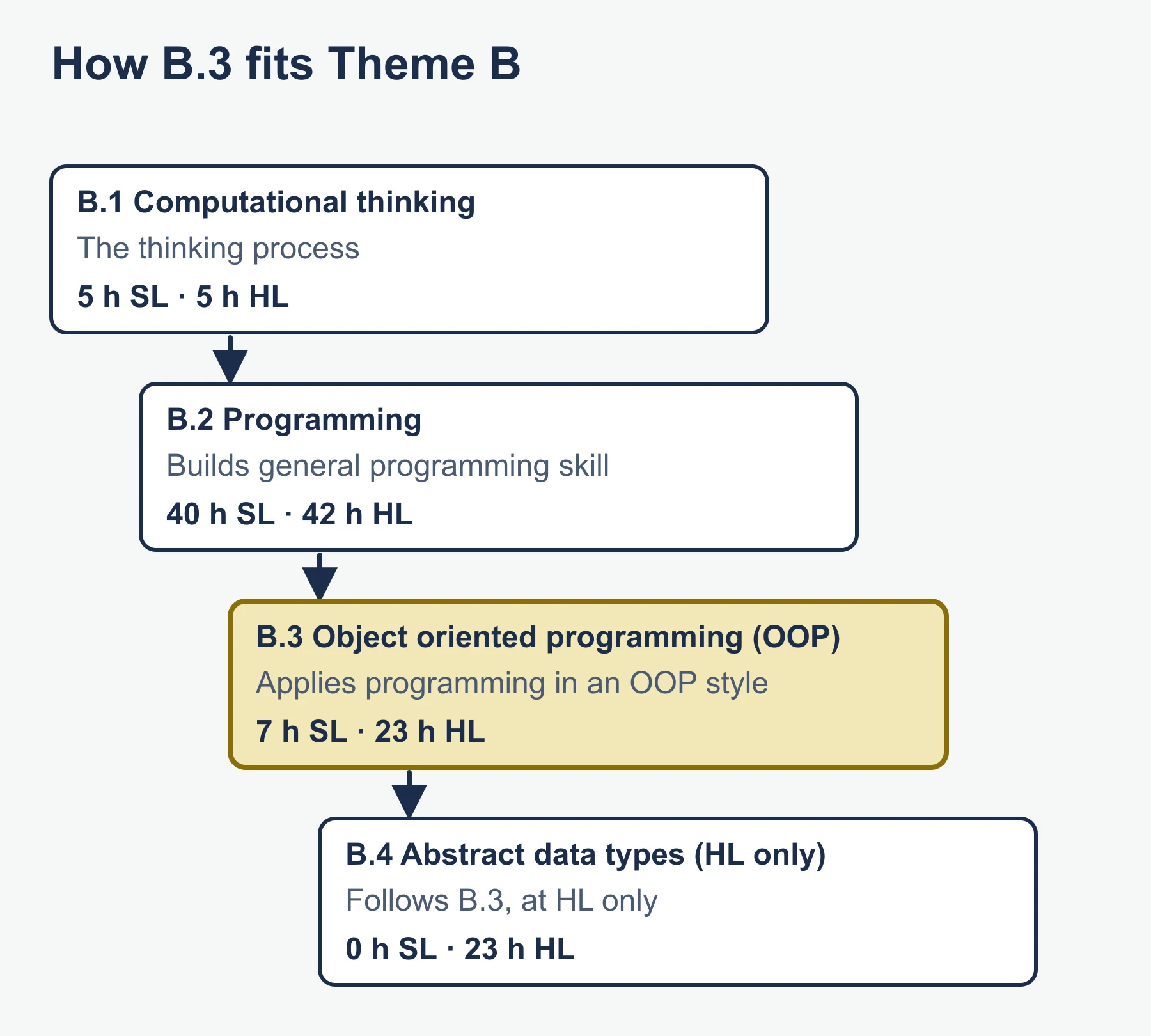
B.3 Object oriented programming (OOP) is a Theme B sub-topic of IB DP Computer Science (first assessment 2027), studied for 7 hours at SL and 23 hours at HL and examined on Paper 2, with extra HL questions on OOP. These notes summarise what the IB’s public subject brief says. The brief does not list B.3’s learning outcomes; those are in the full DP guide, so build your revision checklist from your school’s copy.
Full explanation: B.3 Object oriented programming study guide.
Key facts from the subject brief
| Item | What the brief says |
|---|---|
| Theme | B, “Computational thinking and problem-solving” |
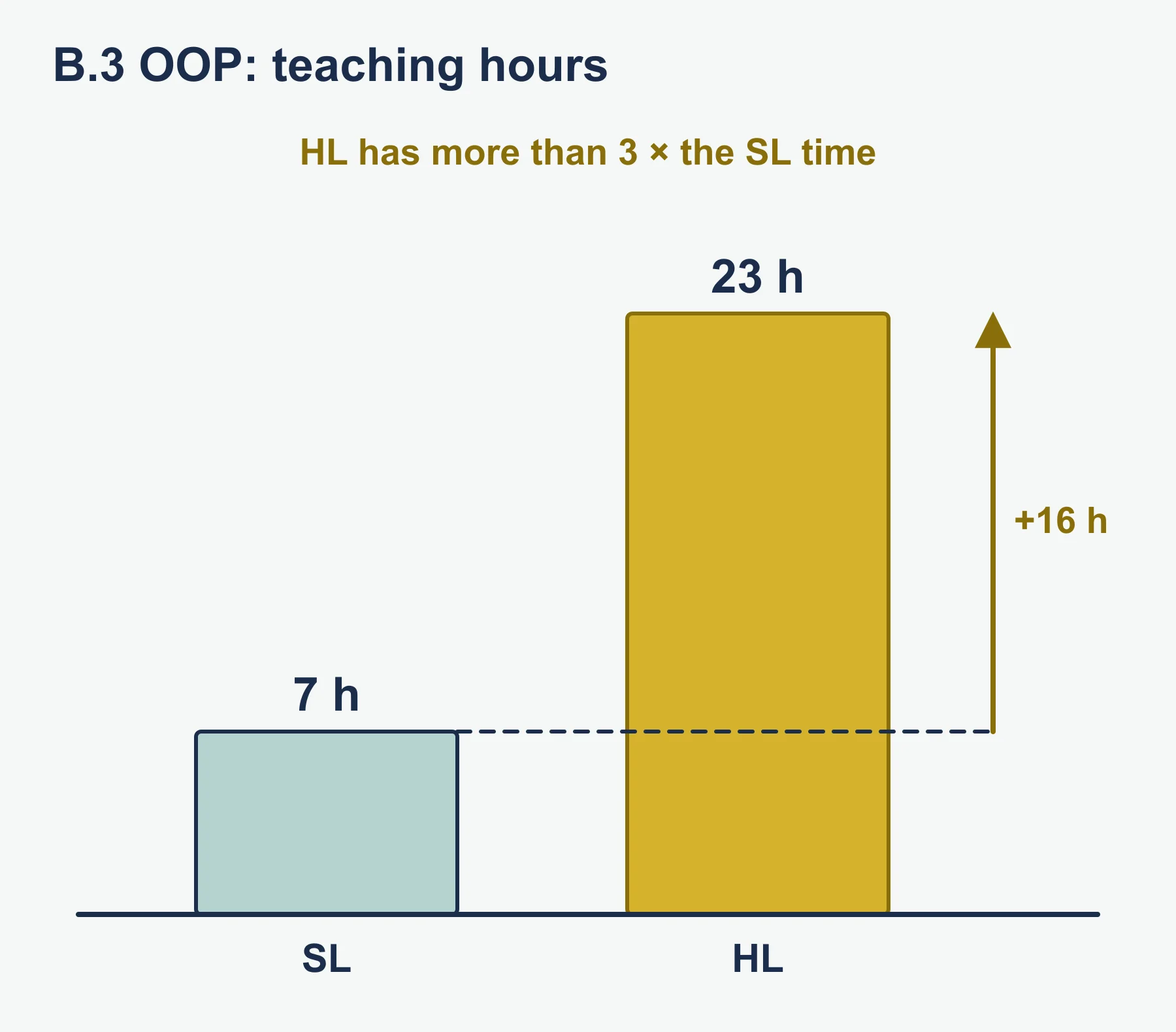
| Teaching hours | 7 SL / 23 HL |
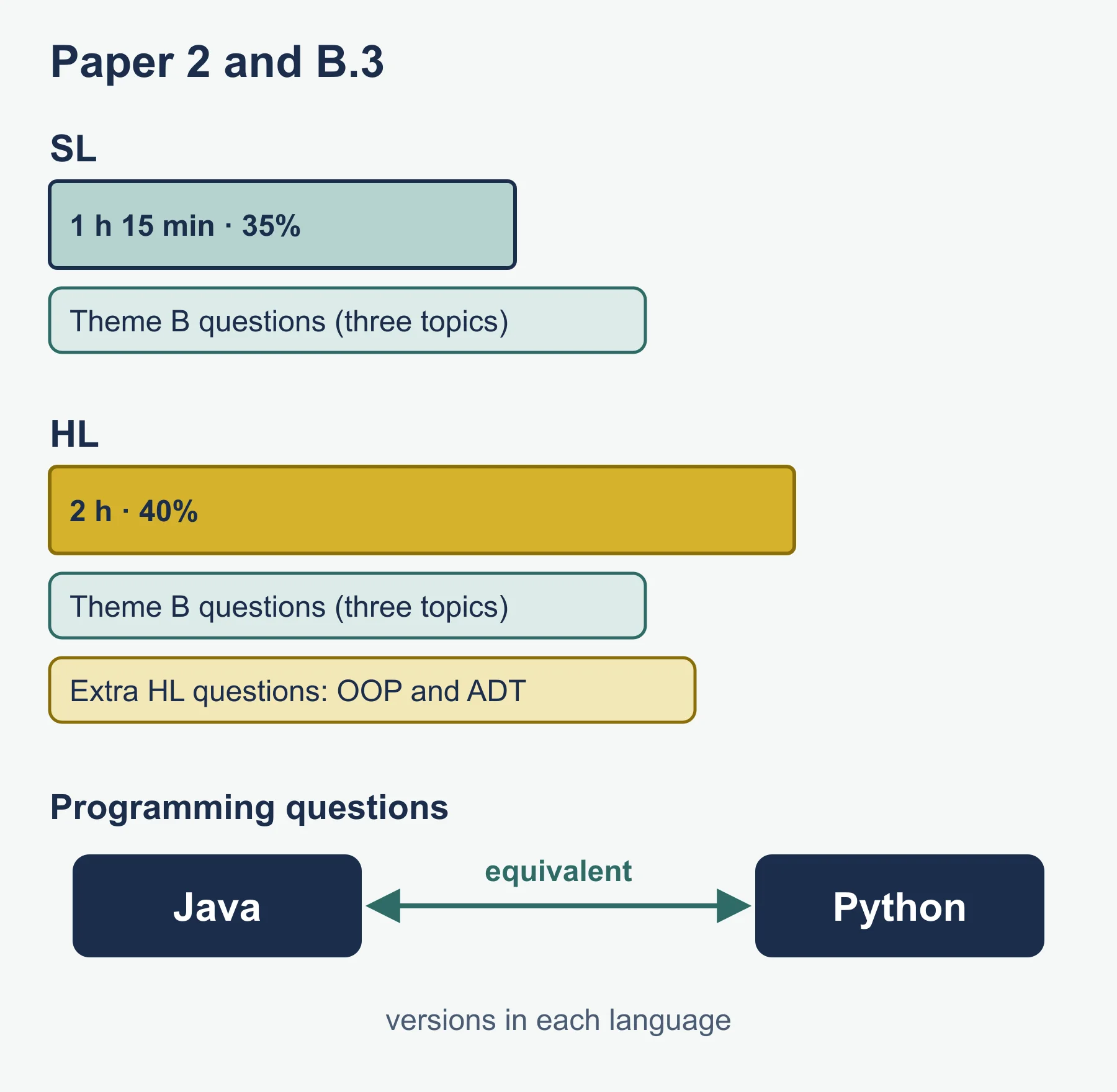
| SL assessment | Paper 2 covers the three Theme B topics for SL and HL (B.1, B.2, B.3) |
| HL assessment | Paper 2 also has additional HL questions on OOP and abstract data types |
| Paper 2 timing | SL 1 h 15 min (35%); HL 2 h (40%) |
| Language | Java or Python; programming questions have equivalent versions in each |
What the numbers mean for revision
- SL: 7 hours is a modest allocation, so expect B.3 to be a smaller part of Paper 2 than B.2 Programming (40 hours).
- HL: 23 hours, more than three times the SL time, plus dedicated HL questions. Treat B.3 as a major HL topic alongside B.4 (23 hours).
- Both levels: Paper 2 can require you to write code, so practise OOP in the language your course uses.
General background (not the IB outcome list)
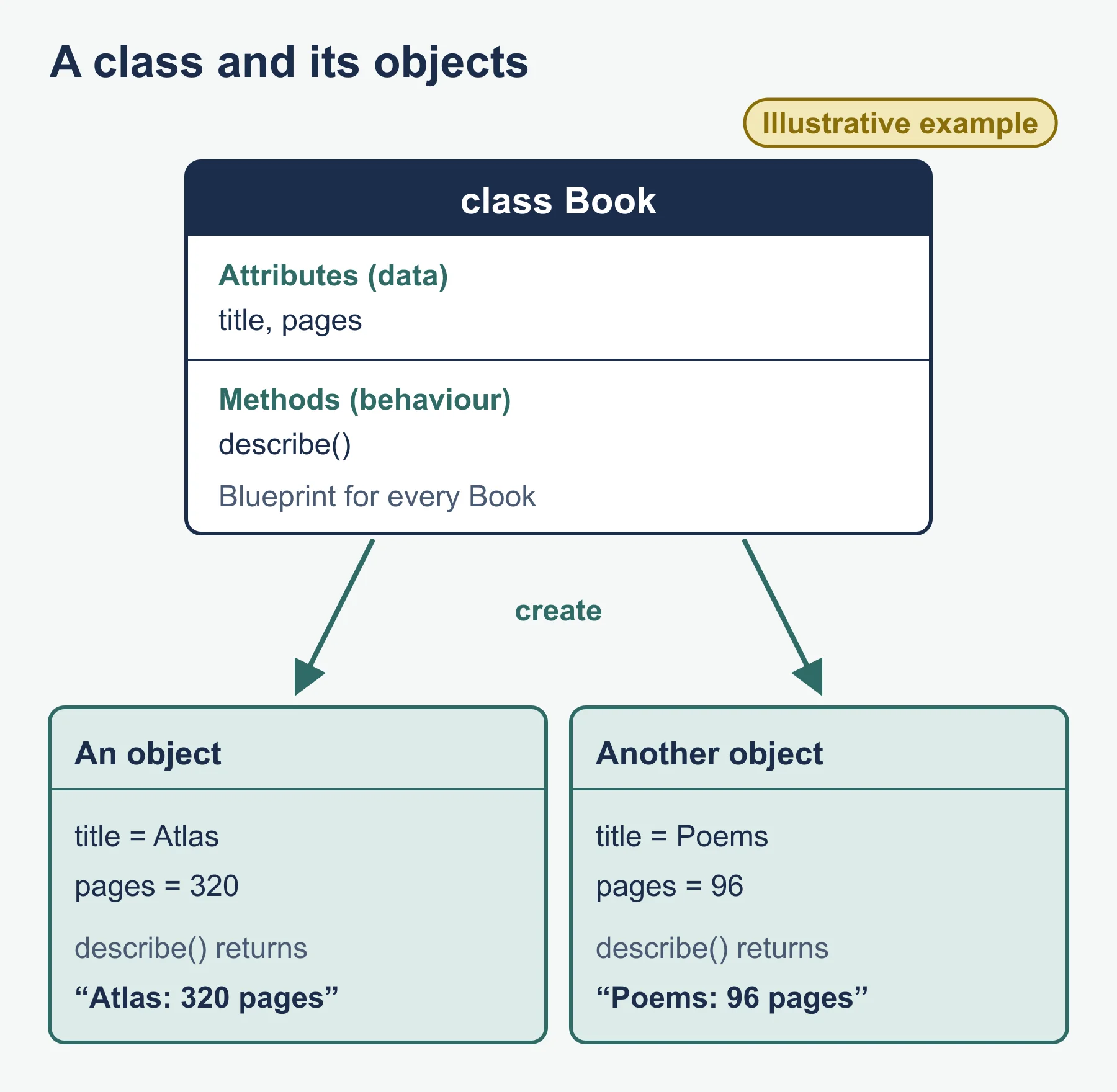
In object oriented programming a class describes the attributes (data) and methods (behaviour) of a kind of thing, and an object is one instance of that class. Java and Python both support classes and objects. Check the full guide for the exact OOP features and vocabulary B.3 requires at SL and at HL.
Revision checklist to build with your teacher
- Copy the B.3 learning outcomes from the full guide, marking which are HL only.
- For each outcome, write one short program in your course language that demonstrates it.
- Practise reading and predicting the output of object oriented code.
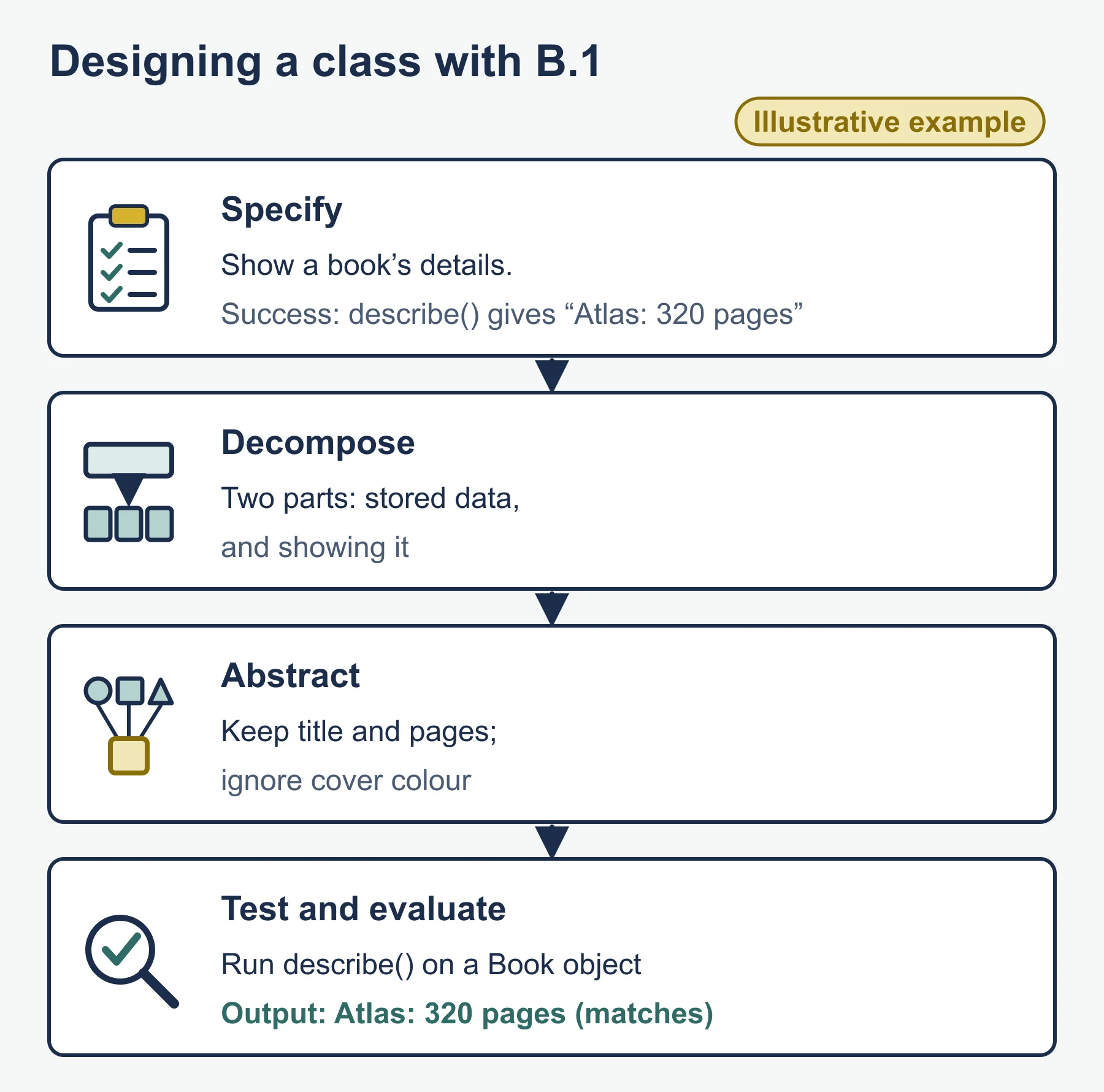
- Apply the B.1 process when designing classes: specify, decompose, abstract, test and evaluate.
- HL: work through longer, multi-part OOP problems under timed conditions.
Common mistakes and exam traps
- Assuming OOP is HL only. The brief lists B.3 with 7 SL hours, and SL Paper 2 covers all three SL Theme B topics.
- Revising OOP from a different syllabus’s list and assuming it matches the IB’s. Use the full guide.
- Learning definitions without writing code; Paper 2 includes programming questions.
Frequently asked questions
How many hours is B.3 at HL? 23 hours, compared with 7 at SL.
Which paper tests OOP? Paper 2, at both levels, with additional HL questions focused on OOP and abstract data types.
Can I answer in Python? Yes. The brief says programming questions have equivalent Java and Python versions.
Self-test
- How many teaching hours does the brief recommend for B.3 at SL and at HL?
- On which paper is OOP assessed?
- What extra Paper 2 questions do HL students answer?
- Which two programming languages can the course be studied in?
Answers: 1. 7 SL, 23 HL. 2. Paper 2. 3. Additional questions focused on OOP and abstract data types. 4. Java and Python.
Related pages
Source
International Baccalaureate Organization, Diploma Programme Subject Brief, Sciences: Computer science, first assessment 2027 (© 2024).
Get free revision emails (optional)
Occasional emails with practice questions, worked explanations and links to free resources for the qualification and subjects you choose. No spam, and you can unsubscribe from any email. The free tools on this site never need an email.
Related resources
-
Study guides
IB Diploma Programme Computer Science: Syllabus Guide
Full syllabus map for IB DP Computer Science, first assessment 2027: Theme A and Theme B sub-topics, the case study and recommended teaching hours at SL and HL.
Computer Science · International Baccalaureate · IB
Read guide -
Study guides
IB DP Computer Science B.3: Object Oriented Programming
Overview study guide to B.3 Object oriented programming in IB DP Computer Science (first assessment 2027): SL and HL hours, Paper 2 coverage and how to prepare.
Computer Science · International Baccalaureate · IB
Read guide -
Practice questions
IB DP Computer Science B.3: Object Oriented Programming – Practice Questions
Original warm-up questions with answers for IB DP Computer Science B.3 Object oriented programming: classes, objects, design and the 2027 brief's assessment.
Computer Science · International Baccalaureate · IB
Try questions
Related articles
-
teaching
A Level tuition in Dubai: Cambridge or Pearson Edexcel International A Level?
Schools in Dubai and Abu Dhabi teach either Cambridge International AS & A Level or Pearson Edexcel International A Level. How the two are structured, why it matters for tuition, and how online classes from Lahore work.
9 October 2026
-
curriculum guides
Choosing subjects at IGCSE and A Level
How subject choices at 14 and 16 affect university options later, and how to keep pathways open without overloading a timetable.
28 July 2026
Studying this with a teacher
Working through Computer Science IB?
This page is free and stays free. If you would rather be taught it, Marlbridge runs Computer Science classes one-to-one, online in your own time zone. The first trial class is free. WhatsApp replies within an hour (8am–11pm Pakistan time, every day); email the same day.
IB Computer Science teachers at Marlbridge