
Revision Notes
IB DP Physics: A.1 Kinematics, graphs, projectiles and fluid resistance (DP Physics) – Revision Notes
Fast-recall IB DP Physics revision notes on A.1 Kinematics: average and instantaneous values, SUVAT, graphs, projectiles and fluid resistance.
- Subject
- Physics
- Level
- IB
- Topic
- A. Space, time and motion
- Author
- Marlbridge Academic Team
- Updated
- Reviewed by
- Iftikhar Azeemi (what this means)
Aligned to International Baccalaureate IB Diploma Programme Physics (DP Physics), First assessment 2025. Official specification .
Syllabus page (what it covers and how it is assessed): IB Diploma Programme Physics.
Syllabus points this page covers
DP Physics
- A.1 Kinematics
Found an error? Report a correction.
Need help with this topic? Request a free trial class for IB Diploma Programme Physics (DP Physics).
These are condensed notes for the IB Diploma Programme Physics guide, first assessment 2025, section A.1 Kinematics in Theme A (Space, time and motion). The content is identical at SL and HL, because the guide gives A.1 no extra higher level material. Use them alongside the existing A.1 study guide and the earlier A.1 revision notes, which cover the basic definitions and one cliff-launch example. These notes add average versus instantaneous values, non-uniform motion, all three launch types and the effect of fluid resistance.
Related pages: A.1 practice set (new), earlier A.1 practice questions, A.2 Forces and momentum, the IB Physics hub, the printable checklist and the free 10-minute diagnostics.
What the guide asks you to understand
| Outcome in A.1 | One-line reminder |
|---|---|
| Describe motion by position, velocity, acceleration | Position is where; velocity is how position changes; acceleration is how velocity changes |
| Velocity is the rate of change of position | v = Δs/Δt for an average; the slope at one point for an instantaneous value |
| Acceleration: how quickly velocity changes | a = Δv/Δt; a vector, so a slowing object has acceleration opposite to its velocity |
| Displacement versus distance | Displacement is a vector, the change in position; distance is the scalar path length |
| Instantaneous versus average values | Average uses a whole interval; instantaneous uses a single instant |
| Equations for uniformly accelerated motion | Four equations, valid only while a is constant |
| Uniform and non-uniform acceleration | Straight v-t line versus curved v-t line |
| Projectiles without fluid resistance | Horizontal and vertical components treated separately |
| Qualitative effect of fluid resistance | Effects on time of flight, trajectory, velocity, acceleration, range and terminal speed |
Quantities and definitions
- Position is the location of a body relative to a chosen origin, with a sign or direction.
- Displacement (symbol s) is the change in position. It has a direction. It can be zero or negative.
- Distance is the total length of the path. It is never negative and never smaller than the size of the displacement.
- Velocity = displacement ÷ time. Speed = distance ÷ time.
- Acceleration = change in velocity ÷ time taken.
Average speed and average velocity are only equal when the motion stays in one direction in a straight line.
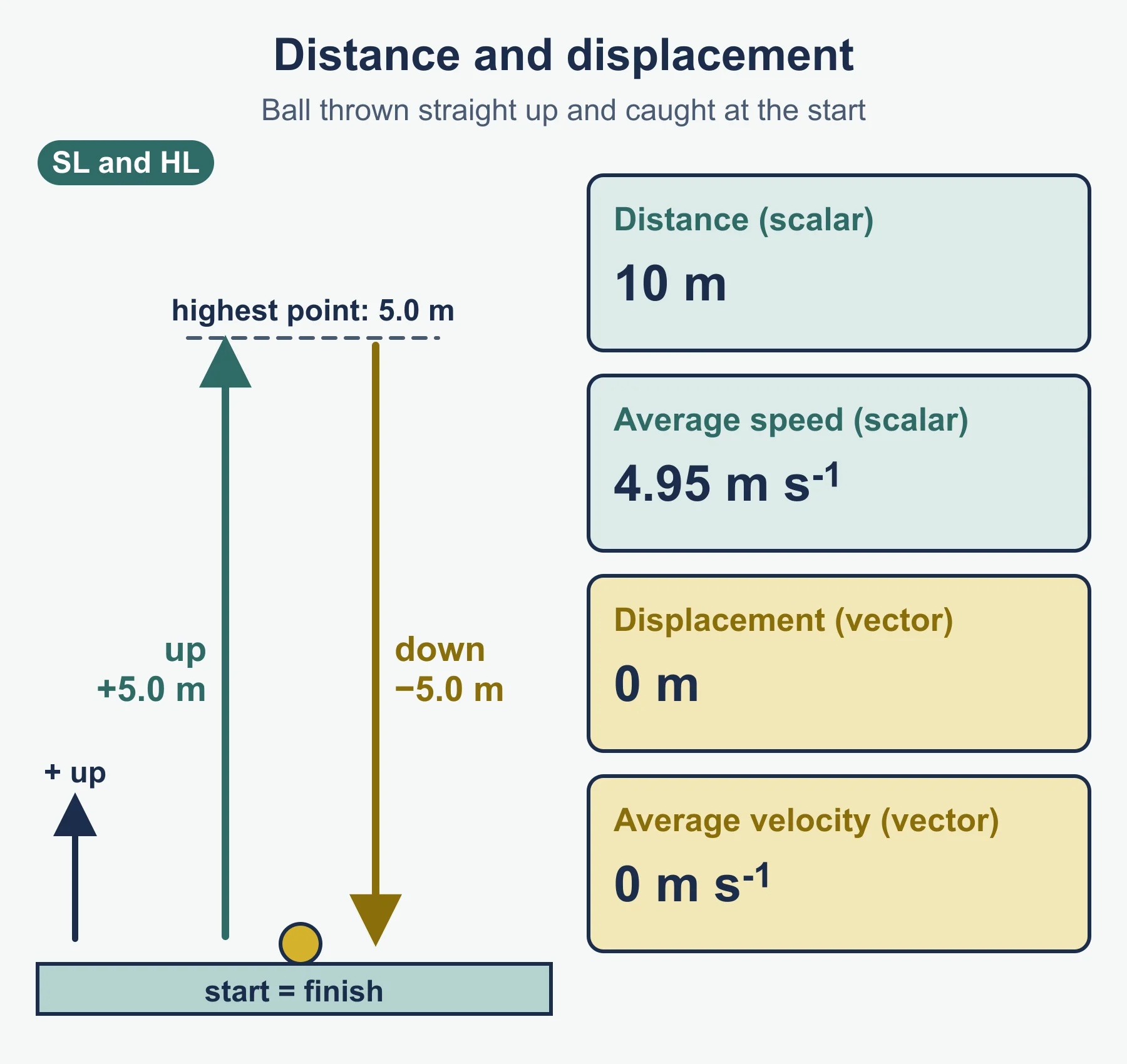
Example. A trolley moves 60 m east and then 20 m west in 16 s. Distance = 80 m, displacement = 40 m east. Average speed = 80 ÷ 16 = 5.0 m s⁻¹. Average velocity = 40 ÷ 16 = 2.5 m s⁻¹ east.
Average and instantaneous values
| Value | How to find it |
|---|---|
| Average velocity over an interval | Total displacement ÷ total time. On a displacement-time graph, the gradient of the chord joining two points |
| Instantaneous velocity at time t | Slope of the tangent drawn on the displacement-time graph at t. With data, shrink the interval around t |
| Average acceleration | Change in velocity ÷ time. Gradient of a chord on a velocity-time graph |
| Instantaneous acceleration | Gradient of the tangent to the velocity-time graph at t |
| Instantaneous speed | The size of the instantaneous velocity |
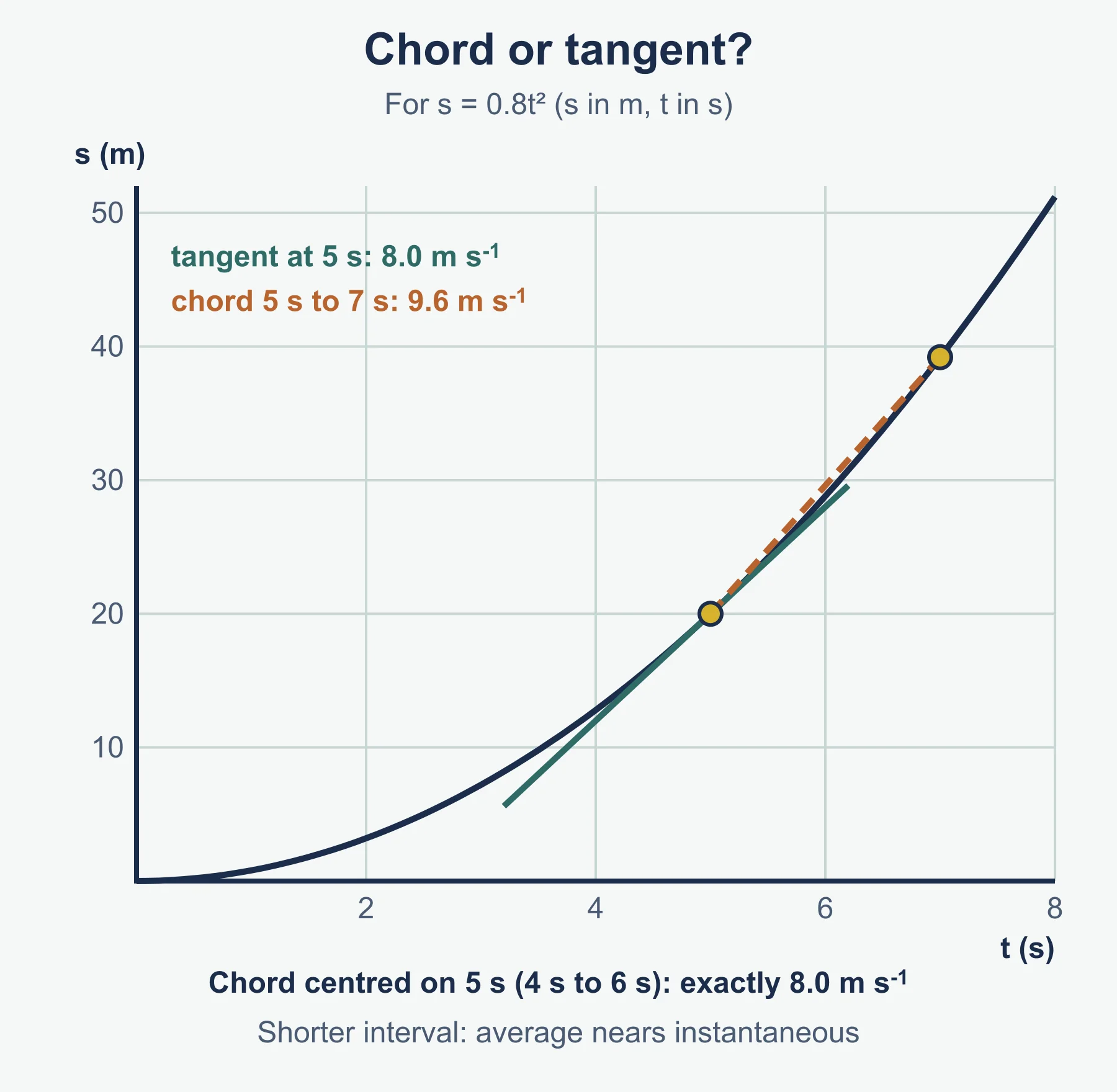
Reminder. For s = 0.8t² (s in m, t in s) the instantaneous velocity at t = 5.0 s is 8.0 m s⁻¹. The average over 5 s to 7 s is (39.2 − 20.0) ÷ 2 = 9.6 m s⁻¹. The shorter the interval, the closer the average gets to the instantaneous value. A chord centred on the instant (4 s to 6 s) gives exactly 8.0 m s⁻¹ here, because the acceleration is constant.
Graph rules
| Graph type | Slope means | Area means |
|---|---|---|
| Displacement-time | Velocity | No simple meaning needed |
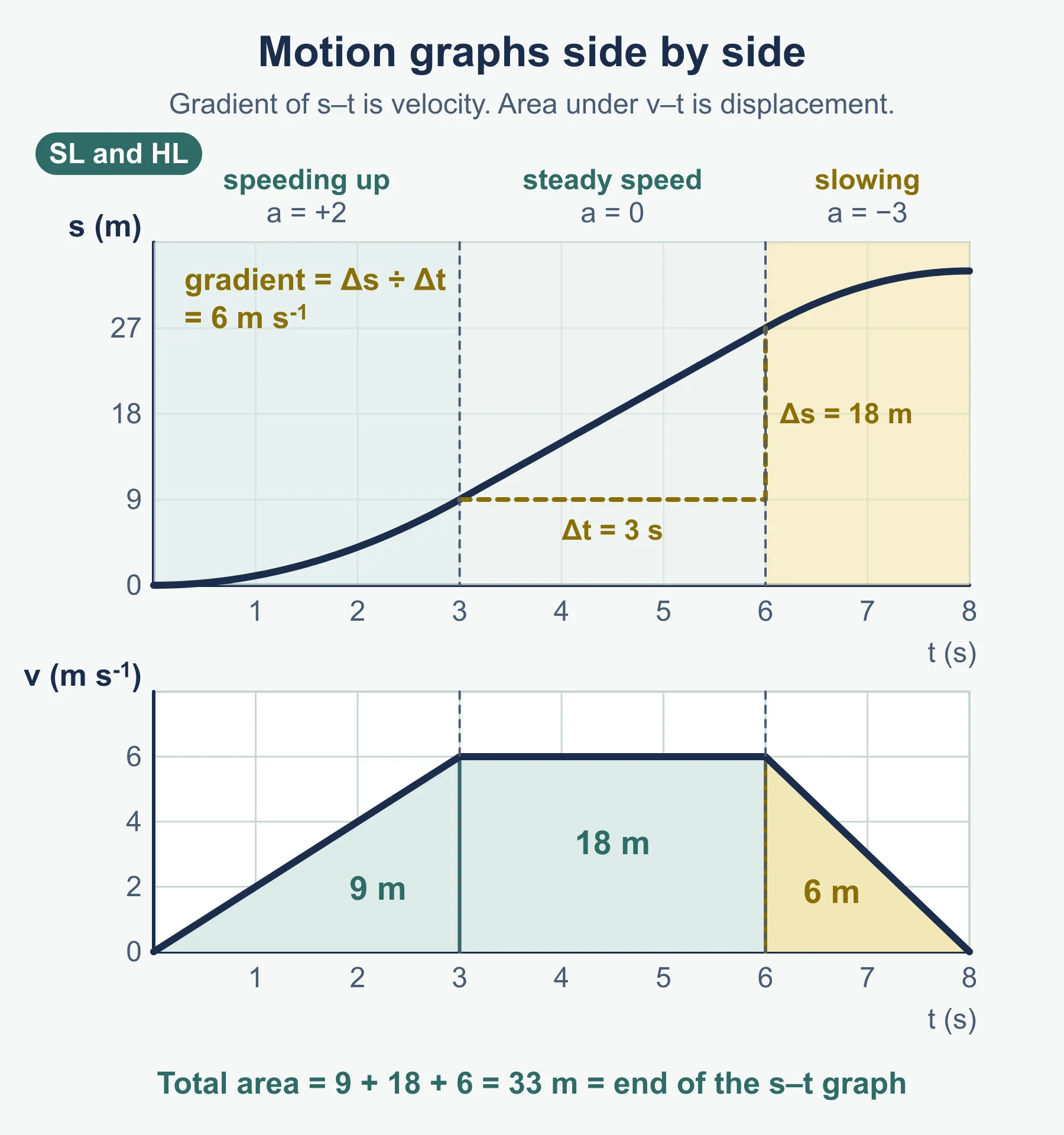
| Velocity-time | Acceleration | Displacement (areas below the time axis count as negative) |
- Straight s-t line: constant velocity. Curve on an s-t graph: velocity is changing.
- Straight v-t line: uniform acceleration. Curved v-t line: non-uniform acceleration.
- A horizontal v-t line has zero gradient: zero acceleration, not zero velocity.
- Crossing the time axis on a v-t graph means the direction of motion reverses.
- For a v-t graph made of straight pieces, split the area into triangles, rectangles and trapeziums. For a curve, count squares or use trapeziums and say the result is an estimate.
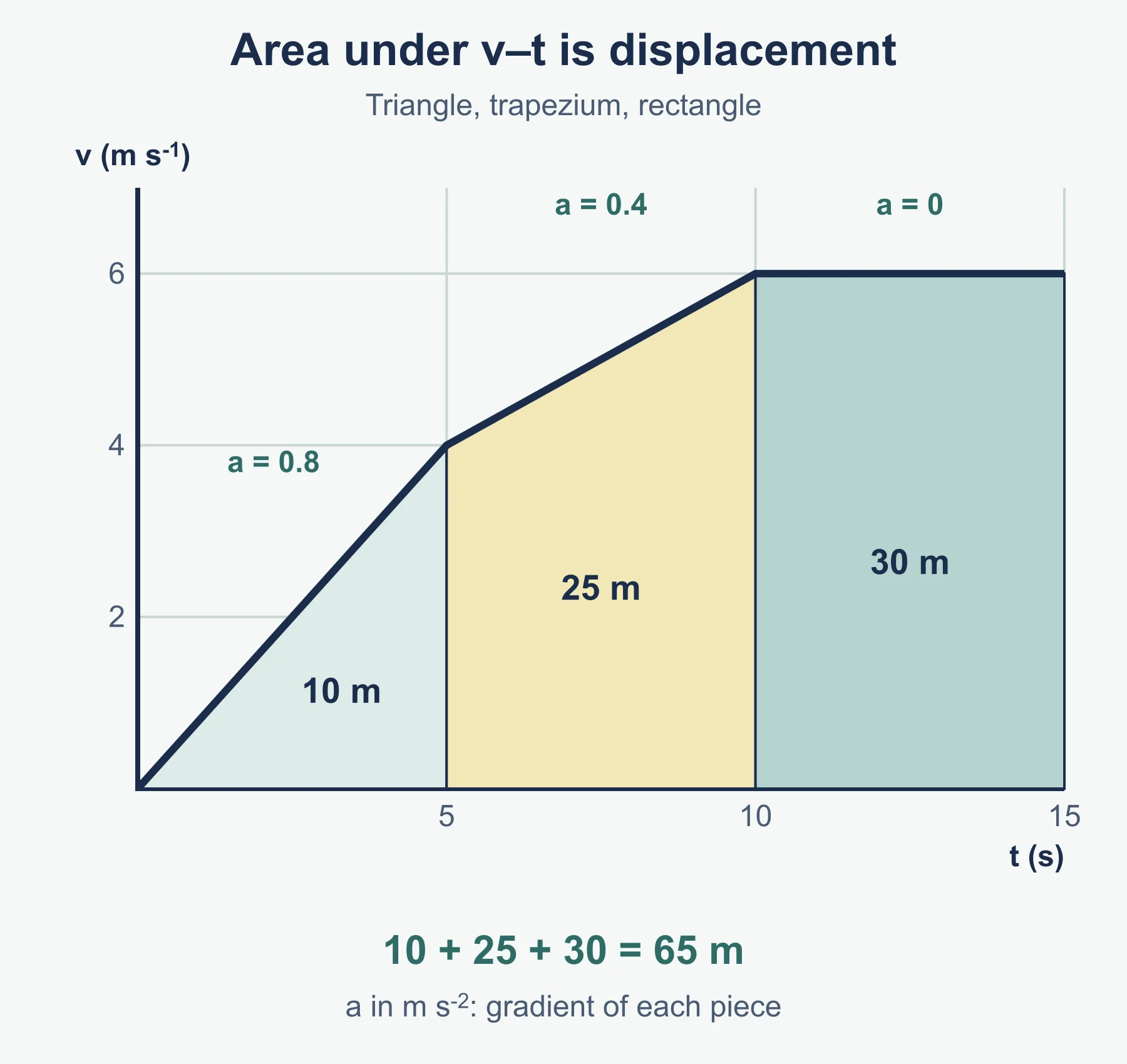
Reminder. A v-t graph rises from 0 to 4 m s⁻¹ in 5 s, then to 6 m s⁻¹ over the next 5 s, then stays at 6 m s⁻¹ for 5 s. Displacement = 10 + 25 + 30 = 65 m.
Equations of motion
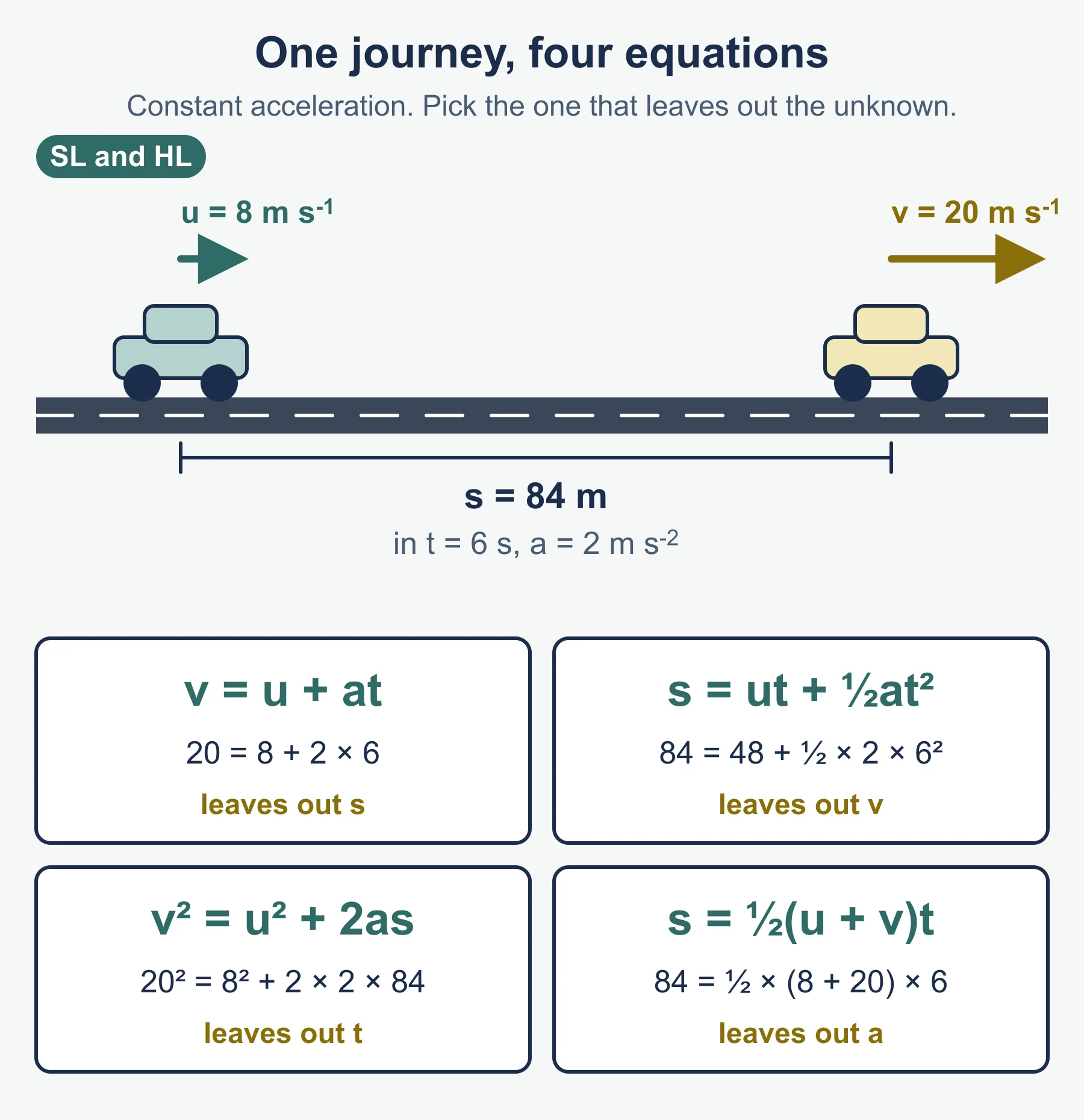
- s = (u + v)t / 2
- v = u + at
- s = ut + ½at²
- v² = u² + 2as
Here s is displacement, u initial velocity, v final velocity, a acceleration and t time.
| Missing variable | Use |
|---|---|
| a | s = (u + v)t / 2 |
| s | v = u + at |
| v | s = ut + ½at² |
| t | v² = u² + 2as |
Method in steps
- Choose a positive direction and draw it.
- List s, u, v, a, t with signs. Mark what you are asked for.
- Pick the equation that contains your three knowns and one unknown.
- Substitute, solve, then check the sign and size make sense.
Warnings.
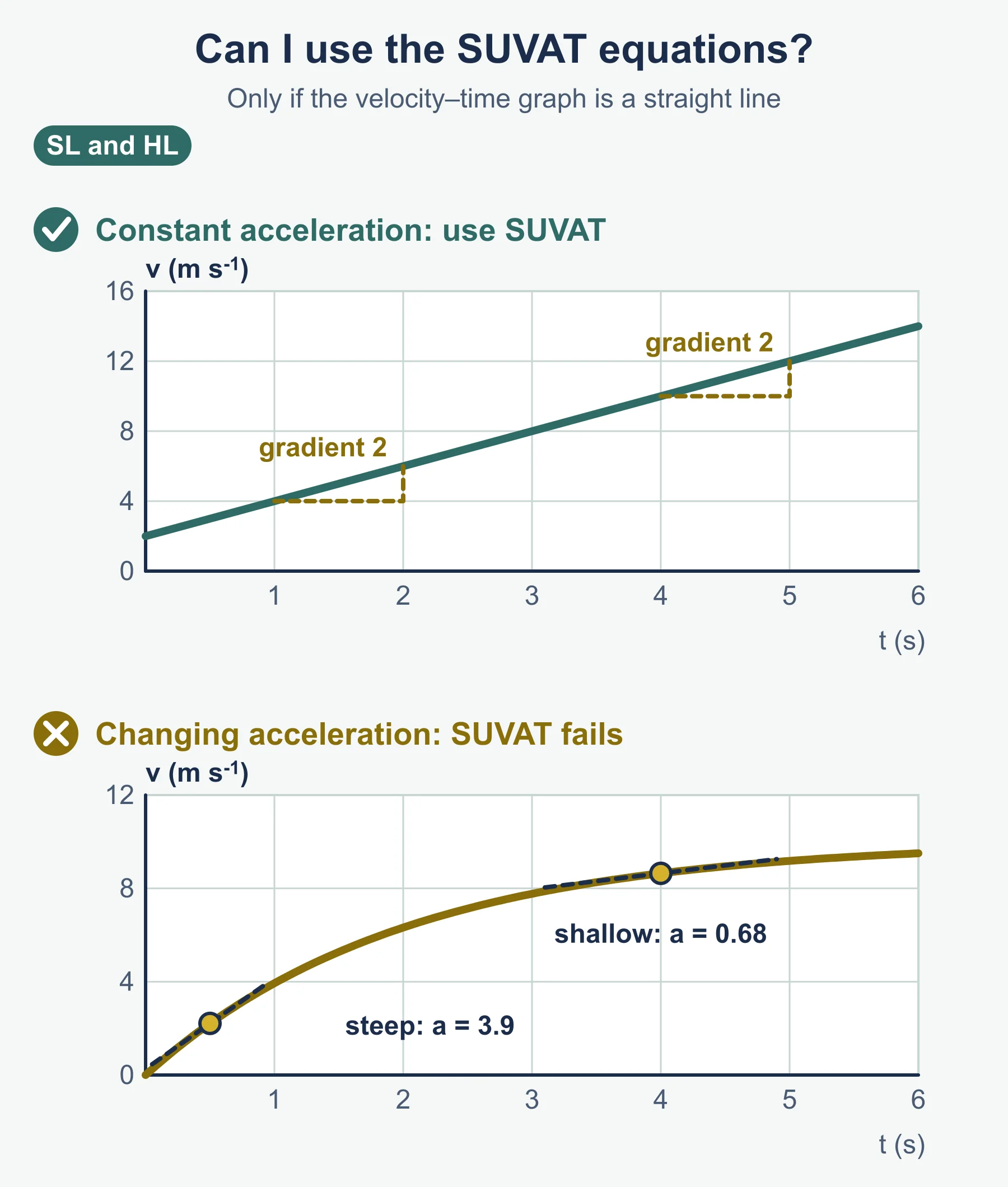
- These four equations need constant acceleration. If the v-t graph is curved, they do not apply across the whole motion.
- A motion with two stages (speeding up, then braking) needs two separate applications, with the final velocity of stage one as the initial velocity of stage two.
- Taking square roots in v² = u² + 2as gives a ± answer. Decide the sign from the physics.
Reminders.
- A train with u = 8.0 m s⁻¹ and a = 0.50 m s⁻² for 12 s has v = 14.0 m s⁻¹ and s = 132 m.
- A car at 30 m s⁻¹ braking at 6.0 m s⁻² stops in 5.0 s over 75 m.
Uniform versus non-uniform acceleration
- Uniform: the acceleration does not change in size or direction. The v-t graph is straight. Use the four equations.
- Non-uniform: the acceleration changes, so the v-t graph is curved. Use gradients and areas of the graph instead, or split the motion into stages that are close to uniform.
- Falling with fluid resistance is the standard non-uniform case in this topic.
Projectiles with no fluid resistance
Only gravity acts. Use a constant g of 9.81 m s⁻² downward near the Earth’s surface.
| Direction | Acceleration | Rule |
|---|---|---|
| Horizontal | 0 | Constant velocity: x = uₓt |
| Vertical | g downward | Use the equations of motion with the vertical components |
The path is a parabola. You do not need the equation of the trajectory.
Launch from an angle θ above the horizontal
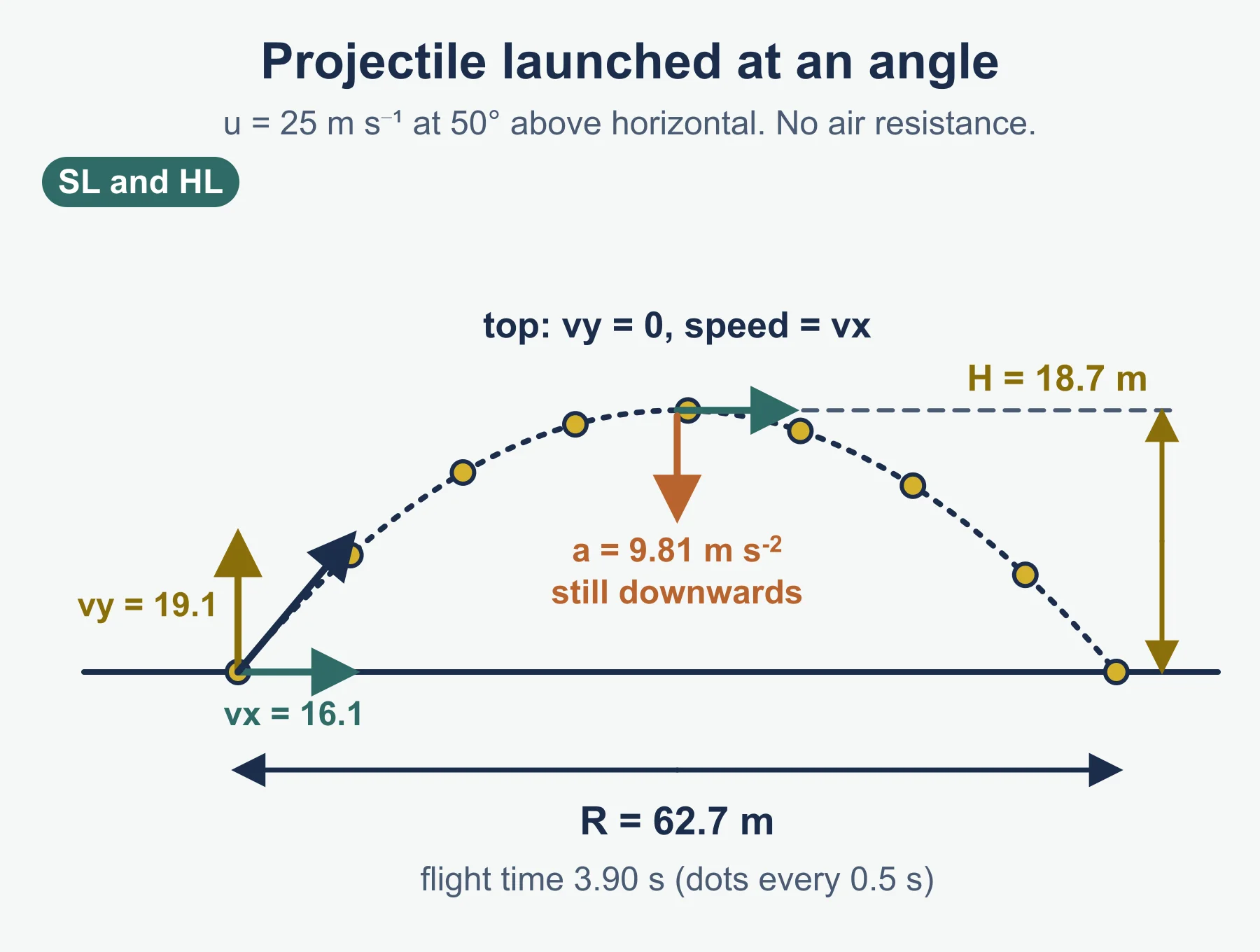
- uₓ = u cos θ and uᵧ = u sin θ.
- At the top, only the vertical velocity is zero; the horizontal velocity is unchanged and non-zero.
- On level ground the up-and-down times are equal. Time of flight T = 2uᵧ/g, range = uₓT.
- Maximum height H = uᵧ²/(2g).
- Landing speed equals launch speed on level ground, with the same angle below the horizontal.
Reminder. u = 24 m s⁻¹ at 40°: uₓ = 18.4 m s⁻¹, uᵧ = 15.4 m s⁻¹, T = 3.15 s, range = 57.8 m, H = 12.1 m.
Launch horizontally
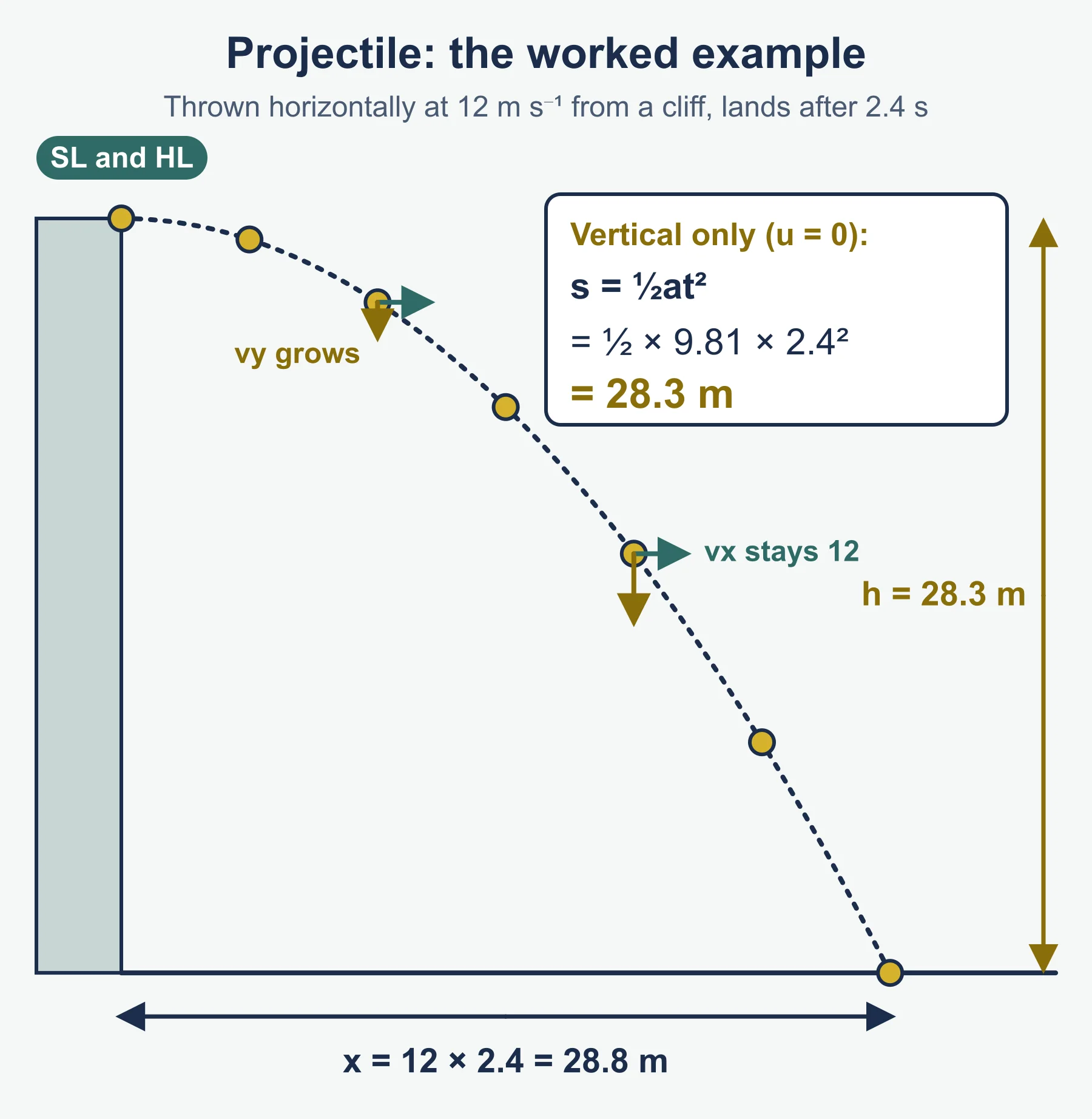
- Vertical initial velocity is zero. Time of fall depends only on the height and g.
- Horizontal distance = uₓ × time of fall.
Launch at an angle below the horizontal
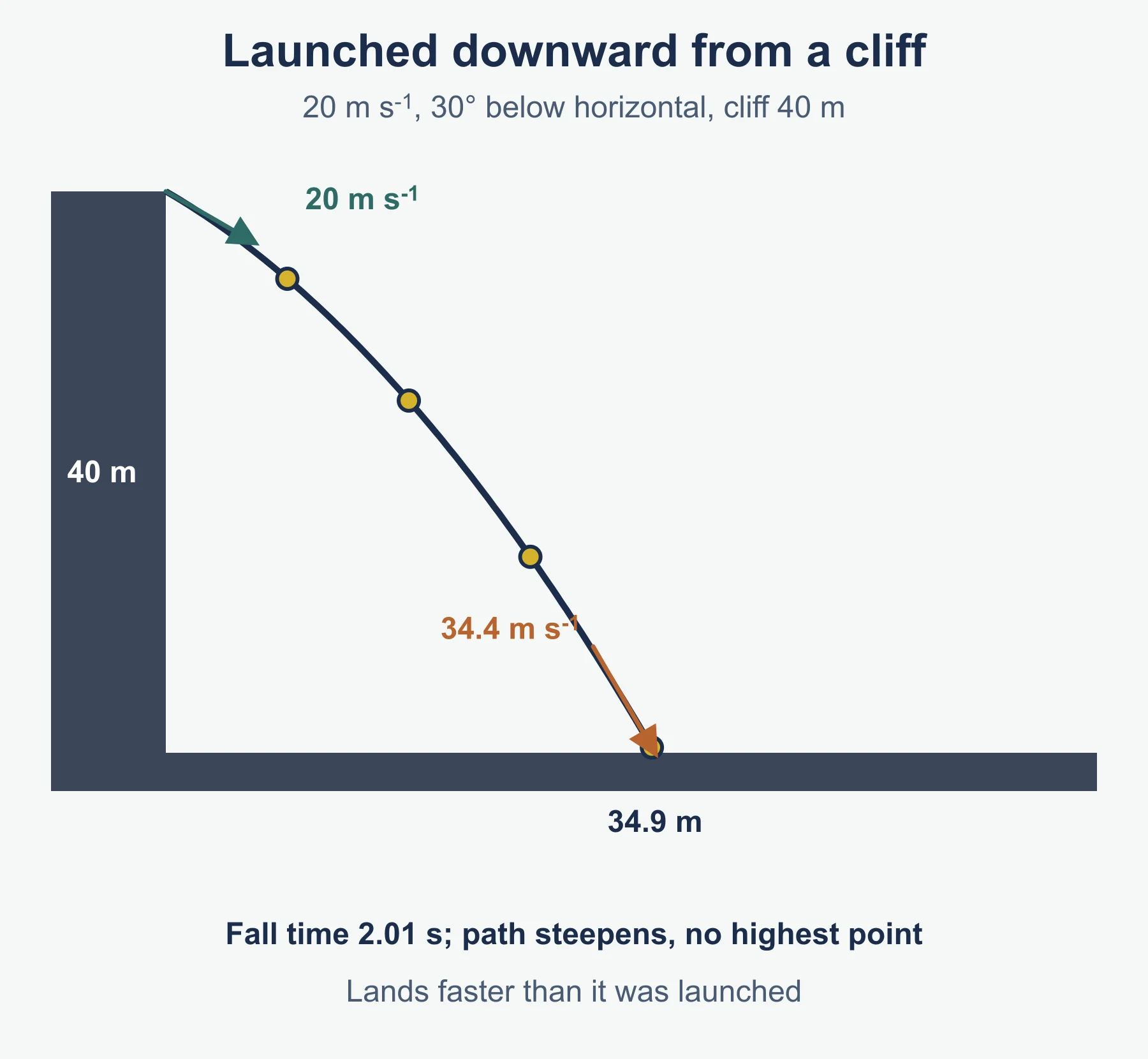
- Take uᵧ as a downward component. With down as positive, uᵧ = u sin θ and a = +g.
- The path starts steep and gets steeper. There is no highest point after launch.
- The landing speed is larger than the launch speed when the landing level is lower than the launch point.
Fluid resistance on projectiles (qualitative)
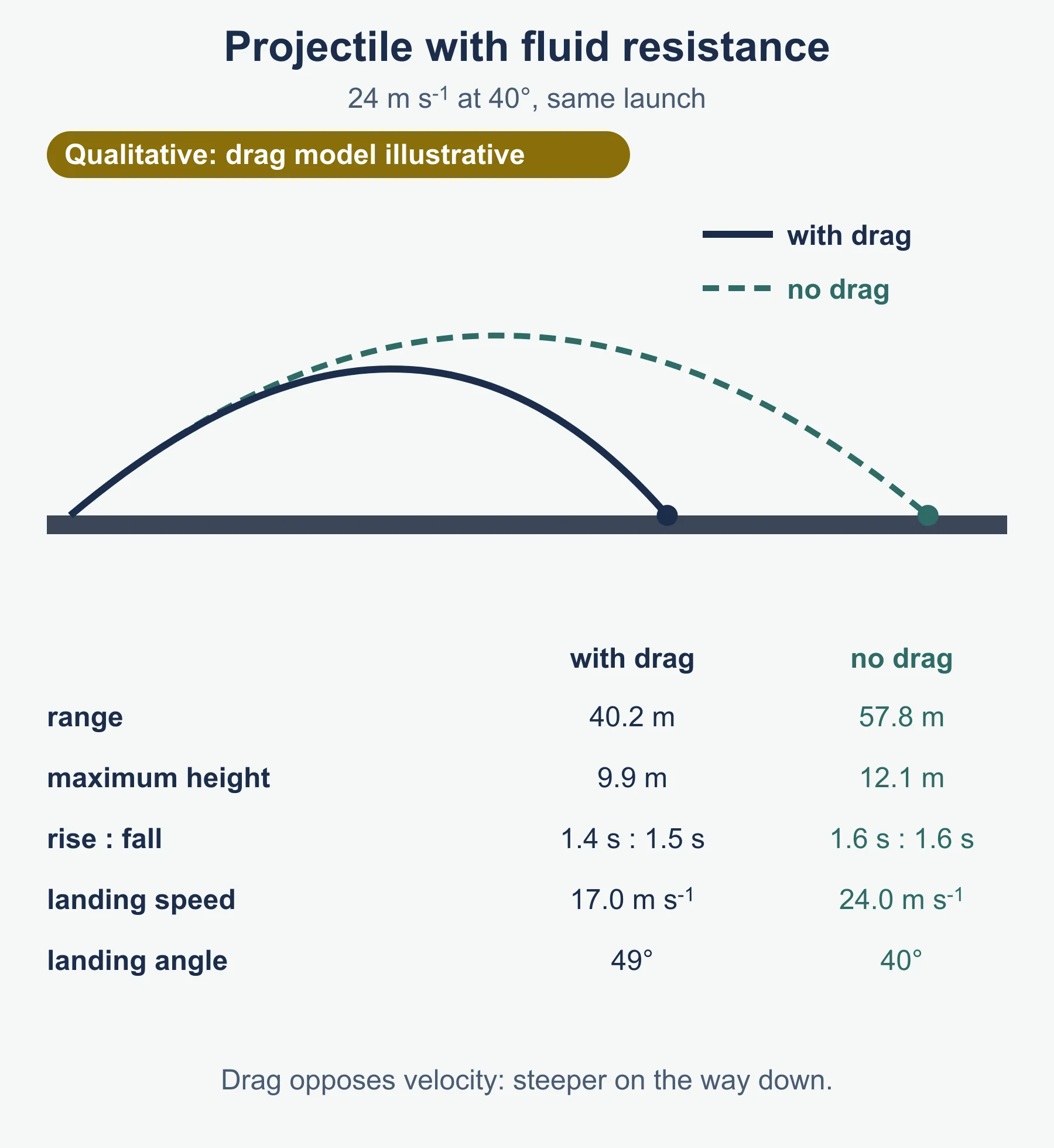
Fluid resistance means the drag from a gas or a liquid. It opposes the velocity and grows with speed. The guide asks for qualitative effects only, so describe them in words.
| Quantity | Effect of fluid resistance |
|---|---|
| Time of flight | The rise takes less time than it would without resistance, and the fall takes longer than the rise. Compare the two stages rather than assuming the total |
| Trajectory | No longer a parabola. Steeper on the way down than on the way up |
| Velocity | Horizontal component keeps falling. Landing speed is less than launch speed on level ground |
| Acceleration | No longer constant. Not equal to g, because drag adds a component along the path |
| Range | Smaller |
| Maximum height | Smaller |
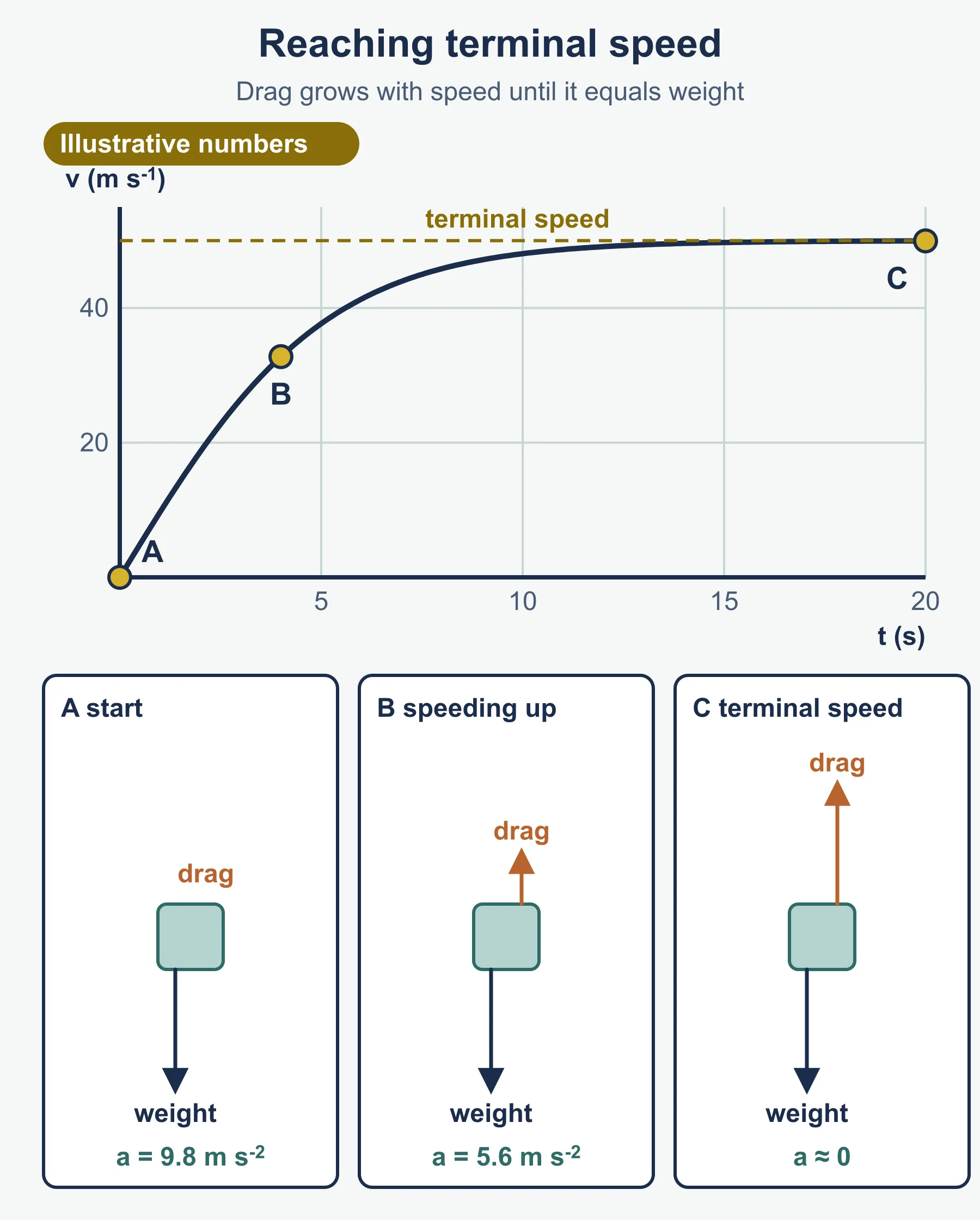
| Terminal speed | A falling body speeds up until drag equals weight. The resultant force is then zero and the speed is constant |
Terminal speed in steps. At release the speed is small, so drag is small and the acceleration is close to g. As the speed rises, drag rises, the resultant force falls and the acceleration falls. When drag equals weight, acceleration is zero and the speed stays at its terminal value. The v-t graph flattens out, and its gradient is the acceleration at each instant.
Must-know distinctions
- Distance versus displacement; speed versus velocity.
- Average versus instantaneous: chord versus tangent.
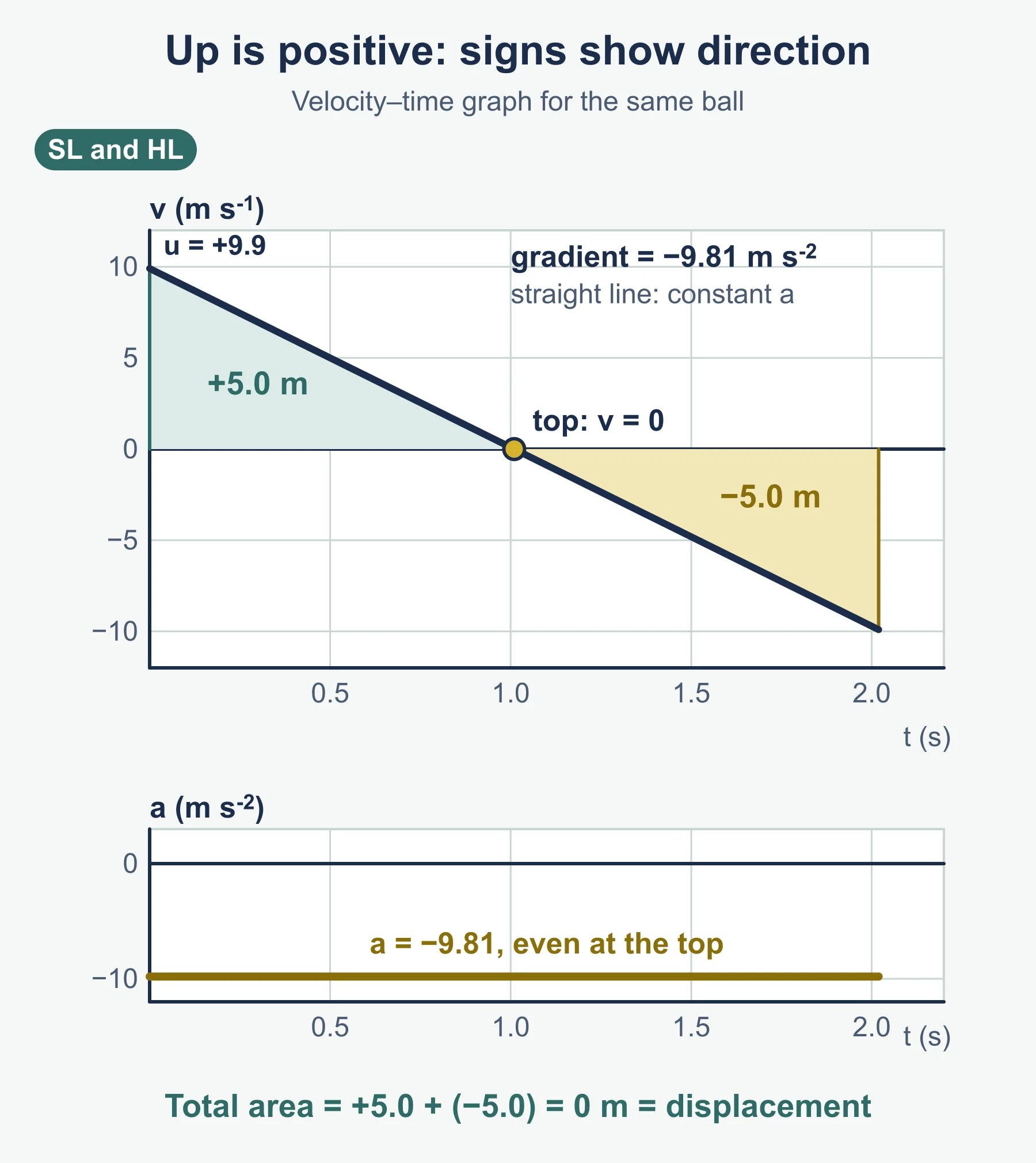
- Zero velocity versus zero acceleration: a ball at the top of its flight has zero vertical velocity but acceleration g.
- Uniform versus non-uniform: straight versus curved v-t line.
- At terminal speed the acceleration is zero and the velocity is constant, but not because no force acts. There are two forces (weight and drag), and they cancel.
Quick self-test
- A runner completes one 400 m lap in 80 s. What are the average speed and the average velocity?
- A cart moves 60 m east then 20 m west in 16 s. State its displacement and average velocity.
- A train at 8.0 m s⁻¹ accelerates at 0.50 m s⁻² for 12 s. Find the distance travelled.
- A car at 30 m s⁻¹ brakes uniformly at 6.0 m s⁻². Find the stopping distance.
- A ball is launched at 24 m s⁻¹, 40° above level ground. Find its time of flight.
- Using the launch in question 5, work out the maximum height.
- On a velocity-time graph, what does a curve that gets less steep show?
- For s = 0.8t², find the instantaneous velocity at 5.0 s using the gradient rule v = 1.6t.
- State what happens to the range of a projectile when fluid resistance acts.
- Explain why a skydiver reaches a constant speed.
Answers
- Average speed 5.0 m s⁻¹. Average velocity 0, because the displacement is zero.
- 40 m east. Average velocity 2.5 m s⁻¹ east.
- 132 m, using s = ut + ½at² = 96 + 36.
- 75 m, using v² = u² + 2as with v = 0.
- 3.15 s, from T = 2 × 15.4 ÷ 9.81.
- 12.1 m, from 15.4² ÷ (2 × 9.81).
- The acceleration is decreasing: non-uniform acceleration with falling gradient.
- 8.0 m s⁻¹.
- The range is smaller.
- Drag rises with speed until it balances the weight. Net force and acceleration then drop to zero, so the speed stays constant.
Where marks are usually lost
- Writing distance when a displacement is asked for, or dropping the direction from a velocity.
- Using the four equations on a curved v-t graph without comment.
- Mixing horizontal and vertical values in one equation.
- Forgetting that the vertical velocity is zero only at the top, not the horizontal one.
- Sign slips: using g as positive upward in one line and downward in the next.
- Describing fluid resistance effects with no reasoning, such as “range decreases” with no mention of drag opposing the velocity.
- Saying terminal speed means no forces act, rather than balanced forces.
- Reading an average from a chord when the question wants an instantaneous value from a tangent.
- Rounding the time of flight early and carrying the error into the range.
Frequently asked questions
Do I need the equation of a projectile’s trajectory for IB DP Physics? No. Without fluid resistance the path is a parabola, but you do not need the equation of the trajectory; treat the horizontal and vertical components separately.
What is the acceleration of a projectile at the top of its flight? It is still g downward. Only the vertical velocity is zero at the top; the horizontal velocity is unchanged, so zero velocity does not mean zero acceleration.
Is the effect of fluid resistance on projectiles examined quantitatively? No. The guide asks for qualitative effects only, such as a smaller range and height, a non-parabolic path and a lower landing speed, so describe them in words.
How do these notes differ from the earlier A.1 revision notes? The earlier notes cover the basic definitions and one cliff-launch example. These add average versus instantaneous values, non-uniform motion, all three launch types and the effect of fluid resistance.
Official syllabus
International Baccalaureate Organization, Physics guide (Diploma Programme), first assessment 2025, section A.1 Kinematics.
Get free revision emails (optional)
Occasional emails with practice questions, worked explanations and links to free resources for the qualification and subjects you choose. No spam, and you can unsubscribe from any email. The free tools on this site never need an email.
Related resources
-
Practice questions
IB DP Physics: A.1 Kinematics, graphs, projectiles and fluid resistance (DP Physics) – Practice Questions
Eleven original IB DP Physics practice questions on A.1 Kinematics with worked answers: graphs, SUVAT, projectiles and fluid resistance.
Physics · International Baccalaureate · IB
Try questions -
Practice questions
Kinematics: Practice Questions
Original IB DP Physics A.1 kinematics practice with worked answers: SUVAT, graphs, horizontal and angled projectiles, air resistance and uncertainty in g.
Physics · International Baccalaureate · IB
Try questions -
Revision notes
Kinematics: Revision Notes
Condensed recall notes on kinematics (topic A.1), common to both SL and HL, for IB Diploma Programme Physics.
Physics · International Baccalaureate · IB
Revise topic
Related articles
-
study skills
How to revise for a science examination
Most science revision fails because it rereads notes instead of retrieving them. A practical method for revising physics, chemistry and biology in the weeks before a paper.
14 July 2026
-
teaching
A Level tuition in Dubai: Cambridge or Pearson Edexcel International A Level?
Schools in Dubai and Abu Dhabi teach either Cambridge International AS & A Level or Pearson Edexcel International A Level. How the two are structured, why it matters for tuition, and how online classes from Lahore work.
9 October 2026
Studying this with a teacher
Working through Physics IB?
This page is free and stays free. If you would rather be taught it, Marlbridge runs Physics classes one-to-one, online in your own time zone. The first trial class is free. WhatsApp replies within an hour (8am–11pm Pakistan time, every day); email the same day.
IB Physics teachers at Marlbridge


