
Revision Notes
IB DP Psychology: Developmental psychology (human development) – Revision Notes
IB DP Psychology human development revision notes: peers and play, trauma and resilience, poverty, brain and cognitive development, attachment and identity.
- Subject
- Psychology
- Level
- IB
- Topic
- Context – Human development
- Author
- Marlbridge Academic Team
- Updated
- Reviewed by
- Kanwal Aslam (what this means)
Aligned to International Baccalaureate IB Diploma Programme Psychology (DP Psychology (2027), DP Psychology (2019) / DP Psychology (2027)), First assessment 2027. Official specification .
Syllabus page (what it covers and how it is assessed): IB Diploma Programme Psychology.
Syllabus topics and points this page is mapped to
DP Psychology (2027)
- 7 Context: Human development (topic-level mapping)
"Topic-level mapping" means this page belongs to that topic; it does not claim to cover every point in it.
Developmental psychology is the study of how and why people’s behaviour and cognition change over time, and it forms the human development context of IB DP Psychology (first assessment 2027), studied at SL and HL. These notes cover what influences children’s cognitive and social development and how they form a sense of self – through attachment, the role of childhood experiences, peers and play, and the development of theory of mind – drawing on biological, cognitive and sociocultural research.
Related: Developmental psychology study guide.
Syllabus coverage (first assessment 2027)
| Area of study in the 2027 guide | Where these notes cover it |
|---|---|
| Models of development; stage theories and continuous models | Piaget’s stages; Vygotsky |
| Brain development | Brain development (Chugani; Gogtay et al.) |
| Sociocultural factors in development | Vygotsky; poverty and socio-economic status |
| Theory of mind | False-belief tasks (Wimmer and Perner; Baron-Cohen et al.) |
| Development of self: attachment; role of childhood experiences; peer influence | Attachment (Bowlby, Ainsworth, Harlow); trauma and resilience; peers and play |
| Not named in the guide | Gender identity and social roles (Smith and Lloyd; gender schema theory), kept as an extension |
Enculturation of social norms and critical periods as an explanation of development are named in the guide but not covered in detail in these notes.
Key theories
| Theory | Claim | Evaluation |
|---|---|---|
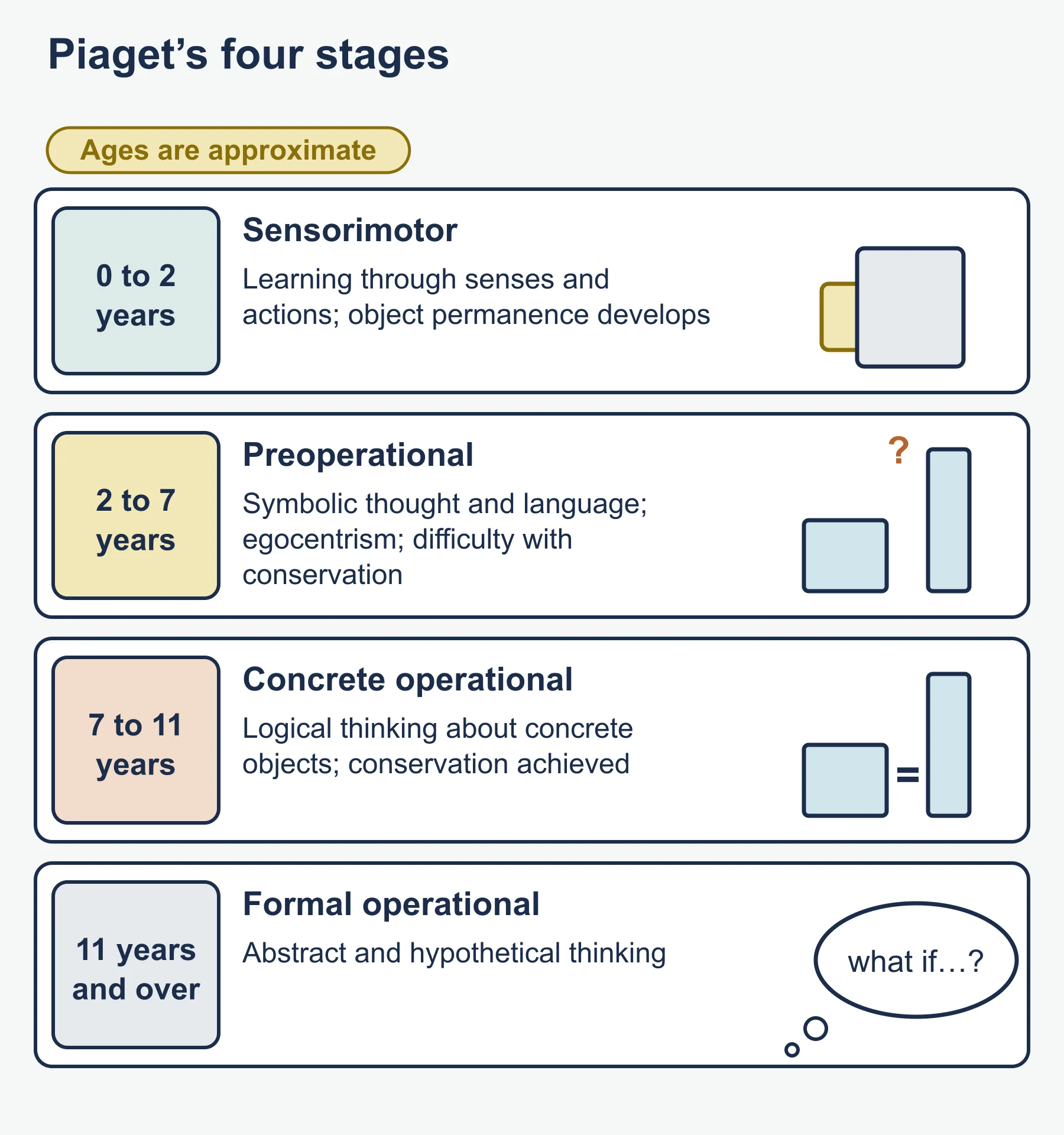
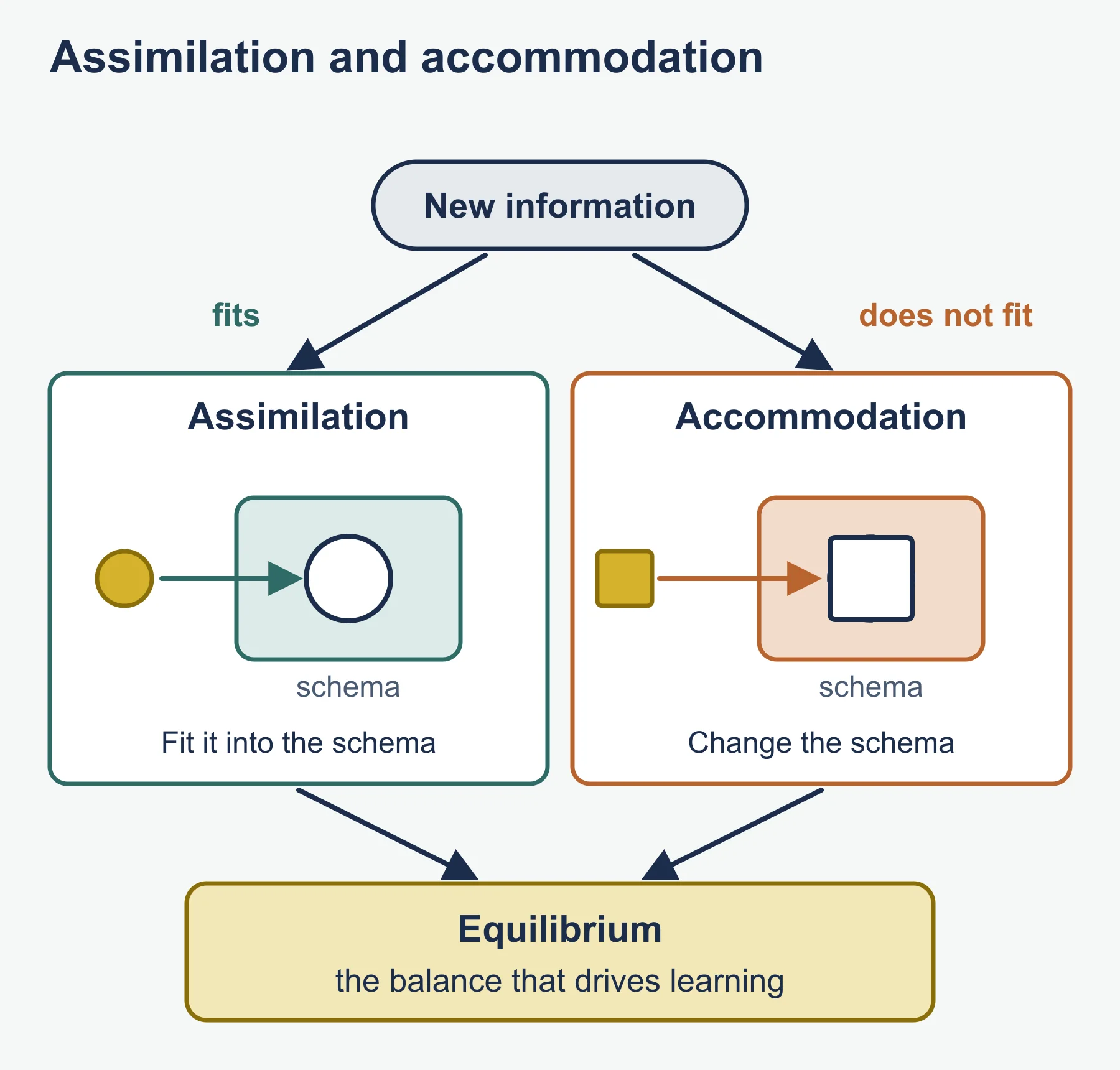
| Piaget’s stages | Sensorimotor, pre-operational, concrete operational, formal operational; children actively construct knowledge through assimilation and accommodation | Influential and testable; underestimated young children’s abilities; less attention to culture |
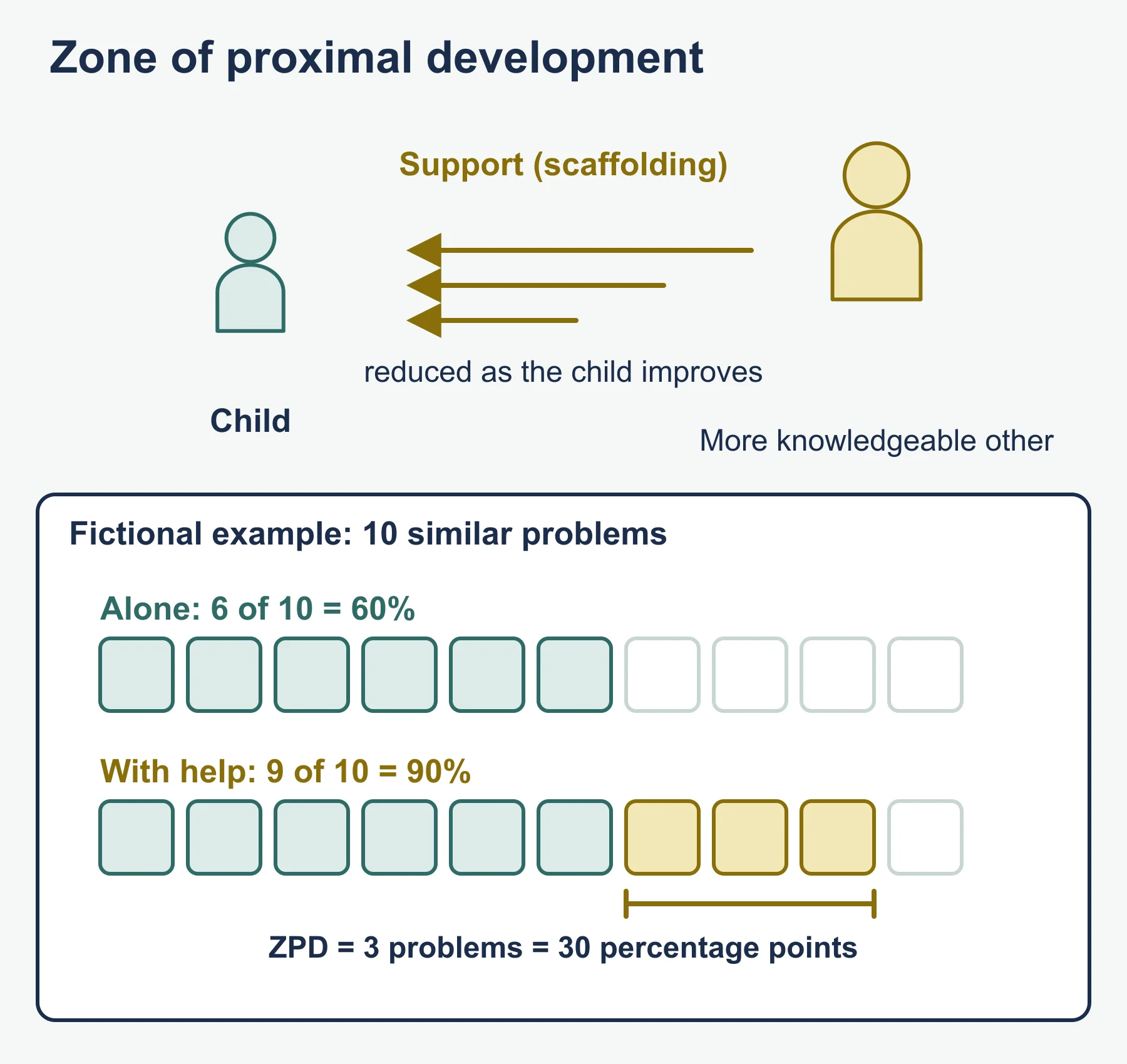
| Vygotsky | Learning is social; the zone of proximal development (ZPD) and scaffolding by more knowledgeable others; play builds self-regulation | Emphasises culture; harder to test precisely |
| Bowlby’s attachment theory | Infants have an innate need to attach to a caregiver; an internal working model guides later relationships | Supported by animal and human research; critics question monotropy and the critical period |
| Social learning / gender schema | Gender roles are learned by observation and reinforcement (Bandura); children build gender schemas that organise information (Martin and Halverson, 1981) | Explains cultural variation; biological factors also play a part |
Key studies
| Study | Finding | Content point |
|---|---|---|
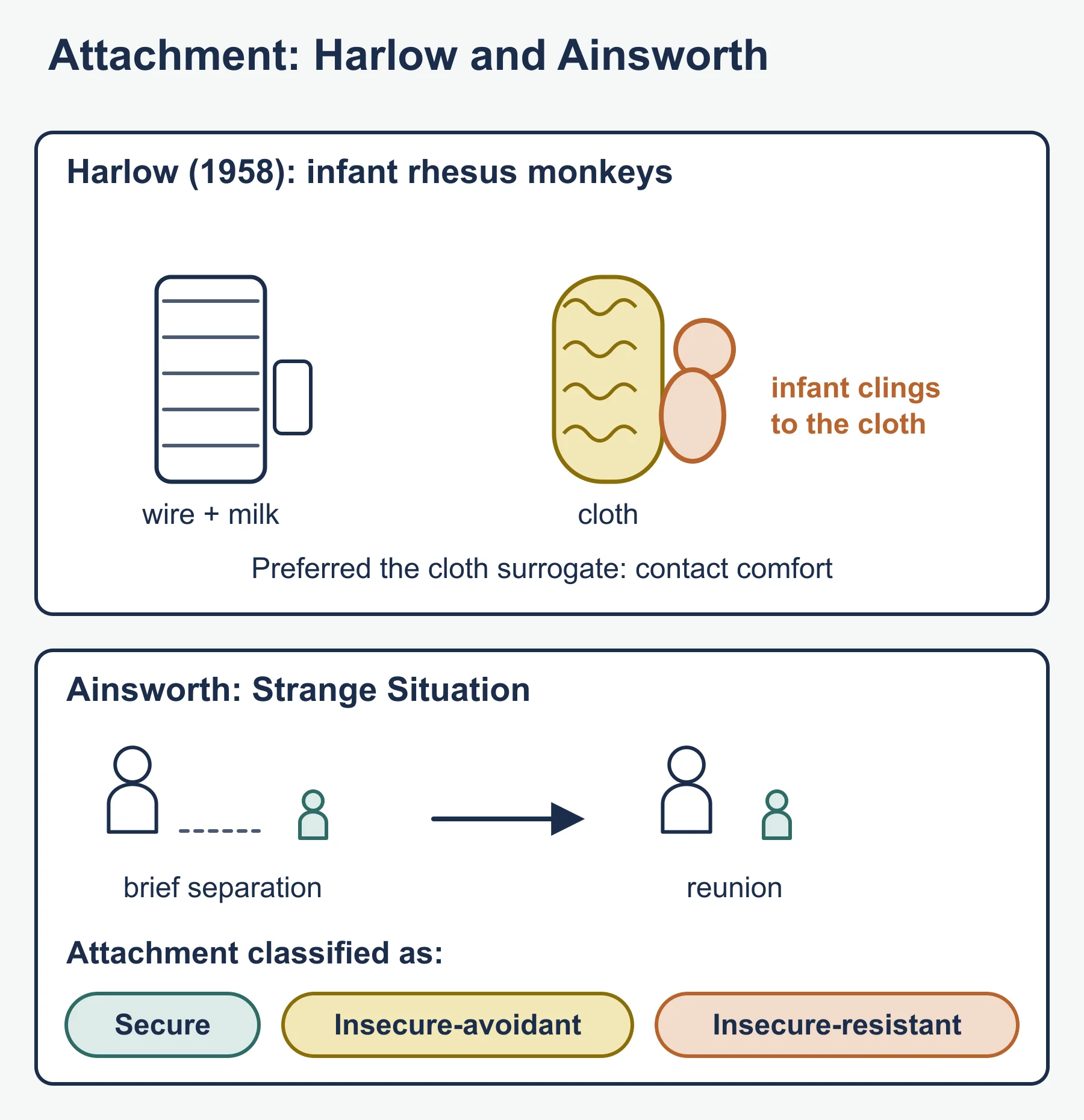
| Harlow (1958) | Infant rhesus monkeys preferred a cloth “mother” for comfort over a wire mother that gave milk | Attachment (contact comfort) |
| Ainsworth et al. (1978) | Strange Situation classified infants as secure, avoidant or resistant; most of the Baltimore sample were secure | Attachment |
| Van IJzendoorn and Kroonenberg (1988) | Meta-analysis of Strange Situation studies in eight countries: secure attachment most common everywhere; avoidant more common in Germany, resistant in Japan and Israel | Attachment and culture |
| Hodges and Tizard (1989); Rutter et al. (English and Romanian Adoptees study) | Children raised in institutions showed later social difficulties; children adopted early from Romanian orphanages recovered better than those adopted later | Childhood trauma and resilience |
| Werner and Smith (Kauai longitudinal study) | About a third of high-risk children grew into competent adults; protective factors included a close bond with a caregiver and community support | Resilience |
| Luby et al. (2013) | Childhood poverty linked to smaller hippocampal and amygdala volumes, partly through caregiving quality and stressful events | Poverty and brain development |
| Hart and Risley (1995) | Large differences in the number of words children heard at home by family socio-economic status, linked to vocabulary growth | Poverty and cognitive development |
| Chugani (1987); Gogtay et al. (2004) | PET and longitudinal MRI studies show brain regions mature at different rates, with the prefrontal cortex maturing last | Brain development |
| Baron-Cohen, Leslie and Frith (1985) | Most autistic children failed the Sally-Anne false-belief task, unlike most children with Down syndrome and typically developing children | Theory of mind |
| Wimmer and Perner (1983) | Children typically pass false-belief tasks around age four | Theory of mind |
| Smith and Lloyd (1978) | Mothers chose gender-typed toys for infants according to the sex they were told the baby was | Gender identity and social roles |
Worked example: linking a study to resilience
Question: Explain one study of resilience.
- Define resilience: positive adaptation despite significant adversity.
- Study: Werner and Smith followed all children born on the Hawaiian island of Kauai in 1955. Around 30% faced several risk factors such as poverty, family discord or parental mental illness.
- Finding: about a third of these high-risk children were already developing into competent, caring young adults by age 18, and many others recovered in adulthood.
- Explanation: protective factors – an easy temperament, at least one close caregiver, school and community support – helped them adapt.
- Evaluation: long-term longitudinal design and a whole birth cohort; but one community, correlational data and attrition over decades.
Common mistakes / exam traps
- Describing Piaget’s stages without linking them to a question on learning. Focus on what they show about cognitive development.
- Treating attachment types as fixed. Research shows they can change with circumstances.
- Using Harlow without ethical evaluation. Animal research raises ethical issues and questions of generalisation to humans.
- Equating poverty with neglect. Explain mechanisms such as stress, nutrition and language exposure.
Frequently asked questions
How is human development examined? On Paper 1 section B you apply content to an unseen situation set in one of the four contexts, and section C is a concept-based extended response set from a context. Paper 2 section A asks four compulsory questions on the class practicals (for this context, an observation).
Which theories are essential? The guide does not prescribe particular theories. Useful ones are Piaget and Vygotsky for models of development, Bowlby and Ainsworth for attachment, and at least one account of theory of mind.
Can I use studies from the other content areas? Yes, if they are relevant – for example Bandura’s social cognitive theory for gender roles – but link them to development.
Self-test
- What is the zone of proximal development? The gap between what a child can do alone and with help.
- Name the three main attachment types in the Strange Situation. Secure, avoidant (insecure-avoidant), resistant (insecure-resistant).
- What does a false-belief task test? Theory of mind – understanding that others can hold beliefs different from reality.
- Which brain region matures last? The prefrontal cortex.
- What is a protective factor? A factor that reduces the effect of adversity, such as a supportive caregiver.
Related resources
-
Study guides
IB DP Psychology: Developmental psychology (human development) – Study Guide
Cognitive and social development, attachment, identity, moral reasoning and learning theories with key studies for the human development context of IB DP Psychology.
Psychology · International Baccalaureate · IB
Read guide -
Study guides
IB DP Psychology: Development of Empathy and Theory of Mind
Empathy and theory of mind for IB DP Psychology (human development): false-belief tasks, cross-cultural and infant research, stages of empathy and an essay plan.
Psychology · International Baccalaureate · IB
Read guide -
Practice questions
IB DP Psychology: Development of Empathy and Theory of Mind – Practice Questions
Original IB DP Psychology practice on empathy and theory of mind: false-belief logic, an invented task to analyse, empathy stages and a 15-mark essay plan.
Psychology · International Baccalaureate · IB
Try questions
Studying Psychology?
This page is free and stays free. Marlbridge is not offering Psychology classes at the moment, so there is no tuition to book for it. The free study resources stay open to everyone.
Get free revision emails (optional)
Occasional emails with practice questions, worked explanations and links to free resources for the qualification and subjects you choose. No spam, and you can unsubscribe from any email. The free tools on this site never need an email.