
Study Guides
IB DP Psychology: Developmental psychology (human development) – Study Guide
Cognitive and social development, attachment, identity, moral reasoning and learning theories with key studies for the human development context of IB DP Psychology.
- Subject
- Psychology
- Level
- IB
- Topic
- Context – Human development
- Author
- Marlbridge Academic Team
- Updated
- Reviewed by
- Kanwal Aslam (what this means)
Aligned to International Baccalaureate IB Diploma Programme Psychology (DP Psychology (2027), DP Psychology (2019) / DP Psychology (2027)), First assessment 2027. Official specification .
Syllabus page (what it covers and how it is assessed): IB Diploma Programme Psychology.
Syllabus topics and points this page is mapped to
DP Psychology (2027)
- 7 Context: Human development (topic-level mapping)
"Topic-level mapping" means this page belongs to that topic; it does not claim to cover every point in it.
Developmental psychology studies how people change across the lifespan, with special attention to childhood and adolescence. This guide supports the human development context, which asks how thinking, relationships and identity develop, what influences that development, and how we know. Because children cannot always be studied in the same way as adults, research methods and ethics are an important part of every answer.
Where this fits in the specification
Human development is one of the four contexts of IB Diploma Programme Psychology (first assessment 2027), studied at SL and HL, and its class practical is an observation. The guide lists areas of study under two headings. Models of development covers cognitive, social, moral or language development, brain development, sociocultural factors, stage theories and continuous models, and theory of mind. Development of self covers attachment, enculturation of social norms, peer influence and the role of childhood experiences. This guide covers Piaget, Vygotsky, attachment, social learning, Kohlberg, identity (Erikson and Marcia) and influences on development and learning; brain development, theory of mind and enculturation are not covered in detail here. Paper 1 section B asks you to apply content to an unseen situation in one of the four contexts, and section C is a concept-based extended response set from a context.
Cognitive development
Piaget
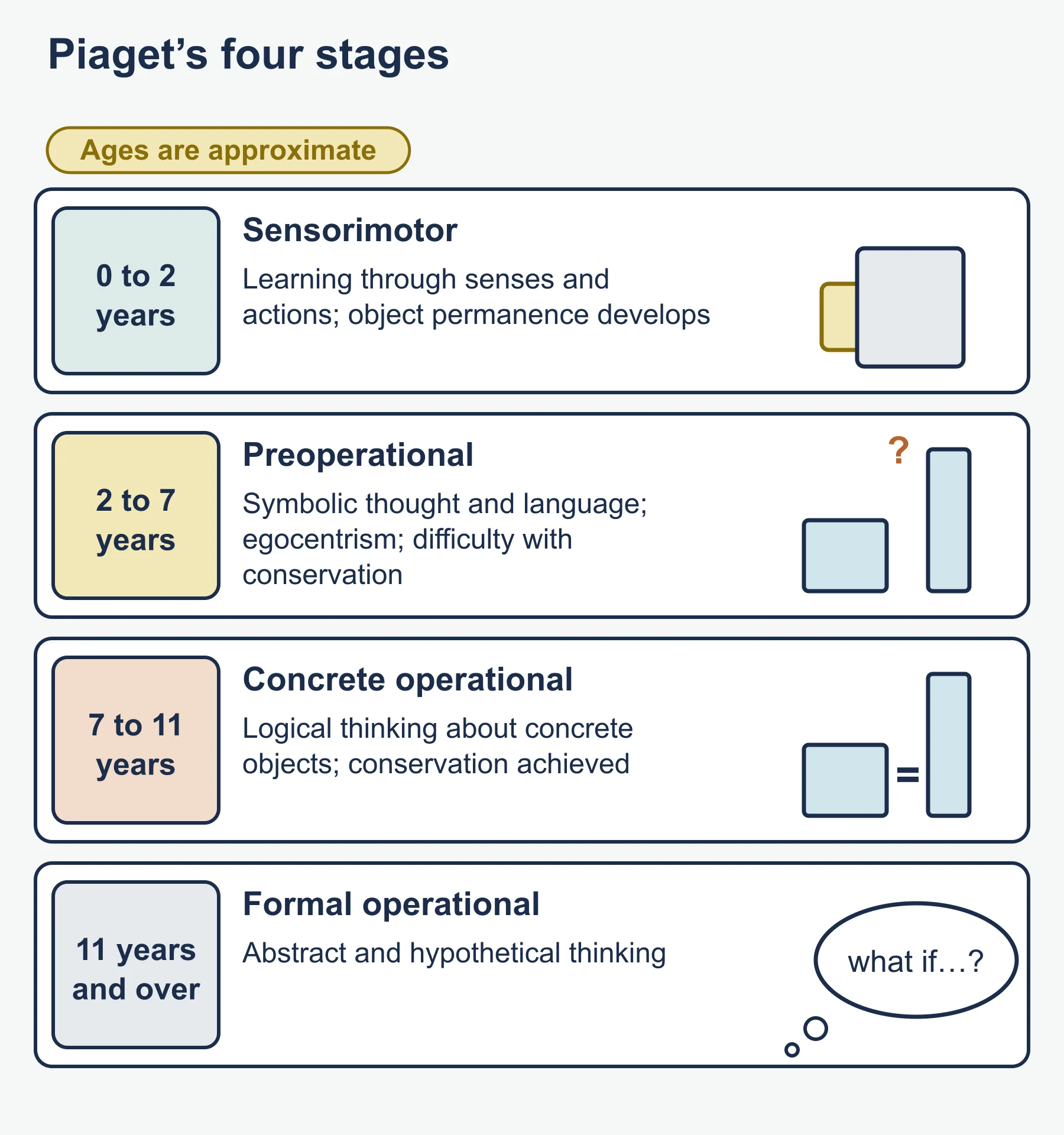
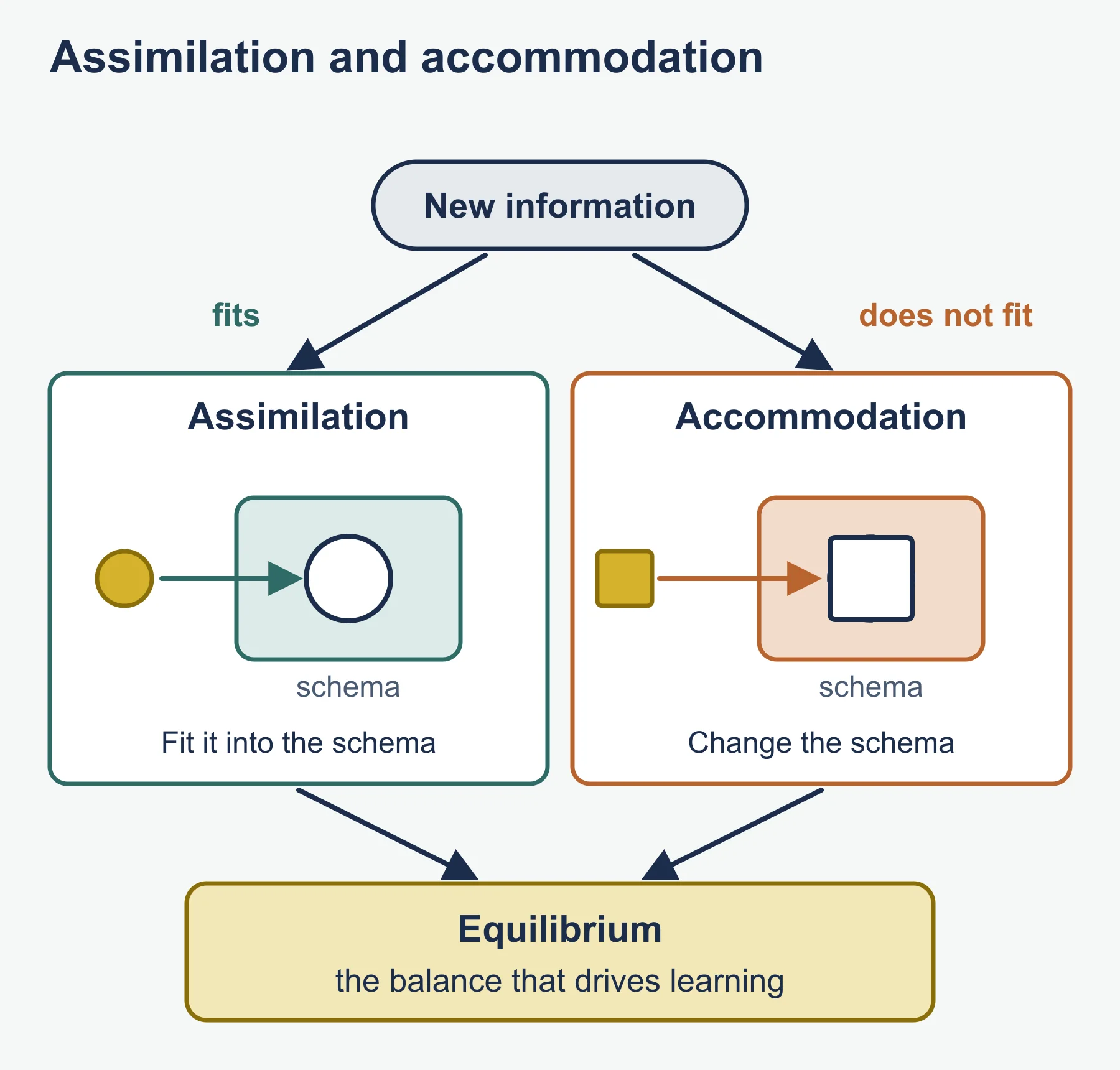
Jean Piaget saw children as active learners who build understanding through experience. A schema is a mental structure organising knowledge. Assimilation fits new information into an existing schema, accommodation changes the schema when new information does not fit, and equilibrium is the balance that drives learning. He proposed four stages:
| Stage | Approximate age | Key features |
|---|---|---|
| Sensorimotor | 0 to 2 years | Learning through senses and actions; object permanence develops |
| Preoperational | 2 to 7 years | Symbolic thought and language; egocentrism; difficulty with conservation |
| Concrete operational | 7 to 11 years | Logical thinking about concrete objects; conservation achieved |
| Formal operational | 11 years and over | Abstract and hypothetical thinking |
Evidence includes the three mountains task (Piaget and Inhelder), in which young children chose a view of a model that was their own rather than that of a doll placed elsewhere, taken as evidence of egocentrism. Critics argue that Piaget underestimated children, because tasks were too demanding or unfamiliar, that development is more continuous than stages suggest, and that he gave little weight to social and cultural influences.
Vygotsky
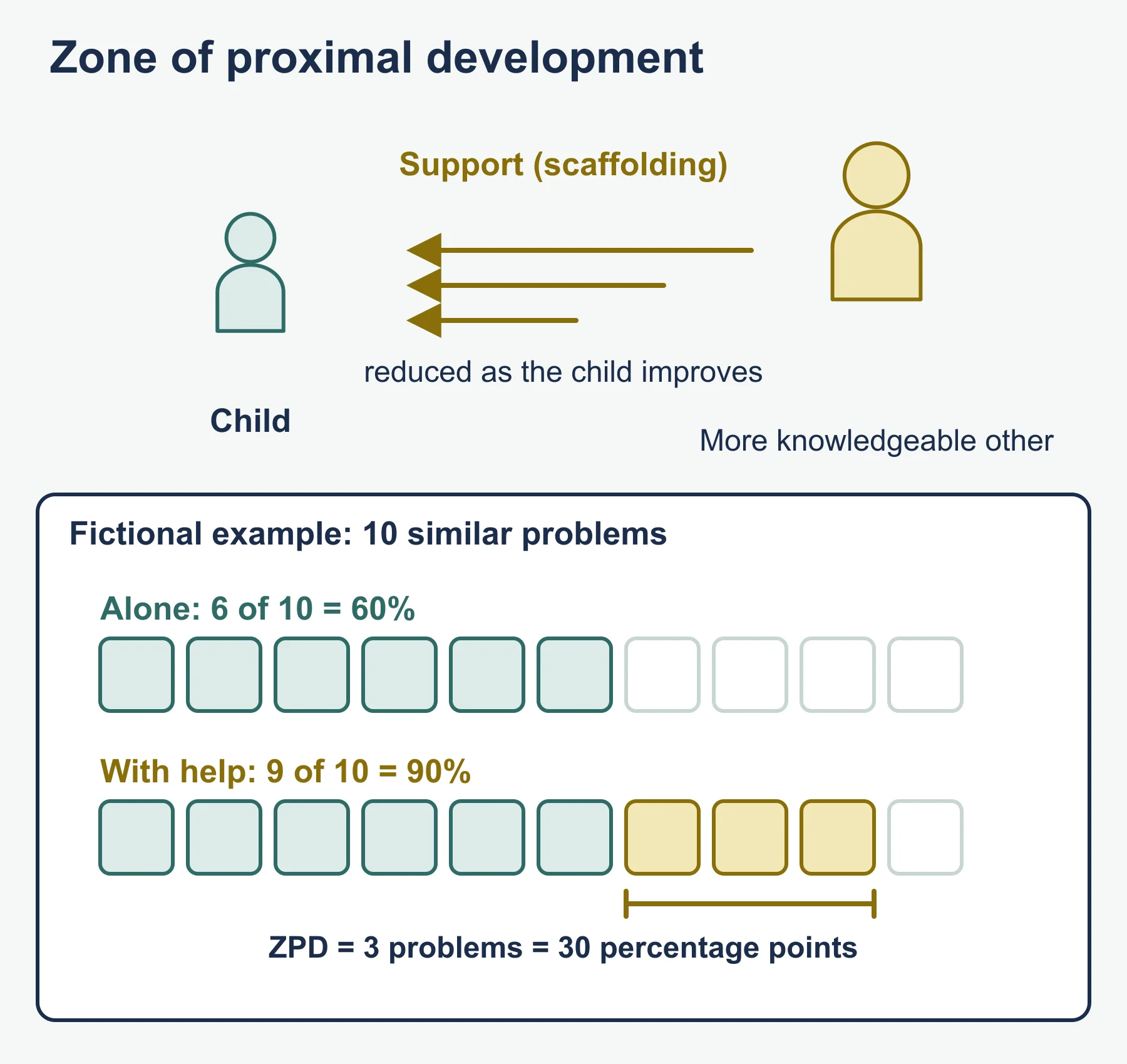
Lev Vygotsky stressed that thinking develops through social interaction and language. The zone of proximal development (ZPD) is the gap between what a child can do alone and what they can do with help from a more knowledgeable other. Scaffolding, a term from Wood, Bruner and Ross (1976), describes the support given by a tutor, which is reduced as the child becomes more competent. Vygotsky’s account fits the importance of culture and teaching, but it is less precise than Piaget’s about the mechanisms, and the benefit of help varies with the child and the culture.
Social development
Attachment
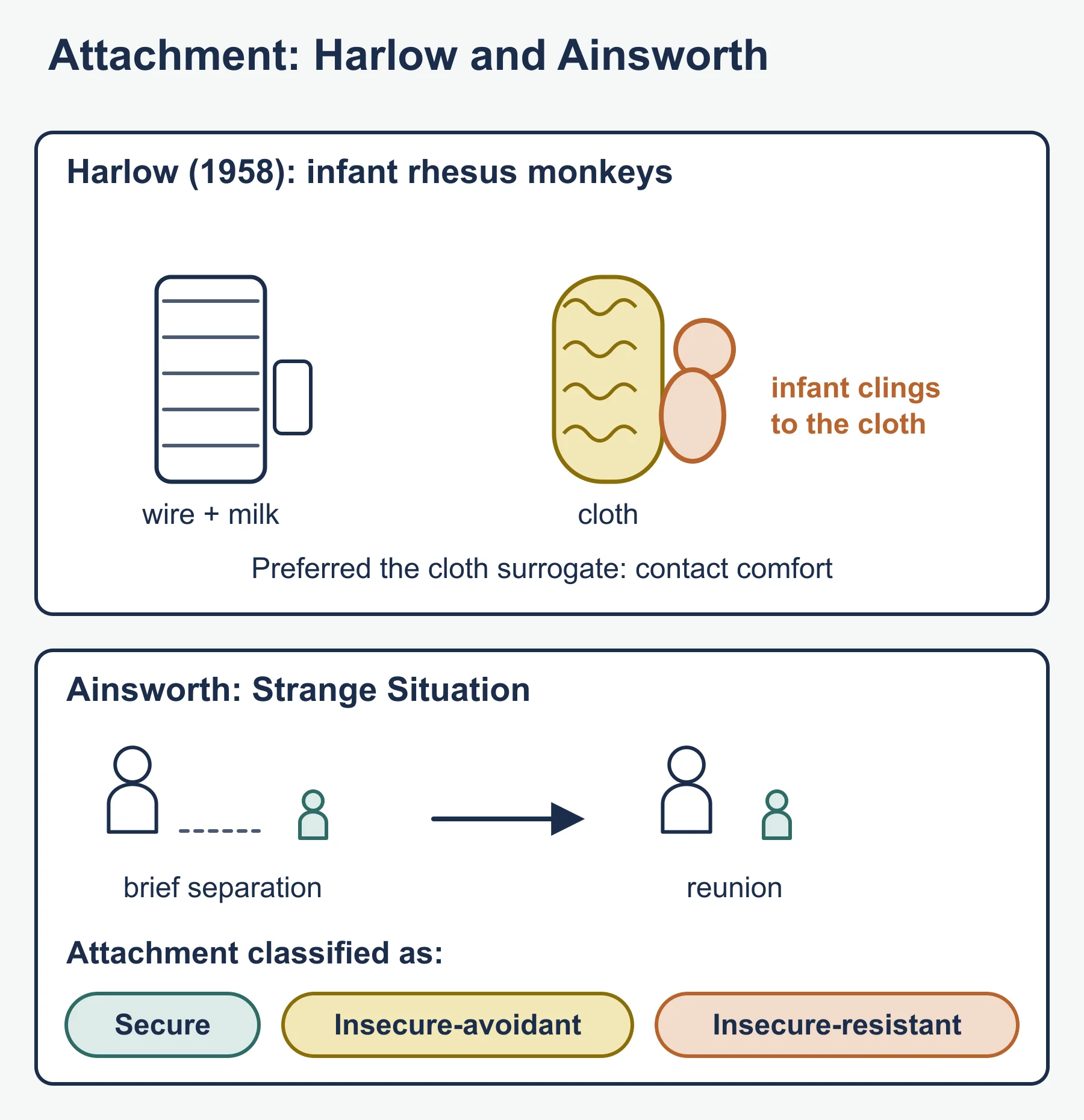
John Bowlby proposed that infants are biologically predisposed to form an attachment to a caregiver, which provides a secure base. He suggested an internal working model of relationships, formed by early experience, that guides later ones. His study of juvenile thieves (1944) linked prolonged early separation to later affectionless behaviour, although it was retrospective and could not prove cause. Harlow (1958) separated infant rhesus monkeys from their mothers and found that they preferred a cloth-covered surrogate to a wire one that provided milk, which showed the importance of contact comfort. The study raised serious animal ethics issues, and generalising from monkeys to human infants is limited.
Mary Ainsworth used the Strange Situation, a laboratory procedure with brief separations and reunions, to classify attachment as secure, insecure-avoidant or insecure-resistant. Critics note the procedure is culturally specific, as the same behaviour can have a different meaning in different societies, and it measures behaviour with one caregiver in an unusual setting.
Social learning and moral development
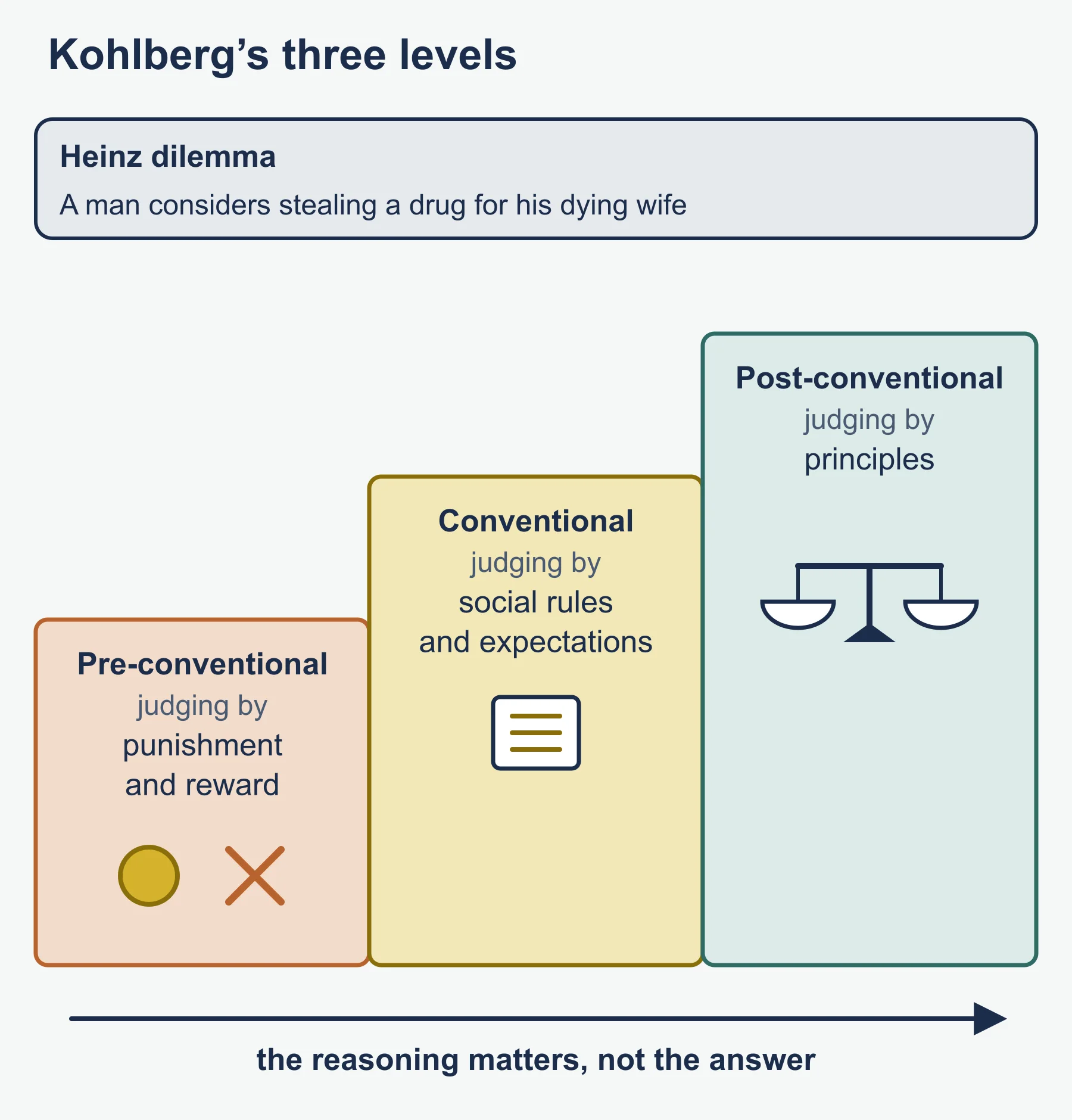
Bandura’s social learning theory explains that children learn by observing and imitating models, with vicarious reinforcement increasing the likelihood of imitation. Lawrence Kohlberg proposed that moral reasoning develops through three levels: pre-conventional (judging by punishment and reward), conventional (judging by social rules and expectations) and post-conventional (judging by principles). He used moral dilemmas such as the Heinz dilemma, in which a man considers stealing a drug for his dying wife. He was interested in the reasoning behind answers, not the answer itself. Critics say the theory is biased towards a Western, male perspective and that reasoning does not always predict behaviour.
Development of identity
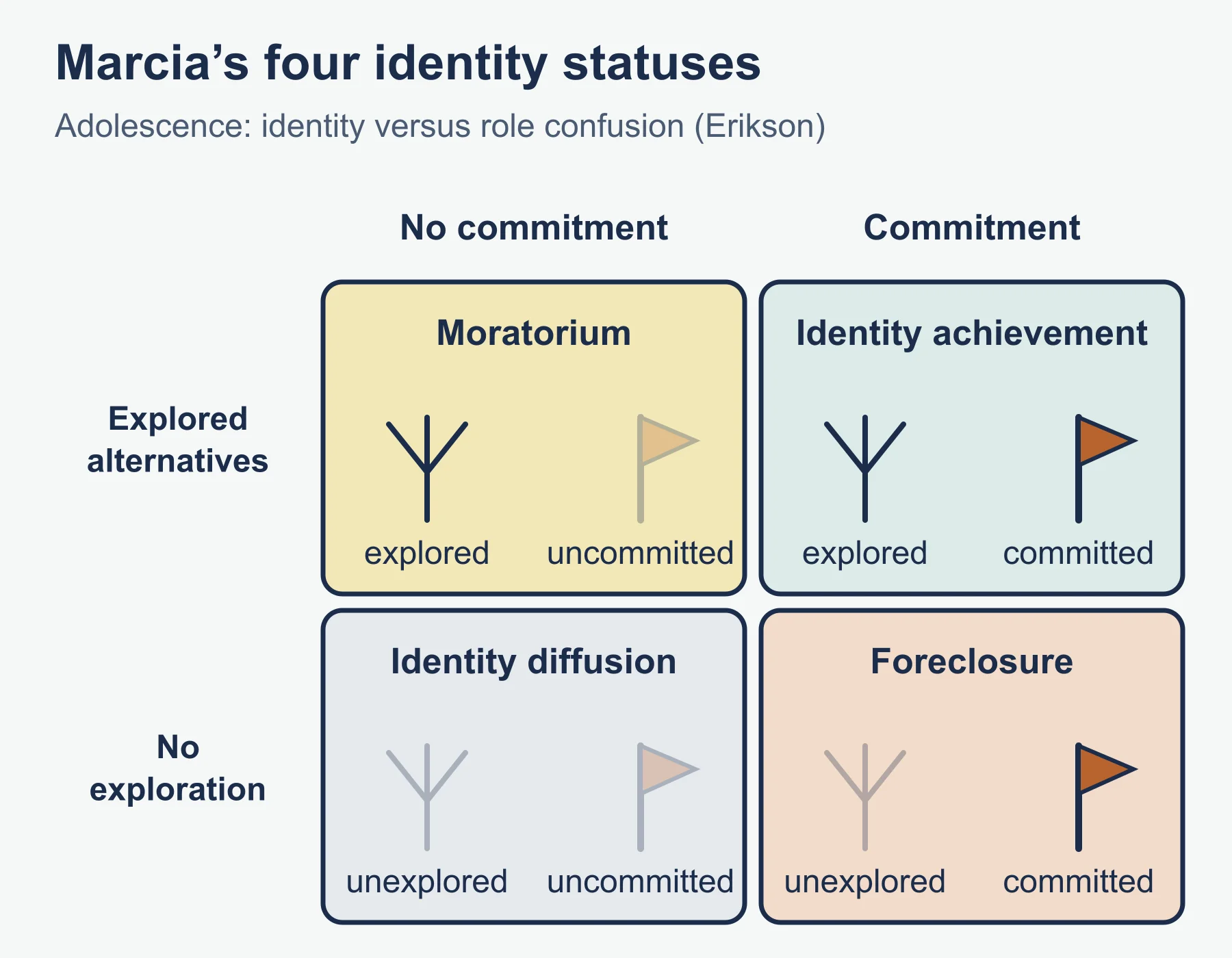
Erik Erikson proposed psychosocial stages, and in adolescence the central conflict is identity versus role confusion: young people explore who they are and what they believe. James Marcia built on this and described four identity statuses, based on whether a person has explored alternatives and made a commitment: identity diffusion (neither), foreclosure (commitment without exploration), moratorium (exploration without commitment) and identity achievement (both). Identity is also shaped by gender and by ethnic and cultural background, including the way family, peers, media and the wider society treat these characteristics. Evaluation considers that identity can change during adulthood, that stages are descriptive rather than explanatory, and that the theories grew out of Western societies.
Influences on development and developing as a learner
Development is shaped by both nature and nurture, and the two interact. Early experience, such as the quality of care, poverty, stress or trauma, can affect cognitive and social outcomes, while many children show resilience. Researchers also study how children become effective learners:
- Expectations affect learning. In Rosenthal and Jacobson’s study (1968), teachers were told that some pupils were about to show rapid gains in ability; those pupils showed greater gains in some age groups than others, which was seen as evidence of a self-fulfilling prophecy. The study has been criticised on methodological grounds.
- Mindset: Carol Dweck distinguished a fixed mindset, the belief that ability is unchangeable, from a growth mindset, the belief that ability can be developed by effort. Praise for effort rather than ability is suggested to encourage a growth mindset.
- Social support and culture: scaffolding, peer collaboration and cultural expectations about education all influence learning.
Research methods in development
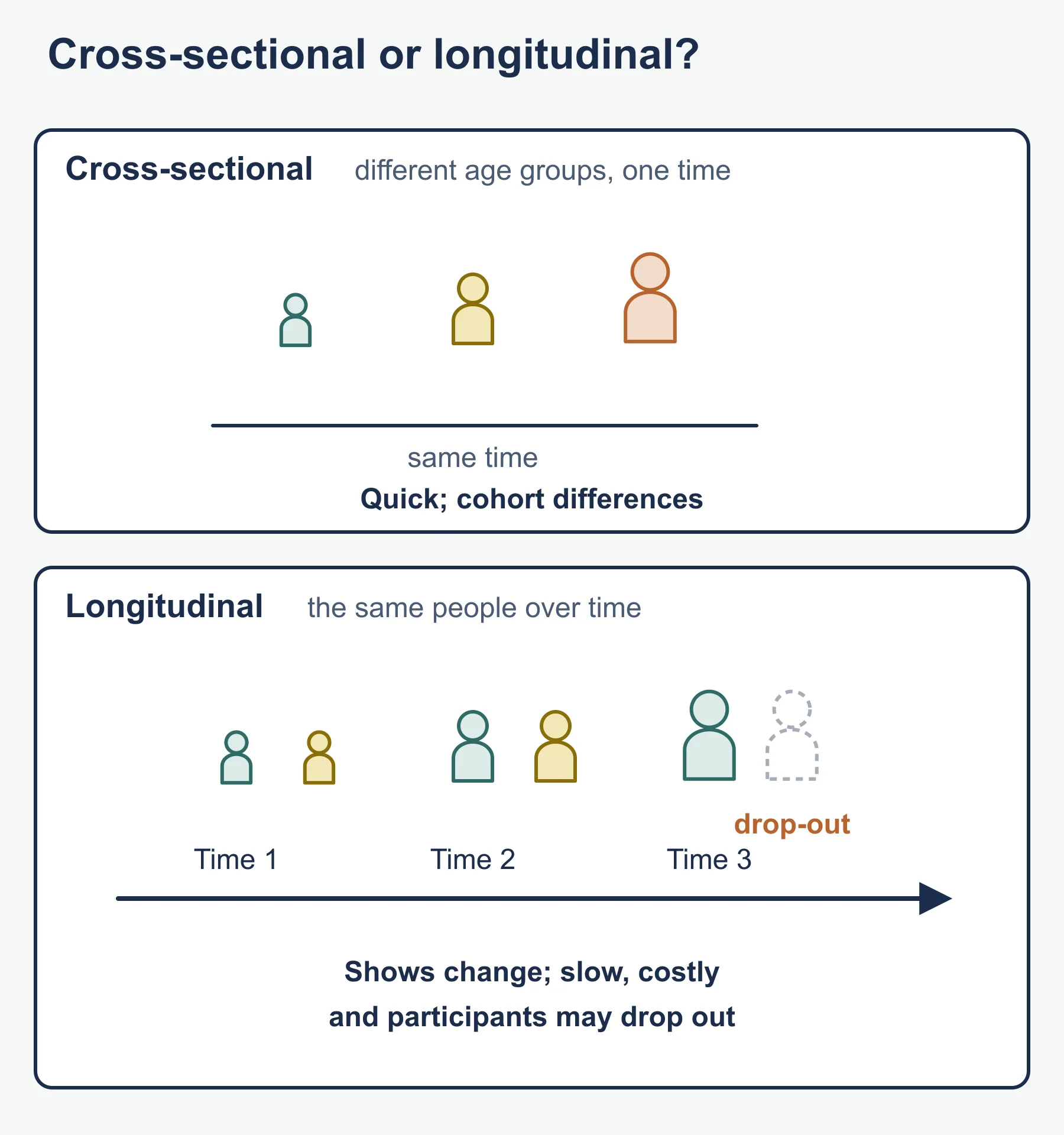
Developmental research may be cross-sectional (comparing different age groups at one time, which is quick but affected by cohort differences) or longitudinal (following the same people over time, which shows change but is slow, costly and subject to participants dropping out). Child participants need parental consent and their own assent, protection from stress, and attention to the effect of the researcher on their behaviour. Observations, interviews and experiments are all used, and the tasks must be understandable to the child.
Worked example
Applying theory to a case: Ana is 5 years old. She pours juice from a short, wide glass into a tall, thin one and says there is now more juice in the tall glass.
- Identify the behaviour: Ana fails a conservation task because she focuses on height and ignores width.
- Link to theory: according to Piaget, a 5-year-old is in the preoperational stage, where children centre on one feature of a situation and have not yet mastered conservation. This is expected, not a problem.
- Compare with Vygotsky: an adult could use scaffolding, for example by asking Ana to pour it back and compare, so that she may reach a higher level with help than alone.
- Quantify the ZPD in a fictional example: working alone, Ana solves 6 out of 10 similar problems. With guided support she solves 9 out of 10. Her independent level is 60 per cent and her assisted level is 90 per cent, so the zone is 3 problems, or 30 percentage points.
- Evaluate: later research suggests that changing the wording or the task can help younger children succeed, so Piaget may have underestimated what they can do.
Common mistakes
- Treating Piaget’s ages as fixed, rather than approximate.
- Describing a study without stating what it shows about the theory.
- Confusing assimilation and accommodation.
- Presenting attachment findings from animals as direct evidence for children.
- Overlooking cultural bias in theories of attachment, morality and identity.
- Describing the stages without evaluation.
Exam technique
Check the command term. Describe asks for a detailed account, explain for reasons, discuss for a balanced consideration of different views and evaluate for strengths, limitations and a judgement. In extended responses, select a small number of relevant theories and studies and use them to build an argument. Only quote findings you can recall accurately, and organise your answer with a clear introduction, a development and a conclusion that answers the question.
Check your understanding
- What is the difference between assimilation and accommodation? Assimilation fits new information into an existing schema; accommodation changes the schema.
- At which Piaget stage do children typically master conservation? Concrete operational, about 7 to 11 years.
- Define the zone of proximal development. The gap between what a child can do alone and what they can do with help.
- Name the three attachment types in Ainsworth’s classification. Secure, insecure-avoidant and insecure-resistant.
- What are Marcia’s four identity statuses? Diffusion, foreclosure, moratorium and achievement.
- Give one limitation of longitudinal studies. They are slow and costly, and participants may drop out.
- A child solves 4 of 10 problems alone and 7 of 10 with help. How large is the gap? 3 problems, or 30 percentage points.
Frequently asked questions
What are Marcia’s four identity statuses? They are identity diffusion, foreclosure, moratorium and achievement, based on whether a person has explored alternatives and made a commitment.
What is the difference between cross-sectional and longitudinal studies? Cross-sectional studies compare different age groups at one time, which is quick but affected by cohort differences. Longitudinal studies follow the same people over time, which shows change but is slow, costly and affected by drop-out.
What is the zone of proximal development? Vygotsky’s zone of proximal development is the gap between what a child can do alone and what they can do with help from a more knowledgeable other.
What are Kohlberg’s three levels of moral reasoning? They are pre-conventional (judging by punishment and reward), conventional (judging by social rules and expectations) and post-conventional (judging by principles).
Related resources
-
Revision notes
IB DP Psychology: Developmental psychology (human development) – Revision Notes
IB DP Psychology human development revision notes: peers and play, trauma and resilience, poverty, brain and cognitive development, attachment and identity.
Psychology · International Baccalaureate · IB
Revise topic -
Study guides
IB DP Psychology: Development of Empathy and Theory of Mind
Empathy and theory of mind for IB DP Psychology (human development): false-belief tasks, cross-cultural and infant research, stages of empathy and an essay plan.
Psychology · International Baccalaureate · IB
Read guide -
Practice questions
IB DP Psychology: Development of Empathy and Theory of Mind – Practice Questions
Original IB DP Psychology practice on empathy and theory of mind: false-belief logic, an invented task to analyse, empathy stages and a 15-mark essay plan.
Psychology · International Baccalaureate · IB
Try questions
Studying Psychology?
This page is free and stays free. Marlbridge is not offering Psychology classes at the moment, so there is no tuition to book for it. The free study resources stay open to everyone.
Get free revision emails (optional)
Occasional emails with practice questions, worked explanations and links to free resources for the qualification and subjects you choose. No spam, and you can unsubscribe from any email. The free tools on this site never need an email.