
Revision Notes
IB DP Psychology: Sociocultural approach – Revision Notes
Revision notes for the IB DP Psychology sociocultural approach: social identity, social cognitive theory, stereotypes, culture, enculturation and acculturation.
- Subject
- Psychology
- Level
- IB
- Topic
- Content: Sociocultural approach
- Author
- Marlbridge Academic Team
- Updated
- Reviewed by
- Kanwal Aslam (what this means)
Aligned to International Baccalaureate IB Diploma Programme Psychology (DP Psychology (2027), DP Psychology (2019) / DP Psychology (2027)), First assessment 2027. Official specification .
Syllabus page (what it covers and how it is assessed): IB Diploma Programme Psychology.
Syllabus topics and points this page is mapped to
DP Psychology (2027)
- 4 Content: Sociocultural approach (topic-level mapping)
"Topic-level mapping" means this page belongs to that topic; it does not claim to cover every point in it.
Course note: these notes follow IB DP Psychology for first assessment 2027 (first examinations May 2027). They were first written for the 2019 course, whose last examination session was November 2026. The 2027 guide lists the terms to know and has no list of required studies, so the studies below are examples of evidence.
The sociocultural approach explains behaviour through the groups people belong to and the cultures they live in. In IB DP Psychology it is one of three content approaches. It is examined on Paper 1 Section A (two compulsory short-answer questions drawn from two of the three content areas, 8 marks in all) and used again in Sections B and C through the contexts. Paper 1 does not assess the details of research studies, so link each theory to an example that you can explain and evaluate.
Related: Sociocultural approach study guide.
Coverage in the 2027 guide
| Terms in the 2027 guide | Content in these notes | Example evidence |
|---|---|---|
| Social identity theory; social learning theory | Social identity theory; social cognitive theory (Bandura) | Tajfel et al. (1971); Abrams et al. (1990); Bandura, Ross and Ross (1961) |
| Cultural dimensions; emic and etic approaches | Culture and its influence on behaviour and cognition; cultural dimensions | Berry (1967); Hofstede’s dimensions |
| Enculturation; models of acculturation | Enculturation; acculturation | Fernald and Morikawa (1993); Berry’s acculturation model; Lueck and Wilson (2011) |
| Not listed in the 2027 guide | Formation of stereotypes and their effect on behaviour (supporting material) | Hamilton and Gifford (1976); Steele and Aronson (1995) |
| Listed, but not covered in these notes | Cognitive dissonance; compliance techniques; conformity | Abrams et al. (1990) touches on conformity |
| HL extension: Culture (HL only, Paper 3) | The influence of globalization on individual attitudes, identities and behaviour | Arnett (2002) on bicultural identity |
Key terms
| Term | Definition |
|---|---|
| Social identity | The part of the self-concept that comes from membership of social groups |
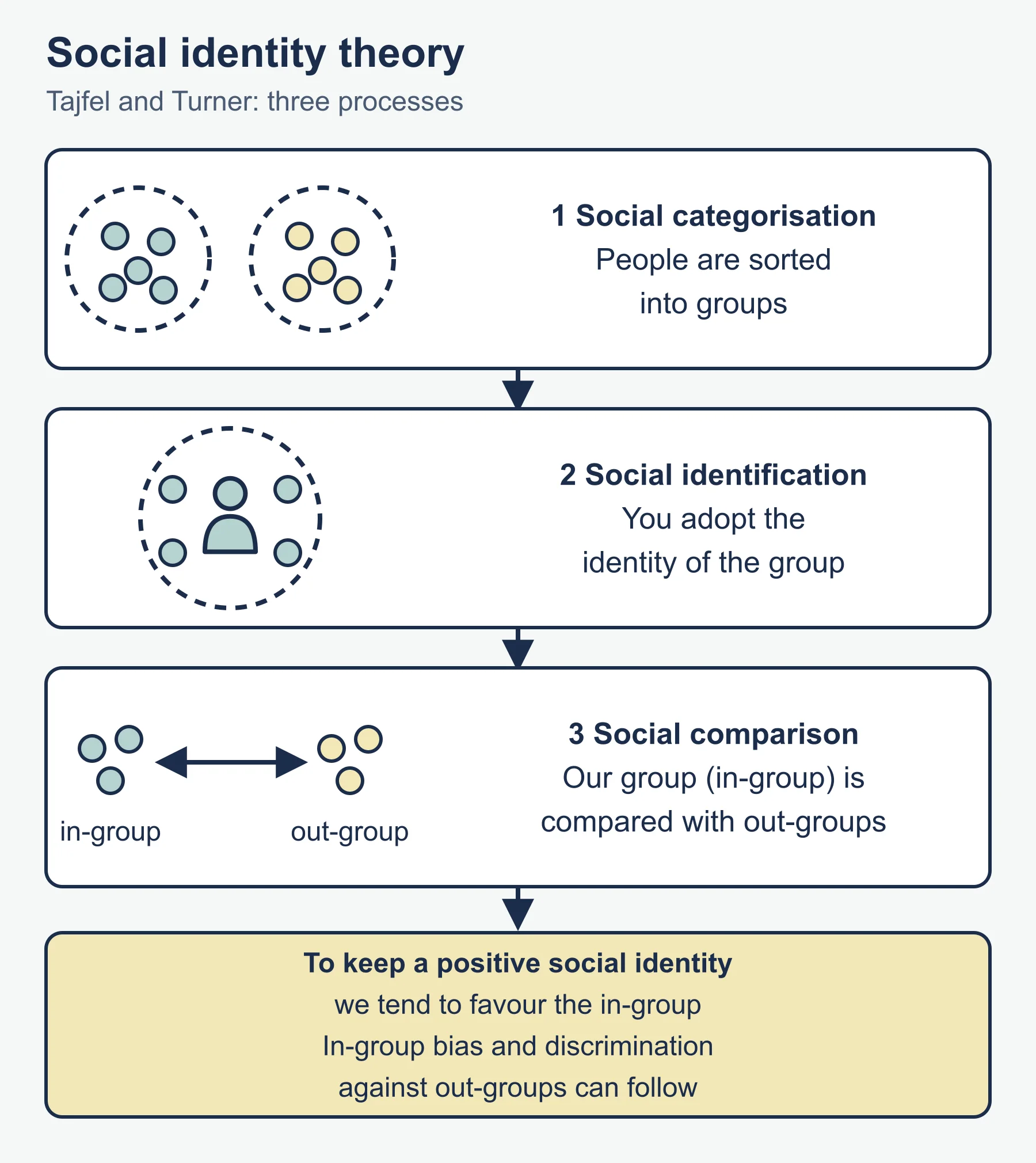
| Social categorisation | Sorting people into groups, including in-groups and out-groups |
| Social comparison | Comparing the in-group favourably with out-groups to raise self-esteem |
| Positive distinctiveness | The motivation to see one’s group as better than others |
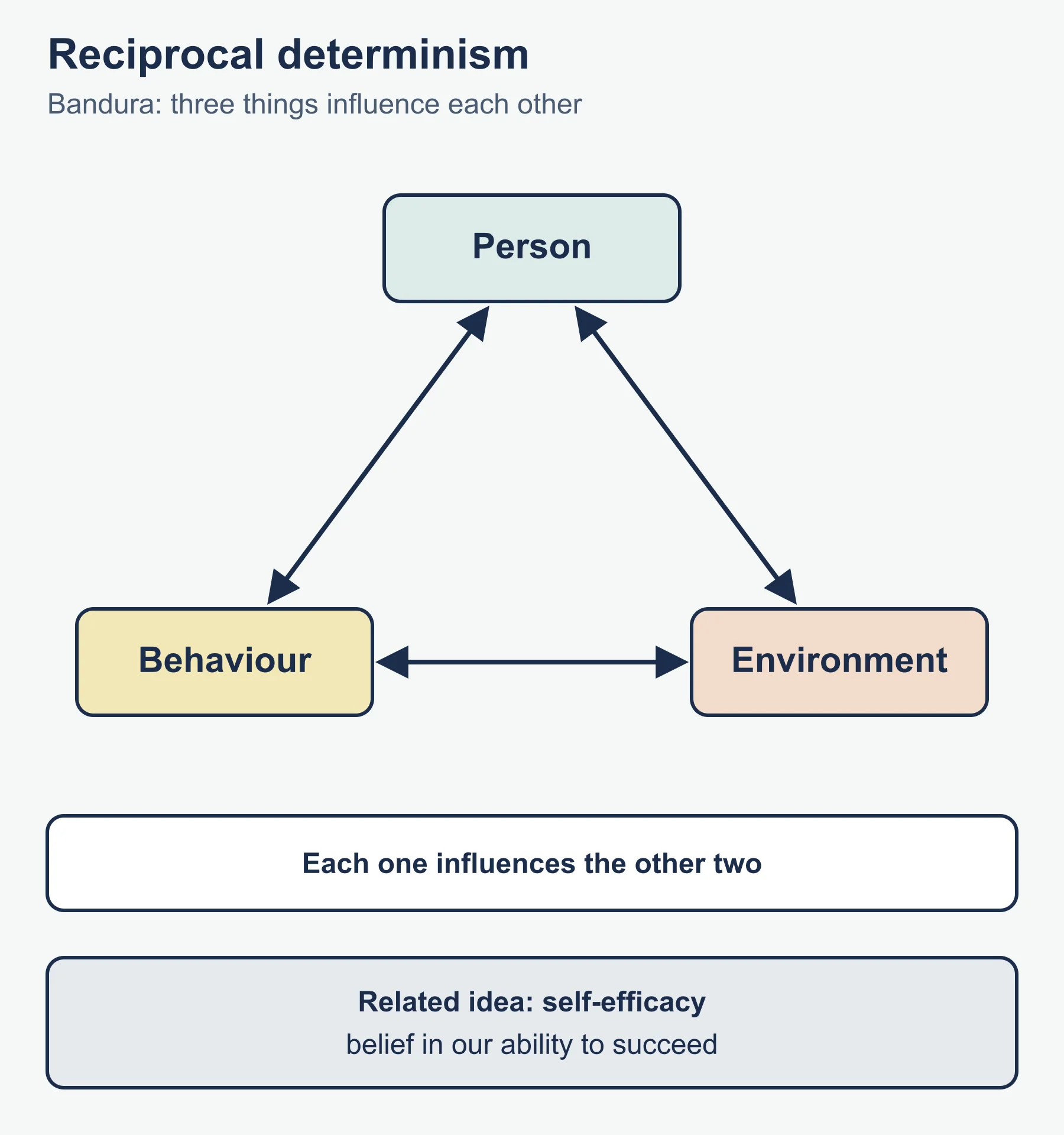
| Reciprocal determinism | Bandura’s idea that the person, behaviour and environment influence one another |
| Stereotype | A generalised belief about members of a group |
| Illusory correlation | Perceiving a relationship between two variables where none exists or it is weaker than believed |
| Stereotype threat | Underperformance caused by fear of confirming a negative stereotype |
| Culture | Shared norms, values, beliefs and practices transmitted across generations |
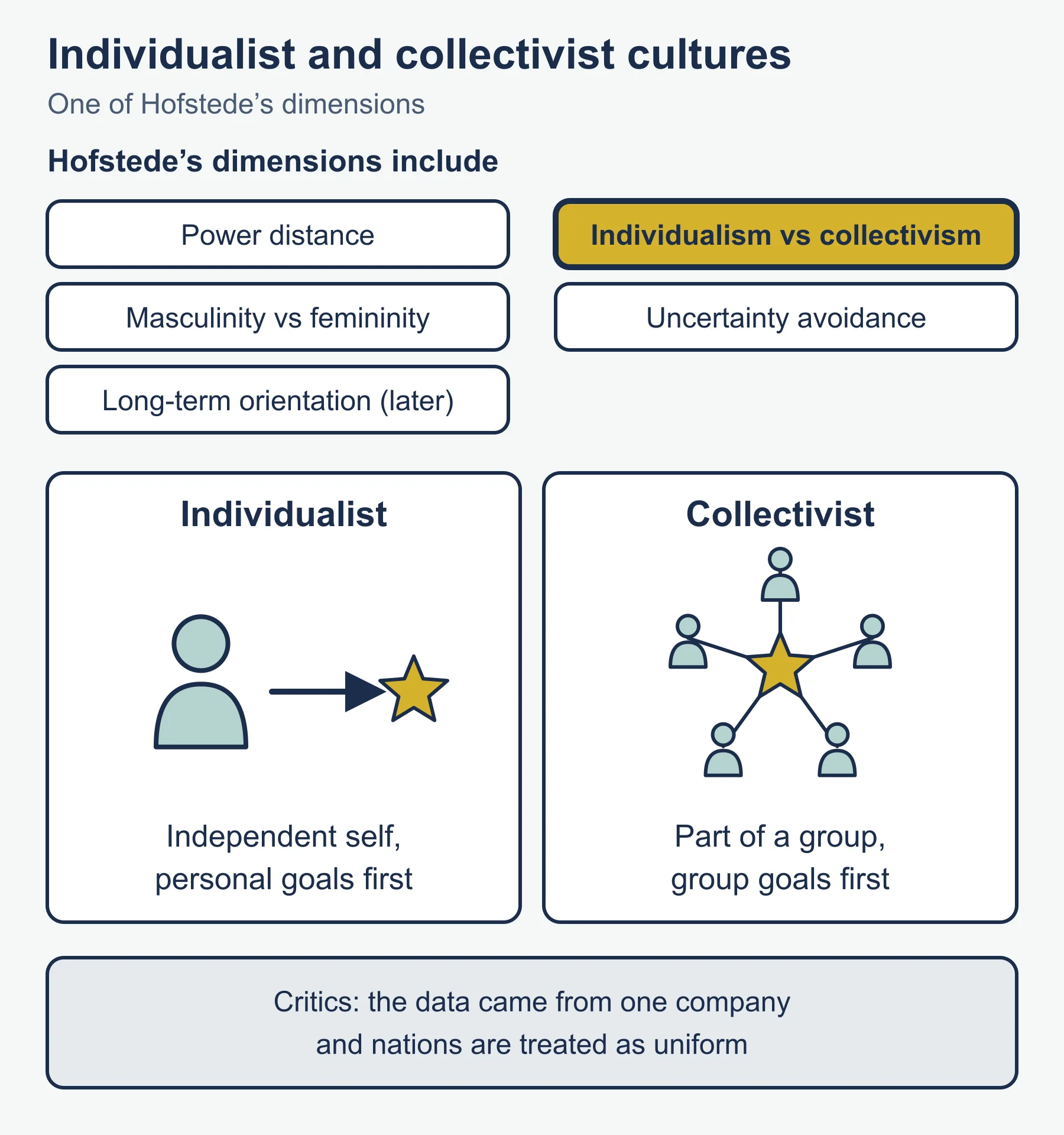
| Cultural dimension | A measurable way in which cultures differ, such as individualism-collectivism |
| Enculturation | Learning the norms of one’s own culture |
| Acculturation | Psychological and cultural change after contact with a different culture |
Key studies in one line each
| Study | Aim and finding | Evaluation point |
|---|---|---|
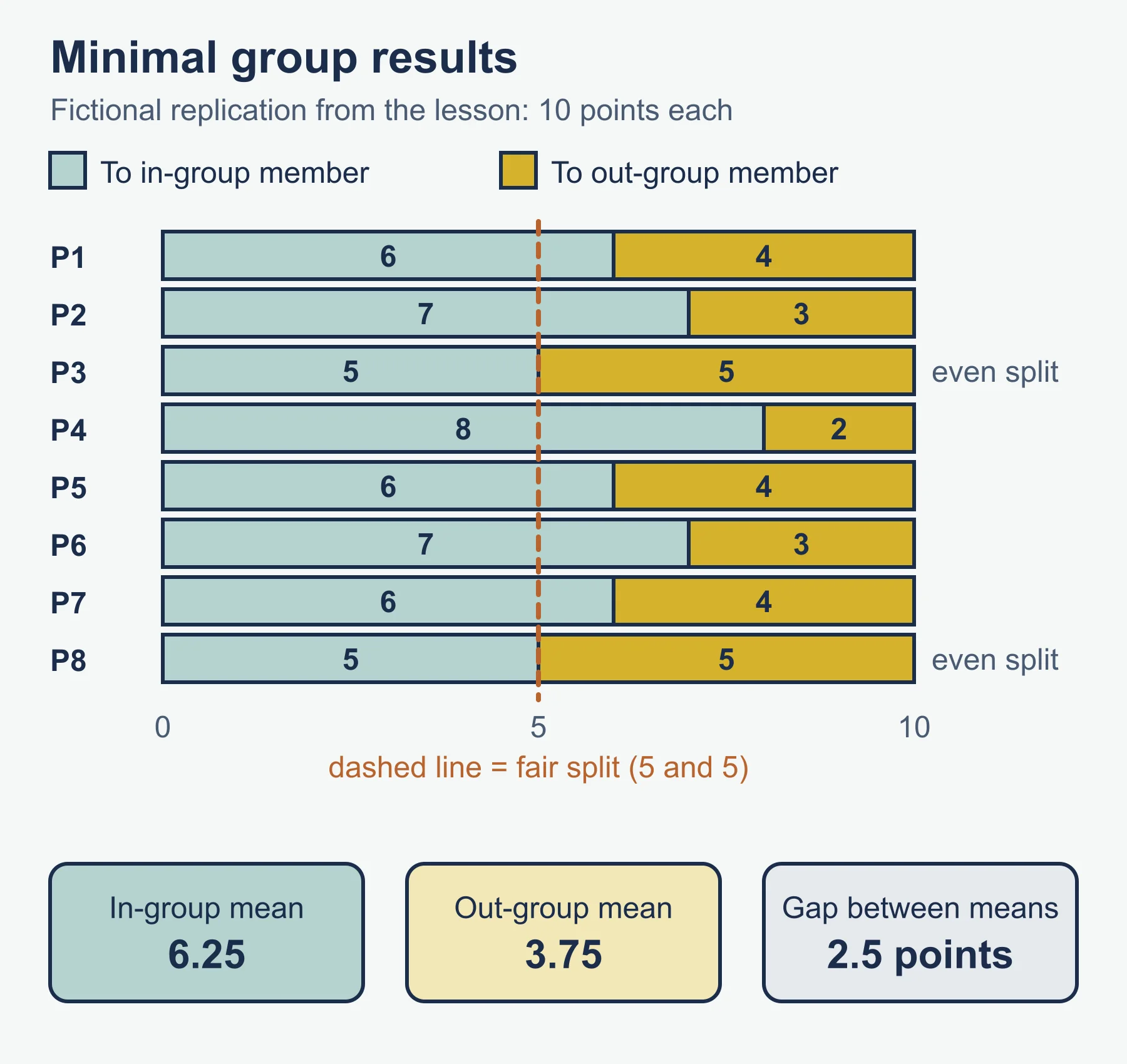
| Tajfel et al. (1971) | Bristol schoolboys placed in “minimal groups” (e.g. a preference for Klee or Kandinsky) allocated points to favour their in-group, even at the cost of a larger joint reward | Lab setting and trivial groups: high control but low ecological validity |
| Abrams et al. (1990) | Conformity in an Asch-style task was higher when confederates were presented as in-group members | Supports SIT’s link between identity and conformity |
| Bandura, Ross and Ross (1961) | Children who watched an adult model act aggressively towards a Bobo doll imitated the aggression | Demonstrates observational learning; short-term, artificial aggression |
| Hamilton and Gifford (1976) | Participants over-associated undesirable behaviours with the smaller of two groups | Shows a cognitive origin for stereotypes |
| Steele and Aronson (1995) | Black American students performed worse when a verbal test was framed as diagnostic of ability | Shows effect of stereotypes on behaviour; mostly student samples |
| Berry (1967) | Temne people (farming society) conformed more than Inuit people (hunting society) in an Asch-type task | Links economy and culture to conformity; small cultural samples |
| Hofstede | Survey of IBM employees across many countries identified dimensions such as individualism-collectivism and power distance | Large data set; risk of treating national averages as individual traits |
| Fernald and Morikawa (1993) | American mothers labelled objects more when talking to infants; Japanese mothers used more social routines | Evidence of enculturation through language |
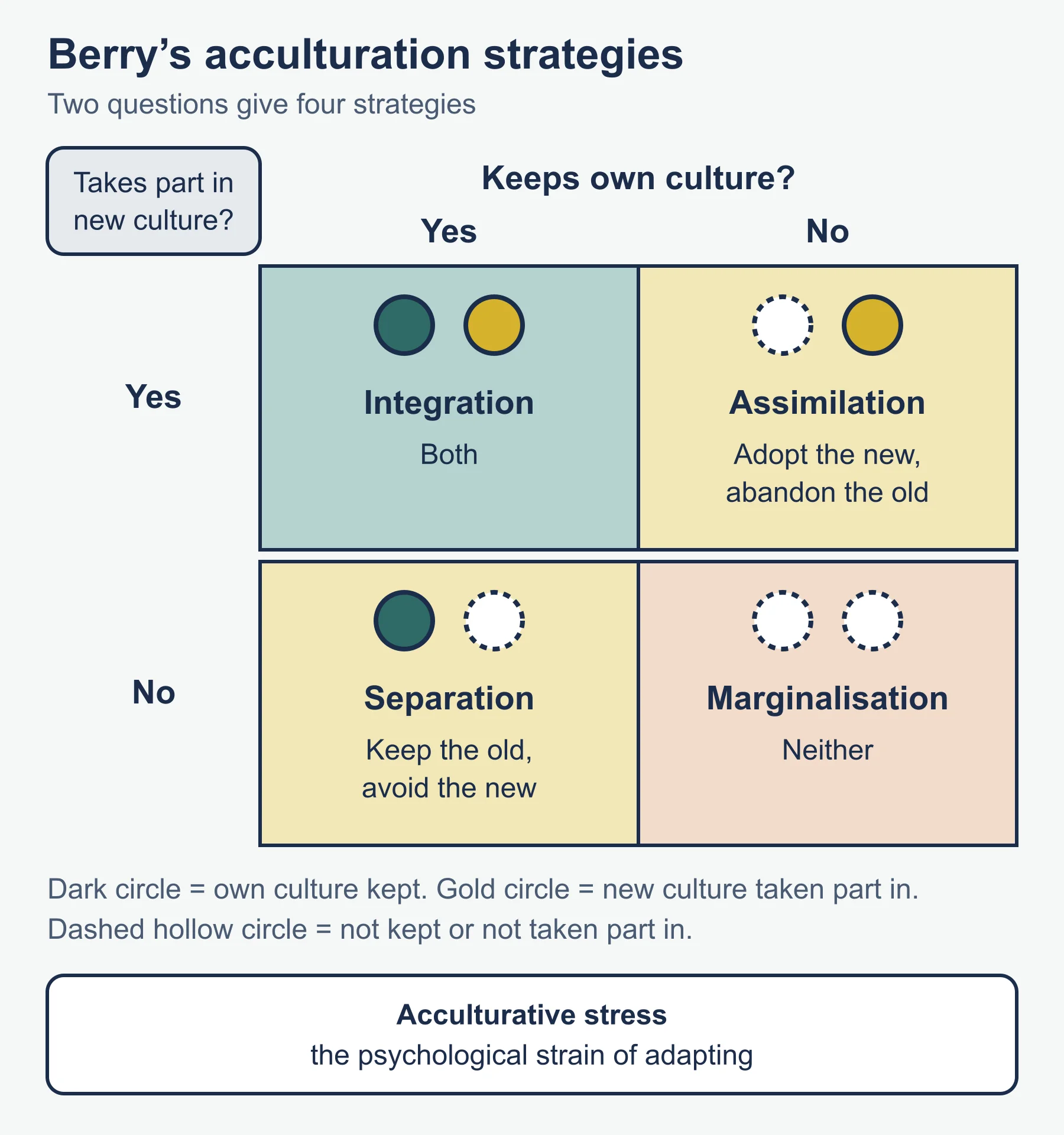
| Berry’s model | Four acculturation strategies: integration, assimilation, separation, marginalisation | Integration usually linked to better well-being; a framework, not a test |
| Lueck and Wilson (2011) | Acculturative stress among Asian Americans related to factors such as language and discrimination | Correlational survey data |
Worked example: a Section A answer outline
Question: Explain social identity theory and give an example. [4]
- Define the theory: part of a person’s self-concept comes from the groups they belong to.
- Explain the processes: social categorisation sorts people into in-groups and out-groups, social identification adopts the group’s identity, and social comparison favours the in-group to keep a positive social identity, which can lead to in-group bias.
- Give an example and explain it: in the minimal group study (Tajfel et al., 1971), schoolboys placed in groups on a trivial basis gave more points to their own group, which shows that categorisation alone can produce in-group favouritism.
- Link back: say what the example shows about the theory.
Section A is marked on how detailed your knowledge of the theory is and on whether the example is relevant and explained. The details of the study are not assessed, and evaluation is not required.
Common mistakes / exam traps
- Describing SIT without its processes. Name categorisation, identification and comparison.
- Confusing enculturation and acculturation. Enculturation is learning your own culture; acculturation follows contact with another.
- Treating Hofstede’s dimensions as personal traits. They describe national averages.
- Evaluating in Section A. “Explain” and “describe” questions need explanation and an explained example, not critique; save evaluation for Section C.
- Studies without links. Every study should end with a sentence that answers the question.
Frequently asked questions
How is the sociocultural approach examined? On Paper 1 (1 hour 30 minutes, 35 marks): Section A has two compulsory short-answer questions drawn from two of the three content areas (8 marks in all); Section B has two compulsory questions that apply content to an unseen situation, each from one of four contexts (12 marks); Section C offers a choice of two concept-based extended-response questions, each from a different context (15 marks).
How many studies should I learn per term? The 2027 guide has no list of required studies and Paper 1 does not assess the details of studies. Learn one example per term that you can explain well, and a second that you can use to evaluate or contrast.
What is the HL extension that relates to this approach? The 2027 HL extension on culture, which is assessed on Paper 3 (HL only). The guide notes that cultural diffusion has raised questions about the effect of globalization on mental and physical health, identity and relationships; see the globalisation study guide.
Self-test
- Name the three cognitive processes in social identity theory. Social categorisation, social identification, social comparison.
- What did Bandura et al. (1961) show? Children imitate aggression they observe in an adult model.
- What is stereotype threat? Underperformance caused by fear of confirming a negative stereotype.
- Give two of Hofstede’s dimensions. Individualism-collectivism; power distance.
- Which acculturation strategy combines keeping one’s original culture with joining the new one? Integration.
Related resources
-
Study guides
IB DP Psychology: Sociocultural approach – Study Guide
Social identity theory, social learning, stereotypes, cultural dimensions and acculturation explained with key studies for the IB DP Psychology sociocultural approach.
Psychology · International Baccalaureate · IB
Read guide -
Practice questions
IB DP Psychology (2027): Content - Sociocultural approach – Practice Questions
Original IB DP Psychology (2027) practice on the sociocultural approach: cognitive dissonance, emic and etic research, enculturation, acculturation, conformity and a 15-mark evaluation.
Psychology · International Baccalaureate · IB
Try questions -
Subject guides
IB Diploma Programme Psychology: Subject Overview
Overview of IB DP Psychology (first assessment 2019): the three core approaches, four options, research methods and how SL and HL are assessed.
Psychology · International Baccalaureate · IB
Read course guide
Studying Psychology?
This page is free and stays free. Marlbridge is not offering Psychology classes at the moment, so there is no tuition to book for it. The free study resources stay open to everyone.
Get free revision emails (optional)
Occasional emails with practice questions, worked explanations and links to free resources for the qualification and subjects you choose. No spam, and you can unsubscribe from any email. The free tools on this site never need an email.