
Study Guides
IB DP Psychology: Sociocultural approach – Study Guide
Social identity theory, social learning, stereotypes, cultural dimensions and acculturation explained with key studies for the IB DP Psychology sociocultural approach.
- Subject
- Psychology
- Level
- IB
- Topic
- Content: Sociocultural approach
- Author
- Marlbridge Academic Team
- Updated
- Reviewed by
- Kanwal Aslam (what this means)
Aligned to International Baccalaureate IB Diploma Programme Psychology (DP Psychology (2027), DP Psychology (2019) / DP Psychology (2027)), First assessment 2027. Official specification .
Syllabus page (what it covers and how it is assessed): IB Diploma Programme Psychology.
Syllabus topics and points this page is mapped to
DP Psychology (2027)
- 4 Content: Sociocultural approach (topic-level mapping)
"Topic-level mapping" means this page belongs to that topic; it does not claim to cover every point in it.
The sociocultural approach explains behaviour by looking at the social groups people belong to and the culture they live in. Instead of asking what happens in the brain or in the mind of an isolated individual, it asks how other people, shared norms and cultural meanings shape what individuals think, feel and do. In IB Diploma Programme Psychology (first assessment 2027) this is one of the three content approaches, with the biological and cognitive approaches, and you are expected to use its theories and concepts to explain behaviour in the contexts, evaluate research and write about it in the examination.
Where this fits in the specification
The sociocultural approach is one of the three content areas of the 2027 course (with the biological and cognitive approaches), alongside research methodology. The guide describes it as emphasising the influence of social and cultural factors on behaviour, growing out of social psychology, and using both etic and emic approaches. It lists ten terms to know: cognitive dissonance, compliance techniques, conformity, cultural dimensions, the emic approach, enculturation, the etic approach, models of acculturation, social identity theory and social learning theory. This guide covers social identity theory, social learning (Bandura’s social cognitive theory), cultural dimensions, enculturation, acculturation and the emic and etic approaches, and also stereotypes, which the 2027 guide does not list. It does not cover cognitive dissonance, compliance techniques or conformity, so use other resources for those terms.
The approach is assessed on Paper 1. Section A has two compulsory short-answer questions drawn from two of the three content areas (8 marks in all): you explain or describe a psychological idea or theory and give an example, and the questions do not specify a context. Sections B and C then apply content to contexts. Knowledge of the details of research studies is not assessed on Paper 1, so use the studies below as evidence and examples rather than as facts to memorise. The guide has no list of required studies.
Individual and group behaviour
Social identity theory
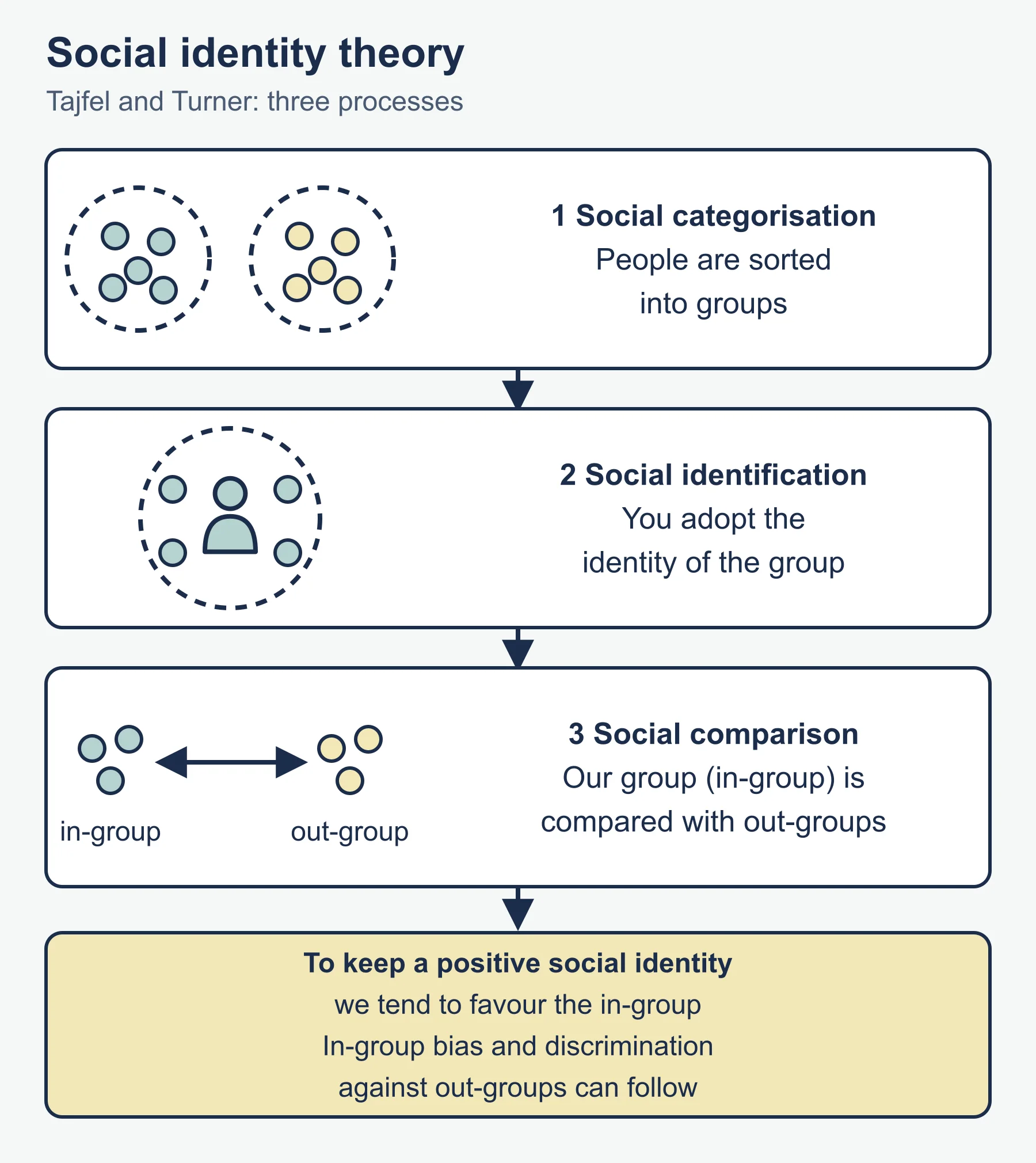
Social identity theory, developed by Henri Tajfel and John Turner, says that part of our self-concept comes from the groups we belong to. It describes three processes. Social categorisation sorts people into groups, social identification is adopting the identity of the group, and social comparison compares our group (the in-group) with others (out-groups). To maintain a positive social identity we tend to favour the in-group, which can lead to in-group bias and discrimination against out-groups.
The minimal group paradigm (Tajfel and colleagues, 1971) tested this. Schoolboys were divided into groups on trivial grounds, such as a supposed preference for the paintings of one of two artists, and then gave points to others identified only by group. They tended to allocate more to members of their own group, even though the groups were meaningless. It suggests that mere categorisation is enough for bias, but the participants were all boys of one age in one country, the setting was artificial, and the task may have encouraged them to guess what the researcher expected.
Social cognitive theory
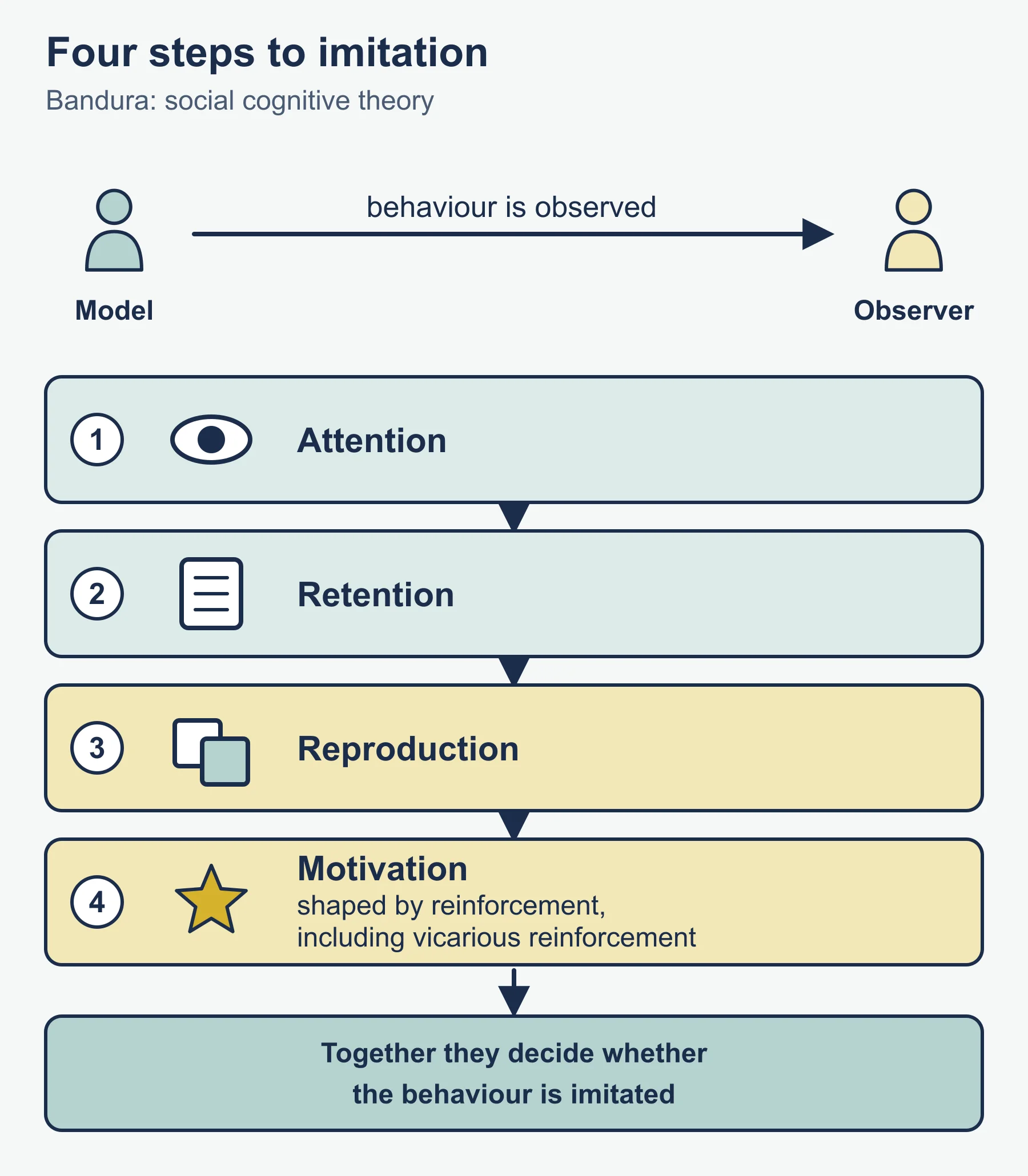
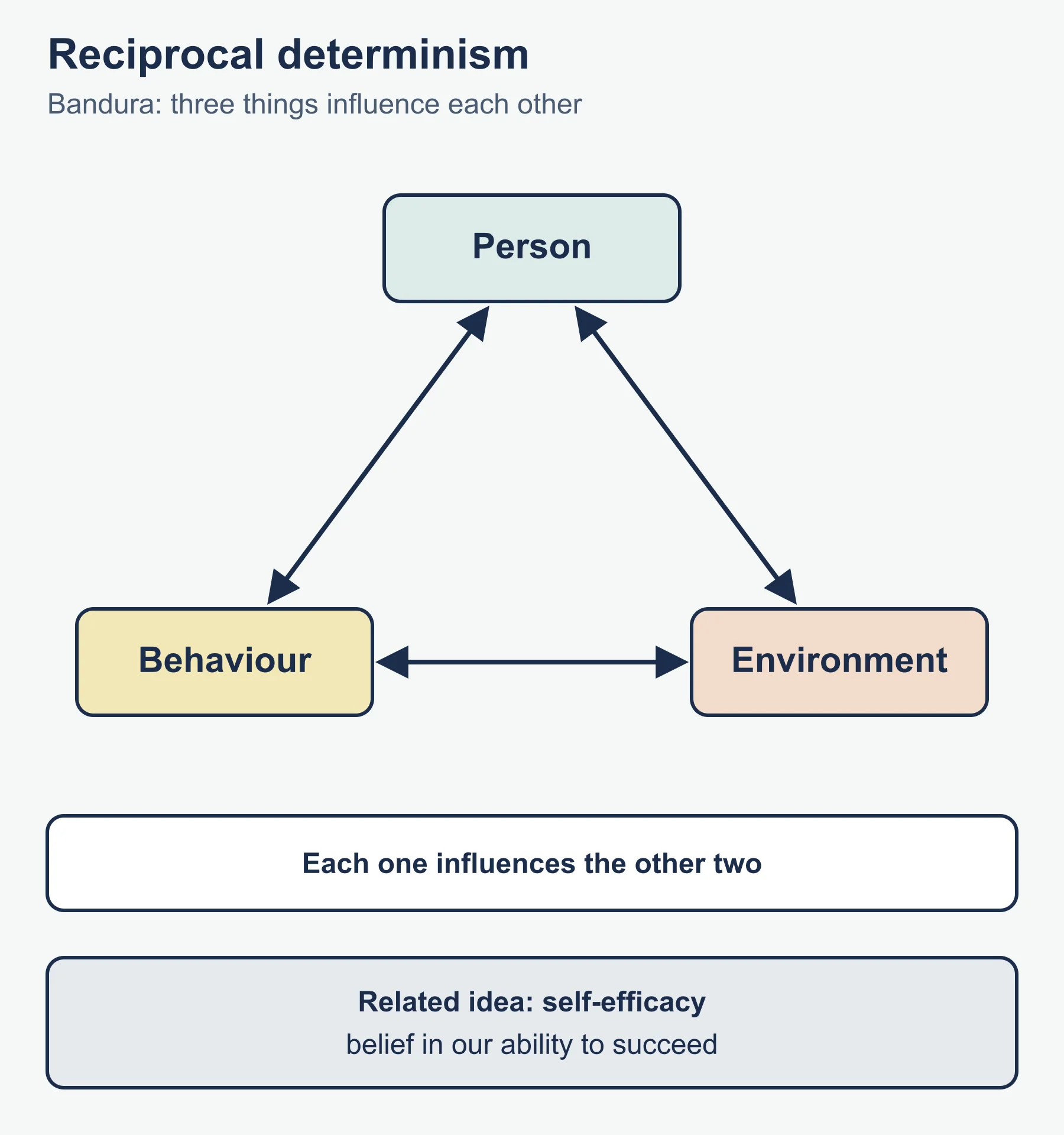
Albert Bandura’s social cognitive theory explains that people learn by observing models. Attention, retention, reproduction and motivation (shaped by reinforcement, including vicarious reinforcement) determine whether an observed behaviour is imitated. Learning is also affected by reciprocal determinism: the person, their behaviour and the environment influence each other, and by self-efficacy, belief in our ability to succeed. In the Bobo doll experiments (Bandura, Ross and Ross, 1961), children who watched an adult behave aggressively towards an inflatable doll were more likely to behave aggressively towards it than children who saw a non-aggressive model, and boys were more likely to imitate aggression than girls. Evaluation points are the artificial laboratory setting, whether hitting a doll shows real aggression, the ethical issue of encouraging aggression in children, and the use of a small sample from one nursery.
Stereotypes
A stereotype is a generalised belief about a group of people. Stereotypes can form through illusory correlation, where two infrequent things are wrongly seen as linked, as shown by Hamilton and Gifford (1976), and through social categorisation, media and cultural learning. Stereotypes can affect behaviour: in Steele and Aronson (1995) African American students did worse on a test of verbal ability when it was described as diagnostic of ability, and the researchers explained this by stereotype threat, anxiety about confirming a negative stereotype. You should be able to explain how stereotypes affect those who hold them and those they target.
Cultural origins of behaviour and cognition
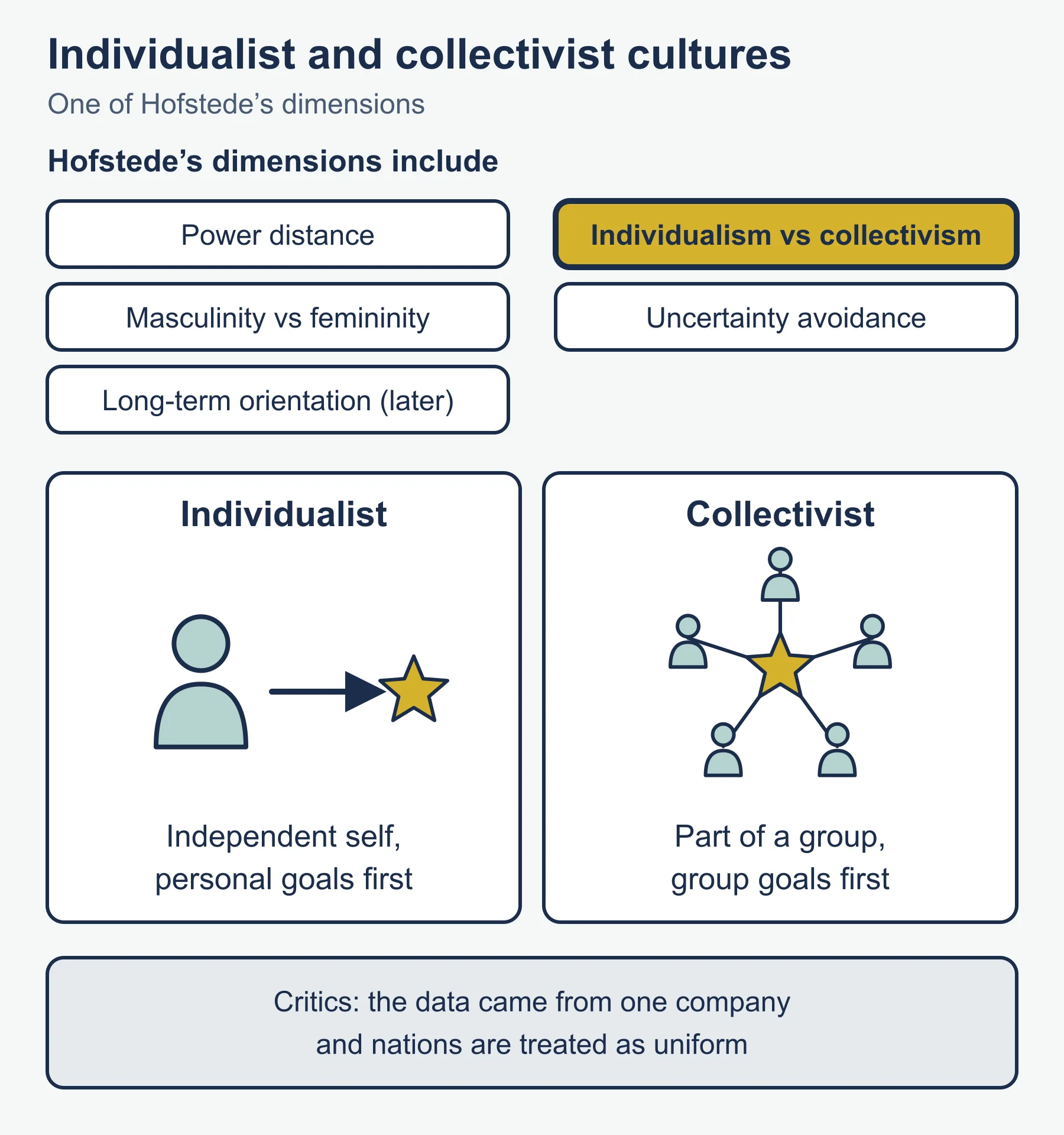
Culture is the set of attitudes, behaviours, norms and values shared by a group and passed from one generation to the next. The process of learning the rules of your own culture is enculturation. Researchers describe cultures in terms of cultural dimensions. Hofstede’s work on employees of one multinational company in many countries produced dimensions such as power distance, individualism versus collectivism, masculinity versus femininity, uncertainty avoidance and, later, long-term orientation. In individualist cultures people see themselves as independent and give priority to personal goals; in collectivist cultures people see themselves as part of a group and give priority to group goals (Markus and Kitayama, 1991, argued that this affects the self-concept). Critics say that the dimensions treat nations as uniform, rely on data from a single company, and risk reinforcing stereotypes.
Cultural norms also shape behaviour that appears universal. Cohen and Nisbett (1996) compared white male students from the northern and southern United States and found that southerners reacted more strongly to an insult, in line with their culture of honour. This shows how culture can affect emotion and aggression.
Cultural influences on individual attitudes, identity and behaviours
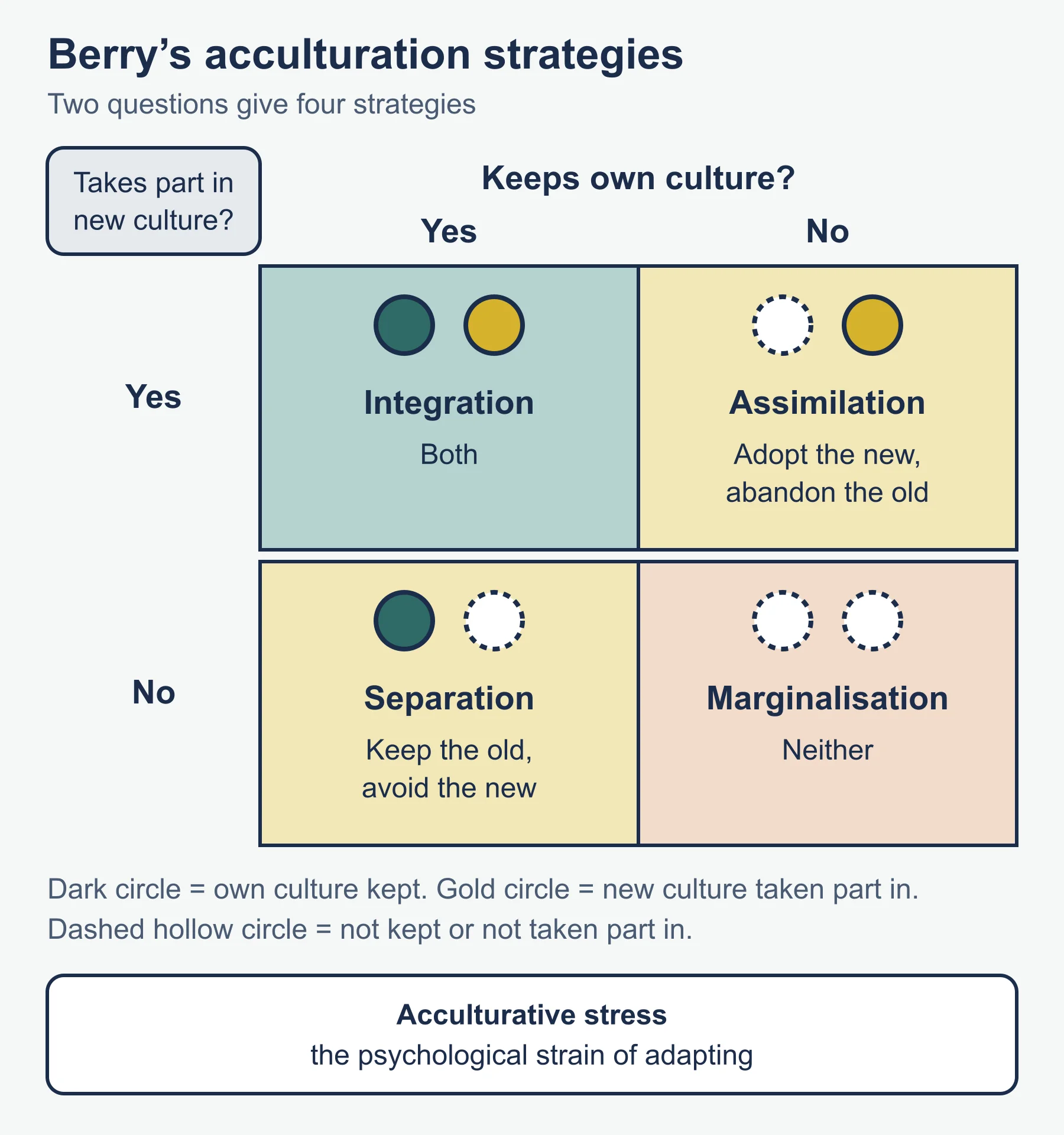
Acculturation is the process of change that occurs when people from different cultures are in continuous contact. John Berry proposed four strategies, depending on whether a person keeps their own culture and whether they take part in the new culture: integration (both), assimilation (adopt the new, abandon the old), separation (keep the old, avoid the new) and marginalisation (neither). Acculturative stress describes the psychological strain of adapting. Research suggests integration tends to be linked to better wellbeing, but this depends on the attitudes of the host society, and the model may over-simplify the experience.
Evaluating sociocultural research
When evaluating, consider these points together:
- Generalisability and sampling: many studies use students or one cultural group, so findings may not apply elsewhere.
- Ecological validity: laboratory studies may not show real-life behaviour.
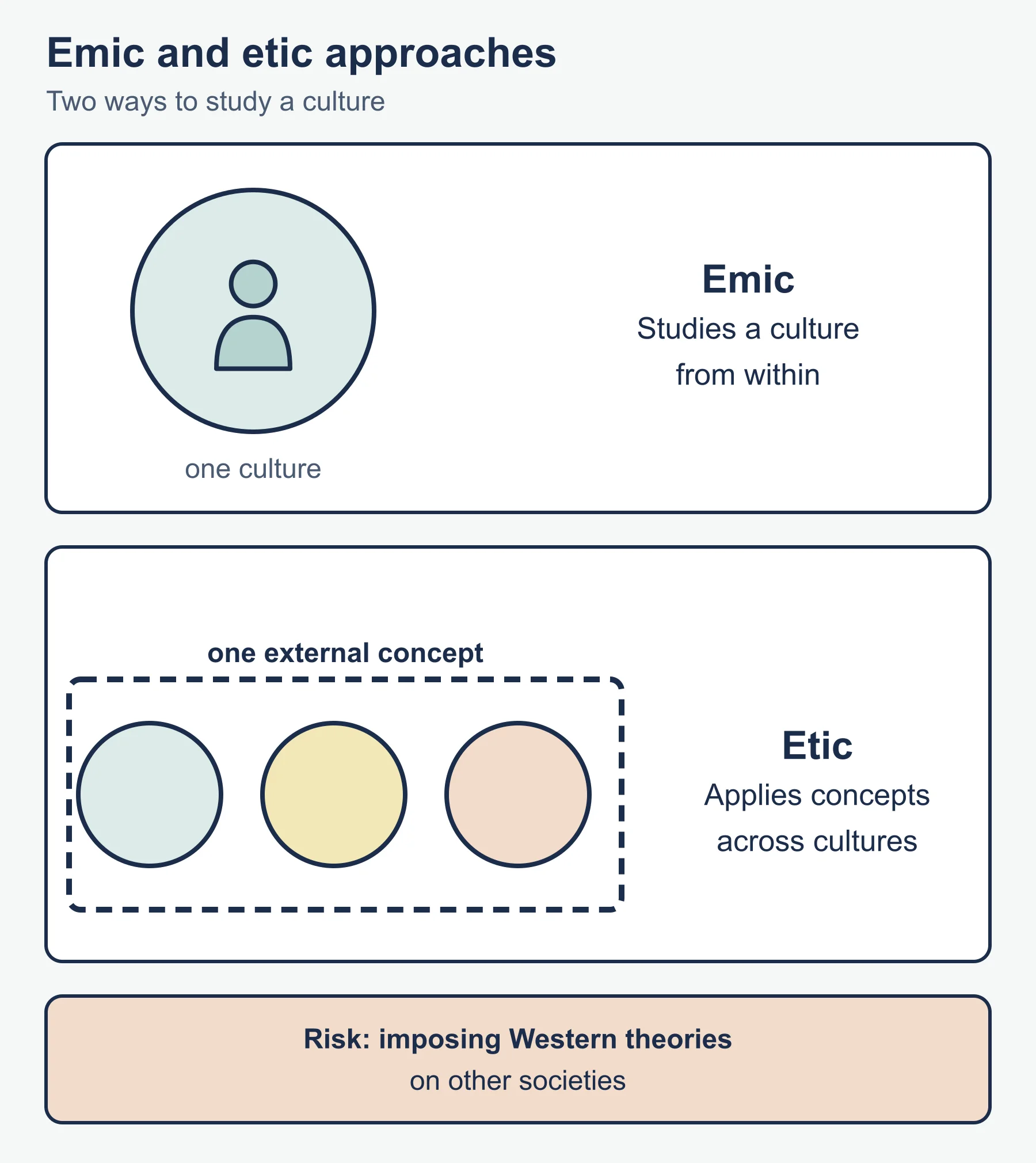
- Cultural bias: theories developed in Western societies may be imposed on other cultures (an etic approach), while an emic approach studies a culture from within.
- Ethics: deception, harm to participants and consent, particularly when children or vulnerable groups are involved.
- Causation: many studies are correlational or quasi-experimental, so culture cannot easily be isolated as the cause.
- Alternative explanations: biological or cognitive factors may play a part, and a sociocultural account should not be treated as the only one.
Worked example
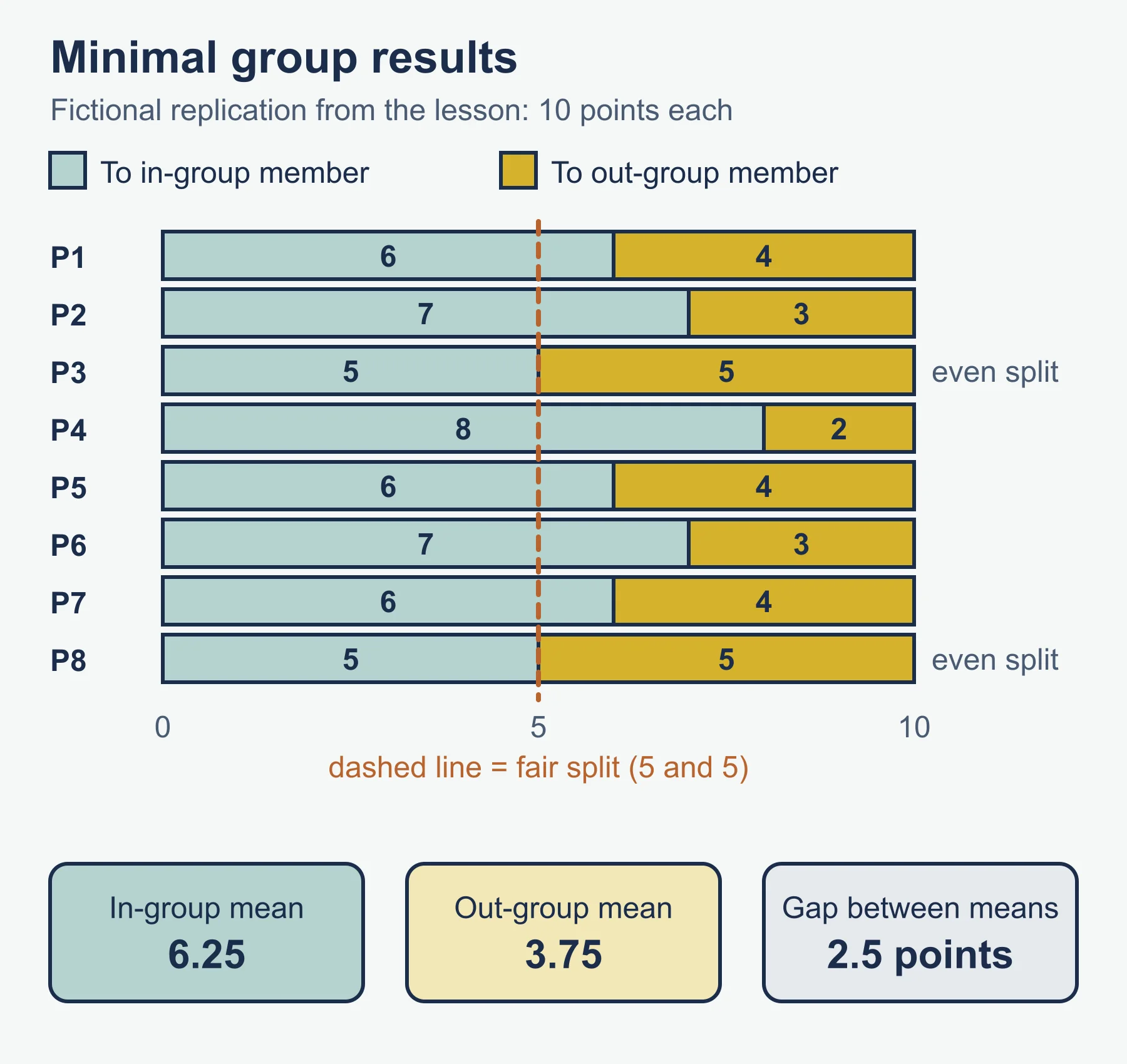
Consider a fictional replication of a minimal group study. Eight participants each divide 10 points between one in-group member and one out-group member. The points given to the in-group member are 6, 7, 5, 8, 6, 7, 6 and 5.
- Total in-group points: 6 + 7 + 5 + 8 + 6 + 7 + 6 + 5 = 50. Mean = 50 / 8 = 6.25.
- Each out-group allocation is 10 minus the in-group share: 4, 3, 5, 2, 4, 3, 4 and 5. The total is 30 and the mean is 30 / 8 = 3.75.
- A fair split would be 5 and 5. The in-group receives 6.25 - 5 = 1.25 points more than fair on average, and the difference between in-group and out-group means is 6.25 - 3.75 = 2.5 points.
- Interpretation: the results fit social identity theory because participants favoured the in-group, even though the groups were arbitrary. Two participants chose an even 5 and 5 split, which shows individual differences.
- Evaluation: with only eight participants and no statistical test the result cannot be generalised, and demand characteristics may have led participants to favour the in-group.
Common mistakes
- Describing a study without saying how it supports or challenges the theory.
- Treating culture and nationality as the same thing, or assuming everyone in a culture behaves alike.
- Listing evaluation points (such as small sample) without explaining their effect on the conclusion.
- Confusing social identity theory with social cognitive theory.
- Mixing up the four acculturation strategies.
Exam technique
IB command terms matter. Describe needs a detailed account; explain needs reasons or causes; discuss needs a balanced review of several points; evaluate needs strengths and limitations with a judgement. In a Section A answer, explain the theory and give a relevant, explained example. In an extended answer (Section C, 15 marks), state the argument, link the content to the concepts the question sets, use relevant research as evidence, and link it back to the question, since a list of studies does not earn credit. Only describe studies you can recall accurately.
Check your understanding
- What are the three processes of social identity theory? Social categorisation, social identification and social comparison.
- What is in-group bias? Favouring members of one’s own group over out-group members.
- Which concept did Steele and Aronson use to explain their findings? Stereotype threat.
- Name Berry’s four acculturation strategies. Integration, assimilation, separation and marginalisation.
- Give one criticism of Hofstede’s cultural dimensions. For example: the data came from one company, and nations are treated as uniform.
- What is the difference between emic and etic approaches? Emic studies a culture from within; etic applies external concepts across cultures.
- Eight participants give an in-group mean of 6.5 points out of 10. What is the out-group mean? 3.5 points.
Frequently asked questions
What are the three processes in social identity theory? Tajfel and Turner’s social identity theory describes social categorisation, social identification and social comparison between the in-group and out-groups.
What did the minimal group paradigm show? Tajfel and colleagues (1971) found that schoolboys divided into groups on trivial grounds tended to give more points to their own group, suggesting mere categorisation can produce in-group favouritism.
What are Berry’s four acculturation strategies? They are integration (keeping your own culture and taking part in the new one), assimilation, separation and marginalisation.
What is the difference between emic and etic approaches? An emic approach studies a culture from within, while an etic approach applies external concepts across cultures, which risks imposing Western theories on other societies.
Related resources
-
Practice questions
IB DP Psychology (2027): Content - Sociocultural approach – Practice Questions
Original IB DP Psychology (2027) practice on the sociocultural approach: cognitive dissonance, emic and etic research, enculturation, acculturation, conformity and a 15-mark evaluation.
Psychology · International Baccalaureate · IB
Try questions -
Revision notes
IB DP Psychology: Sociocultural approach – Revision Notes
Revision notes for the IB DP Psychology sociocultural approach: social identity, social cognitive theory, stereotypes, culture, enculturation and acculturation.
Psychology · International Baccalaureate · IB
Revise topic -
Subject guides
IB Diploma Programme Psychology: Subject Overview
Overview of IB DP Psychology (first assessment 2019): the three core approaches, four options, research methods and how SL and HL are assessed.
Psychology · International Baccalaureate · IB
Read course guide
Studying Psychology?
This page is free and stays free. Marlbridge is not offering Psychology classes at the moment, so there is no tuition to book for it. The free study resources stay open to everyone.
Get free revision emails (optional)
Occasional emails with practice questions, worked explanations and links to free resources for the qualification and subjects you choose. No spam, and you can unsubscribe from any email. The free tools on this site never need an email.