
Revision Notes
IB DP History (DP History): World history topics – Revision Notes
Revision notes for IB DP History Paper 2: the twelve world history topics, example pairs from different regions, essay markbands and the traps examiners report.
- Subject
- World History
- Level
- IB
- Topic
- Topic 2: World history topics
- Author
- Marlbridge Academic Team
- Updated
- Reviewed by
- Azam Siddique (what this means)
Aligned to International Baccalaureate IB Diploma Programme History (DP History), First assessment 2017. Official specification .
Syllabus page (what it covers and how it is assessed): IB Diploma Programme History.
Syllabus points this page covers
DP History
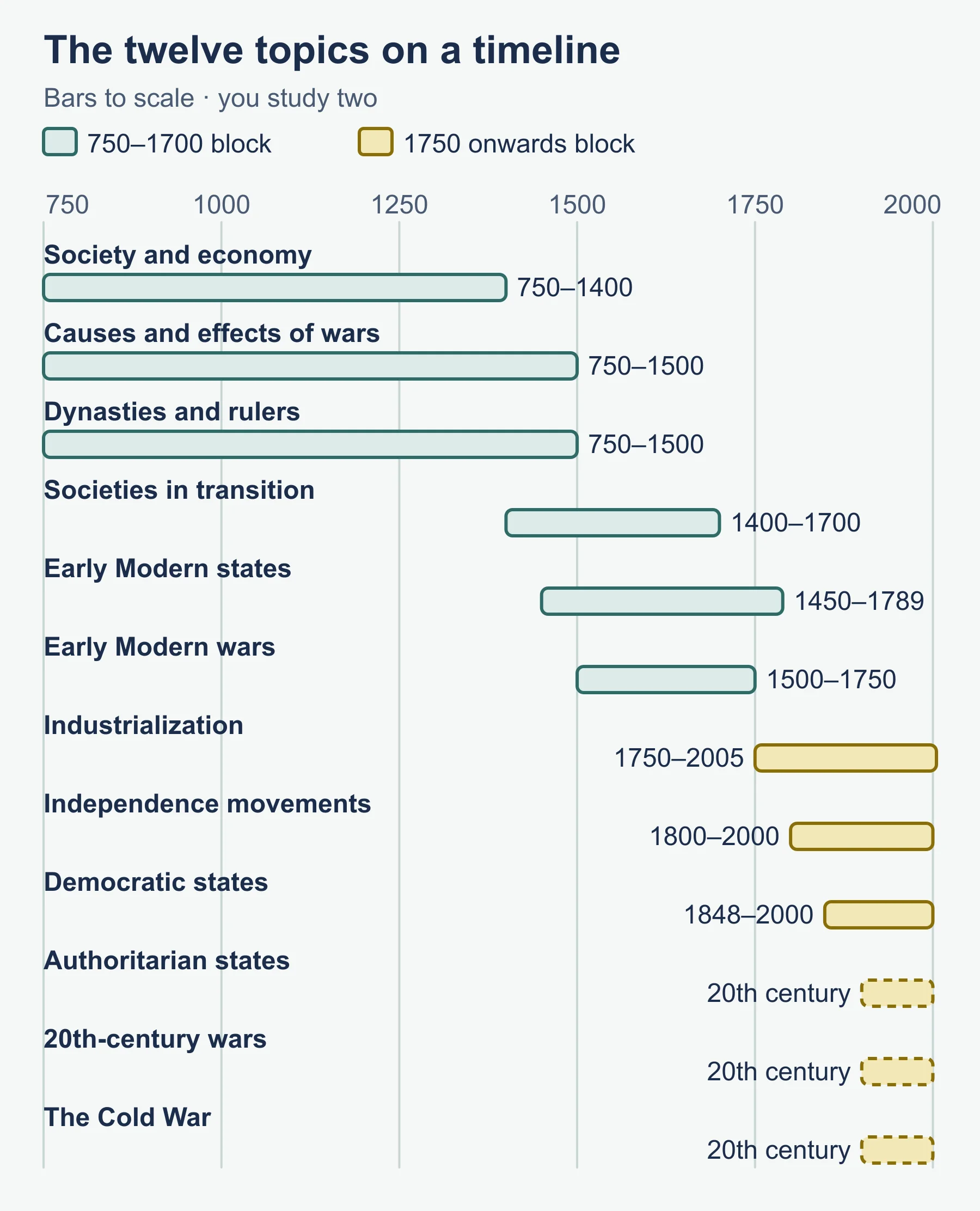
- 1 Society and economy (750-1400)
- 2 Causes and effects of wars (750-1500)
- 3 Dynasties and rulers (750-1500)
- 4 Societies in transition (1400-1700)
- 5 Early Modern states (1450-1789)
- 6 Causes and effects of Early Modern wars (1500-1750)
- 7 Origins, development and impact of industrialization (1750-2005)
- 8 Independence movements (1800-2000)
- 9 Emergence and development of democratic states (1848-2000)
- 10 Authoritarian states (20th century)
- 11 Causes and effects of 20th-century wars
- 12 The Cold War: Superpower tensions and rivalries (20th century)
This page covers all 12 subtopics recorded here in topic 2, World history topics.
Found an error? Report a correction.
Need help with this topic? Request a free trial class for IB Diploma Programme History (DP History / DP History (2028)).
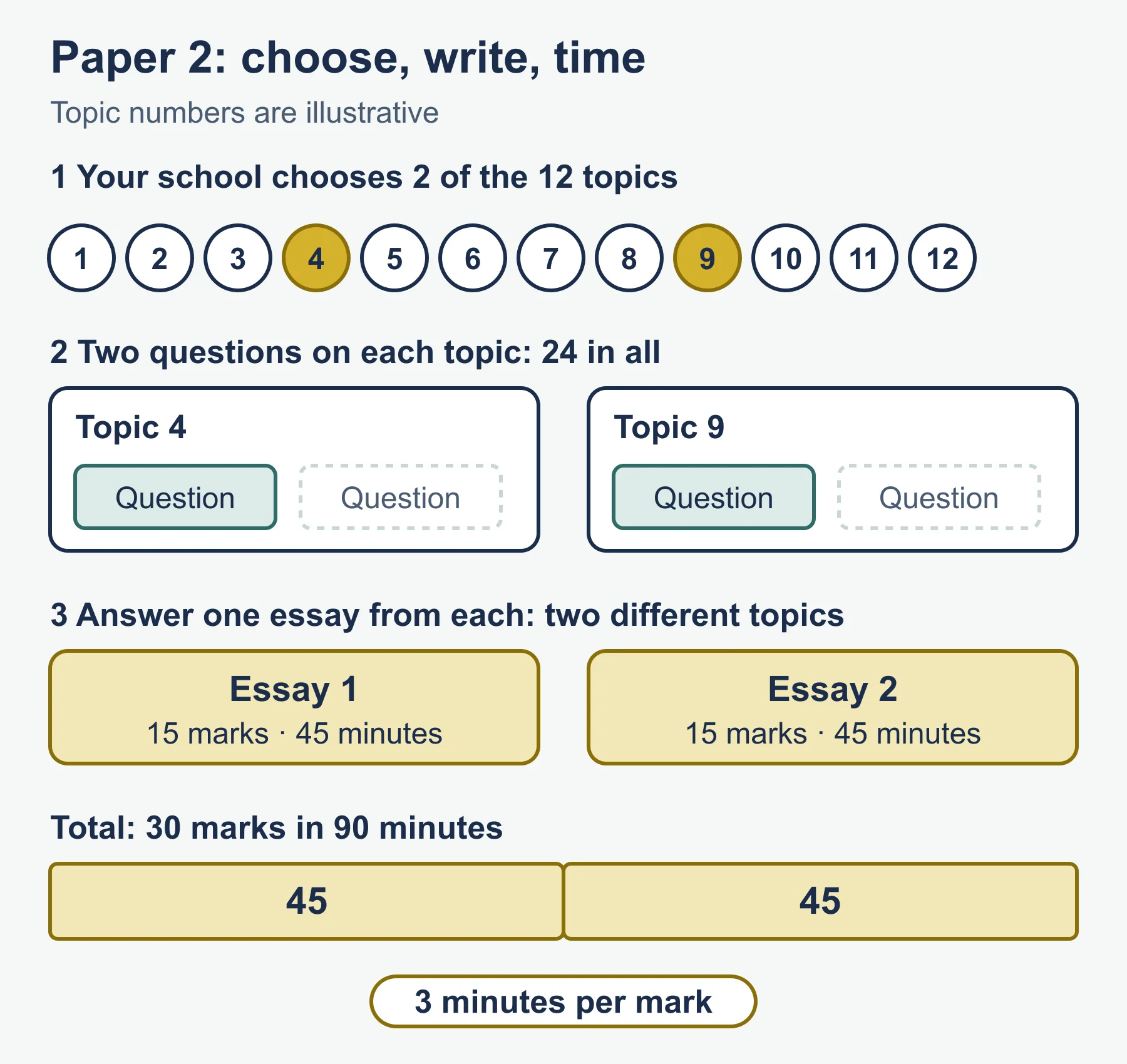
The world history topics are the content of IB DP History Paper 2, a 1 hour 30 minute essay paper taken at both SL and HL in the course first assessed in 2017. Your school teaches two of the twelve topics, and in the exam you write two 15-mark essays, each on a different topic, usually comparing examples drawn from different regions of the world.
Related: World history topics study guide and practice questions.
Syllabus coverage (DP History, first assessment 2017)
| No. | World history topic | Example pairing from two regions (teacher’s choice) |
|---|---|---|
| 1 | Society and economy (750-1400) | Song China and medieval England |
| 2 | Causes and effects of wars (750-1500) | First Crusade (1095-99) and the Mongol conquest of the Khwarazmian Empire |
| 3 | Dynasties and rulers (750-1500) | Charlemagne and Mansa Musa of Mali |
| 4 | Societies in transition (1400-1700) | Reformation Germany and Ming-Qing China |
| 5 | Early Modern states (1450-1789) | Louis XIV’s France and Tokugawa Japan |
| 6 | Causes and effects of Early Modern wars (1500-1750) | Thirty Years’ War (1618-48) and the Imjin War (1592-98) |
| 7 | Origins, development and impact of industrialization (1750-2005) | Britain and Meiji Japan |
| 8 | Independence movements (1800-2000) | India (1947) and Algeria (1962) |
| 9 | Emergence and development of democratic states (1848-2000) | Weimar Germany and post-1994 South Africa |
| 10 | Authoritarian states (20th century) | Hitler’s Germany and Mao’s China |
| 11 | Causes and effects of 20th-century wars | Spanish Civil War and the Chinese Civil War |
| 12 | The Cold War: Superpower tensions and rivalries (20th century) | Korean War and the Cuban Missile Crisis |
The pairings are illustrations; your teacher chooses the examples. IB regions are Africa and the Middle East, the Americas, Asia and Oceania, and Europe.
Paper 2 at a glance
| Feature | Detail |
|---|---|
| Length | 1 hour 30 minutes |
| Questions | Two questions set on each of the 12 topics |
| Task | Answer two questions, each from a different topic |
| Marks | 15 per essay, 30 in total |
| Weighting | 45% at SL; 25% at HL |
| Typical demand | “with reference to two … each chosen from a different region”; “compare and contrast”; “to what extent”; “evaluate”; “discuss” |
Key concepts for each modern topic
| Topic | What examiners typically ask about | Key terms |
|---|---|---|
| 7 Industrialization | Causes (resources, capital, technology, government); social and political effects; the role of the state | Proto-industrialisation, urbanisation, labour movements |
| 8 Independence movements | Origins of nationalism; methods (violent and non-violent); role of leaders; challenges after independence | Decolonisation, mass mobilisation, partition |
| 9 Democratic states | Conditions for emergence; challenges (economic, political, social); responses and success of governments | Franchise, constitution, coalition, civil society |
| 10 Authoritarian states | Emergence (conditions, methods); consolidation and maintenance of power; aims and results of policies, including treatment of women, minorities, religion and the arts | Single-party state, cult of personality, propaganda, terror |
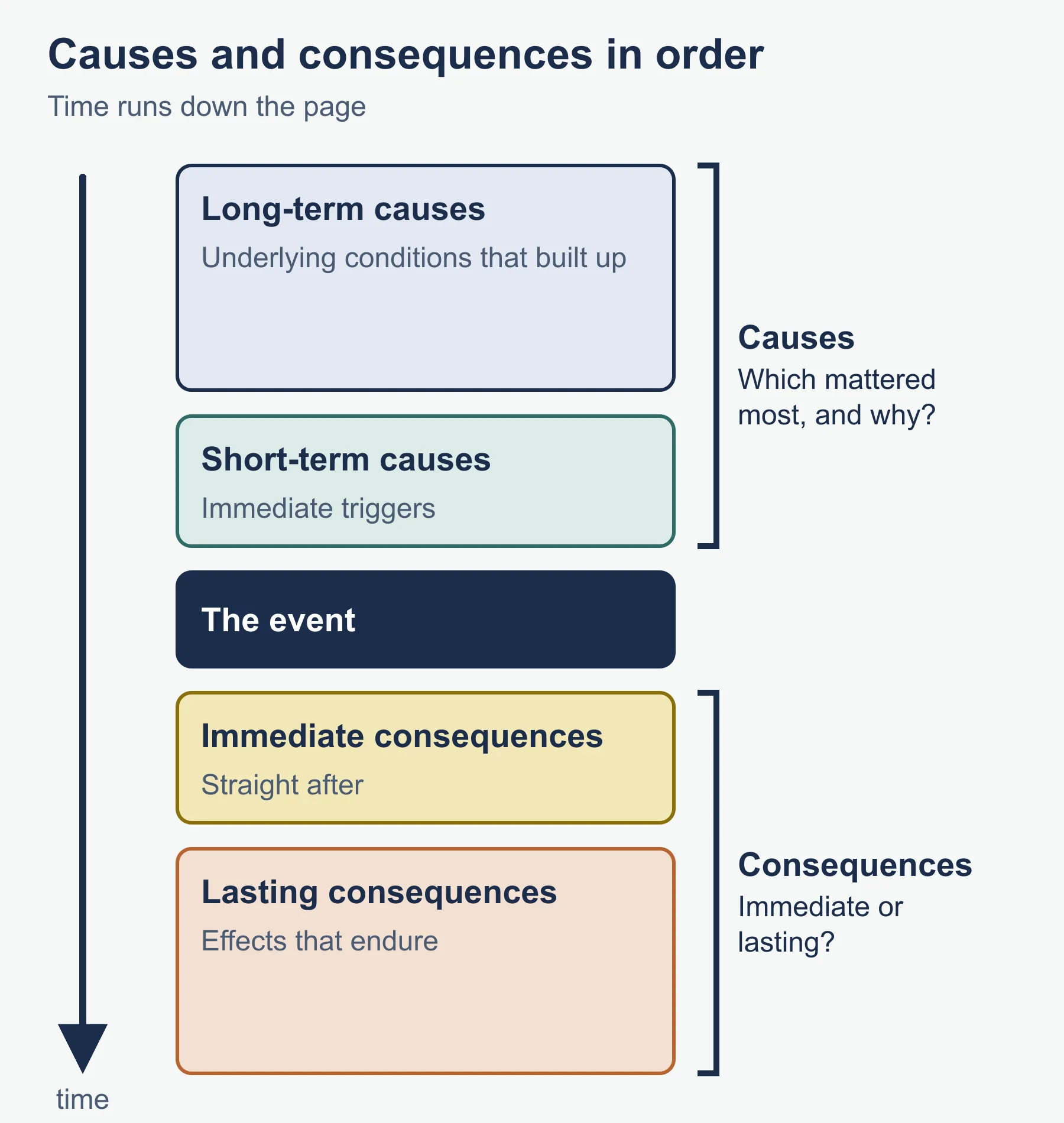
| 11 20th-century wars | Causes (long- and short-term, economic, ideological, territorial); practices (technology, strategy, home front); effects | Total war, limited war, civil war, guerrilla war |
| 12 Cold War | Rivalry, mistrust and accord; leaders and nations; Cold War crises | Containment, brinkmanship, détente, proxy war |
Key concepts for each pre-modern topic
| Topic | Themes | Useful evidence |
|---|---|---|
| 1 Society and economy | Trade, agriculture, towns, religion and social structure | Song paper money and commerce; manorialism; the Black Death (1347-51) |
| 2 Medieval wars | Causes (religion, territory, succession); nature of warfare; political, economic and social effects | Crusades; Mongol campaigns; the Hundred Years’ War (1337-1453) |
| 3 Dynasties and rulers | Legitimacy, administration, expansion and decline | Carolingian, Abbasid and Mali examples |
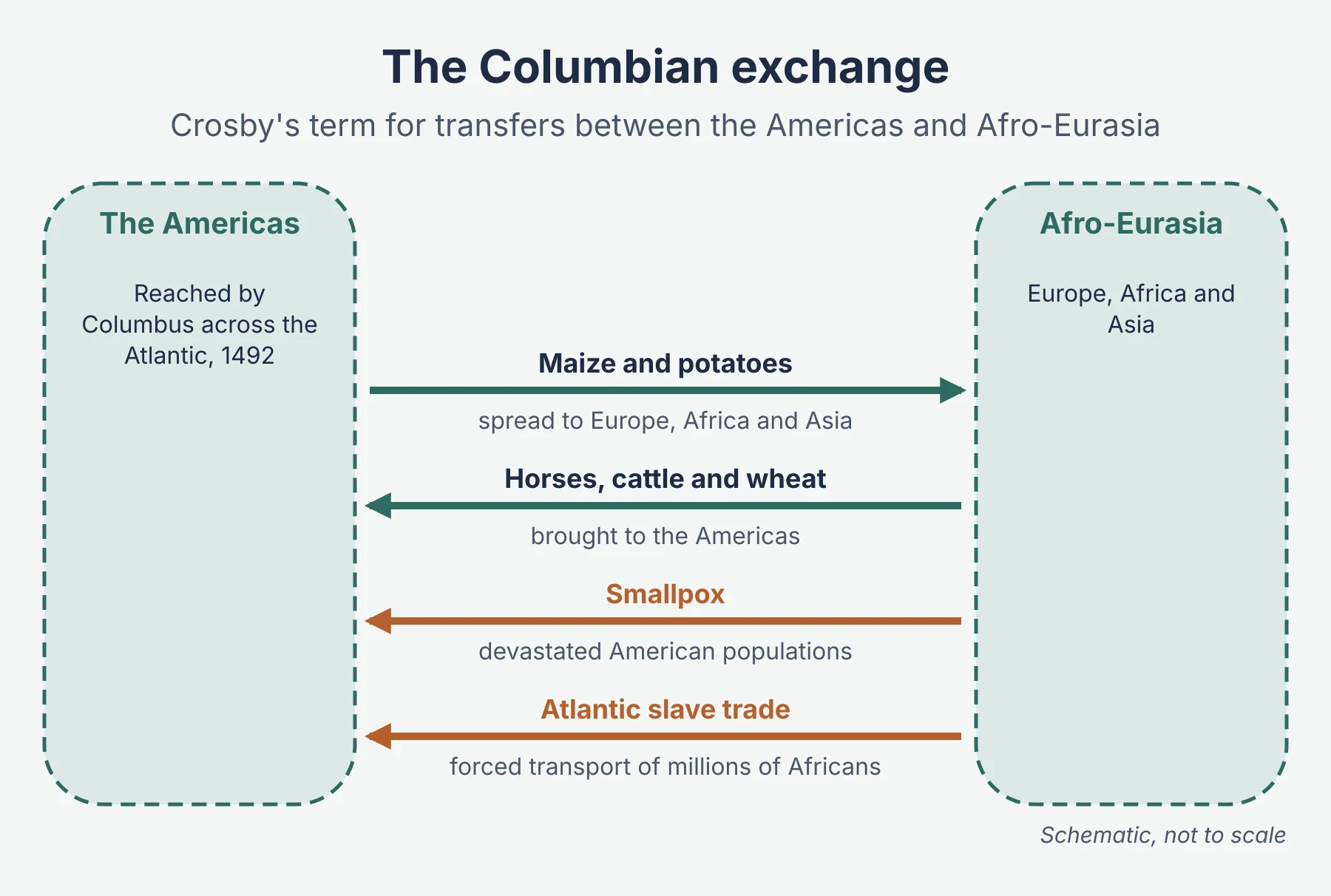
| 4 Societies in transition | Religious, intellectual and economic change; contact between societies | Luther’s 95 Theses (1517); the Columbian exchange |
| 5 Early Modern states | Rise and consolidation of states, centralisation and limits on rulers | Versailles and the intendants; the Tokugawa sankin-kōtai system |
| 6 Early Modern wars | Causes (dynastic, religious), military change, effects on states | Peace of Westphalia (1648); Korean resistance in the Imjin War |
The Paper 2 markbands (summarised)
| Marks | Summary of the IB descriptor |
|---|---|
| 13-15 | Demands of the question clearly understood; detailed, accurate, relevant knowledge; effective comparison where required; clear, coherent argument; evaluation of different perspectives; consistent focus and well-supported conclusion |
| 10-12 | Demands understood; mostly accurate and relevant knowledge; some evaluation; mostly focused argument |
| 7-9 | Demands generally understood; some accurate knowledge; some analysis but more description; limited argument |
| 4-6 | Some understanding of the question; limited knowledge; mainly narrative or descriptive |
| 1-3 | Little understanding; little relevant knowledge |
Worked example: turning a comparison into analysis
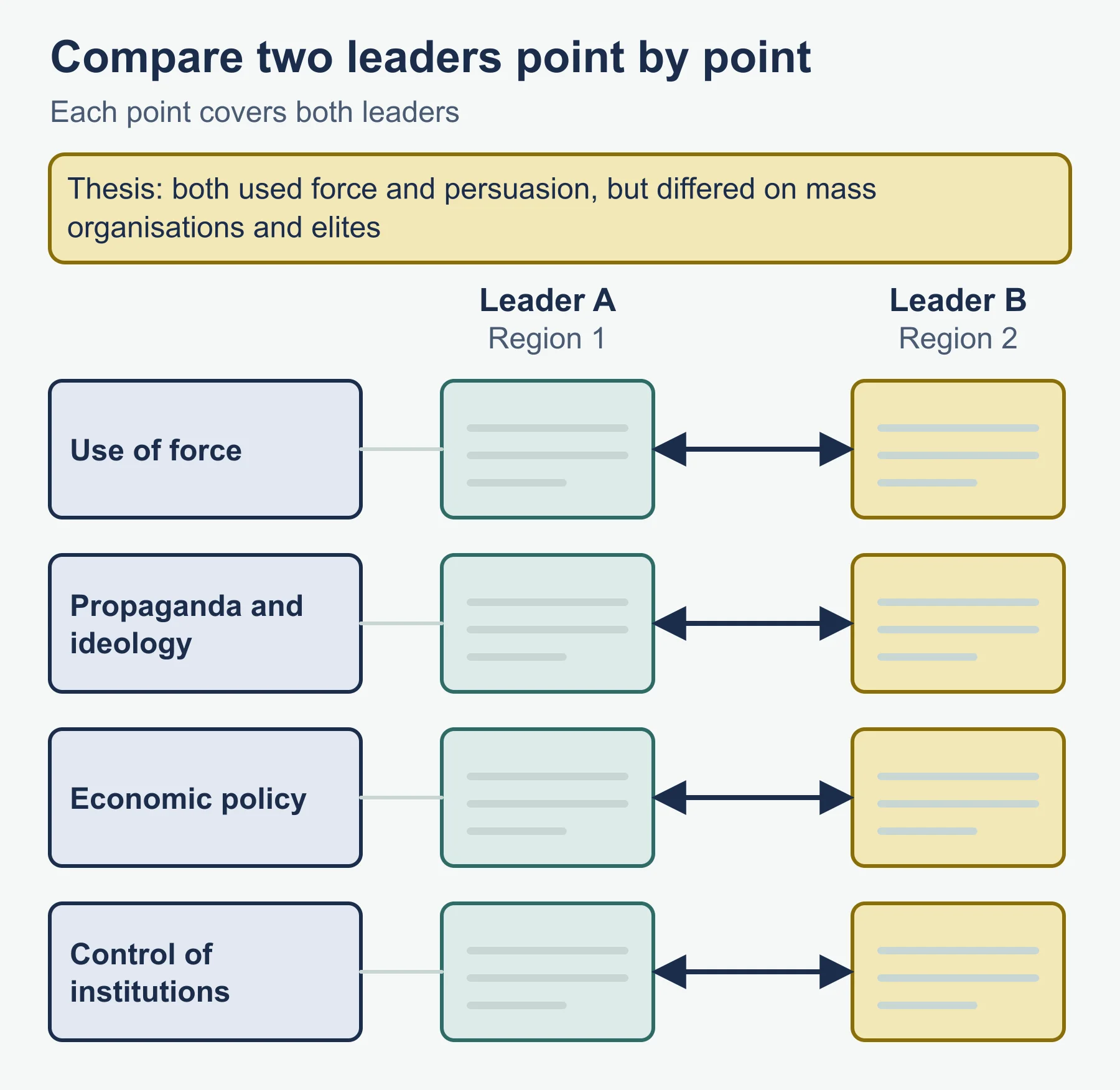
Question: Compare and contrast the methods used by two authoritarian leaders, each chosen from a different region, to maintain power.
- Weak: two halves – Hitler’s methods, then Mao’s.
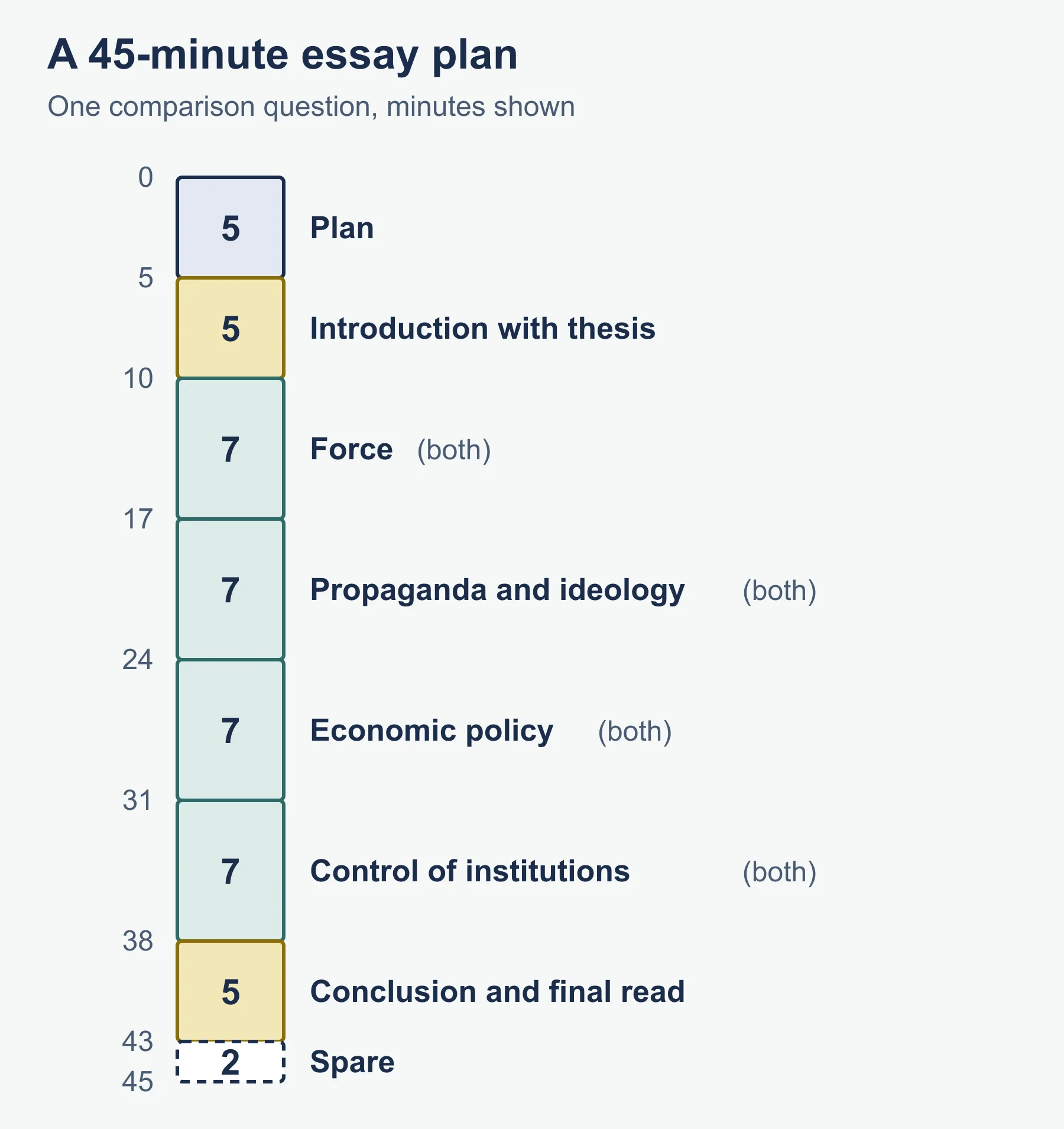
- Strong: paragraph by theme. Terror: both used it (Gestapo and SS; the anti-rightist campaign and laogai camps), but Mao relied more on mass mobilisation against “class enemies”. Propaganda: both built personality cults (Goebbels’ ministry; the “Little Red Book”). Economic policy as control: Nazi recovery bought consent; the Great Leap Forward (1958-62) weakened Mao’s position until the Cultural Revolution. Each paragraph ends with a comparative judgement.
Common mistakes / exam traps
- Answering from one region when two are required. Read “each chosen from a different region” carefully; examples from the same region can cap the mark.
- Two separate narratives in a comparison question. Integrate the examples paragraph by paragraph.
- Ignoring the time limits. Topic 10 is twentieth century; Topic 8 runs to 2000.
- Listing historians. Perspectives must be evaluated, not name-dropped.
- No plan. Five minutes of planning per essay is time well spent in a 45-minute essay.
Frequently asked questions
How many topics should I revise? Your school teaches two topics, and you must answer from two different topics, so revise both thoroughly and enough examples to cover regional requirements.
Is Paper 2 different at HL? No: the same paper and markbands, but weighted 25% at HL instead of 45% at SL.
Can I use the same example in Paper 2 and Paper 3? You may use knowledge across papers, but Paper 2 questions are thematic and often comparative, while Paper 3 questions are regional; tailor the material to the question.
Self-test
- How many questions are set per topic on Paper 2? Two.
- What is the time per essay? About 45 minutes.
- Name the four IB regions. Africa and the Middle East; the Americas; Asia and Oceania; Europe.
- Which topic covers single-party states? Topic 10, Authoritarian states.
- What does the top markband require beyond knowledge? Clear argument, evaluation of perspectives and a well-supported conclusion.
Related resources
-
Study guides
IB DP History (DP History): World history topics – Study Guide
The twelve IB DP History world history topics, from medieval society to the Cold War, with the comparative and thematic skills needed for Paper 2 essays.
World History · International Baccalaureate · IB
Read guide -
Study guides
IB DP History (DP History): Society and economy (750-1400)
IB History Paper 2 world history topic 1, Society and economy 750-1400: population, trade, ideas and religion across regions, with a worked essay plan.
World History · International Baccalaureate · IB
Read guide -
Practice questions
IB DP History (DP History): Society and economy (750-1400) – Practice Questions
Twelve original IB History practice questions on Society and economy 750-1400, from short recall to a full Paper 2 essay, with mark-scheme answers.
World History · International Baccalaureate · IB
Try questions
Get free revision emails (optional)
Occasional emails with practice questions, worked explanations and links to free resources for the qualification and subjects you choose. No spam, and you can unsubscribe from any email. The free tools on this site never need an email.